
Research article · 2024 · Full text
International Journal of Agriculture Extension and Social DevelopmentPerformance and instability analysis of potato-chickpea sequence cropping system under organic production
Volume 7(4) · Pages 304–307 · DOI: 10.33545/26180723.2024.v7.i4d.557 ↗
Research areasGenetic and Environmental Crop StudiesAgricultural pest management studiesAgronomic Practices and Intercropping Systems
Abstract
Author-writtenThe present investigation was undertaken to study the “Performance and Instability Analysis of Potato-Chickpea Sequence Cropping System under Organic Production”. Secondary data of Potato-Chickpea sequence cropping system equivalent yield was collected from Institute of organic farming, Dharwad from the year 2004-05 to 2012-13. Coppack’s instability index, compound annual growth rate and CV were the statistical tools used for the analysis of instability and growth rate. The results from the analysis showed that yield of Potato-Chickpea cropping system was highly instable under integrated production system (61.09%) as compared to organic (57.19%) and inorganic production system (48.78%). Potato-chickpea integrated production gave higher yields over the years. The compound annual growth rate was found to be highest in organic production system followed by integrated and inorganic production system.
Summary
Source-checkedPlain-language reading of the full paper, prepared with AI and checked against the text. Each point links to the authors' own words.
Why it matters
- Potato is a globally significant food crop, ranking fourth after rice, wheat, and maize, and is noted for high dry matter, protein, and calorie production per unit of area and time. View evidence ↗
- Chickpea, or bengal gram, is a critical pulse crop in India, accounting for approximately 35% of the pulse cultivation area and 45% of total pulse production. View evidence ↗
- Organic manures are viewed as sustainable alternatives to chemical fertilizers that can reduce input costs, increase productivity, and improve overall soil-plant health. View evidence ↗
The question
- The study aimed to analyze the performance and instability of a potato-chickpea sequence cropping system specifically under organic production. View evidence ↗
What they did
- The researchers used secondary data from the Institute of Organic Farming in Dharwad, Karnataka, India, covering a period from 2004-05 to 2012-13. View evidence ↗
- Instability and growth rates were analyzed using the Coefficient of Variation (CV), Compound Annual Growth Rate (CAGR), and Coppock's instability index. View evidence ↗
What they found
- The integrated production system exhibited the highest instability (61.09%), followed by the organic system (57.19%) and the inorganic system (48.78%). View evidence ↗
- Integrated production provided higher yields over the study period, with a mean equivalent yield of 6192.25 kg/ha. View evidence ↗
- Organic production achieved the highest compound annual growth rate at 4.67%, followed by integrated production at 3.46%. View evidence ↗
- The inorganic production system showed a positive but non-significant growth rate of 1.35%. View evidence ↗
- A severe drought in 2005-06 caused a sudden decline in the equivalent yield of the potato-chickpea cropping system. View evidence ↗
- Yields decreased in 2007-08 because late sowing in July led to excessive rainfall and subsequent fungal diseases. View evidence ↗
What it means
- The authors concluded that while integrated production was the most unstable, organic production demonstrated the highest growth rate among the systems studied. View evidence ↗
Visual summary
3 visualsIllustrations explain the paper; charts are replotted from the paper's own table values.
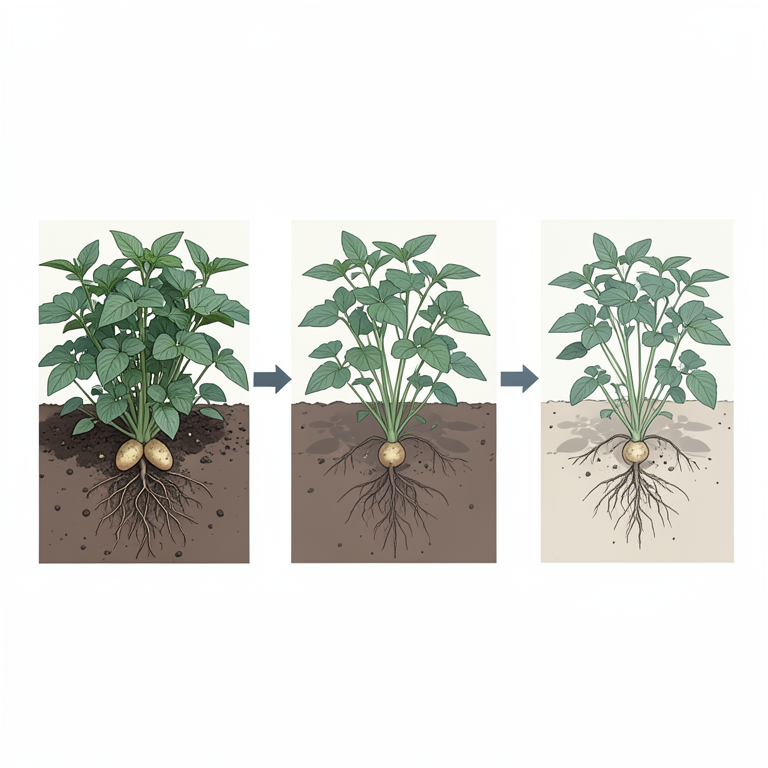
Production System Comparison
AI-generated conceptual illustration (Potato plants and chickpea plants in a field). It explains the idea and does not show study data.
View source evidence ↗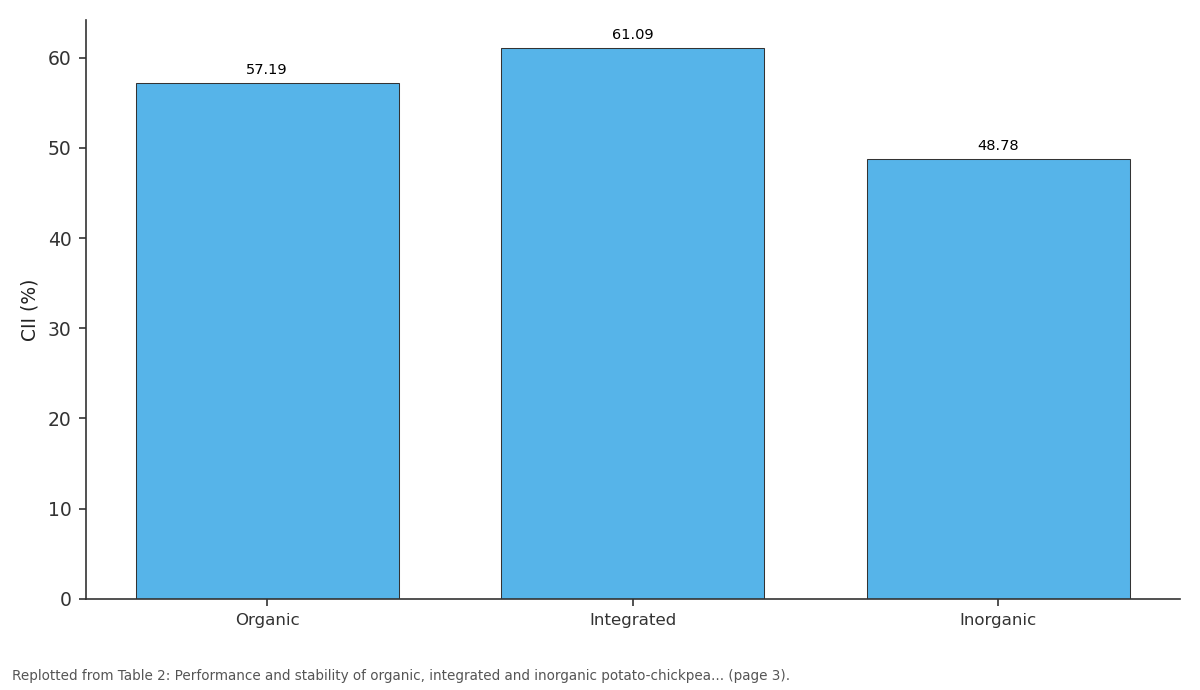
CII (%): Organic vs Integrated vs Inorganic
Replotted from Table 2 (page 3) of the original paper. Every bar is the paper's own table value.
View source evidence ↗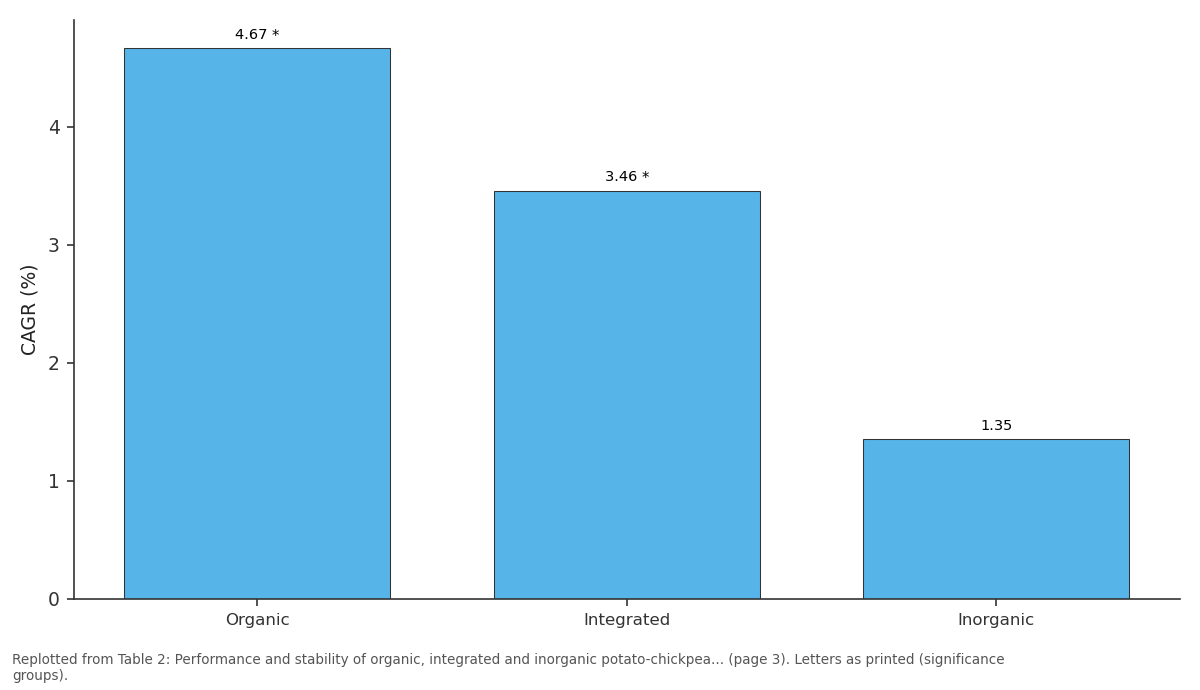
CAGR (%): Organic vs Integrated vs Inorganic
Replotted from Table 2 (page 3) of the original paper. Every bar is the paper's own table value.
View source evidence ↗Figures & tables
From the original paper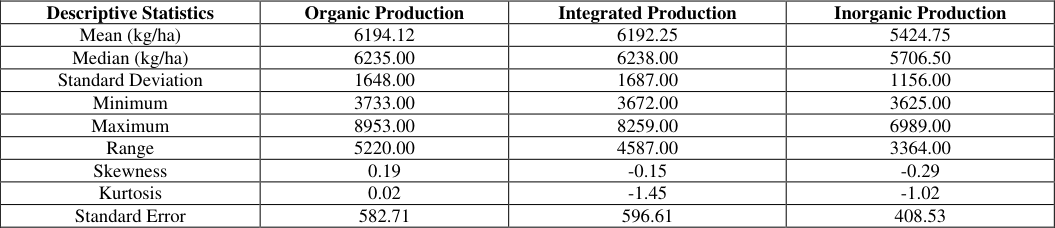 Table 1
 Table 2
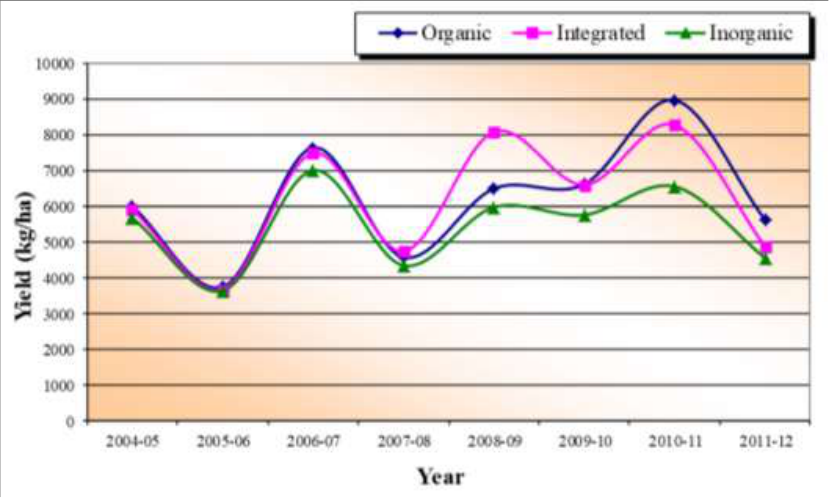 Figure 1
Introduction
The basic principle of organic farming is "live and let live". It is found to be one of the best suitable production systems. After a tumultuous use of chemical fertilizers during the periods of green revolution in most of the parts of the world, people have come to realize that constant use of fertilizers do harm in the long run. Organic farming is a form of agriculture that relies on techniques such as crop rotation, green manure, compost and biological pest control. Organic agriculture is an ecological production management system that promotes and enhances biodiversity, biological cycles and soil biological activity. Some of the benefits of organic farming are the usage of pesticides is very limited and hence, people who consume the food items produced from organic farming are at low risk and food items grown by organic farming are wholesome and healthier. Organic farming is very cost effective compared to the conservative farming (www.omafra.gov.on) [10] . Instability is the state of being unstable or lack of stability. It generally means the tendency of unpredictable behavior or erratic changes of mood. It is unusually or unnaturally large fluctuation that may lead to serious damage or system failure if allowed to continue beyond a certain limit. Instability analysis means the process of analyzing the instability or fluctuation or variation of one farming system to another farming system. A prerequisite for stabilizing production is the necessity of examining and measurement of the extent of instability and also identification of the factors or sources causing the instability.
Potato (Solanum tuberosum) is a fourth major food crop after rice, wheat and maize in the world. It produces the highest dry matter, well balanced protein and more calories per unit area and time (Vishnu, 2016) [7] . Chickpea (Cicer arietinum) is one of the important and oldest pulse crops, grown in our country. It is commonly known as bengal gram. Gram occupies about 35 per cent of area under pulses and contributes about 45 per cent of total pulse production of India (Reddy, 2009) [5] . Potato-chickpea is prominent crop sequence under transitional rainfed condition. The potato production for the year 2018-19 is 474 lakh tonnes from rabi season and 34 lakh tonnes from kharif season. Karnataka produced 534.95 thousand tonnes and shares 1.02 per cent of country production. The chickpea production in India for the year 2017-18 is 90.75 lakh tonnes. Nutrients are one of the most important inputs, required by the plants for their growth and yield. The organic manures is considered as the promising renewable source of energy, nutrient rich source can be served as a substitute to cut down the cost of fertilizer input and increase the productivity in addition to maintain soil productivity, improve the ecosystem and ultimately resulting in improved soil-planthealth in a sustainable agricultural eco-system.
Materials and Methods
The study on performance and stability analysis of potatochickpea cropping system was taken up by using the secondary data, which was collected from the Institute of Organic Farming, UAS Dharwad, Karnataka state of India. The data covered for the period from 2004-05 to 2012-13. www.extensionjournal.com
CAGR (Compound annual growth rate)
Compound annual growth rate was used to study the growth rate of crop equivalent yield. (Damodar et al., 2013) [1] . Before calculating the growth rate, the exponential function of crop equivalent yield has to be estimated. The standard error of the growth rate was estimated and tested for its significance.
Co-efficient of variation:
The coefficient of variation is a relative measure of dispersion. The coefficient of variation was obtained by dividing the standard deviation by the mean and expressed in percentage. (Rangaswamy, 2014) [4] .
Symbolically, coefficient of variation is written as
Where, SD = standard deviation Mean = mean of crop production
Coppock instability index
This method involves a constant percentage changes from year to year and this is better measure than the constant absolute changes from year to year i.e. it is close approximation of the average. Coppock index is performed for any time series data. (Joseph, 2010) [2] The coppock's instability index is also called as the log variance method and is expressed algebraically in the following estimable form CII (per cent) = [(antilog √v log) -1]*100 Where, log v = logarithmic variance N = number of years in the series. X t = crop yield/production in the year 't' X t+1 = crop yield/production in the year't+1' m = arithmetic mean of difference between log's of X t+1 and X t
Steps for calculating CII percentage 1. Logarithms are obtained for each annual value of a variable for example total exports for year 1, year 2 etc. 2. The logarithm of the value for year 1 is subtracted from logarithms of the value for year 2 etc. in order to get first differences of logarithms. 3. The arithmetic mean of the logarithmic first differences is then obtained. 4. The logarithmic mean is subtracted from each year to year logarithmic first difference in order to obtain the logarithmic difference between the actual and average (trend) year to year logarithmic differences. 5. These logarithmic differences from trend some positive and some negative are then squared, summed up and divided by the number of years minus one. The resulting number is termed as "logvariance"
The next step is to take the square root of the log variance and obtain the antilog of the square root value. Unity is then subtracted from antilog and multiply with hundred. The resulting "instability index" is close approximation of the average year to year percentage variation adjusted for trend.
Results and Discussion
The mean equivalent yield of potato-chickpea for nine years under organic, integrated and inorganic production systems has been picturised graphically in Figure 1. Figure 1 picturises that there was more fluctuation in the equivalent yield of potato-chickpea cropping system. There was sudden decline in yield in the year 2005-06 because of severe drought in that period. The potato-chickpea cropping system showed sudden increase and decrease in equivalent yields because potato crop was affected by date of sowing. The yield decreased in the year 2007-08 due to late sowing of potato i.e., potato sown in the month of july, receives more rainfall in Dharwad which adversely affected the crop after sowing. Heavy rainfall causes fungal diseases. The coppock's instability index, CV, compound annual growth rates of equivalent yield of potato-chickpea are furnished in the table 2. Potato-chickpea equivalent yield showed highest instability in integrated production system with 61.09 per cent, followed by organic with 57.19 per cent and inorganic with 48.78 per cent instability. Integrated production means the proper combination of both organic www.extensionjournal.com and inorganic methods. For potato-chickpea integrated production gave higher yields over the years. The higher potato-chickpea yield with integrated production might be due to sufficient supply of manure and inorganic fertilizers improvement in microbial activities, better supply of macro and micronutrients and reduced losses of nutrients from the soil system, which are otherwise not supplied by sole application of inorganic fertilizers. The results were supported by Yadav et al. (2000) [8] and Yadvinder singh et al. (2004) [9] . The equivalent yield of organic and integrated production of potato-chickpea showed significant positive growth rate.
| Production System | CII (%) | CAGR (%) | CV | SD | Mean (kg/ha) |
|---|---|---|---|---|---|
| Organic | 57.19 | 4.67* | 26.60 | 1648.16 | 6194.12 |
| Integrated | 61.09 | 3.46* | 27.25 | 1687.47 | 6192.25 |
| Inorganic | 48.78 | 1.35 | 21.30 | 1155.50 | 5424.75 |
Table text extracted from the original PDF; superscript letters are shown inline. The original table image is below.
View original table image
Here the organic production showed highest growth rate 4.67 per cent followed by integrated production with 3.46 per cent. Inorganic production was found to be positive and not significant growth rate with 1.35 per cent.
The organic production has shown more growth rate as compared to others but there was not any remarkable difference between organic and integrated production system, because sustainable yields are obtained under organic and integrated production systems over the years even under stress conditions. As the soil become productive and yields stabilised over the period of time and the nutrients applied will mostly be in plant available form in combination with the organic manures in the latter which resulted in stable high yields throughout. The outcomes of the study were on line with the Praveen kumar et al. (2018) [3] and Shendhe et al. (2011) [6] .
Conclusion
Potato-chickpea sequence cropping system showed highest instability in integrated production followed by organic production. Organic production has shown more growth rate as compared to other production systems.
Figures and tables from the paper
| Descriptive Statistics | Organic Production | Integrated Production | Inorganic Production |
|---|---|---|---|
| Mean (kg/ha) | 6194.12 | 6192.25 | 5424.75 |
| Median (kg/ha) | 6235.00 | 6238.00 | 5706.50 |
| Standard Deviation | 1648.00 | 1687.00 | 1156.00 |
| Minimum | 3733.00 | 3672.00 | 3625.00 |
| Maximum | 8953.00 | 8259.00 | 6989.00 |
| Range | 5220.00 | 4587.00 | 3364.00 |
| Skewness | 0.19 | -0.15 | -0.29 |
| Kurtosis | 0.02 | -1.45 | -1.02 |
| Standard Error | 582.71 | 596.61 | 408.53 |
Table text extracted from the original PDF; superscript letters are shown inline. The original table image is below.
View original table image
References
4 in the original paper- Praveenkumar NS, Radha Y, Subbarao DV, Srinivasrao V, Gopalkrishna T. Growth and instability of pulses production in Andhra Pradesh. International Journal of Current Microbiology and Applied Sciences. 2018;7(11):490-494.
- Shende NV, Ganvir BN, Thakare SS. Growth and instability of selected crops in Western Vidarbha. International Research Journal of Agricultural Economics and Statistics. 2011;2(1):19-27.
- Yadav RL, Dwivedi BS, Pandey PS. Rice-wheat cropping system: assessment of sustainability under green manuring and chemical fertilizer inputs. Field Crops Research. 2000;65:15-30.
- Yadvinder S, Bijay S, Ladha JK, Khind CS, Gupta RK, Meelu OP, Pasuquin E. Long-term effects of organic inputs on yield and soil fertility in rice and wheat rotation. Soil Science Society of America Journal. 2004;68:845-853.