
Research article · 2024 · Full text
International Journal of Biology SciencesSalivary sialic acid level and oral health statues in sample in Tikrit city
Volume 6(1) · Pages 207–210 · DOI: 10.33545/26649926.2024.v6.i1c.207 ↗
Research areasOral health in cancer treatmentSalivary Gland Disorders and Functionsdental development and anomalies
Abstract
Author-writtenBackground: Gingivitis and periodontitis are prevalent chronic conditions on a global scale. 50% of persons are affected with plaque-induced gingivitis. If periodontitis is not treated, it may lead to the recession of the gums, loss of gingival tissue, alveolar bone, and tooth, resulting in a decline in masticatory function and nutritional status. When some bacteria and their byproducts establish themselves on the gum, they secrete proteolytic enzymes and Reactive Oxygen Species (ROS) that elevate indicators of host tissue damage, leading to the development of periodontal disease. Periodontal tissue may be harmed by free radicals due to smoking, inadequate nutrition, and reduced Antioxidant (AO) capability. Smoking is a singular environmental risk factor that may be modified and has been shown to elevate the incidence of periodontal disease and alter periodontal characteristics. Aim of the study: The aim of this study is to determine the diagnostic sialic acid percentage and its scavenger function in relation to oral health statistics. Conclusion: A statistical analysis reveals a noteworthy association between the properties of the oral cavity and the amounts of salivary sialic acid, as well as its impact on oral health. Statistical analysis: The data analysis was performed with SPSS version 19.0. The current research used many statistical techniques, including descriptive analysis, analysis of variance, student T-test, linear correlation, and multiple linear regression model. It is anticipated that the analysis will provide a significance level of p < 0.05. Important terms: salivary, oral, importance, sialic acid.
Summary
Source-checkedPlain-language reading of the full paper, prepared with AI and checked against the text. Each point links to the authors' own words.
Why it matters
- Gingivitis and periodontitis are common chronic global health issues, with plaque-induced gingivitis affecting approximately 50% of people. View evidence ↗
- Untreated periodontitis can cause gum recession and the loss of teeth and bone, which impairs chewing ability and overall nutrition. View evidence ↗
- Sialic acids are important biomarkers found in saliva, which acts as the primary protective fluid for the oral cavity. View evidence ↗
The question
- The study aimed to determine the diagnostic percentage of sialic acid and its role as a scavenger in relation to oral health statistics. View evidence ↗
What they did
- Unstimulated salivary samples were collected over 5 minutes between 9:00 and 11:00 A.M. from 100 healthy children aged 5 to 15 years. View evidence ↗
- The researchers used standard spectrophotometer and ELISA protocols to analyze the salivary biomarkers. View evidence ↗
- Data analysis was performed using SPSS version 19.0, employing techniques such as ANOVA, student T-tests, linear correlation, and multiple linear regression. View evidence ↗
What they found
- A significant positive correlation (r = 0.400) was found between the salivary flow rate in children and their dental age. View evidence ↗
- A statistically significant connection (p=0.04) was observed between salivary acidity and gastrointestinal levels. View evidence ↗
- Children with mild gingivitis had a mean salivary S.A of 61.5 ul, while those with moderate gingivitis had 61.9 ul, though this difference was not statistically significant. View evidence ↗
- The mean salivary sialic acid level was 0.14 ± 0.02 nmol/µL, which was statistically significant (p < 0.001). View evidence ↗
- The mean level of IL-1β was 251.35 ± 81.19 pg/mL, showing high statistical significance (p < 0.0001). View evidence ↗
- The mean salivary cortisol level was 417.16 ± 99.67 pg/mL, which was statistically significant (p < 0.0001). View evidence ↗
- The mean Superoxide Dismutase (SOD) level was 50.41 ± 4.25 U/mL, which was statistically significant (p < 0.001). View evidence ↗
- A statistically significant relationship (p < 0.001) was found between sialic acid levels and the CI parameter, although the correlation coefficient R was 0. View evidence ↗
- Sialic acid levels showed a significant negative correlation (R = -0.197, p = 0.042) with the FS parameter. View evidence ↗
What it means
- The authors conclude that there is a significant correlation between salivary sialic acid, oral cavity parameters, and overall oral health. View evidence ↗
- The authors noted that renal function tests performed during the study showed no significant association with oral health. View evidence ↗
Visual summary
1 visualsIllustrations explain the paper; they do not show study data.
Sialic Acid as an Oral Health Biomarker
AI-generated conceptual illustration (human oral cavity and saliva). It explains the idea and does not show study data.
View source evidence ↗Figures & tables
From the original paper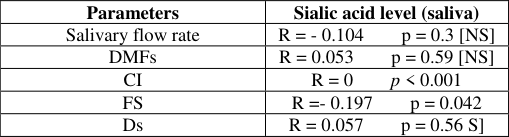 Table 1
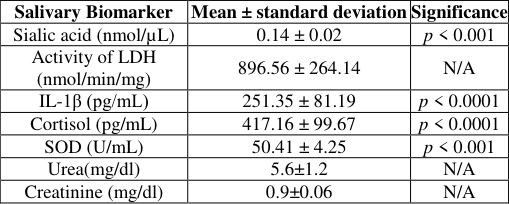 Table 2
Introduction
Periodontal disorders, namely gingivitis and periodontitis, are very frequent chronic conditions that have a significant impact on populations globally. Gingivitis is a condition characterized by inflammation of the gum caused by the buildup of plaque, and it affects around 50% of adults. Periodontitis is a condition that impacts the structures that provide support to the teeth. If not promptly identified and appropriately treated, it can ultimately result in the recession of the gums, loss of gingival tissue, underlying alveolar bone, and tooth loss. These consequences can lead to a decrease in the ability to chew and subsequently affect dietary intake and nutritional status [1][2][3] . The onset of periodontal disease occurs when certain bacteria and their byproducts colonise the gum, leading to an aberrant reaction from the host. This response involves the production of excessive proteolytic enzymes and reactive oxygen species (ROS), which in turn generate elevated levels of biomarkers indicating damage to the host tissue. The occurrence of tissue damage resulting from the generation of free radicals in periodontitis is associated with a diminished capacity for Antioxidants (AOs) and may be attributed to many variables such as smoking and inadequate nutritional status [4,5] . Smoking is a singular environmental risk factor that may be modified and is accountable for the higher frequency of periodontal disease within the community. Furthermore, it has a direct impact on several periodontal variables. The consequences of smoking include a persistent decrease in blood circulation, modified neutrophil activity, alterations in the synthesis of cytokines and growth factors, suppression of fibroblast development and attachment, and a reduction in collagen formation and vascularity. The research presented findings that suggest a correlation between smoking and increased concentrations of free radicals and lipid peroxidation in periodontal tissues. The presence of periodontitis and gingivitis in individuals who smoke is associated with decreased amounts of antioxidants in many bodily components. In addition, smoking and smoking-related disorders are ascribed to socioeconomic disadvantages, inadequate oral hygiene practices, and harmful dietary patterns [6][7][8] . Laboratory tests conducted on samples obtained from plaque, saliva, or gingival crevicular fluid have been found to possess greater accuracy compared to clinical measurements. These tests are specifically designed to assess biomarkers, which are derived from bacterial structure or the host inflammatory system, in order to identify individuals at a heightened risk of developing periodontal diseases. Saliva serves as the first protective fluid, and a significant biomarker found in saliva is sialic acids. These acids are a group of nine carbon acidic mono saccharides that act as systemic inflammatory markers. Salivary glycolipids, glycoproteins like IgA, and many immunological and acute phase proteins are also comprised of these components. The occurrence of periodontitis is linked to increased concentrations of sialic acid, which may be ascribed to its function as a defensive component of human salivary mucin. The diagnosis of periodontitis may be facilitated by the use of lipid-bound sialic acid fraction, indicating that the sialic acids found in mucin serve as scavengers for hydroxyl (OH) free radicals and directly engage with them. The purpose of this study was to assess the levels of sialic acid fractions in individuals who smoke, with the intention of identifying them as prospective biomarkers for periodontal illnesses and associated prognoses [9,10] .
Literature Review Pathogenesis
Numerous salivary biomarkers that have potential in relation to Parkinson's disease have been documented [11] . The development of periodontitis is associated with enzymatic changes [5][6][7][8] . Superoxide Dismutase (SOD) is an antioxidant enzyme found only in the periodontal ligaments of humans. It protects gingival fibroblasts from the damaging effects of superoxide [12] . Matrix Metalloproteinases (MMPs), which degrade tissues and break down bones, are stimulated to develop by IL-1β. Three of the 24 distinct MMPs that have been successfully replicated so far have been discovered in humans. Enzymes such as collagenases, membrane-type metalloproteinases, stromelysins, matrilysins, and collagenase are categorised based on the substrates they are intended to break down [13] . MMP-8 and MMP9 are prominently recognised as indicators for periodontal disease among the MMPs. An office-based kit capable of conducting a 5-minute MMP-8 test has been developed [13,14] . Multiple risk variables, including periodontal infections, have the potential to impact the course of periodontal disease [15] . Smoking is the second most significant risk factor for Parkinson's Disease (PD), behind dental plaque. Studies suggest that the occurrence of periodontitis is 3-6 times greater in those who smoke compared to those who do not smoke, and the heightened risk is directly related to the length of smoking and the rate of smoking. Smokers have more prominent clinical manifestations of Parkinson's Disease (PD) compared to those who do not smoke. These manifestations include the presence of deeper pockets, a more comprehensive and severe loss of attachment, elevated levels of bone deterioration, and increased rates of tooth loss [16] . Furthermore, it has been shown that smoking has a detrimental impact on the efficacy of implant insertion as well as both non-surgical and surgical therapy [17] .
Oral cavity
Mucosal surfaces, found in the mouth cavity, gastrointestinal surfaces, and other areas, have important functions in regularly safeguarding the underlying regions and tissues, such as blood vessels and structural components, from the surrounding environment [17] . Various variables have an impact on the mucosal surfaces of the human oral cavity, which include distinctive anatomical characteristics such as the presence of teeth and tongue. The oral mucosa is often affected by environmental stimuli, including those present in the food, as well as localised impacts caused by the specific niches and areas inside the mouth, which have unique structural characteristics [18] . In conjunction with the aforementioned factors, a significant component of the human oral cavity is its inherent microbial communities that have an effect on the oral mucosa. The oral cavity's mucosal surface is inhabited by significant populations of both gram-positive and gram-negative bacteria, accompanied by fungus and other components that serve as supplementary inhabitants. The microflora present in the oral cavity may be seen in several locations, including supragingival plaque on the exposed surfaces of teeth, subgingival plaque below the gumline, and other specific niches such as the tongue and cheek surfaces. Saline microbial communities may be classified as planktonic components capable of facilitating the transportation of organisms over oral surfaces. In addition to the previous point, the regular consumption of food and its nutritional properties promote the growth of microorganisms, resulting in the production of various substances such as acids, toxins, components of microbial cell walls, and even those with immunogenic and pathogenic properties. Collectively, microbial variables constitute a significant component of the oral stress and inflammatory load. The links between the microbial load inside the human mouth and illness have been extensively documented in the literature, drawing upon data from surveys and clinical investigations. Current practices in the field of clinical dentistry revolve on the consistent adherence to good oral hygiene protocols in order to safeguard oral well-being. The use of toothpaste for tooth brushing is commonly acknowledged as a self-care practice that effectively cleanses the mouth and enhances oral appearance [19] . Despite the widespread availability and educational initiatives aimed at mitigating the prevalence of oral disorders, a substantial effect of these diseases is reported by the majority of people. Caries and periodontal disease are among the most often reported oral illnesses. Without sufficient therapies, these disorders might result in tooth loss and alterations in appearance, which can have lasting effects on one's quality of life. Surveys indicate that, despite the widespread availability of high-quality dental treatment, only around 10% of persons in the UK report having good oral health. Reversible oral disorders, such as gingivitis, which refers to inflammation of the gums and supporting components of the tooth, are often seen in around 90% of certain populations. Extensive laboratory and clinical research have been conducted to explore the impact of microbial effects on the beginning and course of these disorders [20] .
Materials and Methods
Salivary samples were obtained from 100 healthy children, aged 5-15 years, for a duration of 5 minutes, within the time frame of 9:00 -11:00 A.M., without any stimulation. This research aimed to analyses the salivary biomarker parameters linked with age in relation to Parkinson's Disease (PD). This investigation was done using the standard protocol outlined in the preferred reporting items for spectrophotometer and ELISA. The index tests, namely salivary biomarkers, were analysed. The search queries in the title and abstract fields were conducted using a combination of plain text words, including synonyms or plural forms, and a controlled vocabulary of idea, such as Medical Subject Headings terms. The salivary parameters assessed in this research have the potential to serve as valuable indicators for gingival inflammation in pediatric patients, enabling pediatric dentists to effectively implement preventative interventions.
Statistical analysis
The study was carried out with SPSS version 19.0. The current investigation used many statistical techniques, including descriptive analysis, analysis of variance, student T-test, linear correlation, and multiple linear regression model. It is anticipated that the analysis will provide a significance level that is less than 0.05.
Results and Discussion
Table (1) demonstrates the association between sialic acid and the parameters under investigation. There is a significant positive association (r = 0.400) between the flow rate in youngsters and their dental age. On the contrary. A statistically significant connection was observed between salivary Salivary Acidity (S.A) and Gastrointestinal (GI) levels (p=0.04). Table (2) clearly indicates that children with mild gingivitis had a lower mean salivary S.A of 61.5 ul compared to those with moderate gingivitis of 61.9 ul. However, the statistical analysis did not find any significant differences in the numerical values. PD and its severity [23] .
Table 1: Rate of parameters
Table 1: Rate of parameters
Parameters
The enzyme activity was markedly modified; yet, LDH and Beta G proved to be dependable salivary indicators.
Numerous salivary biomarkers that have potential in relation to Parkinson's disease have been documented [24] . The development of periodontitis is associated with enzymatic changes [5][6][7][8] . Superoxide Dismutase (SOD) is an antioxidant enzyme found only in the periodontal ligaments of humans.
It protects gingival fibroblasts from the damaging effects of superoxide [9] . Plasma glutathione peroxidase, which is a peroxidase containing selenium, is a prominent member of a group of enzymes responsible for the elimination of hydrogen peroxide generated by Superoxide Dismutase (SOD) inside the cellular environment [10] . IL-1β induces the production of Matrix Metalloproteinases (MMPs), which have a role in the breakdown of bone and destruction of tissues [11] . Thus far, a total of 24 distinct MMPs have been successfully replicated, with three of them being identified in human beings.
Collagenases, gelatinases (Specifically collagenase), stromelysins, matrilysins, membrane-type metalloproteinases, and other forms are classified based on the substrate they are intended to destroy [25] . MMP-8 and MMP9 are prominently recognized as indicators for periodontal disease among the MMPs. An office-based kit capable of conducting a 5-minute MMP-8 test has been developed [13,14] . Simultaneously, saliva harbours a distinctive and intricate assortment of enzymes and proteins that play crucial roles in oral activities. Regrettably, the diagnostic use of these enzymes in Parkinson's Disease (PD) has been impeded due to the inadequate understanding of the significance of proteins and enzymes in saliva and their association with illness etiology. Moreover, several parameters like temperature, pH, enzyme substrates, and the impact of inhibitors and activators may induce enzymatic modifications [26] . Tobacco specifically enhances the harmful effects of salivary enzymes at the molecular level. Nevertheless, saliva samples have the advantages of being non-invasive, easily accessible, and cost-effective, hence making them a viable substitute for blood as a biomarker. Saliva serves as a valuable oral fluid for assessing the overall condition of the oral cavity, including the identification of Periodontal Disease (PD) [26] . Hence, it is preferable to have a salivary biomarker that is both effective and repeatable, as opposed to other biomarkers. The objective of this research was to assess the available data via a systematic review and to identify possible future avenues for investigating the diagnostic capabilities of salivary biomarkers in relation to Parkinson's disease, with a specific focus on smoking status.
Conclusion
The statistical analysis reveals a noteworthy correlation between the parameters of the oral cavity and salivary sialic acid with oral health. However, the renal function test conducted in the present research did not reveal any significant association with oral health.
Figures and tables from the paper
| Parameters | Sialic acid level (saliva) |
|---|---|
| Salivary flow rate | R = - 0.104 p = 0.3 [NS] |
| DMFs | R = 0.053 p = 0.59 [NS] |
| CI | R = 0 p < 0.001 |
| FS | R =- 0.197 p = 0.042 |
| Ds | R = 0.057 p = 0.56 S] |
Table text extracted from the original PDF; superscript letters are shown inline. The original table image is below.
View original table image
| Salivary Biomarker | Mean ± standard deviation | Significance |
|---|---|---|
| Sialic acid (nmol/µL) | 0.14 ± 0.02 | p < 0.001 |
| Activity of LDH (nmol/min/mg) | 896.56 ± 264.14 | N/A |
| IL-1β (pg/mL) | 251.35 ± 81.19 | p < 0.0001 |
| Cortisol (pg/mL) | 417.16 ± 99.67 | p < 0.0001 |
| SOD (U/mL) | 50.41 ± 4.25 | p < 0.001 |
| Urea(mg/dl) | 5.6±1.2 | N/A |
| Creatinine (mg/dl) | 0.9±0.06 | N/A |
Table text extracted from the original PDF; superscript letters are shown inline. The original table image is below.
View original table image
References
21 in the original paper- Bloomer RJ. Decreased blood antioxidant capacity and increased lipid peroxidation in young cigarette smokers compared to non-smokers: Impact of dietary intake. Nutrition Journal. 2007;6:39.
- Cavas L, Arpinar P, Yurdakoc K. Possible interactions between antioxidant enzymes and free sialic acids in saliva: A preliminary study on elite judoists. International Journal of Sports Medicine. 2005;26(10):832-835.
- Chapple ILC, Milward MR, Dietrich T. The prevalence of inflammatory periodontitis is negatively associated with serum antioxidant concentrations. American Society for Nutrition. 2007;137(3):657-664.
- Dhotre PS, Suryakar AN, Bhogade RB. Oxidative Stress in Periodontitis. European Journal of General Medicine. 2012;9(2):81-84.
- Eguchi H, Ikeda Y, Ookawara T, Koyota S, Fujiwara N, Honke K, et al. Modification of oligosaccharides by reactive oxygen species decreases sialyl lewis xmediated cell adhesion. Glycobiology. 2005;15(11):1094-1101.
- Beltrán-Aguilar ED, Eke PI, Thornton-Evans G, Petersen PE. Recording and surveillance systems for periodontal diseases. Periodontology 2000. 2012;60(1):40-53.
- Grossman FD. Navy periodontal screening exam. Journal of International Society of Preventive and Community Dentistry. 1974;3:41-45.
- Jette AM, Feldman HA, Tennstedt SL. Tobacco use: A modifiable risk factor for dental disease among the elderly. American journal of public health. 1993;83(9):1271-1276.
- Jiang Y, Zhou X, Cheng L, Li M. The impact of smoking on subgingival microflora: From periodontal health to disease. Frontiers in Microbiology. 2020;11:66.
- Monje A, Amerio E, Farina R, Nart J, Ramanauskaite A, Renvert S, et al. Significance of probing for monitoring Peri-implant diseases. International Journal of Oral Implantology. 2021;14(4):385-399.
- Srivastava N, Nayak PA, Rana S. Point of care: A novel approach to periodontal diagnosis-A review. Journal of Clinical and Diagnostic Research. 2017;11(8):ZE01ZE06.
- Ali SA, Telgi RL, Tirth A, Tantry IQ, Aleem A. Lactate dehydrogenase and β-glucuronidase as salivary biochemical markers of periodontitis among smokers and non-smokers. Sultan Qaboos University Medical Journal. 2018;18(3):e318-e323.
- Naresh CK, Rao SM, Shetty PR, Ranganath V, Patil AS, Anu AJ et al. Salivary antioxidant enzymes and lipid peroxidation product malondialdehyde and sialic acid levels among smokers and non-smokers with chronic periodontitis-A clinico-biochemical study. Journal of Family Medicine and Primary Care. 2019;8(9):2960-2964.
- Groeger SE, Meyle J. Oral Mucosal Epithelial Cells. Frontiers in Immunology. 2019;14:208.
- Arweiler NB, Auschill TM, Sculean A. Patient self-care of periodontal pocket infections. Periodontology 2000. 2018;76(1):164-179.
- Varki A, Gagneux P. Multifarious roles of sialic acids in immunity. Annals of the New York Academy of Sciences. 2012;1253(1):16-36.
- Tada A, Senpuku H. The Impact of Oral Health on Respiratory Viral Infection. Dentistry Journal. 2021;9(4):43.
- Kobayashi K, Shono C, Mori T, Kitazawa H, Ota N, Kurebayashi Y, et al. Protein-bound sialic acid in saliva contributes directly to salivary anti-influenza virus activity. Scientific Reports. 2022;12(1):6636.
- Bawankar PV, Kolte AP, Kolte RA. Evaluation of stress, serum and salivary cortisol, and interleukin-1β levels in smokers and non-smokers with chronic periodontitis. Journal of Periodontology. 2018;89(9):1061-1068.
- Hendek MK, Erdemir EO, Kisa U, Ozcan G. Effect of initial periodontal therapy on oxidative stress markers in gingival crevicular fluid, saliva, and serum in smokers and non-smokers with chronic periodontitis. Journal of Periodontology. 2015;86(2):273-282.
- Nazaryan R, Kryvenko L. Salivary oxidative analysis and periodontal status in children with atopy. Interventional Medicine and Applied Science. 2017;9(4):199-203.