
Research article · 2024 · Full text
International Journal of Agriculture and NutritionKnowledge of workers in agricultural extension centers regarding the administrative and organizational factors of the communication function in some central governorates of Iraq
Volume 6(1) · Pages 92–98 · DOI: 10.33545/26646064.2024.v6.i1b.145 ↗
Research areasAgricultural Economics and Practices
Abstract
Author-writtenThe research aimed to identify the level of knowledge of workers in agricultural extension centers regarding the administrative and organizational factors related to the communication function in some central governorates of Iraq. Four sub-objectives emerge from it according to the research areas, which are: the level of knowledge of workers in agricultural extension centers about the organizational factors related to types of communication, and the level of knowledge of workers in extension centers. Agricultural organizational factors related to the goals and policy of the organization, and the level of knowledge of workers in agricultural extension centers with organizational factors related to organizational structure and decision-making, the level of knowledge of workers in agricultural extension centers on the organizational factors related to organized economics. The sample was randomly selected by 50% of the research community consisting of three governorates in central Iraq, namely Baghdad, Salah al-Din, and Anbar, and their number reached (240) agricultural employees. A random sample of 50% was drawn from them to conduct the research, so the research sample became (120) employees. Agriculturally. The questionnaire form was used to collect data from the respondents after presenting it to the specialists. The validity and reliability of the form were verified to achieve the research objectives. Appropriate statistical tools were used to analyze the data and the SPSS statistical program. Field data was collected through personal interviews with workers in the Baghdad Agriculture Directorate during August 2023. The results of the research showed that the level of knowledge of workers in agricultural extension centers about the administrative and organizational factors of the communication function in some central governorates of Iraq indicates average, and there is weakness in the field of organization and management of the extension organization, and this is due to several reasons, including related to the types of communication between the levels of the organization with regard to the extension centers affiliated with it. As well as a weakness in the ability to make decisions, a lack of clarity in the organizational structure of the extension centers, ambiguity affecting the goals and policies of the agricultural extension centers, and a lack of financial support for those centers. The overall average score was 97.93, with an overall weighted average of 2.96, and a standard deviation of 9.77. The research recommended the need for the relevant authorities in the Ministry of Agriculture to support organization and management in agricultural extension, especially extension centers, because of their great importance in developing farmers in the agricultural sector, communicating modern recommendations to them, developing their skills in organization, and improving the organizational structure of agricultural extension centers.
Summary
Source-checkedPlain-language reading of the full paper, prepared with AI and checked against the text. Each point links to the authors' own words.
Why it matters
- The agricultural sector is a critical productive component of the economy for most countries, especially developing nations and Arab countries. View evidence ↗
- Agricultural research and extension organizations are essential for increasing production by providing farmers with improved technology and information. View evidence ↗
- Functional communication serves as the fundamental basis for administration and organization, linking different parts of an organization through oral or written means. View evidence ↗
The question
- The study aimed to determine the level of knowledge among agricultural extension center workers in central Iraqi governorates regarding administrative and organizational factors of the communication function. View evidence ↗
What they did
- The study used a random sample of 120 agricultural employees, representing 50% of the total 240 employees across extension centers in Baghdad, Salah al-Din, and Anbar. View evidence ↗
- Knowledge was measured using a five-point Likert scale ranging from 'I know strongly' to 'I do not know strongly', with assigned scores from 1 to 5. View evidence ↗
- Data was collected via a questionnaire consisting of personal information and 33 items divided into four knowledge areas. View evidence ↗
What they found
- The overall knowledge level of workers was found to be average, with 61.66% of respondents falling into the medium category and an overall average score of 97.93 out of 165. View evidence ↗
- Regarding types of communication, 60.63% of workers demonstrated a medium level of knowledge, with a weighted average of 2.96. View evidence ↗
- Knowledge regarding organizational goals and policies was also average, with 61.09% of respondents in the medium category and a weighted average of 2.94. View evidence ↗
- Knowledge of organizational structure and decision-making was average, with 61.76% of respondents in the medium category and a weighted average of 2.95. View evidence ↗
- Knowledge of organized economics was average, with 62.50% of respondents in the medium category and a weighted average of 2.99. View evidence ↗
- Positive correlations were found between knowledge levels and years of experience, job satisfaction, readiness for change, and orientation toward the organization. View evidence ↗
- No significant relationship was found between the workers' knowledge levels and their age or educational level. View evidence ↗
What it means
- The authors conclude that workers' knowledge of administrative and organizational communication factors is average but tends toward being weak. View evidence ↗
Visual summary
3 visualsIllustrations explain the paper; charts are replotted from the paper's own table values.
Knowledge Distribution Across Domains
AI-generated conceptual illustration (Agricultural extension workers in Iraq). It explains the idea and does not show study data.
View source evidence ↗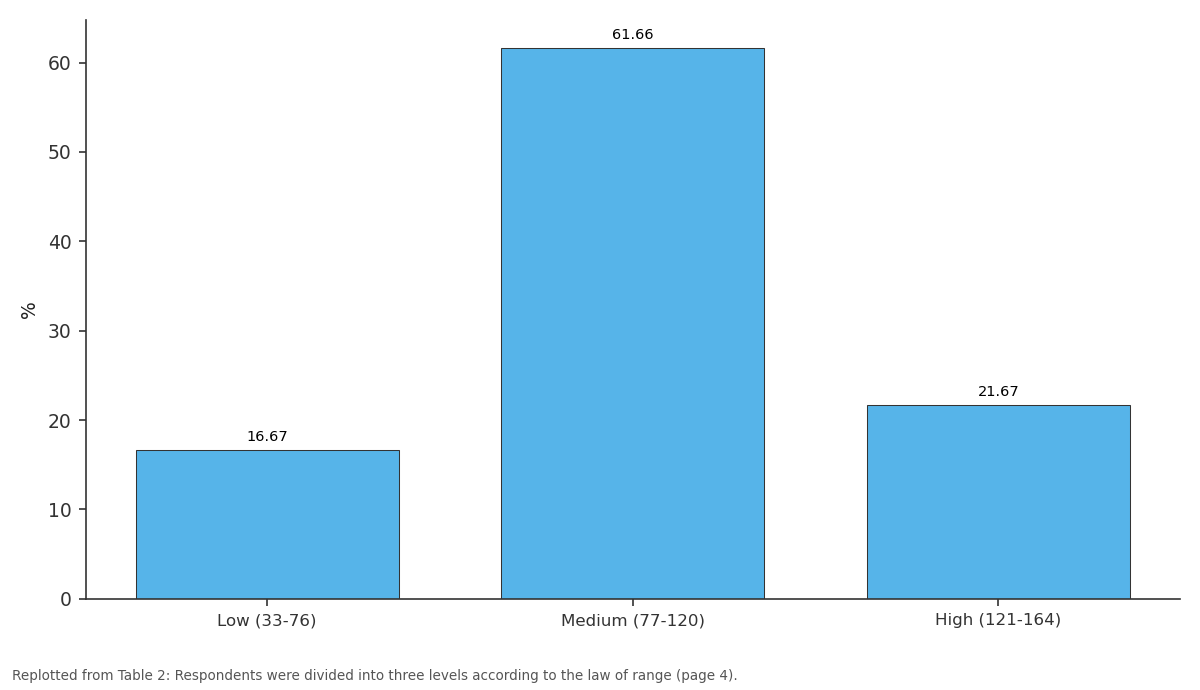
%: Low (33-76) vs Medium (77-120) vs High (121-164)
Replotted from Table 2 (page 4) of the original paper. Every bar is the paper's own table value.
View source evidence ↗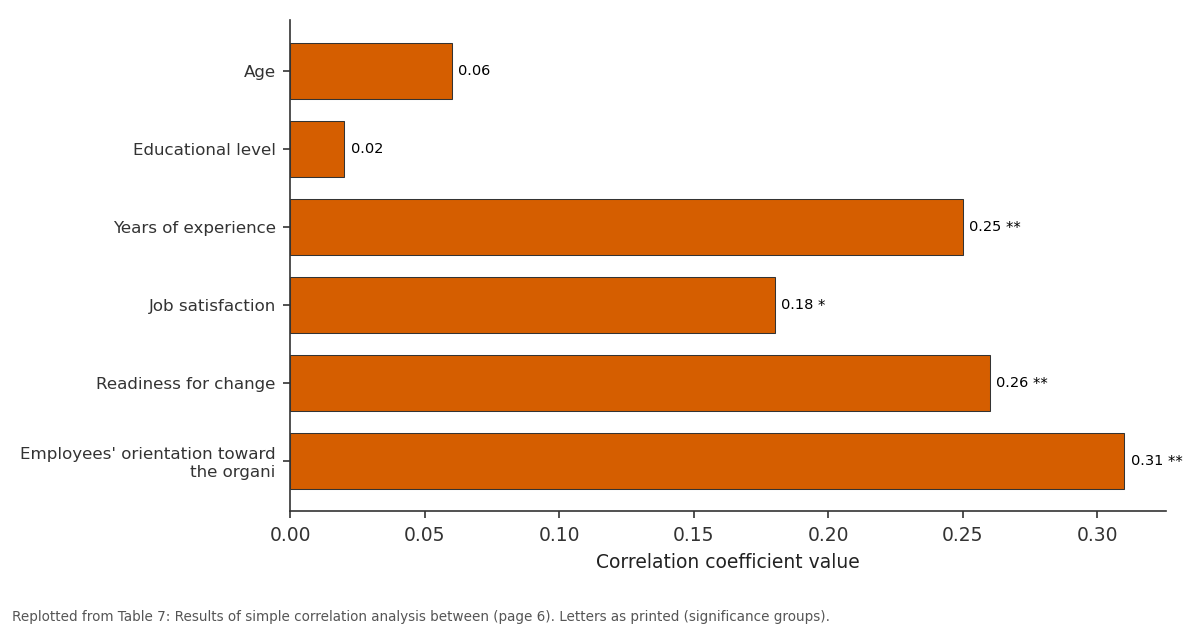
Correlation coefficient value: Age vs Educational level vs Years of experience vs Job satisfaction vs Readiness for change
Replotted from Table 7 (page 6) of the original paper. Every bar is the paper's own table value.
View source evidence ↗Figures & tables
From the original paper Table 1
 Table 2
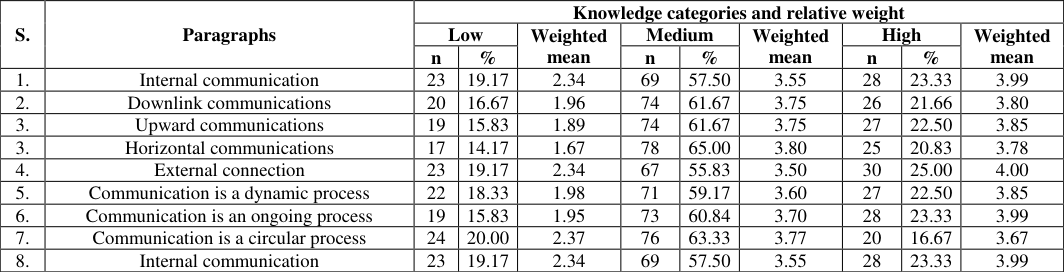 Table 3
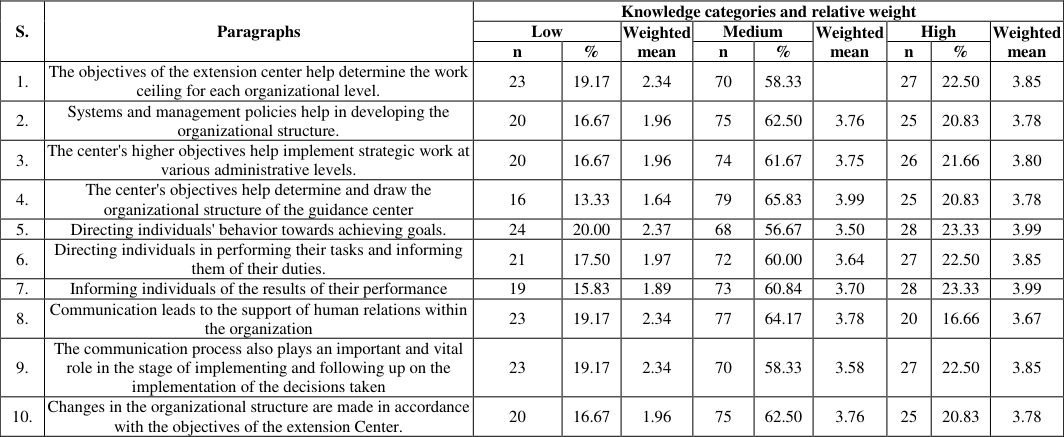 Table 4
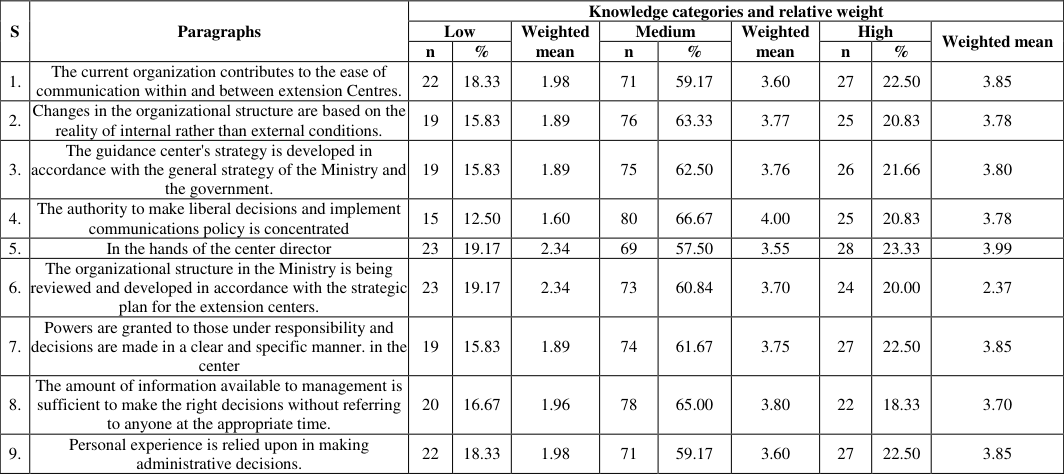 Table 5
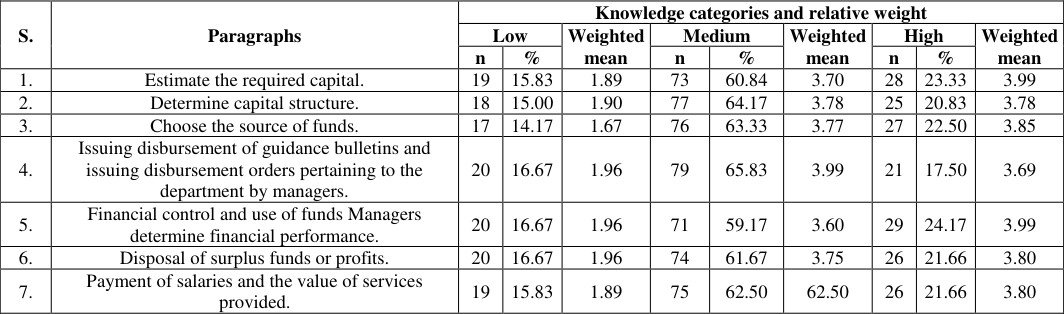 Table 6
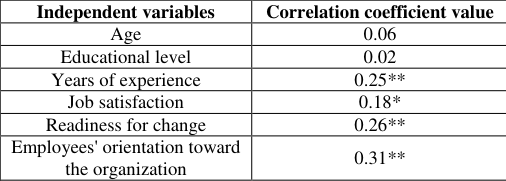 Table 7
Introduction
The agricultural sector is one of the most important productive sectors in the economy of the majority of countries in general, and developing countries in particular, including Arab countries. Agriculture plays an essential role in raising the living and social standard of the population and constitutes a basic source of national income and a field of work for the vast majority of the population of Arab countries.
Research and extension organizations play a pivotal role in providing improved technology and information to farmers to increase agricultural production, formulating public policy and planning research and extension services in all countries, and ensuring broad coverage of farmers' needs for technology, information, and developing methods used (Pareek & Rao, 1992: p63) [1] . There is a need for a new role for agricultural extension workers. One of the basic functions required is that the agricultural extension agent is an information broker and not a technology transmitter. He solves problems more than being a transmitter of a readymade recipe for solutions. He possesses the skills required for effective communication, and this requires providing technical and financial incentives (Ramirez, 1997: p6) [2] . As a result of developments that prevailed in the world during the last two decades of the twentieth century, agricultural extension systems have faced major challenges at various levels. At the global level, we find that rapid technical progress in transportation, electronic communication networks, and biotechnology, and the development of global communication networks have led to the creation of a tremendous capacity to exchange information and ideas (Swanson et al., 1997: p204) [3] . The guide needs to be an effective facilitator and teacher, to contribute to the discovery of local knowledge and techniques, benefit from this knowledge and draw the attention of members of the rural community to its importance, and have the ability to get to know people, analyze their problems, and suggest solutions to them, so the new extension worker needs to be Management specialist, communication specialist, and technical specialist (Naji, 2002: p. 151) [4] . Regarding the level of agricultural extension systems themselves, we find a set of challenges that include the loss of accountability mechanisms to clients, and the dangers facing the sustainability of agricultural systems, such as the excessive use of external inputs and the fragility of the ecosystems of small farms among many poor people, the use of participatory approaches, the difficult working conditions of extensionists and carrying out additional tasks, and difficulties Financing and delivery of the extension service and loss of political support (Anderson, 2003:p16) [5] . In general, agricultural extension fully fulfilling its assigned role depends on the presence of a good agricultural extension worker, as the agricultural extension worker is the main pillar in the success of extension work and represents the base of the pyramid and the front line in agricultural extension agencies. Therefore, one of the most important things is to build a close relationship between the researcher, the extensions, and the farmer, as the objectives of extension include transferring knowledge from researchers to farmers, providing them with advice, teaching them how to make the best decisions, supporting them to clarify their capabilities and goals, and encouraging desired agricultural developments. The concept of knowledge is awareness, awareness, and understanding of facts, and the acquisition of information through experience, through contemplation of the nature of things, or through reviewing the experiences of others and reading their conclusions. Thus, it emphasizes that knowledge is linked to intuition and research to develop oneself and discover the unknown (Al-Sayed, 2011: p. 5) [8] . Knowledge is an integrated framework that works to design and organize strategies, organizational structures, and processes to invest all the knowledge the organization possesses to achieve the best service to its customers and the best economic value (Omotayo, 2015: p2) [9] . Decisionmaking is the focus of the administrative process because it is an intertwined process in all administration functions and activities. When the administration exercises the planning function, it makes specific decisions at every stage of developing the plan, when setting the goal, drawing policies, or preparing programs, and when the administration establishes the appropriate organization. Due to its multiple tasks and activities, it makes decisions regarding the organizational structure, its type, size, and the basis for dividing departments and divisions (Abdullah, 2012: p. 64) [10] . Functional communication is the basic foundation of the work of administration and organization, and it is what connects the joints of the organization, whether the communication is oral or written. It is embodied in communication between the boss and subordinates, or between co-workers, as well as communication with farmers in implementing the guidance aspect of a modern recommendation in agriculture, which is the exchange of information at management levels (Al-Hamdany, 2013: p. 78) [11] . Functional communication of all kinds has a great impact on management, organization, and movement of the organization and determining the organization's relationship with the inputs as well as the processes and outputs of any organization, especially the agricultural extension organization and its administrative levels, and to achieve this at the level of goals as well as decision-making and financial economic matters at the level of the organization to achieve the requirements of management and organization (Hammad, 2016: p35) [12] . Communication is an important function in administrative and organizational work at the level of the organizational structure, as we find the flow of information at the levels of the organization through the structure of authority relationships. This means that information is provided through a chain of formal hierarchy, and some of it is in the form of decisions and directives, it is considered a driving force for integration between the various levels of the organization to achieve Objectives and stability and integration between the levels of the organization on the one hand, and the beneficiaries on the other hand (Maher, 2004: p. 58) [13] . During the researcher's readings on the work of the administrative organizations existing in Iraq and at the level of the Ministry of Agriculture, the connection of administrative decisions to the organizational structures and the type of decisions, as well as the lines of communication and communication between the administrative levels, their impact on the organization and their future effects, and the researcher's acquaintance with the agricultural organization and its affiliated extension centers, there is weakness and lack of clarity in the function of communication between These centers while carrying out the work required to develop the agricultural aspect and the organization's performance, found it necessary to raise an important question, which is: What is the knowledge of the workers in the agricultural extension centers about the administrative and organizational factors of the communication function in some of the central governorates of Iraq?
Research aims
1. The research seeks to achieve a main goal, which is to identify the level of knowledge of workers in agricultural extension centers regarding the administrative and organizational factors in the communication function in some central governorates of Iraq, and four sub-objectives emerge from it according to the areas of research, which are: The first area: is the level of knowledge of workers in agricultural extension centers about the organizational factors related to types of communication.
The second area is the level of knowledge of workers in agricultural extension centers about the organizational factors that include the goals and policy of the organization. The third area is the level of knowledge of workers in agricultural extension centers about organizational factors related to organizational structure and decision-making. The fourth area is the level of knowledge of workers in agricultural extension centers about the organizational factors related to organized economics.
Research Methodology
This research comes within the framework of research that falls within the descriptive approach, as this approach describes what exists in the current situation and interprets it by collecting data on the level of opinions, positions, and reactions regarding the subject of knowledge of workers in agricultural extension centers regarding administrative and organizational factors (Al-Sammak, 2019: 189) [14] .
Research community and sample
The research community included three governorates of central Iraq: Baghdad, Salah al-Din, and Anbar, an area to conduct the research because of its great importance in agricultural extension. Among all employees of agricultural extension centers in those governorates, who numbered (240) agricultural employees, a random sample of 50% was drawn. Of them to conduct the research, the research sample became (120) agricultural employees, as shown in
Research method
The questionnaire consisted of two parts. The first part contained the farmers' personal information, such as (age, educational level, experience, years of service, readiness for change, job satisfaction, and employees' attitude), while the second part consisted of (33) items distributed over four areas to measure the knowledge of workers in the centers. Agricultural guidance: The field of organizational factors that relate to types of communication consists of (8) paragraphs, the field of organizational factors that relate to the goals and policy of the organization consists of (10) paragraphs, and the field of organizational factors that relate to organizational structure and decision-making consists of (9) paragraphs, The field of organizational factors related to organized economics consists of (7) paragraphs) after presenting it to specialists in the field of agricultural extension to verify the apparent validity and content of the questionnaire form. It was deleted, added, and modified to stabilize the form in its final form.
Data collection process
The process of collecting research data was done through a questionnaire form using a personal interview with the respondents, and the data collection process took from 7/1/2023 to 8/20/2023.
Data tabulation and analysis process
After completing the data collection process, it was transcribed through the Excel and SPSS programs used to analyze and process the data statistically. After that, the data was organized into tables in order for the results to be presented and interpreted. The process of tabulating and analyzing the data was as follows:
Measuring the dependent variable A five-point Likert scale was adopted to measure the knowledge of workers in agricultural extension centers for the respondents. The scale consisted of the following levels. The scale will consist of five alternatives (I know strongly, I know, neutral, I do not know, I do not know strongly), and grades will be given to them respectively (1, 2, 3, 4, 5), thus the range of the theoretical scale becomes (33-165) degrees, with a hypothesized average of (82.5) degrees, and about the fields, the scales ranged as follows (organizational factors that relate to types of communication consist of (8-40) degrees, The range of organizational factors that relate to the goals and policy of the organization consists of (10-50) scores, The field of organizational factors that relate to organizational structure and decision making consists of (9-45) scores, and the field of organizational factors that relate to organized economics consists of ( given (4, 3, 2, 1) respectively. Thus, the measure of educational level ranged between (1 -4) degrees.
Number of years of service:
Measured by the number of years. 4. Readiness for change: It was measured by three alternatives (high, medium, low) and weights were given to them (3, 2, 1) respectively. 5. Degree of job satisfaction: It was measured through the levels (satisfied, neutral, dissatisfied) and was given (2, 1, and zero) respectively. 6. Employees' attitude: It was measured by three alternatives (negative, neutral, positive) and weights were given to them (3, 2, 1) respectively.
Results
1. Identifying the level of knowledge of workers in agricultural extension centers regarding administrative and organizational factors regarding the communication function in some central governorates of Iraq in general.
The results of the research showed that 61.66% of the respondents were at the level of knowledge of the respondents in the agricultural extension centers regarding the administrative and organizational factors in the communication function and that the minimum score obtained by the respondents was 33 and the highest score was 165 degrees, with an overall average of 97.93 on the scale of its theoretical limits (1-165) degrees. With an overall weighted average of 2.96 degrees and a standard deviation of 9.77 degrees, the respondents were divided into three levels according to the law of range, as shown in Table 2. The results of Table 2 show that the level of knowledge of workers in agricultural extension centers about the administrative and organizational factors of the communication function in some central governorates of Iraq is generally average and tends to decline. This is due to several reasons, including related to the types of communication between the levels of the organization about the extension centers affiliated with it, as well as weaknesses. In the ability to make decisions, the lack of clarity in the organizational structure of extension centers, the ambiguity affecting the goals and policies of agricultural extension centers, and the lack of financial support for those centers.
| Knowledge category | The number | % | Arithmetic average of knowledge | Relative arithmetic mean |
|---|---|---|---|---|
| Low (33-76) | 20 | 16.67 | 54.40 | 9.07 |
| Medium (77-120) | 74 | 61.66 | 97.15 | 59.91 |
| High (121-164) | 26 | 21.67 | 142.25 | 30.82 |
| the total | 120 | 100 | 98.5 | 100 |
Table text extracted from the original PDF; superscript letters are shown inline. The original table image is below.
View original table image
The first area is the level of knowledge of workers in agricultural extension centers about the organizational factors related to types of communication
The research results showed that 60.63% of the respondents were at the level of knowledge of workers in agricultural extension centers about the organizational factors related to types of communication, with a weighted average of 2.96 degrees, and a standard deviation of 2.61 degrees, as shown in Table 3. It appears from the results of Table 3. The level of knowledge of workers in agricultural extension centers about the administrative and organizational factors of the communication function in some central governorates of Iraq is generally described as average and tends to decline. This is due to several reasons, including related to the types of communication between levels of the organization, such as upward communication and continuity of communication within and between centers. Agricultural extension.
| S. | Paragraphs | Knowledge categories and relative weight | — | — | — | — | — | — | — | — |
|---|---|---|---|---|---|---|---|---|---|---|
| Low | Weighted mean | Medium | Weighted mean | High | Weighted mean | |||||
| n | % | n | % | n | % | |||||
| 1. | Internal communication | 23 | 19.17 | 2.34 | 69 | 57.50 | 3.55 | 28 | 23.33 | 3.99 |
| 2. | Downlink communications | 20 | 16.67 | 1.96 | 74 | 61.67 | 3.75 | 26 | 21.66 | 3.80 |
| 3. | Upward communications | 19 | 15.83 | 1.89 | 74 | 61.67 | 3.75 | 27 | 22.50 | 3.85 |
| 3. | Horizontal communications | 17 | 14.17 | 1.67 | 78 | 65.00 | 3.80 | 25 | 20.83 | 3.78 |
| 4. | External connection | 23 | 19.17 | 2.34 | 67 | 55.83 | 3.50 | 30 | 25.00 | 4.00 |
| 5. | Communication is a dynamic process | 22 | 18.33 | 1.98 | 71 | 59.17 | 3.60 | 27 | 22.50 | 3.85 |
| 6. | Communication is an ongoing process | 19 | 15.83 | 1.95 | 73 | 60.84 | 3.70 | 28 | 23.33 | 3.99 |
| 7. | Communication is a circular process | 24 | 20.00 | 2.37 | 76 | 63.33 | 3.77 | 20 | 16.67 | 3.67 |
| 8. | Internal communication | 23 | 19.17 | 2.34 | 69 | 57.50 | 3.55 | 28 | 23.33 | 3.99 |
Table text extracted from the original PDF; superscript letters are shown inline. The original table image is below.
View original table image
The second area is the level of knowledge of workers in agricultural extension centers about organizational factors related to the goals and policies of the organization
The results of the research showed that 61.09% of the respondents the knowledge of workers in agricultural extension centers about the organizational factors related to the goals and policy of the organization, with a weighted average of 2.94 degrees, and a standard deviation of 2.35 degrees, as shown in Table 4. It appears from the results of Table 4. The knowledge of workers in agricultural extension centers about the organizational factors related to the goals and policies of the organization is described as average and tends to decline. This is due to several reasons, including the weakness of helping the center's objectives to define and draw the organizational structure of the extension center, as well as informing the working individuals of the results of their performance in the center's Guidance.
| S. | Paragraphs | Knowledge categories and relative weight | — | — | — | — | — | — | — | — |
|---|---|---|---|---|---|---|---|---|---|---|
| Low | Weighted mean | Medium | Weighted mean | High | Weighted mean | |||||
| n | % | n | % | n | % | |||||
| 1. | The objectives of the extension center help determine the work ceiling for each organizational level. | 23 | 19.17 | 2.34 | 70 | 58.33 | 27 | 22.50 | 3.85 | |
| 2. | Systems and management policies help in developing the organizational structure. | 20 | 16.67 | 1.96 | 75 | 62.50 | 3.76 | 25 | 20.83 | 3.78 |
| 3. | The center's higher objectives help implement strategic work at various administrative levels. | 20 | 16.67 | 1.96 | 74 | 61.67 | 3.75 | 26 | 21.66 | 3.80 |
| 4. | The center's objectives help determine and draw the organizational structure of the guidance center | 16 | 13.33 | 1.64 | 79 | 65.83 | 3.99 | 25 | 20.83 | 3.78 |
| 5. | Directing individuals' behavior towards achieving goals. | 24 | 20.00 | 2.37 | 68 | 56.67 | 3.50 | 28 | 23.33 | 3.99 |
| 6. | Directing individuals in performing their tasks and informing them of their duties. | 21 | 17.50 | 1.97 | 72 | 60.00 | 3.64 | 27 | 22.50 | 3.85 |
| 7. | Informing individuals of the results of their performance | 19 | 15.83 | 1.89 | 73 | 60.84 | 3.70 | 28 | 23.33 | 3.99 |
| 8. | Communication leads to the support of human relations within the organization | 23 | 19.17 | 2.34 | 77 | 64.17 | 3.78 | 20 | 16.66 | 3.67 |
| 9. | The communication process also plays an important and vital role in the stage of implementing and following up on the implementation of the decisions taken | 23 | 19.17 | 2.34 | 70 | 58.33 | 3.58 | 27 | 22.50 | 3.85 |
| 10. | Changes in the organizational structure are made in accordance with the objectives of the extension Center. | 20 | 16.67 | 1.96 | 75 | 62.50 | 3.76 | 25 | 20.83 | 3.78 |
Table text extracted from the original PDF; superscript letters are shown inline. The original table image is below.
View original table image
The third area is the level of knowledge of workers in agricultural extension centers about organizational factors related to organizational structure and decisionmaking:
The research results showed that a percentage of 61.76% of respondents the level of knowledge of workers in agricultural extension centers about organizational factors related to organizational structure and decision-making, with a weighted average of 2.95 degrees, and a standard deviation of 2.40 degrees, as shown in Table 5. It appears from the results of Table 5. The level of knowledge of workers in agricultural extension centers about organizational factors related to organizational structure and decision-making is described as average and tends to decline. This is due to several reasons, including the weakness of the authority to make liberal decisions and implement policy. Correspondence is concentrated in the hands of the center director, as well as weakness in changes in the organizational structure is based on the reality of internal rather than external conditions.
| S | Paragraphs | Knowledge categories and relative weight | — | — | — | — | — | — | — | — |
|---|---|---|---|---|---|---|---|---|---|---|
| Low | Weighted mean | Medium | Weighted mean | High | Weighted mean | |||||
| n | % | n | % | n | % | |||||
| 1. | The current organization contributes to the ease of communication within and between extension Centres. | 22 | 18.33 | 1.98 | 71 | 59.17 | 3.60 | 27 | 22.50 | 3.85 |
| 2. | Changes in the organizational structure are based on the reality of internal rather than external conditions. | 19 | 15.83 | 1.89 | 76 | 63.33 | 3.77 | 25 | 20.83 | 3.78 |
| 3. | The guidance center's strategy is developed in accordance with the general strategy of the Ministry and the government. | 19 | 15.83 | 1.89 | 75 | 62.50 | 3.76 | 26 | 21.66 | 3.80 |
| 4. | The authority to make liberal decisions and implement communications policy is concentrated | 15 | 12.50 | 1.60 | 80 | 66.67 | 4.00 | 25 | 20.83 | 3.78 |
| 5. | In the hands of the center director | 23 | 19.17 | 2.34 | 69 | 57.50 | 3.55 | 28 | 23.33 | 3.99 |
| 6. | The organizational structure in the Ministry is being reviewed and developed in accordance with the strategic plan for the extension centers. | 23 | 19.17 | 2.34 | 73 | 60.84 | 3.70 | 24 | 20.00 | 2.37 |
| 7. | Powers are granted to those under responsibility and decisions are made in a clear and specific manner. in the center | 19 | 15.83 | 1.89 | 74 | 61.67 | 3.75 | 27 | 22.50 | 3.85 |
| 8. | The amount of information available to management is sufficient to make the right decisions without referring to anyone at the appropriate time. | 20 | 16.67 | 1.96 | 78 | 65.00 | 3.80 | 22 | 18.33 | 3.70 |
| 9. | Personal experience is relied upon in making administrative decisions. | 22 | 18.33 | 1.98 | 71 | 59.17 | 3.60 | 27 | 22.50 | 3.85 |
Table text extracted from the original PDF; superscript letters are shown inline. The original table image is below.
View original table image
The fourth area is the level of knowledge of workers in agricultural extension centers about the organizational factors related to organized economics. The results of the research showed that 62.50% of the respondents showed the level of knowledge of workers in agricultural extension centers about the organizational factors related to organized economics, with a weighted average of 2.99 degrees, and a standard deviation of 2.41 degrees, as shown in Table 6. The results of the research showed that the respondents were distributed according to each scale, that the age variable ranged between (24-62) years, and the percentage of educational level was 45% at the bachelor's level, and the years of experience for the number of years of experience variable ranged from (28) years, and with regard to the job satisfaction variable The percentage of (69%) was in the neutral category, the willingness to change was 54% agreeable, and the workers' attitude towards change was 45% negative towards organization and guidance management. The categories of independent variables were divided according to the law of range, as shown in Table (7). for change, and direction), and there was a positive correlation with regard to the variables (number of years of experience, job satisfaction, readiness). For change and trend), as shown in Table 7. With regard to age, there is no relationship between it and the dependent variable.
| Independent variables | Correlation coefficient value |
|---|---|
| Age | 0.06 |
| Educational level | 0.02 |
| Years of experience | 0.25** |
| Job satisfaction | 0.18* |
| Readiness for change | 0.26** |
| Employees' orientation toward the organization | 0.31** |
Table text extracted from the original PDF; superscript letters are shown inline. The original table image is below.
View original table image
| S. | Paragraphs | Knowledge categories and relative weight | — | — | — | — | — | — | — | — |
|---|---|---|---|---|---|---|---|---|---|---|
| Low | Weighted mean | Medium | Weighted mean | High | Weighted mean | |||||
| n | % | n | % | n | % | |||||
| 1. | Estimate the required capital. | 19 | 15.83 | 1.89 | 73 | 60.84 | 3.70 | 28 | 23.33 | 3.99 |
| 2. | Determine capital structure. | 18 | 15.00 | 1.90 | 77 | 64.17 | 3.78 | 25 | 20.83 | 3.78 |
| 3. | Choose the source of funds. | 17 | 14.17 | 1.67 | 76 | 63.33 | 3.77 | 27 | 22.50 | 3.85 |
| 4. | Issuing disbursement of guidance bulletins and issuing disbursement orders pertaining to the department by managers. | 20 | 16.67 | 1.96 | 79 | 65.83 | 3.99 | 21 | 17.50 | 3.69 |
| 5. | Financial control and use of funds Managers determine financial performance. | 20 | 16.67 | 1.96 | 71 | 59.17 | 3.60 | 29 | 24.17 | 3.99 |
| 6. | Disposal of surplus funds or profits. | 20 | 16.67 | 1.96 | 74 | 61.67 | 3.75 | 26 | 21.66 | 3.80 |
| 7. | Payment of salaries and the value of services provided. | 19 | 15.83 | 1.89 | 75 | 62.50 | 62.50 | 26 | 21.66 | 3.80 |
Table text extracted from the original PDF; superscript letters are shown inline. The original table image is below.
View original table image
As for the educational level variable, Spearman's law was used, which had a value of (0.02) and there was no relationship between it and the dependent variable. To test the significance of the relationship, the (t) test was used for all variables, and to find the relationship, the calculated (t) was compared to the tabular one, and the results appeared in
Figures and tables from the paper
| S. | The center in the governorate | The number | The sample is 50% |
|---|---|---|---|
| 1. | Extension Center in Baghdad | 110 | 55 |
| 2. | Extension Center in Salah al-Din | 80 | 40 |
| 3. | Extension Center in Anbar | 50 | 25 |
| The total | 240 | 120 |
Table text extracted from the original PDF; superscript letters are shown inline. The original table image is below.
View original table image
References
1 in the original paper- Ramirez R. Combining PRA with Agricultural Knowledge Systems Analysis; c1997, p. 66:20. Gatekeeper 66. Available from: https://www.iied.org/docs/gatekeep/GK66.pdf. Accessed: 12/10/2003.