
Research article · 2024 · Full text
International Journal of Veterinary Sciences and Animal HusbandrySeminal characteristics and oxidative stress in high-fertility versus low-fertility Mehsana buffalo bulls
Volume 9(2) · Pages 695–698 · DOI: 10.22271/veterinary.2024.v9.i2j.1312 ↗
Research areasReproductive Physiology in Livestock
Abstract
Author-writtenThe aim of the present study was to assess and compare semen parameters in Mehsana buffalo bulls classified as high-fertile and low-fertile based on their conception rates (CR). Twelve bulls were selected and divided into two groups (high-fertile with CR > 43% and low-fertile with CR < 35%). Frozen semen samples (n=72) were randomly chosen for analysis. Results showed that high-fertile bulls exhibited significantly (p
Summary
Source-checkedPlain-language reading of the full paper, prepared with AI and checked against the text. Each point links to the authors' own words.
Why it matters
- Livestock, particularly cattle and buffaloes, are vital to India's agricultural economy, with the country hosting 192.50 million cattle and 109.9 million buffaloes. View evidence ↗
- Using high-quality genetic bulls for Artificial Insemination (AI) is essential for improving the productivity of buffalo herds. View evidence ↗
- Buffalo sperm are more susceptible to damage during cryopreservation than cattle sperm, which can lead to lower conception rates. View evidence ↗
The question
- The study aimed to compare semen parameters between Mehsana buffalo bulls categorized as high-fertile or low-fertile based on their conception rates. View evidence ↗
What they did
- Twelve Mehsana buffalo bulls were divided equally into high-fertile (conception rate > 43%) and low-fertile (conception rate < 35%) groups. View evidence ↗
- The researchers analyzed 72 frozen semen samples, consisting of six different batches from each of the twelve bulls. View evidence ↗
- Live sperm percentage and morphology were determined using smears stained with eosin-nigrosin at 37 °C. View evidence ↗
- Plasma membrane integrity was assessed via the hypo-osmotic swelling test (HOST), and membrane peroxidative damage was measured by malondialdehyde (MDA) levels. View evidence ↗
What they found
- High-fertile bulls had a significantly higher percentage of live sperm (62.21±0.04%) compared to low-fertile bulls (54.02±0.03%). View evidence ↗
- There was no significant difference in the percentage of HOST-reactive sperm between the high-fertile (63.33±0.01%) and low-fertile (62.05±0.01%) groups. View evidence ↗
- Low-fertile bulls showed significantly higher head abnormalities (4.14±0.01% vs 2.08±0.02%) and total abnormalities (13.65±0.02% vs 9.97±0.02%) than high-fertile bulls. View evidence ↗
- No significant differences were found between high and low fertile bulls regarding mid-piece abnormalities, abnormal tails, or tailless heads. View evidence ↗
- Lipid peroxidation (MDA) levels did not differ significantly between high-fertile (0.37±0.02) and low-fertile (0.31±0.03) groups. View evidence ↗
What it means
- The authors concluded that sperm viability and head morphology are correlated with fertility in Mehsana buffalo bulls. View evidence ↗
- The authors found that lipid peroxidation and plasma membrane integrity did not significantly differ between high and low fertility groups. View evidence ↗
Visual summary
1 visualsIllustrations explain the paper; they do not show study data.
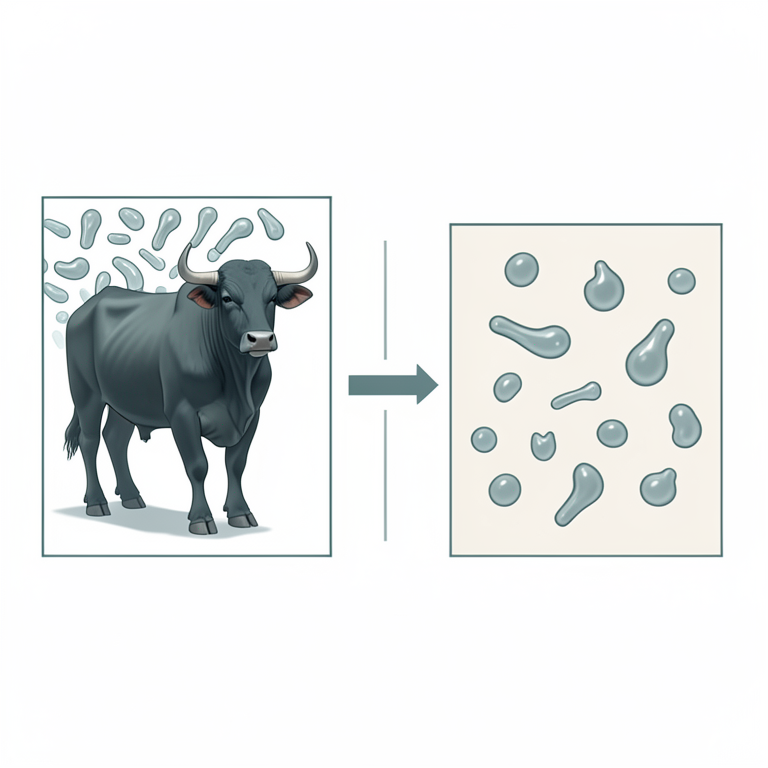
Fertility Correlation Map
AI-generated conceptual illustration (Mehsana buffalo bulls and their sperm cells). It explains the idea and does not show study data.
View source evidence ↗Introduction
Livestock plays a crucial role in India's agricultural industry, with a substantial presence in the country's economy. The country has the largest population of bovines including 192.50 million cattle and 109.9 million buffaloes (Anonymous, 2019) [4] . Despite the relatively low milk production per animal, India leads the world in milk output, contributing 20% of the global production (Anonymous, 2018) [3] . The dairy industry in India relies mainly on both cows and buffaloes, with domestic buffaloes making a significant contribution. According to the annual report (2019-20) of the Central Institute for Research on Buffaloes, domestic buffaloes alone contribute 91.82 million tonnes of milk, emphasizing their vital role in the agricultural economy.
To enhance the future productivity of buffalo herds, it's essential to employ high-quality genetic bulls for Artificial Insemination (AI). AI facilitates the widespread distribution of superior genetic material from a small number of genetically superior males to a large number of females in the population (Vishwanath and Shannon, 2000) [37] . Additionally, challenges such as infertility in buffaloes and the need for multiple insemination attempts contribute to frustration and financial losses for dairy farmers (Stevenson et al., 1990) [34] . Buffalo spermatozoa exhibit lower cryotolerance compared to those of cattle and are more prone to hazards during cryopreservation (Andrabi, 2009) [2] , which may contribute to suboptimal conception rates in buffalo herds. The primary aim of sperm evaluation is to investigate the correlation between semen quality and fertility, with the goal of assessing the fertility potential of donors. Cryopreservation protocols involve several steps that can potentially harm sperm cells, diminishing their capacity to fertilize ova. Thus, it's essential to monitor the quality of cryopreserved semen to anticipate its fertility potential. Moreover, successful reproduction relies on various semen parameters. Therefore, establishing a fertility prediction system based on evaluating multiple semen quality parameters post-freezing and thawing could help exclude bulls with low fertility potential from breeding programs, saving significant time as well as resources.
Throughout cryopreservation, semen undergoes cold shock and exposure to atmospheric oxygen, increasing susceptibility to lipid peroxidation (LPO) due to increased reactive oxygen species (ROS) production (Nair et al., 2006) [27] . This process generates malondialdehyde (MDA), which damages the structure and function of plasma membranes of bull spermatozoa. Freezing and thawing also induce ROS production, altering sperm membrane and antioxidant defence systems of sperm (Bilodeau et al., 2000; Gadea et al., 2013) [6,15] , ultimately resulting in decreased viability and fertility (Bailey et al., 2000) [5] . The ability of spermatozoa to fertilize is closely linked to a range of sperm traits, assessed through diverse laboratory techniques. Numerous studies have indicated that factors such as viability and membrane integrity (Christensen et al., 2005; Christensen et al., 2011) [10,11] , morphology (Nagy et al., 2013) [26] , and lipid peroxidation status (Singh et al., 2016) [33] are associated with bull fertility. Considering the aforementioned facts, the objective of this study was to assess the correlations between fertility and semen parameters in Mehsana buffalo bulls with varying fertility levels.
Material and Methods
Twelve Mehsana buffalo bulls from Banas Dairy's Dama semen production unit were selected based on their conception rate (CR), evaluated through the field progeny testing program led by Banaskantha District Co-Operative Milk Producers' Union Ltd, Palanpur. These bulls were categorized into two groups: high-fertile (CR > 43%,) and low-fertile (CR < 35%), with equal representation in each group.
To compare the semen characteristics between high and low fertile bulls, frozen semen samples (n=72) with six different batches form each bull were included for further semen assessment. To ascertain the percentage of live spermatozoa and location based sperm morphology, a smear was prepared on a pre-warmed clean glass slide by gentle mixing of a drop of frozen-thawed semen and a drop of pre warmed (37 °C) eosin-nigrosin stain. After drying, the smear was examined under the microscope. The hypo-osmotic swelling test (HOST) was performed to assess the plasma membrane integrity of the sperm based on curled and swollen tails as described by Jeyendran et al. (1984) [19] . Membrane peroxidative damage in seminal plasma was determined in terms of malondialdehyde (MDA) using the method of Buege and Aust (1978) [7] with a few modifications. The percentages were transformed into arcsine prior to analysis. Differences among groups in LPO, live sperm, HOS-reacted spermatozoa and sperm abnormality were assessed using a one-way independent t-test, with results presented as mean ± S.E. Significance was determined at the 95% level. Data analysis was conducted using SPSS 20 software.
Results and Discussion
In the present study, the percent live sperms were significantly (p<0.05) higher in high fertile (62.21±0.04) bulls as compared to low fertile (54.02±0.03) Mehsana buffalo bulls. In accordance with the present findings, Selvaraju et al. (2008) [32] , Dogan et al. (2012) [14] , Gliozzi et al. (2017) [18] , Kumaresan et al. (2017) [21] and Narud et al. (2020) [28] observed significantly higher live sperm percentage in high fertile bull as compared to low fertile bull. Similarly, Gamal et al. (2010) [16] found significantly higher live sperm percentage in bull with higher conception rate as compared to lower conception rate. While, Mahmoud et al. (2013) [24] observed significantly higher live sperm percentage in highest fertile bull as compared to lowest fertile bull. Whereas, Kumar et al. (2016) [20] and Turri et al. (2021) [36] found nonsignificantly higher live sperm percentage in high fertile bull as compared to low fertile bull. The overall mean value of percent live sperm (58. 19) reported in present study was in accordance with Lone et al. (2018) [22] . The mean value of percent live sperm recorded in their experiment was 56.89%. However, Maurya and Tuli (2003) [25] , Mahmoud et al. (2016) [23] and Ahmed et al. (2018) [1] found higher percent of live sperm (70.23, 65.3 and 64.41, respectively). While, Chaudhary et al. (2018) [9] observed lower percentage of live sperm (52.33) in Surti buffalo bull as compared to present study. There was non-significant difference in percent HOS reactive sperm between high fertile (63.33±0.01) and low fertile (62.05±0.01) group. In agreement with the present findings, Oliveira et al. (2012) [29] found non-significant difference in the plasma membrane integrity between high conception rate bull and low conception rate bull. Further, similar to present findings they also found numerically lower HOST reacted sperm in bull with numerically lower conception rate. In contrary with the present findings, Correa et al. (1997) [12] reported significantly higher mean value of HOST reacted sperm in high fertile group as compared to low fertile group. The overall mean value of HOST reacted sperm 62.69% reported in present study was almost at par with Chaudhari et al. (2007) [8] in 60% post thaw motility (65.11%) group and higher than in 50% post-thaw motility (55.81%) group in Mehsana buffalo bull. However, Dalal et al. (2019) [13] found lower percent of HOST reactive sperm in their experiment. The mean percentage of head abnormalities and total abnormalities were significantly (p<0.05) higher in low fertile bulls (4.14±0.01 and 13.65±0.02, respectively) as compared to high fertile bulls (2.08±0.02 and 9.97±0.02, respectively). While, mid-piece abnormalities (2.41±0.01, 3.49±0.02), percent abnormal tail (3.00±0.02, 3.48±0.02) and tail less head (0.80±0.02, 0.93±0.01) differed non-significantly between high and low fertile buffalo bulls, respectively. The overall mean percentage of abnormal head, abnormal midpiece, abnormal tail, tail less head and total abnormality were 3.02±0.01, 2.93±0.01, 3.24±0.01, 0.85±0.01 and 11.75±0.01, respectively in present study. In accordance with the present findings, Garcia-Macias et al. (2007) [17] also found significantly higher sperm head abnormality and total abnormality in low fertile bull as compared to high fertile bull. Further, they also found nonsignificant difference in percentage tail abnormality between high fertile and low fertile bulls. Oliveira et al. (2012) [29] also found significantly higher major abnormality and total abnormality in low conception rate bull as compared to high conception rate bull which was in accordance with the present study. However, Mahmoud et al. (2013) [24] found nonsignificantly higher overall mean percentage of sperm abnormality in lowest fertile bull as compared to highest fertile bull. The overall mean value of percent head abnormality (3.02 and 3.24, respectively) observed in present study was lower than the values reported by Patel et al. (2012) [30] in Mehsana (4.27 and 4.93, respectively) and Jafarabadi (4.27 and 4.70, respectively) buffalo bull. While, the overall percent total abnormality was slightly higher than the observation of Patel et al. (2012) [30] in Mehsana (10.83%) and Jafarabadi (10.67%) buffalo bull. However, Swami et al. (2017) [35] observed higher value of sperm abnormality (13.55%) in their experiment as compared to present research work. The mean values of Lipid Peroxidation (MDA) was nonsignificantly differed between high fertile (0.37±0.02) and low fertile (0.31±0.03) groups. In contrary with the present study, Singh et al. (2016) [33] and Saraf et al. (2021) [31] found significantly higher LPO in low fertile bull as compared to high fertile bull.
Conclusion
The findings of present study demonstrated a correlation between head abnormalities and sperm viability with fertility in Mehsana buffalo bulls, with significantly higher head abnormalities and lower live sperm percentages observed in low-fertility bulls compared to their high-fertility counterparts. However, there was no significant difference in sperm plasma membrane integrity as well as lipid peroxidation between high and low fertile Mehsana buffalo bulls.
Acknowledgement
AcknowledgementsAuthors are thankful to the Principal, College of Veterinary Science and AH, Kamdhenu University, Sardarkrushinagar; management, Banaskantha District Co-Operative Milk Producers' Union Ltd, Palanpur and staff members of Dama Semen Production Unit, Banas Dairy for providing necessary help and facilities.
References
36 in the original paper- Ahmed S, Khan MIUR, Ahmad M, Iqbal S. Effect of age on lipid peroxidation of fresh and frozen-thawed semen of Nili-Ravi buffalo bulls. Ital J Anim Sci. 2018;17(3):730-735.
- Andrabi SMH. Factors affecting the quality of cryopreserved buffalo (Bubalus bubalis) bull spermatozoa. Reprod Domest Anim. 2009;44(3):552-569.
- Anonymous. National action plan for dairy development, vision 2022. All India Report. New Delhi: Ministry of Agriculture Department of Animal Husbandry, Dairying & Fisheries; 2018. p. 13.
- Anonymous. Basic animal husbandry statistics 2019. Government of India Department of Animal Husbandry & Dairying; 2019.
- Bailey JL, Bilodeau JF, Cormier NA. Semen cryopreservation in domestic animals: a damaging and capacitating phenomenon. J Androl. 2000;21(1):1-7.
- Bilodeau JF, Chatterjee S, Sirard MA, Gagnon C. Levels of antioxidant defenses are decreased in bovine spermatozoa after a cycle of freezing and thawing. Mol Reprod Dev. 2000;55(3):282-288.
- Buege JA, Aust SD. Microsomal lipid peroxidation. In: Methods in enzymology. Vol. 52. Academic press; 1978. p. 302-310.
- Chaudhari CF, Prajapati KR, Sipai RS. Correlation between post thaw motility and hypo osmotic swelling response in Mehsana buffalo bulls. 3. 2007;9-11.
- Chaudhary PJ, Dhami AJ, Chaudhari DV, Hadiya KK, Patel JA. Efficacy of egg yolk based and egg yolk free soya bean milk based extenders for cryopreservation of Zebu cattle and buffalo semen. Indian J Anim Res. 2018;52(8):1134-1140.
- Christensen P, Boelling D, Pedersen KM, Korsgaard IR, Jensen J. Relationship between sperm viability as determined by flow cytometry and nonreturn rate of dairy bulls. J Androl. 2005;26(1):98-106.
- Christensen P, Labouriau R, Birck A, Boe-Hansen GB, Pedersen J, Borchersen S. Relationship among seminal quality measures and field fertility of young dairy bulls using low-dose inseminations. J Dairy Sci. 2011;94(4):1744-1754.
- Correa JR, Pace MM, Zavos PM. Relationships among frozen-thawed sperm characteristics assessed via the routine semen analysis, sperm functional tests and fertility of bulls in an artificial insemination program. Theriogenology. 1997;48(5):721-731.
- Dalal J, Kumar A, Honparkhe M, Brar P. Effect of ZIETD-Fmk (caspase inhibitor) supplementation on apoptosis like changes developed in buffalo bull sperm during cryopreservation. Int J Curr Microbiol Appl Sci. 2019;8:516-524.
- Dogan S, Mason MC, Govindaraju A, Belser L, Kaya A, Stokes J, et al. Interrelationships between apoptosis and fertility in bull sperm. J Reprod Dev. 2012;58(5):480487.
- Gadea J, Gumbao D, Gomez-Gimenez B, Gardon JC. Supplementation of the thawing medium with reduced glutathione improves function of frozen-thawed goat spermatozoa. Reprod Biol. 2013;13(1):24-33.
- Gamal A, El-Sisy Reda I, El-Sheshtawy M, Alaa A, ElNattat WS. Correlations between semen parameters and conception rate in buffaloes. Glob Vet. 2010;5:15-21.
- Garcia-Macias V, De Paz P, Martinez-Pastor F, Alvarez M, Gomes-Alves S, Bernardo J, Anel E, Anel L. DNA fragmentation assessment by flow cytometry and SpermBos-Halomax (bright-field microscopy and fluorescence microscopy) in bull sperm. Int J Androl. 2007;30(2):8898.
- Gliozzi TM, Turri F, Manes S, Cassinelli C, Pizzi F. The combination of kinetic and flow cytometric semen parameters as a tool to predict fertility in cryopreserved bull semen. Animal. 2017;11(11):1975-1982.
- Jeyendran RS, Van der Ven HH, Perez-Pelaez M, Crabo BG, Zaneveld LJD. Development of an assay to assess the functional integrity of the human sperm membrane and its relationship to other semen characteristics. Reproduction. 1984;70(1):219-228.
- Kumar A, Singh J, Singh P, Singh H, Brar PS. Computer assisted semen analysis based sperm motion traits, viability, membrane integrity of frozen buffalo sperms and their relationship with fertility rates. Indian Vet J. 2016;93(3):32-34.
- Kumaresan A, Johannisson A, Al-Essawe EM, Morrell JM. Sperm viability, reactive oxygen species, and DNA fragmentation index combined can discriminate between above-and below-average fertility bulls. J Dairy Sci. 2017;100(7):5824-5836.
- Lone SA, Prasad JK, Ghosh SK, Das GK, Balamurugan B, Verma MR. Study on correlation of sperm quality parameters with antioxidant and oxidant status of buffalo bull semen during various stages of cryopreservation. Andrologia. 2018;50(4):e12970.
- Mahmoud KGM, Gamal A, Mohamed AA, El-Sokary A, Nawito M. Comparison of semen freezability and in-vivo fertility of Egyptian and Egyptian-Italian crossbred buffalo bulls. Glob Vet. 2016;16(5):472-475.
- Maurya VP, Tuli RK. Post-thaw thermal resistance test on motility and acrosomal integrity of filtered and nonfiltered frozen semen of Murrah buffalo bulls. AsianAustralas J Anim Sci. 2003;16(10):1424-1428.
- Nagy S, Johannisson A, Wahlsten T, Ijäs R, Andersson M, Rodriguez-Martinez H. Sperm chromatin structure and sperm morphology: Their association with fertility in AI-dairy Ayrshire sires. Theriogenology. 2013;79(8):1153-1161.
- Nair SJ, Brar AS, Ahuja CS, Sangha SPS, Chaudhary KC. A comparative study on lipid peroxidation, activities of antioxidant enzymes and viability of cattle and buffalo bull spermatozoa during storage at refrigeration temperature. Anim Reprod Sci. 2006;96(1-2):21-29.
- Narud B, Klinkenberg G, Khezri A, Zeremichael TT, Stenseth EB, Nordborg A, et al. Differences in sperm functionality and intracellular metabolites in Norwegian Red bulls of contrasting fertility. Theriogenology. 2020;157:24-32.
- Oliveira LZ, de Arruda RP, de Andrade AFC, Celeghini ECC, dos Santos RM, Beletti ME, et al. Assessment of field fertility and several in vitro sperm characteristics following the use of different Angus sires in a timed-AI program with suckled Nelore cows. Livest Sci. 2012;146(1):38-46.
- Patel JB, Dhami AJ, Patel PA. Comparative evaluation of physico-morphological attributes of semen of Jafarabadi, Mehsana (Bubalus bubalis) and crossbred (HF X Kankrej) (Bos indicus) bulls. Indian J Vet Sci Biotechnol. 2012;7(03):01-07.
- Saraf KK, Kumaresan A, Sinha MK, Datta TK. Spermatozoal transcripts associated with oxidative stress and mitochondrial membrane potential differ between high-and low-fertile crossbred bulls. Andrologia. 2021;53(5):e14029.
- Selvaraju S, Ravindra JP, Ghosh J, Gupta PSP, Suresh KP. Evaluation of sperm functional attributes in relation to in vitro sperm-zona pellucida binding ability and cleavage rate in assessing frozen thawed buffalo (Bubalus bubalis) semen quality. Anim Reprod Sci. 2008;106(34):311-321.
- Singh RK, Kumaresan A, Chhillar S, Rajak SK, Tripathi UK, Nayak S, et al. Identification of suitable combinations of in vitro sperm-function test for the prediction of fertility in buffalo bull. Theriogenology. 2016;86(9):2263-2271.
- Stevenson JS, Call EP, Scoby RK, Phatak AP. Double insemination and gonadotropin-releasing hormone treatment of repeat-breeding dairy cattle. J Dairy Sci. 1990;73(7):1766-1772.
- Swami DS, Kumar P, Malik RK, Saini M, Kumar D, Jan MH. Cysteamine supplementation revealed detrimental effect on cryosurvival of buffalo sperm based on computer-assisted semen analysis and oxidative parameters. Anim Reprod Sci. 2017;177:56-64.
- Turri F, Capra E, Lazzari B, Cremonesi P, Stella A, Pizzi F. A Combined Flow Cytometric Semen Analysis and miRNA profiling as a Tool to Discriminate Between High-and Low-Fertility Bulls. Front Vet Sci. 2021;8:659275.
- Vishwanath R, Shannon P. Storage of bovine semen in liquid and frozen state. Anim Reprod Sci. 2000;62(13):23-53.
Cited by 1
From OpenAlex, OpenCitations and reference lists read by Scinovex
- Influence of L-Carnitine on Post-Thaw Semen Quality in Mehsana Buffalo Bulls with Different Freezability Levels
Deep Nitinkumar Dudhatra, CHANDRAKANT FULJIBHAI CHAUDHARI, Ravjibhai Karshanbhai Chaudhari, Tarunkumar Virabhai Sutaria, H.C. Nakhashi, Babulal Natvarlal Suthar · International Journal of Veterinary Sciences and Animal Husbandry · 2026
This study evaluated the effect of L-carnitine supplementation on post thaw semen quality and oxidative stress parameters in Mehsana buffalo bulls. Bulls were categorized into three groups based on freezability: poor, moderate and good. Results indicated no significant differences in individual motility among groups at post-dilution and post-thaw stages. Sperm viability showed no significant variation at post-dilution but differed significantly (P<0.05) at the post-thaw stage. Plasma membrane integrity and sperm morphology differed significantly (P<0.05) among groups at both stages. Oxidative