
Research article · 2024 · Full text
International Journal of Agriculture Extension and Social DevelopmentThe level of job performance of workers in the agricultural extension organization for the executive management in the central governorates of Iraq
Volume 7(4) · Pages 229–236 · DOI: 10.33545/26180723.2024.v7.i4c.555 ↗
Research areasBanking, Crisis Management, COVID-19 ImpactAgricultural risk and resilienceAgricultural Economics and Practices
Abstract
Author-writtenThe objective of the research was to determine the job performance level of personnel in the agricultural extension organization for executive management in the central governorates of Iraq across five specific areas: (the decision-making process, the communication process, the motivation process, the leadership process, and the motivation process), as well as testing the relationship between the dependent variable and the factors. The sample was randomly selected by 50% from the agricultural directorates of the governorates of Baghdad, Wasit, Babylon, and Salah al-Din, which numbered 266 employees of the executive management. The research sample became 133 employees, with (45 respondents from Baghdad Governorate, 35 respondents from Babylon Governorate, 30 respondents from Salah al-Din Governorate, and 23 respondents from Diyala Governorate, the questionnaire form was used to collect data from the respondents after presenting it to the specialists. The validity and reliability of the form were verified to achieve the research objectives. Appropriate statistical tools were used to analyze the data and the SPSS statistical program. Field data was collected through a personal interview with the respondents for the executive management of the research sample, in February 2024. The results of the research showed that the level of the job performance of the respondents in the agricultural extension organization for the executive management in the central governorates of Iraq, in general, was average, tending to decline according to the scale, with an arithmetic mean of 98.8, and a standard deviation of 19.82, and the level of performance in the areas of research ranged from medium to low, and the field of The motivation process had the lowest performance level with an average of 16.89 degrees, and the motivation process field had an average performance of 19.43 degrees, and these averages are considered low among other fields. The research recommended that the senior management of the agricultural extension organization in Iraq set priorities in solving the problems of executive management, which is in contact with farmers and works to develop them by introducing them to training courses, rewarding them materially and morally, and working to stimulate their motivation and desire to work.
Summary
Source-checkedPlain-language reading of the full paper, prepared with AI and checked against the text. Each point links to the authors' own words.
Why it matters
- Job performance is a critical indicator of an organization's success, as it reflects the efforts, skills, and experiences of employees in achieving organizational goals. View evidence ↗
- Agricultural extension organizations in developing countries often struggle with a lack of clear job descriptions and specified qualifications for their workers. View evidence ↗
- Field agricultural extension workers are essential tools for the successful implementation of development-focused agricultural programs. View evidence ↗
The question
- The study aimed to determine the job performance levels of executive management personnel in Iraq's central governorates across five areas: decision-making, communication, motivation, leadership, and a second mention of motivation. View evidence ↗
- The research sought to identify the relationship between job performance and variables such as age, education, years of service, training, and attitude toward extension. View evidence ↗
What they did
- The study used a random sample of 133 employees from the agricultural directorates of Baghdad (45), Babylon (35), Salah al-Din (30), and Diyala (23). View evidence ↗
- Data was collected via a 50-item questionnaire covering decision-making (10 items), communication (11 items), motivation (8 items), leadership (12 items), and another motivation section (9 items). View evidence ↗
- Data collection was conducted through personal interviews using a questionnaire in February 2024. View evidence ↗
What they found
- The overall job performance of the executive management was average, with an arithmetic mean of 98.8 and a standard deviation of 19.82, with 60.9% of respondents falling into the average category. View evidence ↗
- Performance in the decision-making process was average, with a mean of 20.91 and 62.41% of respondents in the medium category. View evidence ↗
- The communication process showed average performance, with a mean of 21.18 and 66.17% of respondents in the medium category. View evidence ↗
- The stimulation process had an average performance mean of 16.46, with 60.15% of respondents in the medium category. View evidence ↗
- The leadership (driving) process mean was 24.05, with 55.64% of respondents in the medium category. View evidence ↗
- The motivation process mean was 19.41, with 60.90% of respondents in the medium category. View evidence ↗
- There is a positive correlation between job performance and variables including age (0.205), years of agricultural employment (0.234), years of extension service (0.201), training courses (0.321), and attitude toward extension (0.264). View evidence ↗
- A primary problem identified was that 17.29% of respondents were unaware of their job tasks, duties, and rights, which had a relative importance score of 3.86. View evidence ↗
What it means
- The authors recommend that senior management prioritize solving executive management problems through training, material and moral rewards, and increased motivation. View evidence ↗
- The authors suggest appointing efficient leaders and improving communication between senior and executive management to better achieve extension objectives. View evidence ↗
Visual summary
2 visualsIllustrations explain the paper; charts are replotted from the paper's own table values.
%: low (50-83) vs middle (84-117) vs high (118-150)
Replotted from Table 1 (page 4) of the original paper. Every bar is the paper's own table value.
View source evidence ↗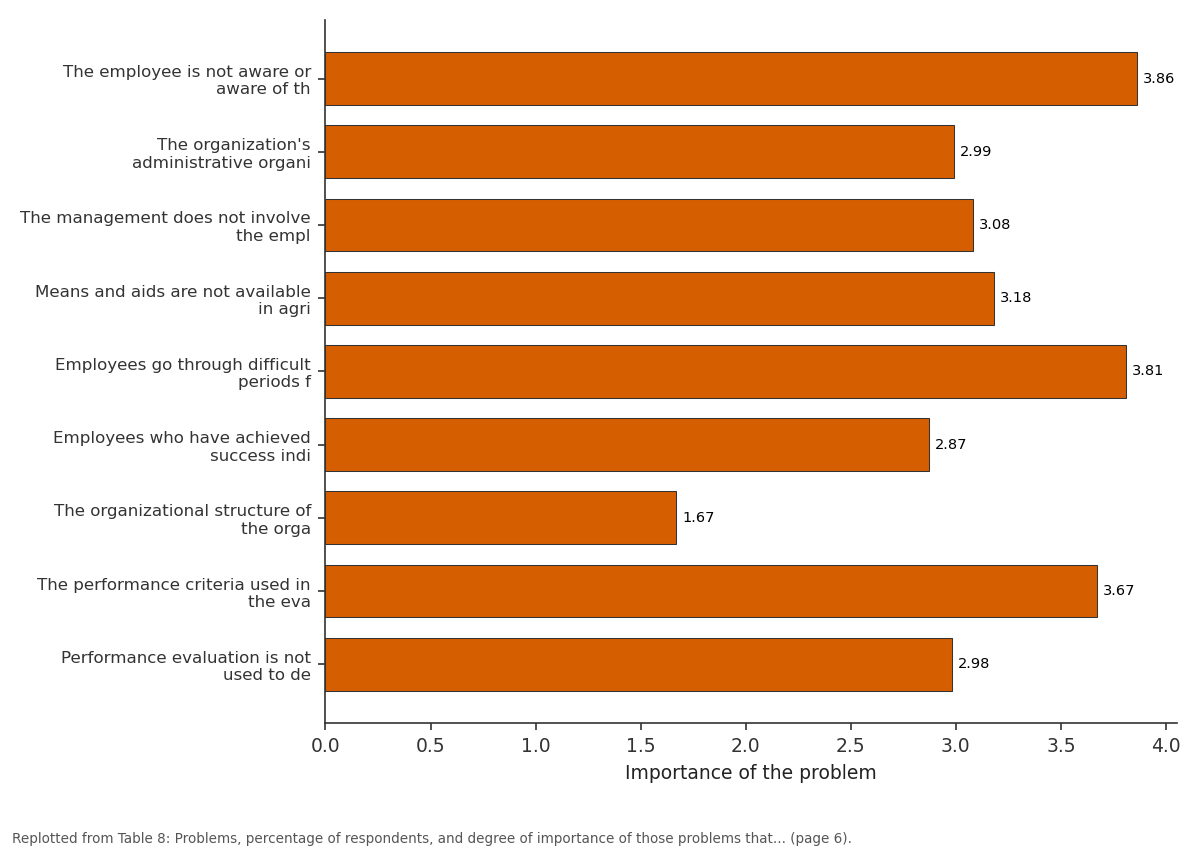
Importance of the problem: The employee is not... vs The organization's... vs The management does not... vs Means and aids are not... vs Employees go through...
Replotted from Table 8 (page 6) of the original paper. Every bar is the paper's own table value.
View source evidence ↗Figures & tables
From the original paper Table 1
 Table 2
 Table 3
 Table 4
 Table 5
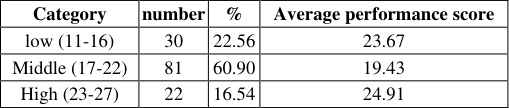 Table 6
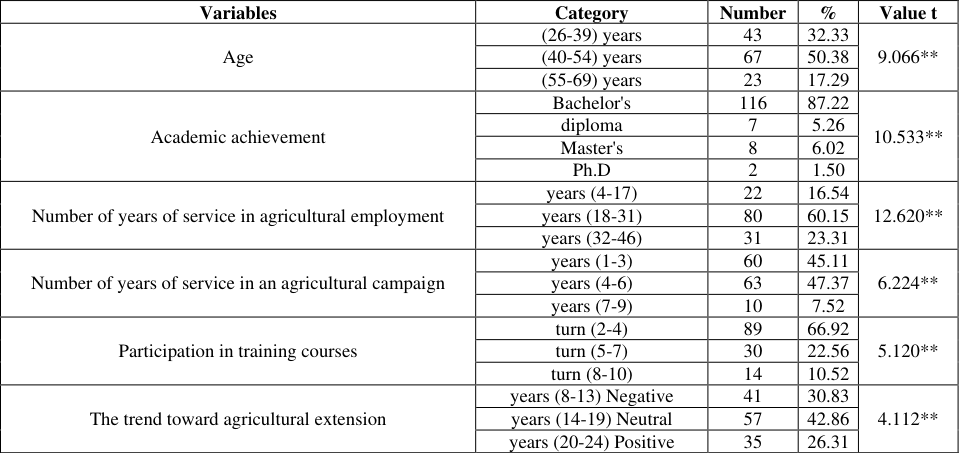 Table 7
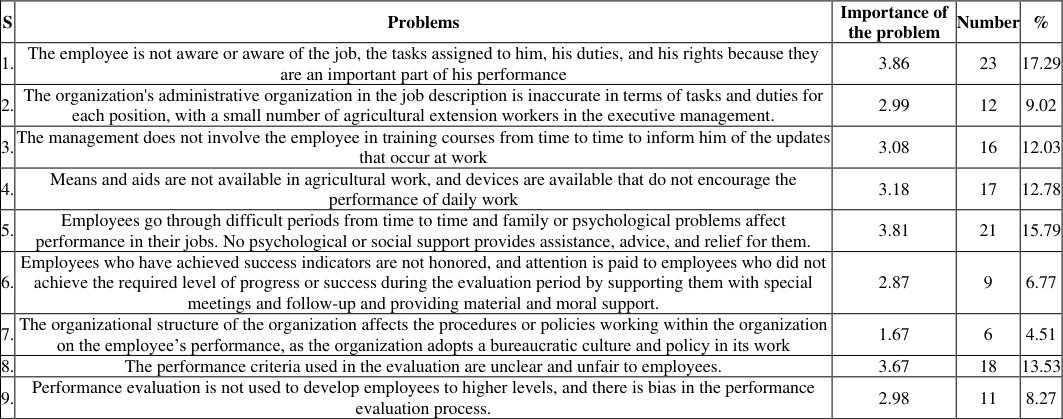 Table 8
Introduction
The current era is characterized by the dominance of organizations and their inclusion in various areas of life, especially the executive ones. Rather, they are considered the vital nerve of the people that meets their various needs, and they strive hard to achieve the goals for which they were established by raising their efficiency and effectiveness through good management and management, the success of which is proven by improving and improving the performance. The organization does not aim to raise its employees' performance level (Arvis, 2018: p. 478) [1] . Performance directly expresses the efforts of employees to achieve the goals of the organization, and the level of performance depends on the capabilities, skills, and experiences of employees that emerge from a set of requirements that include qualifications, inclinations, interests, and other factors. Outstanding performance is focused on a scientific background and practical qualification that clarifies the requirements. Work and simplifies procedures and steps, as the capabilities and previous experiences of workers contribute to supporting innovation and creativity in the performance process (Joan, 2015: p. 60) [2] . Some meanings should not be confused with each other: behavior, achievement, and performance. Behavior is the work that an individual does in the organization. Achievement is the impact or results that remain after the individual stops working. Performance is the interaction between behavior and achievement, which is the sum of behavior and results. Consequent to it, then performance is an interaction between behavior and the results resulting from it. Therefore, job performance is behavior that leads to the written goal with reasonable use of available resources by established standards, and the results resulting from this behavior are expressed in specific units of measurement, indicating the degree of completion of the tasks that make up the job within a period. Specific (Saliha, 2010: 65) [3] . Any process consists of several stages until it comes into existence, produces products, and achieves the goals designed for it. Performance is the main component of the www.extensionjournal.com process, and the living part of it because it is linked to the human being (the human element) who manages the process. Therefore, job performance is of great importance to any organization that wants success and progress. If performance is High, this is a clear indicator of the organization's success, stability, and effectiveness. The organization is more stable and lasts longer when the performance of its workers is as required, meaning that the job performance of workers in any organization is only a reflection of the capabilities and motivations of subordinates and leaders as well (Okasha, 2008: p. 34) [4] . Performance constitutes the basic axis around which all managers focus their efforts, and it represents the common denominator of the interest of management scholars, as it is considered one of the most important activities that reflect the goals and the means necessary to achieve them (Rabaya, 2003: p. 85) [5] . Organizations are keen to carry out all their various tasks with a high level of efficiency and effectiveness, and the employee who is subject to job performance evaluation represents one of the most important basic variables affecting this efficiency and effectiveness, as the effectiveness of any organization is linked to the efficiency of the influential and effective human element in the organization, as the performance evaluation process is one of The most important functions of human resources management used in the organization in general. Through the results of performance evaluation, we can judge the success of recruitment and employment policies We can also use its results to determine the training needs of employees in the organization. We can also take these results as a basis upon which to disburse material and moral rewards and make adjustments among employees. It also gives the president the organization and helps management determine the extent of the employee's suitability for his current job and the extent of his potential for success in any other job. (Abu Hatab, 2009: p. 2) [6] . The goal of improving performance can only be achieved through comprehensive studies of its elements and levels in all departments, senior, middle, and executive management, analyzing the organizational factors affecting it, and developing those factors. The philosophy of improving performance represents a general policy pursued by modern organizations, as it is necessary for continuous improvement and development of all Organizational factors, especially those that affect its employees at all administrative levels (Al-Salami, 2002: p. 147) [7] . The organization's performance has become one of the basic concepts for supervisors of organizations at all levels of the organization, because the outcomes of this performance may have harmful effects on the work, efficiency, and returns of the organization, or maybe the basis of its success and continuity, enhancing its position among organizations, and the success of its work (Hadi, 2005: p. 162) [8] . The efficiency of job performance is the employees' performance of the tasks assigned to them, and their ability to complete them, and performance reflects the manner and method of performing the work requirements and is measured by the results achieved. The study of Al-Kathiri and Mahlar (2021) [10] showed that achieving the organization's goals is when it is exposed to many external and internal influences that affect the nature of human resources management practices and its main role in the organization, as the organization cannot perform its role, which has made work in government organizations stereotypical without creativity, especially since the employee works Seriously and sincerely, it has emerged that it is necessary to pay attention and care when selecting employees in the organization according to precise standards, simultaneously training and qualifying them to the fullest extent (Alkathiri, 2021: p60) [10] . Performance is an administrative process through which the efficiency of workers is determined and the extent of their contribution to the completion of the work entrusted to them, as well as judging the behavior and actions of workers during work and the extent of the progress they make during their work. It is what the worker does after being assigned to it and it is of a specific quantity and a specific quality level. It is the result of the interaction between effort, capabilities, and role awareness (Abu Hamid, 2020) [11] . Job performance is not the goal, but rather the means to achieve the goals. To achieve those goals, most departments focus on strengthening those means to achieve the best results, through understanding and analyzing the factors affecting job performance and raising their efficiency, whether those factors are related to the physical and psychological aspects of the employees. Or linked to the style and behavior of departments (Abdul Razzaq, 2022: p. 45) [12] . Job performance has components that work to support it, and these components or factors increase the effectiveness of performance. The strategic leaders in the organization spread their ideas to the rest of the directorates of the organization and its employees with their experiences, practices, and previous experiences. A leader who trusts his employees and shares decisions with them toward achieving the organization's goals creates a positive climate among his subordinates. It motivates them to work actively and love innovation and creativity at work (Abdel Hafeez et al., 2019, p. 105) [13] . Leadership is also considered one of the most important pillars of the success of organizations and companies in general. The inspiring, motivating manager who follows the work of teams and employees, listens to them, and shares their work, concerns, and the joy of success is the manager who brings the organization together inspires employees to work in a team spirit, and is one of the examples that makes leadership a positive factor influencing behavior. Organizational is the manager's presence at work before the rest of the employees and the manager's interest in the employees' private and general problems and helping to solve them (Al-Qaryouti, 2012) [14] . The correct administrative approach is for the organization to adopt a policy of rewards and incentives for its employees, such as material or moral incentives such as thank-you cards, promotions, or compliments in front of the rest of the employees, and not to be extravagant with many incentives so that the employees do not get used to them It becomes an unimportant matter or a normal routine matter for them. (Ahmed Al-Ghamdi, 2018) [15] . The performance of guidance employees in their tasks and the advanced roles expected of them requires that they be qualified at all levels to perform guidance tasks before and during their joining guidance services. Guidance institutions must also be able to enhance employees' professional competence during their service with certain specifications and characteristics due to the payment and impact that this has. Characteristics in the www.extensionjournal.com way they respond to farmers, to their work, and to the organization to which they belong, and then to the efficiency and effectiveness of their performance of the extension tasks entrusted to them (Saleh et al., 2016: 61) [16] . As organizations expand, the methods of communication and postal correspondence expand with them. Some organizations are interested in the official communication system among their correspondence, so postal correspondence passes gradually between the chains of the administrative hierarchy and thus passes through more than one side. Therefore, the employee at the lower levels does not enjoy administrative independence in his decisions, which causes, He has some distress and resentment, due to the delay in responding to these decisions, unlike horizontal communications in large institutions that depend on the independence of each department. The human and material resources department coordinates with other departments (Al-Baiti, 2022) [17] . The success of any organization in achieving its goals depends on the efficiency of the performance of its employees in carrying out the tasks they are planning to carry out. However, one of the biggest problems that various organizations in developing countries suffer from is their lack of a detailed, accurate, and written description of the tasks of their various job positions, which is expressed in the concepts of management science through job descriptions. Agricultural extension organizations in developing countries suffer from the same problem, as they lack A clear and specific description of the jobs and qualifications of workers. Studies analyzing the role of agricultural extension workers revealed that they face many work-related problems, the most prominent of which is ambiguity in the job role (Al-Hamdallah, 2016: p. 234) [16] . The term job performance refers to all the tasks and activities that the employee does under the circumstances in which he works. It can be said that no matter how much effort, money, time, organization, planning, and evaluation he exerts, it will not achieve the desired goal unless there is an appropriate and appropriate number of capable agricultural extension workers. To carry out their scientific and practical job responsibilities prescribed for the performance of their jobs, as this is considered a contribution to achieving efficient performance of their work, and thus their contribution to achieving the goals of the extension organization, especially for agricultural extension workers (Al-Sayed, 2005: p. 78) [19] . From what was mentioned previously, it becomes clear the great importance and huge responsibility placed on the shoulders of the agricultural extension system in general and on the agricultural extension workers working in it in particular in the current and future circumstances, especially at the local levels, given that field agricultural extension workers are the effective tool for implementing and making successful agricultural extension programs that feed into the crucible of development. In the end, despite the previously mentioned importance of agricultural extension workers and their potential for the success and development of agricultural extension work as a whole, some of the problems that plague their reality have been diagnosed, and some important questions are raised in this research represent the real problem of the research, which are.
Research Methodology
This research comes within the framework of research that falls within the descriptive approach, as this approach describes what exists in the current situation and interprets it by collecting data on the level of opinions, positions, and reactions on the subject of the job performance of workers in the executive management of the agricultural extension organization (Al-Sammak, 2019: 189) [20] .
Community and its research sample
A field survey was conducted in the governorates of Baghdad, Babylon, Diyala, and Salah al-Din to assess the performance of employees working in the executive management of the agricultural extension organization. This survey focused specifically on the agricultural divisions within these governorates, as the executive management is located there. The research community comprised all agricultural employees engaged in agricultural extension. There were a total of 266 agricultural extension units, and 50% of these units were selected to participate in the research. The research sample consisted of 133 agricultural laborers, picked at random from the governorates under study. Specifically, there were 45 respondents from Baghdad Governorate, 35 respondents from Babylon Governorate, 30 respondents from Salah al-Din Governorate, and 23 respondents from Diyala Governorate.
Research method
The questionnaire had two sections. The initial section comprised the farmer's personal details, including age, educational attainment, years of professional agricultural experience, years of service in agricultural extension, participation in training courses, and the respondents' attitude towards agricultural extension. The variables were quantified in the following manner:
1. Age: measured by the number of years.
2. Academic achievement: It was measured through levels (preparatory, institute, bachelor's, higher certificate) and was given (4, 3, 2, 1) respectively. Thus, the educational scale ranged between (1 -4) grades.
Number of years of service:
measured by the number of years.
Number of years of service in agricultural extension:
measured by the number of years. 5. Participation in training courses: measured by the number of courses in which he participated. 6. Attitude towards agricultural extension: It was measured through the levels (negative, neutral, positive) and given (3, 2, 1) respectively. The attitude consists of 8 items, four negative, and the other four positive.
Measure the respondent's performance of the executive management in the agricultural extension organization, the scale consisted of the following levels (high, medium, low), and weights were given to them respectively (3, 2, 1). The scale consisted of (50) items distributed over five areas: (the decision-making process consisted of 10 items and the scale range was (10-30) scores, the communication process consisted of 11 items and the scale range was (11-33) scores, and the motivation process. It consisted of 8 items and the scale range was (8-24) scores, the leadership process consisted of 12 items, and the scale ranges were (12-36) scores and the motivation process consisted of 9 items and the scale range was (9-27) scores. Thus, the theoretical scale scores ranged from (50-150), with a hypothesized average of (75) degrees.
Data collection and analysis
The process of collecting research data was done through a questionnaire form in the form of a personal interview with the respondents in February 2024. After completing the data collection process, it was transcribed through the Excel and (SPSS) programs used to analyze and process the data statistically. After that, the data was organized into tables to be displayed. Results and their interpretation.
Results
Job performance of agricultural extension workers for the executive administration in the central governorates of Iraq.
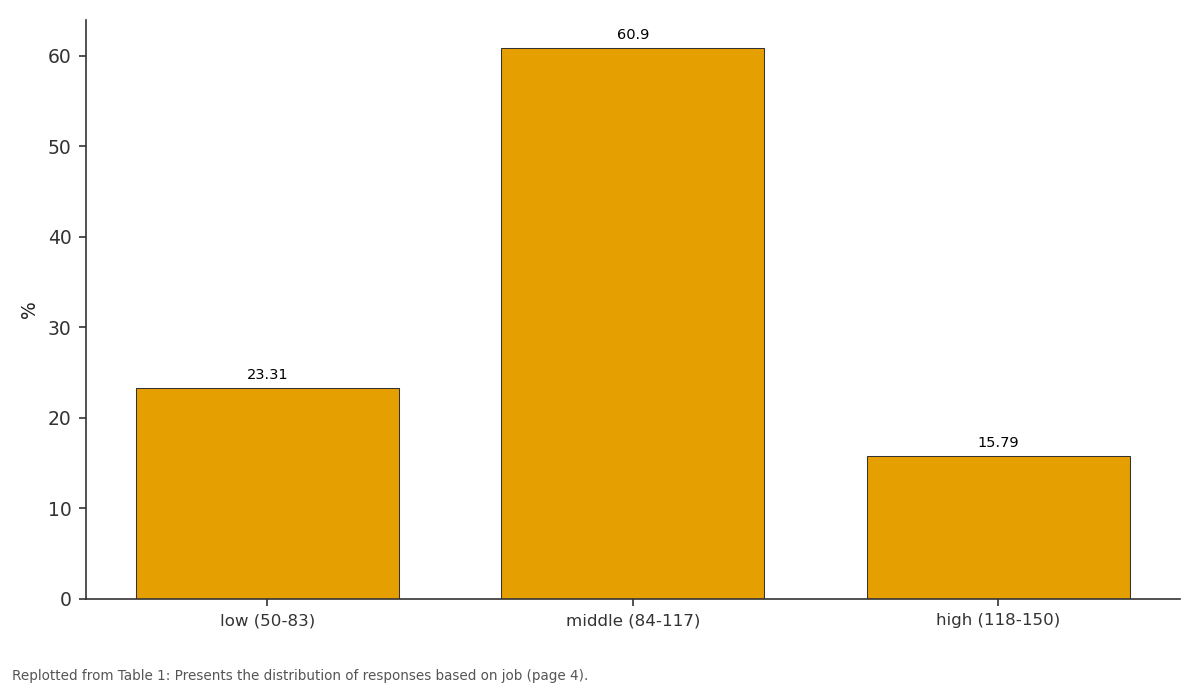
The research results showed that the general arithmetic mean for the respondents was 98.8 for the job performance of the executive management and a standard deviation of 19.82. 60.9% of the respondents were in the average category for the job performance of executive management, 23.31% were in the low category, and 15.79% were in the high category. The level of job performance was categorized into three groups according to the rule of range, as in Table 1. 1. The level of job performance of the agricultural extension workers for the executive management is described as average and tends to be weak, this is due to some reasons, including the inappropriate communication process, as well as weakness in the decision-making process, an important reason is weakness in motivation, Employees perform their daily work at the organizational level. The job performance of the agricultural extension workers for the executive management in all areas of research, as follows.
| Category | Number | % | Average performance score |
|---|---|---|---|
| low (50-83) | 31 | 23.31 | 65.6 |
| middle (84-117) | 81 | 60.90 | 99.2 |
| high (118-150) | 21 | 15.79 | 134.1 |
Table text extracted from the original PDF; superscript letters are shown inline. The original table image is below.
View original table image
The field of the decision-making process
The results of the research showed that the arithmetic mean of the respondents in the performance of the decisionmaking process was 20.91, with a standard deviation of 19.82. The percentage of 62.41% was in the medium category, the percentage of 21.80% was in the low category, and the percentage of 15.79% was in the high category, the job performance score was divided into three categories depending on the range law, as in Table 2. From Table 2. The level of job performance of the respondents in the Agricultural Extension Organization for the executive management in the field of the decisionmaking process is described as average and tends to be weak, the reason may be due to the lack of sufficient data on farmers, as well as their actual needs, administrative restrictions and delegation of powers to them, and lack of Choosing an alternative to work to solve a problem or modify a situation.
| Category | Number | % | Average performance score |
|---|---|---|---|
| low (11-17) | 29 | 21.80 | 13.81 |
| Middle(18-24) | 83 | 62.41 | 21.02 |
| high (25-30) | 21 | 15.79 | 26.79 |
Table text extracted from the original PDF; superscript letters are shown inline. The original table image is below.
View original table image
The field of communication process
The results of the research showed that the arithmetic mean of the respondents in the performance of the communication process was 21.18 degrees, with a standard deviation of 3.52. The percentage of 66.17% was in the medium category, the percentage of 21.05% was in the low category, and the percentage of 12.78% was in the high category, The work performance score was segmented into three distinct areas. Based on the principles of the range law, as in Table 3. www.extensionjournal.com From Table 3. the level of job performance of the respondents in the Agricultural Extension Organization for the executive management in the field of the communication process is described as average, tending to be weak. This is due to several reasons, which may include the lack of means of transportation and extension aids, as well as weak training in modern methods and means of calling.
| Category | Number | % | Average performance score |
|---|---|---|---|
| low (11-18) | 28 | 21.05 | 14.05 |
| Middle(19-26) | 88 | 66.17 | 21.91 |
| high (27-33) | 17 | 12.78 | 29.09 |
Table text extracted from the original PDF; superscript letters are shown inline. The original table image is below.
View original table image
The field of the Stimulation process
The results of the research showed that the arithmetic mean of the respondents in the performance of the Stimulation process was 16.46 degrees, with a standard deviation of 5.01. The percentage of 60.15% was in the medium category, the percentage of 24.81% was in the low category, and the percentage of 15.04% was in the high category. The work performance score was categorized into three distinct groups, Depending on the range law, as in Table 4. From Table 4. the level of job performance of the respondents in the agricultural extension organization for the executive management in the field of the Stimulation process is described as average, tending to be weak. This is due to several reasons, which may include the lack of material and moral rewards for workers in agricultural extension and the weakness of external drivers and influences, which management uses to stimulate achievement motivation among working individuals.
| Category | Number | % | Average performance score |
|---|---|---|---|
| low (10-14) | 33 | 24.81 | 12.01 |
| Middle(15-19) | 80 | 60.15 | 16.89 |
| High(20-28) | 20 | 15.04 | 21.78 |
Table text extracted from the original PDF; superscript letters are shown inline. The original table image is below.
View original table image
The field of leadership process
The results of the research showed that the arithmetic mean of the respondents in the performance of the driving process was 24.05 degrees, with a standard deviation of 5.01. The percentage of 55.64% was in the medium category, the percentage of 26.31% was in the low category, and the percentage of 18.05% was in the high category. The job performance score was divided into three categories. Depending on the range law, as in Table 5. From Table 5. The job performance of the responders in agricultural extension for executive management in the leadership process is characterized as average and quite weak. This can be attributed to several factors, such as the failure to delegate essential authorities and the limited degree of autonomy given to subordinates.
| Category | Number | % | Average performance score |
|---|---|---|---|
| low (14-21) | 35 | 26.31 | 17.31 |
| Middle (22-29) | 74 | 55.64 | 24.45 |
| High (30-36) | 24 | 18.05 | 32.78 |
Table text extracted from the original PDF; superscript letters are shown inline. The original table image is below.
View original table image
The field of motivation process
The results of the research showed that the arithmetic mean of the respondents in the performance of the driving process was 19.41 degrees, with a standard deviation of 3.43. The percentage of 60.90% was in the medium category, the percentage of 22.56% was in the low category, and the percentage of 16.54% was in the high category. The job performance score was divided into three categories, Depending on the range law, as in Table 6. From Table 6. That the level of job performance of respondents in agricultural extension for the executive management in the field of the motivation process is described as average, tending to be weak, this is due to several reasons, including the weakness of an internal drive for human behavior that stems from the individual's self to satisfy specific needs.
| Category | number | % | Average performance score |
|---|---|---|---|
| low (11-16) | 30 | 22.56 | 23.67 |
| Middle (17-22) | 81 | 60.90 | 19.43 |
| High (23-27) | 22 | 16.54 | 24.91 |
Table text extracted from the original PDF; superscript letters are shown inline. The original table image is below.
View original table image
The relationship between the level of job performance of workers in the agricultural extension organization for the executive management in the central governorates of Iraq and the independent variables studied.
The research results showed that the age variable of the respondents in the category (40-54) years was 50.38%, the percentage of the academic achievement variable of the respondents was (87.22%) in the bachelor's degree category, and the percentage of respondents in the variable number of years of service in agricultural employment was 58.39% in the category (18-31) years, and the percentage of 60.15% in the variable number of years of service in agricultural extension was in the category (4-6) years, and in the variable participation in training courses, the percentage of workers in the category number of courses (2-4) was 66.92%, and that The respondents' attitude towards agricultural extension variable was in the neutral category (14-19), with a score of 42.86%, as shown in Table 7. www.extensionjournal.com 7. The calculated t values were greater than the tabulated t value, this result indicates the presence of a positive significant correlation between the variables at the level of (0.01), Therefore, the hypothesis is invalidated. The null hypothesis, which posits a substantial correlation between the variables, is supported. This may be attributed to the positive nature of the personal factors, the greater the performance of the respondents in the executive management in their daily work, and this is reflected in the performance of agricultural extension workers in transmitting information at the same level better. 4-Problems of job performance of agricultural extension workers for the executive administration in the central governorates of Iraq.
| Variables | Category | Number | % | Value t |
|---|---|---|---|---|
| Age | (26-39) years | 43 | 32.33 | 9.066** |
| (40-54) years | 67 | 50.38 | ||
| (55-69) years | 23 | 17.29 | ||
| Academic achievement | Bachelor's | 116 | 87.22 | 10.533** |
| diploma | 7 | 5.26 | ||
| Master's | 8 | 6.02 | ||
| Ph.D | 2 | 1.50 | ||
| Number of years of service in agricultural employment | years (4-17) | 22 | 16.54 | 12.620** |
| years (18-31) | 80 | 60.15 | ||
| years (32-46) | 31 | 23.31 | ||
| Number of years of service in an agricultural campaign | years (1-3) | 60 | 45.11 | 6.224** |
| years (4-6) | 63 | 47.37 | ||
| years (7-9) | 10 | 7.52 | ||
| Participation in training courses | turn (2-4) | 89 | 66.92 | 5.120** |
| turn (5-7) | 30 | 22.56 | ||
| turn (8-10) | 14 | 10.52 | ||
| The trend toward agricultural extension | years (8-13) Negative | 41 | 30.83 | 4.112** |
| years (14-19) Neutral | 57 | 42.86 | ||
| years (20-24) Positive | 35 | 26.31 |
Table text extracted from the original PDF; superscript letters are shown inline. The original table image is below.
View original table image
The results of the research showed that the respondents suffer from problems when performing their daily work in agricultural extension, and 17.29% of the respondents suffer from (the employee is not aware or aware of the job, the tasks assigned to him, his duties, and his rights because they are an important part of his performance), and it had a relative importance of 3.86 degrees. In their daily work lives, as shown in Table 8. Employees who have achieved success indicators are not honored, and attention is paid to employees who did not achieve the required level of progress or success during the evaluation period by supporting them with special meetings and follow-up and providing material and moral support.
7.
The organizational structure of the organization affects the procedures or policies working within the organization on the employee's performance, as the organization adopts a bureaucratic culture and policy in its work
Recommendations
The senior management of the agricultural extension organization in Iraq must set priorities in solving the problems of the executive management, which is in contact with farmers and works to develop them by introducing them to training courses, rewarding them materially and morally, and working to stimulate their motivation and desire to work, as well as setting priorities in the organization's decision to appoint Efficient leaders to achieve the objectives of extension work and to achieve appropriate communication between senior and executive management in a way that achieves positive results for them and is also reflected in achieving the objectives of agricultural extension, as well as increasing the number of agricultural extension workers who hold higher degrees in agricultural extension specializing in working in the executive administration.
References
6 in the original paper- Abu Hamid HBS. The Impact of Material and Moral Incentives on Employees' Performance, Arab Journal for Scientific Publishing, 2020, 21.
- Jihad AA. Factors Affecting Job Performance in Public Institutions, Comprehensive Multidisciplinary Electronic Journal, 2022, 46.
- Abdel Hafeez AM, Al-Badri AQE, Al-Rafadi KM. Factors affecting the job performance of employees in the Benghazi municipal office. University of Benghazi Scientific Journal, 2019, 32(2).
- Al-Ghamdi AM. Learn about the most important factors that affect the performance of your employees. Mal newspaper; c2018. Available at: https://maaal.com/2018/09/112688-2/. 2018.
- Saleh JM, Man NB, Al-Hamdany MHS. Training Requirement of Agriculture Extension Officers in Iraq. American-Eurasian J Agric. &Environ. Sci. 2016;16(1):60.
- Al-Bayti HMA. Directing employees' administrative behavior towards creativity (Microsoft as a model). AlBayti's scientific blog. Available at: https://2u.pw/MxWue0. 2022.