
Research article · 2024 · Full text
International Journal of Research in AgronomyEvaluation of agronomical practices of weed management in garlic under organic production system
Volume 7(4) · Pages 405–409 · DOI: 10.33545/2618060x.2024.v7.i4f.581 ↗
Research areasWeed Control and Herbicide ApplicationsAgronomic Practices and Intercropping SystemsAllelopathy and phytotoxic interactions
Abstract
Author-writtenAn experiment was carried out in the field of at Kuthulia farm of JNKVV, College of agriculture, Rewa (M.P.) under all India coordinated research project on farming system during rabi season 2020-21. The garlic variety was given the experimental design was conducted in a RBD with three replications. The garlic crop was planted on 17/10/2020 at planting geometry of 20 cm x 10 cm in all treatment except in T4 (Stale seed bed + reduced spacing up to 25% + mulching with paddy straw + one hand weeding) in which row to row spacing reduced in 25%. The nutrient was applied at the rate of equivalent to 120 kg N/ha through 1/3rd N through from FYM, 1/3rd through vermicompost and 1/3rd through mustard oil cake while in T6 and additional amount of mustard oil cake 5 t/Ha was applied in garlic crop. The garlic crop was harvested was 3rd and 4th April 2021 and was fertilized with the manorial dose 120 kg N through FYM, vermicompost and mustard oil cake as given in rice. The treatment were T1 (Two hand weeding at 25 and 50 DAT), T2: (Cono weeder-25 DAT + one HW at 50 DAT), T3 Inter cropping with Dhaincha in rice and mustard in garlic in 3:1 row system), T4 (Stale seed bed + reduced spacing up to 25% + mulching with wheat straw +one hand weeding), T5 (Locally available weed mulch + 1 hand pulling), T6 (Incorporation of mustard oil cake 15 days before sowing @ 5 t/ha + 1 HW) and T7 (ITK treatment on weed control practices by farmers as mulching with leaf of mango). The same weed control treatments were given in rice and garlic and planted in the same layout and field. The both crops were grown under organic production system.
Summary
Source-checkedPlain-language reading of the full paper, prepared with AI and checked against the text. Each point links to the authors' own words.
Why it matters
- Garlic is considered a high-value crop with significant medicinal importance. View evidence ↗
- Weed competition causes higher losses in garlic cultivation compared to other cereal and horticultural crops. View evidence ↗
- In organic farming, the prohibition of chemical interventions makes non-chemical weed management a primary limitation for garlic production. View evidence ↗
The question
- The study aimed to evaluate various agronomical weed management practices for garlic grown under an organic production system. View evidence ↗
What they did
- The experiment was conducted during the 2020-21 rabi season at the Kuthulia farm of JNKVV, College of Agriculture, Rewa (M.P.). View evidence ↗
- The study used a Randomized Block Design (RBD) with three replications. View evidence ↗
- Seven treatments were tested: two hand weedings (T1), one hand weeding and one weeding (T2), intercropping with mustard (T3), stale seed bed with reduced spacing and mulching (T4), local weed mulch (T5), mustard oil cake incorporation (T6), and farmer-practiced mango leaf mulching (T7). View evidence ↗
What they found
- The highest plant population of 55 plants/m² was achieved using the stale seed bed and reduced spacing treatment (T4). View evidence ↗
- At harvest, the maximum plant height of 69.54 cm was observed in T4 (close row spacing), followed by T6 (mustard oil cake). View evidence ↗
- The highest bulb yield of 93.68 q/ha was achieved with mustard oil cake and one hand weeding (T6), which was 490.29% higher than the farmer's mulching practice. View evidence ↗
- Two hand weedings at 40 and 80 DAP (T1) resulted in a bulb yield of 66.03 q/ha, a 316.06% increase over the farmer's practice. View evidence ↗
- The maximum straw yield of 31.43 q/ha was recorded in T6, representing a 432.37% increase over the farmer's mulching practice. View evidence ↗
- The highest benefit-cost (B:C) ratio of 2.11 was found in T4, followed by T1 with a ratio of 1.82. View evidence ↗
- The highest total weed intensity of 112.94/m² occurred in T4, followed by the farmer's mulching practice (T7). View evidence ↗
What it means
- The authors conclude that incorporating mustard oil cake at 5 t/ha with one hand weeding provides the maximum garlic yield. View evidence ↗
- The authors state that two hand weedings at 25 and 50 DAT resulted in the maximum net profit of Rs 225,471/ha and a B:C ratio of 2.22. View evidence ↗
Visual summary
3 visualsIllustrations explain the paper; charts are replotted from the paper's own table values.
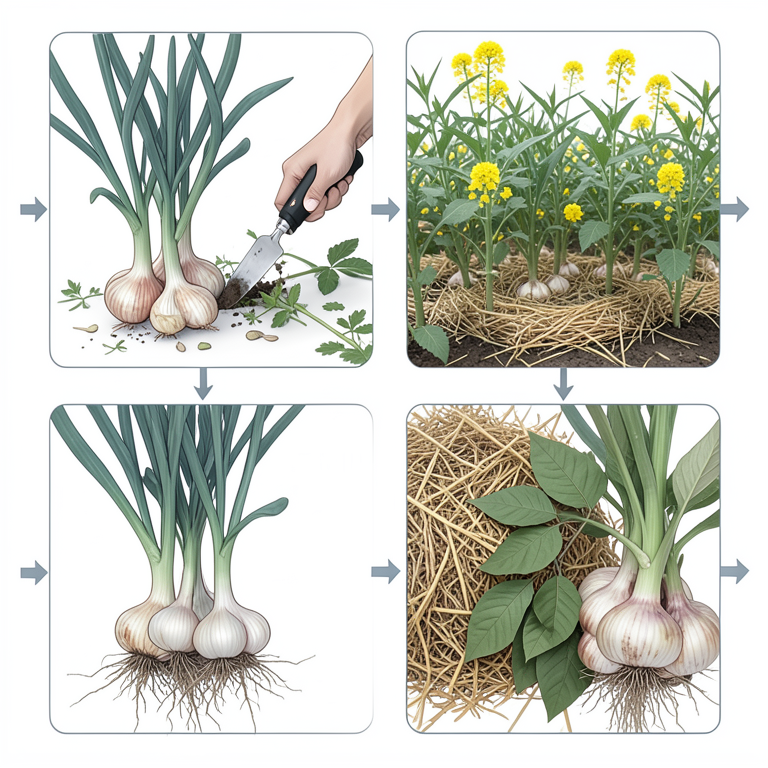
Organic Weed Management Treatments
AI-generated conceptual illustration (garlic plants in an organic field). It explains the idea and does not show study data.
View source evidence ↗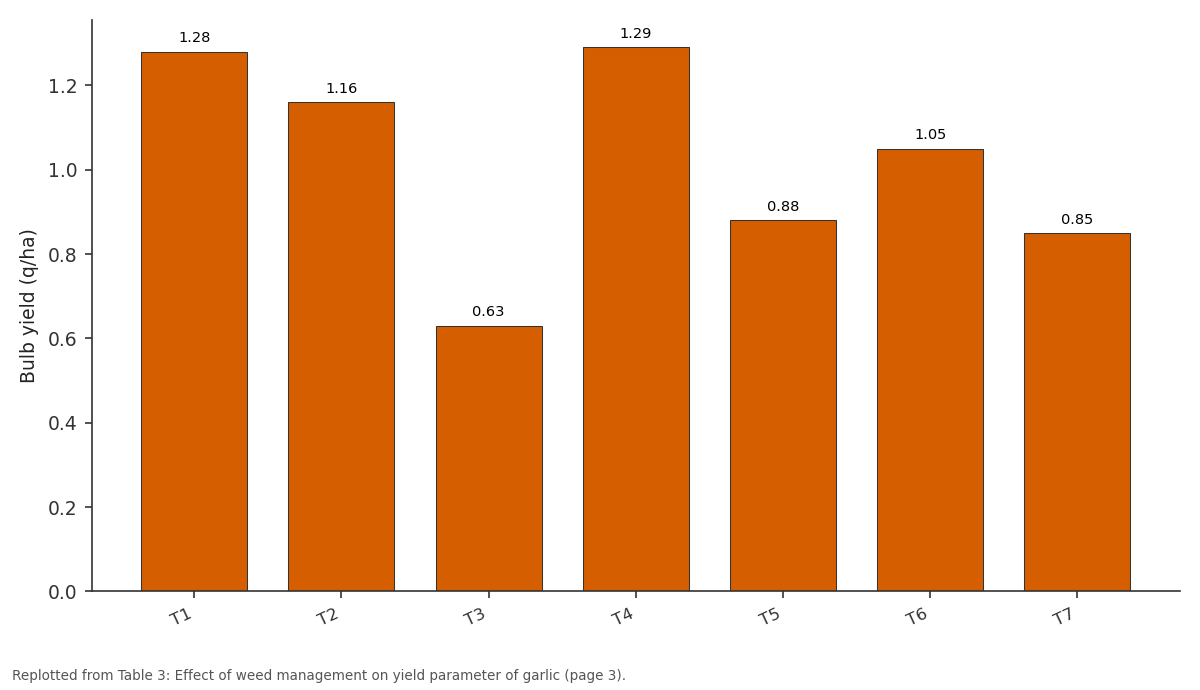
Weight of single clove (g): T1 vs T2 vs T3 vs T4 vs T5
Replotted from Table 3 (page 3) of the original paper. Every bar is the paper's own table value.
View source evidence ↗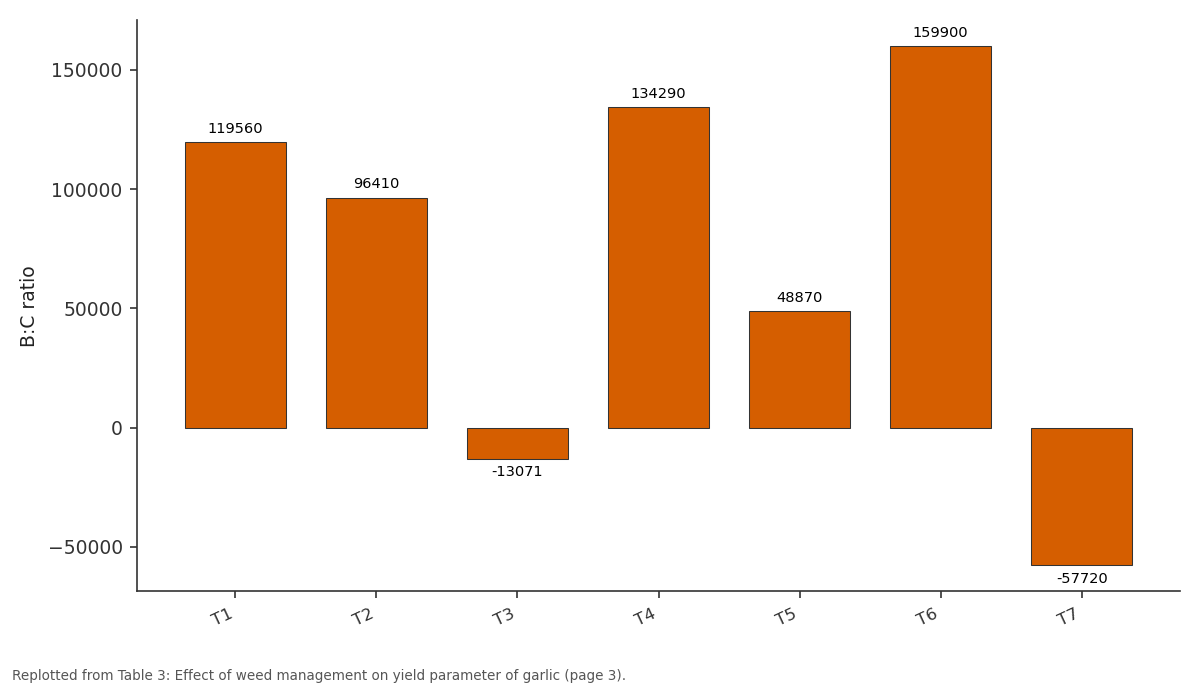
Net return (Rs/ha): T1 vs T2 vs T3 vs T4 vs T5
Replotted from Table 3 (page 3) of the original paper. Every bar is the paper's own table value.
View source evidence ↗Figures & tables
From the original paper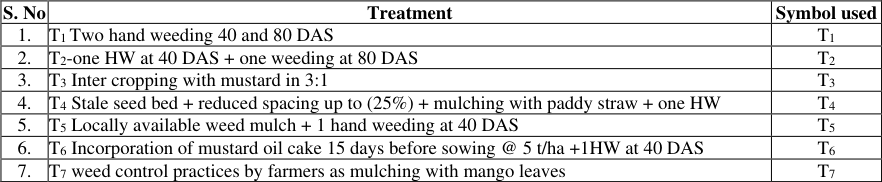 Table 1
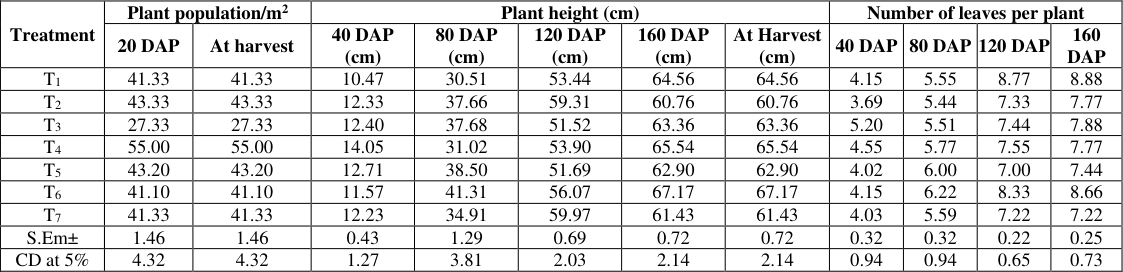 Table 2
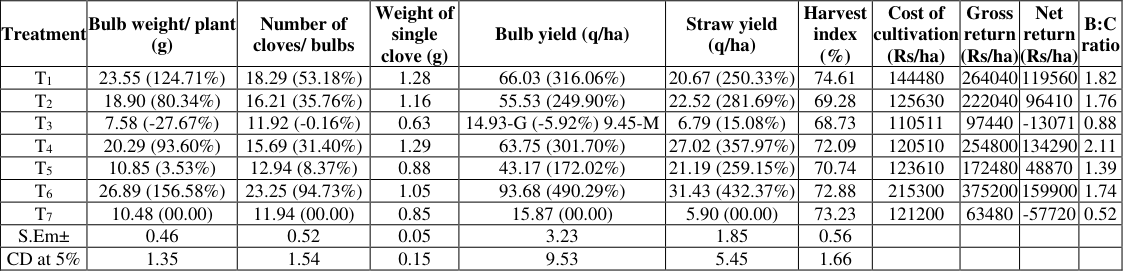 Table 3
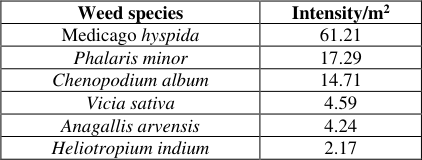 Table 3
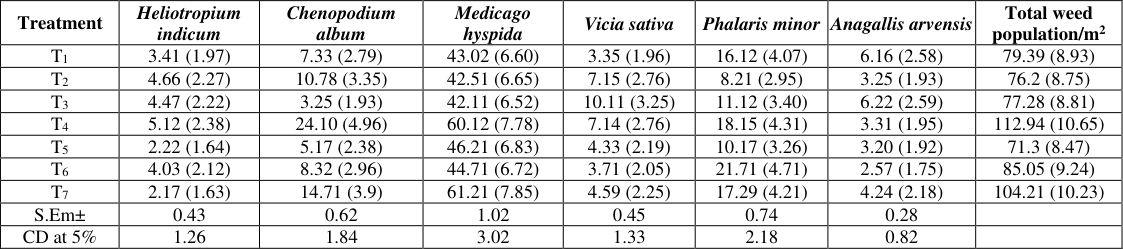 Table 4
Introduction
Garlic is an important medicinal high value crop. Garlic is a bulbous perennial herb, closely related to the onion. It is the second most widely cultivated crop in the family Alliaceae after onion (Ahmed et al., 2007) [1] . The part used medicinally is the bulb. It has one of the bestresearched herbal remedies, holds a unique position in history, traditionally employed to treat infection, colds, diabetes, heart disease, and a host of other disorders. Garlic shows anti-viral, anti-bacterial, antifungal, antioxidant, anti-atherosclerotic and anti-cancer properties. In India, the total area under garlic cultivation is 3.53 lakh ha with the production of 29.18 lakh tones and average yield is 8025 kg/ha. Rajasthan is the highest garlic producing state in India sharing 52.87% of total production of India followed by Uttar Pradesh 17.13% and Gujarat 13.72%. The area under garlic in Madhya Pradesh is 1.8 lakh ha with the total production of 18.33 lakh tonnes with the productivity of 10.15 tonnes/ha. Although the research work on different aspects of garlic cultivation has been conducted, yet weed control problems still need to be addressed. The total losses in garlic cultivation on account of high weed competition are recorded to be much more as compared to be other horticultural and cereals crop. The weeds like Medicago hyspida, Cyperus rotandus, Chenopodium album, Euphorbia hirta, Heliotropium indicum, Vicia sativa, Anagallis arvensis, Phalaris Minor and some winter grass weeds infested the garlic crop to a great extent. Weeds became most limiting factor in organic farming under irrigated condition. Some cultural practices like close row spacing, high seed rate, stale seed bed, mulching by crop residues or tree leaves, late hand weeding and hoeing are being found effective to reduce the weed problem under organic production system. Any practices aimed at enhancing competitive ability of the crop and weed can bring down the adverse effect of weeds on garlic. Seedling vigour, early growth rate, stale seed bed, higher dose of nutrient application and mulching can give competitive advantage to garlic crop. Prajapat (2019) [4] has reported that hoeing at 25 DAP and one hand weeding at 50 DAP was better than mulching and intercropping with musturd in organically grown garlic as weed control practices. However, 2 hand weeding at 25 and 50 DAP was best for weed control in organically grown garlic. Singraul et al. (2020) [5] has obtained maximum garlic yield 111.89 q/ha sunder the application of musturd oilcake 50 q/ha + one hand weeding at 50 DAP which gave114.34% higher bulb yield over farmers practices of mulching as weed control practices in garlic. Two hand weeding at 25 and 50 DAP as weed control treatment in garlic gave 72.52% higher yield over mulching with mango leaves. Use of mustard oilcake at higher level has been found beneficial as it increases the growth character of garlic which has ability to suppress the weed growth (Islam 2007 and Prajapat 2019) [3,4] . Intercropping suppress weeds better than sole cropping and thus provides an opportunity to utilize crop themselves as tools for weed management. Cultivation of garlic at narrow/close row spacing has been found effective to reduce the weed growth and increase the yield as compared to wider spaced crop. It has been reported by Bond and Grundy (2001) [2] that organic farming is gaining momentum in India owing to the concern expressed on the safety of environment, soil, water and food chain. Cultivating crops organically and at the same time maintaining higher production level is a big challenge. Since chemical intervention is not permitted for weed management, nonchemical weed management is the major limitation in garlic under organic farming. A concern about the potential increase in weed population due to non-use of herbicides is rated as serious problem in organic farming. Keeping above fact in view the present experiment has been taken with following objective.
Materials and Methods
An experiment was carried out in the field of at Kuthulia farm of JNKVV, College of agriculture, Rewa (M.P.) under all India coordinated research project on farming system during rabi season 2020-21. The soil of experimental field was silty clay loam in texture, nearly neutral in reaction (pH 6.8), low in organic carbon (0.42%) and low in available nitrogen (180.31 kg/ha) medium in available phosphorous (16.93 kg/ha) and higher in available potash (283.63kg/ha). The total rainfall was 1013 mm during the year while in rabi season only 10.16 mm rainfall was recorded. The maximum and minimum temperatures recorded during the crop season were 36.17 ºC and 5.10 °C in the month of April and February, respectively. The garlic crop was planted on 17/10/2020 at planting geometry of 20 cm x 10 cm in all treatment except in T 4 (Stale seed bed + reduced spacing up to 25% + mulching with paddy straw + one hand weeding) in which row to row spacing reduced in 25%.
Results and Discussion
The plant population of garlic was recorded at 20 DAP and at harvest stage have been given in Table - where mustard oil cake was Incorporated @ 5 t/ha along with one hand weeding followed by T 5 (Locally available weed mulch + 1 hand wedding at 40 DAP). Similar trends at 120 and 160 DAP were also noted. The rate of increase in plant height of garlic was maximum from 80 to 120 DAP and maximum increase was noted upto 160 DAP there after it become constant. Plant height at harvest was significantly maximum 69.54 cm was observed in under T 4 where close row spacing was adopted followed by T 6 where mustard oil cake @ 5 t/ha along with one hand weeding were adopted as weed control practices. In other treatment plant height varied from 61.43 cm to 63.56 cm but the differences were not found significant under different weed control practices. Data pertaining to number of leaves per plant of garlic at different stages of growth have been given where mustard oil cake 5 t/ha along with one hand weeding were giving given as weed control practices in garlic. Similar trends in number of leaves per plant of garlic was also noted at 160 days after planting. ) gave maximum bulb yield 93.68 q/ha which was significantly superior than rest of the weed control practices given in garlic under organic production system. This treatment gave 490.29% higher bulb yield than farmers practice of mulching. Two hand weeding at 40 and 80 DAP (T 1 ) gave bulb yield 66.03 q/ha which gave 316.06% higher bulb yield over farmers practice of mulching followed by stale seed bed + reduced spacing (25%) + mulching + one hand weeding gave bulb yield 63.75 q/ha. These treatments were as par but inferior than T 6 (incorporation of mustard oil cake @ 5 t/ha +1HW at 40 DAP). Intercropping of mustard with garlic gave only 14.93 q/ha bulb yield in which bulb yield was reduced by 5.92% over farmers practice but it also gave 9.45 q/ha Mustard seed yield. Straw yield of garlic was taken after separating the bulb which is given in Table -3. The straw yield varied from 5.9 q/ ha to 31.43 q/ha under different weed control practices. Straw yield 31.43 q/ha was maximum under incorporation of mustard oil cake 5 t/ha + one HW which gave 432.37% higher straw yield as compared to farmers practice of mulching. Stale seed bed + reduced spacing + mulching + 1 HW gave straw yield 27.02 q/ha which was 357.97% higher than farmers practice T 7 . One hoeing at 40 DAP + one HW at 80 DAP (T₂) gave straw yield 22.52 q/ha which was at par to two hand weeding 40 and 80 DAP but this treatments gave 250.33% to 281.69% higher straw yield than farmers practice of mulching. Harvest index of garlic under the influence of different weed Control practices under organic production system has been presented in (ITK treatment on weed control practiced by farmers as mulching with leaf of mango) and 72.83% in T 6 (incorporation of mustard oil cake @ 5 t/ha +1HW at 40 DAP). These treatments were statistically at par but superior than T 5 (locally available weed mulch + one HW at 40 DAP), T 3 (Inter cropping with mustard in 3:1) and T₂ (O ne hoeing at 40 DAP + One weeding at 80 DAP). Cost of cultivation, gross return and net return of garlic under different weed control practices in organic production system have been given in Table -3. Cost of cultivation varied from Rs 110511 to Rs 215300 per hectare under different weed control. Maximum cost of cultivation rupees 215300/ha was calculated for incorporation of mustard oil cake @ 5 t/ha + one HW giving in garlic as weed control practices. Gross return of different weed control practices applied in garlic under organic production system revealed that maximum gross return rupees 375200 / ha was noted under application of mustard oil cake @ 5 t / ha + one HW given as weed control in garlic followed by rupees 264040/ha under two HW at 40 and 80 DAP applied as weed Control practices in garlic in T 1 and rupees 254800/ha in T 4 (stale seed bed + reduced spacing 25% + mulching + one hand weeding). Lowest gross return rupees 97440 /ha was noted under intercropping of garlic with mustard in 3:1 (T 3 ). One hoeing at 40 DAP + one weeding at 80 DAP gave gross return rupees 222040 /ha which was also higher as compare to T 3 (Inter cropping with mustard in 3:1), T 5 (locally available weed mulch + 1 HW at 40 DAP) and farmers practice of mulching in T 7 .Net return of different weed control practices in applied in organically grown garlic revealed that maximum net return rupees 159900/ha was noted under incorporation of mustard Oil Cake @ 5 t/ha + one HW followed by 134290/ha in T 4 (stale seed bed + reduced spacing (25%) + mulching + one hand weeding) and rupees 119560/ha under two HW at 40 and 80 DAP (T 1 ). Other treatments gave inferior net return as compare to above treatments. Net return was negative in T 3 (Inter cropping with mustard in 3:1) and T 7 (ITK treatment on weed control practiced by farmers as mulching with leaf of mango). Benefit cost ratio of garlic under different weed control practices in organic production system has been given in Table -
Conclusion
Growth, yield attributes and yield of rice was maximum under two hand weeding at 25 and 50 DAT followed by incorporation of mustard oil cake @ 5 t/ha+1 HW. These treatments gave 57.25% to 74.35% higher grain yield of rice over farmers practice of mulching with mango leaves. Garlic yield was maximum143.76 q/ha under incorporation of mustard oil cake @ 5 t/ha+1 HW which gave 142.43% higher yield as compared to farmers practice of mulching. Two hand weeding at 25 and 50 DAP gave 109.86 q/ha bulb yield which was 85.26% higher than farmers practice of mulching with mango leaves. Fimbristylis dichotoma was most dominating weeds in rice followed by Monochoria vaginalis. Weed control efficiency 53.5% was maximum under Incorporation of mustard oil cake @ 5 t/ha+1 HW followed by 46.91% under Two hand weeding at 25 and 50 DAT. Medicago hyspida was most dominating weeds in garlic field. Weed control efficiency 55.15% was maximum in T 6 (Incorporation of mustard oil cake @ 5 t/ha+1 HW) followed by 45.87% in two hand weeding at 25 and 50 DAP. The net profit Rs 225471/ha with B:C ratio 2.22 was maximum under Two hand weeding at 25 and 50 DAT followed by Rs 168472 /ha and B:C ratio 1.53 under Incorporation of mustard oil cake @ 5 t/ha+1 HW. All other weed control practices were found inferior than above practices of weed control. Organic carbon, available nitrogen and phosphorus status were reduced under all the weed control practices in organically grown rice-garlic cropping system. Available potash status has been increased under all the weed control practices except two hand weeding at 25 and 50 DAP.
Figures and tables from the paper
| S. No | Treatment | Symbol used |
|---|---|---|
| 1. | T1 Two hand weeding 40 and 80 DAS | T1 |
| 2. | T2-one HW at 40 DAS + one weeding at 80 DAS | T2 |
| 3. | T3 Inter cropping with mustard in 3:1 | T3 |
| 4. | T4 Stale seed bed + reduced spacing up to (25%) + mulching with paddy straw + one HW | T4 |
| 5. | T5 Locally available weed mulch + 1 hand weeding at 40 DAS | T5 |
| 6. | T6 Incorporation of mustard oil cake 15 days before sowing @ 5 t/ha +1HW at 40 DAS | T6 |
| 7. | T7 weed control practices by farmers as mulching with mango leaves | T7 |
Table text extracted from the original PDF; superscript letters are shown inline. The original table image is below.
View original table image
| Treatment | Plant population/m2 | — | Plant height (cm) | — | — | — | — | Number of leaves per plant | — | — | — |
|---|---|---|---|---|---|---|---|---|---|---|---|
| 20 DAP | At harvest | 40 DAP (cm) | 80 DAP (cm) | 120 DAP (cm) | 160 DAP (cm) | At Harvest (cm) | 40 DAP | 80 DAP | 120 DAP | 160 DAP | |
| T1 | 41.33 | 41.33 | 10.47 | 30.51 | 53.44 | 64.56 | 64.56 | 4.15 | 5.55 | 8.77 | 8.88 |
| T2 | 43.33 | 43.33 | 12.33 | 37.66 | 59.31 | 60.76 | 60.76 | 3.69 | 5.44 | 7.33 | 7.77 |
| T3 | 27.33 | 27.33 | 12.40 | 37.68 | 51.52 | 63.36 | 63.36 | 5.20 | 5.51 | 7.44 | 7.88 |
| T4 | 55.00 | 55.00 | 14.05 | 31.02 | 53.90 | 65.54 | 65.54 | 4.55 | 5.77 | 7.55 | 7.77 |
| T5 | 43.20 | 43.20 | 12.71 | 38.50 | 51.69 | 62.90 | 62.90 | 4.02 | 6.00 | 7.00 | 7.44 |
| T6 | 41.10 | 41.10 | 11.57 | 41.31 | 56.07 | 67.17 | 67.17 | 4.15 | 6.22 | 8.33 | 8.66 |
| T7 | 41.33 | 41.33 | 12.23 | 34.91 | 59.97 | 61.43 | 61.43 | 4.03 | 5.59 | 7.22 | 7.22 |
| S.Em± | 1.46 | 1.46 | 0.43 | 1.29 | 0.69 | 0.72 | 0.72 | 0.32 | 0.32 | 0.22 | 0.25 |
| CD at 5% | 4.32 | 4.32 | 1.27 | 3.81 | 2.03 | 2.14 | 2.14 | 0.94 | 0.94 | 0.65 | 0.73 |
Table text extracted from the original PDF; superscript letters are shown inline. The original table image is below.
View original table image
| Treatment | Bulb weight/ plant (g) | Number of cloves/ bulbs | Weight of single clove (g) | Bulb yield (q/ha) | Straw yield (q/ha) | Harvest index (%) | Cost of cultivation (Rs/ha) | Gross return (Rs/ha) | Net return (Rs/ha) | B:C ratio |
|---|---|---|---|---|---|---|---|---|---|---|
| T1 | 23.55 (124.71%) | 18.29 (53.18%) | 1.28 | 66.03 (316.06%) | 20.67 (250.33%) | 74.61 | 144480 | 264040 | 119560 | 1.82 |
| T2 | 18.90 (80.34%) | 16.21 (35.76%) | 1.16 | 55.53 (249.90%) | 22.52 (281.69%) | 69.28 | 125630 | 222040 | 96410 | 1.76 |
| T3 | 7.58 (-27.67%) | 11.92 (-0.16%) | 0.63 | 14.93-G (-5.92%) 9.45-M | 6.79 (15.08%) | 68.73 | 110511 | 97440 | -13071 | 0.88 |
| T4 | 20.29 (93.60%) | 15.69 (31.40%) | 1.29 | 63.75 (301.70%) | 27.02 (357.97%) | 72.09 | 120510 | 254800 | 134290 | 2.11 |
| T5 | 10.85 (3.53%) | 12.94 (8.37%) | 0.88 | 43.17 (172.02%) | 21.19 (259.15%) | 70.74 | 123610 | 172480 | 48870 | 1.39 |
| T6 | 26.89 (156.58%) | 23.25 (94.73%) | 1.05 | 93.68 (490.29%) | 31.43 (432.37%) | 72.88 | 215300 | 375200 | 159900 | 1.74 |
| T7 | 10.48 (00.00) | 11.94 (00.00) | 0.85 | 15.87 (00.00) | 5.90 (00.00) | 73.23 | 121200 | 63480 | -57720 | 0.52 |
| S.Em± | 0.46 | 0.52 | 0.05 | 3.23 | 1.85 | 0.56 | ||||
| CD at 5% | 1.35 | 1.54 | 0.15 | 9.53 | 5.45 | 1.66 |
Table text extracted from the original PDF; superscript letters are shown inline. The original table image is below.
View original table image
| Weed species | Intensity/m2 |
|---|---|
| Medicago hyspida | 61.21 |
| Phalaris minor | 17.29 |
| Chenopodium album | 14.71 |
| Vicia sativa | 4.59 |
| Anagallis arvensis | 4.24 |
| Heliotropium indium | 2.17 |
Table text extracted from the original PDF; superscript letters are shown inline. The original table image is below.
View original table image
| Treatment | Heliotropium indicum | Chenopodium album | Medicago hyspida | Vicia sativa | Phalaris minor | Anagallis arvensis | Total weed population/m2 |
|---|---|---|---|---|---|---|---|
| T1 | 3.41 (1.97) | 7.33 (2.79) | 43.02 (6.60) | 3.35 (1.96) | 16.12 (4.07) | 6.16 (2.58) | 79.39 (8.93) |
| T2 | 4.66 (2.27) | 10.78 (3.35) | 42.51 (6.65) | 7.15 (2.76) | 8.21 (2.95) | 3.25 (1.93) | 76.2 (8.75) |
| T3 | 4.47 (2.22) | 3.25 (1.93) | 42.11 (6.52) | 10.11 (3.25) | 11.12 (3.40) | 6.22 (2.59) | 77.28 (8.81) |
| T4 | 5.12 (2.38) | 24.10 (4.96) | 60.12 (7.78) | 7.14 (2.76) | 18.15 (4.31) | 3.31 (1.95) | 112.94 (10.65) |
| T5 | 2.22 (1.64) | 5.17 (2.38) | 46.21 (6.83) | 4.33 (2.19) | 10.17 (3.26) | 3.20 (1.92) | 71.3 (8.47) |
| T6 | 4.03 (2.12) | 8.32 (2.96) | 44.71 (6.72) | 3.71 (2.05) | 21.71 (4.71) | 2.57 (1.75) | 85.05 (9.24) |
| T7 | 2.17 (1.63) | 14.71 (3.9) | 61.21 (7.85) | 4.59 (2.25) | 17.29 (4.21) | 4.24 (2.18) | 104.21 (10.23) |
| S.Em± | 0.43 | 0.62 | 1.02 | 0.45 | 0.74 | 0.28 | |
| CD at 5% | 1.26 | 1.84 | 3.02 | 1.33 | 2.18 | 0.82 |
Table text extracted from the original PDF; superscript letters are shown inline. The original table image is below.
View original table image
References
5 in the original paper- Ahmed HG, Magaji AI, Yakutu LA, Singh A. Response of garlic (Allium sativum L.) to irrigation interval and clove size in semi-arid, Nigeria. J Plant Sci. 2007;2:202-208.
- Bond W, Grundy AC. Non-Chemical Weed Management in Organic Farming Systems. Weed Res. 2001;41:383-405.
- Islam MM, Anwar MP, Rahman MM, Islam AKMM. Influence of mustard oil cake on the performance of fine rice CV. Chinigara. Int J Bio Res. 2007;3(6):50-54.
- Prajapat R. Weed management studies in rice-garlic cropping sequence under organic production system. MSc (Ag) Thesis submitted to JNKVV, Jabalpur. 2019.
- Singraul A, Mourya BM, Kurmvanshi SM, Pradhan YK. Weed management in rice-garlic under organic production system. Int J Curr Microbial Appl Sci. 2020;9(11):14431449.