
Research article · 2024 · Full text
International Journal of Agriculture Extension and Social DevelopmentUnveiling the agricultural system's water pollution perils: A study in Thrissur and Palakkad districts of Kerala, India
Volume 7(4) · Pages 374–376 · DOI: 10.33545/26180723.2024.v7.i4e.549 ↗
Research areasAgricultural Economics and PracticesWater resources management and optimizationSocial and Economic Development in India
Abstract
Author-writtenWater pollution has emerged as a formidable challenge with far-reaching implications for agricultural systems, causing disruptions to crop productivity, ecosystem equilibrium, and overall human welfare. This paper presents an analysis of water pollution confronting agricultural environments within six distinct panchayats from Thrissur and Palakkad districts of Kerala using a Water Pollution Index. By eliciting insights directly from farmers, this study seeks to quantify the extent of water pollution's impact on diverse agricultural systems. The statistical tools used are, survey method to collect relevant data to the farmers and a Water Pollution Index to find the different dimensions of water pollution. This index synthesized information from nine carefully curated statements and, each statement encapsulated various facets of water pollution's influence on agricultural systems. The data collection process was conducted by purposively selecting 180 farmers practicing rice farming, banana cultivation, and vegetable production, i.e., 30 farmers from each panchayat. The respondents were selected using Purposive Sampling Method. The farmers were initially given information and also asked about their opinion about the ill-effects of excessive chemical fertilizers, waste dumping and industrial effluents on the water bodies and their repercussions on the environment, which they were already aware of. The observed variations in pollution levels bear significant implications for the pursuit of sustainable agricultural practices and the broader imperative of environmental conservation. By delving into the inter-woven relationships between water pollution and agricultural productivity, the study underscores the urgency of adopting strategic interventions to mitigate and manage the ill effects of water pollution. The findings revealed distinct patterns of water pollution in the agricultural systems of the six Panchayats. Puzhakkal showed a high level of water pollution (index = 70.81), Alathur and Nadathara exhibited a moderate level of water pollution (index = 66.37 and 61.93, respectively), Puthur and Madakkathara demonstrated moderate pollution (index = 63.11 and 64.15, respectively), while Pananchery reported the lowest pollution level (index = 60) among the studied Panchayats. The identification of specific pollution patterns within different Panchayats helps in tailoring targeted interventions, and promoting eco-friendly practices that synergistically address the complex interplay between agricultural activities and water quality.
Summary
Source-checkedPlain-language reading of the full paper, prepared with AI and checked against the text. Each point links to the authors' own words.
Why it matters
- Water pollution is a major challenge that disrupts human welfare, ecosystem balance, and the productivity of crops. View evidence ↗
- Pollutants in water bodies typically come from urban runoff, industrial operations, agricultural practices, and sewage discharges. View evidence ↗
- Agricultural water pollution is caused by contaminants like animal waste runoff and the excessive use of chemical fertilizers and pesticides, which harm ecological balance. View evidence ↗
The question
- The study aims to analyze water pollution in agricultural environments across six panchayats in the Palakkad and Thrissur districts of Kerala using a Water Pollution Index. View evidence ↗
- The researchers sought to quantify how water pollution impacts various agricultural systems by gathering direct insights from farmers. View evidence ↗
What they did
- The study used purposive sampling to select 180 farmers (30 per panchayat) involved in vegetable production, banana cultivation, and rice farming. View evidence ↗
What they found
- Puzhakkal was found to have a 'High' level of water pollution with a composite index value of 70.81. View evidence ↗
- Alathur (66.37), Madakkathara (64.15), Puthur (63.11), and Nadathara (61.93) were all classified as having 'Moderate' levels of water pollution. View evidence ↗
- Pananchery reported the lowest pollution level among the studied areas, with a 'Low' classification and an index value of 60. View evidence ↗
- Significant sources of moderate pollution in Nadathara (61.93) and Alathur (66.37) included the use of detergents and the bathing of animals and humans. View evidence ↗
What it means
- The authors conclude that mitigating agricultural water pollution requires a multifaceted approach including efficient water resource management, improved waste management, industrial wastewater treatment, and sustainable practices like reusing agricultural wastes. View evidence ↗
- The authors recommend that stakeholders and policy-makers collaborate on pollution control strategies to protect ecological health and agricultural productivity. View evidence ↗
Visual summary
2 visualsIllustrations explain the paper; charts are replotted from the paper's own table values.
Pollution Distribution Map Concept
AI-generated conceptual illustration (Agricultural landscapes and water bodies in Kerala, India). It explains the idea and does not show study data.
View source evidence ↗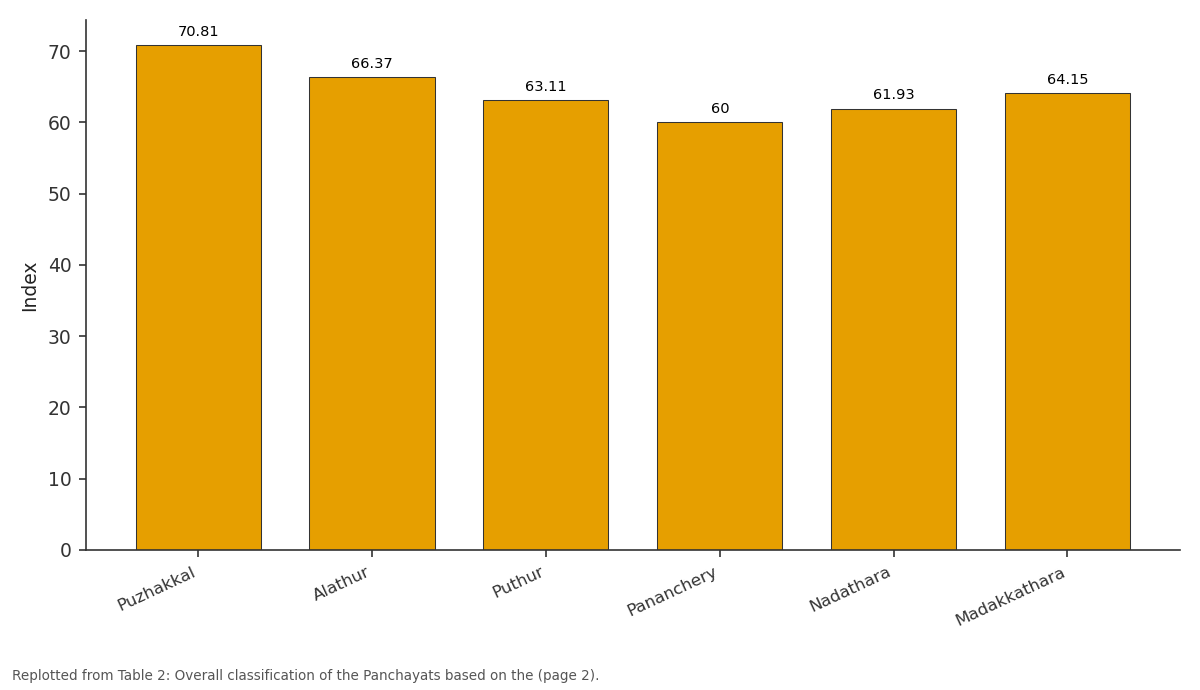
Index: Puzhakkal vs Alathur vs Puthur vs Pananchery vs Nadathara
Replotted from Table 2 (page 2) of the original paper. Every bar is the paper's own table value.
View source evidence ↗Figures & tables
From the original paper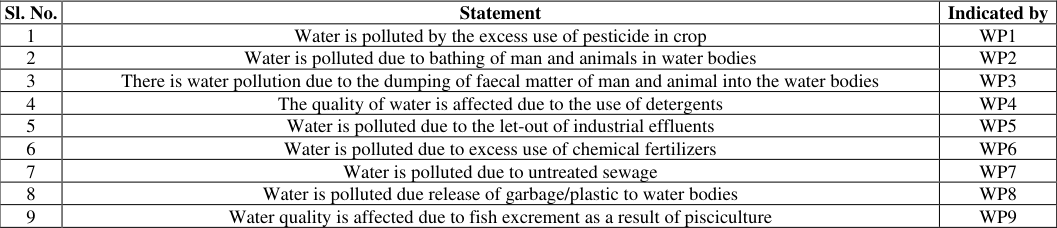 Table 1
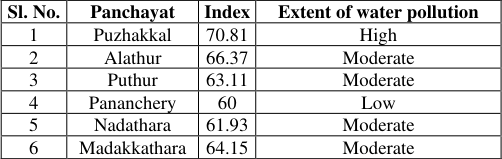 Table 2
Introduction
Water pollution, also known as aquatic pollution, is the contamination of water bodies, which is primarily caused by human activities and has detrimental effects on its various uses. (Marcos, 2007) [8] . The pollutants usually originate from sewage discharges, industrial operations, agricultural practices, and urban runoff, including storm water (Eckenfelder, 2000) [3] . Water pollution can be categorized as either surface water pollution or groundwater pollution. It gives rise to numerous issues such as the degradation of aquatic ecosystems and the spread of water-borne diseases when people consume or use polluted water for drinking or irrigation purposes. Additionally, water pollution hampers the ecosystem services that the water resource would naturally provide, such as being a source of drinking water (Moss, 2008) [6] . There are two main sources of water pollution: point sources and non-point sources. Point sources have identifiable causes, such as specific discharge points like storm drains, wastewater treatment plants, or oil spills. Non-point sources are more diffuse, like agricultural runoff, making it challenging to trace back to a single origin. The pollution accumulates over time due to both types of sources, resulting in toxic substances like oil, metals, plastics, pesticides, and industrial waste products, as well as stressful conditions such as changes in pH, oxygen levels (hypoxia or anoxia), temperature fluctuations, excessive turbidity, and salinity variations. Additionally, water pollution can be caused by the introduction of pathogenic organisms (Moss, 2008) [6] . Water pollution in agriculture occurs when contaminants from agricultural activities find their way into water bodies, compromising their quality and ecological balance. These contaminants stem from a myriad of sources, including excessive use of pesticides, chemical fertilizers, and animal waste runoff. Improper waste disposal, industrial effluents, and untreated sewage further exacerbate the problem (Liu et. al., 2021) [5] . In this paper, we assess the relationship between water pollution and agriculture, analyzing the extent faced by different agricultural systems in 6 panchayats viz., Puzhakkal, Nadathara, Puthur, Pananchery and Madakkathara of Thrissur district and Alathur panchayat of Palakkad district. We aim to shed light on the importance of www.extensionjournal.com mitigating water pollution in agriculture to foster resilient and thriving agricultural practices that coexist harmoniously with the natural environment.
Materials and Methods
Materials and Methods
Sample and study area
The study was conducted in Kerala, India, with a particular focus on two districts, Thrissur and Palakkad, due to their significant contribution to agriculture in the state. These districts were purposively chosen to gain insights into the agricultural practices and challenges associated with these crops in the region. The panchayats selected randomly for the study were Puzhakkal, falling under the special rice production system of lands in Thrissur district, Alathur, a major rice-growing panchayat in Palakkad district, two banana-growing panchayats, Puthur and Pananchery. In order to gather relevant data, a cross-sectional survey was utilized, focusing on farmers residing in the six chosen panchayats. The survey was conducted using an interview schedule consisting of nine statements that pertained to water pollution, and the participating farmers were asked to rank each statement on a five point continuum, indicating the severity or prevalence of water pollution in their respective areas. Using the responses collected, a composite index was developed, enabling the researchers to assess the extent of water pollution in each of the selected panchayats the formula for which is given below; Index of each statement = Total score of the statement X 100
Maximum possible score of the statement To gain meaningful insights from the collected data, Water Pollution Index was used. By analyzing the data, variations in the levels of water pollution across the different panchayats was identified. This process also helped to compare the pollution situations in these areas, shedding light on potential hotspots or areas with relatively better water quality. Water is polluted due to bathing of man and animals in water bodies WP2 3
Results and Discussion
There is water pollution due to the dumping of faecal matter of man and animal into the water bodies WP3 4
The quality of water is affected due to the use of detergents WP4 5
Water is polluted due to the let-out of industrial effluents WP5 6
Water is polluted due to excess use of chemical fertilizers WP6 7
Water is polluted due to untreated sewage WP7 8
Water is polluted due release of garbage/plastic to water bodies WP8 9
Water quality is affected due to fish excrement as a result of pisciculture WP9 [4] . Addressing water pollution in agriculture demands a multifaceted approach that combines sustainable agricultural practices like use of soil conditioners and reuse of agricultural wastes, along with industrial treatment of waste water, improved waste management, and efficient water resource management (Alotaibi and Kassem, 2020) [2] . [7] .
Figures and tables from the paper
| Sl. No. | Statement | Indicated by |
|---|---|---|
| 1 | Water is polluted by the excess use of pesticide in crop | WP1 |
| 2 | Water is polluted due to bathing of man and animals in water bodies | WP2 |
| 3 | There is water pollution due to the dumping of faecal matter of man and animal into the water bodies | WP3 |
| 4 | The quality of water is affected due to the use of detergents | WP4 |
| 5 | Water is polluted due to the let-out of industrial effluents | WP5 |
| 6 | Water is polluted due to excess use of chemical fertilizers | WP6 |
| 7 | Water is polluted due to untreated sewage | WP7 |
| 8 | Water is polluted due release of garbage/plastic to water bodies | WP8 |
| 9 | Water quality is affected due to fish excrement as a result of pisciculture | WP9 |
Table text extracted from the original PDF; superscript letters are shown inline. The original table image is below.
View original table image
| Sl. No. | Panchayat | Index | Extent of water pollution |
|---|---|---|---|
| 1 | Puzhakkal | 70.81 | High |
| 2 | Alathur | 66.37 | Moderate |
| 3 | Puthur | 63.11 | Moderate |
| 4 | Pananchery | 60 | Low |
| 5 | Nadathara | 61.93 | Moderate |
| 6 | Madakkathara | 64.15 | Moderate |
Table text extracted from the original PDF; superscript letters are shown inline. The original table image is below.
View original table image
References
6 in the original paper- Abubakar BZ, Ango AK, Buhari U. The roles of mass media in disseminating agricultural information to farmers in Birnin Kebbi local government area of Kebbi state: A case study of state Fadama II development project. J Agric Extn. 2009;13(2):42-54.
- Alotaibi BA, Kassem HS, Abdullah AZ, Alyafrsi MA. Farmers' awareness of agri-environmental legislation in Saudi Arabia. Land Use Policy. 2020;99(1):104902.
- Jayaswal K, Sahu V, Gurjar BR. Water pollution, human health and remediation. In: Water Remediation. 2018;1(1):11-27.
- Liu Y, Wang P, Gojenko B, Yu J, Wei L, Luo D, Xiao T. A review of water pollution arising from agriculture and mining activities in Central Asia: Facts, causes and effects. Environ Pollut. 2021;291:118209.
- Moss B. Water pollution by agriculture. Philos Trans R Soc. B Biol. Sc. 2008;363(1491):659-666.
- Surya B, Syafri S, Sahban H, Sakti HH. Natural resource conservation based on community economic empowerment: Perspectives on watershed management and slum settlements in Makassar City, South Sulawesi, Indonesia. Land. 2020;9(4):104.