
Research article · 2024 · Full text
International Journal of Agriculture Extension and Social DevelopmentConstraints and suggestions analysis of production and marketing of cauliflower crop in Jammu region of J&K (UT)
Volume 7(4) · Pages 362–365 · DOI: 10.33545/26180723.2024.v7.i4e.547 ↗
Research areasAgricultural Economics and Practices
Abstract
Author-writtenBackground: Cauliflower cultivation in India is greatly influenced by a diverse range of climatic conditions, enabling its growth year-round from temperate regions to humid tropics. India holds the position as the second-largest producer and a significant exporter of cauliflower globally, trailing behind China. Successful cauliflower cultivation necessitates meticulous management and adherence to proper cultivation practices, demanding considerable inputs and resources to achieve high yields and productivity. This endeavor not only aims at securing higher income within a short timeframe but also provides substantial employment opportunities through intensive cultivation. However, despite the efforts invested, farmers often encounter challenges. They struggle to obtain satisfactory prices for their produce and face significant expenses throughout the cultivation and production process. Moreover, the inherent risks associated with fluctuating climatic patterns and evolving market conditions exacerbate the economic strain, creating uncertainty regarding the farmers' ability to attain reasonable incomes. To address these issues comprehensively, this study endeavors to identify the specific challenges confronted by cauliflower cultivators in their agricultural practices and aims to solicit valuable suggestions from experienced cauliflower growers. Methods: The study was conducted in the Jammu district of the Jammu region, Jammu and Kashmir (Union Territory) in 2020-2021, utilizing a descriptive study design. The present study employed a multistage sampling methodology, included a total of 160 cauliflower growers as the sample. A semi-structured interview schedule was designed to collect data from sampled respondents which was further analyzed. Results: The findings reveal that a significant number of respondents perceive the low price of cauliflower during the harvesting season (98%) and the substantial investment required for cauliflower cultivation compared to other crops (87%) as the primary constraints in the study area, ranking them as 1st and 2nd constraint, respectively. Furthermore, the key suggestions provided by cauliflower growers include the need for assured market facilities (ranked 1st) and awareness about various information and communication technology (ICT) tools for obtaining reliable market information (ranked 2nd).
Summary
Source-checkedPlain-language reading of the full paper, prepared with AI and checked against the text. Each point links to the authors' own words.
Why it matters
- Cauliflower is a significant cruciferous vegetable in India, valued for its nutritional content, including proteins, minerals, and various vitamins. View evidence ↗
- The Jammu and Kashmir region is a productive area for cauliflower, achieving a productivity of 31.02 tons per hectare from 3.40 thousand hectares. View evidence ↗
The question
- The study aimed to identify the obstacles hindering cauliflower cultivation practices and collect suggestions to promote the crop's adoption in the Jammu region. View evidence ↗
What they did
- The study used a random sample of 160 cauliflower growers, each cultivating at least 0.05 hectares. View evidence ↗
- A descriptive study design and a multistage sampling methodology were employed to select participants. View evidence ↗
- Data was collected using a pre-tested interview schedule containing both open and closed-ended questions. View evidence ↗
What they found
- The most significant constraint reported by 98% of respondents (157 farmers) was the low price of cauliflower during the harvesting season. View evidence ↗
- The second most prominent constraint was the high investment required for cauliflower cultivation compared to other crops, cited by 87% of respondents. View evidence ↗
- A lack of knowledge regarding available fungicides was the third highest constraint, affecting 75% of the sampled growers. View evidence ↗
- Insufficient storage facilities were ranked as the fourth major constraint by 63% of the respondents. View evidence ↗
- The top suggestion from growers to improve the sector was the provision of assured market facilities, supported by 98% of respondents. View evidence ↗
- Providing high-yielding hybrid seeds through the agriculture department was the second most requested improvement, endorsed by 94% of growers. View evidence ↗
- Making bio-fertilizers accessible in local markets was the third highest suggestion, supported by 81% of respondents. View evidence ↗
- Increasing awareness of ICT tools for reliable market information was ranked as the fifth most important suggestion by 62% of growers. View evidence ↗
What it means
- The authors conclude that comprehensive support, infrastructure development, and awareness programs are essential to improve the sustainability and profitability of cauliflower farming in the region. View evidence ↗
Visual summary
3 visualsIllustrations explain the paper; charts are replotted from the paper's own table values.
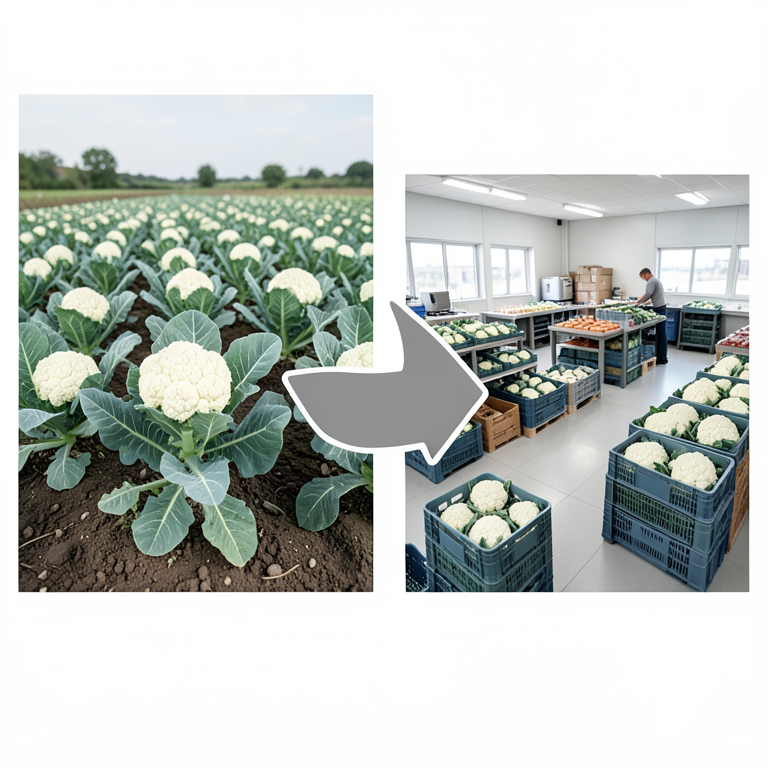
Market Cycle Gap
AI-generated conceptual illustration (cauliflower plants and a wholesale vegetable market). It explains the idea and does not show study data.
View source evidence ↗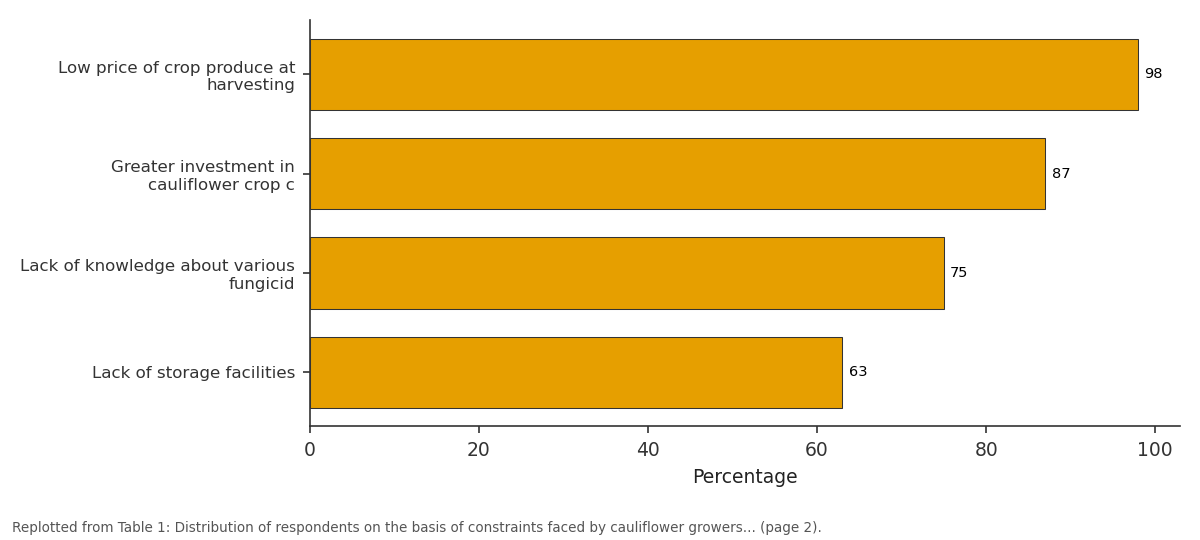
Percentage: Low price of crop... vs Greater investment in... vs Lack of knowledge about... vs Lack of storage...
Replotted from Table 1 (page 2) of the original paper. Every bar is the paper's own table value.
View source evidence ↗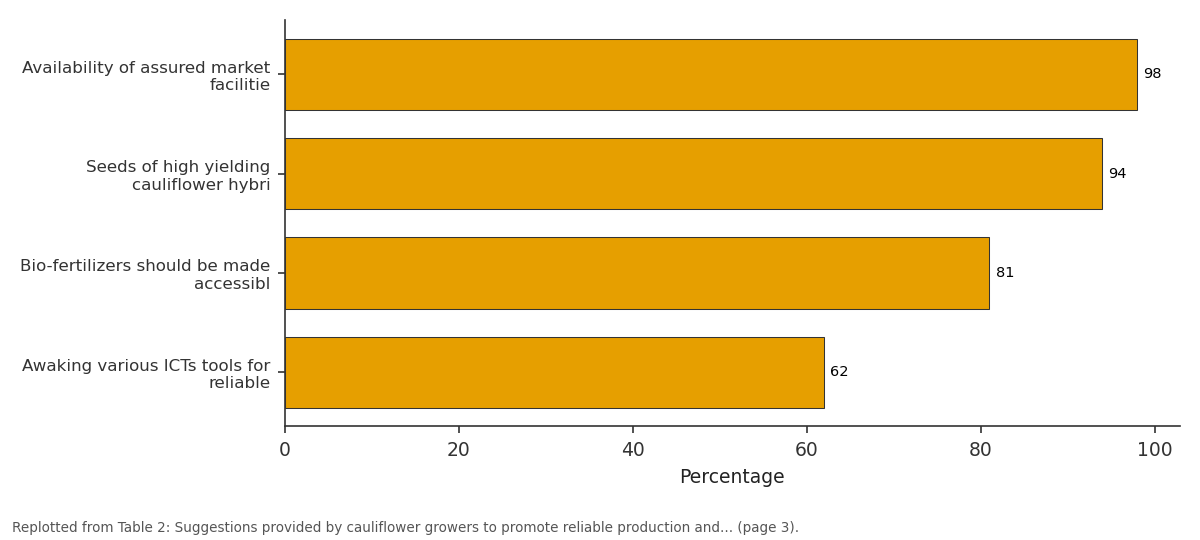
Percentage: Availability of assured... vs Seeds of high yielding... vs Bio-fertilizers should... vs Awaking various ICTs...
Replotted from Table 2 (page 3) of the original paper. Every bar is the paper's own table value.
View source evidence ↗Figures & tables
From the original paper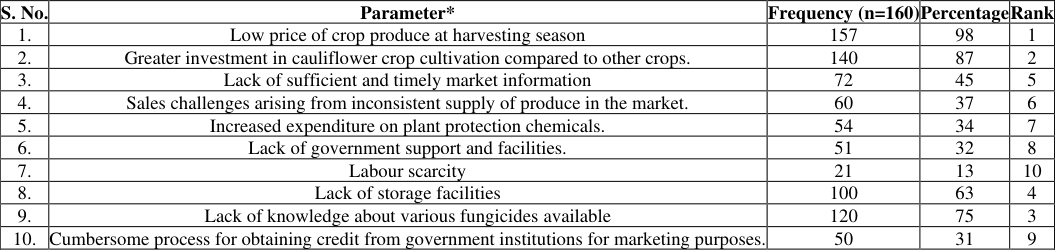 Table 1
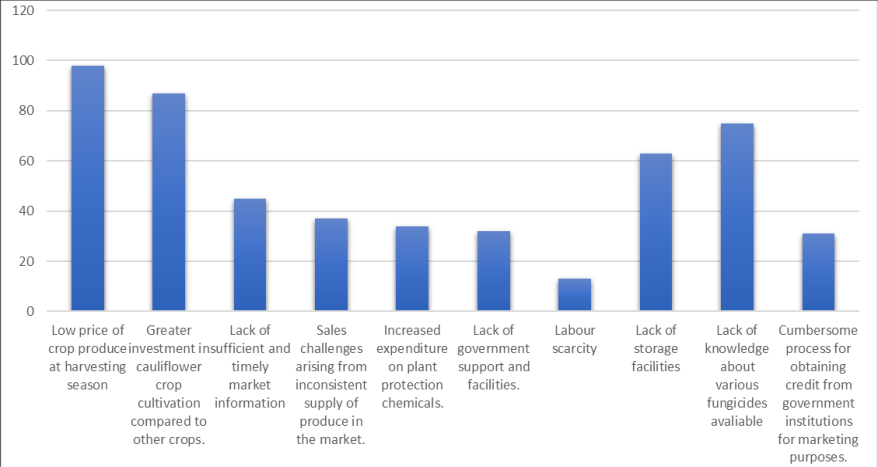 Figure 1
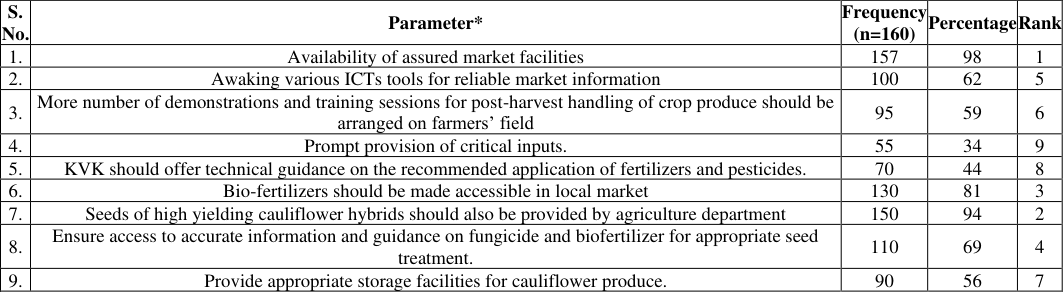 Table 2
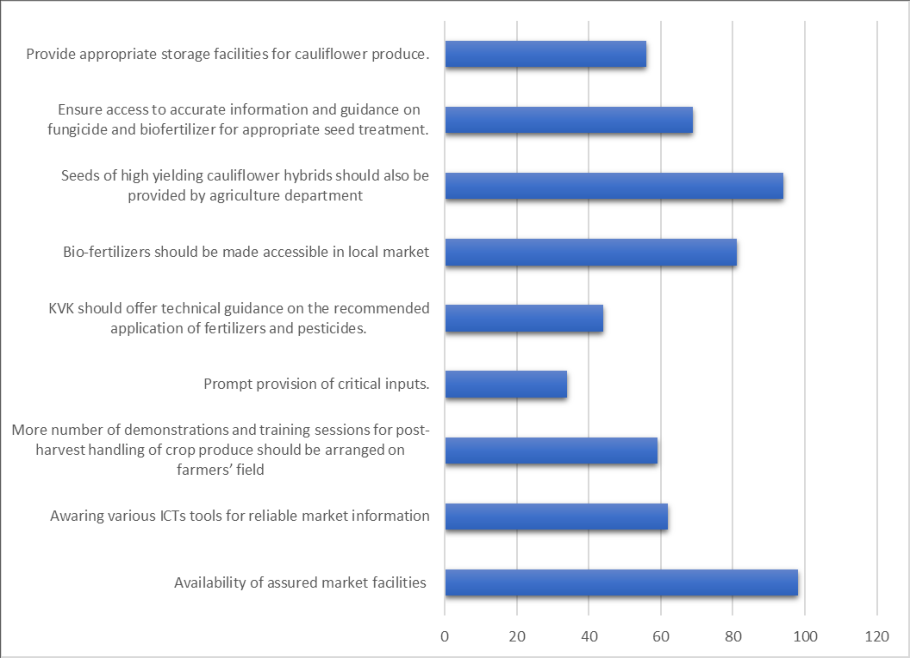 Figure 2
Introduction
The agricultural sector in India contributed to 18 percent of the country's gross domestic product (GDP) in the fiscal year 2022-23, with over half of the population relying on agriculture (MoPSI, 2023). During the same period, horticulture accounted for 30.4 percent of the agriculture GDP and 13.1 percent of the gross cropped area in 2022-23. Vegetables, specifically, constituted 60 percent of the total horticulture production. Among vegetable crops, cauliflower (Brassica oleracea var. botrytis) held significance as a crucial cruciferous vegetable in India, recognized for its palatable taste and rich supply of minerals, protein, carbohydrates, dietary fibers, vitamin C, and vitamin B-6. Cauliflower alone contributed to 4.70 percent of the country's vegetable production, constituting over 32.5 percent of global cauliflower production (Anonymous, 2018) [1] . India stood as the second-largest cauliflowerproducing country in 2017-18, covering an area of 465 thousand hectares, with a production of 9083 thousand metric tons and a productivity of 19.2 tons per hectare (MoA, 2018) [4] . In the North-Western Himalayan region, the union territory of Jammu and Kashmir, renowned for its horticultural produce, created favorable conditions for cultivating various crops, including temperate fruits, medicinal and aromatic plants, floriculture, mushrooms, plantation crops and vegetables. Cauliflower cultivation in Jammu and Kashmir covered 3.40 thousand hectares, yielding a total production of 105.40 thousand metric tons, with a productivity of 31.02 tons per hectare (MoA, 2018) [4] . Despite the high productivity of cauliflower in Jammu and Kashmir, various factors influenced the adoption of cauliflower cultivation practices by farmers. To address this, a study was conducted to identify constraints and gather suggestions from cauliflower growers in the Jammu region of Jammu and Kashmir. The objective was to analyze the obstacles that hinder the adoption of cauliflower cultivation practices and gather insights for promoting the adoption of cauliflower crops. www.extensionjournal.com
Materials and Methods
The study was conducted in the Jammu district of the Jammu region in Jammu and Kashmir in 2020-2021, coinciding with the "International Year of Fruits and Vegetables." The research utilized a descriptive design and implemented a multistage sampling method. Initially, Jammu district was purposively chosen due to its significant cauliflower cultivation area and production. The selection process focused on the agricultural sub-division of 'Marh,' identified as the largest cauliflower cultivation area in Jammu district among four sub-divisions. To ensure comprehensive coverage, the initial list of cauliflower growers provided by the Directorate of Agriculture, Jammu, comprised 281 farmers from 32 villages in Marh. Recognizing the potential for omissions, the researcher conducted personal calls to validate and update the list resulting in a modified list of 500 farmers. From this pool, a random sample of 160 farmers engaged in cauliflower cultivation with a minimum area of 0.05 hectares was selected for structured interviews. To maintain clarity and eliminate testing biases, an interview schedule with both open and closed-ended questions was developed and pretested in non-sampled area.
Results and Discussion
Table 1 presents a comprehensive overview of the various challenges faced by cauliflower growers in the study region. The data reveals a significant obstacle with 98 percent of respondents ranking low prices for their produce during harvesting as the primary constraint (Rank 1). Furthermore, 62 percent of participants identify increased expenditures in cauliflower cultivation as the second most prominent challenge (Rank 2). This rise in costs may be attributed to the escalating expenses of agricultural inputs such as fertilizer, pesticides, labor and seeds, as elucidated by Hasmukhbhai (2013) [2] . Moreover, a substantial portion of cauliflower growers accounting for 45 percent, grapple with the significant issue of a lack of timely market information. This may be attributed to the prevalent use of feature phones among the majority of growers limiting their access to various ICT applications for information on prices and marketing. Additional noteworthy concerns include difficulties in selling due to irregular produce supply in the market (37%), heightened costs associated with plant protection chemicals (34%), a perceived absence of government support and facilities (32%) and a shortage of labor (13%). The study's key takeaway is the paramount constraint (Rank 1) in the study area, revolving around the challenge of low prices for produce during the harvesting period. This emphasizes the urgent need to address this primary issue to enhance the overall viability and sustainability of cauliflower cultivation in the region. 2 illustrates the key suggestions provided by cauliflower growers to promote reliable abd sustainable production and marketing of cauliflower crop. The highest suggestion, endorsed by 98 percent of respondents and securing the top rank, was the need for assured market facilities. Following closely, 94 percent of cauliflower growers suggested that the agriculture department should supply high-yielding cauliflower hybrid seeds, earning the second rank. Additionally, 81 percent of respondents proposed making bio-fertilizers accessible in the local market, securing the third rank. In descending order, the next significant suggestion was to ensure access to accurate information and guidance on fungicide and biofertilizer for appropriate seed treatment with 69 percent of respondents supporting this and obtaining the fourth rank. The fifthranked suggestion endorsed by 62 percent of respondents was the awareness of various ICT tools for reliable market information. Further down the ranking approximately 59 percent of respondents proposed organizing more demonstrations and training sessions for post-harvest handling of crop produce directly on farmers' fields, securing the sixth rank. About 56 percent of respondents suggested the provision of appropriate storage facilities for cauliflower produce, earning the seventh rank. Fewer respondents recommended that Krishi Vigyan Kendra (KVK) should provide technical guidance on the recommended application of fertilizers or pesticides (44%) and that there should be prompt provision of critical inputs (34%), securing the eighth and ninth ranks, respectively. This outcome aligns closely with the findings of Pavithra and Singh (2020) [6] , Nidhi, et al., (2016) [5] emphasizing the importance of strengthening market organizations, developing infrastructure and providing storage facilities to enhance the profitability of cauliflower crops.
| S. No. | Parameter* | Frequency (n=160) | Percentage | Rank |
|---|---|---|---|---|
| 1. | Low price of crop produce at harvesting season | 157 | 98 | 1 |
| 2. | Greater investment in cauliflower crop cultivation compared to other crops. | 140 | 87 | 2 |
| 3. | Lack of sufficient and timely market information | 72 | 45 | 5 |
| 4. | Sales challenges arising from inconsistent supply of produce in the market. | 60 | 37 | 6 |
| 5. | Increased expenditure on plant protection chemicals. | 54 | 34 | 7 |
| 6. | Lack of government support and facilities. | 51 | 32 | 8 |
| 7. | Labour scarcity | 21 | 13 | 10 |
| 8. | Lack of storage facilities | 100 | 63 | 4 |
| 9. | Lack of knowledge about various fungicides available | 120 | 75 | 3 |
| 10. | Cumbersome process for obtaining credit from government institutions for marketing purposes. | 50 | 31 | 9 |
Table text extracted from the original PDF; superscript letters are shown inline. The original table image is below.
View original table image
Figures and tables from the paper
| S. No. | Parameter* | Frequency (n=160) | Percentage | Rank |
|---|---|---|---|---|
| 1. | Availability of assured market facilities | 157 | 98 | 1 |
| 2. | Awaking various ICTs tools for reliable market information | 100 | 62 | 5 |
| 3. | More number of demonstrations and training sessions for post-harvest handling of crop produce should be arranged on farmers’ field | 95 | 59 | 6 |
| 4. | Prompt provision of critical inputs. | 55 | 34 | 9 |
| 5. | KVK should offer technical guidance on the recommended application of fertilizers and pesticides. | 70 | 44 | 8 |
| 6. | Bio-fertilizers should be made accessible in local market | 130 | 81 | 3 |
| 7. | Seeds of high yielding cauliflower hybrids should also be provided by agriculture department | 150 | 94 | 2 |
| 8. | Ensure access to accurate information and guidance on fungicide and biofertilizer for appropriate seed treatment. | 110 | 69 | 4 |
| 9. | Provide appropriate storage facilities for cauliflower produce. | 90 | 56 | 7 |
Table text extracted from the original PDF; superscript letters are shown inline. The original table image is below.
View original table image
References
5 in the original paper- Anonymous. National Horticulture Board 2017-18. Ministry of Agriculture & Farmers' Welfare, Government of India, New Delhi. 2018.
- Ministry of Statistics and Programme Implementation. Contribution of agricultural sector in GDP, 2022-23. https://www.pib.gov.in/PressReleasePage.aspx?PRID= 1909213. 2023.
- MoA. Horticulture Statistics at a Glance 2018. Horticulture Statistics Division, Ministry of Agriculture & Farmers' Welfare, Government of India, New Delhi. Available at: https://agricoop.nic.in/sites/default/files/Horticulture%2 0Statistics%0at%20a%20Glance-2018.pdf. 2018.
- Nidhi, Sharma FL, Kumari S. Suggestions of the cauliflower growers to promote IPM in cauliflower cultivation. International Journal of Research in Applied, Natural and Social Sciences. 2016;4(9):143146.
- Pavithra S, Singh SP. Economics of production and marketing of cauliflower in Indore district of Madhya Pradesh. The Pharma Innovation Journal. 2020;9(11):80-83.