
Research article · 2024 · Full text
International Journal of Veterinary Sciences and Animal HusbandryIntegrating veterinary and poultry component with rice-based farming system for effective utilization of resources, environmental restoration and profitability
Volume 9(2S) · Pages 324–326 · DOI: 10.22271/veterinary.2024.v9.i2se.1317 ↗
Research areasAgricultural Systems and PracticesLivestock and Poultry Management
Abstract
Author-writtenDependence on crop alone is like a gamble where the farmer’s face the problem of crop failure or poor returns. Integrating veterinary components into rice based cropping system seems to provide farmers a risk-free alternative that will enahcne their income and productivity while optimizing resource use for small and marginal farmers. Hence, a field investigaion was conducted to with the objective of effect utilization of resource by integrating veterinary component with rice cropping system for enhancing the productivity and profitability. The field study involves conventional farming system compared with integrated farming system. In regular system farming system rice - rice - pulses cropping system was followed in 4000 m2 area. Under integrated farming system, rice - rice - pulses (2000 m2), fish pond (800 m2), veterinary component (1100 m2) and animal fodder (100 m2) were integrated. In an integrated farming system, the waste from one component is used as a resource for another.In comparison to a typical farming system, integrating veterinary, poultry, and fish production with rice crop yielded higher net returns, gross returns, and benefit cost ratios. It is recommended that dependence of crop alone will give less return, whereas integrating farming system would reduce the cost of input for crop and result in higher profitability.
Summary
Source-checkedPlain-language reading of the full paper, prepared with AI and checked against the text. Each point links to the authors' own words.
Why it matters
- Relying solely on crop production is risky for farmers because they may face poor financial returns or total crop failure. View evidence ↗
- Agricultural growth is limited by a rising population and a decrease in the amount of land available per person, making horizontal expansion difficult. View evidence ↗
- Vertical expansion through integrated farming systems is seen as a viable way to ensure profits while using less space and time. View evidence ↗
The question
- The study aimed to investigate how integrating veterinary components into a rice cropping system could improve resource utilization, productivity, and profitability. View evidence ↗
What they did
- The field experiment was conducted from 2020 to 2022 at the Regional Research Station in Vridhachlam, Tamil Nadu, India. View evidence ↗
- The conventional farming system consisted of a rice-rice-pulses cropping sequence implemented over a 4,000 m² area. View evidence ↗
- The integrated farming system divided the area into rice-rice-pulses (2,000 m²), a fish pond (800 m²), and a veterinary/fodder component (1,200 m²). View evidence ↗
- The livestock components included 16 sheep fed with cumbu napier grass and 50 Aseel variety poultry. View evidence ↗
What they found
- The integrated system produced higher yields than the conventional system: rice yields rose from 4,796 to 5,645 kg/ha in the first season and 5,124 to 6,185 kg/ha in the second, while black gram increased from 658 to 784 kg/ha. View evidence ↗
- The conventional farming system on 4,000 m² generated a total gross income of Rs. 96,600 and a net return of Rs. 53,200 per year, with a benefit-cost ratio of 2.25. View evidence ↗
- The integrated farming system on the same 4,000 m² area significantly increased financial returns, achieving a gross income of Rs. 3,31,800 and a net return of Rs. 2,75,100 per year. View evidence ↗
What it means
- The authors conclude that switching from crop-only farming to an integrated system of crops, veterinary, fish, and poultry can improve living standards and ensure sustainable agriculture. View evidence ↗
Visual summary
1 visualsIllustrations explain the paper; they do not show study data.
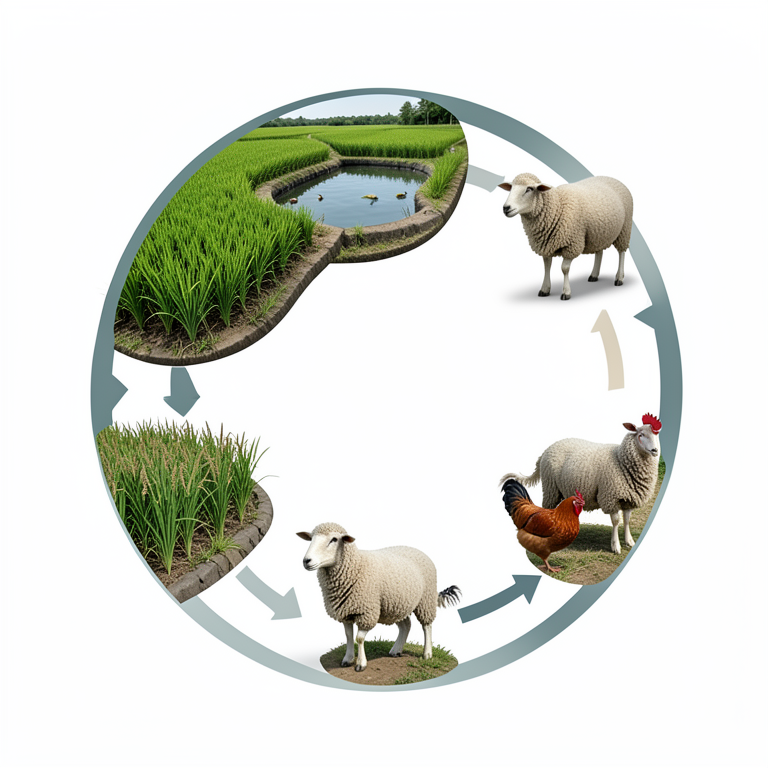
Integrated Farming Resource Cycle
AI-generated conceptual illustration (Rice plants, Aseel poultry, sheep, and a fish pond). It explains the idea and does not show study data.
View source evidence ↗Figures & tables
From the original paper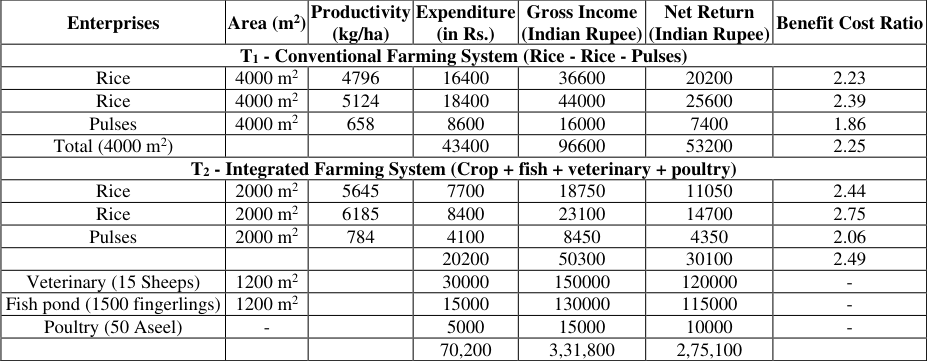 Table 1
 Table 2
Introduction
Farmers' primary source of income and employment opportunities is agricultural production, which is highly unpredictable. The country's declining per capita land supply and steadily rising population limit the potential for horizontal land development for agriculture. The only viable option is vertical expansion through the integration of farming and related businesses, which will need less time and space while guaranteeing farm families adequate profits. In this situation, integrating different agricultural allied component such as cropping, veterinary, fisheries, poultry, etc. has a lot of promise for the agricultural economy and is a good way to help small and marginal farmers earn more revenue. In addition to supporting the sustainability of farming, these affiliated businesses help to increase family labor employment year-round and complement the income of farmers (Murugeswari, 2019) [12] . An integrated agricultural system is essential to addressing the issue of the world's growing population's need for food, as well as a means of boosting small-scale farmers' meaurements and nutrition. In order to complement farm revenue, elements like dairy, poultry, fish culture, sericulture, biogas generation, edible mushroom cultivation, agro-forestry, etc., are crucial. The ideal component guarantees complete bye-product use and should integrate seamlessly with farm level infrastructure. Furthermore, one alternate method for mitigating the effects of climate change is the integrated farming system. An integrated farming system is essential in this situation of coexisting land degradation and carbon emissions to guarantee food security. Moreover, rearing fish in ponds, cattle and poultry beside or above the pond provides continuous organic fertilization to the pond. Using cattle and feed wastes profitably improves the efficiency and profitability of fish culture as well as livestock production (Mali Hansram et al., 2014) [10] . Usually the components differ in their use of resources when they are in integration, they can complement one another and use resources more efficiently, which typically results in higher productivity of the system (Harisudan et al., 2009) [7] . At present situation, the dual goals of improved resource efficiency and increased yield should be the focus of scientific agriculture (Harisudan and Subrahmaniyan, 2020) [5] . The primary goals of an integrated agricultural system are to reduce greenhouse gas emissions, provide livelihood and food security, accomplish sustainable crop production with increased productivity, and adapt to climate change. With this background field study was conducted by integrating various component with rice cropping system.
Materials and Method
Field experiment to identify a suitable Integrated farming system for wetland rice ecosystem was conducted at Regional Research Station, Vridhachlam, Tamil Nadu, India during 2020 to 2022. The objective of the study is to work out the profitability of integrated farming system and resource use efficiency. The study area's predominant soil type was red laterite soil, with a low available nitrogen, medium phosphorus and potash content. Two methods of farming system practices viz. Conventional farming system was compared with integrated farming system. In regular farming system practices, rice -rice -pulses cropping system was followed in 4000 m 2 area. The first crop rice was raised during kuruvai followed by second rice crop during Samba season followed by blackgram during summer season. Under integrated farming system, rice -rice -pulses in 2000 m 2 , fish pond in 800 m 2 , veterinary + fodder component in 1200 m 2 were integrated. The veterinary component involves 16 numbers of sheep and cumbu napier grass was raised as fodder for the sheep component. Leucaena leucocephala (Subabul) was raised as border crop which could be used as fodder for the cattle. The fish pond was erected in 40 x 20 m area with a depth of 1.8 m. The rain water is collected during rainy season wherein the pond could collect around 12 lakh litres of water. Fish composite culture viz., Cutla (surface feeder), Rogu, Mirgal, Common and grass carp each @ 300 fingerlings were let into the fish pond for rearing. Poultry shed of size 12' x 6' was erected over the fish pond. The poultry unit comprises of 50 aseel variety. Since it is a farming system experiment conducted in larger area specific design and replication is not required. Both poultry and sheep were vaccinated regularly. The productivity of each component was recorded and the total resources used for crop, poultry, veterinary and fishery component were calculated and the economics were computed in terms of Indian Rupee.
Results
The results of the comparison study of conventional farming system with integrated farming system showed significant result in productivity and profitability. Rice crop under conventional cropping system recorded lower grain yield of 4,796 kg/ha during first season and 5,124 kg/ha during second season and 658 kg/ha of black gram yield. However, under integrated farming system higher rice grain yield of 5,645 kg/ha was recorded during first season, 6,185 kg/ha was recorded during second season and blackgram yield of 784 kg/ha. The conventional farming involving rice -rice -pulses cropping system fetched a total gross income of Rs. 96,600 with net return Rs. 53,200 with benefit cost ratio of 2.25 in 4000m 2 in a year. Whereas in integrated farming system, the veterinary component fetched Rs.1,50,000 as gross income and net income of Rs.1,20,000 in a year. Fish rearing recorded Rs.1,30,000 as gross income and net income of Rs.1,15,000 in a year. By poultry rearing an additional gross return of Rs.15,000 and net return Rs.10,000 was obtained in a year. The integrated farming system as a whole integrating veterinary, poultry, fishery with crop component recorded higher gross income of Rs. 3,31,800 with net return Rs. 2,75,100 in the same area of 4000 m 2 in a year. The waste from cattle and poultry is a significant resource that may be used as manure for agriculture and feed for other livestock enterprise (Karu Pasupathi. 2019) [9] . The average amount of urine and dung collected from the poultry and cattle is provided below.
Discussion
Under integrated farming system, the rice grain yield and blackgram yield is higher compared to conventional cropping system. The higher system yield may be because of integration of inorganic fertilizers along with organic manures received from the various component of the integrated farming system would have released nutrients to crops slowly and steadily during the entire crop period (Maruthupandi and Jayanthi, 2018) [11] . The organic nutrient source would have favoured the strong biological environment in the soil where microbes and plants interact directly, facilitating the plants' easy access to nutrients (Harisudan et al., 2010) [8] . Providing good soil health with enhance the crop productivity (Subrahmaniyan et al., 2018) [15] . In integrated farming system, agricultural wastes can be utilized as animal feed in a farming system, and manure from poultry and veterinary sources can increase agricultural production by boosting nutrients that improve soil fertility and lowering the need for inorganic fertilizers (Gupta et al., 2012) [4] . It has been claimed that the traditional farming system can be improved on sustainable and eco-friendly basis by integrating veterinary component with crops (Dhiman et al., 2003) [3] . The usage of manure from the veterinary component would have reduced cost of fertilizer resulting low cost of cultivation of rice crop. Including a cattle component in the system improves family nutrition, creates cash income, and recycles livestock waste and crop residues into valuable sources of nutrients for crops, all of which contribute to sustainability (Saxena et al., 2003) [14] . Similar results of high gross income and net income was recorded from the integrated farming system studies reported by Channabasavanna et al., (2002) [2] . Likewise, Bhuvaneswari et al., (2020) [1] evaluated several IFS models and determined that, in terms of output and employment creation (752 mandays/year), crop + fish + poultry + veterinary was the best integrated farming system since it better involved farm family laborers throughout the year. Location specific and economically viable technology will result in higher economic returns (Harisudan, C and Nisha Sapre. 2019) [6] . The best option to meet the rising per capita food demand is through vertical development combined with an integrated farming system (Ramesh et al., 2019) [13] . Utilizing the rice area by integrating with location specific component through proper understanding of the system ecology will increase the system's profitability and productivity (Harisudan and Nish Sapre, 2019) [6] .
Conclusion
For sustainable agriculture and to increase the standard of living, farmers can switch to an integrated farming system that includes crop + veterinary + fish + poultry as a system, as opposed to crop alone.
Figures and tables from the paper
| Enterprises | Area (m2) | Productivity (kg/ha) | Expenditure (in Rs.) | Gross Income (Indian Rupee) | Net Return (Indian Rupee) | Benefit Cost Ratio |
|---|---|---|---|---|---|---|
| T1 - Conventional Farming System (Rice - Rice - Pulses) | ||||||
| Rice | 4000 m2 | 4796 | 16400 | 36600 | 20200 | 2.23 |
| Rice | 4000 m2 | 5124 | 18400 | 44000 | 25600 | 2.39 |
| Pulses | 4000 m2 | 658 | 8600 | 16000 | 7400 | 1.86 |
| Total (4000 m2) | 43400 | 96600 | 53200 | 2.25 | ||
| T2 - Integrated Farming System (Crop + fish + veterinary + poultry) | ||||||
| Rice | 2000 m2 | 5645 | 7700 | 18750 | 11050 | 2.44 |
| Rice | 2000 m2 | 6185 | 8400 | 23100 | 14700 | 2.75 |
| Pulses | 2000 m2 | 784 | 4100 | 8450 | 4350 | 2.06 |
| 20200 | 50300 | 30100 | 2.49 | |||
| Veterinary (15 Sheeps) | 1200 m2 | 30000 | 150000 | 120000 | - | |
| Fish pond (1500 fingerlings) | 1200 m2 | 15000 | 130000 | 115000 | - | |
| Poultry (50 Aseel) | - | 5000 | 15000 | 10000 | - | |
| 70,200 | 3,31,800 | 2,75,100 |
Table text extracted from the original PDF; superscript letters are shown inline. The original table image is below.
View original table image
| Animal type | Urine | — | Manure | — |
|---|---|---|---|---|
| Litre/day | Litre/year | Kg/day | Kg/year | |
| Sheep | 0.72 | 263 | 1.74 | 635 |
| Poultry | - | - | 0.03 | 11.0 |
Table text extracted from the original PDF; superscript letters are shown inline. The original table image is below.
View original table image
References
15 in the original paper- Bhuvaneswari J, Thiyagarajan G, Manikandan M, Natarajan SK, Thenmozhi S. Evaluation of Water Productivity in Integrated Farming System in Wetland Situation of Western Zone of Tamil Nadu. Int J Curr Microbiol App Sci. 2020;9(11):2392-2396.
- Channabasavanna AS, Itnal CJ, Patil SG. Productivity, economics analysis and changes in physicochemical properties as influenced by integrated rice-based farming system. Indian J Agronomy. 2002;46(1):1-5.
- Dhiman KR, Bujarbaruah KM, Satapathy KK. Integrated farming system for sustainable development of rainfed agriculture in North Eastern region. In: Proceedings of International Conference on World Perspective on Short Rotation Forestry for Industrial and Rural Development, held during 7-13 September 2003 at Solan, Himachal Pradesh. 2003;154.
- Gupta V, Rai PK, Risam KS. Integrated crop-livestock farming systems: A strategy for resource conservation and environmental sustainability. Indian Res J Extension Educ. 2012;2:49-54.
- Harisudan C, Subrahmaniyan K. Evaluation of irrigation levels and plant geometry for drip irrigation in groundnut (Arachis hypogaea L.). J Oilseeds Res. 2020;37(4):267271.
- Harisudan C, Nisha Sapre. Evaluation of crop establishment methods and foliar nutrition for enhancing productivity of rice fallow/follow sesame (Sesamum indicum L.). J Oilseeds Res. 2019;36(2):89-92.
- Harisudan C, Senthivel S, Arulmozhiselvan K, Vaidyanathan R, Manivannan V. Blackgram as intercrop in cotton -A Review. Agric Rev. 2009;30(3):219-223.
- Harisudan C, Velmurugan M, Hemalatha P. Rhizosphere management practices in sustaining mycorrhizae. In: Thangadurai D, Busso CA, Hijri M (Eds.), Devarajan Thangadurai, 1 ed. CRC Press, Enfield. 2010;126-137.
- Karu Pasupathi. Revenue generation modes to augment income of farmers by adopting Integrated farming system. In: Farmers training manual on "Integrated Farming Systems to Suit The Global Climate Change". 2019;1-5.
- Mali H, Kumar A, Katara P. Integrated farming system for irrigated and rainfed conditions. In: Proceedings of National Symposium on Agricultural Diversification for Sustainable Livelihood and Environmental Security, held during 18-20 November 2014 at Ludhiana, Punjab. 2014;546.
- Maruthupandi K, Jayanthi C. Contingent Crop Planning for Delayed Onset of Monsoon in Scarce Rainfall Zone of Andhra Pradesh. Int J Curr Microbiol App Sci. 2018;7(09):3564-3574. doi: https://doi.org/10.20546/ijcmas.2018.709.442.
- Murugeswari R. Introduction to Integrated farming system. In: Farmers training manual on "Integrated Farming Systems to Suit The Global Climate Change". 2019;1-5.
- Ramesh KP, Ratnakumar C, Harisudan C, Bhaskar S, Vishnuvardhan Reddy A. Sesame (Sesamum indicum) in the rice fallow environment -a critical appraisal. J Oilseeds Res. 2019;36(4):203-209.
- Saxena DC, Singh NP, Satapathy KK, Panwar AS, Singh JL. Sustainable farming systems for hill agriculture. In: Proceeding of National Seminar 'Approaches for Increasing Agricultural Productivity in Hill and Mountain Ecosystem', held during 18-20 October, 2001at Barapani. 2003;73-85.
- Subrahmaniyan K, Veeramani P, Harisudan C. Heat accumulation and soil properties as affected by transparent plastic mulch in blackgram (Vigna mungo) doubled cropped with groundnut (Arachis hypogaea) in sequence under rainfed conditions in Tamil Nadu, India. Field Crops Research. 2018;219:43-54.