
Research article · 2024 · Full text
International Journal of Advanced Chemistry ResearchInvestigating the catalytic efficacy of copper (II) and Zinc (II) complexes derived from 1, 3-bis (Bromo Salicyl-imino) propane in organic transformations
Volume 6(1) · Pages 63–65 · DOI: 10.33545/26646781.2024.v6.i1a.170 ↗
Research areasChemical Synthesis and ReactionsOxidative Organic Chemistry ReactionsInorganic and Organometallic Chemistry
Abstract
Author-writtenThis study examines the catalytic performance of synthesized copper (II) and zinc (II) complexes derived from 1, 3-bis(bromo salicyl-imino) propane (Br-SIP) in promoting various organic transformations. These metal complexes are explored for their potential as catalysts in reactions such as oxidation, aldol condensation, and Michael addition. The complexes were characterized by spectroscopic methods and their catalytic activity was assessed under various conditions. Our findings suggest that these metal complexes show significant catalytic activity, which can be tuned by modifying reaction conditions such as solvent, temperature, and the metal-to-ligand ratio.
Summary
Source-checkedPlain-language reading of the full paper, prepared with AI and checked against the text. Each point links to the authors' own words.
Why it matters
- Synthetic chemistry focuses on developing catalysts that are more efficient, selective, and environmentally friendly. View evidence ↗
- Copper and zinc are preferred transition metals for catalysis because they are abundant, cost-effective, and have a lower environmental impact than other heavy metals. View evidence ↗
- Copper complexes are effective for electron transfer reactions, such as oxidation and reduction, due to the metal's ability to switch between Cu (I) and Cu (II) oxidation states. View evidence ↗
- Zinc complexes are typically stable in the Zn (II) state and act as Lewis acids, making them suitable for reactions involving nucleophilic attack, like aldol condensations. View evidence ↗
The question
- The study aims to investigate how effective copper (II) and zinc (II) complexes derived from the ligand 1, 3-bis (bromo salicyl-imino) propane (Br-SIP) are in promoting organic transformations. View evidence ↗
What they did
- The Br-SIP ligand was synthesized from 5-bromosalicylaldehyde and 1, 3-diaminopropane in ethanol, and the metal complexes were created by reacting this ligand with copper (II) acetate and zinc (II) acetate under reflux. View evidence ↗
- The resulting compounds were characterized using IR, UV-Vis, 1H NMR spectroscopy, and mass spectrometry. View evidence ↗
- Catalytic activity was tested using three reactions, oxidation of benzyl alcohol, aldol condensation of acetone and benzaldehyde, and Michael addition of dimethyl malonate to trans-β-nitrostyrene, and monitored via GC and HPLC. View evidence ↗
What they found
- In the oxidation of benzyl alcohol, the copper (II) complex was more effective than the zinc (II) complex, achieving 92% conversion and 85% selectivity compared to 75% conversion and 80% selectivity. View evidence ↗
- For the aldol condensation of acetone and benzaldehyde, the zinc (II) complex performed better than the copper (II) complex, with 89% conversion and 89% selectivity versus 85% conversion and 75% selectivity. View evidence ↗
- The copper (II) complex achieved the highest performance in the Michael addition reaction, with a 95% yield and 90% selectivity. View evidence ↗
- The bromo substituents on the Br-SIP ligand improved catalytic performance by altering the electronic properties of the metal centers, aiding in electron transfer and the stabilization of intermediates. View evidence ↗
What it means
- The authors conclude that the synthesized copper (II) and zinc (II) complexes are effective catalysts for oxidation, aldol condensation, and Michael addition. View evidence ↗
- The study suggests these complexes are versatile and efficient, providing a basis for future research into their use in industrial processes. View evidence ↗
Visual summary
3 visualsIllustrations explain the paper; charts are replotted from the paper's own table values.
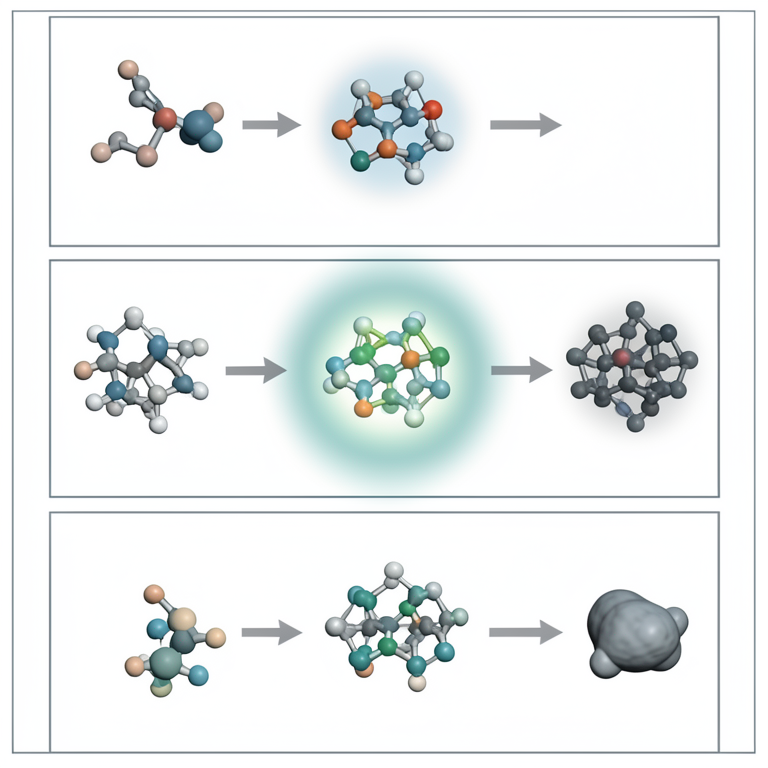
Comparative Catalytic Efficacy
AI-generated conceptual illustration (Copper (II) and Zinc (II) coordination complexes of 1,3-bis(bromosalicylimino)propane). It explains the idea and does not show study data.
View source evidence ↗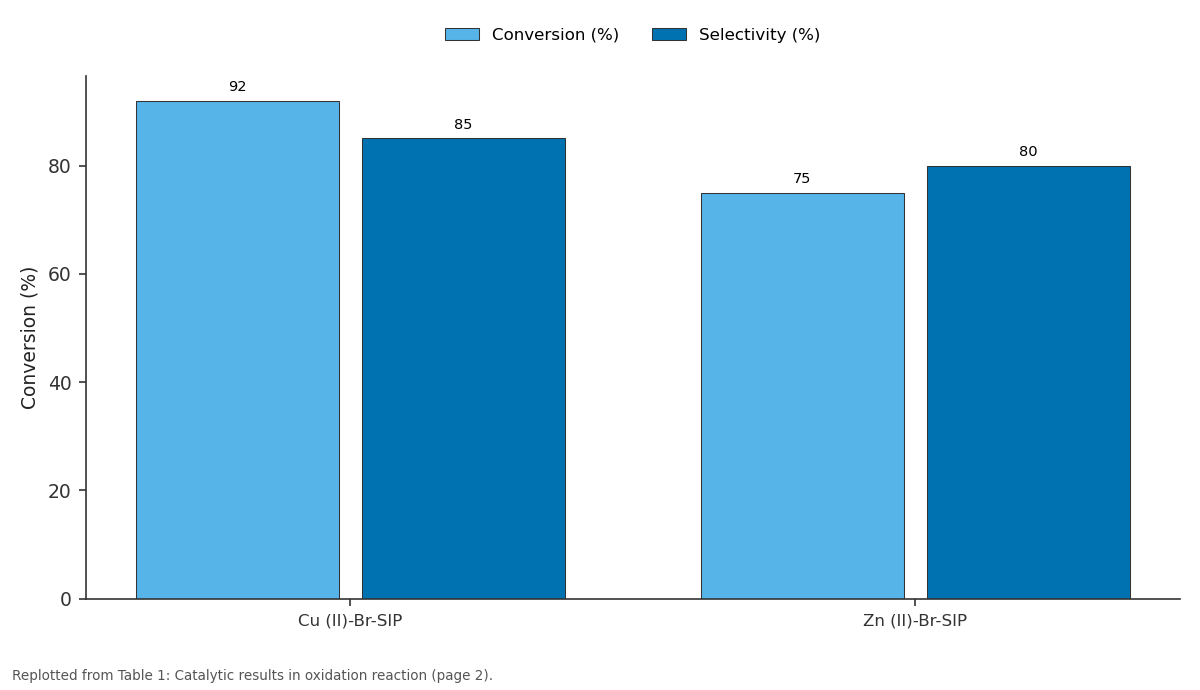
Conversion (%) and Selectivity (%): Cu (II)-Br-SIP vs Zn (II)-Br-SIP
Replotted from Table 1 (page 2) of the original paper. Every bar is the paper's own table value.
View source evidence ↗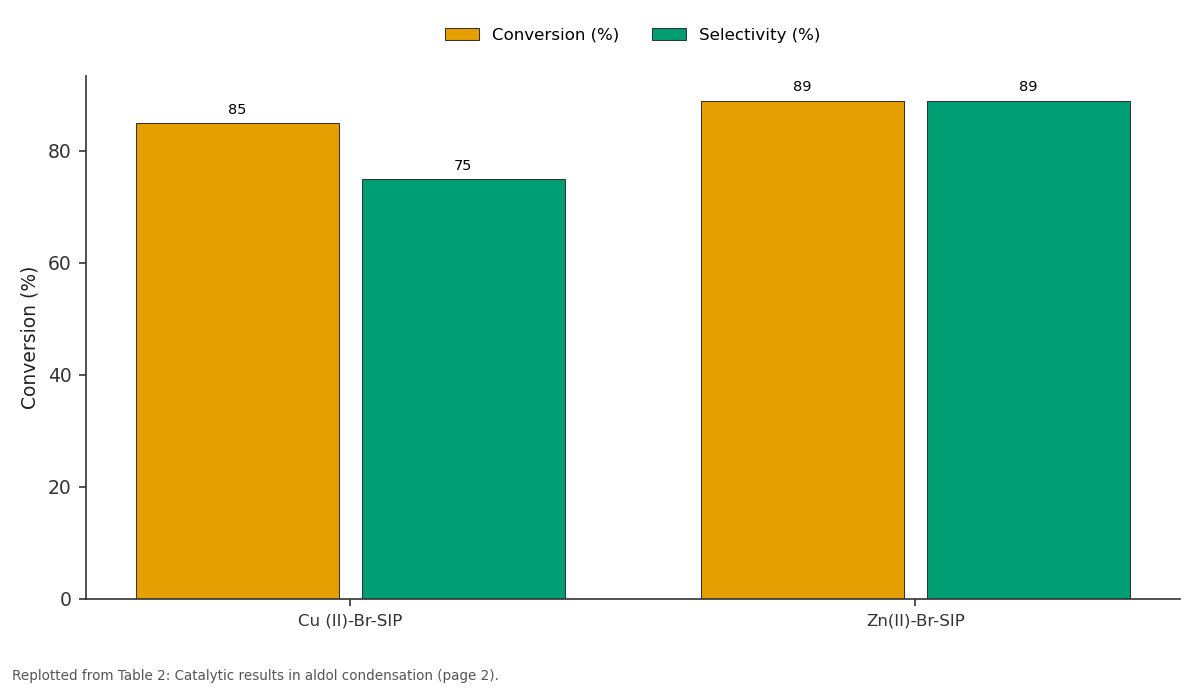
Conversion (%) and Selectivity (%): Cu (II)-Br-SIP vs Zn(II)-Br-SIP
Replotted from Table 2 (page 2) of the original paper. Every bar is the paper's own table value.
View source evidence ↗Figures & tables
From the original paper Table 1
 Table 2
 Table 3
Introduction
The pursuit of more efficient, selective, and environmentally benign catalysts is a central theme in the field of synthetic chemistry. Transition metal complexes, by virtue of their versatile electronic properties and diverse coordination environments, have emerged as pivotal tools in this quest, catalyzing reactions that are foundational to pharmaceutical, materials science, and bulk chemicals industries. Among the various transition metals, copper and zinc stand out due to their relative abundance, cost-effectiveness, and lower environmental impact compared to other heavy metals. This study focuses on the catalytic capabilities of copper (II) and zinc (II) complexes derived from a novel ligand, 1, 3-bis (bromo salicyl-imino) propane (Br-SIP), tailored to explore their utility in various organic transformations. The design of the Br-SIP ligand is predicated on enhancing the metal centre's ability to participate in catalytic cycles, potentially increasing the efficiency and selectivity of reactions such as oxidation, aldol condensation, and Michael addition. Catalysis involving copper and zinc complexes is well-documented, with each metal offering unique advantages due to its distinct electronic configurations and reactivity profiles. Copper complexes are particularly noted for their ability to facilitate electron transfer reactions owing to copper's variable oxidation states Cu (I) and Cu (II), which can be exploited in processes like oxidation and reduction. On the other hand, zinc complexes, typically stable in the Zn (II) state, are recognized for their Lewis acid properties, making them suitable for catalyzing reactions involving nucleophilic attack, such as aldol condensations.
Main Objective
The main objective of the study is to investigate the Catalytic Efficacy of Copper (II) and Zinc (II) Complexes Derived from 1, 3-bis (Bromo Salicyl-imino) Propane in Organic Transformations.
Previous works
Hao, 2020 [1] , Complexes of Copper(II) and Zinc(II) derived from N, N'-bis(4bromosalicylidene)propane-1, 3-diamine exhibited notable antibacterial activity against various bacteria and yeast, with the trinuclear Zinc(II) complex showing distinct coordination configurations.
Liu, Chen, Li et al., 2020 [3] , Copper (II) and Zinc (II) complexes with salicylaldehyde-imine ligands were synthesized, showing excellent catalytic activity in hydrogen peroxide decomposition and significant antibacterial properties against multiple bacteria. Hay, Clifford, & Lightfoot et al., 1998 [4] , Copper (II) and Zinc (II) complexes with bis (benzimidazole) ligands detailed their coordination and modest catalytic activity in the hydrolysis of phosphotriesters.
Materials and Methods
All reagents were of analytical grade and used as received from commercial sources. These included copper (II) acetate, zinc (II) acetate, 5-bromosalicylaldehyde, 1, 3diaminopropane, and various organic substrates for catalytic testing. The ligand, 1, 3-bis (Bromo salicyl-imino) propane (Br-SIP), was synthesized via the condensation of 5bromosalicylaldehyde with 1, 3-diaminopropane in ethanol. Copper (II) and zinc (II) complexes were then formed by reacting this ligand with their respective metal acetates under reflux. The synthesized compounds were characterized by Infrared (IR) Spectroscopy, Ultravioletvisible (UV-Vis) Spectroscopy, Proton Nuclear Magnetic Resonance (^1H NMR) Spectroscopy, and Mass Spectrometry. Catalytic activity was assessed through three reactions: Oxidation of benzyl alcohol, aldol condensation of acetone and benzaldehyde, and Michael addition of dimethyl malonate to trans-β-nitrostyrene. Reactions were monitored using Gas Chromatography (GC) and High-Performance Liquid Chromatography (HPLC).
Results (Catalytic activity results)
Results (Catalytic activity results)
Discussions
The results from the catalytic testing of copper(II) and zinc (II) complexes derived from 1, 3-bis (bromo salicyl-imino) propane (Br-SIP) in various organic transformations provide a compelling insight into the efficacy and potential application of these complexes in synthetic chemistry. The differences in catalytic performance among the reactions tested-oxidation, aldol condensation, and Michael additionoffer a deeper understanding of the influence of metal center and ligand structure on catalytic behavior. The copper (II) complex displayed superior catalytic activity in the oxidation of benzyl alcohol to benzaldehyde, with a conversion rate of 92% and selectivity of 85%. In contrast, the zinc (II) complex achieved a lower conversion (75%) and similar selectivity (80%). Copper's greater efficacy can be attributed to its higher redox potential, which facilitates the transfer of electrons in oxidation reactions more effectively than zinc. The coordination environment provided by the Br-SIP ligand, particularly the presence of bromo substituents, may enhance the oxidative strength of the copper center by stabilizing intermediate oxidation states necessary for efficient catalysis. In the aldol condensation of acetone and benzaldehyde, the zinc (II) complex outperformed the copper (II) complex, both in conversion (89% vs. 85%) and selectivity (89% vs. 75%). Zinc complexes are often preferred in reactions involving enolate or carbonyl intermediates due to their ability to stabilize negative charges through softer Lewis acid interactions. The higher selectivity of the zinc (II) complex suggests that it may better facilitate the formation of the aldol product by aligning the reactive intermediates more effectively within the coordination sphere, thus reducing side reactions. The Michael addition reaction showcased the highest yield with the copper (II) complex, reaching 95% yield and 90% selectivity. This performance is indicative of copper's ability to stabilize carbanionic intermediates through its soft Lewis acid properties. The bromo substituents on the ligand likely enhance this stabilization, promoting a more effective catalytic cycle and reducing potential competitive pathways that might lead to lower yields. The varying performance of the copper (II) and zinc (II) complexes can be understood through the lens of their electronic and structural differences. The Br-SIP ligand, with its bromo substituents, offers a unique coordination environment that modulates the electronic properties of the metal centres. These substituents are electron-withdrawing, which increases the electrophilicity of the metal center, a crucial factor in catalysis involving electron-rich or negatively charged reactants. For oxidation reactions, the ability of the copper (II) complex to undergo reversible redox changes efficiently is key to its high activity. In contrast, the aldol condensation benefits from the zinc (II) complex's capacity to provide a stable environment for the formation and reaction of enolates. Lastly, in Michael's addition, the ability of the copper (II) complex to stabilize negative charges efficiently outweighs the more neutral role played by zinc.
Findings of the study
Catalytic efficiency: The copper (II) complex displayed superior catalytic activity in the oxidation reaction, achieving a high conversion rate and good selectivity, while the zinc (II) complex excelled in the aldol condensation, demonstrating both high conversion and selectivity. Ligand influence: The presence of bromo substituents in the Br-SIP ligand enhanced the catalytic performance by modulating the electronic properties of the metal centers, which facilitated effective electron transfer and stabilization of reaction intermediates. Reaction specificity: Copper was more effective in reactions requiring electron transfer (oxidation and Michael addition), likely due to its better redox flexibility. Zinc showed better performance in reactions involving stable intermediates such as enolates (aldol condensation). Mechanistic insight: The study provided evidence that the catalytic activity is significantly influenced by the electronic and structural configuration of the metal-ligand complex, suggesting tailored ligand design as a key factor in optimizing catalytic processes.
Conclusion
This study successfully synthesized and characterized copper (II) and zinc (II) complexes with the ligand 1, 3-bis (bromo salicyl-imino) propane (Br-SIP). The catalytic testing demonstrated that these complexes are effective catalysts in various organic transformations, including oxidation, aldol condensation, and Michael addition. Copper (II) complexes exhibited superior activity in oxidation reactions, while zinc (II) complexes were more selective in aldol condensation. These findings highlight the potential of these metal complexes as versatile and efficient catalysts in synthetic chemistry, providing a foundation for further exploration of their applications in industrial processes.
Figures and tables from the paper
| Catalyst | Conversion (%) | Selectivity (%) |
|---|---|---|
| Cu (II)-Br-SIP | 92 | 85 |
| Zn (II)-Br-SIP | 75 | 80 |
Table text extracted from the original PDF; superscript letters are shown inline. The original table image is below.
View original table image
| Catalyst | Conversion (%) | Selectivity (%) |
|---|---|---|
| Cu (II)-Br-SIP | 85 | 75 |
| Zn(II)-Br-SIP | 89 | 89 |
Table text extracted from the original PDF; superscript letters are shown inline. The original table image is below.
View original table image
| Catalyst | Yield (%) | Selectivity (%) |
|---|---|---|
| Cu (II)-Br-SIP | 95 | 90 |
| Zn (II)-Br-SIP | 88 | 85 |
Table text extracted from the original PDF; superscript letters are shown inline. The original table image is below.
View original table image
References
10 in the original paper- Hao Y. Copper (II) and Zinc (II) complexes derived from N, N'-Bis (4-bromosalicylidene) propane-1, 3diamine: Syntheses, crystal structures and antimicrobial activity. Acta Chimica Slovenica. 2020;68(1):102-108.
- Hao YM. Copper (II) and Zinc (II) complexes derived from N, N'-Bis (4-bromosalicylidene) propane-1, 3diamine: Syntheses, crystal structures and antimicrobial activity. Acta Chimica Slovenica. 2021;68(1):102-108. PMID: 34057515.
- Liu C, Chen M, Li M. Synthesis, crystal structures, catalytic application and antibacterial activities of Cu (II) and Zn (II) complexes bearing salicylaldehydeimine ligands. Inorganica Chimica Acta. 2020;508:119639.
- Hay R, Clifford T, Lightfoot P. Copper (II) and zinc (II) complexes of N, N-bis (benzimidazole-2-ylmethyl)- amine. Synthesis, formation constants and the crystal structure of [ZnLCl]2]. MeOH. Catalytic activity of the complexes in the hydrolysis of the phosphotriester 2, 4dinitrophenyl diethyl phosphate. Polyhedron. 1998;17(20):3575-3581.
- Nanjundan N, Narayanasamy R, Butcher RJ, Jasinski JP, Velmurugan K, Nandhakumar R, et al. Synthesis, crystal structure, bio-molecular interactions and anticancer properties of Ni (II), Cu (II) and Zn (II) complexes bearing S-allyldithiocarbazate. Inorganica Chimica Acta. 2017;455:283-297.
- Adam MS. Zn (II)-complexes of diisatin dihydrazones as effective catalysts in the oxidation protocol of benzyl alcohol and effective reagents for biological studies. Journal of Molecular Liquids. 2023;381:121841.
- Ashma A, Yahya S, Subramani A, Tamilarasan R, Sasikumar G, Ali SA, et al. Synthesis of new nicotinic acid hydrazide metal complexes: Potential anti-cancer drug, supramolecular architecture, antibacterial studies and catalytic properties. Journal of Molecular Structure. 2022;1250:131860.
- Podder N, Mandal S. The effects of metal cofactors on the reactivity of quercetin 2, 4-dioxygenase: synthetic model studies with M(II)-complexes (M = Mn, Co, Ni, Cu, Zn) and assessment of the regulatory factors in catalytic efficacy. Dalton Trans. 2022;51(44):1706417080.
- Li M, Meng XG, Du J, Zhang P, Zeng WP, Liu Y, et al. Metallomicellar Catalysis: Hydrolysis of PNPP Catalyzed by Copper (II), Zinc (II), Cerium (IV) Complexes with Long Alkyl Pyridine Ligands in CTAB Micellar Solution. Journal of Dispersion Science and Technology. 2009;30(8):1182-1187.
- Kang MS, Cho J, Nayab S, Jeong JH. Synthesis and characterization of Zn (II) and Cu (II) complexes bearing (Chiral substituent), (diethyl)-ethanediamine derivatives as precatalysts for raclactide polymerisation. Polyhedron. 2019;158:135-143.