
Research article · 2024 · Full text
International Journal of Agriculture Extension and Social DevelopmentAdoption level of dairy farmers obtaining information from digital and traditional media in Andhra Pradesh
Volume 7(4S) · Pages 99–101 · DOI: 10.33545/26180723.2024.v7.i4sb.543 ↗
Research areasAgricultural Innovations and Practices
Abstract
Author-writtenThis study investigates the influence of information source on the adoption of dairy husbandry practices among farmers in Andhra Pradesh. Recognizing information source as a key factor influencing farm practice adoption, the research explores this relationship within the context of dairy farming. For this research, one district from each of Andhra Pradesh's three regions with the highest milk production was chosen. Two mandals from each selected district (Visakhapatnam, Prakasam, and Chittoor) were chosen at random, as well as one village from each selected mandal. Twenty dairy farmers from each village were chosen and split into two groups of ten based on their exposure to digital and traditional media. Farmers who predominantly accessed information via digital media (WhatsApp and YouTube) were classified as digital media group, while others were categorized as traditional media. The sample comprised 60 traditional and 60 digital media farmers. A semi-structured interview schedule was used to gather the data. It was observed that 16.67 percent of digital media farmers and 43.33 percent of traditional media farmers had low levels of adoption of feeding practices. A medium level of adoption of breeding practices was observed in the majority of digital media groups (78.33%) and traditional media groups (80.00%), while a medium level of adoption of healthcare and management practices was observed in the majority of digital media groups (63.34%) and traditional media groups (73.33%). Overall, the majority of digital media (68.33%) and traditional media (70.00%) groups adopted dairy husbandry techniques to a medium level.
Summary
Source-checkedPlain-language reading of the full paper, prepared with AI and checked against the text. Each point links to the authors' own words.
Why it matters
- Dairy farming is critical for rural areas because it supports food security, provides employment, and increases nutritional consumption. View evidence ↗
- The productivity and success of dairy farms depend on how well farmers adopt husbandry practices related to feeding, breeding, health care, and management. View evidence ↗
The question
- The study aims to compare the adoption levels of dairy husbandry practices among farmers in Andhra Pradesh who use digital media versus those who use traditional media. View evidence ↗
What they did
- The research was conducted across six randomly selected villages within the districts of Visakhapatnam, Prakasam, and Chittoor in Andhra Pradesh. View evidence ↗
- Farmers were categorized as 'digital media' if they primarily used WhatsApp and YouTube, and 'traditional media' if they used other information sources. View evidence ↗
- Adoption was measured using a standardized questionnaire focusing on three categories: feeding, breeding, and health care/management practices. View evidence ↗
What they found
- Regarding feeding practices, 16.67% of digital media farmers and 43.33% of traditional media farmers showed low levels of adoption. View evidence ↗
- The majority of both groups showed a medium level of adoption for breeding practices: 78.33% for the digital group and 80.00% for the traditional group. View evidence ↗
- For health and management practices, a medium level of adoption was most common, seen in 63.34% of digital media farmers and 73.33% of traditional media farmers. View evidence ↗
- Overall adoption of dairy husbandry techniques was medium for the majority of both groups: 68.33% for digital media and 70.00% for traditional media. View evidence ↗
- Digital media users had a significantly higher mean adoption score (47.7) compared to traditional media users (41.46), with a Z-value of 9.18. View evidence ↗
What it means
- The authors recommend a multimodal approach combining digital and traditional media to reach more farmers quickly and improve the adoption of husbandry practices. View evidence ↗
- The authors conclude that while traditional media provides general advice, digital platforms may offer more detailed and tailored guidance, which influences adoption levels. View evidence ↗
Visual summary
2 visualsIllustrations explain the paper; charts are replotted from the paper's own table values.
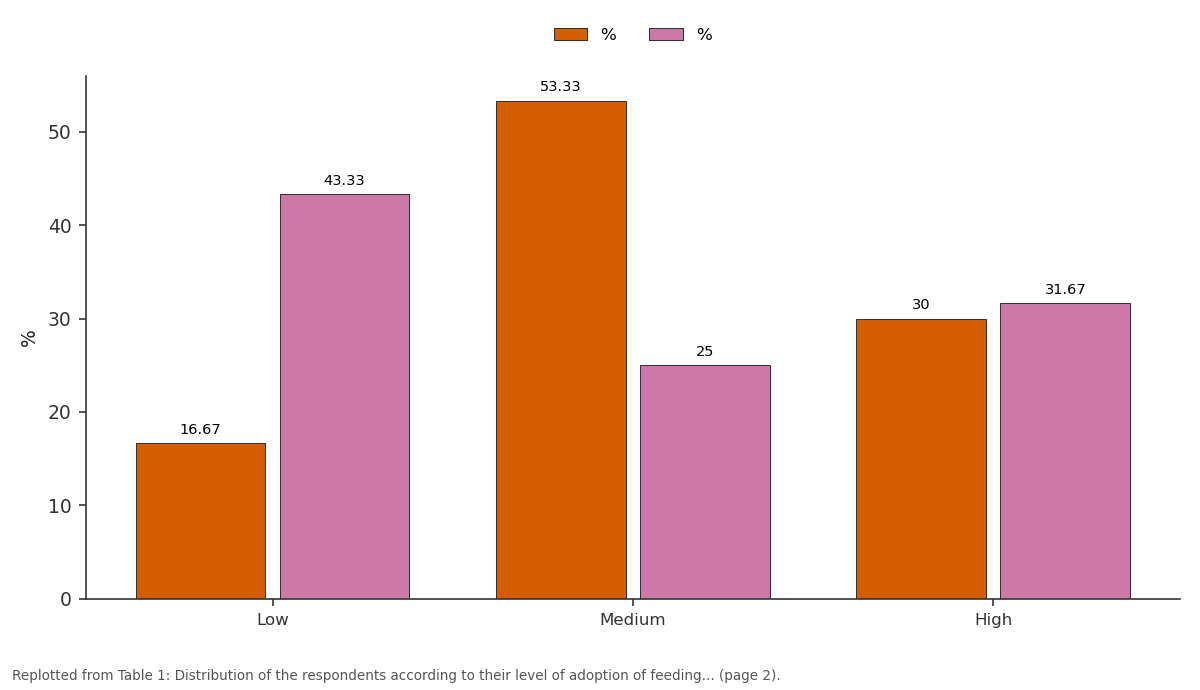
% and %: Low vs Medium vs High
Replotted from Table 1 (page 2) of the original paper. Every bar is the paper's own table value.
View source evidence ↗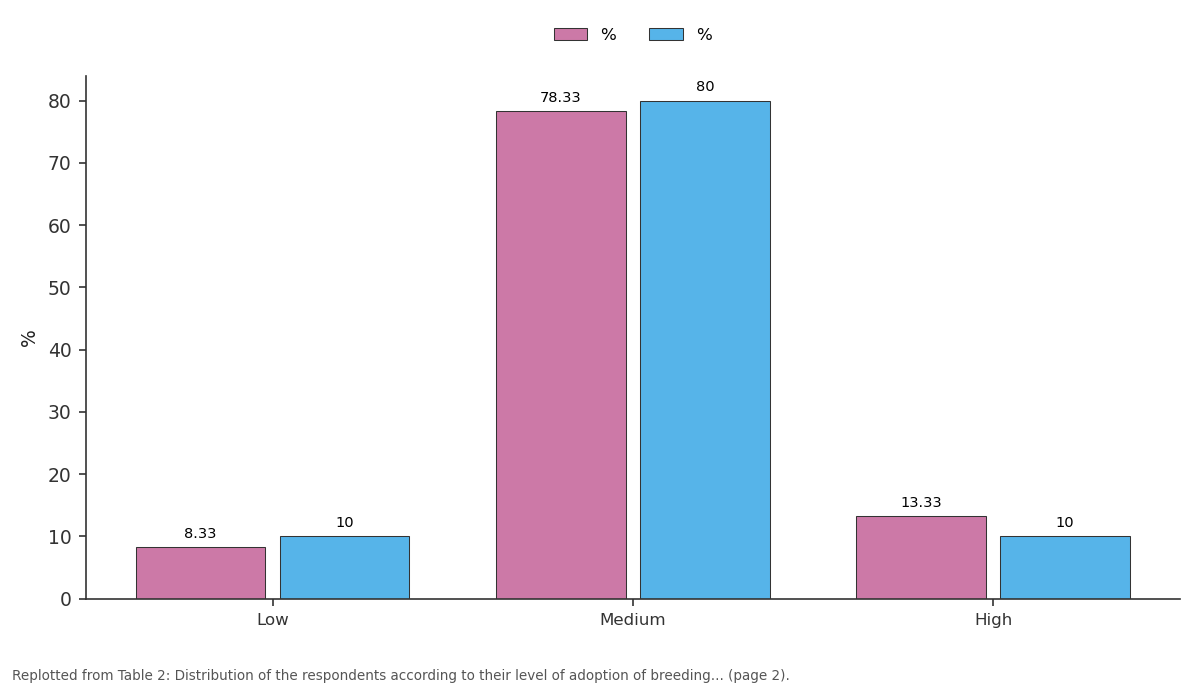
% and %: Low vs Medium vs High
Replotted from Table 2 (page 2) of the original paper. Every bar is the paper's own table value.
View source evidence ↗Figures & tables
From the original paper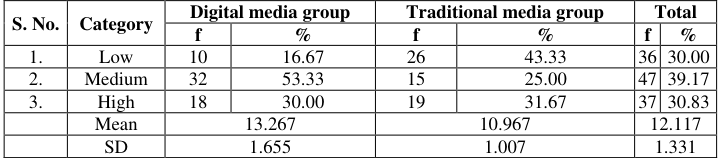 Table 1
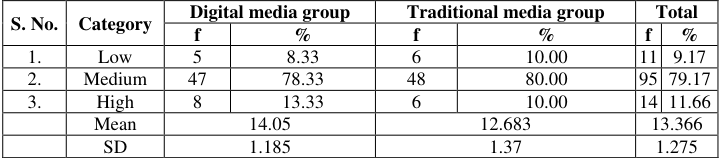 Table 2
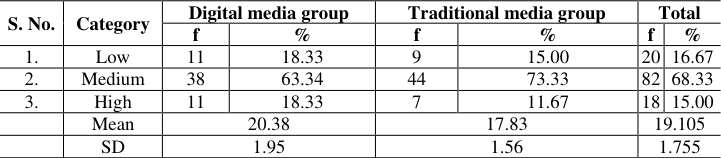 Table 3
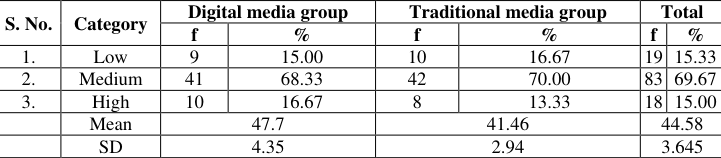 Table 4
 Table 5
Introduction
The agricultural sector in India is crucial to the country's economic prosperity because of its robust dairy farming base. Dairy farming is of paramount importance in rural regions, making a substantial contribution to food security, job opportunities, and total nutritious consumption. Despite India's preeminence in livestock, particularly in terms of milch animals, the integration of dairy farming into the agricultural sector has been historically seamless. However, challenges persist due to constraints faced by the farming community, limiting the realization of predicted improvements in milk output per animal. The success or failure of dairy enterprises hinges significantly on a farmer's adoption of various dairy husbandry practices including breeding, feeding, health care and management. Increased adoption of these dairy husbandry practices is directly correlated with improved productivity and output. In this context, digital media platforms such as YouTube and WhatsApp emerge as pivotal tools for disseminating the latest scientific knowledge and enhancing adoption levels among dairy farmers. Greater access to information is essential for fostering sustainable growth in livestock sector. The dissemination of technical information through digital media platforms plays a crucial role in nurturing the development mindset among farmers. Hence, it is imperative to assess the extent to which these digital media platforms contribute to enhancing the adoption levels and expertise of dairy farmers. Against this backdrop, this research aims to investigate the adoption levels of Andhra Pradesh dairy farmers who rely on information sourced from digital and traditional media.
Methodology
The present study was carried out in six villages that were randomly chosen from the purposively selected districts of Chittoor, Prakasam and Visakhapatnam in Andhra Pradesh. Random selection was employed to select two mandals from each of the selected districts, as well as one village from each of the selected mandals. Twenty dairy farmers were chosen at random from each village and divided into two www.extensionjournal.com groups of ten based on their exposure to traditional and digital media. The farmers who primarily relied on digital media platforms such as WhatsApp and YouTube for obtaining information were classified as belonging to the digital media group, whilst those who relied on other forms of media were categorized as part of the traditional media group. The sample consisted of 60 farmers who relied on traditional media and 60 farmers who relied on digital media. Thus, a total of 120 farmers participated in this research. All key areas of dairy farming were selected and organized for this research into three categories: feeding practices, breeding practices, health care and management practices. Data was collected using a standardized questionnaire. Simple statistical techniques were employed to evaluate the collected data. 1 showed that the majority (39.17%) of respondents had medium followed by high (30.83%) and low (30.00%) levels of adoption of feeding practices respectively. This was attributed to the fact that majority of the respondents possessed medium level of exposure to various fodder varieties and perennial multicut varieties like super napier while some of the respondents felt that it is expensive to feed dairy animals and thus displayed a lack of interest in learning know-how on feeding. The rate of adoption may be increased by training followed by exposure to mass media. Table 2 revealed that the majority (79.17%) of respondents had medium followed by high (11.66%) and low (9.17%) levels of adoption of breeding practices respectively. This was due to the fact that majority of the respondents had medium information seeking behaviour, exposure to mass media and medium level of knowledge regarding breeding practices. Established cultural norms and comfort with traditional methods might hinder complete adoption of newer practices. On perusal of Table 3, it was noticed that, majority (68.33%) of the respondents had medium followed by low (16.67%) and high (15.00) levels of adoption of health and management practices. Majority of the dairy farmers lack awareness regarding essential practices such as maintaining hygienic sheds, ensuring clean milk production, isolating diseased animals, and recognizing diseases stemming from poor management practices. This was due to the fact that majority of the respondents had medium level of knowledge on health care and management practices coupled with medium level of extension contact. From Table 4, it could be concluded that the majority (69.67%) of the respondents had a medium followed by a low (15.33%) and high (15.00%) level of overall adoption. This may be attributed to the fact that improved knowledge is closely correlated to increased adoption of scientific technologies. They made decisions based on their knowledge and perception and adopt innovations. As depicted in Table 5, the mean scores for the adoption variable indicate a significant difference between the digital media and traditional media groups, with digital media respondents exhibiting notably higher mean scores. This disparity may stem from the strong correlation between enhanced knowledge levels and increased adoption of dairy husbandry practices. These practices include feeding strategies involving mineral mixture and concentrates based on milk production, considerations of age and body weight during breeding, adherence to ideal calving intervals, implementation of calf weaning protocols, isolation of diseased animals and post-milking feed provision to facilitate teat closure and clean milk production practices.
| S. No | Variable | Mean scores | — | S.D | — | ‘Z’ value |
|---|---|---|---|---|---|---|
| Digital media group | Traditional media group | Digital media group | Traditional media group | |||
| 1. | Adoption | 47.7 | 41.46 | 4.35 | 2.94 | 9.18** |
Table text extracted from the original PDF; superscript letters are shown inline. The original table image is below.
View original table image
| S. No. | Category | Digital media group | — | Traditional media group | — | Total | — |
|---|---|---|---|---|---|---|---|
| f | % | f | % | f | % | ||
| 1. | Low | 9 | 15.00 | 10 | 16.67 | 19 | 15.33 |
| 2. | Medium | 41 | 68.33 | 42 | 70.00 | 83 | 69.67 |
| 3. | High | 10 | 16.67 | 8 | 13.33 | 18 | 15.00 |
| Mean | 47.7 | 41.46 | 44.58 | ||||
| SD | 4.35 | 2.94 | 3.645 |
Table text extracted from the original PDF; superscript letters are shown inline. The original table image is below.
View original table image
| S. No. | Category | Digital media group | — | Traditional media group | — | Total | — |
|---|---|---|---|---|---|---|---|
| f | % | f | % | f | % | ||
| 1. | Low | 11 | 18.33 | 9 | 15.00 | 20 | 16.67 |
| 2. | Medium | 38 | 63.34 | 44 | 73.33 | 82 | 68.33 |
| 3. | High | 11 | 18.33 | 7 | 11.67 | 18 | 15.00 |
| Mean | 20.38 | 17.83 | 19.105 | ||||
| SD | 1.95 | 1.56 | 1.755 |
Table text extracted from the original PDF; superscript letters are shown inline. The original table image is below.
View original table image
| S. No. | Category | Digital media group | — | Traditional media group | — | Total | — |
|---|---|---|---|---|---|---|---|
| f | % | f | % | f | % | ||
| 1. | Low | 5 | 8.33 | 6 | 10.00 | 11 | 9.17 |
| 2. | Medium | 47 | 78.33 | 48 | 80.00 | 95 | 79.17 |
| 3. | High | 8 | 13.33 | 6 | 10.00 | 14 | 11.66 |
| Mean | 14.05 | 12.683 | 13.366 | ||||
| SD | 1.185 | 1.37 | 1.275 |
Table text extracted from the original PDF; superscript letters are shown inline. The original table image is below.
View original table image
Results and Discussion
Results and Discussion
Conclusion
This research highlights a trend of medium adoption for various dairy husbandry practices (feeding, breeding, health & management) across both digital and traditional media user groups in Andhra Pradesh. The differences in adoption levels of dairy husbandry practices could be influenced by the depth and specificity of information provided through different media channels. Traditional media may offer more generalized advice, while digital media platforms could provide more detailed and tailored guidance on healthcare and management practices thus influencing adoption levels accordingly. Overall, the convergence of adoption levels to a medium level across both digital and traditional media groups indicates a common baseline of adoption among dairy farmers, albeit with variations influenced by the nature and effectiveness of information dissemination through different media sources. For effective information dissemination, a multimodal approach utilizing both digital and traditional media is optimal. This combined strategy can reach a wider audience in a shorter timeframe, fostering the easier spread and adoption of improved dairy husbandry practices.
Figures and tables from the paper
| S. No. | Category | Digital media group | — | Traditional media group | — | Total | — |
|---|---|---|---|---|---|---|---|
| f | % | f | % | f | % | ||
| 1. | Low | 10 | 16.67 | 26 | 43.33 | 36 | 30.00 |
| 2. | Medium | 32 | 53.33 | 15 | 25.00 | 47 | 39.17 |
| 3. | High | 18 | 30.00 | 19 | 31.67 | 37 | 30.83 |
| Mean | 13.267 | 10.967 | 12.117 | ||||
| SD | 1.655 | 1.007 | 1.331 |
Table text extracted from the original PDF; superscript letters are shown inline. The original table image is below.
View original table image
References
12 in the original paper- Bhise RN, Gaikwad DS, Kasal YG, Kadam JR. Adoption behaviour of dairy farmers about recommended dairy management practices. Plant Archives. 2018;18(1):523-530.
- Divekar BS, Trivedi MM. Comparative Adoption Level of Improved Animal Husbandry Practices by Dairy Farmers of Kheda and Panchmahal Districts of Middle Gujarat, India. Int J Curr Microbiol App Sci. 2017;6(11):3018-3023.
- Godara P, Sharma N, Rajput D. Adoption of dairy management practices among the livestock owners of Bikaner district of Rajasthan. J Entomol Zool Stud. 2018;6(5):843-846.
- Gupta J, Subash S, Devi MCA, Mandi K. Adoption Level of Good Dairy Management Practices among Dairy Farmers in Central Plain Zone of Uttar Pradesh, India. Curr J Appl Sci Technol. 2020;47-53.
- Kumawat R, Yadav JP. Adoption of improved dairy husbandry practices by dairy farmers. Indian Res J Ext Edu. 2016;12(2):225-228.
- Nandev MP, Kolhe SR, Shirsat SG. Socioeconomic Status in Relation to Adoption Animal Husbandry Practices (AHPs) of Dairy Farmers. Ind J Pure App Biosci. 2019;7(5):471-475.
- Parihar K, Verma J, Kumar A. Extent of Adoption of Scientific Dairy Farming Practices in Khargone District of Madhya Pradesh. Int Arch App Sci Technol. 2020;11(3):40-44.
- Rahman S, Gupta J. Knowledge and adoption level of improved dairy farming practices of SHG members and non-members in Kamrup district of Assam, India. Indian J Anim Res. 2015;49:234-240.
- Singh MK, Singh AK, Kadian KS. Adoption of Improved Dairy Farming Practices by Dairy Farmers of Haryana, India. Int J Curr Microbiol App Sci. 2018;7(9):3622-3629.
- Singh S, Kumar R, Meena BS. Adoption level of scientific dairy farming practices by dairy farmers of Haryana. Indian Res J Ext Edu. 2016;10(3):45-48.
- Sivaji DV, Natchimuthu K, Ramkumar S, Sreekumar D, Ganesan R. Socio economic profile of Buffalo farmers in Guntur and Prakasam districts of Andhra Pradesh, India. Intl J Curr Microbiol Appl Sci. 2018;7(4):2319-7706.
- Yadav CM, Naagar KC. Dairy farming technologies adopted by the farmers in Bhilwara district of Rajasthan. Indian Res J Ext Edu. 2021;21(1):7-11.
Cited by 1
From OpenAlex, OpenCitations and reference lists read by Scinovex
- Adoption dynamics of scientific milking, healthcare and feeding practices and their relationship between socio-demographic profile of dairy farmers of Anand district
Palak P Vaidh, Manoj Sharma, Nayan H Raval, Palak Shah · International Journal of Advanced Biochemistry Research · 2025
This study investigates the adoption of scientific milking, healthcare, and feeding practices among dairy farmers in Anand district, Gujarat, and explores how socio-demographic characteristics influence these adoption levels. A sample of 400 farmers was selected using multistage random sampling method across four talukas of Anand district: Anand, Petlad, Umreth, and Anklav. Data were collected using a well-structured interview schedule and analyzed using correlation statistics. The findings revealed that education, experience in dairy farming, and professional training significantly influenced