
Research article · 2024 · Full text
International Journal of Agriculture Extension and Social DevelopmentUtilization of cyber-extension for agricultural extension delivery in Lagos state, Nigeria
Volume 7(4) · Pages 275–280 · DOI: 10.33545/26180723.2024.v7.i4d.538 ↗
Research areasICT Impact and PoliciesICT in Developing CommunitiesAgricultural Innovations and Practices
Abstract
Author-writtenThe utilization of cyber-extension tools for agricultural extension delivery has the potential to effectively revolutionize extension services, especially in reaching out to a large and diverse farming population. This study assessed the utilization of cyber-extension for agricultural extension delivery in Lagos State. There are 90 extension personnel in the employment of the Lagos State Agricultural Development Programme therefore; all of them were purposively selected to constitute the sample size for the study. Both primary and secondary data were used for the study. Primary data were collected with the aid of a well-structured questionnaire. The data collected was analyzed using descriptive statistics such as frequency counts, percentages, mean and the inferential statistical tool used in testing the stated hypothesis was Chi-square. The study identified that there were fewer cyber-extension tools available in the study area with their attendant constraints, which poses significant challenges to the effective utilization of the tools by the extension agents. The Chi-square result shows that there was a significant relationship between the type of cyber-extension tools available for agricultural extension delivery and the level of utilization of cyber-extension for agricultural extension delivery. It was recommended that there is a need for increased collaboration and partnerships between government agencies, NGOs, and private sector entities to support the development and deployment of cyber-extension tools and address the constraints associated with their use, for improve farmers' access to information and resources, and enhance agricultural productivity and sustainability in the State.
Summary
Source-checkedPlain-language reading of the full paper, prepared with AI and checked against the text. Each point links to the authors' own words.
Why it matters
- Agricultural extension services are essential for increasing farmer productivity and income by providing necessary knowledge and skills. View evidence ↗
- Nigeria faces a severe shortage of extension personnel, reporting the lowest agent-to-farmer ratio in Africa at 1:7500. View evidence ↗
The question
- The study aimed to assess how cyber-extension is utilized for agricultural extension delivery within Lagos State, Nigeria. View evidence ↗
What they did
- The study purposively sampled all 90 extension personnel from the Lagos State Agricultural Development Programme, including supervisors and agents. View evidence ↗
- Data was gathered via structured questionnaires and analyzed using descriptive statistics and Chi-square tests for hypothesis testing. View evidence ↗
What they found
- The extension workforce in the study area is heavily male-dominated, with 81.1% men and 18.9% women. View evidence ↗
- The extension agents are highly experienced, with a mean of 21 years of experience and 66.7% having worked for 16 years or more. View evidence ↗
- Commonly available tools include Facebook (100%), SMS/email (97.8%), online forums (94.4%), and websites (88.9%). View evidence ↗
- Certain specialized tools, including Plantix, E-learning platforms, and podcasts/webinars, were completely unavailable in the study area. View evidence ↗
- Critical barriers reported by 100% of respondents include erratic power supply, the cost of access, and the unavailability of digital infrastructure. View evidence ↗
- A significant relationship exists between the types of cyber-extension tools available and the level of their utilization (X²=105.853, p=0.000). View evidence ↗
What it means
- The authors recommend improving internet connectivity and digital infrastructure in rural areas to ensure widespread access to these tools. View evidence ↗
- Investment in training and capacity building is recommended to provide extension agents with the technical skills needed for effective tool utilization. View evidence ↗
Visual summary
3 visualsIllustrations explain the paper; charts are replotted from the paper's own table values.
Barriers to Cyber-Extension
AI-generated conceptual illustration (Nigerian cassava farmers and agricultural extension agents in Lagos state). It explains the idea and does not show study data.
View source evidence ↗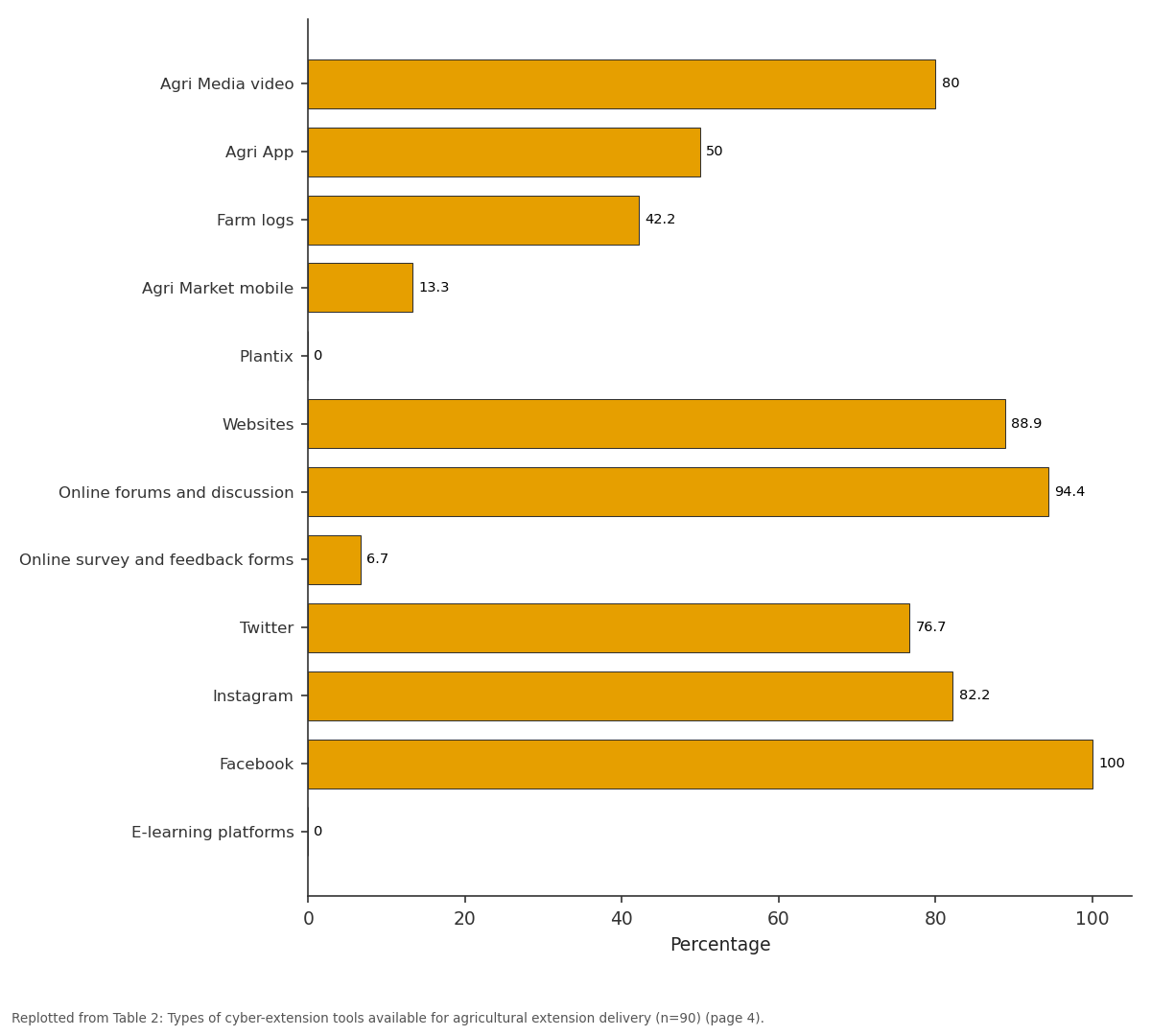
Percentage: Agri Media video vs Agri App vs Farm logs vs Agri Market mobile vs Plantix
Replotted from Table 2 (page 4) of the original paper. Every bar is the paper's own table value.
View source evidence ↗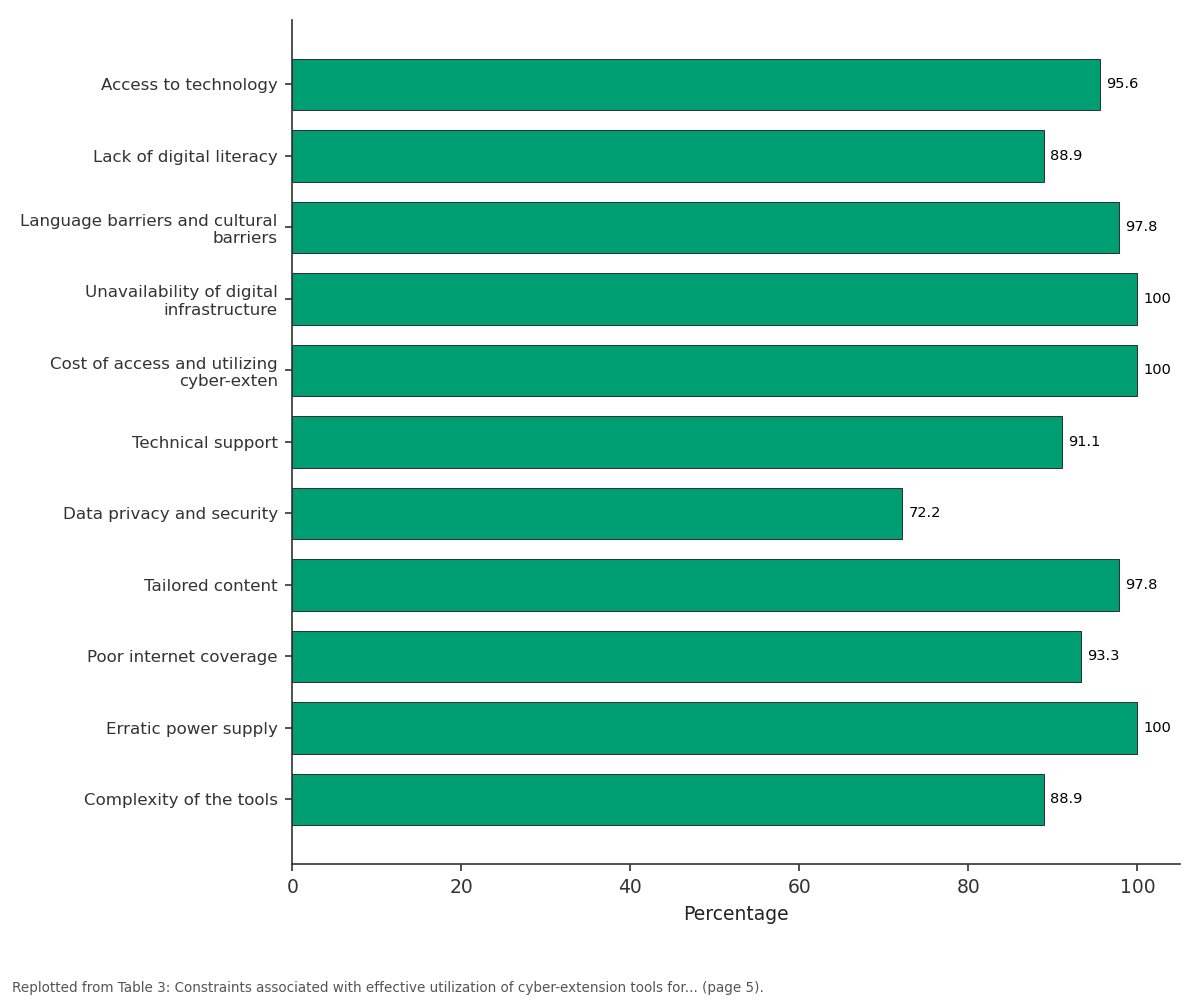
Percentage: Access to technology vs Lack of digital literacy vs Language barriers and... vs Unavailability of... vs Cost of access and...
Replotted from Table 3 (page 5) of the original paper. Every bar is the paper's own table value.
View source evidence ↗Figures & tables
From the original paper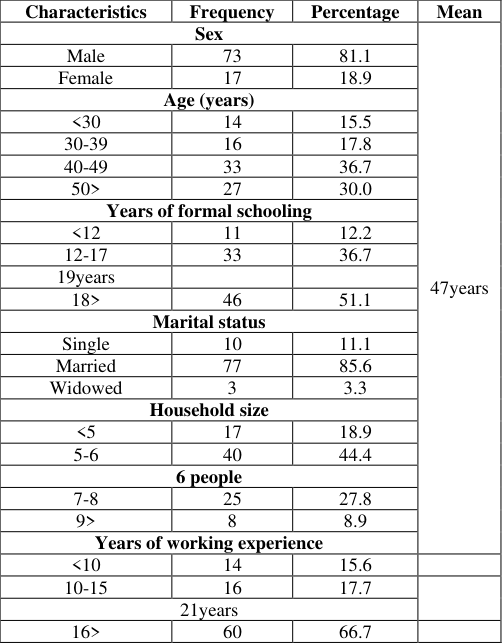 Table 1
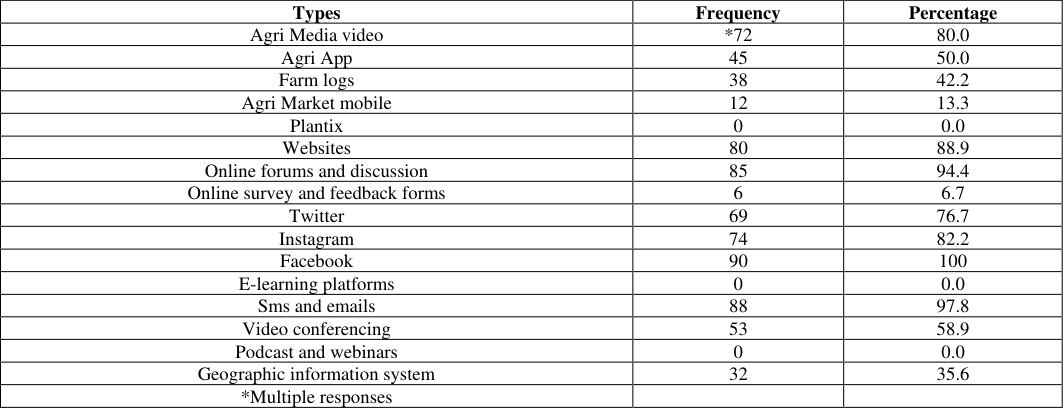 Table 2
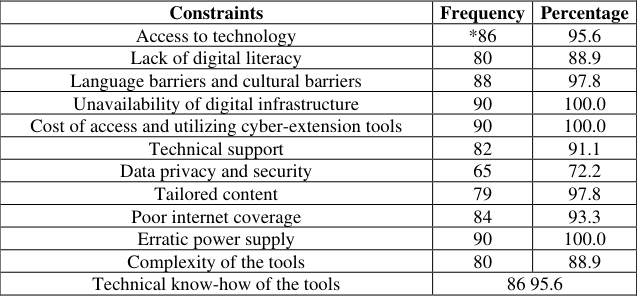 Table 3
 Table 4
Introduction
In recent years, the agricultural sector has undergone significant transformations due to advancements in technology and increased access to digital resources. Agricultural extension services play a crucial role in providing farmers with the necessary knowledge and skills to improve their agricultural practices and ultimately increase their productivity and income. Agricultural extension is indispensable to agricultural development. Agricultural extension plays a strategic role in bringing various stakeholders in agricultural development together. Specifically, it links together scientists and researchers working on different aspects of agriculture and the farmers on the field who implement the various research findings to improve the production and processing of agricultural produce. Furthermore, it helps to improve the livelihood of farmers and contributes to the development of rural communities (Alabi et al., 2021) [2] . Extension services are organized and delivered in a variety of forms, with the ultimate aim of increasing farmers' productivity and income. The success of extension in achieving this will, however, depend on the extension approach that is being used to reach or communicate with farmers. In Nigeria, traditionally, a range of approaches to extension delivery, such as face-to-face interactions, workshops, printed materials, training and visits, ministry of agriculture operated extension, university-operated extension, and a more participatory approach, have been promoted over the years by the various extension service providers, including government and non-governmental organizations. The failure of many of these extension approaches to meet their goals effectively, coupled with inadequate personnel and limited budgets for supporting public extension, has led to continuous modification and experimentation with existing approaches, (Anupam and Balakrishnan, 2018) [3] . Furthermore, Nigeria experiences the problem of an insufficient number of extension agents in the extension organizations in Nigeria. According to the African Seed Access Index (TASAI) 2020 report, Nigeria has the lowest ratio of agricultural extension workers to farmers' ratio in Africa, with an extension agent to farmer ratio of 1:7500. Unfortunately, farming communities are geographically located far apart in difficult-to-reach zones, ranging from 15 to about 60 square kilometres (TASAI, 2020) [14] , and this has to be covered by very few agricultural extension agents. In order to complement the traditional approaches, stakeholders and actors in the agricultural extension service delivery system deem it necessary to use innovative approaches and strategies that will reduce the gap between farmers and extension personnel and increase the speed with www.extensionjournal.com which information is delivered to the target farmers (Anupam and Balakrishnan, 2018) [3] ; hence, the need for the utilization of E-Extension. Extension stands for "the action or process of enlarging or extending something." It could be an extension of area, time, or space. E-extension (Cyber extension) could thus be defined as "the extension over cyberspace." In the applied context of agriculture, cyber extension means "computer communication and digital interactive multi-media to facilitate the dissemination of agricultural technology." E extension could also be termed as a network of institutions that provide a more efficient alternative to the traditional extension system of agriculture. It is a collaboratively built internet-based environment to enhance face-to-face and paper-based transactions, which can also be used as an electronic tool to deliver sound and the latest information on agriculture (Renwick, 2019) [13] . According to Efejika et al. (2019) [8] , E-extension is the use of internet technology or information and communication technology as a platform for exchanging information and providing services to actors in the agricultural value chain. E-extension tools support the delivery of information in diverse styles such as voice, image, motion, instant messages, and applications; therefore; cyber-extension refers to the use of electronic and digital technologies such as the internet, mobile applications, social media, and other digital platforms to deliver extension services to farmers. These technologies have the potential to bridge the gap between extension agents and farmers, especially in remote or underserved areas, and provide timely and relevant information to support the farmers' decision-making processes. E-Extension is also known as cyber extension, is defined as the 'extension over cyber space'. But, in applied context of agriculture, cyber extension means, "using the power of online networks, computer communications and digital interactive multi-media to facilitate dissemination of agricultural technology. It includes effective use of information and communication technology, national and international information networks, internet, expert systems, multi-media learning systems and computer based training systems to improve information access to the farmers, extension workers, research scientists and extension managers, however, with the rapid advancement of technology, there has been a growing interest in utilizing cyber-extension as a means of reaching the farmers more effectively and efficiently. With the advancement of technology, cyber-extension has emerged as a potential tool to enhance the delivery of extension services to the farmers. For effective and timely information dissemination by agricultural extension agents (AEAs), the agricultural extension system needs an alternative strategy for information dissemination rather than the traditional face-toface and other manual means. There is a need for strategies that could boost quick and easy access to information, thereby reducing stress for both farmers and extension agents. This study therefore intends to assess the utilization of cyber-extension for agricultural extension delivery in Lagos State, Nigeria. Specifically, it described the personal characteristics of the respondents, identified the type of cyber-extension tools available to the respondents for agricultural extension delivery and identified the constraints militating against effective utilization of cyber-extension tools for agricultural extension delivery. It was hypothesized that there is no significant relationship between type of cyber-extension tools available for agricultural extension delivery and level of utilization of cyber-extension for agricultural extension delivery.
Materials and Methods
This study was carried out in Lagos State, Nigeria. The state was created out of the former western region by the then regime of General Yakubu Gowon. Its capital is Ikeja. Prior to this, Lagos Municipality had been administered by the Federal Government through the Federal Ministry of Lagos Affairs as the regional authority, while the Lagos City Council (LCC) governed by the City of Lagos. Equality, the metropolitan areas (colony province) of Ikeja, Agege, Mushin, Ikorodu, Epe and Badagry were administered by the western region. It shares boundaries with Ogun State both in the north and east and is bounded on the west by the Republic of Benin and in the south, it stretches for 180 kilometers along the coast of Atlantic Ocean. The small state in the federation, it occupies an area of 3,345 square kilometers, 22% or 787 square kilometre of which consists of lagoons and creeks. Lagos State has a population of 9,013,534 (NPC, 2006) with twenty local government areas namely Agege, Ajeromi-Ifelodun, Alimosho, Amuwo-Odofin, Apapa, Badagry, Epe. Eti-osa, Ibeju/Lekki, Ifako-IjayeIkeja, Ikorodu, Kosofe, Lagos Island, Lagos Mainland, Mushin,Ojo/Oshodi-Isolo, Shomolu and Surulere. The State is essentially a Yoruba speaking environment, it is nevertheless, a socio-cultural melting pot attracting both Nigerians and Foreigners alike. All the extension personnel under the Lagos State Agricultural Development Programme constitute the target population for this study. There are 90 extension personnel in the employment of the Lagos State Agricultural Development Programme namely; 64 agricultural extension supervisors, 10 block extension agents and 16 block extension supervisors hence all the extension personnel were purposively selected to constitute the sample size for the study. Both primary and secondary data were used for the study. Primary data was collected with the aid of a well-structured questionnaire. Data was analysed using descriptive statistics such as frequency counts, percentages and means and inferential statistical tool used in testing the stated hypothesis was Chi-square.
Results and Discussion
Results and Discussion
Respondents' personal characteristics
The result presented in table 1 shows that 81.1% of the extension workers in the study area were males while 18.9% were females. The findings reveal that agricultural extension organization in the study area is male dominated. The implication of this finding is that there may have limited perspectives in the needs and challenges faced by female farmers which can result into the development and dissemination of agricultural information and practices that are not fully tailored to the needs of the female farmers. Also, it may lead into limited access for female farmers in which women may face barriers in accessing extension services which may result into female farmers being excluded from valuable information and resources thus leading to a widening gender gap in agricultural productivity and income as well as bring about gender www.extensionjournal.com disparities in extension outcomes which can hinder efforts to achieve gender equality and inclusive economic development in the agricultural sector. This finding is in line with the work of Adebayo and Worth, (2023), when they discovered that most agricultural extension practitioners in many developing countries are men, and their services are often oriented and channeled to favour men farmers, thereby depriving women farmers of the essential agricultural extension services needed to realize their potential. The table further reveal that the respondents mean age was 47 years hence it could be seen that 33.3% of them fall below the mean age while 36.7% were within the mean age range and 30% of them were above the mean age range. This indicates that extension workers in the study area are still youthful, vibrant and in their active age. This implies that the extension agents may have varying degrees of familiarities and comfort with using cyber-extension tools, the younger extension agents might be more adept with technology while the older agents may need additional training and support to effectively utilize these tools. Also the younger extension agents may possess fresh perspectives and digital literacy skills that could contribute to the organization's knowledge base and facilitate knowledge transfer to older agents. This finding contradict the finding of Ifeanyi-obi and Ekere, (2021) [7] , when they said the average age of extension agents was found to be 46 years. Similarly, the extension agents mean year spent schooling was 19 years therefore, 12.2% of the respondents spent below 12 years schooling while 36.7% spent between 12 to 17 years in school and 51.1% spent 18 years and above. This indicates that more than half of the respondents have strong educational background. This implies that extension agents spending 18 years and above in school are likely to be more comfortable with and proficient in using various cyber-extension tools which can lead to a more effective and efficient communication and delivery of agricultural extension services to the farmers. It may contribute to the agents' ability to adapt to new and emerging cyberextension tools because they may be open to learning and integrating new technologies into their extension work which can enhance their ability to reach and engage with their target audience. This finding is in line with the finding of Ifeanyi-obi and Ekere (2021) [7] , where it was discovered that extension agents possess solid educational credentials, contrary to popular belief and assumption that extension work is a low-profile job reserved for the illiterate. It was observed that most of the agricultural extension workers were married (85.6%) while 11.1% were single and only 3.3% were widow. This indicate that majority of the respondents were married. Married extension agents mat have greater access to technology due to shared resources within their household which could potentially lead to increased utilization of cyber-extension tools as compared to single agents who may rely solely on their own resources. Also, marital status of the extension agents may influence their attitude and openness to adopting and using cyberextension tools. This finding is in line with the work of Kemunto, Adhiambo and Bosire (2018) [9] and Anyango, Ojera and Ochieng (2013) [4] established that marital status had an influence on job satisfaction where the married were much happier in their jobs than the single. This shows that being married may positively influence commitment and involvement in extension works. Furthermore, it could be seen that 44.4% of the respondents have household size of between 5-6, 27.8% have household size of between 7-8 people while 18.9% have household size of less than 5 people and 8.9% have household size of 9 people and above and a mean household size of 6 people. This indicates that the agricultural extension workers in the study area have moderate household. The findings conform with the studies of Ogunwande, Odefadehan and Akinrinola (2018) [11] and Okwuokenye and Okoedo-Okojie (2014) [12] which reported that agricultural extension workers in Nigeria had between low to moderate family size. Also, the result presented in table 1 shows that 66.7% of the extension agents have working experience of 16 years and above while 17.7% have working experience of between 10-15 tears and 15.6% have working experience of below 10 years with mean years of working experience of 21 years. This implies that the extension agents have in-depth knowledge and expertise in agricultural practices and the needs of the local farming communities which may enable them to effectively identify the most relevant cyber-extension tools and content for the specific needs of the farmers. Also, the extension agents are likely to possess strong adaptability and proficiency in adopting new technologies which can make them more receptive and capable of learning and leveraging cyberextension tools to enhance their outreach and impact thereby bridging the gap between traditional agricultural practices and modern cyber-extension tools. This study does not conform with the assertions of Okwuokenye and Okoedo-Okojie (2014) [12] who reported over 17 years of experience for the extension workers in Delta State, Nigeria while Davis and Franzel, (2018) [5] reported 15 years as the average years of experience among extension workers in Nigeria.
| Characteristics | Frequency | Percentage | Mean |
|---|---|---|---|
| Sex | 47years | ||
| Male | 73 | 81.1 | |
| Female | 17 | 18.9 | |
| Age (years) | |||
| <30 | 14 | 15.5 | |
| 30-39 | 16 | 17.8 | |
| 40-49 | 33 | 36.7 | |
| 50> | 27 | 30.0 | |
| Years of formal schooling | |||
| <12 | 11 | 12.2 | |
| 12-17 | 33 | 36.7 | |
| 19years | |||
| 18> | 46 | 51.1 | |
| Marital status | |||
| Single | 10 | 11.1 | |
| Married | 77 | 85.6 | |
| Widowed | 3 | 3.3 | |
| Household size | |||
| <5 | 17 | 18.9 | |
| 5-6 | 40 | 44.4 | |
| 6 people | |||
| 7-8 | 25 | 27.8 | |
| 9> | 8 | 8.9 | |
| Years of working experience | |||
| <10 | 14 | 15.6 | |
| 10-15 | 16 | 17.7 | |
| 21years | |||
| 16> | 60 | 66.7 |
Table text extracted from the original PDF; superscript letters are shown inline. The original table image is below.
View original table image
Types of cyber-extension tools available for agricultural extension delivery
On the availability of cyber-extension tools for extension delivery, result presented in Table 2 show that all (100%) of the respondents indicated the availability of Facebook, short message services and email (97.8%), online forum and discussion (94.4), websites (88.9%), instagram (82.2%), agrimedia video (80%) and Twitter accounted for 76.7%, video conferencing (58.9%), agriapp (50%), farmlogs (42.2%), geographic information system (35.6%), agrimarket mobile (13.3%), online services and feedback forms (6.7%) while tools such as plantix, E-learning and podcast/webinar were some of the unavailable cyberextension tools in the study area. This indicates that not all needed tools for effective functioning of cyber-extension are available in the study area which may be attributed to the cost of the tools. This implies that with fewer cyberextension tools available, there is a reduced capacity to reach and serve a wider audience of farmers and agricultural stakeholders which can hinder the effort of providing timely and relevant information to the farmers' especially in remote or underserves areas. Also, it may result in limited opportunities for interactive communication and engagement between extension providers and the farmers as well as hinder the dissemination of diverse and tailored information to different target groups of farmers as each tool serves unique purposes and format for conveying information. This finding is in line with the finding of Ezeh (2013) [6] who reported the used of old ICT for extension service delivery.
| Types | Frequency | Percentage |
|---|---|---|
| Agri Media video | *72 | 80.0 |
| Agri App | 45 | 50.0 |
| Farm logs | 38 | 42.2 |
| Agri Market mobile | 12 | 13.3 |
| Plantix | 0 | 0.0 |
| Websites | 80 | 88.9 |
| Online forums and discussion | 85 | 94.4 |
| Online survey and feedback forms | 6 | 6.7 |
| 69 | 76.7 | |
| 74 | 82.2 | |
| 90 | 100 | |
| E-learning platforms | 0 | 0.0 |
| Sms and emails | 88 | 97.8 |
| Video conferencing | 53 | 58.9 |
| Podcast and webinars | 0 | 0.0 |
| Geographic information system | 32 | 35.6 |
| *Multiple responses |
Table text extracted from the original PDF; superscript letters are shown inline. The original table image is below.
View original table image
Constraints associated with effective utilization of cyberextension tools for agricultural extension delivery
Further result presented in Table 3 reveals the identified constraints associated with effective utilization of cyberextension tools to include; access to technology (95.6%), digital literacy (88.9%) and language barriers and cultural barriers (97.8%). Also, unavailability of digital infrastructure (100%), cost of access and utilizing cyberextension tools (100%), technical support (91.1%) and data privacy and security (72.2%). Others include tailored content (97.8%), poor internet coverage (93.3%), erratic power supply (100%), complexity of the tools (88.9%) and technical know-how of the tools (95.6%). This means that all identified constraints may affect the utilization of cyberextension tools for effective extension service delivery. There will be restriction in the reach of cyber-extension tools which may result to digital divide with some farmers being left out of crucial extension services and information. Also, the identified constraints can lead to disparities in access to cyber-extension tools with certain demographic groups or region being disproportionately affected which can contribute to existing inequalities within the agricultural sector thereby exacerbating disparities in knowledge, productivity and income. This finding confirms the findings of Thomas and Laseinde (2015), that extension workers are faced by a number of constraints in the use of cyberextension tools. Therefore, it is fair to posit that cyber extension usage is adversely affected by the constraints mentioned above and capable of affecting extension service delivery by extension workers in the study area and agricultural productivity in general. www.extensionjournal.com
| Constraints | Frequency | Percentage |
|---|---|---|
| Access to technology | *86 | 95.6 |
| Lack of digital literacy | 80 | 88.9 |
| Language barriers and cultural barriers | 88 | 97.8 |
| Unavailability of digital infrastructure | 90 | 100.0 |
| Cost of access and utilizing cyber-extension tools | 90 | 100.0 |
| Technical support | 82 | 91.1 |
| Data privacy and security | 65 | 72.2 |
| Tailored content | 79 | 97.8 |
| Poor internet coverage | 84 | 93.3 |
| Erratic power supply | 90 | 100.0 |
| Complexity of the tools | 80 | 88.9 |
| Technical know-how of the tools | 86 95.6 |
Table text extracted from the original PDF; superscript letters are shown inline. The original table image is below.
View original table image
Test of hypothesis
There is no significant relationship between types of cyberextension tools available for agricultural extension delivery and level of utilization of cyber-extension for agricultural extension delivery. The result of Chi-square analysis presented in Table 4 shows that there was a significant relationship between type of cyber-extension tools available for agricultural extension delivery (X 2 =105.853, p=0.000) and level of utilization of cyber-extension for agricultural extension delivery. The significant relationship implies that different types of cyber-extension can improve access to agricultural information for the farmers and extension agents thereby, leading to an increase in knowledge and awareness of modern farming practices and techniques which has the potential to positively impact the agricultural sector by promoting sustainable practices, improving productivity and enhancing the livelihoods of the farmers. This finding is in line with finding of Ogunkunle et al. (2019) [10] who posited that there is a significant relationship between availability and utilization of ICT tools for accessing agricultural information among women farmers in Ogun State.
Conclusion and Recommendations
In conclusion, the study reveals that the utilization of cyberextension tools for agricultural extension service delivery can contribute to enhanced reach, cost-effectiveness, customization, interactivity, timely information, data-driven decision-making, capacity building in the agricultural sector and increase the efficiency and effectiveness of extension services. Also, the types of cyber-extension tools available significantly influence their level of utilization however, the availability of cyber-extension tools and the constraints associated with their use can pose significant challenges to their adoption and utilization hence, the following recommendations are made based on the findings of the study; 1. It is important to recognize that the successful implementation of cyber-extension tools required addressing digital divide challenges hence, efforts should be made to improve internet connectivity and provision of digital infrastructure in rural and remote areas to ensure widespread access to cyber-extension tools. 2. Investment in capacity building and training programmes is essential to equip extension agents with the necessary technical skills and knowledge to effectively utilize these tools. 3. Also, the development of user-friendly and context-appropriate cyberextension tools that are tailored to the specific needs and preferences of the target users is crucial 4. There is a need for increased collaboration and partnerships between government agencies, NGOs and private sector entities to support the development and deployment of cyber-extension tools and address the constraints associated with their use.
References
13 in the original paper- Adebayo JA, Worth SH. Profile of women in African agriculture and access to extension services. J Soc Sci Humanit. 2023;9:1-7. Available from: http://creativecommons.org/licenses/by/4.0/
- Alabi OS, Ajayi AO, Fapojuwo OE, Alabi TO. Knowledge and skill of agricultural extension agents in research and data management in Southwest, Nigeria. Ife J Agric. 2021;33(3).
- Anupam, Balakrishnan. Smart phone applications: role in Agri-information dissemination. Agric Rev. 2018;39(1):82-85. Print ISSN: 0253-1496 / Online ISSN: 0976-0539.
- Anyango C, Ojera P, Ochieng I. Employee characteristics and job satisfaction. Int J Sci Res. 2013;4(6):2607-2611.
- Davis K, Franzel S. Extension and advisory services in 10 developing countries: a cross-country analysis. Developing Local Extension Capacity (DLEC) Project. Available from: https://www.digitalgreen.org/wp content/uploads/2017/09/EASin-Developing-CountriesFINAL.pdf (accessed 20 March 2020).
- Ezeh AN. Extension agents access and utilization of information and communication technology (ICT) in www.extensionjournal.com extension service delivery in South East Nigeria. J Agric Ext Rural Dev. 2013;5(11):266-276.
- Ifeanyi-obi CC, Ekere K. Assessment of climate change training needs of agricultural extension agents in Abia state, Nigeria. South African J Agric Ext. 2021;49(3):76-89. http://dx.doi.org/10.17159/24133221/2021/v49n3a12854 (License: CC BY 4.0).
- Ifejika PI, Asadu AN, Enibe DO, Ifejika LI, Sule AM. Analysis of social media mainstreaming in E-extension by agricultural development programmes in north central zone, Nigeria. J Agric Ext Rural Dev. 2019;11(4):80-83.
- Kemunto ME, Adhiambo RP, Bosire J. Is marital status a predictor of job satisfaction of public secondary school teachers? Int. J Psychol. Behav. Sci. 2018;8(3):51-58.
- Ogunwande IO, Odefadehan OO, Akinrinola OO. Analysis of agricultural extension contact effects on rural farming households' productivity in Oyo State, Nigeria. J Sustain Technol. 2018;9(2):1-11.
- Okwuokenye GF, Okoedo-Okojie DU. Evaluation of extension agents commitment to the agricultural loans and inputs supply programme on special rice production in Delta State, Nigeria. J Appl Sci Environ Manage. 2014;18(2):327-335.
- The African Seed Access Index, TASAI. Nigeria Ratio of Agricultural Extension Workers to Farmers lowest in Africa -Report. 2020.
- Thomas KA, Laseinde AA. Training needs assessment on the use of social media among extension agents in Oyo State, Nigeria. J Agric Inf. 2015;6:110-111.
Cited by 1
From OpenAlex, OpenCitations and reference lists read by Scinovex
- Rural community empowerment: strengthening the capacity of rice farmers based on cyber extension in Konda District South Konawe Regency ↗
Sukmawati Abdullah, Bunyamin · Frontiers in Sustainable Food Systems · 2026
Introduction Sustainable rural development requires strengthening farmers’ capacities and leveraging Cyber Extension to address productivity stagnation, the digital divide, and limited access to information in support of the self-reliance of rice farmers. This study aims to analyze the role of capacity strengthening of rice farmers through the utilization of Cyber Extension in promoting rural community empowerment in Konda Subdistrict. Methods…
❝ 0PDF