
Research article · 2024 · Full text
International Journal of Research in AgronomyScreening of plant morphological characteristics of safflower against Safflower aphid
Volume 7(4S) · Pages 181–185 · DOI: 10.33545/2618060x.2024.v7.i4sc.575 ↗
Research areasAgricultural pest management studiesSunflower and Safflower CultivationPeanut Plant Research Studies
Abstract
Author-writtenThe investigation entitled “Screening of plant morphological characteristics of safflower against safflower aphid” was carried out at the Department of Agricultural Entomology, VNMKV, Parbhani, during Rabi 2021-22. In screening studies, 15 safflower genotypes were screened against the safflower aphid under field conditions. Based on foliage drying grade, aphid population, plant morphological characters and yield contributing characters it is observed that the safflower genotype entries having more spines, green, thin and waxy leaves, thin capitula, small sized seeds sheltered less aphid population than genotype entries of non-spiny, erect plant type, leathery leaves with succulent stems. Considering the all plant morphological characters more spiny genotypes viz., SSF-682, SSF-695, SSF-714, SSF-704, SSF-734 were observed resistance against safflower aphid compared to national check A-1. Mostly the plant morphology plays crucial role in the aphid resistance mechanism.
Summary
Source-checkedPlain-language reading of the full paper, prepared with AI and checked against the text. Each point links to the authors' own words.
Why it matters
- Safflower is recognized as the most significant oilseed crop grown during the rabi season. View evidence ↗
- The safflower aphid (Uroleucon compositae) is a primary pest that can reduce seed yields by 20% to 60%. View evidence ↗
- Aphid infestations not only lower yield but can also reduce seed weight by 50.6% and oil content by up to 32%. View evidence ↗
The question
- The study aimed to identify safflower germplasm accessions resistant to aphids to support the development of integrated pest management through resistant varieties. View evidence ↗
What they did
- The research was conducted in Parbhani, Maharashtra, during 2021-22, using 14 safflower germplasm accessions arranged in a Randomized Block Design. View evidence ↗
- The study utilized a susceptible infester check and the A-1 variety as a resistant check for comparison. View evidence ↗
- Aphid populations were monitored weekly on 15 randomly selected plants per plot by counting aphids on a 5 cm twig. View evidence ↗
What they found
- All 14 tested genotypes were categorized as resistant with A.I.I. values between 1.30 and 2.00, while the A-1 check was only moderately resistant. View evidence ↗
- Genotypes SSF-704, SSF-695, SSF-682, SSF-734, and SSF-714 showed the lowest aphid populations, ranging from 54.95% to 62.30% relative to the A-1 check. View evidence ↗
- The number of spines on the leaves was found to be directly correlated with resistance, as plants with more spines were more resistant to aphid infestation. View evidence ↗
- Resistance was associated with spiny genotypes, thin stems, and pale green leaves, whereas susceptibility was linked to non-spiny, tall, late-maturing plants with succulent stems and leathery green leaves. View evidence ↗
What it means
- The authors concluded that five spiny genotypes, SSF-682, SSF-695, SSF-704, SSF-714, and SSF-734, are the most promising for resistance against the safflower aphid. View evidence ↗
- The authors state that plant morphology plays a crucial role in the mechanism of resistance to aphids. View evidence ↗
Visual summary
3 visualsIllustrations explain the paper; charts are replotted from the paper's own table values.
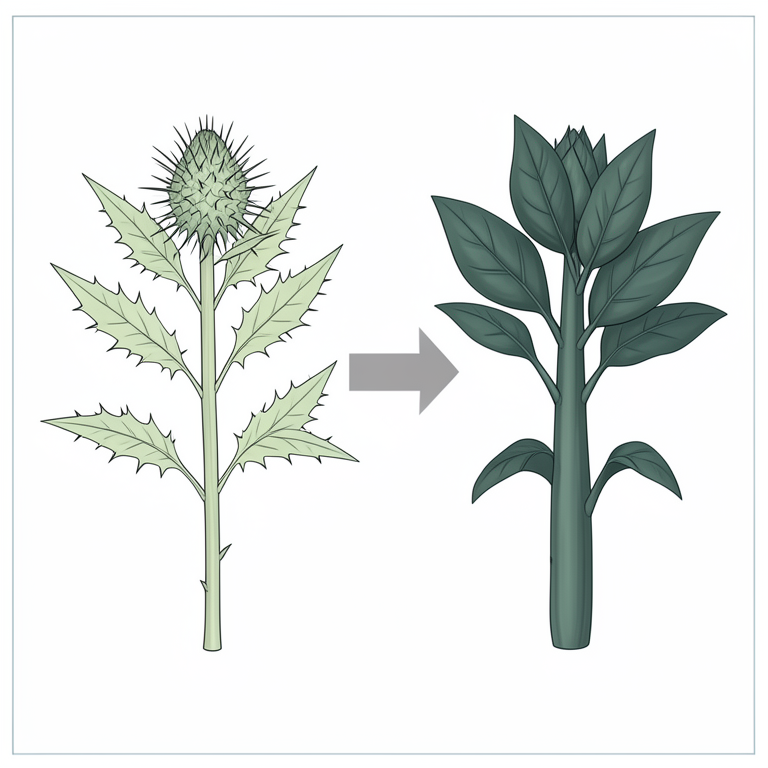
Morphological Resistance Comparison
AI-generated conceptual illustration (safflower plants). It explains the idea and does not show study data.
View source evidence ↗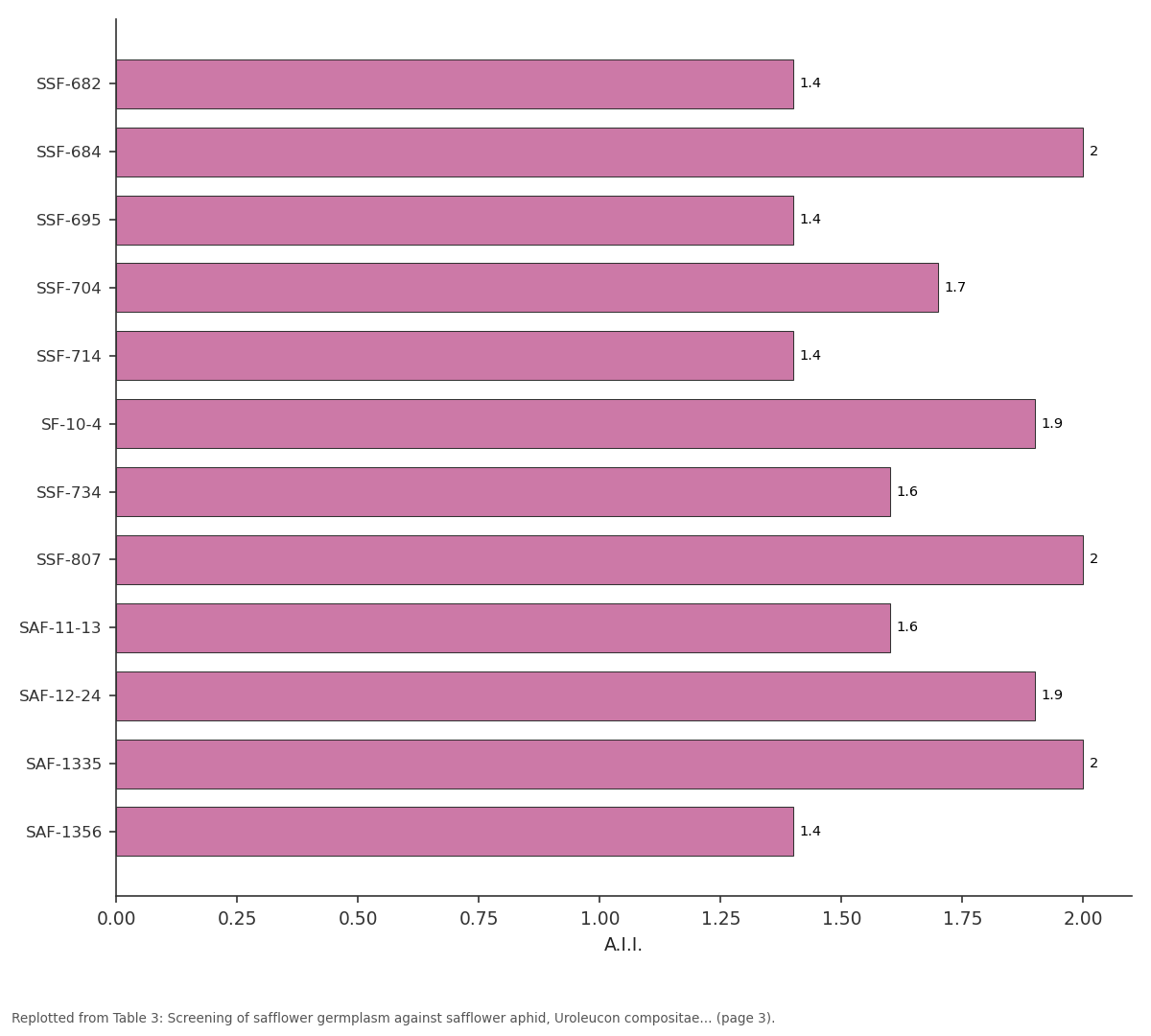
A.I.I.: SSF-682 vs SSF-684 vs SSF-695 vs SSF-704 vs SSF-714
Replotted from Table 3 (page 3) of the original paper. Every bar is the paper's own table value.
View source evidence ↗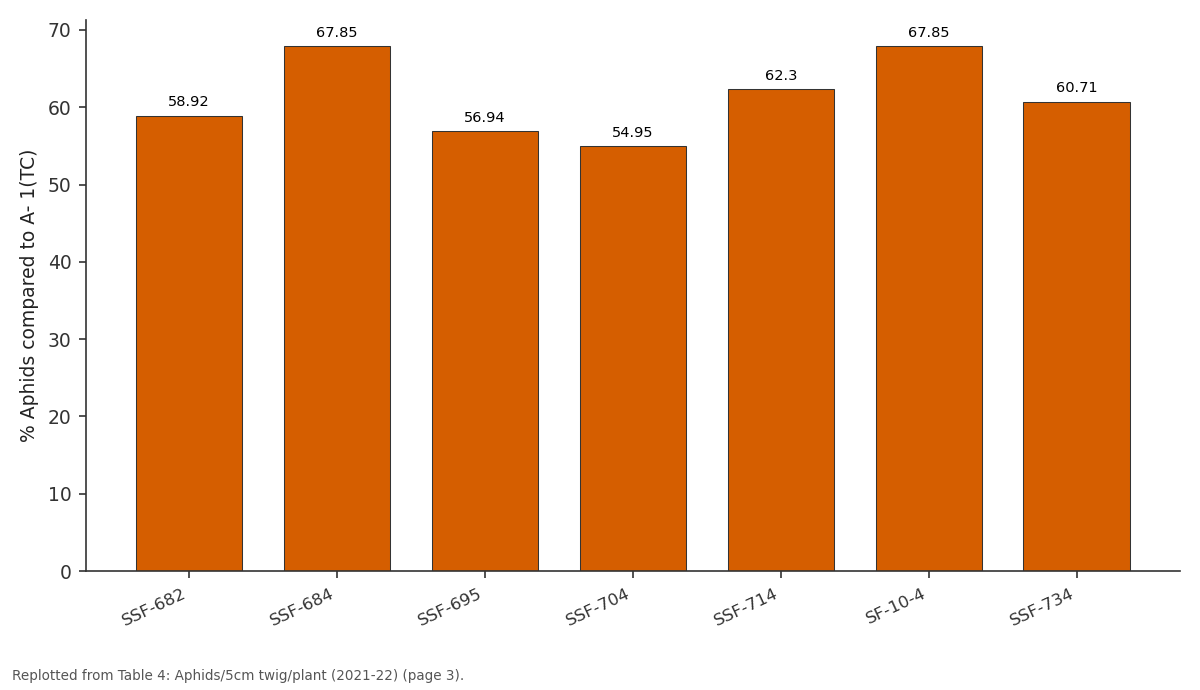
% Aphids compared to A- 1(TC): SSF-682 vs SSF-684 vs SSF-695 vs SSF-704 vs SSF-714
Replotted from Table 4 (page 3) of the original paper. Every bar is the paper's own table value.
View source evidence ↗Figures & tables
From the original paper Table 1
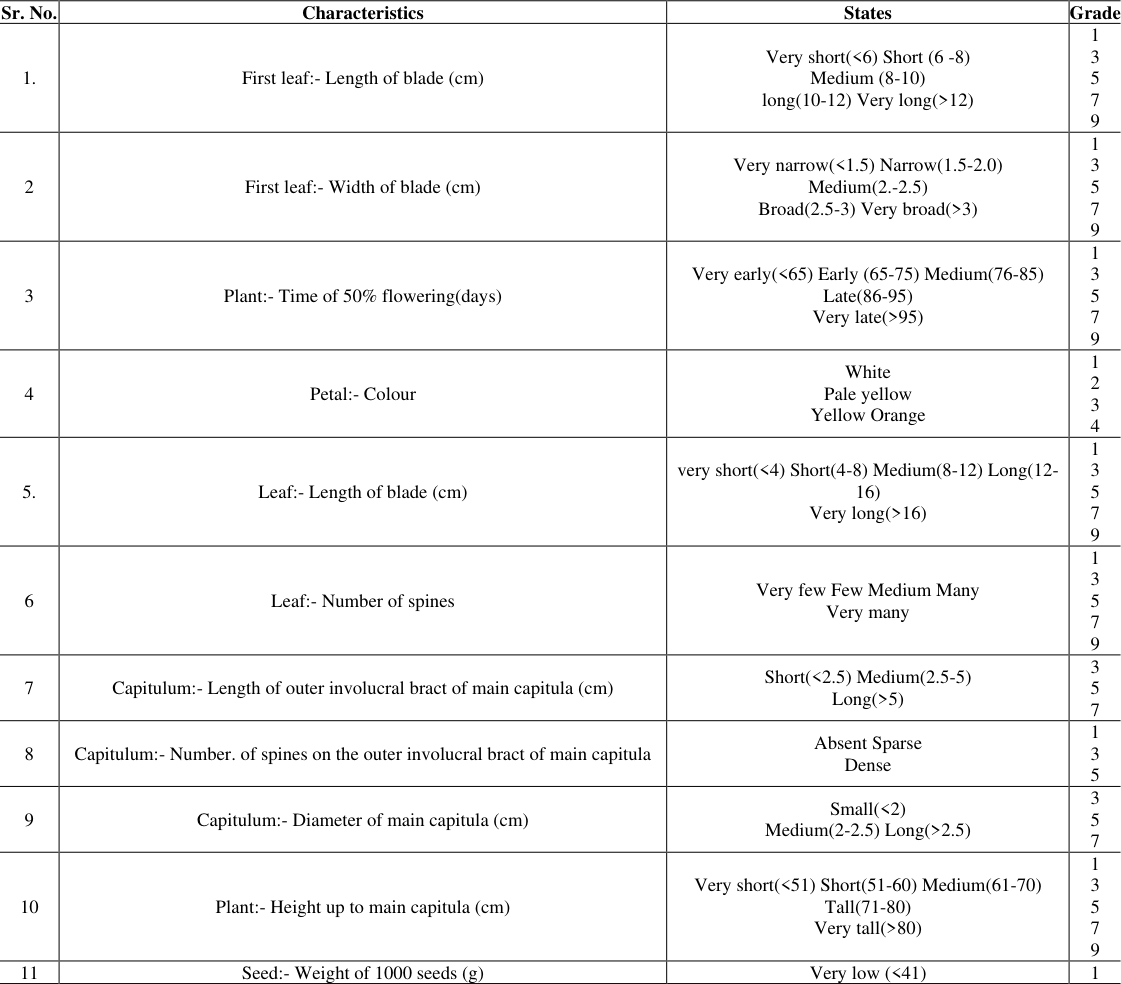 Table 2
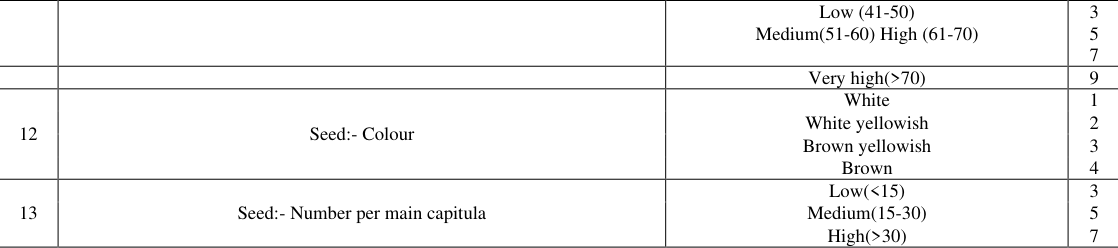 Table 3
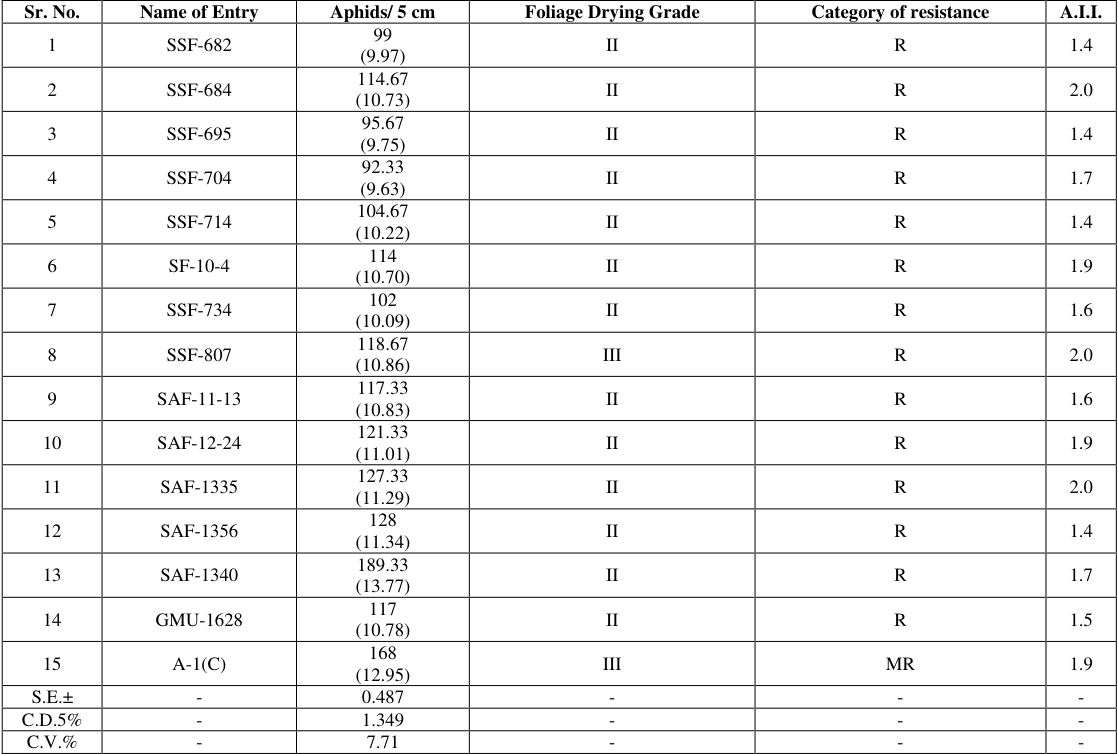 Table 3
 Table 4
 Table 5
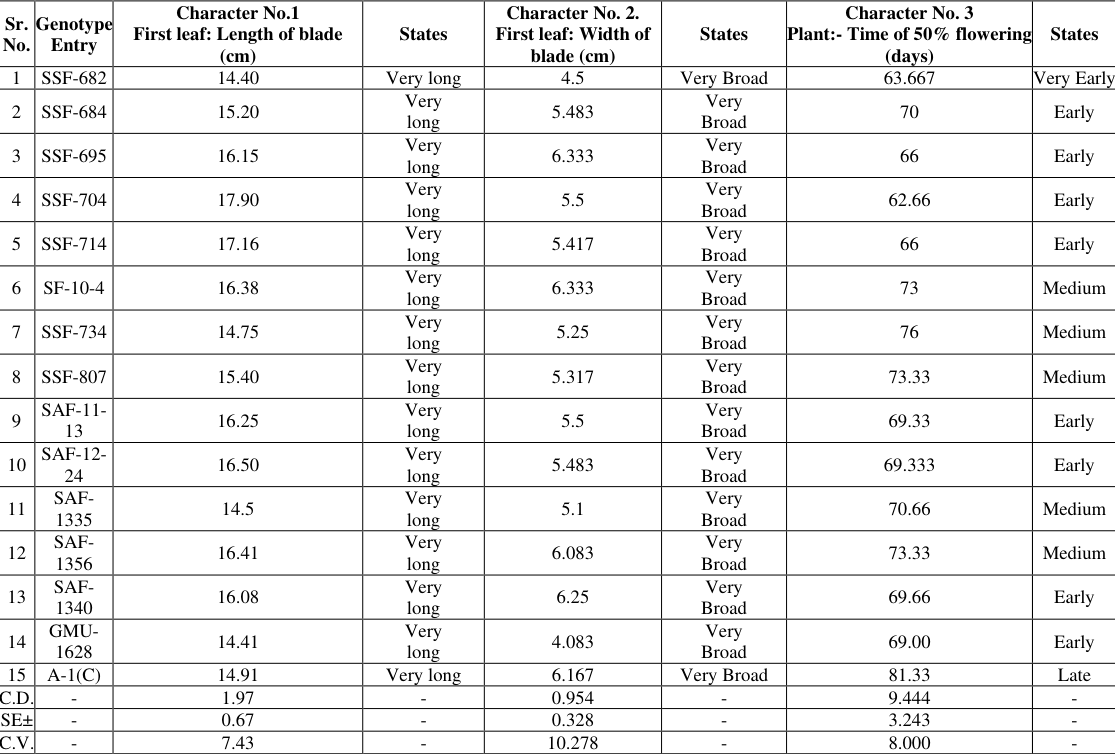 Table 5
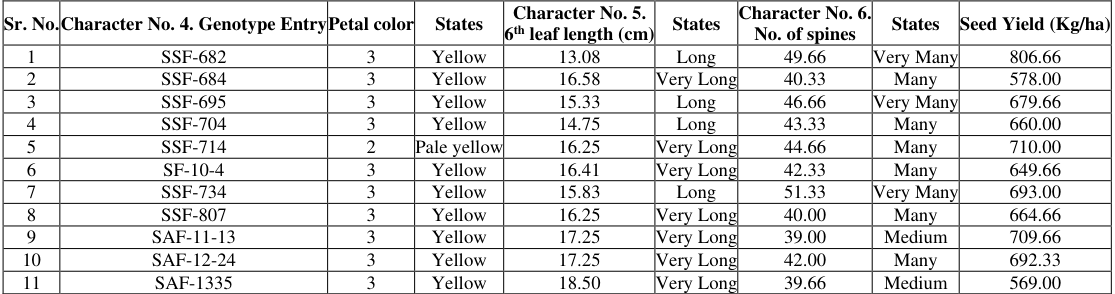 Table 6
Introduction
Safflower Carthamus tinctarium L, Compositae is the most important rabi oilseed crop. There are numbers of safflower varieties under cultivation in different agroclimatic region in India. Still the area under cultivation decreases day by day. Number of factors is responsible for decreasing area. Crop damage due to insect pest is one of the major constraints. Safflower crop is damaged by a number of insect pests of which Aphid Uroleucon compositm Theobald (Aphidae: Homoptera) is the key pest causing 20-60% loss in seed yield of safflower. Safflower flowers contain all necessary amino acids except tryptophan [11] . India, United States, Mexico, and China are the world's top safflower producers in the ascending order. In India, safflower production is primarily limited to rainfed conditions throughout the winter season, particularly in the Rabi track. In the year 2021-22, India is the largest producer of safflower (2.0 lakh tones) in the world with highest acreage (4.3 lakh hectares) but with average productivity of only 465 kg/ha. [1] . Besides loss in seed yield, aphids incidence also results in reduction in oil content of damaged seeds up to 32% and seed weight by 50.6%. Many broad spectrum insecticides are being use intensively and indiscriminately by farmers for the management this pest, which lead to several problems like pest resurgence, insecticidal resistance in key pest species. Secondary pest outbreak, pesticides residues in food chain, degradation in the quality of ecosystem and human health. To overcome this problem, present study was carried out to find out germplasm accession for resistant to safflower aphids and to develop a component integrated pest management as aphid resistant variety. Among the several factors responsible for low production of safflower, insect pests have been considered as one of the important biotic factors. Among them, aphid (Uroleucon compositae Theobald) is the key pest of the crop which causes yield losses to the extent of 20 to 60% with an average of 37% throughout India [10] . Use of resistant varieties/genotypes is a way of lowering the cost of pest protection as part of integrated pest management in safflower.
Materials and Methods
The experiment was conducted during 2021-22 at College of Agriculture, Parbhani, Department of Agril. Entomology Farm, Vasantrao Naik Marathwada Krishi Vidyapeeth, Parbhani, Maharashtra by growing a total of 14 safflower germplasm accessions on 23 rd November, 2022 in an Randomized Block Design. The plots were two rows 4 m long and spaced 45 cm apart with 20 cm between plants within rows. The susceptible infester check and A-1 as a resistant check was used. The observation of safflower aphid in untreated regimes were recorded at weekly interval on 15 randomly selected plants in each plot size. Aphid count was taken by observing 5 cm twig of the selected and tagged plot from experiment plot. The aphid count recorded on resistant plot compared with checks. After survival of aphids the genotype and checks are categorized into1 to 5 scales on the basis of foliage drying due to aphid feeding. The A.I.I was calculated with the help of following formula. Where a, b, c, d, e are the actual number of plants falling each of the corresponding damage foliage drying grades i.e. 1 to 5.
Table 2:
The following plant characters were recorded during the crop growth period. As per the data given in the Table 3. it is seen that the all 14 genotypes were categorized under resistant A.I.I. (1.30-2.00) whereas A-1 was categorized into moderately resistant category. The results reveled that (Table. 4) Comparing the aphid population with national check A-1 it is observed that the percent aphid population recorded by the genotypes viz., SSF-682, SSF-695, SSF-704, SSF-714 and SSF-734 were to the tune of 58.92, 56.94, 54.95, 62.30, 60.71 percent respectively compared to A-1 (100%).
| Sr. No. | Name of Entry | Aphids/ 5 cm | Foliage Drying Grade | Category of resistance | A.I.I. |
|---|---|---|---|---|---|
| 1 | SSF-682 | 99 (9.97) | II | R | 1.4 |
| 2 | SSF-684 | 114.67 (10.73) | II | R | 2.0 |
| 3 | SSF-695 | 95.67 (9.75) | II | R | 1.4 |
| 4 | SSF-704 | 92.33 (9.63) | II | R | 1.7 |
| 5 | SSF-714 | 104.67 (10.22) | II | R | 1.4 |
| 6 | SF-10-4 | 114 (10.70) | II | R | 1.9 |
| 7 | SSF-734 | 102 (10.09) | II | R | 1.6 |
| 8 | SSF-807 | 118.67 (10.86) | III | R | 2.0 |
| 9 | SAF-11-13 | 117.33 (10.83) | II | R | 1.6 |
| 10 | SAF-12-24 | 121.33 (11.01) | II | R | 1.9 |
| 11 | SAF-1335 | 127.33 (11.29) | II | R | 2.0 |
| 12 | SAF-1356 | 128 (11.34) | II | R | 1.4 |
| 13 | SAF-1340 | 189.33 (13.77) | II | R | 1.7 |
| 14 | GMU-1628 | 117 (10.78) | II | R | 1.5 |
| 15 | A-1(C) | 168 (12.95) | III | MR | 1.9 |
| S.E.± | - | 0.487 | - | - | - |
| C.D.5% | - | 1.349 | - | - | - |
| C.V.% | - | 7.71 | - | - | - |
Table text extracted from the original PDF; superscript letters are shown inline. The original table image is below.
View original table image
Results and Discussion
Results and Discussion
Figures and tables from the paper
| Sr. No. | Percent foliage yellowing and drying | Damaging grade | Resistance category | Aphid infestation grade (A.I.I) |
|---|---|---|---|---|
| 1. | 0-20% | 1 | Highly resistance | 1.0 |
| 2 | 21-40% | 2 | Resistance | 1.1-2.0 |
| 3 | 41- 60% | 3 | Moderataly resistance | 2.1-3.0 |
| 4 | 61-80% | 4 | Susceptible | 3.1-4.0 |
| 5 | 80% & above | 5 | Highly susceptible | 4.1-5.0 |
Table text extracted from the original PDF; superscript letters are shown inline. The original table image is below.
View original table image
| Sr. No. | Genotype Entry | Aphid/5cm twig/plant | % Aphids compared to A- 1(TC) |
|---|---|---|---|
| 1 | SSF-682 | 99 | 58.92 |
| 2 | SSF-684 | 114.67 | 67.85 |
| 3 | SSF-695 | 95.67 | 56.94 |
| 4 | SSF-704 | 92.33 | 54.95 |
| 5 | SSF-714 | 104.67 | 62.30 |
| 6 | SF-10-4 | 114 | 67.85 |
| 7 | SSF-734 | 102 | 60.71 |
Table text extracted from the original PDF; superscript letters are shown inline. The original table image is below.
View original table image
| 8 | SSF-807 | 118.67 | 70.63 |
|---|---|---|---|
| 9 | SAF-11-13 | 117.33 | 69.83 |
| 10 | SAF-12-24 | 121.33 | 72.22 |
| 11 | SAF-1335 | 127.33 | 75.79 |
| 12 | SAF-1356 | 128 | 76.19 |
| 13 | SAF-1340 | 189.33 | 112.6 |
| 14 | GMU-1628 | 117 | 69.64 |
| 15 | A-1(C) | 168 | 100 |
Table text extracted from the original PDF; superscript letters are shown inline. The original table image is below.
View original table image
| Sr. No. | Genotype Entry | Character No.1 First leaf: Length of blade (cm) | States | Character No. 2. First leaf: Width of blade (cm) | States | Character No. 3 Plant:- Time of 50% flowering (days) | States |
|---|---|---|---|---|---|---|---|
| 1 | SSF-682 | 14.40 | Very long | 4.5 | Very Broad | 63.667 | Very Early |
| 2 | SSF-684 | 15.20 | Very long | 5.483 | Very Broad | 70 | Early |
| 3 | SSF-695 | 16.15 | Very long | 6.333 | Very Broad | 66 | Early |
| 4 | SSF-704 | 17.90 | Very long | 5.5 | Very Broad | 62.66 | Early |
| 5 | SSF-714 | 17.16 | Very long | 5.417 | Very Broad | 66 | Early |
| 6 | SF-10-4 | 16.38 | Very long | 6.333 | Very Broad | 73 | Medium |
| 7 | SSF-734 | 14.75 | Very long | 5.25 | Very Broad | 76 | Medium |
| 8 | SSF-807 | 15.40 | Very long | 5.317 | Very Broad | 73.33 | Medium |
| 9 | SAF-11- 13 | 16.25 | Very long | 5.5 | Very Broad | 69.33 | Early |
| 10 | SAF-12- 24 | 16.50 | Very long | 5.483 | Very Broad | 69.333 | Early |
| 11 | SAF- 1335 | 14.5 | Very long | 5.1 | Very Broad | 70.66 | Medium |
| 12 | SAF- 1356 | 16.41 | Very long | 6.083 | Very Broad | 73.33 | Medium |
| 13 | SAF- 1340 | 16.08 | Very long | 6.25 | Very Broad | 69.66 | Early |
| 14 | GMU- 1628 | 14.41 | Very long | 4.083 | Very Broad | 69.00 | Early |
| 15 | A-1(C) | 14.91 | Very long | 6.167 | Very Broad | 81.33 | Late |
| C.D. | - | 1.97 | - | 0.954 | - | 9.444 | - |
| SE± | - | 0.67 | - | 0.328 | - | 3.243 | - |
| C.V. | - | 7.43 | - | 10.278 | - | 8.000 | - |
Table text extracted from the original PDF; superscript letters are shown inline. The original table image is below.
View original table image
| Sr. No. | Character No. 4. Genotype Entry | Petal color | States | Character No. 5. 6th leaf length (cm) | States | Character No. 6. No. of spines | States | Seed Yield (Kg/ha) |
|---|---|---|---|---|---|---|---|---|
| 1 | SSF-682 | 3 | Yellow | 13.08 | Long | 49.66 | Very Many | 806.66 |
| 2 | SSF-684 | 3 | Yellow | 16.58 | Very Long | 40.33 | Many | 578.00 |
| 3 | SSF-695 | 3 | Yellow | 15.33 | Long | 46.66 | Very Many | 679.66 |
| 4 | SSF-704 | 3 | Yellow | 14.75 | Long | 43.33 | Many | 660.00 |
| 5 | SSF-714 | 2 | Pale yellow | 16.25 | Very Long | 44.66 | Many | 710.00 |
| 6 | SF-10-4 | 3 | Yellow | 16.41 | Very Long | 42.33 | Many | 649.66 |
| 7 | SSF-734 | 3 | Yellow | 15.83 | Long | 51.33 | Very Many | 693.00 |
| 8 | SSF-807 | 3 | Yellow | 16.25 | Very Long | 40.00 | Many | 664.66 |
| 9 | SAF-11-13 | 3 | Yellow | 17.25 | Very Long | 39.00 | Medium | 709.66 |
| 10 | SAF-12-24 | 3 | Yellow | 17.25 | Very Long | 42.00 | Many | 692.33 |
| 11 | SAF-1335 | 3 | Yellow | 18.50 | Very Long | 39.66 | Medium | 569.00 |
Table text extracted from the original PDF; superscript letters are shown inline. The original table image is below.
View original table image
References
6 in the original paper- Akashe VB, Datkhile RV, Patil RC, Shende VD, Deokar CD. Field screening of safflower entries against aphid. J. Maharashtra Agric. Univ. 1993;18(2):268-69.
- Akashe VB, Mehtre SP, Veer DM, Koli BD. Screening of exotic germplasm accessions of safflower against aphids (Uroleucon compositae Theobald). Sesame and Safflower Newsletter. 1996;11:104-110.
- Murumkar DR, Indi DV, Akashe VB, Patil AJ, Gud MA. Multiple resistance sources against major diseases and pests of safflower Carthamus tinctorius L. J of Oilseeds Res. 2011;26(2):175-176.
- Rathod PK, Mane PN, Balode KL, Deshmukh KN, Sarap PA. Evaluation of promising and elite entries for their reaction to safflower aphid, Uroleucon compositae Theobald. J of Oilseeds Res. 2012;29(2):312-320.
- Rayappa BL. Evaluation of promising safflower cultivars for resistance to aphid (Uroleucon compositae Theobald). Research gate. 2015;30(1):34-39.
- Singh V, Singh H. Biology of safflower aphid, Uroleucon compositae Theobald on different safflower genotypes under laboratory conditions and their field reaction. J, of Oilseeds Res, 2007;24(2):286-288.
Cited by 1
From OpenAlex, OpenCitations and reference lists read by Scinovex
- Morphological and biochemical basis of tolerance mechanism in safflower against aphid
Shreya Raut, PN Mane, DB Undirwade, PK Rathod, SJ Gahukar, Shivani Tale · International Journal of Agriculture and Food Science · 2025
The present investigation entitled “Morphological and biochemical basis of tolerance mechanism in safflower against aphid” was conducted at Oilseeds Research Unit, Dr. PDKV, Akola during Rabi 2024- 25. The trial consisted of 29 genotypes replicated twice in Randomized Block Design. The research was performed to check out the reaction of different safflower genotypes against aphid. Among these GMU-7331, GMU-3205, AKS-325, AKS-322 and AKS/S-33 were found least Aphid Infestation Index (A.I.I.) with 2.0 and graded under tolerant category. Foliage drying due to aphids was observed in the range of 2