
Research article · 2024 · Full text
International Journal of Advanced Biochemistry ResearchDisposition profile of Danofloxacin in broiler chickens
Volume 8(4S) · Pages 274–278 · DOI: 10.33545/26174693.2024.v8.i4sd.960 ↗
Research areasAntibiotics Pharmacokinetics and EfficacyAnimal Nutrition and PhysiologyVeterinary medicine and infectious diseases
Abstract
Author-writtenDanofloxacin, a fluoroquinolones antimicrobial was exclusively used in veterinary clinical practice for treating a variety of bacterial infections in avian species. Accompanying other fluoroquinolones, Danofloxacin has broad-spectrum bacterial action against Enterobacteriaceae (Escherichia coli, Klebsiella, Salmonella) and some gram-positive cocci, such Staphylococcus. The pharmacokinetics studies in avian species are very scare and the there is huge gap of information on pharmacokinetic behaviour of Danofloxacin in broilers. The present study was done to explores the disposition kinetics of Danofloxacin after single dose intravenous administration at the dose rate of 5.0 mg/kg body weight. The study was performed on eight healthy broiler chicken, weighing between 0.9-1.2 kg. Danofloxacin concentrations were measured using the reversed-phase ultra-high-performance liquid chromatography (UHPLC) with UV detector. A non-compartmental technique was used to analyse the plasma concentration-time data. Following single dose intravenous administration of Danofloxacin at the dose rate of 5.0 mg/kg, the immediate plasma concentration of Danofloxacin at 0.083 h was observed as 2.97 ± 0.05 µg/mL, which rapidly declined to 0.17 ± 0.01 µg/mL at 12 h. The mean value of elimination rate constant (β) was found as 0.15 ± 0.002 h-1. The drug was eliminated from the body of bird with an average half-life (t1/2β) of 4.64 ± 0.07 h. The mean values of area under curve (AUC) and mean residence time (MRT) were observed to be 7.63 ± 0.11 µg.h/mL and 5.87 ± 0.09 h, respectively. The average values of volume of distribution (Vd(area)) and volume of distribution at steady state (Vd(ss)) were calculated as 4.40 ± 0.06 and 3.85 ± 0.03 L/kg, respectively. The body of bird was able to eliminate the drug from the body at a rate was found to be 0.66 ± 0.01 L/h/kg, which was indicated by total body clearance (CLB). Danofloxacin has clinically superior pharmacokinetic properties, including the longer elimination half-life, wide volume of distribution and slower clearances in broiler chicken. The pharmacokinetics data obtained from this study may serve an important tool for PK/PD relationship to optimize the dosage regimen of Danofloxacin targeted for the treatment of diseases caused by susceptible bacteria with known minimum inhibitory concentration values in broiler chicken.
Summary
Source-checkedPlain-language reading of the full paper, prepared with AI and checked against the text. Each point links to the authors' own words.
Why it matters
- Danofloxacin is a fluoroquinolone antimicrobial used in veterinary medicine to treat various bacterial infections in birds. View evidence ↗
- The drug provides broad-spectrum action against several bacteria, including Salmonella, Escherichia coli, Klebsiella, and some gram-positive cocci like Staphylococcus. View evidence ↗
- There is a significant lack of information regarding the pharmacokinetic behavior of Danofloxacin specifically in broiler chickens. View evidence ↗
The question
- The study aimed to explore the disposition kinetics of Danofloxacin in broilers following a single intravenous dose of 5.0 mg/kg. View evidence ↗
What they did
- The experiment used eight healthy broiler chickens, aged 3 to 3.5 weeks and weighing between 0.9 and 1.2 kg. View evidence ↗
- Danofloxacin was administered intravenously via the brachial vein at a dose of 5 mg/kg. View evidence ↗
- Blood samples were collected at ten specific intervals ranging from 0 minutes to 24 hours post-administration. View evidence ↗
- Drug concentrations in the plasma were measured using reversed-phase ultra-high-performance liquid chromatography (UHPLC) with a UV detector. View evidence ↗
- The plasma concentration-time data were analyzed using a non-compartmental technique. View evidence ↗
What they found
- After a 5.0 mg/kg dose, plasma concentration peaked at 2.97 ± 0.05 µg/mL at 0.083 hours and fell to 0.17 ± 0.01 µg/mL by 12 hours. View evidence ↗
- The average elimination half-life of the drug in the birds was 4.64 ± 0.07 hours. View evidence ↗
- The mean area under the curve (AUC) was 7.63 ± 0.11 µg.h/mL and the mean residence time (MRT) was 5.87 ± 0.09 hours. View evidence ↗
- The average volume of distribution (Vd(area)) was 4.40 ± 0.06 L/kg and the volume of distribution at steady state (Vd(ss)) was 3.85 ± 0.03 L/kg. View evidence ↗
- The total body clearance (CLB) was found to be 0.66 ± 0.01 L/h/kg. View evidence ↗
- Plasma concentrations remained above the therapeutic threshold (0.17 µg/mL) for up to 12 hours, covering the MIC90 value of 0.13 µg/mL for most susceptible infections. View evidence ↗
What it means
- The authors conclude that intravenous administration of danofloxacin at 5.0 mg/kg could be effective in broiler chickens due to its favorable pharmacokinetic properties and lack of observed adverse reactions. View evidence ↗
- The authors state that further PK/PD studies are necessary to optimize treatment for diseases caused by bacteria with known minimum inhibitory concentration values. View evidence ↗
Visual summary
1 visualsIllustrations explain the paper; they do not show study data.
Experimental Workflow
AI-generated conceptual illustration (broiler chickens). It explains the idea and does not show study data.
View source evidence ↗Figures & tables
From the original paper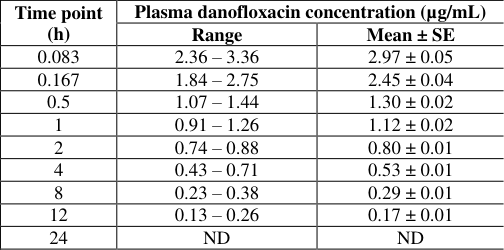 Table 1
 Table 2
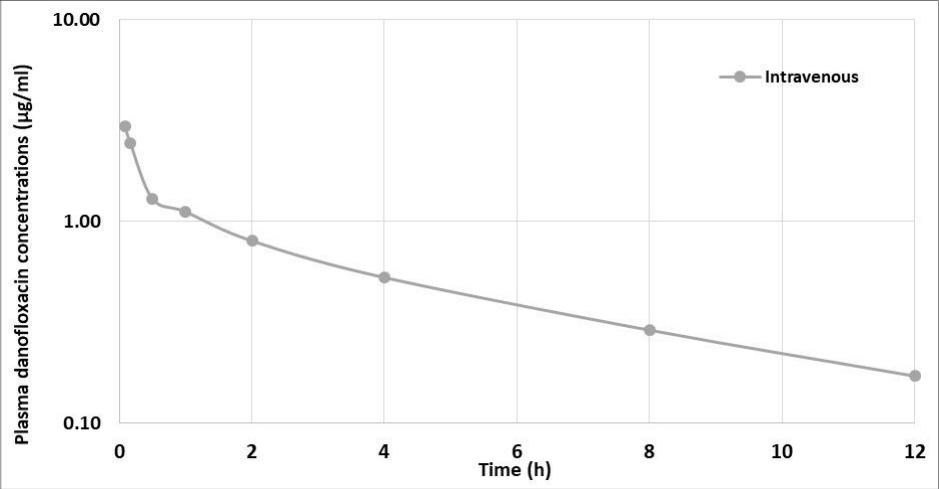 Figure 1
Introduction
The second-generation animal-specific fluoroquinolone, developed by Pfizer Inc. danofloxacin, is a fluorinated quinolone that is used to treat and prevent bacterial infections in domestic animals and birds. It is a promising antimicrobial for poultry due to its bactericidal effect, wide range of activity, and concentration-dependent killing mechanism. (Brown, 1996; Gosal et al., 2009; Sarasola et al., 2002) [3,10,13] . Being a fluoroquinolone, It acts on bacterial DNA synthesis via inhibition of bacterial DNA gyrase and topoisomerase IV, compromising bacterial DNA replication (Drlica and Zhao, 1997) [7] . The clinical prospect of the danofloxacin is promising because of greater cell permeability, larger plasma and tissue drug concentrations, and more potent antibacterial activity (Wang et al., 2022) [14] . The European Medicines Agency has authorized the use of danofloxacin in all foodproducing species (EMEA, 2002) [8] . The use of antibiotics to prevent and treat infectious diseases is critical to the profitability of broiler production. However, emergence of antimicrobial resistance has caused the loss of effectiveness of the conventional antimicrobials. In this case, danofloxacin may be a potential antimicrobial for broiler production. However, before introducing it into clinical practice, pharmacokinetics data must be obtained to determine the ideal dosing schedules suitable to local climatic and management practice. Hence, to fulfil the objectives of generating pharmacokinetics data applicable for calculating optimum dosage regimens, the present investigation on disposition kinetics of danofloxacin at a dosing rate of 5.0 mg/kg body weight after single dose intravenous administration in broilers was carried out.
Materials and Methods
Materials and Methods
Animal treatment
A total of 8 healthy broiler chickens at the age of 3 to 3.5 weeks, weighing between 0.9 to 1.2 kg were obtained from a registered commercial poultry farm. Each chicken was individually placed in a wire cage measuring 55 × 55 × 45 cm, which was equipped with an automatic water dispenser. All the chickens were provided with an antimicrobial-free diet and had unrestricted access to water. The feeding environment was maintained at a temperature of 21 ± 0.6 °C, with proper ventilation, and a daily light exposure of 16 h. Before beginning of the study procedures, the chickens were given a two-week acclimation period, during which the health of birds was monitored clinically through daily examination.
Chemicals and reagents
The analytical standard powder (Certified reference Material) of danofloxacin was purchased from Sigma-Aldrich (USA) having batch number BCCD0344 and lot number CAS# 112398-08-0. The purity of assay was more than 99.6%. Water, methanol, perchloric acid (70-72%), formic acid, triethylamine and acetonitrile of HPLC grade were purchased from S.D. Fine chemical Ltd., Mumbai.
Experimental protocol
All broiler chicken were given danofloxacin by intravenous route at the dose rate of 5 mg/kg body weight via brachial vein using 25 G needle. Periodical blood samples were collected from the poultry in sterilized and heparinized test tube at 0 minutes (before administration), 5 minutes (0.083 hours), 10 minutes (0.167 hours), 30 minutes (0.5 hours), 1 hours, 2 hours, 4 hours, 8 hours, 12 hours, and 24 hours. Approximately 0.2 mL of blood was collected at every interval. The plasma was separated after centrifugation of blood samples at 4000 revolution per minute for 10 minutes. The plasma samples were transferred in cryo-vials (0.5 mL capacity) and stored at -20 ºC until assayed for danofloxacin concentration using UHPLC procedure.
Danofloxacin quantification
Danofloxacin was extracted from plasma sample by method suggested in Abo-El-Sooud et al. (2017) [1] with few modifications. To 100 μl aliquot of chicken plasma, 100 μl of 20% perchloric acid was added. The mixture was vortexed for 1 minute, and then centrifuged at 10,000 rpm for 10 min at 4 ºC. An aliquot of the supernatant solution was transferred to another Eppendorf tube, aliquot of 20 µl was injected into UHPLC system.
UHPLC instrumentation
The concentration of danofloxacin was determined using the Thermofischer's Dionex Series UHPLC system, which was connected to pump (Dionex ultimate 3000) and UV detector (model 2020 Plus), and controlled by Chromleon Software (Version 6.8). The separation process utilized a (Chromolith RP -18e, 100 × 4.6 mm, Merck KGaA, Germany). Each sample (20 μL) was injected, and the column was maintained at room temperature for elution over a duration of 12 min. UV detection was carried out at 282 nm wave length. The isocratic mobile phase consisted of 0.01 M formic acid buffer (prepared in HPLC water): acetonitrile (82:18 v/v %) and pumped into system at a flow rate of 0.5 mL/min. To prepare buffer containing 0.01 M formic acid, exactly 460 µl of formic acid was dissolved in 1.0 litter of HPLC water and pH was adjusted to 3.2 by adding 400 µl of triethylamine
Validation of analytical method
The method was validated prior to it's deployment in quantification of danofloxacin from broilers' plasma samples for study. The validation criteria calculated were the linearity, accuracy, and precision (intraday and interday) as per CDER guidelines (CDER, 1994) [4] . The quantification of danofloxacin was observed to be linear over the concentration range of 0.10 to 16.00 μg/mL in chicken plasma with regression co efficient value of 0.9991. The intra-day and inter-day coefficients of variation for three samples were satisfactory, with relative standard deviations (RSD) less than 5.6%. Mean values of recovery of danofloxacin from chicken's plasma was observed to as 95%.
Pharmacokinetics
With the aid of the software "PK solver 2.0," a menu-driven add-in programme for Microsoft Excel created in visual basic for application (VBA), the plasma concentration time curve of individual chicken was examined for derived pharmacokinetic parameters. Non-compartmental analysis performed by this software is based on the basic theory of statistical moment concepts. The mean values along with the standard error (Mean ± SE) were calculated for plasma concentration analysed and data generated after pharmacokinetics using the MS-Excel programme. The concentration-time data of danofloxacin in each broiler chicken plasma were analysed using the non-compartment model analysis (NCA) method in "PK solver 2.0," (a menudriven add-in programme for Microsoft Excel created in visual basic for application VBA) to obtain pharmacokinetic parameters. For intravenous routes of danofloxacin administration, the first-order rate constant associated with the terminal phase (λz) was calculated using linear regression, from which the terminal half-life (t 1/2λz ) was determined as ln2/λz. The area under the concentration-time curve (AUC) and the first moment curve (AUMC) were calculated using the linear trapezoidal rule with extrapolation to infinity. AUC% represents the ratio of AUC last-∞ to AUC 0-∞ . The mean residence time (MRT) was calculated as MRT = AUMC 0-∞ /AUC 0. Total body clearance (Cl) was determined as the ratio of the intravenous dose to AUC, while the volume of distribution (V Z ) was calculated as V Z = Dose/AUC/λz, where Dose represents the intravenous dose. The volume of distribution at steady state (V SS ) was determined as V SS = MRT IV × Cl. (Jo et al. 2023) [20] .
Results and Discussion
The extraction and quantification methods employed for danofloxacin in present study showcased robust specificity, high accuracy and precision, as well as excellent selectivity, in detecting danofloxacin in plasma. The retention time of danofloxacin was determined to be approximately 6.8 min, effectively avoiding interference from impurity peaks. The linearity of employed quantification method was observed over the concentration range of 0.1 to 16 µg/mL. With an R 2 of 0.9991, the regression equation for the calibration curve was C = 7 × 10 -9 S + 0.0021, (where C is the predicted danofloxacin concentration and S is the peak area of danofloxacin in the chromatogram). Under these conditions, the recovery rate of danofloxacin was above 95% (at concentration of 0.1, 1 and 10 µg/mL). the intra-day variation coefficient ranged from 1.35% to 4.15%, and the inter-day variation coefficient ranged from 0.33% to 5.67%. All the broilers birds were free from any adverse effects associated with intravenous administration of danofloxacin (5 mg/kg body weight) and remained apparently healthy throughout experiment and even after experiment. The assayed plasma concentrations of danofloxacin at different time points after its single dose intravenous (IV) administration at the dose rate of 5 mg/kg in birds are tabulated as the mean and standard error (SE) values for all eight birds in Table 1 and graphically represented by semilogarithmic plot of mean danofloxacin concentration in plasma versus time following intravenous administration (Figure 1). Mean danofloxacin concentration in plasma at the first collection time point i.e., 0.083 h (5 minutes) after drug administration was found to be 2.97 µg/mL and declined by about 57% to 1.30 µg/mL at 0.5 h. The average plasma danofloxacin concentration at 1, 2, 4, 8 and 12 h were found to be 1.12, 0.80, 0.53, 0.29 and 0.17 µg/mL, respectively. The plasma concentrations were not detectable in the posttreatment samples collected at 24 and 36 h in all eight birds. In the present study, the mean plasma concentration of danofloxacin after IV administration at the dose rate of 5.0 mg/kg body weight of chicken was maintained above the therapeutic concentration up to 12 h (0.17 µg/mL), which covers MIC 90 values of 0.13 µg/mL against most susceptible bacterial infections in broiler chicken (Watts et al.,1997) [5] . The pharmacokinetic (PK) parameters calculated from plasma concentrations of danofloxacin after its single dose IV administration (5 mg/kg body weight) in birds are shown in Table 2. The calculation of pharmacokinetic parameters was based on a non-compartmental approach. The results were expressed as a mean ± SE value of eight birds. The pharmacokinetics is not reported in any species in India.
| Pk parameter | Unit | P1 | P2 | P3 | P4 | P5 | P6 | P7 | P8 | Mean ± SE |
|---|---|---|---|---|---|---|---|---|---|---|
| Β | h-1 | 0.16 | 0.13 | 0.15 | 0.19 | 0.16 | 0.16 | 0.14 | 0.13 | 0.15 ± 0.002 |
| t1/2β | h | 4.33 | 5.49 | 4.59 | 3.71 | 4.28 | 4.44 | 5.01 | 5.28 | 4.64 ± 0.07 |
| Cp0 | μg/mL | 3.49 | 3.53 | 3.33 | 5.09 | 5.07 | 3.03 | 3.17 | 4.09 | 3.85 ± 0.10 |
| AUC0→∞ | µg.h/mL | 7.78 | 9.62 | 6.99 | 7.23 | 6.76 | 7.59 | 7.43 | 7.64 | 7.63 ± 0.11 |
| MRT | h | 5.89 | 7.39 | 5.52 | 4.82 | 5.38 | 6.05 | 5.87 | 6.07 | 5.87 ± 0.09 |
| Vd(area) | L/kg | 4.01 | 4.12 | 4.73 | 3.70 | 4.56 | 4.22 | 4.86 | 4.99 | 4.40 ± 0.06 |
| Vdss | L/kg | 3.78 | 3.84 | 3.94 | 3.33 | 3.98 | 3.98 | 3.95 | 3.97 | 3.85 ± 0.03 |
| ClB | L/h/kg | 0.64 | 0.52 | 0.71 | 0.69 | 0.74 | 0.66 | 0.67 | 0.65 | 0.66 ± 0.01 |
Table text extracted from the original PDF; superscript letters are shown inline. The original table image is below.
View original table image
| Time point (h) | Plasma danofloxacin concentration (µg/mL) | — |
|---|---|---|
| Range | Mean ± SE | |
| 0.083 | 2.36 – 3.36 | 2.97 ± 0.05 |
| 0.167 | 1.84 – 2.75 | 2.45 ± 0.04 |
| 0.5 | 1.07 – 1.44 | 1.30 ± 0.02 |
| 1 | 0.91 – 1.26 | 1.12 ± 0.02 |
| 2 | 0.74 – 0.88 | 0.80 ± 0.01 |
| 4 | 0.43 – 0.71 | 0.53 ± 0.01 |
| 8 | 0.23 – 0.38 | 0.29 ± 0.01 |
| 12 | 0.13 – 0.26 | 0.17 ± 0.01 |
| 24 | ND | ND |
Table text extracted from the original PDF; superscript letters are shown inline. The original table image is below.
View original table image
There are few references in other species of animals abroad.
The value of the elimination rate constant (β) was observed to be 0.15 ± 0.002 h -1 which was in close approximation to values reported in chicken as 0.12 h -1 (Lych et al., 1994) [12] . The elimination half-life (t 1/2β ) was shown to be 4.64 ± 0.07 h comparatively shorter half-lives were observed in guinea fowl (3.31 h) and quils (3.84 h) by Dimitrova et al. (2014) [6] . Higher value of elimination half-life was reported in pheasant (6.82 h) by Dimitrova et al., 2014 [6] and nonlaying hen (7.69 ± 3.40 h) by Chen et al., 2023 [19] . Variation in half-lives because of properties of the body fluids of birds, including volume status, protein content, body fluid pH and presence of drugs which compete for binding sites, pathophysiological states, including age, gender, obesity and blood delivery to organs of clearance (Yartsev, 2023a) [16] . The values of volume of distribution at steady state (V dss ) and apparent volume of distribution (V d(area) ) were observed to be 4.40 and 3.85 L/kg, respectively. Because it is sufficiently lipid-soluble to penetrate tissues and is supported by large distribution volumes of danofloxacin. Higher concentrations of danofloxacin in tissues than in plasma of broiler chickens (Knoll et al., 1999) [11] . The value of volume of distribution at steady state obtained in present study was close to the values observed to be 4.20 L/kg in guinea fowl and 5.81 L/kg in quil (Dimitrova et al., 2014) [6] . Higher values also reported as 8.57 L/kg in pheasant (Dimitrova et al., 2014) [6] , 10.02 L/kg in chicken (Knoll et al., 1999) [11] . Drug characteristics that alter tissue and protein binding are the main factors of volume of distribution. These include the lipid/water partition coefficient, pKa, charge, and molecule size. Other physiological factors like age, gender, body muscle/fat proportion, level of hydration and water distribution also affect the volume of distribution in birds (Gibaldi and McNamara, 1978; Yartsev, 2023b) [9,17] . The value of the area under time concentration curve from 0 to ∞ (AUC 0→∞ ) was observed to be 7.63 µg.h/mL. It suggested that danofloxacin covers a vast body area upon intravenous administration. Very close value of area under time concentration curve from 0 to ∞ (AUC 0→∞ ) was reported to be 8.29 µg.h/mL in guinea fowl (Dimitrova et al., 2014) [6] . The lower values of area under concentration time curve from 0 to ∞ (AUC 0→∞ ) reported in chicken (3.55 and 4.07 µg.h/mL) by Knoll et al., 1999 [11] and Lynch et al., 1994, respectively, pheasant (4.90 µg.h/mL) and quils (6.49 µg.h/mL) by Dimitrova et al., 2014 [6] . The difference in AUC values might be due to variation in the physiology of fluid compartment and total physiological body space available to the drug. The mean residence time (MRT) was calculated to be 5.87 ± 0.09 h. The value obtained in present study was consistent to value reported in quils (5.54 h) by Dimitrova et al., 2014 [6] . Lower value of MRT was reported in guinea fowl (4.91 h) by Dimitrova et al., 2014 [6] and higher value of MRT was reported in pheasant (9.84 h) by Dimitrova et al., 2014 [6] . In present study low MRT value indicates that danofloxacin remains for shorter span of time in birds due to relatively faster elimination of drug compared to other species. The total body clearance (Cl B ) was observed to be 0.66 L/h/kg. Relatively faster values of total body clearance were reported in chicken (1.41 and 1.23 L/h/kg) by Knoll et al., 1999 [11] and Lynch et al., 1994 [12] , respectively, guinea fowl (1.23 L/h/kg) and quills (1.61 L/h/kg) by Dimitrova et al., 2014 [6] . Relatively slower value of total body clearance was studied in pheasant (0.45 L/h/kg) by Dimitrova et al., 2014 [6] . The variation in values of clearance in the present study is due to individual factors that can influence clearance, such as the intrinsic functions of the liver or kidneys. Therefore, variations in clearance can be anticipated when there is a major impairment of these organs. Blood flow to the organs of elimination can also affect clearance.
Conclusions
It is concluded that, since general adverse reactions were not observed in any broiler chicken of the study, and in light of the favourable pharmacokinetic properties such as long halflife, slower clearance and volumes of distribution, danofloxacin administered at 5.0 mg/kg via intravenous routes could be effective in broiler chicken. However, further pharmacokinetics/pharmacodynamics studies are necessary for the treatment of diseases caused by susceptible bacteria with known minimum inhibitory concentration values in broiler chicken.
References
15 in the original paper- Annual Report 2020-2021 Department of Animal Husbandry and Dairying, Ministry of Fisheries, Animal Husbandry and Dairying, Government of India.
- Brown SA. Fluoroquinolones in animal health. J Vet Pharmacol Ther. 1996;19(1):1-14. https://doi.org/10.1111/j.1365-2885.1996.tb00001.x
- Clearance - Pharmacokinetics. 2023. https://sepia2.unil.ch/pharmacology/parameters/clearan ce/#:~:text=The%20individual%20factors%20that%20c an,elimination%20can%20also%20affect%20clearance.
- Dimitrova DJ, Haritova AM, Dinev TD, Moutafchieva RG, Lashev LD. Comparative pharmacokinetics of danofloxacin in common pheasants, guinea fowls and Japanese quails after intravenous and oral administration. Br Poult Sci. 2014;55(1):120-125. https://doi.org/10.1080/00071668.2013.871502
- Drlica K, Zhao X. DNA gyrase, topoisomerase IV, and the 4-quinolones. Microbiol Mol Biol Rev. 1997;61(3):377-392. https://doi.org/10.1128/mmbr.61.3.377-392.1997
- EMEA. The European Medicines Agency. https://www.ema.europa.eu/ema/index.jsp?curl=search.j sp&q=danofloxacin&btnG=Search&mid=; 2002.
- Gibaldi M, McNamara PJ. Apparent volumes of distribution and drug binding to plasma proteins and tissues. Eur J Clin Pharmacol. 1978;13(5):373-378. https://doi.org/10.1007/BF00644611
- Gosal NS, Satyavan R, Saloni G, Chaudhary RK. Effect of paracetamol on the pharmacokinetics of danofloxacin in buffalo calves. Indian Vet J. 2009;86(5):466-468.
- Knoll U, Glünder G, Kietzmann M. Comparative study of the plasma pharmacokinetics and tissue concentrations of danofloxacin and enrofloxacin in broiler chickens. J Vet Pharmacol Ther. 1999;22(4):239-246. https://doi.org/10.1046/j.13652885.1999.00217.x
- Lynch MJ, Rice JR, Ericson JF, et al. Residue depletion studies on danofloxacin in the chicken. J Agric Food Chem. 1994;42(2):289-294. https://doi.org/10.1046/j.1365-2885.1999.00217.x
- Wang S, Huang A, Gu Y, et al. Rational use of danofloxacin for treatment of Mycoplasma gallisepticum in chickens based on the clinical breakpoint and lung microbiota shift. Antibiotics. 2022;11(3):403. https://doi.org/10.3390/antibiotics11030403
- Watts JL, Salmon SA, Sanchez MS, Yancey Jr RJ. In vitro activity of premafloxacin, a new extendedspectrum fluoroquinolone, against pathogens of veterinary importance. Antimicrob Agents Chemother. 1997;41(5):1190-1192. https://doi.org/10.1128/aac.41.5.1190
- Zootecnica. Poultry production in India -Zootecnica International. Zootecnica International. https://zootecnicainternational.com/fieldreports/poultry-production-inindia/#:~:text=Current%20scenario,5th%20in%20chick en%20meat%20production; 2022, February 17.
- Chen JC, Kang JJ, Zhang M, et al. Pharmacokinetics of danofloxacin after single oral and intravenous administration in non-laying hens. J Vet Pharmacol Ther. 2023;46:119-124. https://doi.org/10.1111/jvp.13098
- Jo SJ, Bae SH, Huang Z, et al. Benzisothiazolinone: Pharmacokinetics, tissue distribution, and mass balance studies in rats. Metabolites. 2023;13:584. https://doi.org/10.3390/metabo13050584
Cited by 2
From OpenAlex, OpenCitations and reference lists read by Scinovex
- In vitro binding dynamics of Danofloxacin in broiler chicken plasma
Darshana K Asari, Ragini Singh, HB Patel, CM Modi, Hasmukh A. Patel · International Journal of Advanced Biochemistry Research · 2025
Danofloxacin is a fluoroquinolone antimicrobial agent used exclusively in veterinary medicine. It exhibits broad-spectrum activity against several Gram-negative bacterial pathogens such as Escherichia coli, Klebsiella, Salmonella, and some Gram-positive organisms like Staphylococcus species, and thus has potential therapeutic applications for treating bacterial infections in poultry. Plasma protein binding significantly influences the pharmacokinetics and pharmacodynamics of antimicrobial drugs. Despite its clinical relevance, data on the plasma protein binding of danofloxacin in broiler chick
- Pharmacokinetics of danofloxacin following intravenous and intramuscular administration in Kankrej cow calves
Gupta Abhishek A, Patel Hitesh B, Makwana Jaymin D, Patel Dhruv S, Singh RD, Mody CM · International Journal of Advanced Biochemistry Research · 2025
The present study evaluated the pharmacokinetics of danofloxacin following single intravenous (IV) and intramuscular (IM) administration at a dose of 5.0 mg/kg body weight in Kankrej cattle calves. After IV administration, plasma concentrations of danofloxacin remained above the minimum inhibitory concentration (MIC ≤ 0.125 µg/mL) for up to 24 h. The elimination half-life was 5.94±0.83 h, clearance was 0.37±0.01 L/h/kg, area under the plasma concentration-time curve (AUC0-∞) was 13.73±0.57 µg·h/mL, and mean residence time (MRT) was 7.44±1.03 h. Following IM administration, danofloxacin was rap