
Research article · 2024 · Full text
International Journal of Advanced Biochemistry ResearchManagement of invasive pest, rugose spiralling whitefly in oil palm and its economic impact
Volume 8(4S) · Pages 285–288 · DOI: 10.33545/26174693.2024.v8.i4sd.962 ↗
Research areasOil Palm Production and Sustainability
Abstract
Author-writtenThe KVK, Bhadradri Kothagudem conducted front line demonstration during 2019-20, 2020-21 and 2021-22 in KVK operational area of adopted villages on “Demonstration on Management of Rugose spiraling whitefly in Oil palm”. Demonstrations were conducted in ten different farmers fields to assess the damage potential and its management strategies. Two treatments viz., technology demonstration i.e Installation of yellow sticky traps. Starch powder @ 10 g/l to remove sooty mold. Azadirachtin 10000 PPM @ 1 ml/l + detergent powder @ 10 g/l two to three sprays at 20 days interval. Release of parasitoids, Encarsia guadeloupae and foliar application of Isaria fumosorosea @ 1x 10⁸ (5 g/l) along with sticker 2 ml/l with intermittent water spray and check (farmers practice) i.e., Spraying of acetamipride @ 0.2 g/l after noticing the infestation of white fly. Significantly higher income was recorded from the technology demonstrated plot over the three years compared to control plot. On an average, the benefit cost ratio was high in treatment i.e., 2.90:1, 3.10:1 and 3.15:1 compared to control plot i.e., 2.66: 1, 2.54:1 and 2.88:1 during 2019-20, 2020-21 and 2021-22 respectively.
Summary
Source-checkedPlain-language reading of the full paper, prepared with AI and checked against the text. Each point links to the authors' own words.
Why it matters
- Oil palm is a highly productive, eco-friendly perennial crop that provides farmers with a steady income for up to 30 years. View evidence ↗
- RSW pests stress oil palms by removing water and nutrients from leaves and producing honeydew, which leads to sooty mold growth that can reduce photosynthesis. View evidence ↗
The question
- The study aimed to demonstrate the damage potential of RSW in oil palm and evaluate the effectiveness of specific management strategies. View evidence ↗
What they did
- The technology demonstration treatment included yellow sticky traps, starch powder (10 g/l) for mold removal, Azadirachtin (10,000 PPM @ 1 ml/l) with detergent, and the release of Encarsia guadeloupae parasitoids and Isaria fumosorosea (5 g/l). View evidence ↗
- The control group (farmer's practice) consisted of spraying acetamipride at 0.2 g/l once whitefly infestation was noticed. View evidence ↗
- Researchers measured the percentage of infested leaves per palm before and after treatment and collected yield data from both the demonstration and control plots. View evidence ↗
What they found
- The technology demonstration reduced RSW infestation to between 9.47% and 11.44%, whereas farmer practices resulted in higher infestation rates between 14.26% and 18.42%. View evidence ↗
- The technology demonstration led to a yield increase of 5.8%, 18.9%, and 15.6% over the three study years compared to standard farmer practices. View evidence ↗
- The benefit-cost ratio was higher for the technology demonstration (ranging from 2.90:1 to 3.15:1) than for the control plots (ranging from 2.54:1 to 2.88:1) over the three years. View evidence ↗
What it means
- The authors conclude that the integrated pest management (IPM) intervention is highly effective and recommend its wide-scale adoption in the Bhadradri Kothagudem district. View evidence ↗
- The authors note a significant yield gap between current farmer practices and the demonstrated technology, highlighting an urgent need for better extension services to educate farmers. View evidence ↗
Visual summary
3 visualsIllustrations explain the paper; charts are replotted from the paper's own table values.
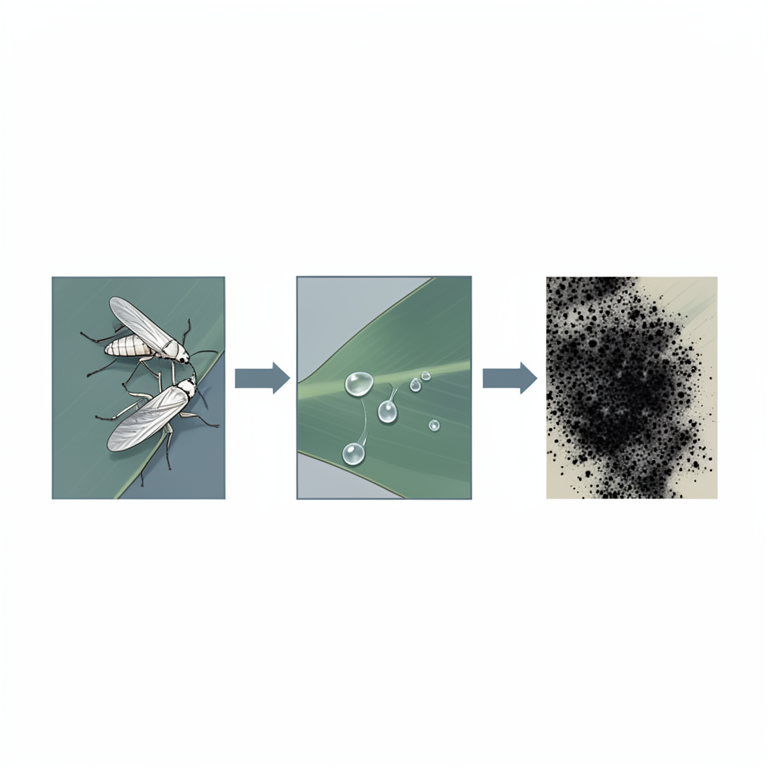
RSW Damage Cycle
AI-generated conceptual illustration (oil palm leaves and rugose spiralling whiteflies). It explains the idea and does not show study data.
View source evidence ↗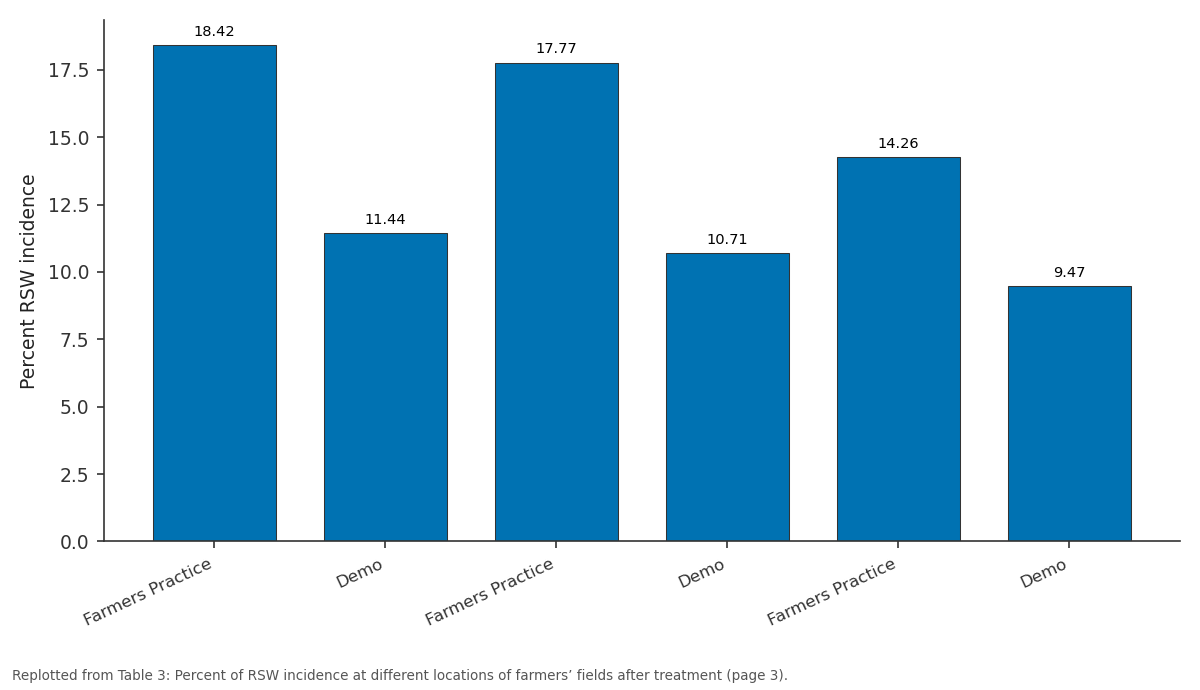
Mean: Farmers Practice vs Demo vs Farmers Practice vs Demo vs Farmers Practice
Replotted from Table 3 (page 3) of the original paper. Every bar is the paper's own table value.
View source evidence ↗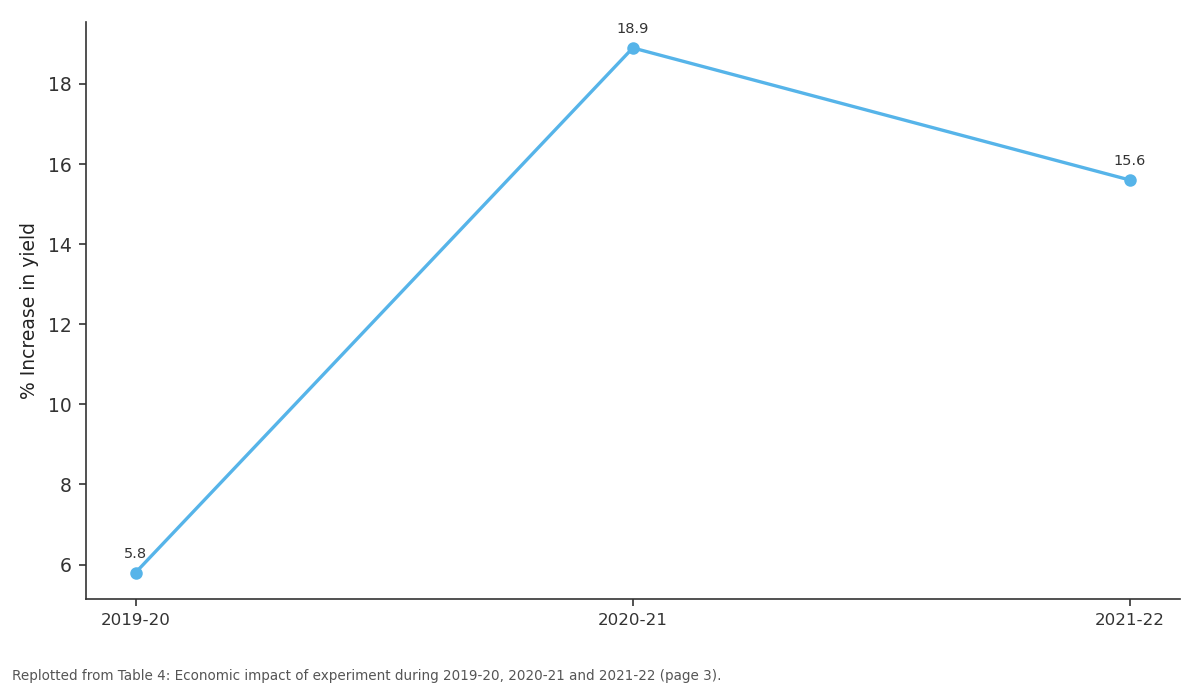
% Increase in yield: 2019-20 vs 2020-21 vs 2021-22
Replotted from Table 4 (page 3) of the original paper. Every bar is the paper's own table value.
View source evidence ↗Figures & tables
From the original paper Table 1
 Table 2
 Table 3
 Table 4
 Table 5
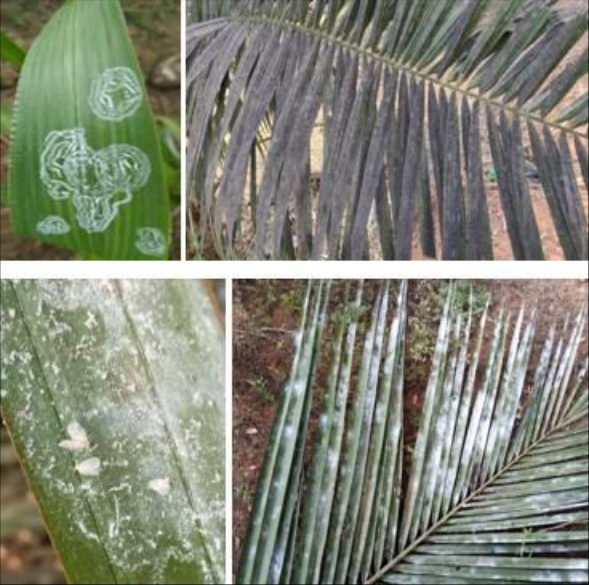 Figure 1
Introduction
Indian vegetable oil economy is world's fourth largest after USA, China and Brazil which includes oil palm. Oil palm (Elaeis guineensis Jacq.) is the only perennial and eco-friendly crop that gives highest oil yield among other edible oil crops giving regular and assured income to the farmers up to 30 yrs. Oil palm, being the cheapest among the edible oils, is widely consumed among the Indian households and contributes to 70% of total vegetable oil import (Department of Horticulture, 2020) [2] . Oil palm is native to West Africa and it is the crop of the present and future vegetable oil economy of the world as well as India (Kalidas et al., 2011) [3] . Oil palm accounts to 60% i.e. 8-9 million tons of the total imports worth of Rs. 40,000 crores. Recently, its productivity is getting reduced due to the incidence of pests and diseases. RSW is one among them. Rugose spiralling whitefly, Aleurodicus rugioperculatus Martin, an invasive whitefly species belonging to the family Aleyrodidae, originally called as gumbo limbo spiralling whitefly, was first reported in coconut (Cocos nucifera L.) during 2004 in Belize, Central America (Martin, 2004) [5] . In India, the dangerous invasive pest was reported for the first time on the same coconut crop at Pollachi, Tamil Nadu in India during August 2016 (Sundararaj and Selvaraj, 2017) [9] . Subsequently, the pest was reported to feed on many horticultural plants such as banana, sapota, mango, guava, custard apple, water apple (Selvaraj et al., 2017) [7] . The RSW was reported to feed on more than 30 host plants in India and about 120 plant species including several economically important horticultural and ornamental crops globally. It was a serious threat to several arecaceae plant species in Florida (Stocks and Hodges, 2012) [8] . Rugose spiraling whitefly (RSW) is a feeding pest that can cause serious infestation in oil palm. RSW nymphs and adults feed on the sap from the under surface of leaves and leaflets. Its feeding causes stress to the host plant by removing water and nutrients. They have a concentric waxy spiralling appearance and can also be found on other ornamentals such as cocoa, guava and papaya. Production of honeydew, which covers the surface of leaves results in the growth of sooty mold, its presence on the upper surface of the leaf can potentially reduce photosynthesis of the plant. Indiscriminate and unwise use of chemical insecticides can result in control failure, besides polluting the environment and upsetting the ecological balance. To minimize the harmful effects of chemical pesticides, integrated pest management involving various eco-friendly tactics and sensible use of pesticides is needed to reduce the losses caused by pests to tolerable levels. The districts Khammam, Bhadradri Kothagudem, Nalgonda and Suryapet grows oil palm. In Bhadradri Kothagudem district oil palm crop occupied nearly 63,000 acres accordingly, high incidence of RSW has been reported from this district. The farmers are unable to diagnose the pest and assess the damage potential caused by it. Hence the FLD was planned to demonstrate the damage potential caused by RSW in oil palm and its management strategies.
Materials and Methods
The present study was undertaken at ten different farmers' fields of Bhadradri Kothagudem district of Telangana with two treatments viz., technology demonstration and check (farmers practice) (Table 1). The experiment was conducted consecutively for three years i.e. during Kharif seasons of 2019-20, 2020-21 and 2021-22. The experimental design, site and farmer selection, the layout of demonstration, farmer's participation, etc., were followed as suggested by Choudhary (1999) [1] . The crops were grown by following all the agronomic practices. The following observations were made during the crop period. Observations on RSW incidence made before the spray on palm infestation. Percentage of leaves infested/palm (no. of leaves infested by RSW /total leaf per palm) was done before and after the treatment. (Table 1). The yield data were collected from both technologies demonstrated plot and farmers practiced plot. Yield parameters of both technology assessment plot and farmers practiced plot were recorded. Using the yield parameters extension gap, technology gap, yield gap, technology index was calculated as procedure suggested by Rajashekhar et al., (2022) [6] , Samui et al., (2000) [11] and Lakshmi Narayanamma, 2023 [4] . To find out the economic impact of treatments effected due to RSW incidence and yield the benefit cost ratio was calculated. --------------------------------X --------------------------------X ---------------------------------X 100 Potential yield
| Technology intervention | Farmers practice | Gap |
|---|---|---|
| Installation of yellow sticky traps. | Not Followed | Full Gap |
| Starch powder @ 10 g/l to remove sooty mold. Azadirachtin 10000 PPM @ 1 ml/l + detergent powder @ 10 g/l two to three sprays at 20 days interval. | Not Followed | Full Gap |
| Release of parasitoids, Encarsia guadeloupae and Foliar application of Isaria fumosorosea @ 1x 10⁸ (5 g/l) along with sticker (2 ml/lit) with intermittent water spray | Not Followed | Full Gap |
| Need based spray | Indiscriminate use of insecticides | Partial Gap |
Table text extracted from the original PDF; superscript letters are shown inline. The original table image is below.
View original table image
Results and Discussion
According to the current results and subsequent analysis of the data in all the three consecutive years, the infestation of RSW was lower in the technology demonstrated plot compared to farmers practice. The reason behind this is regular monitoring of the pest incidence and timely application of starch powder @ 10 g/l to remove sooty mold. Also included spraying of azadirachtin 10,000 PPM @ 1 ml/l + detergent powder @ 10 g/l and use of biological control agents like release of parasitoids, Encarsia guadeloupae and foliar application of Isaria fumosorosea along with sticker (2 ml/lit) with intermittent water spray, which further reduced the infestation up from 9.47 -11.44 percent in technology demonstrated plot compared to farmer practice (18.42 to 14.26) (Table 1, 2 and 3).
Table 1: Details of the treatment's technological intervention and farmer's practice
Table 1: Details of the treatment's technological intervention and farmer's practice
Technology intervention
Farmers practice Gap Installation of yellow sticky traps.
Not Followed Full Gap Starch powder @ 10 g/l to remove sooty mold. Azadirachtin 10000 PPM @ 1 ml/l + detergent powder @ 10 g/l two to three sprays at 20 days interval. Not Followed Full Gap
Release of parasitoids, Encarsia guadeloupae and Foliar application of Isaria fumosorosea @ 1x 10 8 (5 g/l) along with sticker (2 ml/lit) with intermittent water spray Not Followed Full Gap
Need based spray Indiscriminate use of insecticides Partial Gap The highest yield of 285.0, 305.0 and 325.0 (Q/ha) was recorded in the technology demonstrated plot, while lower yield of 269.4, 256.5 and 289.4 (Q/ha) was recorded in the farmers practice plots during 2019-20, 2020-21 and 2021-22, respectively. (Table 4). The percent increase in yield in technology assessment plot when compared with the farmers practiced plot was 5.8, 18.9 and 15.6, respectively (Table 4). Subsequently, higher net returns were recorded in the technology demonstrated plots with Rs 1,67,900/-, Rs.1,72,800/-and Rs.1,88,500/ha and lower net returns of Rs.1,51,433/-, Rs.1,50,450/-and Rs. 1,62,064/-, respectively were recorded in the farmers practice plots during 2019-20, 2020-21 and 2021-22, respectively. On an average, the benefit cost ratio was high in treatment compared to control plot during three years of experimentation. The results clearly indicated that the technology provided was proved effective for the farmers, as it recorded the least incidence of RSW and reaped higher yields, accordingly, highest benefit cost ratio. [12] and in Mandya, Mysuru, East and West Godavari by Selvaraj et al., 2019 [10] .
| Year | Yield (Q/ha) | — | % Increase in yield | Net returns Rs. /ha | — | B:C Ratio | — |
|---|---|---|---|---|---|---|---|
| Demo | Farmers Practice | Demo | Farmers Practice | Demo | Farmers Practice | ||
| 2019-20 | 285.0 | 269.4 | 5.8 | 1,67,900 | 1,51,433 | 2.90:1 | 2.66:1 |
| 2020-21 | 305.0 | 256.5 | 18.9 | 1,72,800 | 1,50,450 | 3.10:1 | 2.54:1 |
| 2021-22 | 325.0 | 289.4 | 15.6 | 1,88,500 | 1,62,064 | 3.15:1 | 2.88:1 |
Table text extracted from the original PDF; superscript letters are shown inline. The original table image is below.
View original table image
Conclusion
On the basis of the result obtained in present study it can be concluded that location specific IPM modules have gained significance due to the changing pest scenario in different seasons and agroecosystems. The yield gap between farmer practices and technology demo plot was perceptibly higher, there is urgent need to make stronger extension services for educating the cultivators in the implementation of improved technology. However, the yield level under local practice was lower which could be further improved by adopting recommended integrated pest management technologies. The FLD intervention is highly effective among farmers with increased net returns. With the results obtained in technology demonstrated plot it is recommended to take further into wide scale in Bhadradri Kothagudem district.
Acknowledgement
AcknowledgementAuthors are sincerely thankful to ICAR-ATARI & PJTSAU, Rajendranagar, Hyderabad for the financial support. We also thank innovative oil palm farmers of the Bhadradri Kothagudem district, Telangana for their help in the field layout, experiment planning, data collection and smooth execution of the investigation in three consecutive years.
Figures and tables from the paper
| — | Percent RSW incidence/ locations | — | — | — | — | — | — | — | — | — | — | — |
|---|---|---|---|---|---|---|---|---|---|---|---|---|
| 1 | 2 | 3 | 4 | 5 | 6 | 7 | 8 | 9 | 10 | Mean | ||
| 2019-20 | Farmers Practice | 23.2 | 25.2 | 19.1 | 32.2 | 25.3 | 24.7 | 26.1 | 21.2 | 23.3 | 22.1 | 24.24 |
| Demo | 24.7 | 24.2 | 30.5 | 31.8 | 37.7 | 25.9 | 22.4 | 19.6 | 24.7 | 20.3 | 26.18 | |
| 2020-21 | Farmers Practice | 21.1 | 13.3 | 23.2 | 24.5 | 25.6 | 21.7 | 14.7 | 16.8 | 17.2 | 22.9 | 20.10 |
| Demo | 21.0 | 24.0 | 21.5 | 28.4 | 29.2 | 21.1 | 26.5 | 21.7 | 25.4 | 23.6 | 24.24 | |
| 2021-22 | Farmers Practice | 21.7 | 25.6 | 21.0 | 21.7 | 14.9 | 14.0 | 13.0 | 17 | 15.4 | 16.0 | 18.03 |
| Demo | 17.2 | 15.3 | 16.7 | 14.0 | 15.0 | 17.7 | 18.6 | 12.0 | 13.8 | 16.2 | 15.65 |
Table text extracted from the original PDF; superscript letters are shown inline. The original table image is below.
View original table image
| — | Percent RSW incidence/ locations | — | — | — | — | — | — | — | — | — | — | — |
|---|---|---|---|---|---|---|---|---|---|---|---|---|
| 1 | 2 | 3 | 4 | 5 | 6 | 7 | 8 | 9 | 10 | Mean | ||
| 2019-20 | Farmers Practice | 15.5 | 21.7 | 16.8 | 20.8 | 19.7 | 17.5 | 20.0 | 16.5 | 16.5 | 19.2 | 18.42 |
| Demo | 12.2 | 10.7 | 12.6 | 11.5 | 12.7 | 14.1 | 12.5 | 10.3 | 9.4 | 8.4 | 11.44 | |
| 2020-21 | Farmers Practice | 18.4 | 9.7 | 21.0 | 16.2 | 17.8 | 21.0 | 15.4 | 17.7 | 19.0 | 21.5 | 17.77 |
| Demo | 15.1 | 9.8 | 8.0 | 9.9 | 8.9 | 10.0 | 12.0 | 13.6 | 12.7 | 7.1 | 10.71 | |
| 2021-22 | Farmers Practice | 18.1 | 15.7 | 17 | 15.0 | 12.0 | 15.8 | 9.3 | 12.3 | 14.2 | 13.2 | 14.26 |
| Demo | 8.9 | 10.2 | 11.2 | 12.3 | 9.2 | 8.5 | 7.5 | 7.2 | 10.2 | 9.5 | 9.47 |
Table text extracted from the original PDF; superscript letters are shown inline. The original table image is below.
View original table image
| Year | Yield gap (%) | Extension gap (Q/ha) | Technology gap (Q/ha) | Technology index (%) | Additional returns (Rs.) |
|---|---|---|---|---|---|
| 2019-20 | 5.8 | 15.6 | 65 | 18.57 | 16467 |
| 2020-21 | 18.9 | 48.5 | 45 | 14.75 | 22350 |
| 2021-22 | 15.6 | 35.6 | 25 | 7.14 | 26436 |
Table text extracted from the original PDF; superscript letters are shown inline. The original table image is below.
View original table image
References
11 in the original paper- Department of Horticulture. Prospects and scope of Oil Palm cultivation in Telangana state. Department of Horticulture. Government of Telangana, 2020. /https:// horticulture. tg.nic.in/ Oil Palm/Downloads/ Oil%20Palm.pdf
- Kalidas P. Strategies on pest management in oilpalm. Recent Trends in Integrated Pest Management (Dhawan, A K; Singh, B; Singh, R and Bhuller, M Beds.). Indian Society for the Advancement of Insect Science. 2011, p. 177-185
- Lakshmi Narayanamma V, Ratnakar V, Vishwatej R, Ram Prasad M, Shiva B, Veeranna G, et al. Demonstration on management strategies of stem weevil Pempherulus affinis (Faust) and its economic impact in cotton. The Pharma Innovation Journal. 2023;SP-12(6):317-320.
- Martin JH. The whiteflies of Belize (Hemiptera: Aleyrodidae) Part 1 -introduction and account of the subfamily Aleurodicinae Quaintance & Baker. Zootaxa. 2004;681:1-119.
- Rajashekhar M, Prabhakar Reddy T, Chandrashekara KM, Rajashekar B, Jagan Mohan Reddy M, Ramakrishna K, et al. Evaluation of integrated pest management module for pink bollworm, Pectinophora gossypiella (Saunders) and its economic analysis under farmer's field conditions. International Journal of Pest Management. 2022;68(3):1-9.
- Selvaraj K, Gupta A, Venkatesan T, Jalali SK, Ballal CR, Sundararaj R. First record of invasive rugose spiraling whitefly Aleurodicus rugioperculatus Martin (Hemiptera: Aleyrodidae) along with parasitoids in Karnataka. J Biol. Cont. 2017;31(2):74-78. DOI 10.18311/jbc/2017/16015.
- Stocks IC, Hodges G. The rugose spiralling whitefly, Aleurodicus rugioperculatus Martin, a new exotic whitefly in south Florida (Hemiptera: Aleyrodidae). Florida Department of Agriculture and Consumer Services, Division of Plant Industry, 2012. http://freshfromflorida.samazonaws.com/aleurodicusrug ioperculatus-pest-alert.pdf, accessed on 10 January 2011
- Sundararaj R, Selvaraj K. Invasion of rugose spiraling whitefly, Aleurodicus rugioperculatus Martin (Hemiptera: Aleyrodidae): A potential threat to coconut in India. Phytoparasitica. 2017;45(1):71-74.
- Rugioperculatus Martin, A Serious Pest of Oil Palm Elaeis Guineensis in India. Journal of Oil Palm Research. 2019. https://doi.org/10.21894/jopr.2019.0052
- Samui SK, Maitra S, Roy DK, Mondal AK, Saha D. Evaluation of front-line demonstration on groundnut (Arachis hypogea L.) in Sundarbans. Journal of the Indian Society of Coastal Agricultural Research. 2000;18(2):180-183.
- Visalakshi M, Selvaraj K, Poornesha B, Sumalatha BV. Biological control of invasive pest, rugose spiralling whitefly in coconut and impact on environment Journal of Entomology and Zoology Studies. 2021;9(1):12151218.