
Research article · 2024 · Full text
International Journal of Agriculture Extension and Social DevelopmentA scale to measure entrepreneurial behaviour of dairy farm women
Volume 7(4S) · Pages 47–53 · DOI: 10.33545/26180723.2024.v7.i4sa.525 ↗
Research areasLivestock Management and Performance Improvement
Abstract
Author-writtenThe present research investigation was under taken in North Gujarat. Two districts namely, Banaskantha and Sabarkantha were selected by random procedure, total 120 dairy farm women from eight villages of four talukas, 15 from each village constituted the sample size to measure their entrepreneurial behaviour. To measure the Entrepreneurial Behaviour of Dairy Farm women a scale was developed. The standard procedure was followed to develop the scale such as collection of components, selection of components, relevancy test, computation of scale value by normalized rank method, preparation of statements/items, item analysis, testing reliability of the scale and testing validity of the scale as per criteria given by Edward (1969). Finally, nine components of entrepreneurial behaviour of dairy farm women namely, innovativeness, decision making ability, achievement motivation, risk orientation, planning ability, coordinating ability, information seeking behaviour, self-confidence and cosmopoliteness were selected based on relevancy weightage and scale value. It was observed that the scale values of components of entrepreneurial behaviour of dairy farm women i.e. innovativeness, decision making ability, achievement motivation, risk orientation, planning ability, coordinating ability, information seeking behaviour, self-confidence and cosmopoliteness were 9.97, 7.52, 6.07, 5.64, 4.82, 3.96, 3.24, 3.24 and 2.27, respectively. It also revealed that all the statements under components of entrepreneurial behaviour of dairy farm women were found to be highly significant. And also, all the statements had relevancy weightage more than 0.70. Hence, the entrepreneurial behaviour scale was found to be standardized.
Summary
Source-checkedPlain-language reading of the full paper, prepared with AI and checked against the text. Each point links to the authors' own words.
Why it matters
- Entrepreneurial development is considered essential for a nation to achieve rapid and sustained economic growth. View evidence ↗
- Dairying is a critical enterprise for the Indian economy, providing steady income and employment for rural households. View evidence ↗
- Women are central to the Indian dairy industry, accounting for 93% of total employment in dairy production. View evidence ↗
The question
- The study aimed to develop a standardized scale to measure the entrepreneurial behavior of dairy farm women, incorporating modern dairy farming components. View evidence ↗
What they did
- The research was conducted in North Gujarat with a sample of 120 dairy farm women selected from eight villages across the Banaskantha and Sabarkantha districts. View evidence ↗
- The scale was developed using the normalized rank approach as recommended by Guilford (1954). View evidence ↗
- To determine the relevancy of components, 109 judges were contacted, with 59 providing responses. View evidence ↗
- The reliability of the scale was tested using the split-half method with 28 dairy farm women from a non-sampled area. View evidence ↗
What they found
- The final scale consists of nine components: innovativeness, decision making ability, achievement motivation, risk orientation, planning ability, coordinating ability, information seeking behaviour, self-confidence, and cosmopoliteness. View evidence ↗
- Innovativeness had the highest scale value (9.97), while cosmopoliteness had the lowest (2.27). View evidence ↗
- All statements within the components were found to be highly significant, with relevancy weightages exceeding 0.70. View evidence ↗
- The scale demonstrated a reliability coefficient of 0.76, which was highly significant at the 0.01 probability level. View evidence ↗
Visual summary
2 visualsIllustrations explain the paper; charts are replotted from the paper's own table values.
Hierarchy of Entrepreneurial Components
AI-generated conceptual illustration (dairy farm women). It explains the idea and does not show study data.
View source evidence ↗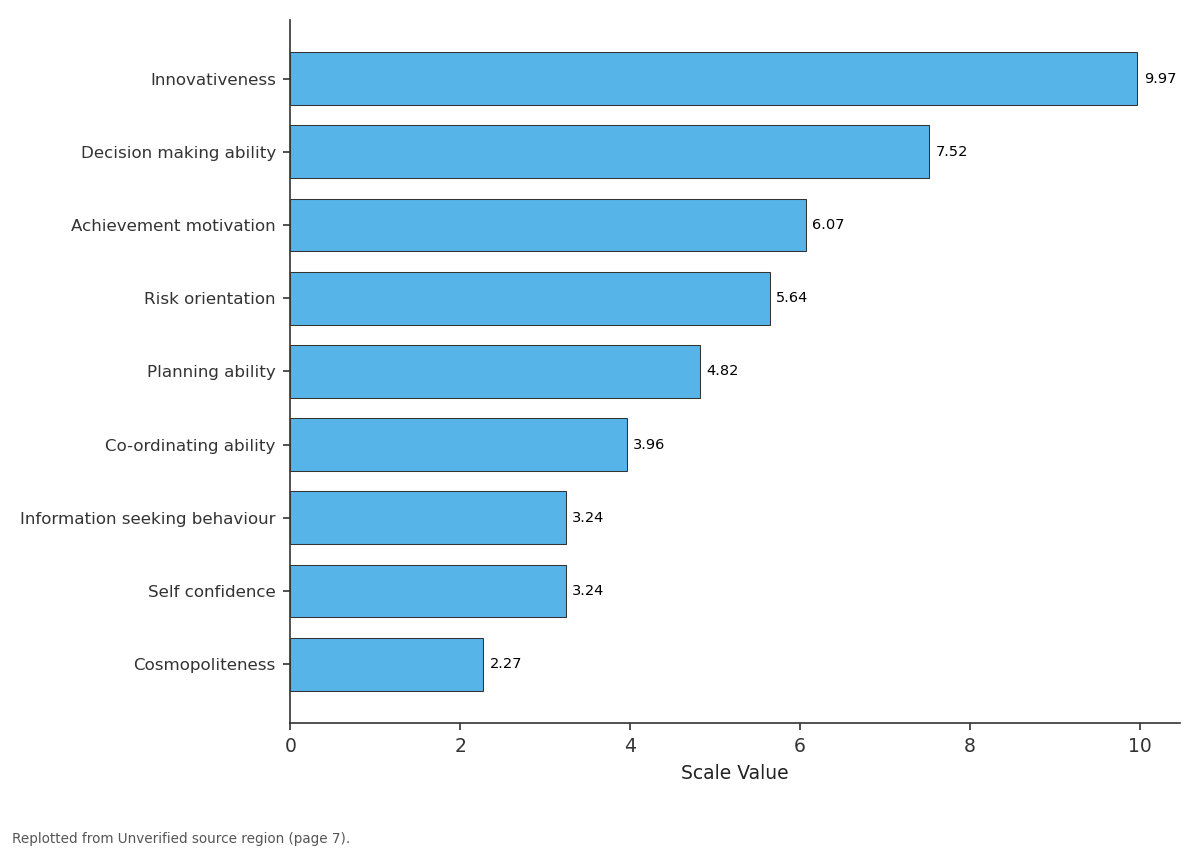
Scale Value: Innovativeness vs Decision making ability vs Achievement motivation vs Risk orientation vs Planning ability
Replotted from a table (page 7) of the original paper. Every bar is the paper's own table value.
View source evidence ↗Figures & tables
From the original paper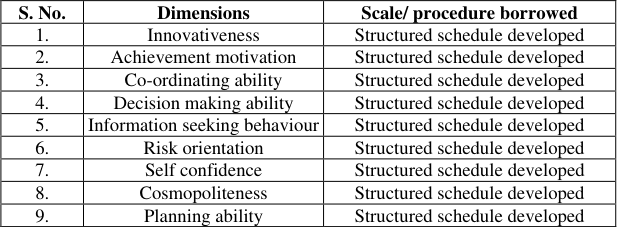 Table 1
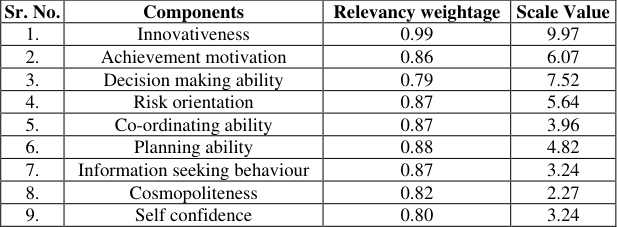 Table 1
Introduction
In the era of innovations and self-sufficiency, entrepreneurs are the building blocks of the nation. They are the key persons of any country for promoting economic growth and technological change, they revolutionize the pattern of production; introduce an untried technological possibility for producing a new commodity. No country can achieve rapid and sustained economic development without concerted efforts towards entrepreneurial development. Dairying is one of the most promising and important enterprises to support the rural households in providing gainful employment and steady income as well as contributes greatly to the Indian Economy. Entrepreneurship development in livestock farming specifically in Dairy is an important way out to bring a transformation in our rural areas. Indian dairy industry has been a leading sector globally, which employs over 70 per cent women of the country. Women account for 93 per cent of total employment in dairy production (Anonymous-2022). Women are the backbone of the dairy cooperative model; they have contributed endlessly to the growth and development dairy enterprise. Lot many technological transformations are there, a significant change has been there in the way the dairy farming business is performed now a days. Looking to this it was felt necessary to develop scale to measure entrepreneurial behaviour of farm women while incorporating the major modern dairy farming components.
Material and Methods
Development of entrepreneurial behaviour scale for dairy farm women was attempted by using the normalized rank approach recommended by Guilford (1954). The following procedure and steps were followed for construction of entrepreneurial behaviour scale: Collection of components Selection of components Relevancy test Computation of scale value by normalized rank method Preparation of statements/items Item analysis Testing reliability of the scale Testing validity of the scale
Collection of components
Based on review of literature on various measures of entrepreneurial behaviour and discussion with experts in the field of veterinary extension, veterinary science, dairy sciences, etc., eleven components had been identified.
Selection of components 2.2.1 Relevancy test
It was quite possible that all the eleven components identified may not have equal relevance in measuring entrepreneurial behaviour of dairy farm women. Therefore, these eleven components of entrepreneurial behaviour were subjected to scrutiny by an expert panel of judges to determine the relevancy and their subsequent screening. For relevancy and screening, these eleven components were mailed/personally handed over to a panel of judges in the field of veterinary science and animal husbandry, extension education, communication, and dairy science. In all, 109 judges were requested to indicate relevancy of the components for inclusion in the scale. The responses of judges were secured on three-point continuum namely, 'Most relevant', 'Relevant' and 'Not relevant' and scored as 2, 1 and 0, respectively. (Appendix -I). In all 59 judges could respond. These responses were used to work out the Relevancy Weightage (RW) of each component by using following formula. Considering relevancy weightage, the components were screened for their relevancy. Accordingly, components having relevancy weightage of more than 0.40 were considered. Using this process, ten components having more than 0.40 relevancy weightage were selected (Appendix -II).
Computation of scale value by normalized rank method
Based on relevancy weightage, the selected ten components had been mailed to 100 judges for ranking. Out of 100 judges, forty-nine judges had responded (Appendix -III).
The ranks given by the 49 judges based on relative importance of the components in measuring the entrepreneurial behaviour of dairy farm women were used to work out the scale value. The following formula suggested by Guilford (1954) [3] was used for calculation of scale values: Rc = 2.357 Rj -7.01
The details of the procedure, along with the scale values for each item, are shown in Appendix IV and Appendix V. An index was developed to measure the entrepreneurial behaviour of dairy farm women by using the following formula:
Preparation of Statements /Items
The statements called items were prepared on each of the selected nine components for measuring the entrepreneurial behaviour of dairy farm women. The statements were framed on each component based on review of literature and discussion with experts in the field of veterinary extension education, student' research council-committee members, and department of Veterinary Sciences and Dairy Science, KU, Sardarkrushinagar. The statements were edited based on 14 criteria suggested by Edward (1969) [2] . These statements were then subjected to scrutiny by an expert panel of judges to determine the relevancy. For this purpose, the statements were mailed to a panel of 98 judges on google form format and requested to indicate appropriateness of each statement for inclusion in the scale. The responses were obtained on three-point quantinuum viz., 'Most relevant', 'Relevant' and 'Not relevant' with scores of 2, 1 and 0, respectively. Based on judges' responses, the relevancy weightage was worked out for the statements by using the formula stated above.
Applying the criteria that the statements having relevancy weightage more than 0.70 were selected (Appendix VI).
Item Analysis
Final selection of the items made on the basis of item analysis. It was considered essential to delineate the items (Statements) based on the extent to which, they can differentiate the person's entrepreneurial behaviour, for this purpose item analysis was carried out. The statements were administered to 40 dairy farm women from non-sample area.
For item analysis, 't-test' was used. The respondents were arranged in ascending order on the basis of total score earned by them. Then 25 per cent respondents with highest total score and 25 per cent with total lowest score were selected. These two groups provided the criterion groups for item analysis. The critical ratio (t) for each item was calculated by using following formula. The significance of the difference of the means of these two groups was found out by 't' test. The 't' value is the measure of the extent to which given statement differentiate between high and low groups. The 't' value equal to or greater than 1.75 indicate that the average response of high and low group differs significantly and differentiates between high and low groups. Finally, the statements having 't' value greater than 1.75 were selected.
Testing Reliability of the Scale
Reliability depends upon the population measures as well as upon the measurement instruments. According to Kerlinger (1973) [4] reliability is the accuracy or precision of the measuring instrument. A scale is said to be reliable when it consistently produces the same results when applied to measure the same phenomena from time to time.
Split half method
In this method the scale was split in to two equal halves on the basis on odd and even number of statements and administered to 28 dairy farm women from non-sampled area. The correlation co-efficient was computed between the two sets of scores of the scale. The reliability co-efficient of the statements under nine components of entrepreneurial behaviour of dairy farm women was found to be 0.76 and was highly significant at 0.01 level of probability.
Testing Validity of the Scale
Guilford (1954) [3] said that a test is valid when it measures what it is presumed to measure. According to Kerlinger (1973) [4] the commonest definition of validity is optimized by the questions: Are we measuring what we think we are measuring? Kerlinger (1973) [4] defined content validity as the representativeness or sampling adequacy of the content, the substance, the matter, the topics of a measuring instrument.
The scale was examined for the content validity of determining how well the content of the scale represented the subject matter under study. In collection and selection of components and items for the construction of the present scale sufficient care had been taken. It covered important components responsible for entrepreneurial behaviour of dairy farm women based on judges' ratings and included the items which represented the universe of content of dairy farm women' entrepreneurial behaviour for maintaining the dairy enterprise. As all the possible components and items covering the universe of content were selected by discussing the same with experts, subject matter specialist and reviewing the available literature on the subject as well as by working out relevancy weightages, the scale satisfied the content validity.
Methods used to measure the components of entrepreneurial behaviour of dairy farm women
There were nine components included in the final scale to measure entrepreneurial behaviour of dairy farm women. The method used to measure each of these components in an objective way is given below:
Innovativeness (scale value 9.97)
It is operationally defined as the degree to which a dairy farm woman adopts new ideas relatively earlier than other dairy farm women in her social system. It consisted of thirteen practices in respect of the dairy business management on modern scientific way, which were common to all the dairy farm women included in the sample. If the dairy farm women would have adopted the practice from five years or more than five years, she would get five points, one point for each year. Therefore, minimum score was zero and maximum score was 65. Details are furnished in Appendix VII.
Innovativeness
Sr. No. Innovations "RW" "r" 1.
Sex sorted semen 0.89 0.91 2.
Feeding colostrums to newly born calves at proper time, in proper amount 0.88 0.79 3.
Providing feed, fodder and balance concentrate mixture based on physiological need/status 0.88 0.72 4.
Preparing ration at home or on farm following ration balancing techniques and incorporating local ingredients 0.88 0.75 5.
All scientific techniques for clean milk production like cooling, preservation & storage care. 0.87 0.69 6.
Timely and regular vaccination against common contagious diseases 0.87 0.71 7.
Feed [5] defined achievement motivation as a social value that emphasizes a desire for the excellence in order for an individual to attain a sense of personal accomplishment.
The instrument consisted of five criteria each with two statements. Each statement had two options and out of these, one was concerned with achievement motivation. Thus, the total score for each dairy farm women on her achievement motivation would range from zero to twenty.
Achievement motivation
1. In accomplishing a task, I like: "RW" "r" a.
Not to give up till I achieve the desired results 0.92 0.85 b.
To do it much better than other dairy entrepreneurs 0.91 0.81 2. My desire is to be: a.
An average dairy entrepreneur 0.89 0.61 b.
A successful dairy entrepreneur 0.89 0.79 3. I feel my success depends: a.
Upon my perseverance, sincere efforts & dedication to achieve target 0.87 0.56 b.
Upon my family members & labourers working in dairy farming 0.87 0.71 4. I like: a.
To earn more profit and expand my business 0.84 0.63 b.
To satisfy my minimum needs 0.83 0.66 5. After 10 years I will be: a.
One of the highest profit earning, a well-known dairy entrepreneur 0.83 0.67 b.
My status will be the same. 0.82 0.66
Risk Orientation (Scale value 5.64)
It was operationalized as the degree to which the dairy farm women is oriented towards risk and uncertainty in facing problems in dairy enterprise. The instrument consisted of four statements and responses obtained on three-point continuum viz., 'agree', 'undecided', and 'disagree'. A weightage of 2, 1 and 0, respectively assigned to the response categories in case of positive statement and scoring was reversed for negative statements. Statement number 1, 3 and 4 were positive, while 2 was negative statement. The total score range was 0 to 8.
Risk Orientation
Risk Orientation
Sr. No. Risk orientation "RW" "r" 1.
A dairy entrepreneur should take greater risk than the average farmers. 0.87 0.85 2. A dairy entrepreneur should try new dairy farming practices only after successfully used by other dairy entrepreneurs. 0.83 0.81 3.
Trying an entirely new practice in dairy enterprise involves risk but it is worth. 0.82 0.79 4.
Dairy entrepreneur should sustain risk in development of his enterprise. 0.82 0.63
Planning ability (Scale value 4.82)
It is the degree to which, a dairy farm women is capable of starting the activities that she intends to do by certain ways in dairy enterprise.
In the present study, the statements were framed to measure the planning ability of dairy farm women. The scale consisted of six statements. It was measured on two point continuum as 'followed' and 'not followed' by assigning the score 1 and 0, respectively. The score range was 0 to 6. Ensuring in advance the number of animals required for maintaining regular flow of milk for customers. 0.89 0.79 6.
Ensuring in advance the services required for smooth functioning of machineries & equipment. 0.85 0.68
Coordinating ability (Scale value 3.96)
It is operationalized as the degree to which dairy farm women co-ordinates actions in time dimension. In the present study total four questions were considered. The score of 2, 1 and 0 were assigned for the responses 'well in advance', 'at nick of time' and 'never', respectively. Total score was obtained by summing up the score recorded. The score range was 0 to 8.
Coordinating ability
Sr. No. Statement "RW" "r" 1.
Estimation & arrangement for the capital required for the enterprise. 0.89 0.92 2.
Usually consulting veterinarian regarding guidance on the health and treatment of the animals. 0.88 0.79 3.
Estimation of capital & required quantity of fodder. 0.87 0.81 4.
Seeking guidance in advance for ensuring about market of milk & milk products. 0.87 0.79
Information seeking behaviour (Scale value 3.24)
It was operationally defined as the degree of frequency of contacts by a dairy farm woman with various information sources. This is the pattern by which, a dairy farm woman gets information either on her own seeking or as a consequence of being a part of a network.
In the present study, the degree of frequency of contacts with information sources of dairy farm women was classified on the basis of type of sources such as formal, informal and media sources. The contacts with formal sources were measured on four point continuum viz., once in a fortnight, once in a month, occasionally and never by assigning scores of 3, 2, 1 and 0, respectively, whereas the information seeking from informal and media sources was measured on three point continuum viz., 'regularly', 'occasionally' and 'never' by assigning the scores of 2, 1, and 0, respectively. The total score was computed for each respondent by summing the scores recorded. The score range was 0 to 33.
Self-confidence (Scale value 3.24)
It is operationally defined as the degree of belief in one's own abilities in achieving the things one wishes. It consisted of five questions. The responses were obtained on dichotomous continuum i.e., in 'yes' and 'no' form by assigning the scores of 1 and 0, respectively for positive questions and it was reversed for negative questions. The question number 5 was positive question and 1, 2, 3 and 4 were negative questions. The total score range was 0 to 5.
Self-confidence
Sr. No. Statement "RW" "r" 1.
Facing difficulty in expressing the right opinion at the right time. 0.89 0.81 2.
My past negative life experiences dictate my future. 0.80 0.77 3.
Seeking approval from others for most of decisions. 0.74 0.80 4.
Often over thinking on any embarrassing situation. 0.73 0.81 5.
Having enough faith in oneself to make profit in dairy enterprise. 0.70 0.89 2.7.9 Cosmopoliteness (Scale value 2.27) It is operationally defined as the degree to which a dairy farm woman is oriented towards outside of her social system. The instrument consisted of six statements and responses were obtained on three point continuum viz., 'agree', 'undecided' and 'disagree' by assigning a weightage of 2, 1 and 0, respectively for positive statements while, it was reversed for negative statements. There were four statements out of these, the statement numbered as 3 alone was negative statement, whereas 1, 2 and 4 were the positive statements. The score range was 0 to 8.
Results and Discussion
The final format of the scale is given in Table 1. From Table 1 it was observed that the scale values of components of entrepreneurial behaviour of dairy farm women i.e. innovativeness, decision making ability, achievement motivation, risk orientation, planning ability, coordinating ability, information seeking behaviour, self-confidence and cosmopoliteness were 9.97, 7.52, 6.07, 5.64, 4.82, 3.96, 3.24, 3.24 and 2.27, respectively and the relevancy weightage score in all the components was more than 0.80. It reveals that all components of entrepreneurial behaviour of dairy farm women were found to be highly significant. Moreover, all the statements in nine components had relevancy weightage more than 0.70. Hence, the entrepreneurial behaviour scale was found to be a standardized and an objective one, as indicated by the validity, reliability and norms of distribution of scores. Therefore, this scale can be used to measure the entrepreneurial behaviour of dairy farm women in an objective way. www.extensionjournal.com
| Sr. No. | Components | Relevancy weightage | Scale Value |
|---|---|---|---|
| 1. | Innovativeness | 0.99 | 9.97 |
| 2. | Achievement motivation | 0.86 | 6.07 |
| 3. | Decision making ability | 0.79 | 7.52 |
| 4. | Risk orientation | 0.87 | 5.64 |
| 5. | Co-ordinating ability | 0.87 | 3.96 |
| 6. | Planning ability | 0.88 | 4.82 |
| 7. | Information seeking behaviour | 0.87 | 3.24 |
| 8. | Cosmopoliteness | 0.82 | 2.27 |
| 9. | Self confidence | 0.80 | 3.24 |
Table text extracted from the original PDF; superscript letters are shown inline. The original table image is below.
View original table image
| S. No. | Dimensions | Scale/ procedure borrowed |
|---|---|---|
| 1. | Innovativeness | Structured schedule developed |
| 2. | Achievement motivation | Structured schedule developed |
| 3. | Co-ordinating ability | Structured schedule developed |
| 4. | Decision making ability | Structured schedule developed |
| 5. | Information seeking behaviour | Structured schedule developed |
| 6. | Risk orientation | Structured schedule developed |
| 7. | Self confidence | Structured schedule developed |
| 8. | Cosmopoliteness | Structured schedule developed |
| 9. | Planning ability | Structured schedule developed |
Table text extracted from the original PDF; superscript letters are shown inline. The original table image is below.
View original table image
Appendix III: Scale value of components of entrepreneurial behaviour of dairy farm women for their ranking n=49
References
1 in the original paper- Anonymous. Women Empowerment-The Indian way. Dairy India, 2023. Available from: indiadairy.com. Accessed 2022 Mar 8.