
Research article · 2024 · Full text
International Journal of Research in AgronomyResidual effect of sulphur and boron fertilization as influenced by liming on yield and yield attributes of summer greengram under rapeseed-greengram cropping sequence
Volume 7(4) · Pages 265–269 · DOI: 10.33545/2618060x.2024.v7.i4d.549 ↗
Research areasNitrogen and Sulfur Effects on BrassicaAgricultural Science and FertilizationAgronomic Practices and Intercropping Systems
Abstract
Author-writtenThe field experiment was conducted to study the effect of S and B under limed and unlimed condition on yield and its attributes on rapeseed and its residual effect on summer greengram in sandy loam soil during rabi and summer seasons of years 2017-18 and 2018-19 at Instructional farm of Krishi Vigyan Kendra, Udalguri, Assam Agricultural University, Assam. The experiment was laid out in randomized block design with factorial concept, comprising 4 treatment combinations of S and B ((S0B0, S15B0.75, S20B1.0 and S25B1.25 kg ha-1) and two factors (limed and unlimed) with three replications. Sulphur and B were applied to rapeseed as a basal along with recommended dose of fertilizer (40:35:15::N:P2O5:K2O kg ha-1) and the residual effect of treatments was studied in summer greengram crop which too received recommended dose of fertilizers (N:P2O5:K2O::15:35:0 kg ha-1) without S, B and lime. The residual effect of applied S, B and lime @ 20 kg S + 1.0 kg B + 490 kg lime ha-1 resulted significantly highest LAI (4.41), plant height (36.99 cm), dry matter yield (314.55 g m-2), pod plant-1 (25.65), seed pod-1 (10.24), test weight (26.90 g), seed yield (8.74 q ha-1) and stover yield (49.38 q ha-1) of greengram. Under unlimed condition, the treatment 20 kg S + 1.0 kg B ha-1 showed 15.23% and 23.84% increase in seed and stover yield over control and in limed condition, the same treatment recorded 5.17% and 39.89% increase in seed and stover yield over control.
Summary
Source-checkedPlain-language reading of the full paper, prepared with AI and checked against the text. Each point links to the authors' own words.
Why it matters
- Sulphur is a critical plant nutrient, required in amounts similar to phosphorus, and is essential for the activity of proteolytic enzymes and the synthesis of amino acids. View evidence ↗
- In the acidic soils of Assam, low yields of greengram are partly attributed to insufficient fertilization of sulphur and boron. View evidence ↗
The question
- The study aimed to determine how sulphur and boron applied to a preceding rapeseed crop affect the yield and growth attributes of a subsequent summer greengram crop in acidic soils, both with and without liming. View evidence ↗
What they did
- The experiment took place over two years (2017-18 and 2018-19) during the rabi and summer seasons at the Krishi Vigyan Kendra in Udalguri, Assam. View evidence ↗
- Sulphur and boron were applied as basal fertilizer to the rapeseed crop; the subsequent greengram crop received only the recommended NPK dose without additional S, B, or lime to test residual effects. View evidence ↗
What they found
- The combination of 20 kg S + 1.0 kg B + 490 kg lime ha-1 produced the highest pooled results for greengram, including a seed yield of 8.74 q ha-1 and a stover yield of 49.38 q ha-1. View evidence ↗
- In unlimed soils, applying 20 kg S + 1.0 kg B ha-1 increased seed yield by 15.23% and stover yield by 23.84% compared to the control. View evidence ↗
- Overall, greengram crops grown in limed plots showed significantly higher mean yields and growth attributes than those in unlimed plots. View evidence ↗
What it means
- The authors conclude that applying 20 kg S + 1.0 kg B + 490 kg lime ha-1 to rapeseed provides the optimum residual benefit for the subsequent greengram crop. View evidence ↗
Visual summary
3 visualsIllustrations explain the paper; charts are replotted from the paper's own table values.
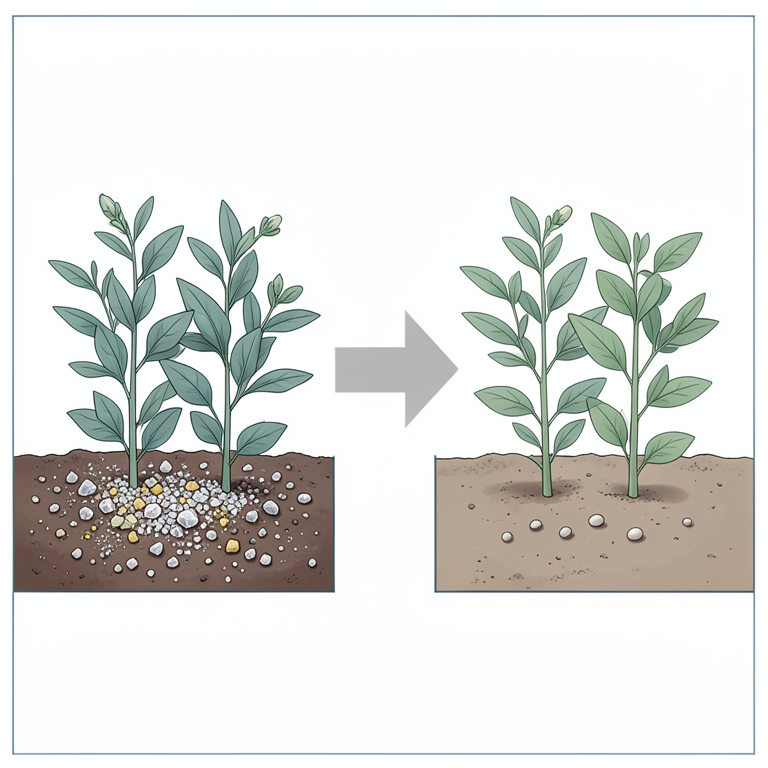
Cropping Sequence Workflow
AI-generated conceptual illustration (rapeseed plants and summer greengram plants in soil). It explains the idea and does not show study data.
View source evidence ↗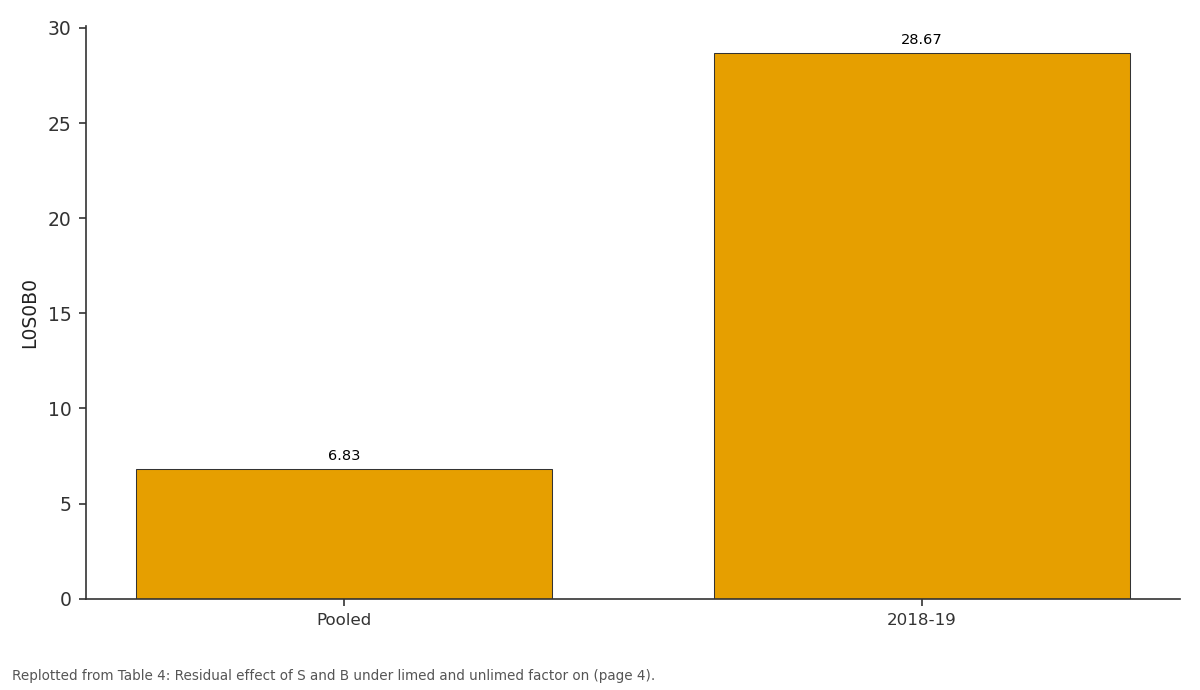
L0S0B0: Pooled vs 2018-19
Replotted from Table 4 (page 4) of the original paper. Every bar is the paper's own table value.
View source evidence ↗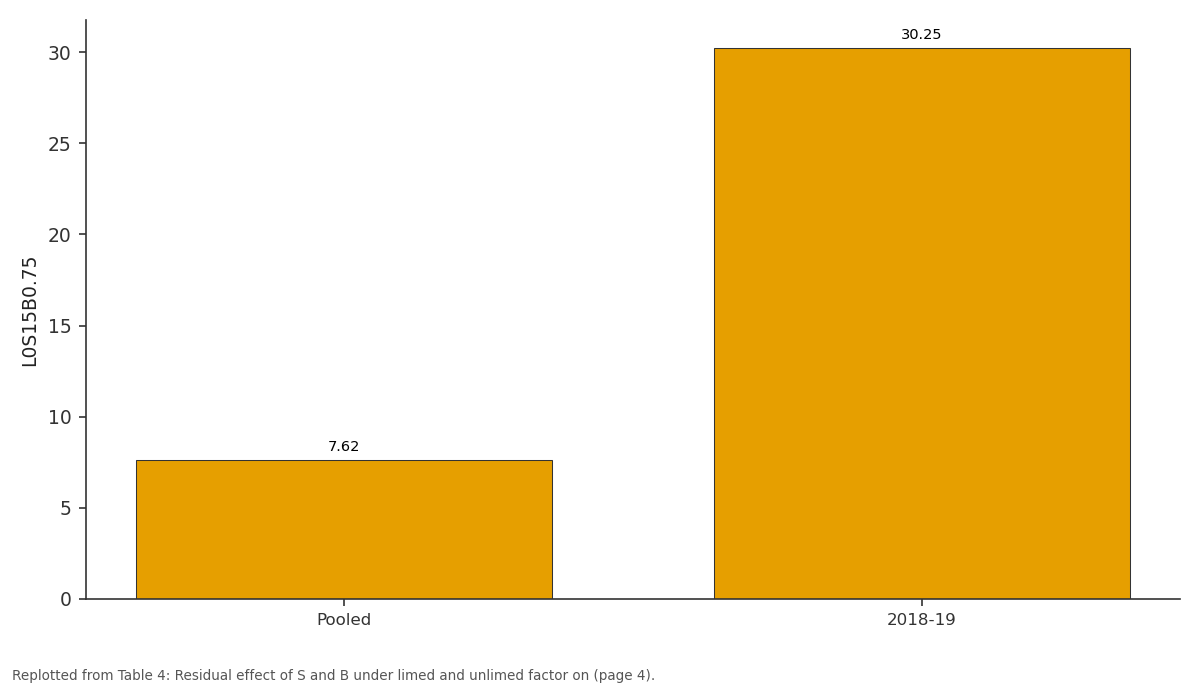
L0S15B0.75: Pooled vs 2018-19
Replotted from Table 4 (page 4) of the original paper. Every bar is the paper's own table value.
View source evidence ↗Figures & tables
From the original paper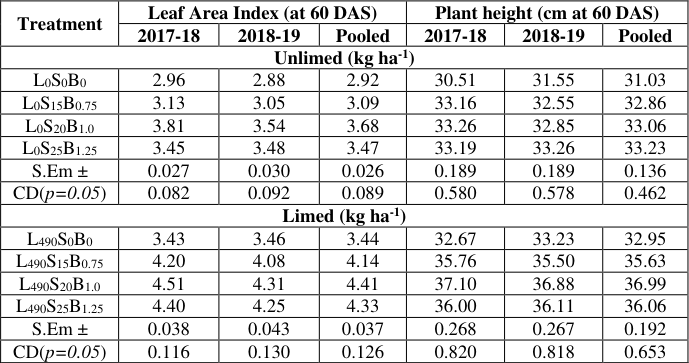 Table 1
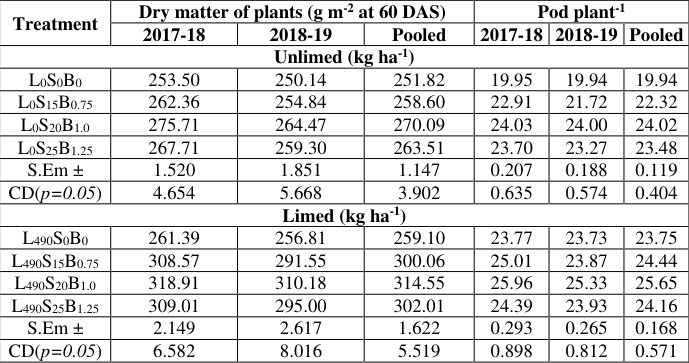 Table 2
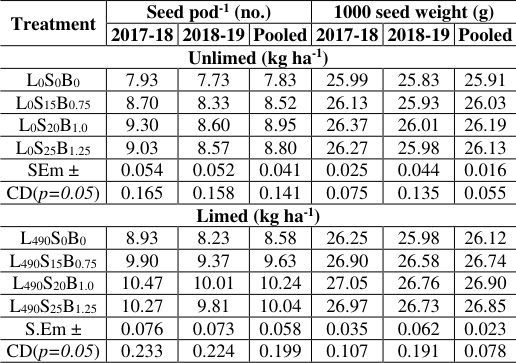 Table 3
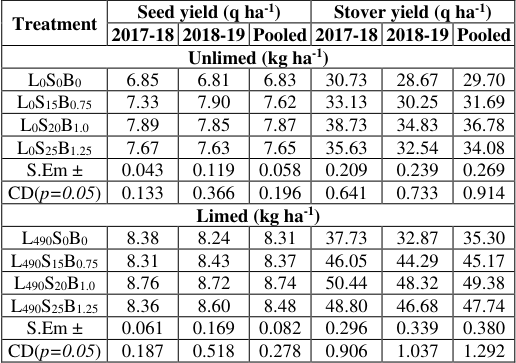 Table 4
Introduction
Sulphur (S) requirement by crop is equivalent to that of phosphorus (Scherer, 2001) [19] and plays a vital role in synthesis of amino acids and activity of proteolytic enzymes. Availability of S in soil depends on factors such as pH, organic matter content, soil texture, type of clay minerals, level of other nutrient elements in soil solution and climatic conditions (Rattan et al., 2015) [16] . The SO 4 2-ions are loosely held by positive charges developed on soil colloids under low pH condition. Unlike other anions, SO 4 2-is less susceptible to leaching losses but under high rainfall conditions it is leached down. The recent reports appeared in scientific literature revealed several cases of S deficiency in various parts of the country (Tandon, 2011; Aulakh, 2003 and Singh, 1999) [24,2,21] . The continuous removal of S under intensive cultivation with high yielding varieties, use of high-analysis fertilizers and imbalance fertilization leads to such deficiency in soils of India. The specific deficiency symptoms of boron (B) are well documented in several crops. It plays an important role in cell differentiation and development, membrane permeability regulation, tissue differentiation, carbohydrate and protein metabolism, translocation of photosynthates and growth regulators to sink and growth of pollen grains (Sakal et al., 1991) [18] . Adequate B nutrition is stated to reduce incidence of many diseases in plants because of its role in lignin formation. Boron availability in soil is known to be influenced by several factors such as texture, pH, organic carbon content and abundance of Fe and Al oxides. Generally, light textured soils contain less available B than heavy soils. This element is present as boric acid (H 3 BO 3 ) in acid soils, which can be leached down from light textured soils. Hence, deficiency of this element is common in acid soils. Greengram (Vigna radiata L.) is the third most important food legumes consumed and it is the second important pulse in Assam. It is required in almost all social and religious ceremonies of the indigenous people of the state. It grows on a variety of soil and climatic conditions in both kharif and summer seasons and can be easily incorporated in the conventional cropping sequence because of its short duration. Considering the gradual deterioration of soil health, inclusion of a pulse crop in the existing cropping sequence is an important aspect in present day agriculture. Recently, commercial cultivation of pulses are gaining momentum in Assam due to its higher nutritive value, high return, soil fertility, short duration, high productivity and good market potential. The total area under greengram in Assam is 7513 ha (Anonymous, 2016) [1] . However, besides natural calamities there are numbers of manageable constraints that hinder smooth and successful cultivation of greengram in Assam. The inadequate S and B fertilization in greengram cultivation is one of the major reasons behind the low yield of this crop in these acidic soils. The status of S and B was reported as deficient in soils of several districts of Assam (Borkakati and Takkar (2000) [6] ; Sakal and Singh (1995) [17] and Basumatary et al., (2017) [3] . But till date, proper recommendation of S and B for rapeseed-greengram cropping sequence has not been formulated. It is therefore necessary to undertake a systematic research work on scientific nutrient management in rapeseedgreengram cropping sequence for remunerative production of these crops in alluvial plains of Assam. Generally, the S and B applied to main crops leaves residual effect on succeeding crops. The positive influence of residual effect of S and B on growth, uptake of nutrients and yield of many crops were reported by many researchers (Kour et al., (2014) [11] ; Patel et al., (2019) [14] and Kumar and Singh (2018) [12] . But little information is available on residual effect of S and B on pulses grown in Assam. Thus this research work was undertaken to study the residual effect of S and B fertilization applied to rapeseed on yield and its attributes of summer greengram in the acidic soils of Assam under limed and unlimed condition.
Materials and Methods
The field experiment was conducted during the rabi and summer seasons for two years 2017-18 and 2018-19 at the Instructional farm of Krishi Vigyan Kendra, Udalguri, Assam Agricultural University, Assam. The soil of the experimental field was sandy loam in texture with the pH of 5.24, organic carbon (0.82%), Available N (361.7 kg ha -1 ), P 2 O 5 (16.16 kg ha -1 ), K 2 O (172.9 kg ha -1 ), S (4.70 kg ha -1 ) and HWS-B (0.53 mg kg -1 ). The treatment comprised four levels of sulphur and boron (S 0 B 0 , S 15 B 0.75 , S 20 B 1.0 and S 25 B 1.25 kg ha -1 ) with two factors (limed @ 490 kg ha -1 and unlimed). Sulphur and B were applied to rapeseed as basal along with recommended dose of fertilizers (40:35:15 kg N:P 2 O 5 :K 2 O ha -1 ). The experiment was laid out in factorial randomized block design with three replications. Summer Greengram (cv. Pratap) received recommended dose of N:P 2 O 5 :K 2 O (15:35:0 kg ha -1 ) in the same plot with no S, B and lime application. The residual effects of treatments were studied and the yield and its attributes were recorded at 60 DAS and at the time of harvest. The experimental data were analyzed as per the procedure outlined by Steel and Torrie (1982) [23] .
Results and Discussion
Residual effect of S and B on Leaf area index (LAI) and plant height of greengram: Under limed factor the residual effect of 20 kg S + 1.0 kg B + 490 kg lime ha -1 gave significantly highest LAI (4.51, 4.31 and 4.41) and plant height (37.10, 36.88 and 36.99 cm) of greengram (Table 1) in both the years as well as on pooled basis than control (L 490 S 0 B 0 ). Similar trend was also observed under unlimed condition. Application of 20 kg S + 1.0 kg B + 0 kg lime ha -1 resulted highest LAI (3.81, 3.54 and 3.68) in both the years as well as on pooled basis while plant height was highest (33.26 cm) 1 st year in treatment 20 kg S + 1.0 kg B + 0 kg lime ha -1 while in 2 nd year as well as on pooled basis it was highest (32.85 and 32.85 cm) in treatment 25 kg S + 1.25 kg B + 0 kg lime ha -1 . All the treatments showed significantly higher results over control under both factor. This might be due to increase in S and B status after harvest of rapeseed during both the years, as S was involved in increased metabolic processes in plants which seems to have promoted meristematic activities resulting in higher apical growth and expansion of photosynthetic surface and role of B in increasing plant height, number of leaves, shoot fresh weight and plant spread. The similar results were reported by Bharathi and Poongothai (2008) [5] and Shekhawat and Shivay (2012) [20] for greengram crop.
| Treatment | Leaf Area Index (at 60 DAS) | — | — | Plant height (cm at 60 DAS) | — | — |
|---|---|---|---|---|---|---|
| 2017-18 | 2018-19 | Pooled | 2017-18 | 2018-19 | Pooled | |
| Unlimed (kg ha-1) | ||||||
| L0S0B0 | 2.96 | 2.88 | 2.92 | 30.51 | 31.55 | 31.03 |
| L0S15B0.75 | 3.13 | 3.05 | 3.09 | 33.16 | 32.55 | 32.86 |
| L0S20B1.0 | 3.81 | 3.54 | 3.68 | 33.26 | 32.85 | 33.06 |
| L0S25B1.25 | 3.45 | 3.48 | 3.47 | 33.19 | 33.26 | 33.23 |
| S.Em ± | 0.027 | 0.030 | 0.026 | 0.189 | 0.189 | 0.136 |
| CD(p=0.05) | 0.082 | 0.092 | 0.089 | 0.580 | 0.578 | 0.462 |
| Limed (kg ha-1) | ||||||
| L490S0B0 | 3.43 | 3.46 | 3.44 | 32.67 | 33.23 | 32.95 |
| L490S15B0.75 | 4.20 | 4.08 | 4.14 | 35.76 | 35.50 | 35.63 |
| L490S20B1.0 | 4.51 | 4.31 | 4.41 | 37.10 | 36.88 | 36.99 |
| L490S25B1.25 | 4.40 | 4.25 | 4.33 | 36.00 | 36.11 | 36.06 |
| S.Em ± | 0.038 | 0.043 | 0.037 | 0.268 | 0.267 | 0.192 |
| CD(p=0.05) | 0.116 | 0.130 | 0.126 | 0.820 | 0.818 | 0.653 |
Table text extracted from the original PDF; superscript letters are shown inline. The original table image is below.
View original table image
Residual effect of S and B on dry matter production and pod plant -1 of greengram:
Under unlimed factor application of 20 kg S + 1.0 kg B ha -1 gave significantly highest dry matter of plant at 60 DAS (275.71, 264.47 and 270.09 g m -2 ) and pod plant -1 (24.03, 24.00 and 24.02) of greengram (Table 2) in both the years as well as on pooled basis than control (L 0 S 0 B 0 ). Under limed factor, the treatment 20 kg S + 1.0 kg B + 490 kg lime ha -1 gave significantly highest dry matter of plant (318.91, 310.18 and 314.55 g m -2 ) and pod plant -1 (25.96, 25.33 and 25.65) of greengram in both the years as well as on pooled basis than control (L 490 S 0 B 0 ). Here too all the treatments showed significantly higher results over control. This might be due to the residual S and B. The B plays an important role in viability, germination, proper pollination and fruit or seed setting. The combined influences of S and B on dry matter, protein content, oil content and seed and pod production in pulses. The results are in agreement with the findings of Singh et al. (2004) [22] and Vaiyapuri et al. (2010) [25] .
| Treatment | Dry matter of plants (g m-2 at 60 DAS) | — | — | Pod plant-1 | — | — |
|---|---|---|---|---|---|---|
| 2017-18 | 2018-19 | Pooled | 2017-18 | 2018-19 | Pooled | |
| Unlimed (kg ha-1) | ||||||
| L0S0B0 | 253.50 | 250.14 | 251.82 | 19.95 | 19.94 | 19.94 |
| L0S15B0.75 | 262.36 | 254.84 | 258.60 | 22.91 | 21.72 | 22.32 |
| L0S20B1.0 | 275.71 | 264.47 | 270.09 | 24.03 | 24.00 | 24.02 |
| L0S25B1.25 | 267.71 | 259.30 | 263.51 | 23.70 | 23.27 | 23.48 |
| S.Em ± | 1.520 | 1.851 | 1.147 | 0.207 | 0.188 | 0.119 |
| CD(p=0.05) | 4.654 | 5.668 | 3.902 | 0.635 | 0.574 | 0.404 |
| Limed (kg ha-1) | ||||||
| L490S0B0 | 261.39 | 256.81 | 259.10 | 23.77 | 23.73 | 23.75 |
| L490S15B0.75 | 308.57 | 291.55 | 300.06 | 25.01 | 23.87 | 24.44 |
| L490S20B1.0 | 318.91 | 310.18 | 314.55 | 25.96 | 25.33 | 25.65 |
| L490S25B1.25 | 309.01 | 295.00 | 302.01 | 24.39 | 23.93 | 24.16 |
| S.Em ± | 2.149 | 2.617 | 1.622 | 0.293 | 0.265 | 0.168 |
| CD(p=0.05) | 6.582 | 8.016 | 5.519 | 0.898 | 0.812 | 0.571 |
Table text extracted from the original PDF; superscript letters are shown inline. The original table image is below.
View original table image
Residual effect of S and B on seed pod -1 and test weight of greengram:
The unlimed treatment 20 kg S + 1.0 kg B ha -1 applied to rapeseed gave significantly highest seed pod -1 (9.30, 8.60 and 8.95) and 1000 seed weight (26.37, 26.01 and 26.19 g) of greengram in both the years as well as on pooled basis, (Table 3) however, results of both parameters are at par with treatment 25 kg S +1.25 kg B ha -1 . The limed treatment 20 kg S + 1.0 kg B + 490 kg lime ha -1 gave significantly highest seed pod -1 (10.47, 10.01 and 10.24) and 1000 seed weight (27.05, 26.76 and 26.90 g) of greengram in both the years as well as on pooled basis, however, 1000 seed weight was at par with treatment 25 kg S +1.25 kg B + 490 kg lime ha -1 . All the treatments for both the parameter showed significantly higher results over control under both the factors. The increase in seed pod -1 and 1000 seed weight might be due to increase in residual S and B of soil as S is known to enhance chlorophyll system, improve nutritional availability in the soil, which might have favourably influenced the carbohydrate metabolism due to energy transformation and activation of carbon fixing enzymes. These favourable effects led to increased transportation of photosynthates towards sink and resulted in the formation of more seed and relatively bold seeds (Rahman et al., 2007) [15] . Boron on the other hand helps in viability, germination and growth of pollen tubes and S and B together helps on dry matter and seed yield as well as protein content and protein yield of seed (Jaiswal et al. 2015) [9] . The trend on the effect of S and B was found to be similar with the observation of Bharathi and Poongothai (2008) [5] and Begum et al. (2015) [4] in greengram.
| Treatment | Seed pod-1 (no.) | — | — | 1000 seed weight (g) | — | — |
|---|---|---|---|---|---|---|
| 2017-18 | 2018-19 | Pooled | 2017-18 | 2018-19 | Pooled | |
| Unlimed (kg ha-1) | ||||||
| L0S0B0 | 7.93 | 7.73 | 7.83 | 25.99 | 25.83 | 25.91 |
| L0S15B0.75 | 8.70 | 8.33 | 8.52 | 26.13 | 25.93 | 26.03 |
| L0S20B1.0 | 9.30 | 8.60 | 8.95 | 26.37 | 26.01 | 26.19 |
| L0S25B1.25 | 9.03 | 8.57 | 8.80 | 26.27 | 25.98 | 26.13 |
| SEm ± | 0.054 | 0.052 | 0.041 | 0.025 | 0.044 | 0.016 |
| CD(p=0.05) | 0.165 | 0.158 | 0.141 | 0.075 | 0.135 | 0.055 |
| Limed (kg ha-1) | ||||||
| L490S0B0 | 8.93 | 8.23 | 8.58 | 26.25 | 25.98 | 26.12 |
| L490S15B0.75 | 9.90 | 9.37 | 9.63 | 26.90 | 26.58 | 26.74 |
| L490S20B1.0 | 10.47 | 10.01 | 10.24 | 27.05 | 26.76 | 26.90 |
| L490S25B1.25 | 10.27 | 9.81 | 10.04 | 26.97 | 26.73 | 26.85 |
| S.Em ± | 0.076 | 0.073 | 0.058 | 0.035 | 0.062 | 0.023 |
| CD(p=0.05) | 0.233 | 0.224 | 0.199 | 0.107 | 0.191 | 0.078 |
Table text extracted from the original PDF; superscript letters are shown inline. The original table image is below.
View original table image
Residual effect of S and B on seed and stover yield of greengram:
The unlimed treatment 20 kg S + 1.0 kg B ha -1 showed significantly highest seed yield in 1 st year as well as on pooled basis and treatment 15 kg S +0.75 kg B ha -1 gave highest seed yield in 2 nd year but it was at par with 20kg S + 1.0 kg B ha - 1 . The treatment 20 kg S + 1.0 kg B ha -1 showed significantly the highest stover yield in both the years and on pooled basis (Table 4). All treatments for both parameters resulted significantly higher yield over control (L 0 S 0 B 0 ). The limed factor treatments also depicted similar trend of results with highest significant seed yield (8.76, 8.72 and 8.74 kg ha -1 ) and stover yield (50.44, 48.32 and 49.38 kg ha -1 ) in both the years as well as on pooled basis was recorded in treatment 20 kg S + 1.0 kg B + 490 kg lime ha -1 . Here too all the treatments for both the parameters showed significantly higher results over control (L 490 S 0 B 0 ). The enhanced yields of greengram as a result of residual S and B are attributable to the increased availability of nutrients to plants (Jaiswal et al., 2015) [9] . They concluded that the increase in seed yield might be due to the role of B in viability, germination and growth of pollen tubes. The yield is ultimate test to judge the performance of a particular treatment. The significant increase in seed yield due to S reflects its possible role in the synthesis of S-containing amino acids, proteins and enhanced photosynthetic activity of plant with increased chlorophyll synthesis (Juszczuk and Ostaszewska, 2011) [10] . Sulphur is also involved in energy transformation, activation of enzymes and carbohydrate metabolism (Davidian and Kopriva, 2010) [7] . Boron application increased both seed and stover yield which may be attributed partly to the low status of boron in soil under study and partly to the greater application of nutrients to the crop. Moreover, B regulates carbohydrate metabolism and its transport within the plant besides the synthesis of amino acids and proteins and fruit and seed setting (Ganie et al., 2013) [8] .
| Treatment | Seed yield (q ha-1) | — | — | Stover yield (q ha-1) | — | — |
|---|---|---|---|---|---|---|
| 2017-18 | 2018-19 | Pooled | 2017-18 | 2018-19 | Pooled | |
| Unlimed (kg ha-1) | ||||||
| L0S0B0 | 6.85 | 6.81 | 6.83 | 30.73 | 28.67 | 29.70 |
| L0S15B0.75 | 7.33 | 7.90 | 7.62 | 33.13 | 30.25 | 31.69 |
| L0S20B1.0 | 7.89 | 7.85 | 7.87 | 38.73 | 34.83 | 36.78 |
| L0S25B1.25 | 7.67 | 7.63 | 7.65 | 35.63 | 32.54 | 34.08 |
| S.Em ± | 0.043 | 0.119 | 0.058 | 0.209 | 0.239 | 0.269 |
| CD(p=0.05) | 0.133 | 0.366 | 0.196 | 0.641 | 0.733 | 0.914 |
| Limed (kg ha-1) | ||||||
| L490S0B0 | 8.38 | 8.24 | 8.31 | 37.73 | 32.87 | 35.30 |
| L490S15B0.75 | 8.31 | 8.43 | 8.37 | 46.05 | 44.29 | 45.17 |
| L490S20B1.0 | 8.76 | 8.72 | 8.74 | 50.44 | 48.32 | 49.38 |
| L490S25B1.25 | 8.36 | 8.60 | 8.48 | 48.80 | 46.68 | 47.74 |
| S.Em ± | 0.061 | 0.169 | 0.082 | 0.296 | 0.339 | 0.380 |
| CD(p=0.05) | 0.187 | 0.518 | 0.278 | 0.906 | 1.037 | 1.292 |
Table text extracted from the original PDF; superscript letters are shown inline. The original table image is below.
View original table image
Residual effect of liming: While comparing the results of residual liming and unliming treatments on yield and its attributes of greengram, the liming factor treatments recorded significantly higher mean yield and its attributes compared to unlimed factor treatments. The rationale behind the higher yield and its attributes of greengram in limed treatments might be due liming effect. Liming acid soil increases soil solution pH which on the other hand enhances majority of essential nutrients availability to plant and hence results higher yield and its attributes. Kumar et al. (2014) [13] reported that increasing levels of lime from 0 to 0.6 t ha -1 significantly increased growth, yield attributes and yield of ricebean. Verma et al. (2017) [27] reported significant improvement on dry matter accumulation, leaf, stem, total dry matter/plant, number of trifoliate, yields of grain, stover and biological due to lime application in greengram. Valeur and Nilsson (1993) [26] reported that limed soil had a higher S mineralization regardless of the incubation techniques used due to highest microbial activity in the soil.
Conclusion
The overall results inferred that in rapeseed-greengram cropping sequence, the residual influence of 20 kg S + 1.0 kg B + 490 kg lime ha -1 applied to rapeseed gave optimum greengram yield and its attributes. The soil health was also maintained after harvest of greengram, as the pulse contributed to nitrogen fertility in soil.
The NPK recommended dose of fertilizer should be applied to both rapeseed and greengram crops at the time of sowing. As greengram is a short duration and nitrogen fixing crop it can easily fit to different types of cropping sequence.
References
21 in the original paper- Basumatary P, Narzary BD, Phookan DB, Basumatary A. Combined effect of nitrogen, phosphorus, potassium and boron on yield and quality of broccoli [Brassica oleraceae (L.) var. italica]. Res Crop. 2017;18(3):468-471.
- Begum R, Jahiruddin M, Kader MA, Haque MA, Hoque A. Effects of zinc and boron application on onion and their residual effects on mungbean. Prog Agric. 2015;26(2):9096.
- Bharathi C, Poongothai S. Direct and residual effect of sulphur on growth, nutrient uptake, yield and its use efficiency in maize and subsequent greengram. Res J Agric Biol Sci. 2008;4(5):368-372.
- Borkakati K, Takkar PN. Forms of boron in acid alluvial and lateritic soils in relation to ecosystem and rainfall distribution. In: International Conference on Managing Resources for Sustainable Agricultural Production in the 21st century. Crops Prog Fmg. 2000;21:13-22.
- Davidian JC, Kopriva S. Regulation of sulphate uptake and assimilation -the same or not the same? Mol Plant Biol. 2010;3:314-325.
- Ganie MA, Akhter F, Bhat MA, Malik AR, Junaid JM, Shah MA, Bhat AH, Bhat TA. Boron -A critical nutrient element for plant growth and productivity with reference to temperate fruits. Curr Sci. 2013;104:76-85.
- Jaiswal AD, Singh SK, Singh YK, Singh S, Yadav SN. Effect of sulphur and boron on yield and quality of mustard (Brassica juncea L.) grown on Vindhyan Red Soil. J Indian Soc Soil Sci. 2015;63(3):362-364.
- Juszczuk IM, Ostaszewska M. Respiratory activity, energy and redox status in sulphur deficient bean plants. Environ Exp Bot. 2011;74:245-254.
- Kour S, Arora S, Jalali VK, Bali AS, Gupta M. Direct and residual effect of sulphur fertilization on yield, uptake and use efficiency in Indian mustard and succeeding rice crop. J Plant Nutr. 2014;37:2291-2301.
- Kumar A, Singh AP. Direct and residual effect of zinc and boron on growth parameters of rice and wheat grown in sequence in red and alluvial soils of eastern Uttar Pradesh. Int J Chem Stud. 2018;6(1):587-592.
- Kumar R, Chatterjee D, Kumawat N, Pandey A, Roy A, Kumar M. Productivity, quality and soil health as influenced by lime in ricebean cultivars in foothills of northeastern India. Crop J. 2014;2:338-344.
- Patel VN, Patel KC, Parmar VP. Residual effect of silicon and sulphur fertilization on growth and yield of wheat under rice-wheat cropping sequence. Crop Res J. 2019;54(3&4):65-69.
- Rahman MN, Islam MB, Sayem SM, Rahman MA, Masud MM. Effect of different rates of sulphur on the yield and yield attributes of rice in old Brahmaputra floodplain soil. J Soil Nat. 2007;1:22-26.
- Sakal R, Singh AP, Sinha RB, Bhogal NS. Relative susceptibility of some important varieties of sesamum and mustard to boron deficiency in calcareous soil. Fertilizer News. 1991;36(3):43-46.
- Scherer HW. Sulphur in crop production. Eur J Agron. 2001;14:81-111.
- Shekhawat K, Shivay YS. Residual effects of nitrogen sources, sulphur and boron levels on mungbean (Vigna radiate) in a sunflower (Helianthus annuus)-mungbean system. Arch Agron Soil Sci. 2012;58(7):765-776.
- Singh MV. Importance of sulphur in balanced fertilizer use in India. Fertilizer News. 1999;46:13-35.
- Singh SK, Varma SC, Singh RP. Residual effect of organic and inorganic sources of nutrients in lowland rice on succeeding lentil. Indian J Agric Res. 2004;38(2):121-125.
- Vaiyapuri K, Amanullah MM, Rajendran K. Influence of sulphur and boron on yield attributes and yield of soybean. Madras Agric J. 2010;97(1/3):65-67.
- Valeur I, Nilsson I. Effects of lime and two incubation techniques on sulfur mineralization in a forest soil. Soil Biol Biochem. 1993;25(10): 1343-1350.
- Verma D, Meena RS, Kumar S. Response of mungbean to fertility and lime levels under soil acidity in an alley cropping system of Vindhyan Region, India. Int J Chem Stud. 2017;5(4):1558-1560.