
Research article · 2024 · Full text
International Journal of Veterinary Sciences and Animal HusbandryEnhancing nutritional value and reducing sugar content in mango shrikhand using date powder
Volume 9(2S) · Pages 248–250 · DOI: 10.22271/veterinary.2024.v9.i2sd.1295 ↗
Research areasDate Palm Research StudiesAgricultural Economics and Practices
Abstract
Author-writtenShrikhand, a traditional Indian dessert made with curd, sugar, and flavorings, is high in sugar content. This study investigates the potential of date powder as a natural sweetener and nutritional enhancer in Mango Shrikhand. Four Shrikhand samples were prepared with varying sugar to date powder ratios (100%:0%, 85%: 23%, 70%: 45%, and 50%: 74%). The physicochemical properties and sensory evaluation were conducted to determine the optimal substitution level. The results showed that date powder incorporation significantly decreased moisture content but increased fat, protein, ash, carbohydrate content, and calorific value compared to the control sample with only sugar. Acidity and pH levels also increased with increasing date powder concentration. Sensory evaluation will be performed to assess consumer preference for taste, texture, and overall liking of Mango Shrikhand with different sugar-to-date powder ratios. This study explores the feasibility of using date powder as a healthy sugar substitute in shrikhand while maintaining sensory acceptability.
Summary
Source-checkedPlain-language reading of the full paper, prepared with AI and checked against the text. Each point links to the authors' own words.
Why it matters
- Shrikhand is a traditional Indian dairy dessert, but its high sugar content is a health concern for many consumers. View evidence ↗
- Date powder, made from dehydrated dates, provides a concentrated source of vitamins, minerals, and dietary fiber. View evidence ↗
- Compared to other alternatives like stevia, date powder offers a caramel-like sweetness and a mouthfeel similar to sugar, making it suitable for mango shrikhand. View evidence ↗
The question
- The study aims to find the optimal amount of date powder that can replace sugar in mango shrikhand without negatively affecting its sensory appeal. View evidence ↗
What they did
- Four samples were prepared with different levels of sugar replacement: a control (0%), and three experimental groups replacing 15%, 30%, and 50% of the sugar. View evidence ↗
- The samples were made using 200g of chakka; the control used 100g sugar, while S1 used 85g sugar/23g date powder, S2 used 70g sugar/45g date powder, and S3 used 50g sugar/74g date powder. View evidence ↗
- The researchers used one-way ANOVA via SPSS version 29.0 to analyze the data. View evidence ↗
What they found
- Fat content increased with higher date powder concentrations, rising from 6.03% in the control to 6.79% in sample S3. View evidence ↗
- Protein levels increased as more date powder was added, moving from 5.42% in the control to 6.14% in sample S3. View evidence ↗
- Ash content was higher in all date powder samples (0.71% to 0.74%) compared to the control sample (0.67%). View evidence ↗
- The calorific value increased with date powder concentration, from 262.52 kcal in the control to 275.59 kcal in sample S3. View evidence ↗
- Acidity increased from 1.009% lactic acid in the control to 1.307% in sample S3. View evidence ↗
- The pH of the shrikhand decreased as date powder was added, falling from 4.401 in the control to 4.187 in sample S3. View evidence ↗
What it means
- The authors conclude that date powder is an effective natural sweetener that can replace some sugar in shrikhand without compromising sensory acceptability. View evidence ↗
- The authors suggest that future research should investigate the storage stability and shelf life of date powder shrikhand for commercial use. View evidence ↗
Visual summary
3 visualsIllustrations explain the paper; charts are replotted from the paper's own table values.
Experimental Design
AI-generated conceptual illustration (mango shrikhand in bowls with date powder). It explains the idea and does not show study data.
View source evidence ↗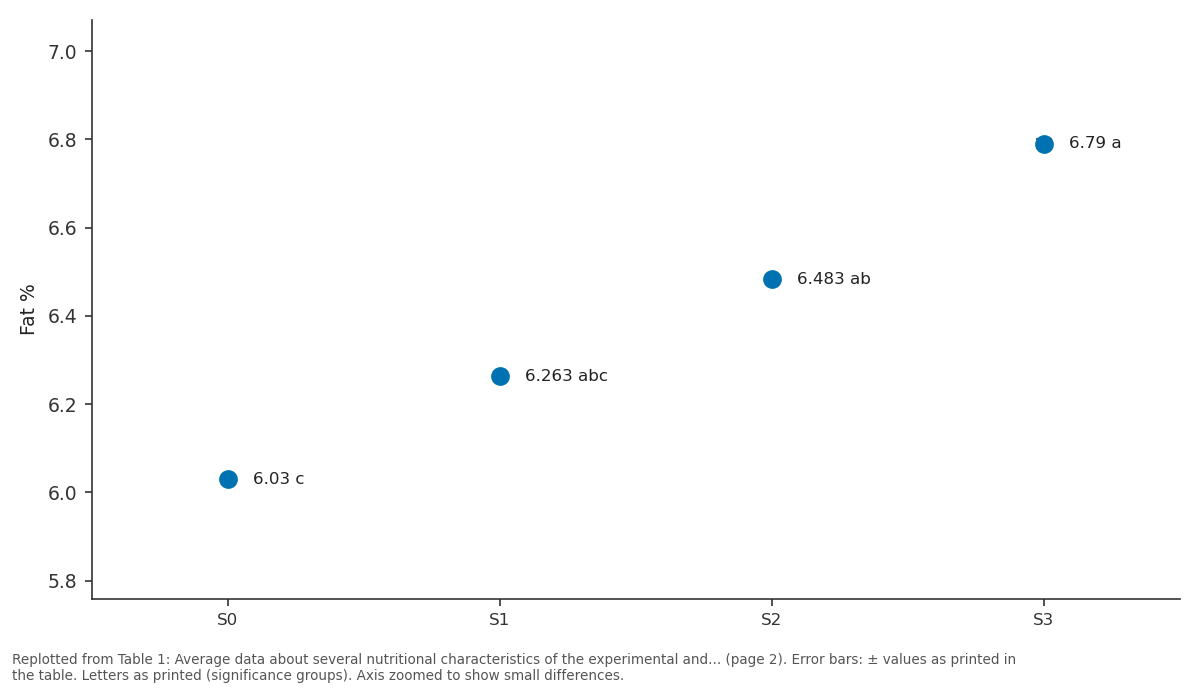
Fat: S0 vs S1 vs S2 vs S3
Replotted from Table 1 (page 2) of the original paper. Every bar is the paper's own table value.
View source evidence ↗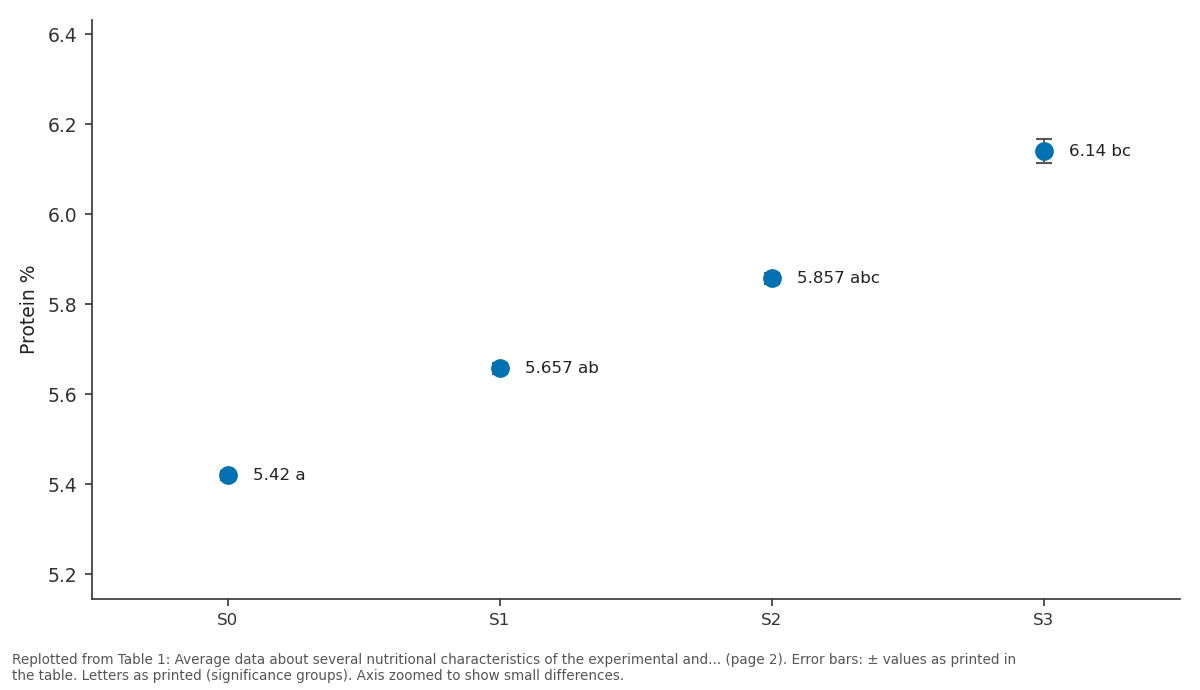
Protein: S0 vs S1 vs S2 vs S3
Replotted from Table 1 (page 2) of the original paper. Every bar is the paper's own table value.
View source evidence ↗Figures & tables
From the original paper Table 1
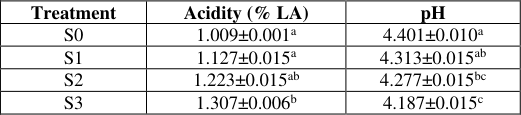 Table 1
Introduction
Shrikhand a Indian dessert is traditionally made with curd, sugar, and cardamom or saffron for flavor. Shrikhand is a delicious indigenous dairy product, but its high sugar level is an increasing concern for health-conscious consumers. The purpose of this study is to examine the potential of date powder in mango shrikhand as a natural sweetener and nutritional booster. Dehydrated dates are used to make date powder, which also contains dietary fiber, vitamins, and minerals in concentrated form. Date powder can help Shrikhand in two ways: it can lower its total sugar level and improve its nutritional profile at the same time. The goal of this study is to determine how much data powder can replace sugar in mango shrikhand without compromising the dish's sensory appeal. The sensory study will determine how consumers appreciate shrikhand made with various ratios of date powder to sugar in terms of taste, texture, and overall liking. This study investigates the possibility of date powder as a natural sweetener in Shrikhand, which helps to generate healthier dessert options. The results can help create healthier recipes for people who want to enjoy traditional Indian treats but cut back on their sugar intake. Another well-liked sugar alternative that could be considered for shrikhand sugar reduction is stevia extract. Date powder, however, has several benefits: Taste and Mouthfeel: Although stevia extract is very sweet, it occasionally leaves an aftertaste that is licorice-or bitter-like [10] . In contrast, date powder provides a naturally sweet taste with a hint of caramel that goes well with mango in shrikhand. Moreover, date powder thickens the mouthfeel, which may resemble the texture attained with sugar [1] . Nutritional content: Stevia extract has very little nutritional content and is a highly refined product [9] . Unlike processed sugar, date powder has all of the natural nutrients found in dates, such as fiber, potassium, magnesium, and other vitamins [1] . This may help the shrikhand's nutritional profile become more balanced.
Materials and Methods
Fresh milk with a standardized fat content of 6% and solidnot-fat (SNF) content of 12% was obtained from Shyam Dairy Products a local dairy industry in Prayagraj, Uttar Pradesh, India. Good quality sugar powder was used as a sweetening agent, Date powder, known for its sweetness equivalent to approximately 68 grams of sugar per 100 grams, and Alphonso mango pulp, essential for flavoring, were all procured from the local market. Alphonso mango essence was used to enhance the mango flavor, and for coloring purposes, tetrazine and sunset yellow were used. There were four samples prepared with concentration values (sugar: date powder) S0 -Control sample (0% sugar replaced) S1 -(15% sugar replaced) S2 -(30% sugar replaced) S3 -(50% sugar replaced) According to the manufacturer's instructions, 100 grams of date powder equals 68 grams of sugar.
One liter of fresh pasteurized milk (with standardization of 6% fat and 12% solid not fat) was heated to 90 °C for 10 minutes and cooled to 40 °C. Curd starter culture was added @1.8% and then milk was incubated at 37 °C for 6 hours. After curd formation, the curd solids were kept in a muslin cloth and hung to remove excess moisture. The product obtained is known as chakka. Obtained chakka was divided into 4 equal quantities of 200 g each and 100 g sugar was added for the control sample S0. For S1, 85 g sugar powder and 23 g date powder were used. For S2, 70 g of sugar powder and 45 g of date powder were used. For S3, 50 g of sugar powder and 74 g of date powder were used. 20 g of Alphonso mango pulp was added with 0.2 ml Alphonso mango essence and for coloring tetrazine and sunset yellow was used @ 0.08%.
Analytical methods
The fat content of Shrikhand was determined as per the modified Gerber fat test for Shrikhand Puntambekar (1968). The total protein of Shrikhand was determined by the semikjeldahl method (IS: 1479-part-II, 1961), using kjel plus unit. Total sugar in the Shrikhand was determined by the Lane-Eynon method as per (IS: 2802-1964). The carbohydrate content of the sample was determined by the difference method % carbohydrate = 100-(%Moisture + %Fat + %Protein + %Ash). Ash content was determined by the procedure described in BIS (IS: 1547-1985). Energy value in terms of Total calorie content was measured as per Arbuckle (1986). Total calorie content = (%carbohydrate × 3.87) + (% Fat×8.79) + (% Protein × 4.27). The Titrable acidity of Shrikhand was determined by the method described in BIS (IS: 1166-1968) for condensed milk. The PH of the sample was determined by using a digital PH meter. The total solid content of Shrikhand was determined by using the gravimetric method as per the procedure described in IS: 12333-1977; ISO 6731-1989 and to analyze moisture content the total solids were subtracted from 100.
Statistical Analysis
Data were evaluated by the analysis of variance (one-way ANOVA) using SPSS version 29.0.
Results and Discussion
The physicochemical characteristics of the Shrikhand samples, including moisture, fat, protein, carbohydrate, energy (calorific value), ash, acidity (%LA), PH, and instrumental color indicators, were examined.
Nutritional analysis Moisture:
The moisture content of samples significantly decreased with an increase in the date powder concentration. The mean value for moisture content of sample S0 was 40.117 percent whereas, for S1, S2, and S3 were 39.123 percent, 38.210 percent, and 37.243 percent respectively (table 1). The results are corroborated by Tondare and Hembade, (2021) [11] , they prepared Amrakhand with different level of stevia and found that moisture content increased from 37.47 percent to 44.23 percent, 45.24 percent, 45.72 percent, 46.56 percent and 47.52 with 70 percent, 75 percent, 80 percent, 85 percent and 90 percent replacement of stevia leaf extract powder respectively.
| Treatment | Acidity (% LA) | pH |
|---|---|---|
| S0 | 1.009±0.001a | 4.401±0.010a |
| S1 | 1.127±0.015a | 4.313±0.015ab |
| S2 | 1.223±0.015ab | 4.277±0.015bc |
| S3 | 1.307±0.006b | 4.187±0.015c |
Table text extracted from the original PDF; superscript letters are shown inline. The original table image is below.
View original table image
| Treatment | Sugar reduced % | Constituents % | — | — | — | — | — |
|---|---|---|---|---|---|---|---|
| Moisture | Total Solids | Fat | Protein | Carbohydrate | Ash | ||
| S0 | 0 | 40.117±0.031a | 59.860±0.044a | 6.030±0.001c | 5.420±0.010a | 47.74±0.036b | 0.67±0.000a |
| S1 | 15 | 39.123±0.015ab | 61.010±0.026a | 6.263±0.006abc | 5.657±0.012ab | 48.38±0.010b | 0.71±0.000a |
| S2 | 30 | 38.210±0.010bc | 61.793±0.076ab | 6.483±0.006ab | 5.857±0.012abc | 48.73±0.059bc | 0.72±0.001a |
| S3 | 50 | 37.243±0.021c | 62.740±0.061b | 6.790±0.010a | 6.140±0.026bc | 49.067±0.035c | 0.74±0.006a |
Table text extracted from the original PDF; superscript letters are shown inline. The original table image is below.
View original table image
Fat:
The average value for the fat content of samples S0, S1, S2 and S3 were 6.03 percent, 6.263 percent, 6.483 percent and 6.79 percent respectively. Samples containing date powder had higher fat contents than the control group. The fat content rose in tandem with the date powder concentration.
Protein: Significant differences were found in the protein composition of the treated and control samples. Protein level increased with an increase in date powder content. In comparison to control sample S0 which is 5.42 percent, the mean values for S1, S2 and S3 were 5.657 percent, 5.857 percent and 6.14 percent respectively.
Carbohydrates: Carbohydrates are the major chemical constituents of dates [3] . The sugar content of dates is naturally high, mainly consisting of fructose, sucrose, and glucose [9] . The water content of these dates is eliminated during the drying and powder grinding processes, producing a more concentrated form of carbohydrates. Comparing this concentration to conventional shrikhand produced without date powder results in a noticeable increase in the total amount of carbohydrates in the finished product.
Ash: There are solids in date powder that do not dissolve completely and thus increase the ash content and also cause a grainy feel in the mouth when having mango shrikhand with high date powder content. Ash content in treated samples S1, S2, and S3 (0.71 percent, 0.72 percent, and 0.74 percent respectively) was more than the control sample S0 (0.67 percent)
Conclusion
This research investigated the potential of date powder as a natural sweetener and nutritional enhancer in mango shrikhand. The findings demonstrated that date powder can effectively replace a portion of sugar in shrikhand while maintaining sensory acceptability. The optimal substitution level, as determined by sensory evaluation, achieved a desirable balance between sweetness, texture, and overall liking. Incorporating date powder into shrikhand offers a two-fold benefit: reducing the total sugar content and enhancing the nutritional profile. Date powder provides a natural sweetness with a complementary flavor profile, contributes dietary fiber and essential minerals, and aids in achieving a desirable texture. This study sheds light on the viability of date powder as a healthy sugar substitute in traditional Indian desserts like shrikhand. Further research could explore the application of date powder in a wider variety of desserts while optimizing sweetness levels and sensory characteristics for different flavor combinations. Additionally, investigating the shelf life and storage stability of shrikhand prepared with date powder can provide valuable insights for commercial production. By promoting the use of natural sweeteners like date powder, this research contributes to the development of healthier dessert options for consumers seeking to reduce sugar intake while enjoying traditional sweets.
Acknowledgement
AcknowledgementThe present study was carried out in Shyam Dairy Products, Prayagraj, Uttar Pradesh, India, with the help of General Manager, Chief Engineer and Quality Control Manager.
References
6 in the original paper- Alazami MS, Alghamdi MS. Chemical composition and nutritional properties of date palm fruits and pits: A review. Int J Food Sci Technol. 2018 Mar;53(3):535-547.
- Arbuckle WS. Ice cream. 4th ed. New York: AVI Pub Co Inc; 1986. p 10-11.
- Ashraf Z, Hamidi-Esfahani Z. Date and date processing: a review. Food Rev Int. 2011;27(2):101-133.
- Rao VS, et al. Safety evaluation of stevioside from Stevia rebaudiana (Bertoni). Food Chem Toxicol. 2009 Sep;47(9):1992-2001.
- Sylvets C, et al. The myth of the natural sweetenerimplications of consuming steviol glycosides. Appetite. 2017;110:236-243.
- Tondare JC, Hembade AS. Nutritional and physicochemical measurement and characterization of dietetic Amrakhand manufactured by using stevia leaf extract powder. Vidyabharati Int Interdiscip Res J. 2021:29512956.