
Research article · 2024 · Full text
International Journal of Agriculture Extension and Social DevelopmentMulberry based integrated cropping system: An ideal approach for effective utilization of land resources in Sericulture
Volume 7(4S) · Pages 36–39 · DOI: 10.33545/26180723.2024.v7.i4sa.523 ↗
Research areasSilkworms and Sericulture ResearchAgricultural Systems and PracticesLivestock and Poultry Management
Abstract
Author-writtenMulberry (Morus spp.) is an important economic plant cultivated commercially for rearing Lepidopteran larvae of silkworm Bombyx mori L. and additionally for it’s by product utilization. Owing to its wide adaptability to varied agro-climatic conditions, it can be easily cultivated and maintained as bush, dwarf and tree plantations. In current experiment an attempt has been made to formulate suitable design and layout for practicing integrated cropping or mixed cropping under different planting system of mulberry cultivation namely; pit, row and paired row system. Pit system was followed for one year old mulberry sapling with dimensions of 90 x 90 cm, row system with 60 x 90cm and paired row system with 90 + 150 x 60 cm. Three separate blocks were formulated for each system of the area of 15 x 10 feet (length x width). For the first block with pit system of plantation, boundaries were utilized for planting vegetables as intercrops along with mulberry saplings. Funnel, fenugreek and potato were grown on the side boundaries of the first blocks. Garlic and onion were grown as intercrop for second and third block having row and paired row system respectively. This is inspite of the fact that unlike other plants, mulberry provides two harvests of leaf annually. This is due to the fact that its annual growth cycle is such that it remains without foliage most of the time thereby causing least interception of solar light for the crops that can be grown underneath. From the current experiment, results have been drawn showing significant production of seasonal vegetables and mulberry leaf from each block. Moreover, the harvested vegetables and mulberry leaves showed good qualitative features too. This therefore provides an ideal choice of growing mulberry and seasonal vegetables simultaneously for effective land and resource utilization ensuring round the year cash flow to farmers. The current experiment emphasizes how the integration of mulberry and seasonal vegetables can help in improving productivity per unit area through effective land utilization and resource management.
Summary
Source-checkedPlain-language reading of the full paper, prepared with AI and checked against the text. Each point links to the authors' own words.
Why it matters
- Mulberry is a commercially significant plant used primarily for rearing silkworms and for its various by-products. View evidence ↗
- Many sericulture farmers operate on small land holdings with limited resources, making it difficult for them to diversify their crops or take financial risks. View evidence ↗
- Mulberry's growth cycle leaves it without foliage for significant periods, which minimizes the blocking of sunlight for crops grown beneath it. View evidence ↗
The question
- The study aimed to develop an effective design and layout for integrated or mixed cropping using pit, row, and paired row mulberry planting systems. View evidence ↗
What they did
- The experiment was conducted at the University of Jammu's Poonch campus during the spring and autumn seasons of 2022 and 2023. View evidence ↗
- The study used three planting systems: pit (90 x 90 cm), row (60 x 90 cm), and paired row (90 + 150 x 60 cm), with each block measuring 15 x 10 feet. View evidence ↗
- Intercrops were assigned by block: funnel, fenugreek, and potato were grown on the boundaries of the pit system block, while garlic and onion were used in the row and paired row blocks. View evidence ↗
- Yield and quality data for both mulberry and intercrops were analyzed using ANOVA via SPSS software. View evidence ↗
What they found
- Across all treatments, the average maximum fresh leaf weight was 10.1g and the maximum dry weight was 3.3g. View evidence ↗
- The average moisture percentage for treatments reached as high as 76.23% and 54.16%, with a moisture retention capacity (MRC) of 73.24%. View evidence ↗
- Mulberry leaves generally exhibited an ovate shape, with an average maximum leaf area of 126cm² and an actual leaf area of 74cm². View evidence ↗
- The leaf yield per mulberry plant was recorded as 257.5g, based on a total harvest of 2575g from 10 randomly selected plants. View evidence ↗
- Among the intercrops, onion and maize produced the highest yields at 10kg each, followed by garlic at 8kg. View evidence ↗
- Funnel and fenugreek intercrops produced the lowest yields, both recording 500g. View evidence ↗
What it means
- The authors conclude that intercropping does not seriously negatively affect the qualitative or quantitative growth of mulberry. View evidence ↗
- The authors recommend intercropping seasonal vegetables with mulberry to maximize land resource utilization and help farmers realize the full potential of their crops. View evidence ↗
Visual summary
1 visualsIllustrations explain the paper; they do not show study data.
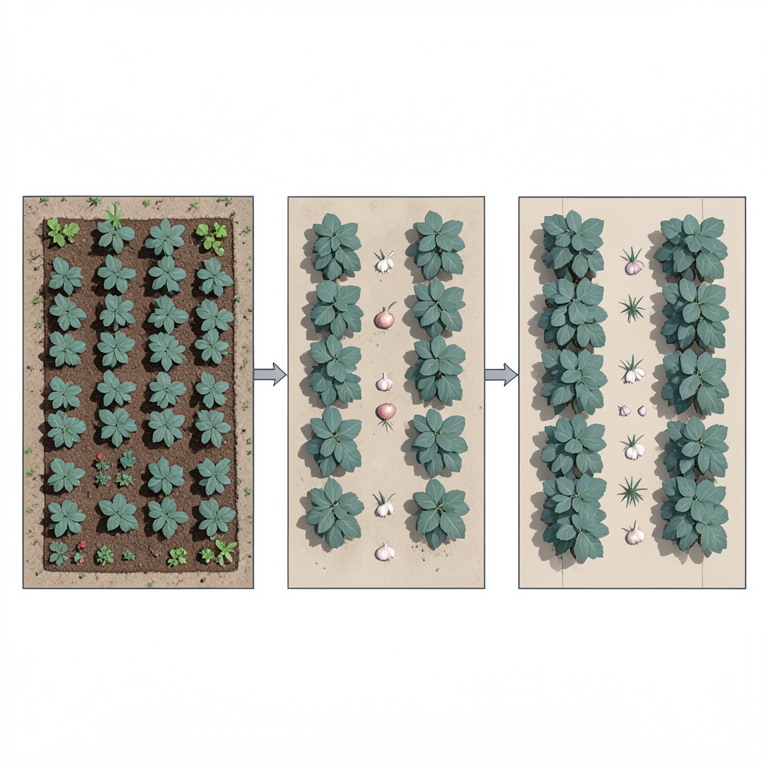
Mulberry Intercropping Layouts
AI-generated conceptual illustration (Mulberry plants and intercrops (garlic, onion, potato, fenugreek, and funnel gourd) in a field). It explains the idea and does not show study data.
View source evidence ↗Figures & tables
From the original paper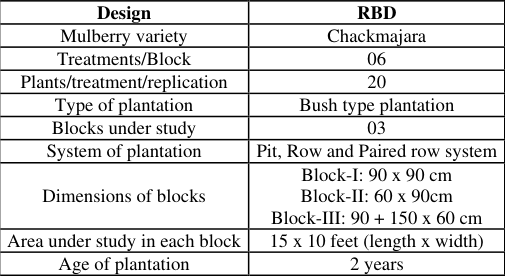 Table 1
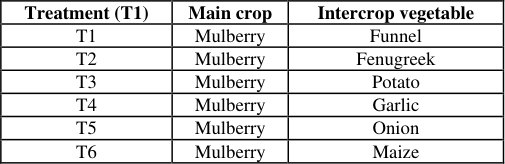 Table 2
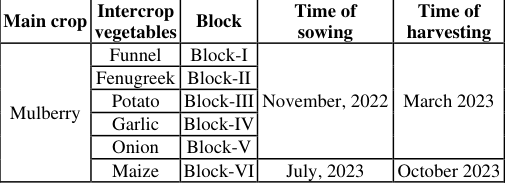 Table 3
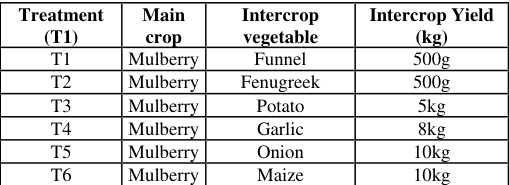 Table 4
Introduction
Intercropping can be defined as agricultural practice of cultivating or growing of two or more crops simultaneously on the same area of land for increasing the returns from unit area of land. The crops are not necessarily sown at exactly the same time and their harvest times may be quite different, but they are usually "simultaneous" for a significant part of their growing periods. It is a practice often associated with sustainable agriculture and organic farming. Intercropping is one form of polyculture, using companion planting principles. Intercropping may benefit crop yield or the control of some kind of pest, or may have other agronomic benefits. In intercropping, there is often one main crop and one or more added crops, with the main crop being the one of primary importance because of economic or food production reasons. The two or more crops used in an intercrop may be from different species and different plant families, or they may simply be different varieties or cultivars of the same crop species. Intercropping offers farmers the opportunity to engage nature's principle of diversity on their farms. Spatial arrangements of plants planting rates and maturity dates must be considered when planning intercrops. Intercrops can be more productive than growing pure stands. The most common objective of intercropping is to produce a greater yield on a given piece of land by making use of resources that would otherwise not be utilized by a single crop and thereby to augment the income. Careful planning is required, taking into account the soil, climate, crops, and varieties. It is particularly important not to have crops competing with each other for physical space, nutrients, water, or sunlight. Intercropping of compatible plants also encourages biodiversity, by providing a habitat for a variety of insects and soil organisms that would not be present in a single crop environment. This biodiversity can in turn help to limit outbreaks of crop pests by increasing the diversity or abundance of natural enemies, such as spiders or parasitic wasps. Increasing the complexity of the crop environment through intercropping also limits the places where pests can find optimal foraging or reproductive conditions (Rajegowda et al. (2020) [13] . Sericulture is facing tough competition due to limited land www.extensionjournal.com resources and competition with other agricultural crops. Therefore, there is an urgent need to develop mutual harmony between sericulture and agriculture for of sustainable co-existence. In general, most of the of the sericulture farmers have very small land holdings and depend mainly upon family labor and simple tools, they neither have the capacity to take risk nor have enough land to diversify the cropping system. Thus, by growing other of short duration crops, the farmer gets additional benefits from intercrops (Ahasn et al., 1989) [1] . Lot of work has already been done for integration of Sericulture with agriculture and horticulture (Gargi et al., 1997; Mir et al., 2018; Mir et al., 2022) [4,12,11] . Intercropping of mulberry with saffron in Kashmir yielded a good quality of mulberry leaf from the same field Where saffron was cultivated alone to generate work as well as good deal of returns to farmers during lean period when there are no operations related to saffron cultivation (Kaur et al., 2002) [5] . Various recent studies also suggest that mulberry can successfully intercropped with medicinal plants like Aloe barbadensis, Asparagus racemosa, Acorus calamus (Madhusudan et al., 2015) [9] . Thus, an attempt has been made to design suitable model with best possible combinations of mixed cropping system with mulberry as main crop for harnessing maximum benefits from sericulture.
Materials and Methods
The current study was developed and designed at P. G. Department of Sericulture, Poonch campus, university of Jammu. Experimental data for the selected parameters was recorded in the experimental plot with trail crops during the spring and autumn season during the year 2022 and 2023. In current experiment an attempt has been made to formulate suitable design and layout for practicing integrated cropping or mixed cropping under different planting system of mulberry cultivation namely; pit, row and paired row system. Pit system was followed for one year old mulberry sapling with dimensions of 90 x 90 cm, row system with 60 x 90cm and paired row system with 90 + 150 x 60 cm. Three separate blocks were formulated for each system of the area of 15 x 10 feet (length x width). For the first block with pit system of plantation, boundaries were utilized for planting vegetables as intercrops along with mulberry saplings. Funnel, fenugreek and potato were grown on the side boundaries of the first blocks. Garlic and onion were grown as intercrop for second and third block having row and paired row system respectively. The data obtained on various yield and quality parameters of mulberry and inter crops was subjected to statistical analysis on SPSS software for determination of ANOVA. Various parameters studied during the experiment included: 1. Fresh leaf weight of 100 mulberry leaves (g): For values of fresh leaf weight, 10 mature leaves were randomly picked up from the selected genotypes and weighed immediately on electronic weighing balance.
The same leaves were oven dried in hot air oven at 60°C for 6 hours till constant weight was attained and finally weighed on electronic weighing balance for dry leaf weight (g). In graph method, the randomly selected leaves were placed on graph paper, outline of the leaf was drawn with the help of pencil and total no. of full and partial grids of the graph was calculated to find out the actual leaf area.
The crops grown along with mulberry as intercrops were harvested individually and weighed on weighing balance to get the exact value of yield.
For determination of leaf yield per plant, ten plants were randomly selected and entire foliage was harvested. The harvested leaves were weighed on electronic weighing balance and the value obtained was divided by ten to get the exact yield per plant. It can be expressed as: www.extensionjournal.com
Results and Discussion
Fresh and dry weight of 10 leaves 10 mature leaves of mulberry plants under different treatments were randomly harvested and weighed for fresh leaf weight on electronic weighing balance. Maximum fresh weight was recorded as 10.1g on an average for all the studied treatments. The same leaves were then oven dried for 6 hours at 60 °C for obtaining values of dry weight that recorded to be maximum as 3.3g.
Moisture percentage and MRC of mulberry leaf
The values for moisture percentage for different treatments was recorded on an average as high as 76.23 and 54.16 percent with MRC percentage of 73.24 percent.
Leaf shape:
The shape of leaf of any plant is very important for morphological studies specially for the identification of the plant. In present study different types of mulches are used in different treatments and one is kept control under wild condition. Different leaf shapes are observed in plants under treatments shown in table-4. Generally, the ovate type of leaf shape was recorded for all the treatments and control exhibited ovate but smaller leaf.
Leaf size of mulberry: For determination of leaf size, the space formula of length × Width was applied and the maximum leaf size was recorded to be 126cm2 on an average.
Actual leaf area of mulberry leaf:
In the current study actual leaf area was calculated by graph method. For the calculation of actual leaf area nearly 60-70 days old leaf was randomly picked from different treatments and placed on graph paper for drawing outline of the leaf. Total number of full and partial grids was counted manually to find out the actual leaf area for different samples. The maximum leaf area was recorded for mulberry plant growing under intercrop trial was recorded as 74cm2.
For calculation of mulberry leaf yield per plant 10 mulberry plants were selected randomly and harvested to get the total yield that recorded as 2575g and the leaf yield per plant was recorded as 257.5g.
The crops grown along with mulberry as intercrops were harvested individually and weighed on weighing balance to get the exact value of yield.
The values obtained for yield harvest of various intercrops is detailed in Table-04 given below.
Discussion
Mulberry is a fast-growing tree sharing good compatibility even under intercropping system and don't pose any serious harm to the adjacent intercrops. The current experiment revealed many interesting results pertaining to growth and quality parameters of mulberry when grown under intercropping system (Koul et al., 2008; Eskandari et al., 2009b) [7,2] . The study revealed maximum fresh and dry weight as 10.1g, 3.3g resp. on an average for all the studied treatments that corresponds to the earlier results recorded by et al. The values for moisture percentage and MRC percentage were observed as 76.23 and 73.24 percent resp. indicating good quality of mulberry leaf. The current observations find close confirmation with earlier reports of (Eskandari, 2012b) [3] . In morphological observations, generally ovate type of leaf shape was recorded for all the treatments with maximum leaf area as 126cm2 and actual leaf area as 74cm2 on an average which confirmed the results of (Mahapatra, 2011; Zhang and Li, 2003) [10,15] who stated that intercrops actually impart complementary effects for promoting mulberry growth. The crops grown along with mulberry as intercrops were harvested individually for observation of exact yield per intercrop. Leaf yield per plant is one of the most important criteria for deciding the suitability of mulberry for cultivation and silkworm rearing www.extensionjournal.com as well. For the studied blocks, maximum leaf yield per plant in mulberry was recorded as 257.5g which found quite satisfactory independent of the stress of any kind posed by the intercrops. On the other hand, among all the six different intercrops, maize, onion and garlic revealed maximum yield of 10 kg, 10kg and 5 kg respectively that supports the results obtained by Singhvi and Katiyar (2009) [14] and Khan et al., (2015) [6] . Therefore, it can be assumed that cultivation of mulberry under intercropping system doesn't render any serious affect of the qualitative or quantitative growth of mulberry which find close similarity with the statements made by Mir et al., 2022 [11] .
Conclusion
Mulberry (Morus) is a multipurpose tree that can be easily propagated and maintained as bush, dwarf plant or as and tree plantations. In bivoltine regions like UT of Jammu and Kashmir medium and tall bush plantation is commonly plasticized by the sericultural farmers. Being bivoltine crop, only two harvests are possible in the Jammu and Kashmir which poses great stress upon the farers to accelerate their incomes. Thus, intercropping could serve as a solution to the problem and farmers can try to generate additional income by adopting intercropping in their mulberry fields. In other sericultural progressive regions like Karnataka and Andhra Predesh etc. it is already a common practice to conduct mixed cropping system. Being a perennial crop with good foliage and root-spread, mulberry contributes to soil conservation and provides green cover. Thus, in sericulture sector, intercropping of seasonal vegetables and other crops could holds great prospects as it helps the farmers to realise full potential of the crop and ensures effective utilization of land resources.
Acknowledgement
AcknowledgementThe corresponding author is highly thankful to Prof. Rakesh Vaid (Director, Poonch campus, University of Jammu) for his cooperation while conducting the trial in their campus
Figures and tables from the paper
| Design | RBD |
|---|---|
| Mulberry variety | Chackmajara |
| Treatments/Block | 06 |
| Plants/treatment/replication | 20 |
| Type of plantation | Bush type plantation |
| Blocks under study | 03 |
| System of plantation | Pit, Row and Paired row system |
| Dimensions of blocks | Block-I: 90 x 90 cm Block-II: 60 x 90cm Block-III: 90 + 150 x 60 cm |
| Area under study in each block | 15 x 10 feet (length x width) |
| Age of plantation | 2 years |
Table text extracted from the original PDF; superscript letters are shown inline. The original table image is below.
View original table image
| Treatment (T1) | Main crop | Intercrop vegetable |
|---|---|---|
| T1 | Mulberry | Funnel |
| T2 | Mulberry | Fenugreek |
| T3 | Mulberry | Potato |
| T4 | Mulberry | Garlic |
| T5 | Mulberry | Onion |
| T6 | Mulberry | Maize |
Table text extracted from the original PDF; superscript letters are shown inline. The original table image is below.
View original table image
| Main crop | Intercrop vegetables | Block | Time of sowing | Time of harvesting |
|---|---|---|---|---|
| Mulberry | Funnel | Block-I | November, 2022 | March 2023 |
| Fenugreek | Block-II | |||
| Potato | Block-III | |||
| Garlic | Block-IV | |||
| Onion | Block-V | |||
| Maize | Block-VI | July, 2023 | October 2023 |
Table text extracted from the original PDF; superscript letters are shown inline. The original table image is below.
View original table image
| Treatment (T1) | Main crop | Intercrop vegetable | Intercrop Yield (kg) |
|---|---|---|---|
| T1 | Mulberry | Funnel | 500g |
| T2 | Mulberry | Fenugreek | 500g |
| T3 | Mulberry | Potato | 5kg |
| T4 | Mulberry | Garlic | 8kg |
| T5 | Mulberry | Onion | 10kg |
| T6 | Mulberry | Maize | 10kg |
Table text extracted from the original PDF; superscript letters are shown inline. The original table image is below.
View original table image
References
13 in the original paper- Ahasn MM, Dhar KL, Fotedar RK, Dhar A. Studies on the intercropping of short durations crops with mulberry. Indian Journal of Sericulture. 1989;28(2):194-199.
- Gargi Sukla P, Kumar D, Kumar R, Pandey RK. Intercropping for profitable in Purvanchal. Indian Silk. 1997;35(11):31-32.
- Kaur R, Mir MR, Khan MA, Mir S. Intercropping of mulberry with saffron Indian Silk. 2002;41(2):5-6.
- Khan SA, Hussain M, Naureen N, Fatima S, Noo-ulAne, Abbas Z. Yield performance of Turmeric varieties intercropped with mulberry plantation. American Eurasian J Agri. and Environt Sci. 2015;15(10):207679.
- Koul S, Fotadar RK, Dhar KL, Anil, Singhal BK. Suitable crops for intercropping with mulberry in Jammu area. Indian Silk. 2008;46(7):4-6.
- Kour R, Mir MR, Khan MA, Nazir S. Intercropping of mulberry with saffron in the valley-Convienent and profitable. Indian Silk. 2002;41(2):115-118.
- Madhusudan Chamoli VK, Varshney PK, Srinivasan Rajeev Pandey, Kanta S. Intercropping of some medicinal plants with mulberry. Cibtech Journal of BioProtocols. 2015;4(1):2-30.
- Mahapatra SC. Study of grass-legume intercropping system in terms of competition indices and monetary advantage index under acid lateritic soil of India. American Journal of Experimental Agriculture. 2011;1(1):1-6.
- MR Mir, IL Khan, MF Baqual, RK Sharma. Mulberry based farming system, an effective way of land utilization for silkworm rearers of Kashmir, India. The Pharma Innovation Journal. 2022;SP-11(7):4208-4210.
- Mushtaq Rasool Mir, Muneesa Banday, Irfan Latief Khan, Baqual MF, Rameez Raja. Efficacy of mulberry based intercropping system in the Pirpanjal and Shiwalik regions of Himalayas, Journal in Science Agriculture & Engineering. 2018;8(25):56-60.
- Rajegowda Vinuth BS, Vinitha C, Sanathkumar VB. Effect of intercrops on growth and yield of tree mulberry in turn its influence on and cocoon yield. International journal of Current Microbiology and Applied Sciences. 2020;9(5):3134-3139.
- Singhvi NR, Katiyar RL. Intercropping of mulberry with garlic, onion and carrot in Maharashtra. Plant Archives. 2009;9(1):265-266.
- Zhang F, Li L. Using competitive and facilitative interactions in intercropping systems enhances crop productivity and nutrient-use efficiency. Plant and Soil. 2003;248:305-312.
Cited by 1
From OpenAlex, OpenCitations and reference lists read by Scinovex
- Sericulture-based agroforestry systems in India: Farming models for Economic and environmental sustainability
Samarpan Chakraborty, Tilak Mondal, Ravindra Dhar, Sujan Biswas, Debabrata Basu · International Journal of Agriculture Extension and Social Development · 2025
Sericulture-based agroforestry systems represent an integrated land-use strategy that combines silk production with sustainable agro based forestry, offering ecological and economic benefits across diverse Indian landscapes. This review explores the potential of combining sericulture with agroforestry models involving mulberry, tasar, eri, and muga silkworms. These systems enable the integration of host trees with food crops, fruit trees, and fodder grasses, enhancing soil fertility, biodiversity, and carbon sequestration while diversifying farm incomes. This paper highlights successful cases