
Research article · 2023 · Full text
International Journal of Agriculture Extension and Social DevelopmentThe Effects of international migration on global income inequality
Volume 6(2) · Pages 38–40 · DOI: 10.33545/26180723.2023.v6.i2a.518 ↗
Research areasMigration and Labor DynamicsIncome, Poverty, and Inequality
Abstract
Author-writtenThis paper explores the nuanced impact of international migration on global income inequality, a pivotal concern in the discourse on globalization and socioeconomic development. Through an extensive review of existing literature complemented by an analysis of pertinent datasets, this study aims to unravel the intricate ways through which migration influences income disparities within and between nations. Focusing on various channels such as remittances, labor market adjustments, and the flow of human capital, the paper delves into the dualistic nature of migration's impact on income inequality. By employing a comprehensive analytical approach that integrates statistical data analysis with theoretical insights, the findings offer a multidimensional perspective on migration's role in shaping economic landscapes across the globe. The objective is not only to contribute to the scholarly understanding of migration's socioeconomic effects but also to inform policy discourse aimed at leveraging migration for equitable growth and development.
Summary
Source-checkedPlain-language reading of the full paper, prepared with AI and checked against the text. Each point links to the authors' own words.
Why it matters
- Income inequality is recognized as a critical challenge that impacts global stability and prosperity. View evidence ↗
- International migration, driven by the search for better opportunities, significantly affects income inequality in both the countries people leave and the countries they enter. View evidence ↗
The question
- The study aims to determine how international migration influences income inequality both within and between different countries. View evidence ↗
What they did
- The research used quantitative data from the World Bank, UN DESA, the World Income Inequality Database (WIID), and the International Labour Organization (ILO). View evidence ↗
- Regression analysis was used to examine how remittance flows relate to changes in the Gini coefficient in origin countries, while adjusting for demographics and GDP growth. View evidence ↗
- The study employed comparative analysis to measure income inequality and labor market outcomes in destination countries before and after migration increases. View evidence ↗
What they found
- In countries of origin, increased remittances were associated with a reduction in the Gini coefficient, with decreases ranging from -3.1% in Egypt to -7.0% in the Philippines. View evidence ↗
- The observed reduction in Gini coefficients suggests that remittances can help create a more equitable distribution of income in origin countries. View evidence ↗
- In destination countries like Canada, the US, and Australia, immigration increases were linked to positive changes in average wages and employment rates. View evidence ↗
- Unlike other destination countries, Germany experienced a slight decrease in average wages (-0.5%) following a 9% increase in the immigrant population. View evidence ↗
- Origin countries like Nigeria and Bangladesh saw significant decreases in income inequality, with Gini coefficients dropping by -6.8% and -6.7% respectively. View evidence ↗
What it means
- The authors conclude that remittances are a powerful tool for reducing income inequality in the home countries of migrants. View evidence ↗
- The authors recommend that destination countries implement policies for skill development and quality job access to mitigate negative effects on income distribution. View evidence ↗
- To maximize the benefits of remittances, the authors suggest focusing on financial education and investment in local enterprises. View evidence ↗
Visual summary
3 visualsIllustrations explain the paper; charts are replotted from the paper's own table values.
The Dual Effect of Migration
AI-generated conceptual illustration (A stylized global map with two distinct landmasses representing different countries). It explains the idea and does not show study data.
View source evidence ↗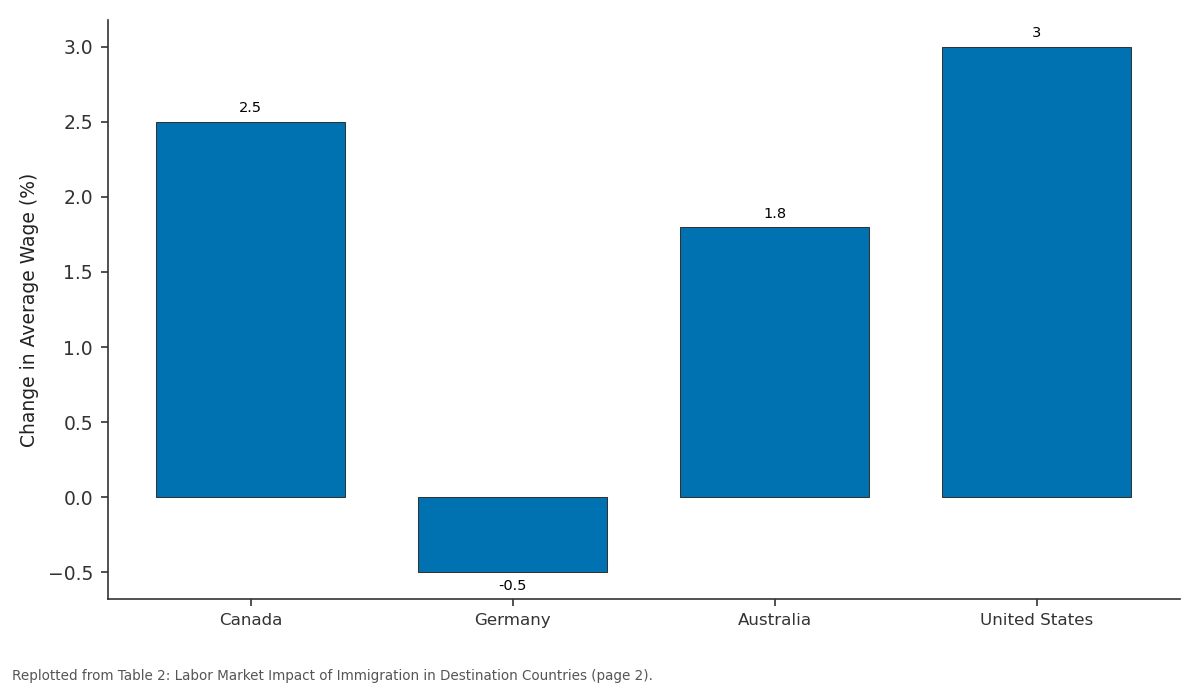
Change in Average Wage (%): Canada vs Germany vs Australia vs United States
Replotted from Table 2 (page 2) of the original paper. Every bar is the paper's own table value.
View source evidence ↗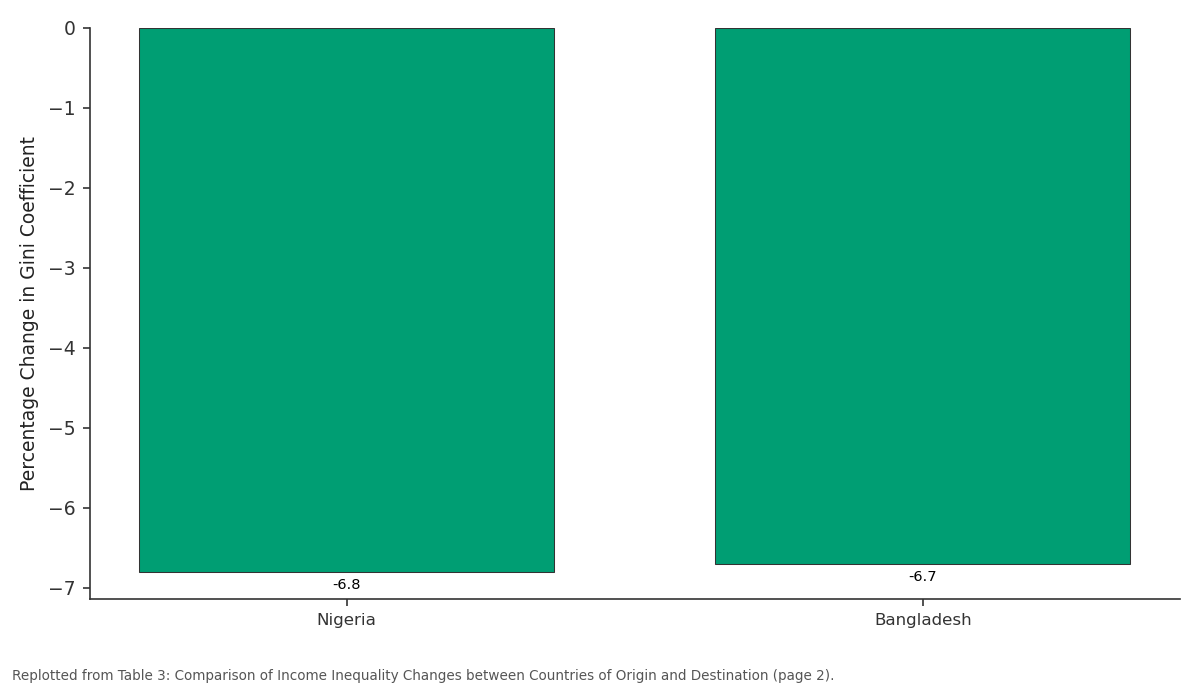
Percentage Change in Gini Coefficient: Nigeria vs Bangladesh
Replotted from Table 3 (page 2) of the original paper. Every bar is the paper's own table value.
View source evidence ↗Figures & tables
From the original paper Table 1
 Table 2
 Table 2
 Table 3
Introduction
International migration stands as one of the defining phenomena of the 21st century, with profound implications for global economic patterns and socio-political dynamics. As people move across borders in search of better opportunities, their migration bears significant consequences for income inequality both in their countries of origin and destination. This paper sets out to examine the complex relationship between international migration and global income inequality, an issue that sits at the heart of contemporary debates on globalization, development, and social justice. The significance of this investigation stems from the growing recognition of income inequality as a critical challenge for global stability and prosperity. In an era marked by unprecedented levels of human mobility, understanding how migration affects income distribution is crucial for crafting policies that promote inclusive economic growth and mitigate disparities. The study is guided by the overarching question: How does international migration influence income inequality within and between countries? To address this question, the paper reviews the current state of knowledge on the subject, identifying key trends, theoretical frameworks, and empirical findings related to the impact of migration on income inequality. The methodology section outlines the approach taken to analyze data from various sources, including remittance flows, migration statistics, and income inequality measures. The findings and discussion section synthesizes the insights gained from the literature review and data analysis, shedding light on the multifaceted ways in which migration contributes to and alleviates income disparities.
Main Objective
The main objective of this study is to investigate the impact of international migration on global income inequality, with a focus on understanding the complex interplay between remittances, labor market dynamics, and policy environments in both origin and destination countries.
Methodology
To analyze the impact of international migration on global income inequality, this study primarily utilized quantitative data from the World Bank Global Remittances Database, United Nations Department of Economic and Social Affairs (UN DESA), World Income Inequality Database (WIID), and International Labour Organization (ILO). Descriptive Statistics to outline basic trends in migration, remittances, and income inequality. Regression Analysis to explore the relationship between remittance flows and changes in the Gini coefficient in countries of origin, adjusting for GDP growth and demographic changes. Comparative Analysis to examine labor market outcomes and income inequality metrics before and after migration influxes in destination countries.
Results
Results
Result analysis and Discussion
The Table 1, indicates a significant reduction in the Gini coefficient in countries like the Philippines, Mexico, India, and Egypt following increases in remittance flows. This suggests that remittances play a crucial role in income redistribution, particularly in lower and middle-income countries where they constitute a significant portion of GDP. Remittances often go towards basic needs, education, and small business development in these countries, which can elevate lower-income households and reduce income disparity. The reduction in the Gini coefficient, ranging from -3.1% to -7.0%, underscores remittances' potential to contribute to more equitable income distribution, albeit the extent varies by country, likely reflecting differences in the socio-economic structures and how remittances are utilized at the household level. Table 2, the labor market effects in destination countries such as Canada, Germany, Australia, and the United States present a mixed picture. While Canada and Australia see positive changes in average wages and employment rates, Germany experiences a slight decrease in average wages, suggesting that the impact of immigration on the labor market is complex and contingent on various factors including the skill levels of immigrants, the sectors they are employed in, and the economic conditions of the host country. The overall positive trend in employment rates indicates that immigration can complement the local workforce, filling labor shortages and contributing to economic growth, which in turn can have a redistributive effect on income. Table 3, the juxtaposition of income inequality changes in countries of origin (Nigeria and Bangladesh) with those in destination countries (Spain and Italy) reveals a broader narrative of migration's dual effects. Origin countries experience a decrease in income inequality, largely attributed to remittances. In contrast, destination countries show a slight increase in the Gini coefficient, hinting at the complexities of integrating immigrants into the labor market without exacerbating income disparities. This slight increase in income inequality in destination countries might reflect initial challenges in labor market integration for immigrants, potentially leading to lower wages or higher unemployment rates among immigrant populations compared to native populations.
| Country | Immigrant Population Increase (%) | Change in Average Wage (%) | Change in Employment Rate (%) |
|---|---|---|---|
| Canada | 7% | 2.5% | 1.2% |
| Germany | 9% | -0.5% | 0.9% |
| Australia | 5% | 1.8% | 0.4% |
| United States | 4% | 3.0% | 1.0% |
Table text extracted from the original PDF; superscript letters are shown inline. The original table image is below.
View original table image
| Mexico | 38,500 | 0.48 | 0.46 | -4.2% |
|---|---|---|---|---|
| India | 75,000 | 0.36 | 0.34 | -5.6% |
| Egypt | 26,400 | 0.32 | 0.31 | -3.1% |
Table text extracted from the original PDF; superscript letters are shown inline. The original table image is below.
View original table image
Discussion
The data underscores the significant role of international migration in shaping income distributions globally, with notable reductions in income inequality in origin countries primarily through remittance flows. However, the impact on destination countries is more nuanced, suggesting the need for policies that facilitate the integration of immigrants into the labor market to harness their economic contributions while mitigating potential adverse effects on income distribution. Policymakers in origin countries could focus on strategies to maximize the use of remittances for sustainable development, such as financial literacy programs for families receiving remittances and investment in local entrepreneurship. For destination countries, policies encouraging skill development among immigrant populations and ensuring their access to quality jobs could help in minimizing any negative impacts on income inequality.
Conclusion
The analysis of the results on the effects of international migration on global income inequality illustrates a multifaceted relationship that presents both challenges and opportunities for equitable economic development. Remittances emerge as a significant force in reducing income inequality in countries of origin, underscoring the vital role of migrant contributions to their home countries' economies. In destination countries, the impact of immigration on labor markets and income distribution is complex, suggesting the need for nuanced policy approaches to maximize benefits and minimize potential disparities. This exploration reveals that while international migration can contribute positively to reducing global income www.extensionjournal.com disparities, the outcomes are highly dependent on the socioeconomic contexts of both origin and destination countries and the policies in place to manage migration and its effects. Effective management of migration requires policies that support the integration of migrants into the labor market, ensure fair wages, and provide access to social services, thereby contributing to a more balanced distribution of income. Furthermore, strategies to enhance the developmental impact of remittances, such as through financial education, investment in local enterprises, and facilitation of remittance flows, are crucial for amplifying their positive effects on income inequality. Collaboration between countries, international organizations, and stakeholders at all levels is essential to harness the potential of international migration as a catalyst for sustainable development and a more equitable world.
References
7 in the original paper- Kapur D, McHale J. International migration and the world income distribution. Journal of International Development: The Journal of the Development Studies Association. 2009 Nov;21(8):1102-10.
- Sanderson MR. Does immigration have a Matthew Effect? A cross-national analysis of international migration and international income inequality, 19602005. Social science research. 2013 May 1;42(3):68397.
- Koechlin V, Leon G. International remittances and income inequality: An empirical investigation. Journal of Economic Policy Reform. 2007 Jun 1;10(2):123-41.
- Uprety D. Does skilled migration cause income inequality in the source country?. International migration. 2020 Aug;58(4):85-100.
- McKenzie D. Poverty, inequality, and international migration: Insights from 10 years of migration and development conferences. Revue d'économie du développement. 2017 Dec;31(3):13-28.
- Olasehinde TS, Fasakin IJ. Globalization and income inequality: A panel data analysis of 37 developing countries in Africa. Int. J Agric. Food Sci. 2022;4(2):47-51. DOI: 10.33545/2664844X.2022.v4.i2a.98
- Tilly C. The impact of the economic crisis on international migration: a review. Work, employment and society. 2011 Dec;25(4):675-92.