
Research article · 2024 · Full text
International Journal of Advanced Biochemistry ResearchRambai (Baccaurea sapida): A prospective lesser-known fruit with the potential to uplift the socio-economic conditions of rural communities in West Bengal
Volume 8(4) · Pages 113–115 · DOI: 10.33545/26174693.2024.v8.i4b.934 ↗
Research areasFood Science and Nutritional StudiesAgricultural Economics and Practices
Abstract
Author-writtenRambai (Baccaurea sapida) an underutilized fruit species, is grown in marginal lands of West Bengal. It is commonly known as lotka, lotkon or bugi in Bengali locally and commonly grown in Southern and Northern zone viz., Cooch Behar, Jalpaiguri, Darjeeling districts. Being a highly economical species for the local inhabitants and rural people, it is commercially grown by them in a large scale. Rambai fruits are rich in vitamins, minerals, fibers, and pharmacologically significant substances such as phenolic acids, flavonoids, and terpenes. They contain low amounts of carotenoids, making them effective in preventing malnutrition among rural populations. The fruit has been reported to be beneficial in heart disease, as its high potassium content is associated with lower stroke risk and reduced blood pressure. Rambai also aids in the treatment of constipation, while various parts of the plant are utilized to treat conditions like arthritis, abscesses, and injuries. Given its substantial importance, prioritizing the cultivation of this crop can contribute to nutritional security and improve the socio-economic conditions of impoverished rural communities. Therefore, comprehensive information on various aspects of this crop, including its medicinal properties, nutritional value, cultivation practices, etc., has been compiled to fully exploit the potential of this underutilized fruit crop.
Summary
Source-checkedPlain-language reading of the full paper, prepared with AI and checked against the text. Each point links to the authors' own words.
Why it matters
- Rambai (Baccaurea sapida) is an underutilized fruit species typically grown on marginal lands in West Bengal. View evidence ↗
- The species is highly economical for rural populations and is already grown commercially on a large scale by local inhabitants. View evidence ↗
- Prioritizing the cultivation of Rambai has the potential to improve nutritional security and the socio-economic status of poor rural communities. View evidence ↗
The question
- The authors aim to compile comprehensive information on the medicinal properties, nutritional value, and cultivation practices of Rambai to fully exploit its potential. View evidence ↗
What they did
- The study focuses on Rambai (Baccaurea sapida), also known as Burmese grape, a tropical fruit from the Euphorbiaceae family. View evidence ↗
- The review examines the crop's presence in West Bengal, specifically in the northern districts (Cooch Behar, Jalpaiguri, Darjeeling, Kalimpong, Uttar and Dakshin Dinajpur) and parts of Southern Bengal. View evidence ↗
What they found
- Rambai fruits contain high levels of vitamins, minerals, fibers, phenolic acids, flavonoids, and terpenes. View evidence ↗
- The fruit's high potassium content is associated with reduced blood pressure and lower stroke risk, making it beneficial for heart disease. View evidence ↗
- Gas chromatography of seed oil shows that over 55% of total fatty acids are saturated, including palmitic acid (23.57%), stearic acid (21.28%), and arachidonic acid (7.43%). View evidence ↗
- The unsaturated fatty acids in the seed oil consist of oleic acid (25.45%) and 11-transeicosenoic acid (11.45%). View evidence ↗
- Leaf extracts contain total polyphenols (79.06±0.03 mg GAE/g), flavonoids (28.80±0.01 mg QE/g), and proanthocyanidins (29.42±0.01 μg cathechin equivalent/g). View evidence ↗
- Fruit juice and wine contain total phenols (141.27-313.78 mg GAE/L), flavonoids (149.2-531.2 mg QE/L), flavonols (103.2-179.2 mg QE/L), and proanthocyanidins (1.46-8.45 μg catechin/L). View evidence ↗
- Rapid fruit growth occurs between 21 and 28 days after fruit set (DAFS). View evidence ↗
- A high percentage of fruit drop is observed between 21 and 35 DAFS, which correlates with the period of elevated growth rates. View evidence ↗
What it means
- The authors recommend investing in R&D for improved cultivation techniques and disease-resistant varieties to enhance quality and productivity. View evidence ↗
- The authors note that the success of cultivation depends on climate suitability, requiring further assessment and selection of locations. View evidence ↗
Visual summary
1 visualsIllustrations explain the paper; they do not show study data.
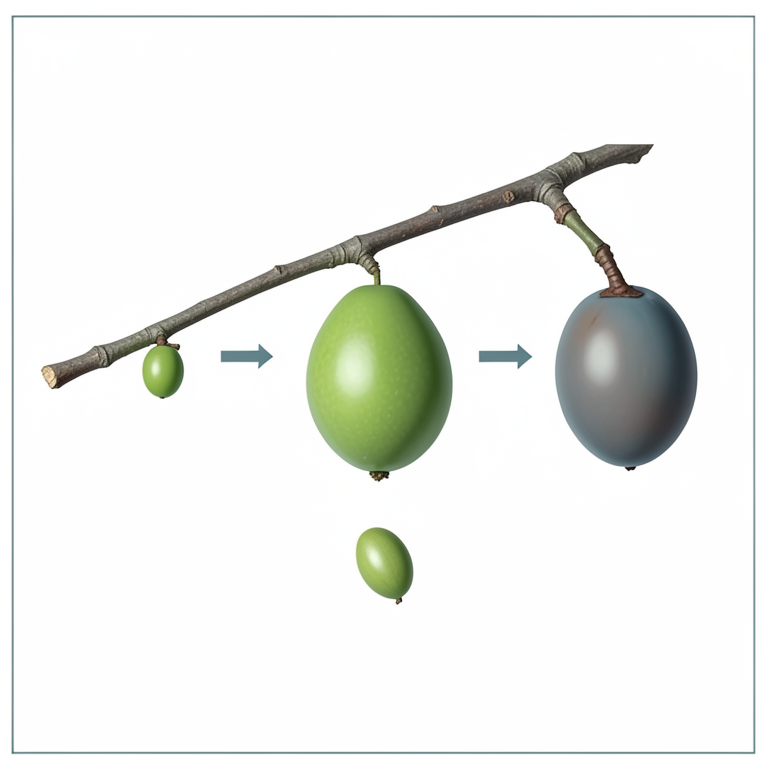
Rambai Fruit Growth Cycle
AI-generated conceptual illustration (Rambai (Baccaurea sapida) fruit on a branch). It explains the idea and does not show study data.
View source evidence ↗Figures & tables
From the original paper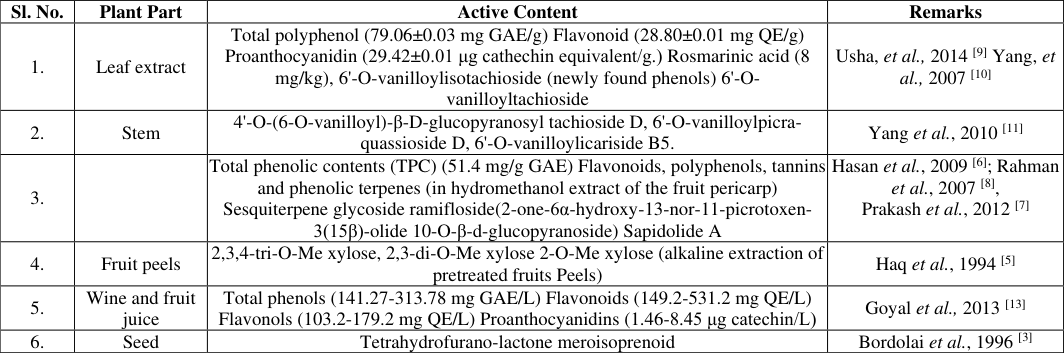 Table 1
Introduction
Rambai (Baccaurea sapida), commonly known as Burmese grape, is a tropical underutilized fruit belonging to the Euphorbiaceae family (2n=26). It is abundantly found in South-East Asia, with wide distribution in tropical countries such as Malaysia, Myanmar, Nepal, Bangladesh, India, and Southern China (Goyal, 2013) [4] . In West Bengal, particularly in the northern parts like Cooch Behar, the foothills of Darjeeling, Kalimpong, Uttar and Dakshin Dinajpur, Jalpaiguri, and some pockets of Southern Bengal, Rambai is highly popular, known locally as 'Lotkan' or 'Lotko.' The plant is evergreen, dioecious, and thrives in shaded conditions, often grown in homestead settings in this climatic region (Bhowmik, 2010) [2] . Rambai plants flower during March-April, and the fruits mature during the rainy season. The edible part of the fruit is the aril (3-4 arils per fruit), surrounded by a leathery rind. The cauliflorous bearing habit of the fruit is similar to Jackfruit and Cocoa. The fruits are round to oval, with a yellowish skin at maturity (Bhowmik, 2010) [2] . Despite being an underutilized crop, Rambai boasts significant nutritional and medicinal value. Various plant components are used to treat injuries, abscesses, and arthritis, while the fruit juice is primarily employed to alleviate constipation. The fruits exhibit promising physicochemical and medicinal properties, making them worthy of exploration and consideration.
Nutritional and Physiochemical properties of Burmese grape
Based on its low iodine value, a result from gas chromatographic of the oil from the seeds of Baccaurea sapida revealed that more than 55% of the total fatty acids are composed of saturated fatty acids such palmitic acid (23.57%), stearic acid (21.28%), and arachidonic acid 7.43%). The unsaturated fatty acids included in Baccaurea (Sapida are oleic (25.45%) and 11-transeicosenoic (11.45%) acids. [11] 3.
Total phenolic contents (TPC) (51.4 mg/g GAE) Flavonoids, polyphenols, tannins and phenolic terpenes (in hydromethanol extract of the fruit pericarp) Sesquiterpene glycoside ramifloside(2-one-6α-hydroxy-13-nor-11-picrotoxen-3(15β)-olide 10-O-β-d-glucopyranoside) Sapidolide A Hasan et al., 2009 [6] ; Rahman et al., 2007 [8] , Prakash et al., 2012 [7] 4.
Fruit peels 2,3,4-tri-O-Me xylose, 2,3-di-O-Me xylose 2-O-Me xylose (alkaline extraction of pretreated fruits Peels) Haq et al., 1994 [5] 5.
Wine and fruit juice
Total 6. Seed Tetrahydrofurano-lactone meroisoprenoid Bordolai et al., 1996 [3] In India, raw bark is chewed or juice is used internally used for constipation (Khan, 2008) [12] . The locals use of the fruit liberally for ceremonial purposes during the Holy Chariot Lord Jagannath's procession. People honor God by performing other ceremonies and hurling the latka fruit (Goyal, 2013) [14] . In Bangladesh, in addition to fresh food consumption, it mostly grown for the manufacturing of the important dye annatto seeds. 4.8-6% of the annatto dye is present in seeds.
Flowering and fruit set
The growth cycle of Burmese grape begins with the flowering stage. The tree produces small, inconspicuous flowers on its branches. These flowers contain both male and female reproductive parts and are usually pollinated by insects, particularly bees. Successful pollination is necessary for fruit formation. After successful pollination, the flowers develop into small, green fruits. These fruits initially appear as tiny, round structures, and they start to grow in size over time. As they develop, the fruits may be green or yellowishgreen, and they gradually increase in size.
Fruit growth and development
The fruit exhibited rapid growth between days 21 and 28 after fruit set (DAFS). Fruit growth is believed to be influenced by endogenous auxins, gibberellins, and cytokinins. Younger fruits release a higher proportion of hormones, and this proportion decreases with maturity. Fruit weight showed a steady increase until maturity, with a significant spike between 21 and 77 DAFS. The initial slow increase in weight may be attributed to cell division, while the rapid increase is likely due to both active cell enlargement and the accumulation of food resources in fruit flesh cells (Barker and Davis, 1951) [1] . Various parameters such as fruit length, width, weight, peel weight, seed weight, and pulp percentage experienced significant increases during fruit growth and development until reaching maturity. To enhance yield, careful attention to plant care, including packaging and methods, is crucial during this stage, particularly between the 14 th and 28 th DAFS, where there is notable growth in fruit length, breadth, and weight. This stage is pivotal in horticulture due to the high percentage of fruit drop observed between the 21st and 35th DAFS, correlating with elevated fruit growth rates. Applying manures, fertilizers, and irrigation may enhance fruit quality and productivity, especially considering that Burmese grapes are often cultivated with minimal or no fertilizer and manure. Biochemical characteristics, including TSS (Total soluble solids), total sugar, and reducing sugar, showed a significant increase, while pH and acidity decreased.
Maturation and harvesting
The maturation process of Burmese grapes involves changes in color, size, and flavor. The fruits transition from green to yellowish-brown or reddish-brown as they ripen. The pulp inside the fruit also changes in texture and flavor, becoming sweeter as it matures. The outer skin of the fruit may become thinner and easier to peel as it ripens. Burmese grapes are typically harvested when they are fully ripe. This is important because they are best enjoyed when their sweet and sour flavor is at its peak. The harvesting season can vary depending on the region and climate but generally occurs when the fruits have reached their desired color and flavor.
In cultivation, proper care, including adequate watering and nutrient management, can promote healthy fruit development. Additionally, pruning and shaping the tree can help improve fruit production and make harvesting easier. Overall, the growth and development of Burmese grape follow a natural cycle that results in delicious and unique tropical fruit ready for consumption when fully ripe.
Commercial value of Burmese grape
Commercial value of Burmese grape
Figures and tables from the paper
References
11 in the original paper- Barker GA, Davis LD. Growth of the check diameter of peaches. Proceedings of A. Soci. of Hort. Sci. 1951;57:104-110.
- Bhowmick N. Some lesser known minor fruits of Northern parts of West Bengal. Acta. Horticulturae. 2010;890:61-64.
- Bordoloi M, Barua NC, Mohan S, Dutta SC, Mathur RK, Ghos AC, et al. Sapidolide A: an unprecedented spherical carbocyclic lactone from Baccaurea sapida seed kernels: Is it a meroisoprenoid Tetrahedron Lett. 1996;37:6791.
- Goyal AK, Mishra T, Sen A. Antioxidant profiling of Latkan (Baccaurea ramiflora Lour.) wine. Ind. J Biotech. 2013;12:137-139.
- Haq GN, Nabi MN, Hannan A, Kashem A. Studies on polysaccharides from the fruit peels of Baccaurea sapida (Bengali-latkan) Bang. J Sci. Indust. Research. 1994;29(3):83-87.
- Hasan SMR, Hossain MM, Akter R, Jamila M, Mazumder MEH, Rahman S, et al. DPPH free radical scavenging activity of some Bangladeshi medicinal plants. J of Med. P Res. 2009;3:875-879.
- Prakash D, Upadhyay G, Gupta C, Pushpangadan P, Singh KK. Antioxidant and free radical scavenging activities of some promising wild edible fruits. International Food Research Journal. 2012;19(3):11091116.
- Usha T, Middha SK, Bhattacharya M, Lokesh P, Goyal AK. Rosmarinic Acid, a New Polyphenol from Baccaurea ramiflora Lour. Leaf: A Probable Compound for Its Anti-Inflammatory Activity. Antioxidants. 2014;3:830-842.
- Yang XW, Wang JS, Ma YL, Xiao HT, Zuo YQ, Lin H, et al. Bioactive Phenols from the Leaves of Baccaurea ramiflora. Planta Medica. 2007;73:1415-1417.
- Yang XW, He HP, Ma YL, Wang F, Zuo YQ, Lin H, et al. Three new vanilloid derivatives from the stems of Baccaurea ramiflora. Planta Medica. 2010;76(1):88-90.
- Khan S, Cao Q, Zheng YM, Huang YZ, Zhu YG. Health risks of heavy metals in contaminated soils and food crops irrigated with wastewater in Beijing, China. Environmental pollution. 2008 Apr 1;152(3):686-692.
Cited by 2
From OpenAlex, OpenCitations and reference lists read by Scinovex
- Post-harvest Processing, Packaging, and Commercialization of Underutilized Fruits of India ↗
Vasundra Vijay Bhat, Manpreet Kaur, Akash Deep Shukla, Yashi Srivastava · Springer eBooks · 2025
❝ 0 - Exploration of Rambai Fruit (Baccaurea motleyana) and its Potential as a Natural Antioxidant ↗
Mukhtarudin Muchsiri, Alhanannasir Alhanannasir, Nico Syah Putra, Harum Sahara, Joncer Naibaho · SSRN Electronic Journal · 2025
❝ 0PDF