
Research article · 2024 · Full text
International Journal of Advanced Biochemistry ResearchImpact of ginger and garlic powder supplementation on carcass yield and cut up parts performance of broiler chickens
Volume 8(4) · Pages 165–168 · DOI: 10.33545/26174693.2024.v8.i4sc.938 ↗
Research areasAnimal Nutrition and PhysiologyPharmacological Effects of Natural CompoundsRabbits: Nutrition, Reproduction, Health
Abstract
Author-writtenA feeding experiment was conducted to study the effects of Ginger and Garlic feed supplements on carcass traits, of broilers. For this purpose, 200 day old broiler chicks (Cobb) were randomly allocated into four groups with two replicates of 25 chicks each. The treatment group (T0) served as control while in other treatments Ginger and Garlic supplements were added. The results of the experiment indicated that dietary inclusion of Ginger and Garlic in broilers showed that dressed and cut up yields were significantly increased in feed supplemented group. This is beneficial and cost effective for poultry farmers.
Summary
Source-checkedPlain-language reading of the full paper, prepared with AI and checked against the text. Each point links to the authors' own words.
Why it matters
- Commercial poultry production faces a significant challenge in securing high-quality feed at stable prices. View evidence ↗
- Ginger and garlic are considered potential natural alternatives to antibiotic growth promoters in poultry. View evidence ↗
- Garlic possesses a wide range of medicinal properties, including antibacterial, antifungal, and antioxidant characteristics. View evidence ↗
The question
- The study aimed to evaluate how different levels of ginger and garlic powder supplementation affect the carcass quality and cut-up parts of broiler chickens. View evidence ↗
What they did
- The experiment used 200 day-old Cobb broiler chickens, divided into four groups with two replicates of 25 birds each using a Complete Randomized Design. View evidence ↗
- Treatments included a control group (T0) on a basal diet, T1 with 0.5% ginger, T2 with 0.5% garlic, and T3 with both 0.5% garlic and 0.5% ginger. View evidence ↗
- The study lasted six weeks, after which four birds per treatment (two per replicate) were sacrificed on the 42nd day to analyze carcass and cut-up yields. View evidence ↗
What they found
- The highest dressed yield without giblets was observed in the combined ginger and garlic group (T3) at 75.28±0.55%, compared to the control (T0) at 70.67±0.57%. View evidence ↗
- Dressed yield with giblets was highest in the T3 group (79.25±0.16%) and lowest in the control group (73.63±0.55%). View evidence ↗
- Back weight was significantly higher in all supplemented groups compared to the control, with the T3 group reaching a maximum of 19.93±0.01%. View evidence ↗
- Breast weight was highest in the T3 group (18.80±0.03%) and lowest in the control group (17.45±0.02%). View evidence ↗
- Thigh weight peaked in the T3 group at 11.18±0.03%, while the control group was the lowest at 10.47±0.02%. View evidence ↗
- Drumstick weight was highest in the T3 group (10.47±0.04%) compared to the control (9.72±0.01%). View evidence ↗
- Wing weight was highest in the T3 group (10.12±0.02%) and lowest in the control group (9.44±0.03%). View evidence ↗
- Neck weight was highest in the T3 group (5.09±0.04%) and lowest in the control group (4.58±0.02%). View evidence ↗
What it means
- The authors conclude that supplementing broiler feed with 0.5 g/kg of both ginger and garlic improves carcass quality and dressed edible yields. View evidence ↗
- The use of these supplements is recommended as a beneficial and cost-effective strategy for broiler production. View evidence ↗
Visual summary
1 visualsIllustrations explain the paper; they do not show study data.
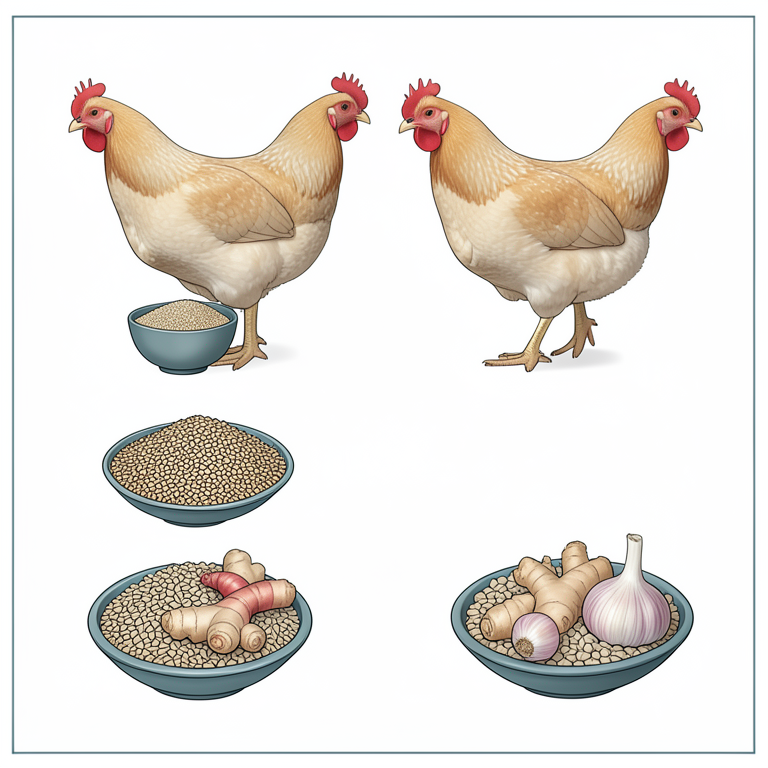
Experimental Group Layout
AI-generated conceptual illustration (broiler chickens). It explains the idea and does not show study data.
View source evidence ↗Figures & tables
From the original paper Table 1
 Table 2
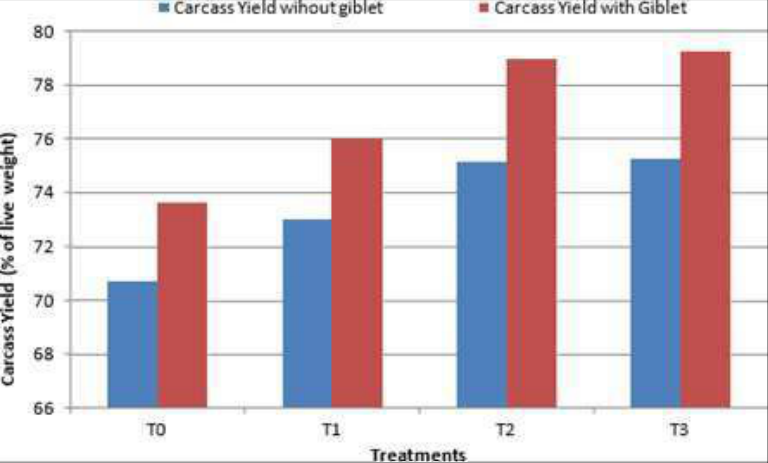 Figure 1
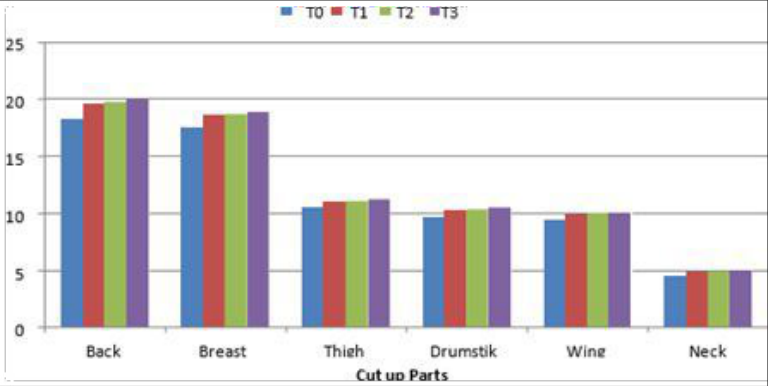 Figure 2
Introduction
The increase in average income and urban populations has causes a tremendous increase in the poultry demand and increase in consumption over the years. The consumption of poultry meat in India was found to be over 3.9 million metric tons in 2020. The poultry population in India has grown at rapid pace. But the poultry sector has grown a lot comparatively ever since in 2019. The population of poultry in country was over 800 million and this was a 16 percent increase over the last five years. The biggest challenge of commercial poultry production is the availability of good quality feed with stable prices instead of this challenge, commercial poultry production ranks among the highest source of animal protein. In India, poultry production accounts for 0.66 percent of GDP and 7.72 percent GDP from the livestock sector. The per capita availability of poultry meat is 2.8 kg; against recommended level of 11 kg. The increase in size of the poultry industry has faster as compared to other food-producing animal industries. The trade volume of poultry products has also increased to rapid growth of world poultry meat and egg production. In Poultry Feed is the major component of the total cost of production in the poultry industry to ensure more net return and to minimize high expenditure on feed, many research strategies have practiced such as using feed supplements. Thus, broiler poultry farming is being promoted for sustainability of poultry production and upliftment of economic condition of Indian farmers. Both garlic and ginger essential oils have gained importance due to their wide range of properties not only in improving performance of broilers but, many other ways where the almost aim is to improve nutritive value of poultry meat products (Bamidele and Adejumo, 2012) [3] . Several studies have identified the separate use of this plants extracted oils in broiler nutrition as natural feed additives, the present study was conducted to evaluate the single and combined effect of garlic (Allium sativum) [3] and ginger (Zingiber officinale) on the performance of broiler chickens and meat quality of broiler chicks. Ginger and Garlic as natural growth promoters can be potential alternatives for growth promoters likes antibiotics (Demir et al., 2003) [5] . Ginger is the rhizome of plant Zingiber officinale, consumed as a delicacy, medicine and spice. The research indicates that nine compounds found in ginger bind to serotonin receptors which may affect gastrointestinal function. Research showed that in-vitro shows that ginger extract control the quantity of free radicals and the peroxidaion of lipids (AI-Amin et al, 2006) [1] and have anti-diabetic properties. Garlic (Allium sativum) [3] has used as spice and medicine. It has possessed antibacterial, antifungal, antiparasitic, antiviral, antioxidant, anticholesteremic, anti-cancerous, and vasodilator characteristics (Hanieh et al., 2010) [7] . Ginger and garlic supplements in broiler chicken diets have known for their strong stimulating effect on the immune and digestive systems in birds (AI-Shuwali et al., 2015) [2] . Recent research works on ginger and garlic formulations as feed additives have shown encouraging results in weight gain, lowered mortality, feed efficiency and increased livability in poultry birds. However, detail studies are required to assess the efficacy of Ginger and Garlic powder on the productive performance and immunity of different varieties of chicken. Hence, a study was done on the efficacy of Ginger and Garlic powder at graded levels on the performance of broiler chickens with objective of effect of feeding Ginger & Garlic powder on carcass quality and Cut up parts of broiler chickens.
Materials and Methods
Day old 200 Cobb broiler chickens were taken as the experimental birds divided in to 4 groups with two replicate group of each, having 25 broiler birds in every replicate in a Complete Randomized Design. The broiler birds used in this research were obtained from Ambedker Nagar. The broiler birds were weighed and transferred to experimental shed in the farm itself with standard health care and management practices. The treatment were as follows: T 0 (Control)-Basal Diet, T 1 Basal Diet + 0.5% Ginger, T 2 -Basal Diet + 0.5% Garlic and T 3 -Basal Diet + 0.5% Garlic + 0.5% Ginger. The Ginger and Garlic used in this experiment was fresh, washed and sliced. The sliced Ginger and Garlic was sundried and ground into powder. The powdered Ginger and Garlic was sealed in air tied container before incorporation into the feed. Carcass Characteristics, Dressed weight with viscera -The oil gland from vent region, the head from occipital joint and feet from hock. Wings -The wings were cut first. The wing was pulled away from the body by giving a cut. The cut was on the wing side of the joint and not on the breast side, the wing includes entire wing with all muscles and skin intact. The weights of both the wings were recorded as wing weight. Neck-The neck was separated from carcass at the shoulder joint .The individual weight of neck of each bird was recorded as neck weight. Back -The back of the carcass was cut by hand saw. The back includes scapula, vertebra, vertebral ribs, pelvic bones with all skin and muscle intact. The individual weight of the back of each bird was recorded as back weight. Breast -The breast was separated from back of the carcass by a cut at shoulder joint across the junction of vertebral and sternal ribs and its includes keel bone also. The individual weight of breast of each bird was recorded as breast weight. Drumstick-The drumstick were separated from the thigh by giving a cut through the knee joint. The two drumsticks were recorded as drumstick weight. Thighs -The thighs of the carcass were separated from the thigh by a cut through the knee joint. The thighs of the carcass were separated at the knee and hip joint. The weight of the thighs was recorded as thigh weight. All the weights of the carcass and cut-up parts of bird were subjected for analysis to get their percentage yield. The joint were severed and removed. Dressed Weight-Weight of the carcass with edible viscera like liver, heart, gizzard and abdominal fat was recorded as dressed weight. Processing of Giblets-Liver -Liver was clipped from the viscera with a scissor by holding with a forcep. Gall bladder was removed carefully without breaking it. Heart -The heart was removed from viscera with a scissor. The arteries were trimmed off the heart. The outer thin membrane as pericardium was removed. The heart was washed and weighed in pan. Gizzard-The gizzard was removed first by cutting the esophagus just or below the proventriculus and beginning of the duodenum. Both the openings of the gizzard were cleaned. The gizzard was cut opened with scissors. The inner serous lining was removed. The weight was recorded in a perforated pan.
Different Cut-up Parts and weights
After carcass weight of each bird, the different cut-up parts were weighed. All the weights of the carcass and cut -up parts broiler bird were subjected for analysis to get their percentage yield. The calculations were done by Standard procedure. Statistical analysis the data generated in trial were statistically analyzed with standard software.
Results and Discussion
A feeding experiment was conducted to study the effects of incorporation of feed supplements Ginger and Garlic on carcass traits of broilers. This study was for six weeks. At the end on 42 nd day, two poultry birds from each replicate (4 birds/ treatment) were randomly sacrificed for the study of carcass yield and cut up parts.
Dressed yield
The effects of feed supplements on dressed yield (without or with giblet) of broilers have been presented in Table -1 and Fig1.The average values of dressed yield without giblets of different groups of broilers viz., T 0 to T 3 were 70.67±0.57, 72.99±0.74, 75.12±0.63 and 75.28±0.55. percent in broilers of T 0 to T 3 groups respectively. Maximum 75.28± 0.55 percent dressed yield without giblets was found in T 3 group followed by T 2, (75.12±0.63), T 1 (72.99±0.74) and T 0 (70.67±0.57) of broilers. All the broilers of feed supplemented showed significantly (p<0.05) higher dressed yield as compared to T 0 group. Minimum dressed yield without giblets was observed for T 0 (Control). However, there were no significant differences in dressed yield without giblet between T 2 and T 3 . Mean values of dressed yield with giblets of different groups of broilers viz., T 0 to T 3 were 73.63±0.55, 75.97±0.45, 78.96±0.30 and 79.25±0.16 percent, respectively. Maximum 79.25±0.16, percent dressed yield with giblet was found in T 3 group followed by T 2 (78.96±0.30), T 1 (75.97±0.45) and T 0 (73.63±0.55) of broilers. All the broilers of feed supplemented showed significantly (p<0.05) higher dressed yield with giblets compared to the T 0 (control). Minimum dressed yield with giblets was observed for T 0 (control). However, there were no significant difference in the dressed yield with giblet between T 2 and T 3 groups of broilers. Results of the experiment on carcass yield were similar with the findings of Fadlalla et al. (2010) [6] showed that Garlic at 0.3% in broiler feed causes significant effect on carcass yield. Zhamg et al. (2009) [8] and Bampidis et al. (2005) [4] reported that Garlic an alternative of growth promoters in poultry showed its excellent effects on carcass characteristics and growth. Higher dressed yield in Ginger and Garlic diet supplemented groups may be due to better fleshing and favourable meat to bone ratio as a result of increased availability of nutrients in the treated groups.
Cut-up parts
The effect of feed supplementations on the cut-up parts as back, breast, thigh, drumstick, wings and neck have shown in Table 2.0 and Fig. was found in T 3 group followed by T 2 (19.75±0.02), T 1 (19.56±0.04) and T 0 (18.27±0.02). All the broilers of supplemented groups showed significantly (p<0.05) higher back weight compared to the T 0 groups . Minimum back weight (18.27±0.02) percent was observed for T 0 group. However, there were nonsignificant differences in back weight among T 1, T 2, T 3 . Wing weight of 10.12±0.02 percent was found in T 3 group followed by T 2 (10.05±0.03), T 1 (9.98±0.02) and T 0 (9.44±0.03). All the broilers of supplemented groups have shown significantly (p<0.05) higher wing weight as compared to the T 0 groups. . Minimum Wing Weight (9.44±0.03) percent was observed for T 0 group. However, there were non significant differences in wing weight among T 1, T 2, T 3, group of broilers. Mean values of Neck Weight of different groups of broilers viz., T 0 to T 3 were 4.58±0.02, 4.89±0.04, 4.95±0.02 and 5.09±0.04 percent respectively. Maximum Neck weight of 5.09±0.04 percent was found in T 3 group followed by T 2 (4.95±0.02) T 1 (4.89±0.04) and T 0 (4.58±0.02). All the broilers of supplemented groups have shown significantly (p<0.05) higher neck weight as compared to the T 0 groups. Minimum neck weight (4.58±0.02) percent was observed for T 0 group. However, there were nonsignificant differences in neck weight among T 1 and T 2 group of broilers. The higher cut up yields observed in supplemented groups may be due to more edible muscle mass in broilers in supplemented groups.
| Treatments | Back | Breast | Thigh | Drumstick | Wing | Neck |
|---|---|---|---|---|---|---|
| T0 | 18.27a±0.02 | 17.45a±0.02 | 10.47a±0.02 | 9.72a±0.01 | 9.44a±0.03 | 4.58a±0.02 |
| T1 | 19.56b±0.04 | 18.65b±0.03 | 10.99b±0.01 | 10.29b±0.02 | 9.98b±0.02 | 4.89b±0.04 |
| T2 | 19.75b±0.02 | 18.71b±0.02 | 11.07b±0.03 | 10.36b±0.04 | 10.05b±0.03 | 4.95b±0.02 |
| T3 | 19.93b±0.01 | 18.80b±0.03 | 11.18b±0.03 | 10.47b±0.04 | 10.12b±0.02 | 5.09c±0.04 |
Table text extracted from the original PDF; superscript letters are shown inline. The original table image is below.
View original table image
Conclusion
It may be concluded that supplementation of chicks with Ginger + Garlic @ 0.5 g/kg feed improved the performance of broilers in terms of dressed edible yields and carcass quality. It is beneficial and cost effective for broiler production.
Figures and tables from the paper
| Treatments | Dressed yield without giblet | Dressed yield with giblet |
|---|---|---|
| T0 | 70.67a±0.57 | 73.63a±0.55 |
| T1 | 72.99b±0.74 | 75.97b±0.45 |
| T2 | 75.12c±0.63 | 78.96c±0.30 |
| T3 | 75.28c±0.55 | 79.25c±0.16 |
Table text extracted from the original PDF; superscript letters are shown inline. The original table image is below.
View original table image
References
8 in the original paper- Al-Amin ZM, Thomson M, Al-Qattan KK, PeltonenShalaby R, Ali M. Anti-diabetic and hypolipidemic properties of ginger (Zingiber officinale) in streptozotocin-induced diabetic rats. British Journal of Nutrition. 2006;96:660-666.
- Al-Shuwaili MA, Ibrahim E, Naqi Al-Bayati M. Effect of dietary herbal plants supplement in turkey diet on performance and some blood biochemical parameters. Global Journal of Biosciences and Biotechnology. 2015;4:153-157.
- Bamidele O, Adejumo IO. Effect of Garlic (Allium sativum L.) and ginger (Zingiber officinale Roscoe) mixtures on performance characteristics and Cholesterol profile of growing pullets. International Journal of Poultry Science. 2012;11(3):217-220.
- Bampidis VA, Christodoulou V, Christaki E, flouPaneri P, Spais AB. Effect of dietary garlic bulb and garlic husk supplementation on performance and carcass characteristics of growing lambs. Animal Feed Science and Technology. 2005;121:273-283.
- Demir E, Sarica S, Ozcan MA, Suicmez M. The use of natural feed additives as alternatives for an antibiotic growth Promoter in broiler diets. British Journal of Poultry Science. 2003;44:44-45.
- Fadlalla IMT, Mohammed BH, Bakhiet AO. Effect of feeding garlic on the performance and immunity of broilers. Asian Journal of Poultry Science. 2010;4:182189.
- Hanieh H, Narabara K, Piao M, Gerile C, Abe A, Kondo Y. Modulatory effects of two levels of dietary Alliums on immune responses. Animal Science Journal. 2010;81:673-680.
- Zhang GF, Yang ZB, Wang Y, Yang, WR, Jiang SZ, Gal GS. Effects of ginger root (Zingiber officinale) processed to different particle sizes on growth performance, antioxidant status, and serum metabolites of broiler chickens. Poultry Science. 2009;88:21592166.
Cited by 1
From OpenAlex, OpenCitations and reference lists read by Scinovex
- Effect of different forms of garlic (Allium sativum) on carcass traits, sensory quality, serum lipid profile and economics of Grampriya breed of poultry
Sayyed Samee, Chauhan DS, Thombre BM · International Journal of Advanced Biochemistry Research · 2026
A ten-week feeding experiment was conducted to assess the effect of different forms of garlic (Allium sativum) on carcass traits, sensory quality, serum lipid profile and economics of Grampriya poultry production. Two hundred day-old straight-run chicks were randomly distributed into five treatments with four replications of 10 birds each. T1 received the basal ration, T2 received 3 per cent fresh garlic, T3 received 3 per cent garlic powder, T4 received 3 per cent black garlic powder and T5 received 1 per cent each of fresh garlic, garlic powder and black garlic powder. At the end of the expe