
Research article · 2024 · Full text
International Journal of Agriculture Extension and Social DevelopmentBarriers in agripreneurship experienced by the agricultural students in SAU’s of Gujarat
Volume 7(4) · Pages 134–137 · DOI: 10.33545/26180723.2024.v7.i4b.510 ↗
Research areasLivestock Management and Performance Improvement
Abstract
Author-writtenAgripreneurship is combination of agriculture and business. Though the blooming opportunities available in agripreneurship sector, students are reluctant to start their venture due to some barriers. So, the study has undertaken to study the barriers in agripreneurship and obtain their suggestions. The present study was conducted among the agriculture students in four state agricultural universities in Gujarat. An Ex-post-facto research design was used. The total respondent size was 300. Out of the foremost barriers experienced by students under each category, majority were reported agripreneurship is considered as low socio- economic status in our society as the major socio-personal barrier, less number of visits/tours to various enterprises for exposure as the main management and technical barrier, complicated and difficult loan lending procedure as financial and infrastructural barrier and lack of market intelligence regarding price forecasting. The major suggestions offered by the students to overcome the barriers in each category such as, to government agencies and educational institutions need to support agripreneurship as a career, exposure visits/ tours should be organized to different agri-enterprises, creating awareness regarding different schemes which are promoting entrepreneurship and product certification procedures should be simplified.
Summary
Source-checkedPlain-language reading of the full paper, prepared with AI and checked against the text. Each point links to the authors' own words.
Why it matters
- There is a vast scope for students to enter agripreneurship, supported by encouraging government policies and schemes. View evidence ↗
- Despite available opportunities, students are often reluctant to start agri-ventures due to various barriers. View evidence ↗
What they did
- The research was conducted among agriculture students across four state agricultural universities in Gujarat. View evidence ↗
- A total of 300 respondents were selected via random sampling, consisting of 25 students from each degree (B.Sc. final year, M.Sc., and Ph.D.) from each of the four universities. View evidence ↗
- The study employed an ex-post-facto research design and collected data through personal interviews using an interview schedule. View evidence ↗
- Barriers were categorized into four groups: socio-personal, management and technical, financial and infrastructural, and marketing. View evidence ↗
What they found
- The primary socio-personal barrier was the perception that agripreneurship is associated with low socio-economic status (Weighted Mean Score: 2.25). View evidence ↗
- The top management and technical barrier was an insufficient number of exposure visits or tours to various enterprises (WMS: 2.45). View evidence ↗
- The most significant financial and infrastructural barrier was the complicated and difficult loan lending procedure (WMS: 2.52). View evidence ↗
- The leading marketing barrier was a lack of market intelligence regarding price forecasting (WMS: 2.60). View evidence ↗
- To address socio-personal barriers, 55.67% of students suggested that government agencies and educational institutions should support agripreneurship as a career. View evidence ↗
- For management and technical barriers, the top suggestion (57.66%) was to organize exposure visits and tours to different agri-enterprises. View evidence ↗
- Regarding financial barriers, 62.00% of students recommended creating awareness about various schemes that promote entrepreneurship. View evidence ↗
- The primary suggestion for overcoming marketing barriers was the simplification of product certification procedures (47.33%). View evidence ↗
What it means
- The authors recommend establishing agribusiness incubation forums in state agricultural universities to provide technology commercialization, financial linkages, and capacity building. View evidence ↗
- The authors conclude that negative social perceptions of agripreneurship can be mitigated through targeted education, skill development, and training. View evidence ↗
Visual summary
3 visualsIllustrations explain the paper; charts are replotted from the paper's own table values.
Categorization of Agripreneurship Barriers
AI-generated conceptual illustration (Agricultural students in Gujarat, India). It explains the idea and does not show study data.
View source evidence ↗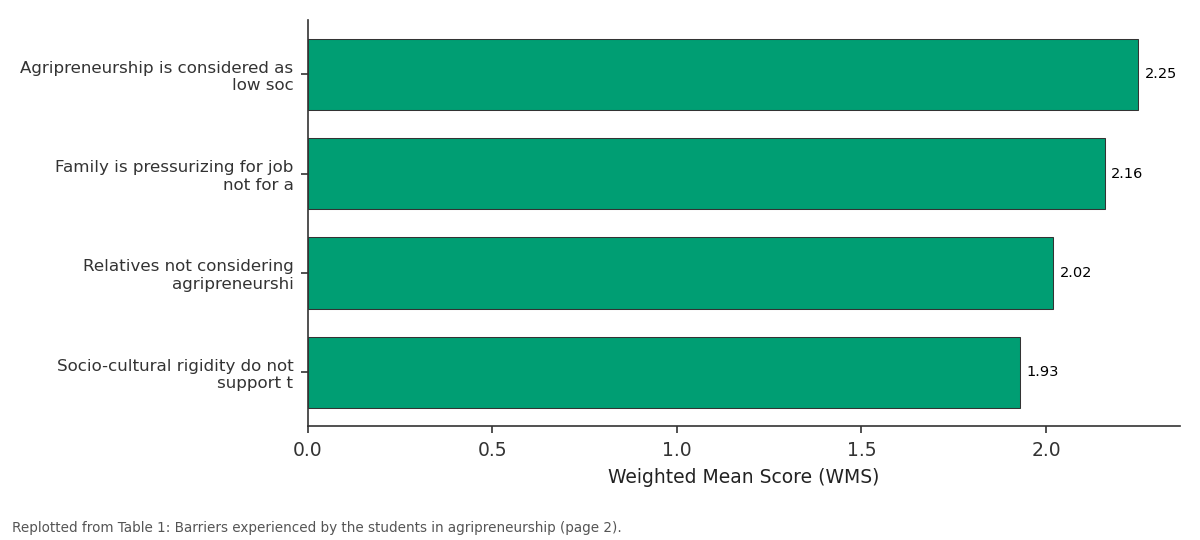
WMS: Agripreneurship is... vs Family is pressurizing... vs Relatives not... vs Socio-cultural rigidity...
Replotted from Table 1 (page 2) of the original paper. Every bar is the paper's own table value.
View source evidence ↗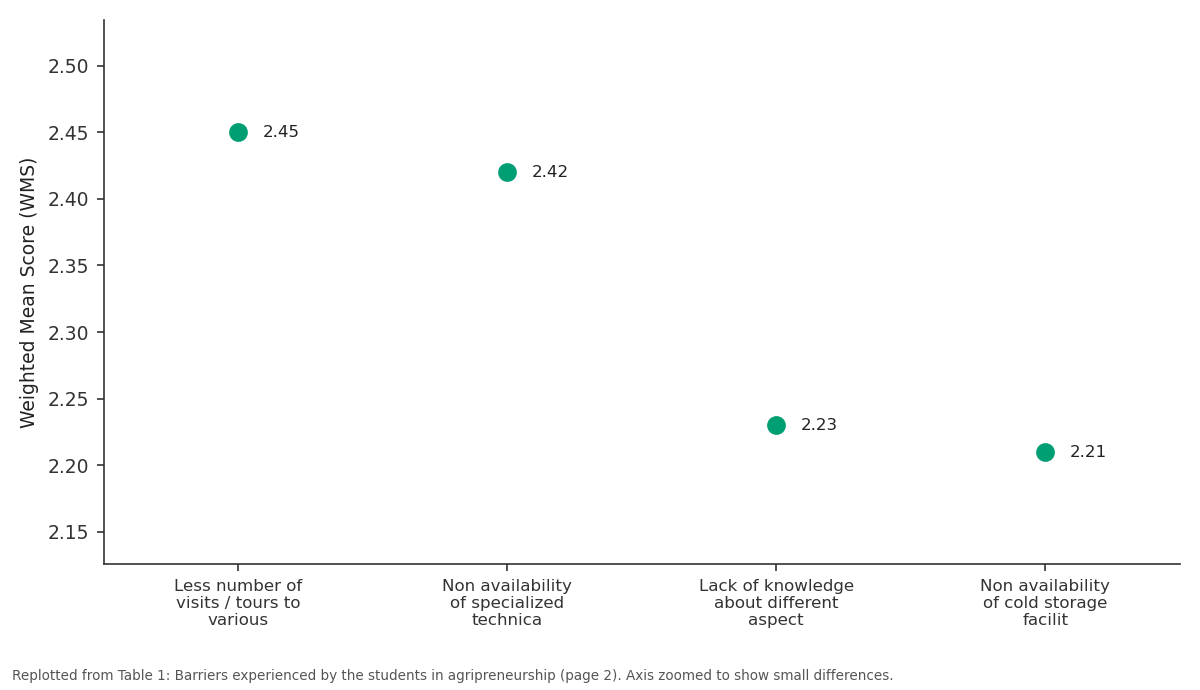
WMS: Less number of visits /... vs Non availability of... vs Lack of knowledge about... vs Non availability of...
Replotted from Table 1 (page 2) of the original paper. Every bar is the paper's own table value.
View source evidence ↗Figures & tables
From the original paper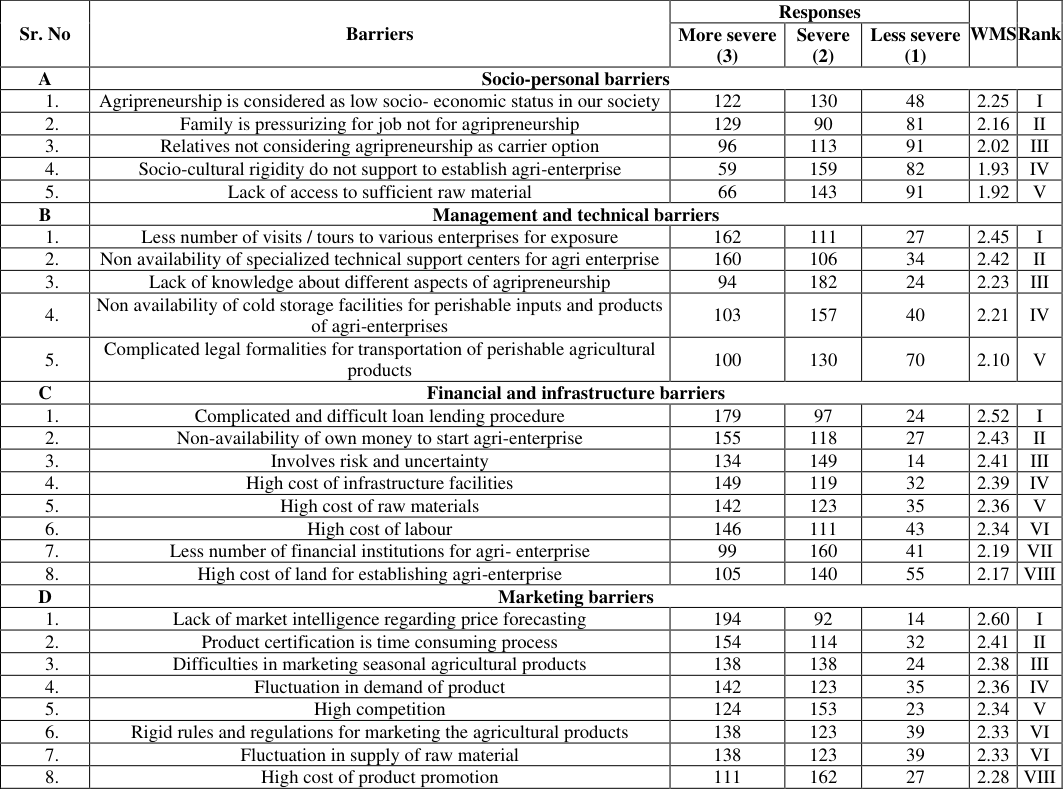 Table 1
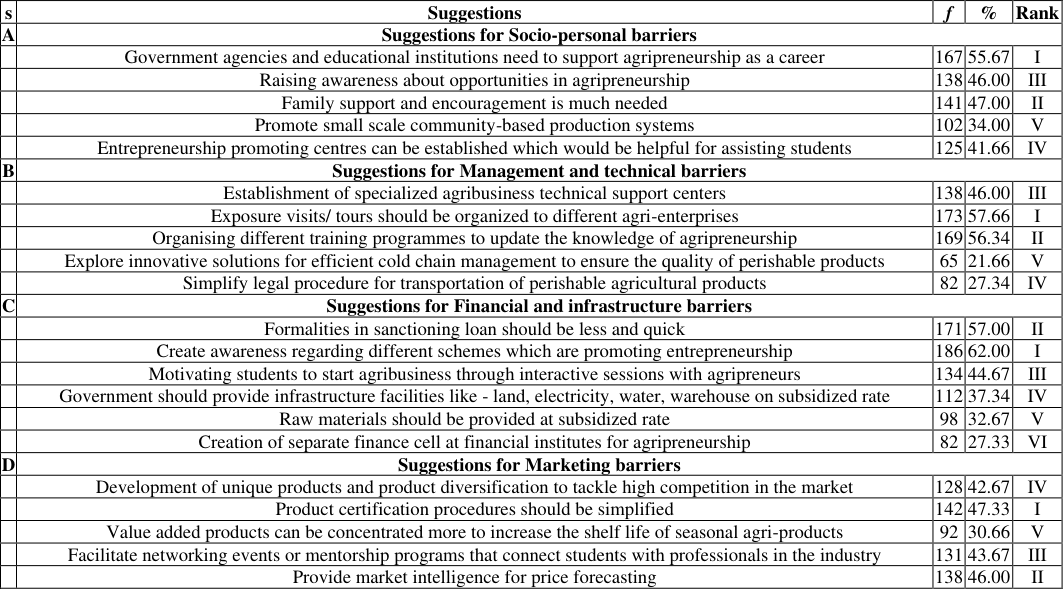 Table 2
Introduction
Entrepreneurship is a state of mind that allows taking calculated risks with confidence in order to attain a certain economic or industrial goal. It is a way of analysing and addressing a need while also adding value to the stakeholders (Sharma et al., 2019) [3] . Agripreneurship is the combining the terms "entrepreneurship" and "agriculture, which refers to the application of entrepreneurial concepts and creative problem-solving to agricultural endeavors. It entails converting conventional farming methods into innovative, market-driven businesses that boost rural economic growth in addition to agricultural production (Arumugam and Manida, 2023) [1] . Barriers can refer to various obstacles, hindrances, or obstacles that impede progress. The suggestion refers as one's opinion which can be used as a solution or strategy to overcome the barriers. The degree in agriculture is one of the basic and first step in agriculture education which provides knowledge on application of science and technology in agriculture. Application of technology in the field of agriculture and its allied sectors is huge. Hence the scope for the students to become an agripreneur is vast and attractive. Government policies and schemes are also very well supporting and encouraging for starting an enterprise. Irrespective of all these supportive measures, the students are not coming forwarding to start an agribusiness. In order to understand the reasons behind their hesitance, this study has been formulated with following specific objectives 1. To study the barriers experienced by the students in agripreneurship. 2. To obtain the suggestions for developing extension strategies.
Research Methodology
The present study was conducted among the agriculture students in four state agricultural universities in Gujarat such as Navsari Agricultural University, Anand Agricultural University, Junagadh Agricultural University and Sardarkrushinagar Dantiwada Agricultural University. The faculty of agriculture was selected purposively. An Ex-postfacto research design was used in the present study. According to Kerlinger (1976) [2] , ex-post-facto research design is worthy to be applied when the independent variables have already acted upon.
Results and Discussion
The barriers experienced by the agricultural students in agripreneurship were presented in the Table 1 and suggestions in the Table 2. Product certification procedures should be simplified 142 47.33 I 3.
| s | Suggestions | f | % | Rank |
|---|---|---|---|---|
| A | Suggestions for Socio-personal barriers | |||
| Government agencies and educational institutions need to support agripreneurship as a career | 167 | 55.67 | I | |
| Raising awareness about opportunities in agripreneurship | 138 | 46.00 | III | |
| Family support and encouragement is much needed | 141 | 47.00 | II | |
| Promote small scale community-based production systems | 102 | 34.00 | V | |
| Entrepreneurship promoting centres can be established which would be helpful for assisting students | 125 | 41.66 | IV | |
| B | Suggestions for Management and technical barriers | |||
| Establishment of specialized agribusiness technical support centers | 138 | 46.00 | III | |
| Exposure visits/ tours should be organized to different agri-enterprises | 173 | 57.66 | I | |
| Organising different training programmes to update the knowledge of agripreneurship | 169 | 56.34 | II | |
| Explore innovative solutions for efficient cold chain management to ensure the quality of perishable products | 65 | 21.66 | V | |
| Simplify legal procedure for transportation of perishable agricultural products | 82 | 27.34 | IV | |
| C | Suggestions for Financial and infrastructure barriers | |||
| Formalities in sanctioning loan should be less and quick | 171 | 57.00 | II | |
| Create awareness regarding different schemes which are promoting entrepreneurship | 186 | 62.00 | I | |
| Motivating students to start agribusiness through interactive sessions with agripreneurs | 134 | 44.67 | III | |
| Government should provide infrastructure facilities like - land, electricity, water, warehouse on subsidized rate | 112 | 37.34 | IV | |
| Raw materials should be provided at subsidized rate | 98 | 32.67 | V | |
| Creation of separate finance cell at financial institutes for agripreneurship | 82 | 27.33 | VI | |
| D | Suggestions for Marketing barriers | |||
| Development of unique products and product diversification to tackle high competition in the market | 128 | 42.67 | IV | |
| Product certification procedures should be simplified | 142 | 47.33 | I | |
| Value added products can be concentrated more to increase the shelf life of seasonal agri-products | 92 | 30.66 | V | |
| Facilitate networking events or mentorship programs that connect students with professionals in the industry | 131 | 43.67 | III | |
| Provide market intelligence for price forecasting | 138 | 46.00 | II |
Table text extracted from the original PDF; superscript letters are shown inline. The original table image is below.
View original table image
| Sr. No | Barriers | Responses | — | — | WMS | Rank |
|---|---|---|---|---|---|---|
| More severe (3) | Severe (2) | Less severe (1) | ||||
| A | Socio-personal barriers | |||||
| 1. | Agripreneurship is considered as low socio- economic status in our society | 122 | 130 | 48 | 2.25 | I |
| 2. | Family is pressurizing for job not for agripreneurship | 129 | 90 | 81 | 2.16 | II |
| 3. | Relatives not considering agripreneurship as carrier option | 96 | 113 | 91 | 2.02 | III |
| 4. | Socio-cultural rigidity do not support to establish agri-enterprise | 59 | 159 | 82 | 1.93 | IV |
| 5. | Lack of access to sufficient raw material | 66 | 143 | 91 | 1.92 | V |
| B | Management and technical barriers | |||||
| 1. | Less number of visits / tours to various enterprises for exposure | 162 | 111 | 27 | 2.45 | I |
| 2. | Non availability of specialized technical support centers for agri enterprise | 160 | 106 | 34 | 2.42 | II |
| 3. | Lack of knowledge about different aspects of agripreneurship | 94 | 182 | 24 | 2.23 | III |
| 4. | Non availability of cold storage facilities for perishable inputs and products of agri-enterprises | 103 | 157 | 40 | 2.21 | IV |
| 5. | Complicated legal formalities for transportation of perishable agricultural products | 100 | 130 | 70 | 2.10 | V |
| C | Financial and infrastructure barriers | |||||
| 1. | Complicated and difficult loan lending procedure | 179 | 97 | 24 | 2.52 | I |
| 2. | Non-availability of own money to start agri-enterprise | 155 | 118 | 27 | 2.43 | II |
| 3. | Involves risk and uncertainty | 134 | 149 | 14 | 2.41 | III |
| 4. | High cost of infrastructure facilities | 149 | 119 | 32 | 2.39 | IV |
| 5. | High cost of raw materials | 142 | 123 | 35 | 2.36 | V |
| 6. | High cost of labour | 146 | 111 | 43 | 2.34 | VI |
| 7. | Less number of financial institutions for agri- enterprise | 99 | 160 | 41 | 2.19 | VII |
| 8. | High cost of land for establishing agri-enterprise | 105 | 140 | 55 | 2.17 | VIII |
| D | Marketing barriers | |||||
| 1. | Lack of market intelligence regarding price forecasting | 194 | 92 | 14 | 2.60 | I |
| 2. | Product certification is time consuming process | 154 | 114 | 32 | 2.41 | II |
| 3. | Difficulties in marketing seasonal agricultural products | 138 | 138 | 24 | 2.38 | III |
| 4. | Fluctuation in demand of product | 142 | 123 | 35 | 2.36 | IV |
| 5. | High competition | 124 | 153 | 23 | 2.34 | V |
| 6. | Rigid rules and regulations for marketing the agricultural products | 138 | 123 | 39 | 2.33 | VI |
| 7. | Fluctuation in supply of raw material | 138 | 123 | 39 | 2.33 | VI |
| 8. | High cost of product promotion | 111 | 162 | 27 | 2.28 | VIII |
Table text extracted from the original PDF; superscript letters are shown inline. The original table image is below.
View original table image
Value added products can be concentrated more to increase the shelf life of seasonal agri-products 92 30.66 V 4. Facilitate networking events or mentorship programs that connect students with professionals in the industry 131 43.67 III 5.
Provide market intelligence for price forecasting 138 46.00 II Regarding the suggestions offered by the students in context to their social-personal barriers were, majority (55.67%) of the respondents were given first rank to government agencies and educational institutions need to support agripreneurship as a career, followed by family support and encouragement is much needed (47.00%) ranked second, raising awareness about opportunities in agripreneurship (46.00%) ranked third, entrepreneurship promoting centers can be established which would be helpful for assisting students (41.66%) ranked fourth and promote small scale community-based production systems (34.00%) ranked fifth.
Regarding the suggestions provided for management and technical barriers, the majority (57.66%) of the students were given first rank to exposure visits/ tours should be organized to different agriIn regard to suggestion offered for marketing barriers, majority (47.33%) of the students were given first rank to product certification procedures should be simplified, followed by provide market intelligence for price forecasting (46.00%) ranked second, facilitate networking events or mentorship programs that connect students with professionals in the industry (43.67%) ranked third, development of unique products and product diversification to tackle high competition in the market (42.67%) ranked fourth and value added products can be concentrated more to increase the shelf life of seasonal agri-products (30.66%) ranked fifth.
Conclusion
Based on the suggestions, the extension strategies formulated are, Agribusiness incubation forum can be established in state agricultural universities for technology commercialization, market and financial linkages, other business services, capacity building programs and outreach activities which might be helpful for encouraging the students to start agriculture-based startups. In socialpersonal aspects, perceptions associating agripreneurship with a lower socio-economic status might be overcome by creating awareness about agripreneurship through education and skill development and training. To accept agripreneurship as career, the essential qualities of entrepreneur such as risk taking, self confidence, problem solving, critical thinking could be encouraged among the students. In management and technical aspects, regarding exposure visit, it could be not only visiting the big www.extensionjournal.com enterprises, it might be in the form of making the students to visit the normal vendor shops related to agriculture and observe the practical aspects of business, to identify the need of the customers and marketing strategy can be learned through the practical classes. As per quote "To be successful, you don't have to do extraordinary things. Just do ordinary things extraordinarily well". So, make the students to identify the opportunities even in small things and do SWOT analysis of it. For financial aspects, awareness regarding making project proposal in a clearcut way which make them to get easier loan access and awareness about government schemes which are promoting entrepreneurship and financial institutions such as lead bank and NABARD etc, might be helpful for the students to know the opportunities in getting loan. For marketing aspects, encouraging the students to use of agriculture-based ICT apps and website for access of market information. Make the students to aware about the demand and supply of raw materials, multiple sources of raw material procurement, market dynamics, logistic support for starting the business. To sustain in the competition, the innovative products or technology development and advertising strategies for the products could be given through trainings.
Acknowledgement
AcknowledgementI would like to express my gratitude and heartful to Indian Council of Social Science Research, for funding the research work.
References
3 in the original paper- Arumugam U, Manida M. Agripreneurship for Sustainable Economic Development in India. Com Fin Research. 2023;11(4):15-23.
- Sharma A, Bhooshan N, Singh A, Deshmukh SS, Patra SP. Portrait of an agripreneur of India: An acceleration study. Indian J Agric. Sci. 2019;89(11):108-112.
- Thakkar MG. Entrepreneurial Motivation among the Rural Youth: Study of Students of Navsari Agricultural University. Global Journal of Research in Management. 2023;13(1):40.
Cited by 1
From OpenAlex, OpenCitations and reference lists read by Scinovex
- Barriers perceived by students of Junagadh Agricultural University towards entrepreneurship
Sanjivani Sanjeev Bhalerao, CD Lakhlani, B. Swaminathan · International Journal of Agriculture Extension and Social Development · 2026
Entrepreneurship is a key driver of economic growth, job creation and innovation and this matters especially in India, given its large youth population and persistently high youth unemployment. Supporting entrepreneurship can therefore play a crucial role in tackling these challenges and unlocking the country's economic potential, yet turning entrepreneurial intention into actual business ventures is often held back by a range of perceived barriers. This study set out to examine the barriers perceived by students of Junagadh Agricultural University (JAU) towards entrepreneurship, drawing on a