
Research article · 2024 · Full text
International Journal of Research in AgronomyA review on important diseases of rice in West Bengal
Volume 7(4S) · Pages 67–70 · DOI: 10.33545/2618060x.2024.v7.i4sa.533 ↗
Research areasRice Cultivation and Yield ImprovementPlant Disease Resistance and GeneticsGenetics and Plant Breeding
Abstract
Author-writtenIn India 24 percent of cropped area is being occupied by Rice, among which West Bengal ranks first in rice production. Rice, a staple food for billions of people, is susceptible to several devastating diseases that can significantly impact yield and food security. Among these diseases are the important diseases in West Bengal are brown spot, blast disease, sheath blight, and bacterial blight, each caused by different pathogens and exhibiting distinct symptoms. Brown spot of rice: Caused by the fungus Bipolaris oryzae, it leads to small, circular lesions with brown centers and yellow halos on the leaves. These lesions can coalesce, causing extensive damage to the foliage. Blast of rice: Rice blast, caused by the fungus Magnaporthe oryzae, is one of the most destructive rice diseases globally. It manifests as diamond-shaped lesions on leaves, stems, and panicles, eventually leading to complete plant destruction. Sheath blight: Rhizoctonia solani is the causal agent of sheath blight. This disease results in elongated lesions on leaf sheaths and stems, often causing lodging and reduced grain filling. Bacterial blight: Caused by the bacterium Xanthomonas oryzae pv. Oryzae, bacterial blight affects leaves, producing water-soaked lesions that later turn necrotic. These lesions often have a characteristic
Summary
Source-checkedPlain-language reading of the full paper, prepared with AI and checked against the text. Each point links to the authors' own words.
Why it matters
- Rice is a critical crop in India, with West Bengal leading the country in its production. View evidence ↗
- Plant pathogens cause significant economic damage, resulting in an estimated annual cost of USD 33 billion and yield losses between 15% and 30%. View evidence ↗
- The most significant rice diseases affecting crops in West Bengal are blast, brown spot, bacterial blight, and sheath blight. View evidence ↗
The question
- The paper aims to review the important diseases affecting rice in West Bengal, including their causes, symptoms, and management. View evidence ↗
What they did
- The review examines management strategies consisting of chemical treatments, resistant crop varieties, and cultural practices. View evidence ↗
- The authors review integrated disease management, specifically the use of biological control agents like Pseudomonas and Trichoderma. View evidence ↗
What they found
- A brown spot pandemic in 1943 led to rice yield reductions of 40–90% and is linked to the deaths of 3 million people during the Bengal famine. View evidence ↗
- There is significant variation in brown spot resistance among cultivars, with the Radha-4 variety producing 5.420 tons/ha compared to the vulnerable Mithila variety at 2.34 tons/ha. View evidence ↗
- Rice blast outbreaks are highly destructive, potentially causing yield losses of 70–80%. View evidence ↗
- Bacterial Leaf Blight (BLB) is a global epidemic capable of reducing rice yields by more than 50%. View evidence ↗
- Sheath blight causes annual yield losses ranging from 8% to 50% in South East Asian rice cultivation. View evidence ↗
- In assessments of sheath blight, the Swarnadhaan cultivar showed a disease index 50% lower than the susceptible Swarna variety. View evidence ↗
What it means
- The authors conclude that farmer awareness and the implementation of proper management practices are essential to prevent rice disease outbreaks. View evidence ↗
Visual summary
1 visualsIllustrations explain the paper; they do not show study data.
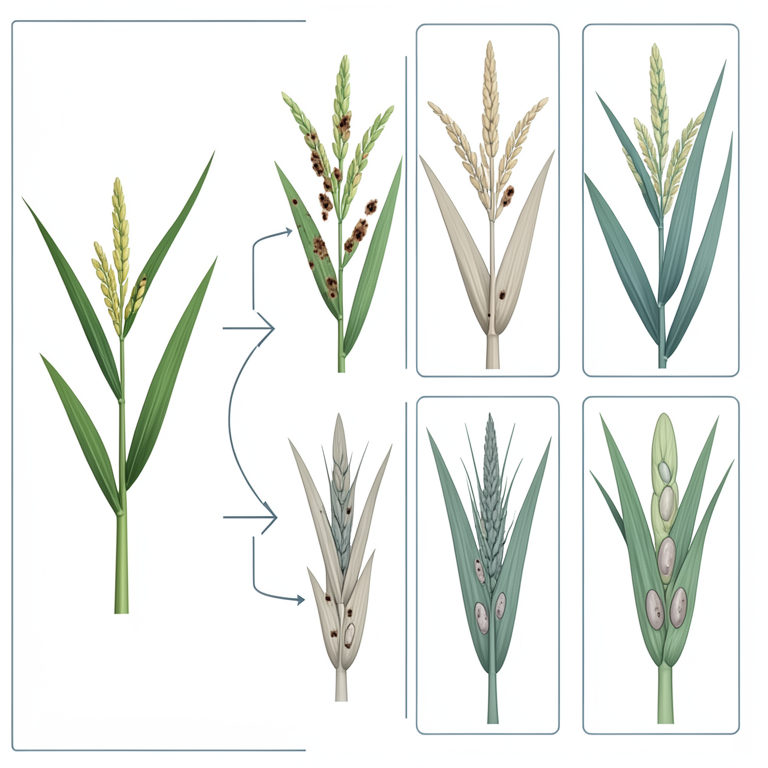
Major Rice Diseases in West Bengal
AI-generated conceptual illustration (Oryza sativa (rice plants)). It explains the idea and does not show study data.
View source evidence ↗Figures & tables
From the original paper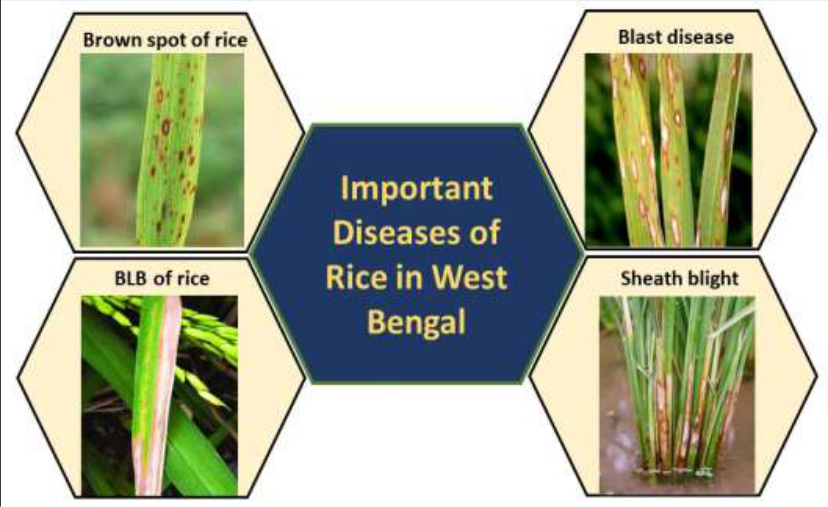 Figure 1
Introduction
Rice (Oryza sativa); is the major cereal crop which is consumed by half of the world population every day. A hot, humid atmosphere is required for the rice production. It works best in areas with high humidity, continuous sunlight, and a reliable supply of water. Rice is a major meal in west Bengal and is essential to the area's economy. It is nutritious and has a high protein and carbohydrate content, which gives you immediate energy. But the productivity or rice is suffering huge loss due to insect pest attack and weed infestation. Pathogens are thought to be responsible for 15%-30% of the yield loss in rice, which is estimated to cost roughly USD 33 billion yearly. Numerous diseases that affect rice plants, including blast, leaf blights, sheath blights, sheath rot, brown spot, and tungro, are brought on by a broad variety of phytopathogens. These diseases reduce crop production and quality, among other agricultural losses (Nayak et al., 2021) [12] . In West Bengal condition important diseases of rice are blast, brown spot, bacterial blight, sheath blight that can cause significant damage to the plant (Fig. 1) (Prasher et al. 2022) [13] .
Important diseases of rice in West Bengal
Brown spot of rice: In 1943, a catastrophic famine in Bengal caused a disease that lowered the yield of rice to 40-90%, and it is believed that 3 million people starved to death as a result of this disease. Nothing as disastrous as the 1942 Bengal rice brown spot pandemic has been documented in plant pathology literature, in accordance to the Crop Life Foundation (Kifer 2016). This disease is also referred to as fungal blight. Symptoms: Coleoptile blight, oval, dark brown to purplishbrown patches on the leaves, reduced photosynthetic capacity in rice plants, and finally burning and death of the leaves are all symptoms of the disease. There have been reports of early senescence infected leaves, fewer tillers, and reduced root and shoot elongation. From the seedling stage to the milk stage, the pathogen infection is visible. The distinctive brown patches on leaves sometimes have a grey or white core and have an oval to cylindrical form. Numerous spots cluster together, and the leaf withers. When the glumes are diseased, the grains begin to shrivel (Surendhar et al. 2021) [20] .
Pathogen survival
It has been found that the pathogen may persist in the plant debris and several other weed hosts like Setaria italica, Leersia hexandra etc. as a primary inoculum. It is discovered that the pathogen infects more than 50 species of the gramineous family (Dagnachew Lule et al. 2014) [5] . A combination of constant rain, cloudy weather, and an excessive daytime temperature, quickens the spread of the disease. For the infection to become severe, the host leaf must be moist for 8 to 24 hours and there should be a shortage of N or K (Surendhar et al. 2021) [20] .
Disease Management Practices
According to Laxman Aryal et al. (2019) [1] , Oryzae sp. has a wide genetic background that comprises cultivars that are entirely vulnerable [Mithila (2.34 tons/ha)] and somewhat resistant [Radha-4 variety (5.420 tons/ha)] to Brown spot disease. Mizobuchi et al. (2016) [11] reported quantitative trait loci (QTLs) controlling resistance to brown spot disease. Trichoderma, Bacillus, and Pseudomonas were the most often utilized commercially available bio-control agents. According to Carvalho et al. (2010) [3] , a balanced nutrient supply is the greatest strategy for lowering the prevalence of several disorders, particularly in brown spot. The brown spot resistant varieties are becoming vulnerable due to loss of nutrients like Fe, Mn, K, and Zn. According, to reports, application of silicon boosts the host plants' immunogenic activity to various biotic stimuli in addition to reducing the occurrence of brown spots (Surendhar et al. 2021) [20] . Application of various fungicides such as Propiconazole @ 0.1%, Hexaconazole @0.2%, captan among others have proved to be highly effective (Surendhar et al. 2021) [20] .
Blast of Rice
Blast disease outbreaks can result in significant losses in agricultural crops with rice suffering a 70-80% yield loss.
According to reports, the blast in South India in 1920 caused loss of about 80% to the crop (Saha 2022) [14] .
Etiology: Rice blast disease is caused by the anamorph fungus Pyricularia oryzae Cavara, and teleomorph Magnaporthe oryzae ((Hebert) Barr). The five species that make up the genus Magnaporthe are M. grisea, M. oryzae, M. salvinii, M. poae, and M. rhizophila -which have same physical characteristics including three-septate fusiform ascospores and black, nonstromatic perithecia (Chikkaballi et al. 2022) [4] .
Symptoms:
The rice plant is nearly entirely affected by the blast disease, which can attack the plant at any stage of crop growth. Nursery blast, leaf blast, node blast, neck blast, and panicle blast are some of the names given to the symptoms at various stages. The infected plants exibits lesions that cause them to wilt and rot. On the leaf surface spindle spots with greyish centre and dark brown coloured margin are observed. In severe infection nodes and neck portion become blackish in colour, rots and grains are damaged or lost. Saha (2022) [14] conducted a comparison study using three consecutive years' weather data of West Bengal. It was noted that the weather was ideal for Pyricularia oryzae, the pathogen that causes blast disease. Additionally, the crop stages during which disease rapidly develops were noted. The relationship between PDI values and plant age, corresponding pathogenic spore concentration, and five climatic data was examined using multiple regression analysis (MRA). By using the step-down equation, it was found that as plant age, airborne spore concentration, RH, and rainfall rise, so does the severity of the disease in both seasons.
Management
There are several strategies to manage rice blast such as crop rotation, use of resistant varieties like Rasi, Vikash, IR-64, Himalya-1, Himalya-2 etc., fungicide application, and cultural practices such as pruning of infected areas and cleaning the fields are helpful to prevent the spread of the disease. (Skamnioti, P. and Gurr, S.J. 2009) [18] .
Bacterial leaf blight
One of the main rice diseases, Bacterial Leaf Blight Disease (BLB), which is known to be the global epidemic. in many parts of the world, can cause yield loss by more than 50% (Dai et al.
Etiology: Bacterial leaf blight is one of the first known diseases, discovered by Japanese farmers in 1884 and is caused by the bacterium Xanthomonas oryzae pv. oryzae (Xoo) (Tagami and Mizukami 1962) [21] . The bacteria enter through the hydathodes present at the leaf tips and leaf edge. The Xoo grows inside the xylem vessel, blocking it and leading the plant to wilt.
Symptoms: Both leaf blight and "kresek" symptoms are signs of BLB, which affects rice at all stages of development. Generally, on both leaf edges, but rarely on only one, the disease is distinguished by linear, yellow to straw-colored stripes with wavy borders. The wild rice varieties Oryza rufipogon, O. berthii, and O. glaberimma contain BLB resistance genes that are also present in O. sativa (Singh et al. 2013) [16] .
Management
Using resistant variety like IR-54, Laxmi etc. Use clean seeds from certified sources and avoid over fertilization of fields. Practice good field management. (Gnanamanickam, S. et al.
Sheath blight of rice
Sheath blight disease is a significant barrier to the intensification of the cultivation of rice in South East Asian nations, resulting in an annual yield loss of 8 to 50 percent. The sheath blight disease of rice (Oryza sativa) is caused by the fungus Rhizoctonia solani, which is the most damaging species of Rhizoctonia. Most of the world's rice-growing regions use those varieties that are vulnerable to sheath blight (Basu et al. 2016) [2] .
Causal organism:
The pathogen Rhizoctonia solani causing sheath blight in rice is a waterborne and also a soilborne fungus.
The pathogen is able to persist for two crop seasons as sclerotia or mycelia before being spread by irrigation water or air (Kumar et al. 2009) [10] . Basu et al. (2016) [2] discovered that the resistant rice variety Swarnadhaan (IET 5656) and the susceptible variety Swarna (MTU 7029) were both early hosts of the sheath blight pathogen. Investigations on entire plants revealed that the disease was more severe in Swarna than in Swarnadhaan and the later cultivar had a disease index that was 50% lower than Swarna in a detached leaf assessment.
Symptoms: R. solani mostly affects the leaf sheath and leaf blades of rice plants, yet in serious conditions it can also infect the entire plant, including newly formed panicles. The disease may occur at any stage of plant growth, the tillering stage of the rice crop being most susceptible. The usual symptom is the emergence of round, rectangular, or ellipsoid, about 1 cm long, greenish-gray water-soaked lesions on the leaf sheath close to the water level. These lesions grow larger and take on an uneven appearance, with a gray-white centre and brown edges (Senapati et al. 2022) [15] .
Management
Crop rotation with non-cereal crop. Using resistant varieties like PR-108, Mandira, Nalini, Sabita etc. Seed treatment with sedaxane @ 0.1% Soil treatment with thiram @ 3g/sq. m as a foliar spray. Several actinomycetes, various species of Trichoderma, Gliocladium, Aspergillus have been found to manage sheath blight disease (Senapati et al., 2022) [15] . Apply carbendazim or benomyl @ 0.1% at 45, 55 and 65 days after transplanting (Singh et al., 2019) [17] .
Conclusion
Rice is one of the most important food crops in India, and it is essential to keep the crop healthy and protected from various plant diseases. Proper management practices can help to prevent or avoid disease outbreaks in rice field. Farmers must be aware of these diseases and strategies to protect their crop.
References
17 in the original paper- Aryal L, Bhattarai G, Subedi A, Subedi M, Subedi B, Sah G. Response of rice varieties to brown spot disease of rice at Paklihawa, Rupandehi. Global Journal of Biology, Agriculture and Health Sciences. 2019;5(2):50-54.
- Basu A, Chowdhury S, Ray CT, Kundu S. Differential behaviour of sheath blight pathogen Rhizoctonia solani in tolerant and susceptible rice varieties before and during infection. Plant Pathol. 2016;65:1333-1346.
- Carvalho MP, Rodrigues FA, Silveira PR, Andrade CCL, Baroni JCP, Paye HS, et al. Rice resistance to brown spot mediated by nitrogen and potassium. Journal of Phytopathology. 2010;158:160-166.
- Dagnachew L, Santie DV, Masresha F, Teshome B, Tesfaye A, Geleta G, et al. Pathogenicity and yield loss assessment caused by Magnaporthe oryzae isolates in cultivated and wild relatives of Finger millet (Eleusine coracana). Indian Journal of Agricultural Research. 2014;(48):258-268.
- Dai LY, Liu XL, Xiao YH, Wang GL. Recent advances in cloning and characterization of disease resistance genes in rice. J Integr. Plant Biol. 2007;49:112-119.
- Gnanamanickam SS, Priyadarisini VB, Narayana NN, Vasudevan P, Kavitha S. An Overview of bacterial blight disease of rice and strategies for its management. Curr Sci. 1999;1435-1444.
- Ito S, Kunibayashi K. Production of ascigerous stage in culture of Helminthosporium oryzae. Ann. Phytopathol Soc. Jpn. 1927;(2):1-8.
- Mizobuchi R, Fukuoka S, Tsushima S, Yano M, Sato H. QTLs for Resistance to Major Rice Diseases Exacerbated by Global Warming: Brown Spot, Bacterial Seedling Rot and Bacterial Grain Rot. Rice (N Y). 2016;9(1):23.
- Nayak S, Samanta S, Sengupta C, Swain SS. Rice crop loss due to major pathogens and the potential of endophytic microbes for their control and management. J Appl. Biol. Biotechnol. 2021;9(05):166-175.
- Saha M. Forecasting of rice blast disease severity in West Bengal, India based on PDI values and Cumulative logic model. J Mycopathol Res. 2022;60(4):523-530.
- Senapati M, Tiwari A, Sharma N, Chandra P, Bashyal BM, Ellur RK, et al. Rhizoctonia solani Kühn Pathophysiology: Status and Prospects of Sheath Blight Disease Management in Rice. Front Plant Sci. 2022;13:881116.
- Singh AK, Sarma BK, Singh PK, Nandan R. Screening of rice (Oryza sativa L.) germplasms against Xanthomonas oryzae pv. oryzae. J Eco-friendly Agric. 2013;8(1):86-88.
- Singh P, Mazumder P, Harikrishna JA, Babu S. Sheath blight of rice: A review and identification of priorities for future research. Planta. 2019;250:1387-1407.
- Skamnioti P, Gurr SJ. Against the grain: safeguarding rice from rice blast disease. Trends Bio-technol. 2009;27(3):141-150.
- Sunder S, Singh RAM, Agarwal R. Brown spot of rice: an overview. Indian Phytopathol. 2014;67(3):201-215.
- Tagami Y, Mizukami T. Historical review of the researches on bacterial leaf blight of rice caused by Xanthomonas oryzae (Uyeda et Ishiyama) Dowson. Special report of the plant diseases and insect pests forecasting service No. 10. Plant Prot. Div., Ministry Agric. Forestry, Tokyo, Japan. 1962;112.
- Zarbafi SS, Ham JH. An overview of rice QTLs associated with disease resistance to three major rice diseases: blast, sheath blight, and bacterial panicle blight. Agronomy. 2019;9(4):177.
Cited by 3
From OpenAlex, OpenCitations and reference lists read by Scinovex
- Leveraging ML to predict climate change impact on rice crop disease in Eastern India ↗
Satiprasad Sahoo, Chiranjit Singha, Ajit Govind, Mamta Sharma · Environmental Monitoring and Assessment · 2025
❝ 6 - Evaluation of rice blast disease in key cultivation regions of the Indo-Gangetic plains ↗
Debanjana Debnath, Pravallika Sree Rayanoothala, Sunita Mahapatra · Discover Plants. · 2025
A comprehensive survey on the incidence and severity of rice blast disease was conducted across six major rice-growing districts in the Indo-Gangetic plains of West Bengal. The assessment was based on symptomatic evaluation of different rice varieties, including Satabdi, Khitish, Lal Minikit, and Rajendra Bhagabati, during the tillering stage, which are predominantly cultivated by farmers in these regions. This study…
❝ 2PDF - SiPadi: An Android-Based Rice Disease Detection Application Using YOLOv8 with CPMAI Methodology – A Case Study in Kandri Village ↗
Angeline Diva Pramana Putri, Cindy Agustine Sugiarto Go, Sugiarto Hartono, Ian Val P. Delos Reyes · Procedia Computer Science · 2025
As a cornerstone of global food security, rice production faces constant threats from climatic shifts, pests, and rapidly spreading diseases that can devastate entire harvests. This issue is especially severe in rural areas like Kandri Village, Central Java, Indonesia where farmers, using traditional methods and limited resources, struggle with early and accurate plant disease diagnosis, and often resulting in irreversible…
❝ 0PDF