
Research article · 2024 · Full text
International Journal of Agriculture and NutritionComposition of nutrients and antioxidant properties in Mung beans
Volume 6(1) · Pages 57–59 · DOI: 10.33545/26646064.2024.v6.i1a.142 ↗
Research areasFood Quality and Safety StudiesPhytoestrogen effects and researchAgriculture, Soil, Plant Science
Abstract
Author-writtenThis study comprehensively examines the composition of nutrients and antioxidant properties of mung beans (Vigna radiata), aiming to elucidate their potential health benefits and functional food value. Through analytical assessment, the research quantifies the macronutrients, micronutrients, and bioactive compounds present in mung beans, focusing on their role in human health. Additionally, the study investigates the impact of various cooking methods on the nutritional and antioxidant profiles of mung beans. The findings contribute to a deeper understanding of mung beans' dietary significance and promote their inclusion in health-oriented dietary practices.
Summary
Source-checkedPlain-language reading of the full paper, prepared with AI and checked against the text. Each point links to the authors' own words.
Why it matters
- Mung beans (Vigna radiata) are a common legume used globally and are recognized for their ability to promote health. View evidence ↗
- These beans contain phenolic acids and flavonoids that help fight oxidative stress, potentially lowering the risk of cancer, diabetes, and cardiovascular disease. View evidence ↗
- While cooking is known to alter the nutrients and antioxidants in food, the specific effects on mung beans have not been fully explored. View evidence ↗
The question
- The study aims to analyze the antioxidant properties and nutrient composition of mung beans to evaluate their potential as a functional food. View evidence ↗
What they did
- The researchers used fresh, mature mung beans of uniform size and color to ensure consistency in the results. View evidence ↗
- The experiment compared four groups: uncooked beans (control), beans boiled at 100 °C for 10 minutes, beans steamed for 10 minutes, and beans microwaved at 800W for 5 minutes. View evidence ↗
- The study measured protein, dietary fiber, magnesium, folate, vitamin C, flavonoids, total phenolic content, and DPPH radical scavenging activity. View evidence ↗
- Statistical analysis was performed using one-way ANOVA and Tukey's HSD test, with significance set at p < 0.05 and all tests run in triplicate. View evidence ↗
What they found
- Steaming and microwaving were more effective at preserving antioxidants than boiling, likely because they involve less water contact and shorter durations. View evidence ↗
What it means
- The authors conclude that steaming and microwaving are superior to boiling for maintaining the nutritional and functional value of mung beans. View evidence ↗
- The authors suggest that future research should examine different cooking durations and a wider variety of bioactive compounds and nutrients. View evidence ↗
Visual summary
2 visualsIllustrations explain the paper; charts are replotted from the paper's own table values.
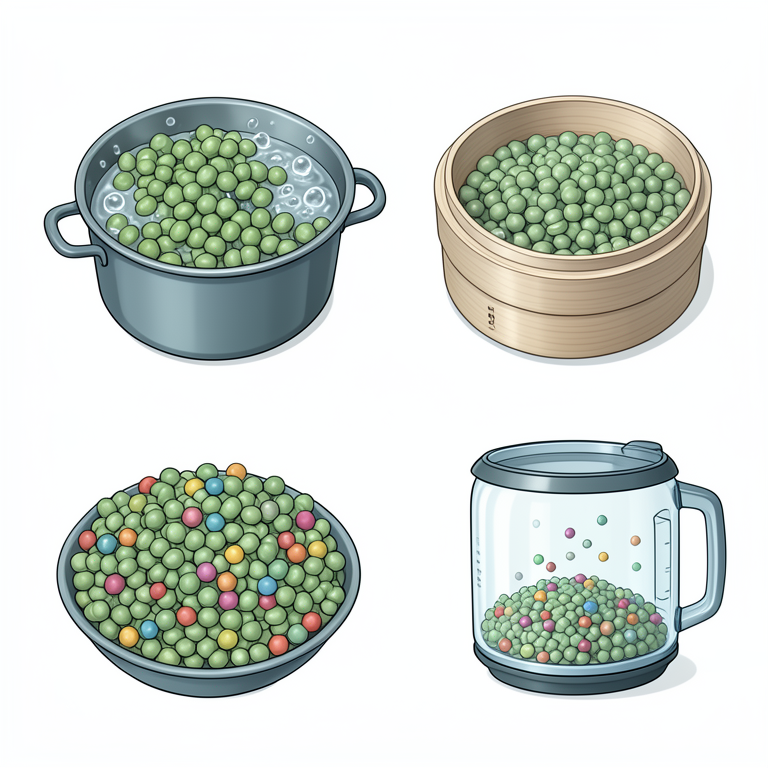
Comparison of Cooking Methods
AI-generated conceptual illustration (mung beans). It explains the idea and does not show study data.
View source evidence ↗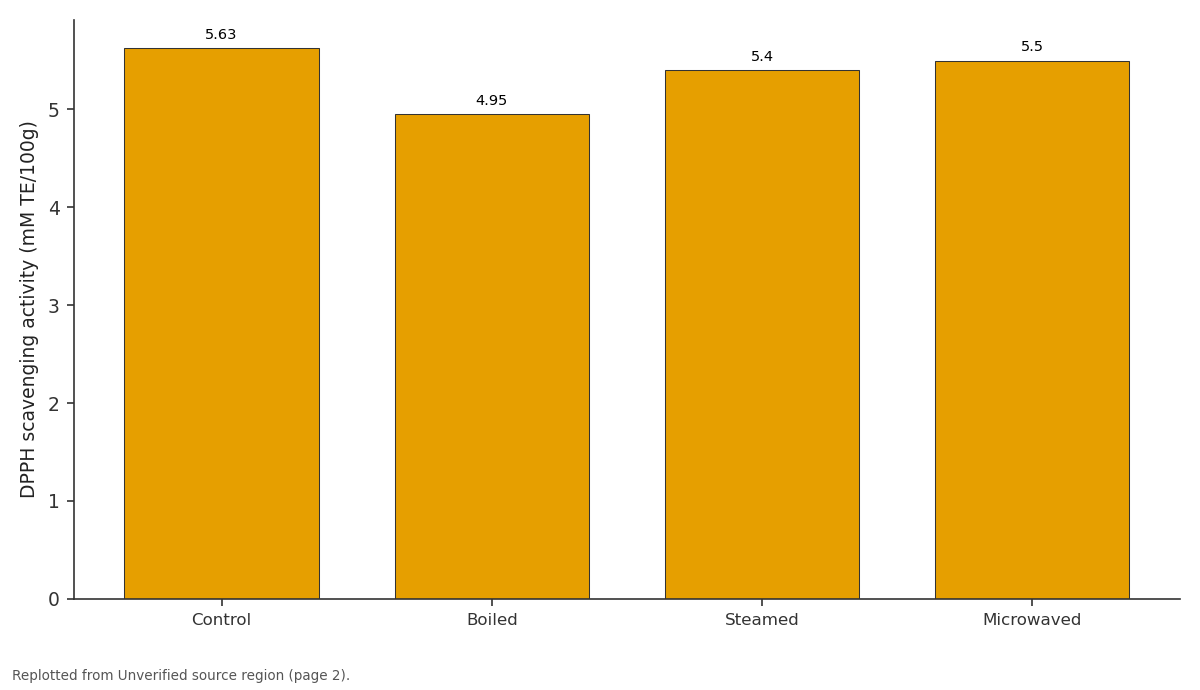
DPPH scavenging activity (mM TE/100g): Control vs Boiled vs Steamed vs Microwaved
Replotted from a table (page 2) of the original paper. Every bar is the paper's own table value.
View source evidence ↗Introduction
Mung beans (Vigna radiata), a staple legume in many diets worldwide, have garnered attention for their health-promoting properties. Characterized by high protein content, dietary fiber, vitamins, and minerals, mung beans play a crucial role in addressing nutritional deficiencies and promoting overall health. Beyond their basic nutritional value, mung beans are rich in antioxidants, including phenolic acids and flavonoids, which are critical for combating oxidative stress and reducing the risk of chronic diseases such as cardiovascular disease, diabetes, and cancer. Recent dietary trends emphasize the importance of whole foods with high nutritional and functional value, positioning mung beans as an essential component of such diets. However, despite their apparent health benefits, comprehensive analyses of the nutrient composition and antioxidant properties of mung beans remain sparse. Moreover, cooking methods can significantly affect the nutrient and antioxidant profiles of foods, yet the impact on mung beans is not thoroughly understood. The global shift towards plant-based diets and the increasing demand for nutrient-dense, health-promoting foods underscore the need for detailed research on mung beans. Such research can inform dietary recommendations, food processing techniques, and consumer choices, ultimately contributing to improved public health outcomes.
Main objective
The primary objective of this study is to provide a detailed analysis of the nutrient composition and antioxidant properties of mung beans, thereby assessing their potential as a functional food within diverse diets.
Nutritional composition and antioxidant properties in mung bean
Mung beans are an excellent source of protein (17.36-24.89 g/100 g), with a balanced amino acid profile that is essential for human health (Shi et al., 2016) [1] . Fats and Fatty Acids: The fat content in mung beans ranges from 4.24-12.18 g/100 g, with palmitic acid and linoleic acid being the dominant fatty acids, contributing to their nutritional and health benefits (Wang et al., 2021) [2] . (Dahiya et al., 2015) [4] , contain significant amounts of dietary fiber, promoting digestive health and aiding in cholesterol management.
Mung beans are a rich source of iron (5.9-7.6 mg/100 g), providing essential minerals for blood health and overall vitality (Dahiya et al., 2015) [4] . Mung beans contain a variety of phenolic compounds and flavonoids, including vitexin and isovitexin, contributing to their strong antioxidant activities. These antioxidants help in reducing oxidative stress and preventing chronic diseases (Yang et al., 2020) [5] . The antioxidant activities of mung beans, evaluated through various assays, have shown that these beans possess the capability to scavenge free radicals, thereby protecting the body from oxidative damage and enhancing overall health (Duh et al., 1997) [6] .
Materials and Methods
Materials and Methods
Sample preparation
Mung beans selection: Fresh, mature mung beans (Vigna radiata) were selected, ensuring uniform size and color to minimize variability.
Initial processing:
The beans were thoroughly washed under running tap water, soaked in distilled water for 12 hours at room temperature, and then drained to ensure uniform water content before cooking.
Cooking treatments
Boiling: Mung beans were placed in a pot with distilled water at a ratio of 1:5 (w/v) and boiled at 100 °C for 10 minutes.
Steaming: Mung beans were placed in a steamer basket over boiling water, ensuring no direct contact with the water, and steamed for 10 minutes.
Microwaving: Mung beans were placed in a microwavesafe container with a lid, with minimal water just covering the bottom of the container, and microwaved on high power (800W) for 5 minutes.
Control group:
A batch of mung beans was left uncooked to serve as the control.
Nutrient analysis Protein:
The Kjeldahl method was used to determine nitrogen content, which was then converted to protein content by using a conversion factor of 6.25.
Dietary fiber:
The AOAC 985.29 method was applied to quantify total dietary fiber.
Vitamins and minerals: High-Performance Liquid Chromatography (HPLC) was employed to measure vitamin C and folate concentrations. Magnesium content was determined using Atomic Absorption Spectroscopy (AAS).
Antioxidant property analysis
The Folin-Ciocalteu method was used, with results expressed as grams of Gallic Acid Equivalents (GAE) per 100 grams of dry weight. The aluminum chloride colorimetric method was utilized to quantify flavonoid content, with results expressed as grams of Catechin Equivalents (CE) per 100 grams of dry weight. The ability to scavenge DPPH radicals was measured using a spectrophotometric method, with results expressed as mM Trolox Equivalents (TE) per 100 grams of dry weight.
Statistical analysis:
Data were analyzed using one-way ANOVA followed by Tukey's HSD test for multiple comparisons. A p-value <0.05 was considered statistically significant. All experiments were performed in triplicate, and results are presented as mean ± standard deviation.
Experimental design
Three batches of mung beans were subjected to boiling (100 °C for 10 minutes), steaming (above boiling water for 10 minutes), and microwaving (on high power for 5 minutes). A control batch was left uncooked. Post-cooking, each batch was analyzed for nutrient composition (focusing on protein, dietary fiber, vitamin C, folate, and magnesium) and antioxidant properties (total phenolic content, flavonoids, and DPPH radical scavenging activity).
Experimental Results
Experimental Results
Treatment
Treatment
Antioxidant properties
There was a noticeable decrease in total phenolic content and flavonoids in the boiled samples, which could be attributed to the leaching of these compounds into cooking water. Steaming and microwaving preserved more of these antioxidants, likely due to reduced water contact and shorter cooking times. The decrease in DPPH radical scavenging activity in boiled samples correlates with the reduction in phenolic content and flavonoids. Steaming and microwaving maintained higher antioxidant activity, underscoring the importance of cooking method on preserving the antioxidant capacity of foods.
Conclusion
The study demonstrates that the method of cooking significantly affects the nutrient composition and antioxidant properties of mung beans. Steaming and microwaving are preferable to boiling, as they better preserve the beans' nutritional and functional qualities. These findings are vital for dietary recommendations, emphasizing cooking methods that retain the healthpromoting components of mung beans. Further research should explore the impact of cooking duration and other methods on a broader range of nutrients and bioactive compounds.
References
6 in the original paper- Shi Z, Yao Y, Zhu Y, Ren G. Nutritional composition and antioxidant activity of twenty mung bean cultivars in China. Crop Journal. 2016;4(5):398-406.
- Wang F, Huang L, Yuan X, Zhang X, Guo L, Xue C, et al. Nutritional, phytochemical and antioxidant properties of 24 mung bean (Vigna radiate L.) genotypes. Food Production, Processing and Nutrition. 2021;3(1):01-12.
- Kebede ZY. Case study report on improved mung bean technology demonstration under North-West Ethiopia. International Journal of Agriculture and Food Science. 2022;4(1):35-37.
- Dahiya P, Linnemann A, Boekel M, Khetarpaul N, Grewal R, Nout M et al. Mung Bean: Technological and Nutritional Potential. Critical Reviews in Food Science and Nutrition. 2015;55(5):670-688.
- Yang Q, Ge Y, Gunaratne A, Kong K, Li H, Gul K, et al. Phenolic profiles, antioxidant activities, and antiproliferative activities of different mung bean (Vigna radiata) varieties from Sri Lanka. Food Bioscience. 2020;37:100705.
- Duh P, Yen W, Du P, Yen G. Antioxidant activity of mung bean hulls. Journal of the American Oil Chemists' Society. 1997;74:1059-1063.
Cited by 4
From OpenAlex, OpenCitations and reference lists read by Scinovex
- Seed Coat Color-Mediated Differences in Nutritional Composition and Antioxidant Activity of Mung Bean ↗
Miaomiao Wu, Qianyu Tao, Suhua Wang, Yang Yao, Lixia Wang · Agronomy · 2026
The mung bean (Vigna radiata) is rich in nutrients and bioactive compounds and is valuable for its antioxidant content in functional food development. However, mung bean seed coats are discarded or used as a low-value feed owing to their coarse texture. Here, 12 homozygous mung bean lines with different seed coat colors were selected from six recombinant inbred lines. The…
❝ 2PDF - Short-Day Legume Crops Exhibit a Conserved Molecular-Genetic Basis for Early Flowering, Maturity and Adaptation to Long-Day Environments in High-Latitude Regions ↗
Lixi Jiang, Yingxiao Su, М О Синеговский, И. В. Сеферова, Pei Wang, Tingting Wu et al. · Russian Journal of Plant Physiology · 2025
Abstract Originating from low and middle latitudes, soybean, common bean, mung bean, and adzuki bean are typical short-day legumes. Through long-term natural evolution and artificial selection, numerous ultra-early maturing varieties adapted to long-day conditions have emerged in these four short-day legumes, becoming a crucial component of agricultural ecosystems in high-latitude regions. Therefore, investigations into the molecular mechanisms governing flowering time…
❝ 1 - Alternative protein sources in food product design: Functionality and sensory optimization ↗
Neha Chatterjee, Oshin Sahni, Ravi Pirati, Priya Kosuru · Journal of Current Research in Food Science · 2026
❝ 0Found by Scinovex - Comparative Study on Antioxidant Properties and Nutrient Composition of Mung Beans and Other Legumes ↗
Anjali Chhetri · Journal of Phytopharmacology and Phytomedicine · 2025
Mung beans (Vigna radiata) are among the most commonly consumed legumes, particularly in Asia, due to their remarkable nutritional profile and health-promoting properties. This study compares the antioxidant properties and nutrient composition of mung beans with other legumes, including chickpeas (Cicer arietinum), lentils (Lens culinaris), and kidney beans (Phaseolus vulgaris). We focused on various aspects such as total phenolic content