
Research article · 2024 · Full text
International Journal of Research in AgronomyEffect of integrated nutrient management and plant geometry on phenological observation of rice (Oryza sativa L.) under SRI technique
Volume 7(4) · Pages 65–68 · DOI: 10.33545/2618060x.2024.v7.i4b.521 ↗
Research areasLeaf Properties and Growth Measurement
Abstract
Author-writtenThe present investigation was conducted at Agronomy Research Farm of Acharya Narendra Deva University of Agriculture & Technology, Acharya Narendra Nagar (Kumarganj), Ayodhya (U.P.) during Kharif seasons with the objective to know the effect of integrated nutrient management and plant geometry on growth and yield attributes of rice varieties. The study comprised six treatments of integrated nutrient management (F0: Control, F1: RDF (120:60:60) F2: 50% RDF + 50% Vermicompost, F3: 75% RDF + 25% N through Vermicompost, F4: 50% RDF + 50% N through FYM F5: 75% RDF + 25% N through FYM) with two varieties namely NDR-359 and Sarju 52 and two plant geometry (a) S1: 20 cm X 20 cm. (b) S2: 30 cm X 30 cm. The experiments were conducted in Factorial Randomized Block Design (R.B.D.) with three replications. Maximum days taken to 50% heading and maturity was recorded with the application of F2 (50% RDF + 50% N through vermicompost), varieties (NDR-359) and plant geometry (20 cm ×20 cm). It was at par with F4 (50% RDF + 50% N through FYM).
Summary
Source-checkedPlain-language reading of the full paper, prepared with AI and checked against the text. Each point links to the authors' own words.
Why it matters
- Rice is a critical global crop, serving as the primary food source for more than 3 billion people in Asia, where 90% of the world's rice is produced and consumed. View evidence ↗
- Wider plant spacing, such as 30 x 30 cm, is thought to provide seedlings with more space to grow and improve resource utilization. View evidence ↗
- Using a square pattern for wide spacing is intended to give roots more room to grow and increase the plants' access to air and sunlight. View evidence ↗
The question
- The study aimed to determine how integrated nutrient management and plant geometry affect the growth and yield attributes of different rice varieties. View evidence ↗
What they did
- The research was conducted during the Kharif seasons of 2015 and 2016 at the Agronomy Research Farm of Acharya Narendra Deva University of Agriculture & Technology in Ayodhya, Uttar Pradesh. View evidence ↗
- The experiment tested six nutrient management treatments (ranging from a control to various combinations of Recommended Dose of Fertilizer (RDF), vermicompost, and farm yard manure), two rice varieties (NDR-359 and Sarju 52), and two plant geometries (20x20 cm and 30x30 cm). View evidence ↗
- The study utilized a Factorial Randomized Block Design (R.B.D.) with three replications. View evidence ↗
- The researchers visually recorded the number of days from sowing to 50% heading and the number of days from sowing to physiological maturity. View evidence ↗
What they found
- In the pooled analysis, the longest time to 50% heading (102.31 days) occurred with treatment F2 (50% RDF + 50% N through vermicompost), which was similar to F4 but significantly longer than other treatments; the shortest time (94.28 days) was in the control group (F0). View evidence ↗
- Variety Sarju-52 took significantly longer to reach 50% heading (104.01 days) compared to variety NDR-359 in the pooled analysis. View evidence ↗
- The 20 cm x 20 cm plant geometry (S1) resulted in a significantly longer time to 50% heading (103.31 days) than the 30 cm x 30 cm geometry (S2). View evidence ↗
- Treatment F2 (50% RDF + 50% N through vermicompost) led to the maximum days to maturity (pooled: 143.24 days), which was similar to F4 but significantly higher than the control (F0), which had the minimum days to maturity (pooled: 130.72 days). View evidence ↗
- Variety NDR-359 took significantly longer to reach maturity (pooled: 142.22 days) than variety Sarju-52. View evidence ↗
- The 30 cm x 30 cm plant geometry (S2) resulted in a significantly longer time to maturity (pooled: 141.53 days) compared to the 20 cm x 20 cm geometry (S1). View evidence ↗
What it means
- The authors conclude that the maximum days to 50% heading and maturity were associated with treatment F2 (or F4), variety NDR-359, and the 20 cm x 20 cm plant geometry. View evidence ↗
Visual summary
3 visualsIllustrations explain the paper; charts are replotted from the paper's own table values.
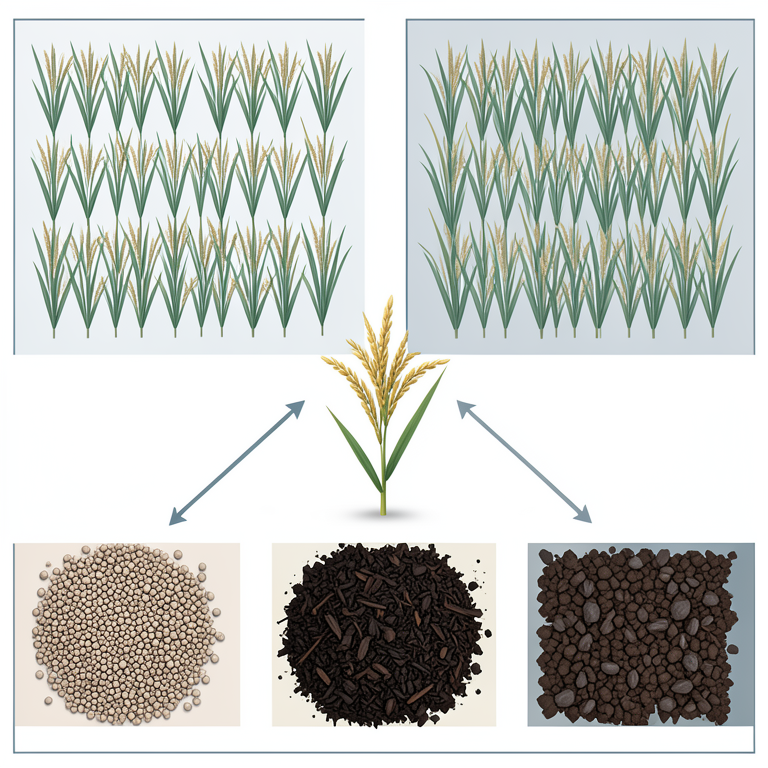
Experimental Factors
AI-generated conceptual illustration (Rice plants (Oryza sativa L.)). It explains the idea and does not show study data.
View source evidence ↗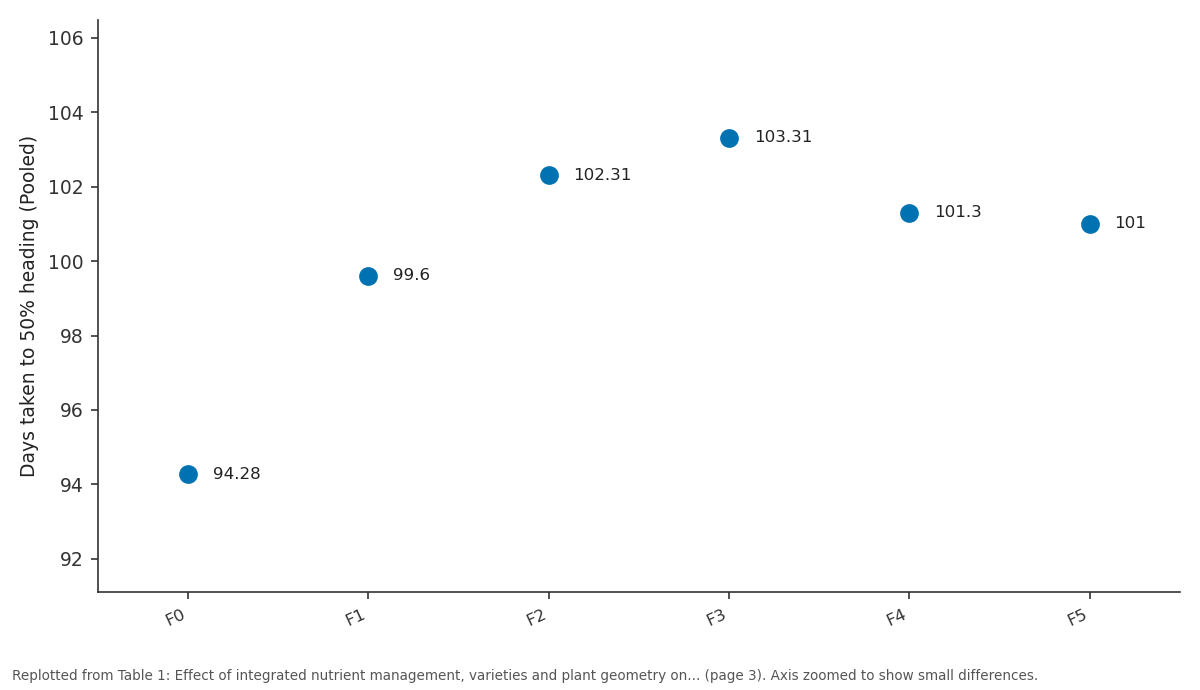
Pooled: F0 vs F1 vs F2 vs F3 vs F4
Replotted from Table 1 (page 3) of the original paper. Every bar is the paper's own table value.
View source evidence ↗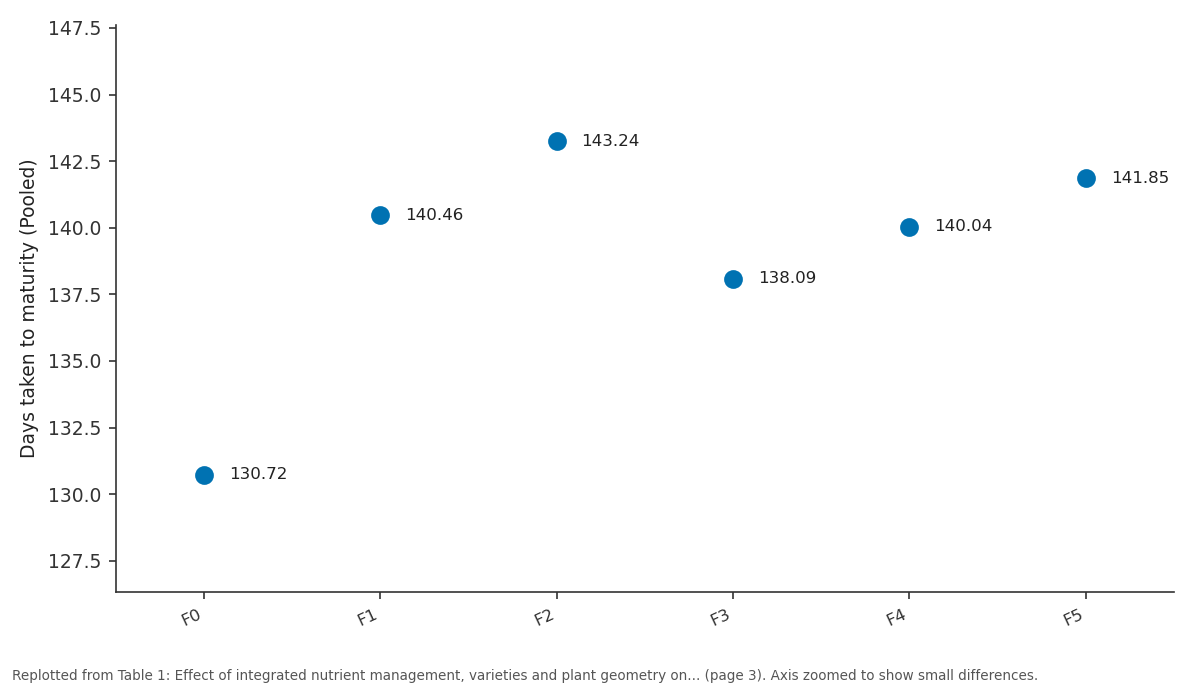
Pooled: F0 vs F1 vs F2 vs F3 vs F4
Replotted from Table 1 (page 3) of the original paper. Every bar is the paper's own table value.
View source evidence ↗Figures & tables
From the original paper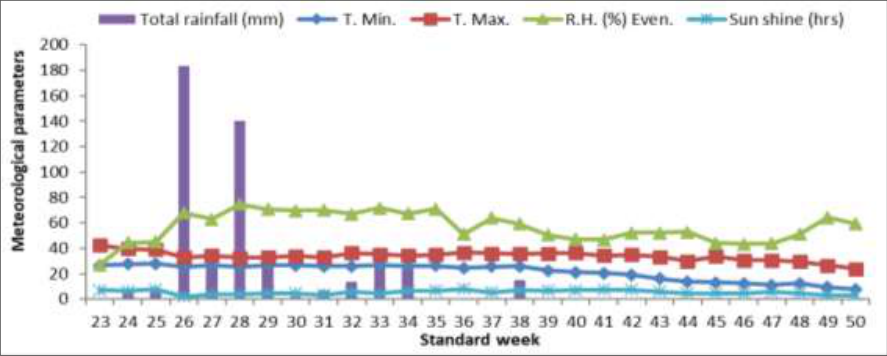 Figure 1
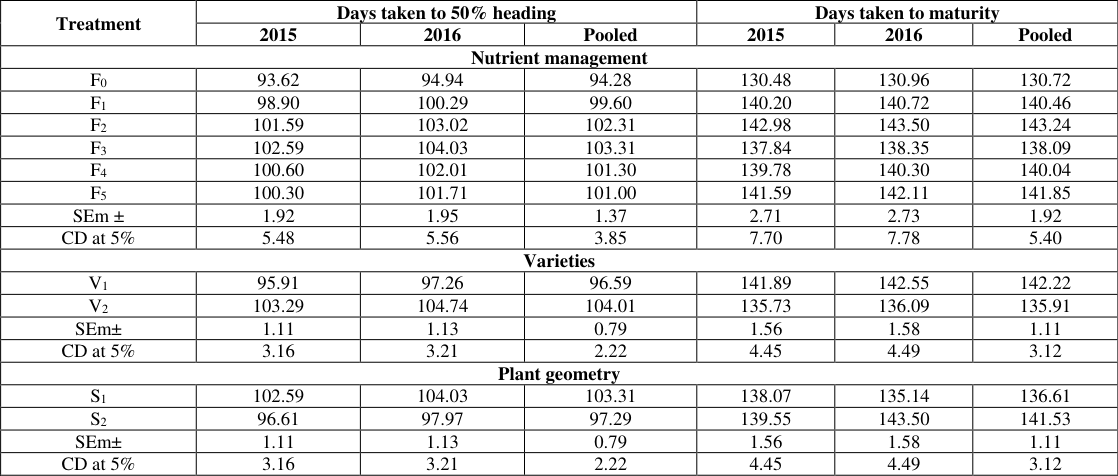 Table 1
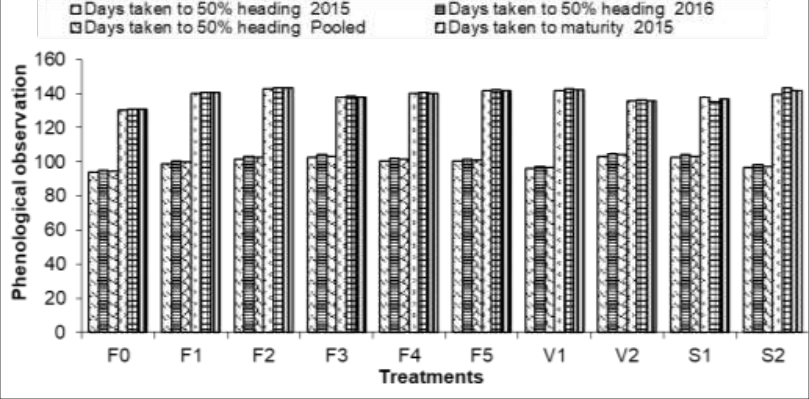 Figure 2
Introduction
Rice is the staple food of over 3 billion people in Asia, which account for the production and consumption of 90 per cent of world rice. India is the major rice producer next to China. Rice is the main crop in most tropical countries. It is cultivated in sub-tropics and temperate countries also. Generally, rice is a short day plant, the average temp. through out the crop period should be around 21 to 37 °C. The temperature range should be from 30.4 to 32.6 °C for short duration varieties from transplanting to harvest. The temperature required for blooming is 26.5 to 29.5 °C and for ripening is 20 to 25 °C. High altitudes and low temperatures delay flowering and maturity (B. Gururajan and V. Swaminathan, 2008) [2] . Rajesh et al. (2003) [5] reported that seedling planted at wider spacing of 30 x 30 cm got sufficient space to grow and also utilized resource in a better way. Therefore, younger seedlings planted at wider spacing was congenial for higher yield of both hybrid (PHB-71) and non -hybrid (NDR-359) rice cultivation. Long duration varieties perform better with wider spacing than short duration varieties (Baloch et al., 2002; Stoop 2005) [1,6] . Which allows a greater realization of tillering potential of rice plants and wide spacing on a square pattern which gives the roots more space to grow and get more sunlight and air (Uphooff and Kassam, 2002). System Rice Intensification (SRI) as defined by Uphoff et al., (2002) [8] Seedlings should be transplanted before the fourth phyllochron begins to preserve the tillering potential (Rafaralahy, 2002) [4] .
Materials and Methods
The field experiment was conducted during Kharif 2015 and 2016 at Agronomy Farm of Narendra Deva University of Agriculture and Technology, Narendra Nagar (Kumarganj), Ayodhya (U.P.). The experimental site located at Kumarganj is situated 42 km away from Faizabad city on Faizabad-Raibarely road. Geographically the experimental site is situated at 26.47 0 North latitude and 81.12 0 East longitude with is an elevation of about 113 m. from mean sea level in the Indo Gangatic Plain Zone of eastern Uttar Pradesh.
The climate in this region is humid and characterized with high rainfall (300 cm year -1 ). The soil is sandy to sandy loam with a pH of 5.05 and 0.72% organic C. Soil low in available N (127.92 kg ha -1 ), medium in available P (21.59 kg ha -1 ) and low in available K (122.46 kg ha -1 ). The treatment was carried out with 24 treatment combination formed with six nutrient management levels, two varieties and two levels of plant geometry, in rice which were allocated in split plot design with three replications. The six irrigation levels (a) N 0 : Control (b) N 1 : RDF (120:60:60) (c) N 2 : 50% RDF + 50% Vermicompost (d) N 3 : 75% RDF + 25% Vermicompost (e) N 4 : 50% RDF + 50% FYM (f) N 5 : 75% RDF + 25% FYM with two varieties namely NDR-359 and Sarju 52 and two plant geometry (a) S 1 : 20 cm X 20 cm. (b) S 2 : 30 cm X 30 cm. The crop was fertilised with an uniform dose of 60 kg P 2 O 5 /ha through single super phosphate, 40 kg K 2 O/ha through muriate of potash and half dose of the Nitrogen management as per treatments with organic and inorganic.
Agronomical Practices
Nursery beds were prepared at small plot. A common procedure was followed in raising seedlings in the seedbed. The seedbed was prepared by puddling with repeated ploughing followed by laddering. Weeds were removed and irrigation was gently provided to the bed as and when necessary. The sprouted seeds were broadcasted in seedbed on 01.07.2015 and 05.07.2016. The moisture was maintained in the seedbed properly at two to three day interval, which ensured proper growth of all the seedlings in the seedbed. The seed rate for 20 × 20 cm was 6 kg/ha and for 30 × 30 cm was 4 kg/ha. After the harvest of previous crop the experimental field was ploughed once with soil turning plough and cross harrowed two times. After each ploughing, planking was done to level the field and obtain the fine tilth and lay out was done. The specific quantity of each fertilizer was calculated on the basis of gross plot size and as per treatment taken per plot. The optimum dose of fertilizers 120:60:60 was calculated for rice. The half quantity of nitrogen and full quantity of phosphorus and potassium were broadcasted in the field during final field preparation as basal dose before the transplanting in the field. The rest half dose of nitrogen was top-dressed in two splits dose after first and second irrigation at 45 DAT and 75 DAT. The crop was fertilised with an uniform dose of 60 kg P 2 O 5 /ha through single super phosphate, 60 kg K 2 O/ha through muriate of potash and half dose of the Nitrogen management as per treatments with organic and inorganic. Two hand weeding were done with 'khurpi' at 20 and 40 days after transplanting.
12 to 14 days old seedlings were transplanted in the prepared plot just after uprooting from the nursery bed and this process completed within two to four hours. Only one seedling was planted per hill in square pattern 20 × 20 (S 1 ) and 30× 30 (S 2 ) cm spacing on date 14.07.2015 and 18.07.2016.During the year of experimentation, there were occurrence of sufficient rains during vegetative stage, however there was occasional moisture stress during reproductive phase, hence four irrigations were given at different stages viz., 10 DAT, flowering and milking stages and grain filling stage of crop growth. The crop was harvested manually by serrated edged sickles at physiological maturity when panicle had about 85% ripened spikelet and upper portion of spikelet's look straw coloured. At the time of harvesting the grains were subjected to hard enough, having less than 16 percent moisture in the grains. First of all, the border area was harvested. The harvesting of net plot area was done separately and the harvested material from each net plot was carefully bundled and tagged after drying for three days in the field and then brought to the threshing floor.The bundle of harvested produce of each net plot was weighed after sun drying for recording biological yield. Threshing of each bundle of individual plot was done manually by wooden sticks. The grain yield of individual plot after winnowing was weighed. The quantity of straw per plot was calculated by subtracting the weight of grains from biological produce. Yield of both grain and straw was expressed in q ha -1 .
Days taken to 50% heading
Total number of days taken from sowing to heading in 50% plant of the total plant population of each plot were recorded visually.
Days taken to maturity
Total number of days taken from sowing to physiological maturity was recorded visually from each plot.
Geographical situation and climate
The experimental site lies in the Indo Gangatic Plain Zone of eastern Uttar Pradesh. The has sub-tropical zone which in characterized by hot and dry summer with cold winters. Rain is more often confined to the period from July to September with occasional winter and summer rain. The mean annual rainfall ranges from 1000-1200 mm. Weather pattern during the cropping seasons was recorded at the meteorological observatory of the university situated near the experimental field, are given in Fig1.
Research Findings Phonological observation Days taken to 50% heading
The data on days taken to 50% heading was significantly influenced due to various INM treatments, varieties and plant geometry under SRI technique during Y 1 (2015), Y 2 (2016) and pooled analysis have been presented in Table 1 and depicted in Fig. 2. In 2015, the maximum days taken to 50% heading (101.59) was recorded with the application of F 2 (50% RDF + 50% N through vermicompost) which, took significantly maximum days to 50% heading than rest of other INM treatments except treatment F 4 (50% RDF + 50% N through FYM). It was statistically at par with treatment F 4 . However, the minimum days taken to 50% heading (93.62) were observed in F 0 (control).Variety NDR-359 recorded maximum days to 50% heading (103.29), which was significantly higher than Sarju-52 under SRI technique. The plant geometry S 1 (20 cm × 20 cm) took maximum days to 50% heading (102.59) which, was significantly higher than S 2 (30 cm×30 cm). In 2016, the maximum days taken to 50% heading (103.02) was recorded with the application of F 2 (50% RDF + 50% N through vermicompost) which, was significantly higher than rest of other INM treatments except treatment F 4 (50% RDF + 50% N through FYM). While, statistically at par with F 4 . However, the minimum days taken to 50% heading (94.94) was observed in F 0 (control). Among varieties, variety Sarju-52 recorded maximum days taken to 50% heading (104.74) which, was significantly higher than NDR-359. The plant geometry S 1 (20 cm × 20 cm) recorded maximum days taken to 50% heading (104.03), which was significantly higher than S 2 (30 cm×30 cm) under SRI technique.
| Treatment | Days taken to 50% heading | — | — | Days taken to maturity | — | — |
|---|---|---|---|---|---|---|
| 2015 | 2016 | Pooled | 2015 | 2016 | Pooled | |
| Nutrient management | ||||||
| F0 | 93.62 | 94.94 | 94.28 | 130.48 | 130.96 | 130.72 |
| F1 | 98.90 | 100.29 | 99.60 | 140.20 | 140.72 | 140.46 |
| F2 | 101.59 | 103.02 | 102.31 | 142.98 | 143.50 | 143.24 |
| F3 | 102.59 | 104.03 | 103.31 | 137.84 | 138.35 | 138.09 |
| F4 | 100.60 | 102.01 | 101.30 | 139.78 | 140.30 | 140.04 |
| F5 | 100.30 | 101.71 | 101.00 | 141.59 | 142.11 | 141.85 |
| SEm ± | 1.92 | 1.95 | 1.37 | 2.71 | 2.73 | 1.92 |
| CD at 5% | 5.48 | 5.56 | 3.85 | 7.70 | 7.78 | 5.40 |
| Varieties | ||||||
| V1 | 95.91 | 97.26 | 96.59 | 141.89 | 142.55 | 142.22 |
| V2 | 103.29 | 104.74 | 104.01 | 135.73 | 136.09 | 135.91 |
| SEm± | 1.11 | 1.13 | 0.79 | 1.56 | 1.58 | 1.11 |
| CD at 5% | 3.16 | 3.21 | 2.22 | 4.45 | 4.49 | 3.12 |
| Plant geometry | ||||||
| S1 | 102.59 | 104.03 | 103.31 | 138.07 | 135.14 | 136.61 |
| S2 | 96.61 | 97.97 | 97.29 | 139.55 | 143.50 | 141.53 |
| SEm± | 1.11 | 1.13 | 0.79 | 1.56 | 1.58 | 1.11 |
| CD at 5% | 3.16 | 3.21 | 2.22 | 4.45 | 4.49 | 3.12 |
Table text extracted from the original PDF; superscript letters are shown inline. The original table image is below.
View original table image
In pooled analysis, the maximum days taken to 50% heading (102.31) was recorded with the application of F 2 (50% RDF + 50% N through vermicompost) which was significantly higher than rest of other INM treatments except treatment F 4 (50% RDF + 50% N through FYM). It was statistically at par with F 4 . However, the minimum days taken to 50% heading (94.28) was observed in F 0 (control) under SRI technique. Variety Sarju-52 recorded maximum days taken to 50% heading (104.01), which was significantly higher than NDR-359. The plant geometry S 1 (20 cm × 20 cm) recorded maximum days taken to 50% heading (103.31), which was significantly higher than S 2 (30 cm×30 cm).
Discussion
Days taken to 50% heading and maturity were influenced significantly by different nutrient management. More days to 50% heading and maturity were recorded under the application of F 2 (50% RDF + 50% N through vermicompost) which was significantly higher than rest of other INM treatments except treatment F 4 (50% RDF + 50% N through FYM). It was statistically at par with F 4 . The increase in days taken to 50% heading and maturity with increase in nutrient availability might be due to excess nutrient, which increased vegetative growth repoted by (Vananja and Raju 2002) [7] and (Kumar et al., 2012) [3] .
Conclusion
Finally it may be cocluted that the Maximum days taken to 50% heading and maturity was recorded with the application of F 2 (50% RDF + 50% N through vermicompost), varieties (NDR-359) and plant geometry (20 cm ×20 cm). It was at par with F 4 (50% RDF + 50% N through FYM).
References
8 in the original paper- Baloch AW, Soomro AM, Javed MA, Ahmad M. Optimum plant density for high yield in rice. Asian Journal of Plant Science. 2002;1:25-27.
- Gururajan B, Balasubramanian R, Swaminathan V. Recent strategies on crop production, A book. Kalyani Publishers. 2008, 1-6.
- Kumar M, Yaduvanshi NPS, Singh YV. Effect of integrated nutrient management on rice yield, nutrient uptake and soil fertility status in reclaimed sodic soil. Journal of Indian Society of Soil Science. 2012;60(2):132-137.
- Rafaralahy S. An NGO perspective on SRI and its origin in Madagascar. In Assessment of the SRI Proceedings of the International Conference, Sanya, China, April 1-4, 2002. 2002;12:17-22.
- Rajesh V, Thanunathan K. Effect of seedling age, number and spacing on yield and nutrient uptake of traditional Kambanchamba rice. Madras Agricultural Journal. 2003;90(1-3):47-59.
- Stoop WA, Kassam AH. The SRI controversy: A response. Field Crops Research. 2005;91:357-360.
- Vananja M, Raju AS. Integrated nutrient managementperformance in rice crop. Annals of Agricultural Research. 2002;23(1):51-56.
- Uphoff N, Kassam A. A review of agricultural research issues raised by the system of rice intensification (SRI) from Madagascar: opportunities for improving farming systems for resource poor farmers. Agricultural Systems. 2002;71:24.
Cited by 1
From OpenAlex, OpenCitations and reference lists read by Scinovex
- Influence of organic and inorganic nutrient sources on growth attributes of rice (Oryza sativa L.) under the Koshi region of Bihar
Shradha Kumari, Rina Roy, Adyant Kumar, Manish Kumar, Awdhesh Kumar, PD Mane · International Journal of Research in Agronomy · 2026
Rice (Oryza sativa L.) is the principal staple food crop of India, and its sustainable production largely depends on balanced nutrient management. Continuous reliance on inorganic fertilizers has resulted in declining soil fertility, nutrient imbalance, and reduced productivity, particularly in the rice-growing ecosystems of the Koshi region of Bihar. To address this issue, a field experiment entitled “Influence of Organic and Inorganic Nutrient Sources on Growth Attributes of Rice (Oryza sativa L.) under the Koshi Region of Bihar” was carried out during the Kharif season of 2025 at the colleg