
Research article · 2024 · Full text
International Journal of Agriculture Extension and Social DevelopmentStudy on perception of natural farming practices in Hingoli district of Maharashtra
Volume 7(4) · Pages 86–89 · DOI: 10.33545/26180723.2024.v7.i4b.502 ↗
Research areasAgricultural Economics and PracticesLivestock Management and Performance ImprovementAgricultural Systems and Practices
Abstract
Author-writtenAgriculture is a fundamental pillar of human civilization, providing sustenance, livelihoods, and economic stability. Over the years, conventional farming practices have dominated the agricultural landscape, relying heavily on synthetic inputs such as chemical fertilizers, pesticides, and genetically modified organisms. So, that present study was conducted with objectives to study the profile of natural farming growers and perception of farmers on natural farming practices. The present study was conducted in Hingoli District of Marathwada Region of Maharashtra State during the year 2022-23. The district comprises of 5 blocks namely Hingoli, Kalamnuri, Sengaon, Aundha Nagnath and Basmat. Fromthese blocks Kalamnuri, Hingoli and Basmatblock were selected purposively where Krishi Vigyan Kendra, Tondapur has given training and demonstrations on natural farming. The 15 natural farming growers were selected purposively for present study. The data were collected using a well-structured and pretested interview schedule by covering all dimensions. The data was analyzed by using various statistical tools and methods. It can be revealed that 53.33% of respondents belong to the old age group, while 86.66% educated up to high school, 73.33% had 1-2 Ha land holding, 40.00% medium experience in farming, 93.33% medium annual income (127450-367835). Whereas60.00 of respondent’s medium source of information, 73.33 low training received, 60.00% of respondents had 0.40 ha of land under turmeric crop while, 46.66% of the respondents have medium perception on natural farming practices.
Summary
Source-checkedPlain-language reading of the full paper, prepared with AI and checked against the text. Each point links to the authors' own words.
Why it matters
- Conventional agriculture relies heavily on synthetic inputs like chemical fertilizers and pesticides. View evidence ↗
- Interest in natural farming is growing due to concerns regarding the health, environmental, and sustainability impacts of conventional farming. View evidence ↗
- Farmer perception is a key factor that determines whether sustainable natural farming practices are successfully adopted. View evidence ↗
The question
- The study aimed to analyze the profile of natural farming growers and their perceptions of natural farming practices in the Hingoli district of Maharashtra. View evidence ↗
What they did
- The research was conducted in the Hingoli District of Maharashtra during 2022-23. View evidence ↗
- The study used a purposive sample of 15 natural farming growers. View evidence ↗
- Data collection was performed using a pretested, structured interview schedule. View evidence ↗
What they found
- Over half of the respondents (53.33%) belonged to the old age group (49 years and above). View evidence ↗
- The majority of the growers (86.66%) were educated up to high school. View evidence ↗
- Most respondents (73.33%) had land holdings between 1 and 2 hectares. View evidence ↗
- Mobile phones were the most frequently used source of information, used 'always' by 93.33% of respondents. View evidence ↗
- A high percentage of farmers (73.33%) agreed that natural farming increases soil microorganisms and earthworms. View evidence ↗
- Two-thirds of the respondents (66.66%) perceived natural farming as difficult to practice. View evidence ↗
- The overall perception of farmers regarding natural farming practices was medium for 46.66% of the respondents. View evidence ↗
What it means
- The authors conclude that while natural farming may not enhance yields, it increases income by reducing cultivation costs and ensuring long-term sustainability. View evidence ↗
- The authors recommend that the government develop a certification system and create specialized markets for chemical-free produce to allow for premium pricing. View evidence ↗
- The authors suggest that future research should focus on reducing reliance on inputs, crop rotation, and the development of agroforestry to maintain soil fertility. View evidence ↗
Visual summary
2 visualsIllustrations explain the paper; charts are replotted from the paper's own table values.
Economic Trade-off of Natural Farming
AI-generated conceptual illustration (Indian farmland with traditional crops). It explains the idea and does not show study data.
View source evidence ↗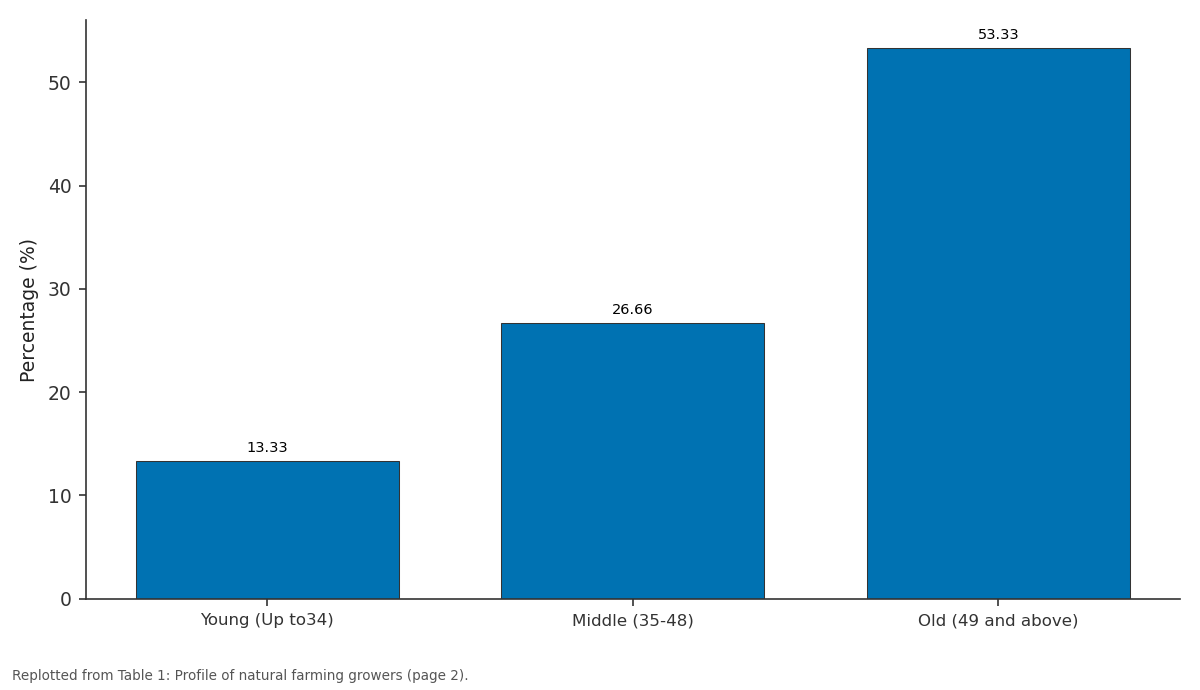
Percentage (%): Young (Up to34) vs Middle (35-48) vs Old (49 and above)
Replotted from Table 1 (page 2) of the original paper. Every bar is the paper's own table value.
View source evidence ↗Figures & tables
From the original paper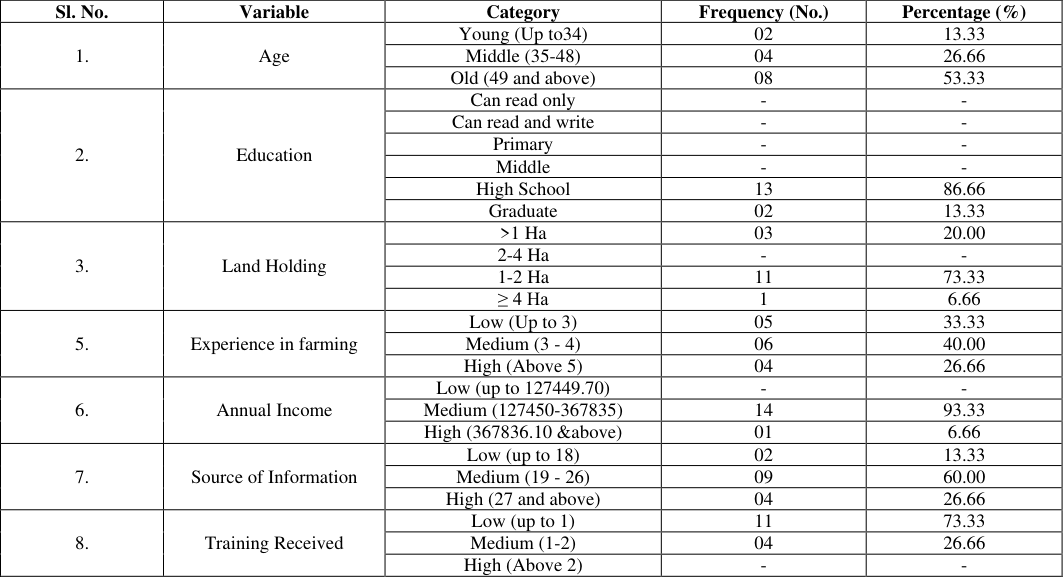 Table 1
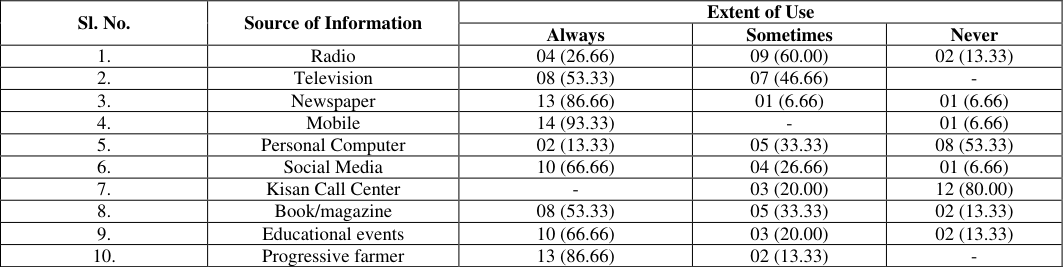 Table 2
 Table 3
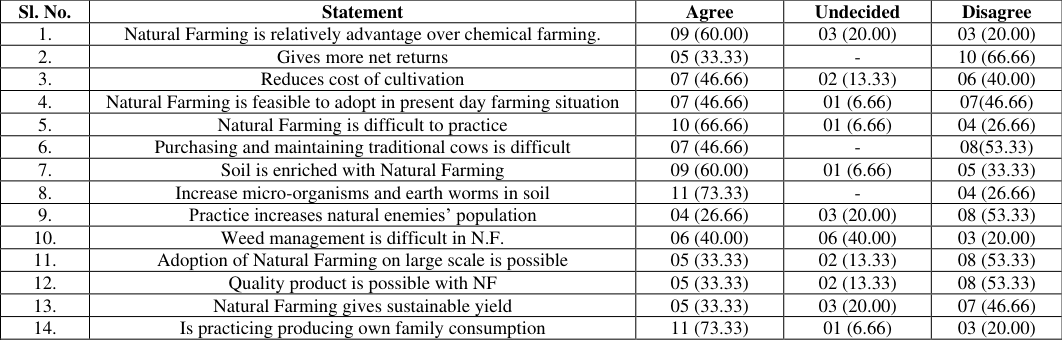 Table 4
 Table 5
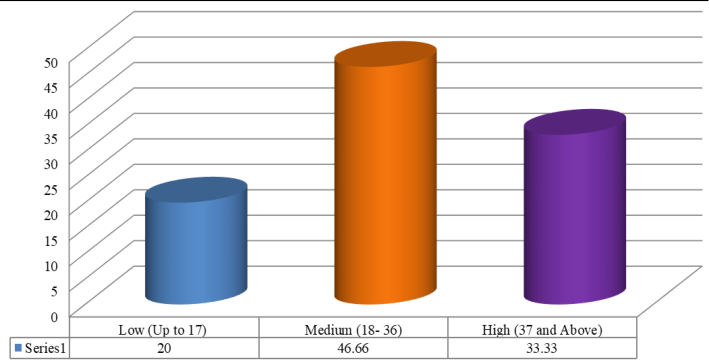 Figure 1
Introduction
Agriculture is a fundamental pillar of human civilization, providing sustenance, livelihoods, and economic stability. Over the years, conventional farming practices have dominated the agricultural landscape, relying heavily on synthetic inputs such as chemical fertilizers, pesticides, and genetically modified organisms. However, concerns about the environmental impact, long-term sustainability, and the health implications of these practices have led to a growing interest in alternative approaches like natural farming. Natural farming involves minimizing external inputs, promoting biodiversity, and fostering soil health through techniques such as cover cropping, composting, and crop rotation. As the global community grapples with the challenges of climate change, soil degradation, and diminishing natural resources, the adoption of natural farming practices becomes increasingly relevant. The perception of farmers towards natural farming practices is a critical factor influencing the widespread adoption and success of this sustainable approach. Understanding the perception, beliefs, and challenges faced by farmers in transitioning to natural farming is essential for promoting its acceptance and integration into mainstream agricultural systems. This study is crucial in advancing our understanding of the complex interplay between farmers and agricultural practices, contributing to the ongoing dialogue on sustainable and environmentally friendly approaches to food production.
Natural farming practices are built on four core principles Beejamrutis a microbial coating/treatment of seeds using cow dung and urine-based preparations. Jeevamrutis and application of mixture of cow dung, cow urine, jiggery, pulse-flour, water, and soil for multiplication of soil microbes. Mulching, a layer/bed of organic material to the soil surface in to prevent/reduce water evaporation. Waaphasa, soil aeration through a favorable microclimate in the soil.
In the context the present study was attempted on study on perception of natural farming practices in hingoli district of Maharashtra with following objectives. To study the profile of natural farming growers To study the perception of farmers on natural farming practices.
Methodology
The present study was conducted in Hingoli District of Marathwada region of Maharashtra State during the year 2022-23. The district comprises of 5 blocks namely Hingoli, Kalamnuri, Sengaon, Aundha Nagnath and Basmat from these block Kalamnuri, Hingoli and Basmatblock was selected purposively where Krishi Vigyan Kendra, Tondapur has given training and demonstration on natural farming. The Kandli, Idoli, Dhangarwadi, Dhanora, Mohamadpuri Wadi, Hyatnagar, Pimprala, Satipangra village was selected purposively. The 15 natural farming growers were selected purposively for present study. The data were collected using a well-structured and pretested interview schedule by covering all dimensions. The data was analyzed by using various statistical tools and methods.
Problems Faced by the Farmers in Conventional Agriculture
Chemical farming, also known as conventional agriculture, is a method of farming that relies heavily on the use of synthetic fertilizers, pesticides, and herbicides to enhance crop yields and control pests. While it has been instrumental in increasing food production and feeding a growing global population, it has also raised significant concerns about its environmental and health impacts. Here are some of the major problems faced by farmer which are associated with chemical farming. It can be revealed from Table 3. That 60.00% of respondents grow turmeric crops on natural farming might be due to that Hingoli district has maximum area under this crop and natural farming is relative advantage over other crops. It can be observed from Table 4. that equal 73.33% increase micro-organisms and earth worms in soil, practicing producing own family consumption,66.66% natural farming is difficult to practice. Whereas 66.66% of respondents agree soil is enriched with natural farming is relatively advantage over chemical farming. It might be due to that there are many advantages to adopt natural farming but adoption of natural farming on large scale is not possible& purchasing and maintaining traditional cows is difficult this point needs to be addressed for adoption of natural farming on large scale.
| Sl. No. | Statement | Agree | Undecided | Disagree |
|---|---|---|---|---|
| 1. | Natural Farming is relatively advantage over chemical farming. | 09 (60.00) | 03 (20.00) | 03 (20.00) |
| 2. | Gives more net returns | 05 (33.33) | - | 10 (66.66) |
| 3. | Reduces cost of cultivation | 07 (46.66) | 02 (13.33) | 06 (40.00) |
| 4. | Natural Farming is feasible to adopt in present day farming situation | 07 (46.66) | 01 (6.66) | 07(46.66) |
| 5. | Natural Farming is difficult to practice | 10 (66.66) | 01 (6.66) | 04 (26.66) |
| 6. | Purchasing and maintaining traditional cows is difficult | 07 (46.66) | - | 08(53.33) |
| 7. | Soil is enriched with Natural Farming | 09 (60.00) | 01 (6.66) | 05 (33.33) |
| 8. | Increase micro-organisms and earth worms in soil | 11 (73.33) | - | 04 (26.66) |
| 9. | Practice increases natural enemies’ population | 04 (26.66) | 03 (20.00) | 08 (53.33) |
| 10. | Weed management is difficult in N.F. | 06 (40.00) | 06 (40.00) | 03 (20.00) |
| 11. | Adoption of Natural Farming on large scale is possible | 05 (33.33) | 02 (13.33) | 08 (53.33) |
| 12. | Quality product is possible with NF | 05 (33.33) | 02 (13.33) | 08 (53.33) |
| 13. | Natural Farming gives sustainable yield | 05 (33.33) | 03 (20.00) | 07 (46.66) |
| 14. | Is practicing producing own family consumption | 11 (73.33) | 01 (6.66) | 03 (20.00) |
Table text extracted from the original PDF; superscript letters are shown inline. The original table image is below.
View original table image
| Sl. No. | Crop Name | Total Cropped Area (Ha) | — | — | — | — | — |
|---|---|---|---|---|---|---|---|
| 0.2 | 0.4 | 0.8 | 01 | 02 | 3 Ha & Above | ||
| 1. | Turmeric | 1 (6.66) | 9 (60.0) | 2 (13.33) | - | - | 1 (6.66) |
| 2. | Soybean | 3 (20.00) | 6 (40.00) | 2 (13.33) | 1 (6.66) | 1 (6.66) | |
| 3. | Gram | 3 (20.00) | 5 (33.33) | ||||
| 4. | Arhar | 2 (13.33) | |||||
| 5. | Karonda | 1 (6.66) | |||||
| 6. | Green Gram | 1 (6.66) |
Table text extracted from the original PDF; superscript letters are shown inline. The original table image is below.
View original table image
Figures and tables from the paper
| Sl. No. | Variable | Category | Frequency (No.) | Percentage (%) |
|---|---|---|---|---|
| 1. | Age | Young (Up to34) | 02 | 13.33 |
| Middle (35-48) | 04 | 26.66 | ||
| Old (49 and above) | 08 | 53.33 | ||
| 2. | Education | Can read only | - | - |
| Can read and write | - | - | ||
| Primary | - | - | ||
| Middle | - | - | ||
| High School | 13 | 86.66 | ||
| Graduate | 02 | 13.33 | ||
| 3. | Land Holding | >1 Ha | 03 | 20.00 |
| 2-4 Ha | - | - | ||
| 1-2 Ha | 11 | 73.33 | ||
| ≥ 4 Ha | 1 | 6.66 | ||
| 5. | Experience in farming | Low (Up to 3) | 05 | 33.33 |
| Medium (3 - 4) | 06 | 40.00 | ||
| High (Above 5) | 04 | 26.66 | ||
| 6. | Annual Income | Low (up to 127449.70) | - | - |
| Medium (127450-367835) | 14 | 93.33 | ||
| High (367836.10 &above) | 01 | 6.66 | ||
| 7. | Source of Information | Low (up to 18) | 02 | 13.33 |
| Medium (19 - 26) | 09 | 60.00 | ||
| High (27 and above) | 04 | 26.66 | ||
| 8. | Training Received | Low (up to 1) | 11 | 73.33 |
| Medium (1-2) | 04 | 26.66 | ||
| High (Above 2) | - | - |
Table text extracted from the original PDF; superscript letters are shown inline. The original table image is below.
View original table image
| Sl. No. | Source of Information | Extent of Use | — | — |
|---|---|---|---|---|
| Always | Sometimes | Never | ||
| 1. | Radio | 04 (26.66) | 09 (60.00) | 02 (13.33) |
| 2. | Television | 08 (53.33) | 07 (46.66) | - |
| 3. | Newspaper | 13 (86.66) | 01 (6.66) | 01 (6.66) |
| 4. | Mobile | 14 (93.33) | - | 01 (6.66) |
| 5. | Personal Computer | 02 (13.33) | 05 (33.33) | 08 (53.33) |
| 6. | Social Media | 10 (66.66) | 04 (26.66) | 01 (6.66) |
| 7. | Kisan Call Center | - | 03 (20.00) | 12 (80.00) |
| 8. | Book/magazine | 08 (53.33) | 05 (33.33) | 02 (13.33) |
| 9. | Educational events | 10 (66.66) | 03 (20.00) | 02 (13.33) |
| 10. | Progressive farmer | 13 (86.66) | 02 (13.33) | - |
Table text extracted from the original PDF; superscript letters are shown inline. The original table image is below.
View original table image
| Sl. No. | Category | Frequency | Percentage |
|---|---|---|---|
| 1. | Low (Up to 17) | 03 | 20.00 |
| 2. | Medium (18- 36) | 07 | 46.66 |
| 3. | High (37 and above) | 05 | 33.33 |
Table text extracted from the original PDF; superscript letters are shown inline. The original table image is below.
View original table image
References
5 in the original paper- Rao MMV, Lakshman TSSK, Kella P, Ravisankar N, Panwar AS. Study on perception and extent of adoption of natural farming practices in Vizianagaram district of Andhra Pradesh, India. Pharma Innovation Journal. 2021;10(8):989-993.
- Kumar R, Kumar S, Yashavanth BS, Meena PC. Natural Farming Practices in India: Its Adoption and Impact on Crop Yield and Farmers' Income. Indian Journal of Agricultural Economics. 2019;74(3):420432.
- Kumar VR, Laishram C, Sharma S. Problems and Factors affecting adoption of natural farming in Sirmaur District of Himachal Pradesh. Indian Journal of Ecology. 2021;48(3):944-949.
- Kumar R, Kumar S, Yashavanth BS, Venu N, Meena PC, Dhandapani A, et al. Natural farming practices for chemical-free agriculture: implications for crop yield and profitability. Agriculture. 2023 Mar 9;13(3):647.
- Shrey R, Bante R, Pallewar S, Acharya GK, Dhurwey C. Constraints perceived by farmers in crop-dairy mixed farming system on small farms in Parbhani district of Marathwada region (Maharashtra), India. Plant Archives. 2015;15(1):41-46.