
Research article · 2024 · Full text
International Journal of Horticulture and Food ScienceGlobal value chain approach and it’s multiple effect on horticultural product marketing in India
Volume 6(1) · Pages 49–54 · DOI: 10.33545/26631067.2024.v6.i1a.190 ↗
Research areasInnovation and Socioeconomic Development
Abstract
Author-writtenThe agricultural global value chain (AGVC) has increased rapidly and transformed the nature of horticultural production around the world. Multiple actors, including traders, producers, retailers, consumers, functionaries, and service providers, shape and promote the activities in the global value chain. Participation in GVC changes the GDP and employment share of the horticultural sector. This paper measures AGVCs through the gross export decomposition method. Both GDP share and employment share in the horticultural sector are positively associated with the increase in AGVC participation. This study contributes to the literature on conceptual frameworks as well as structural transformation.
Summary
Source-checkedPlain-language reading of the full paper, prepared with AI and checked against the text. Each point links to the authors' own words.
Why it matters
- The horticultural industry is a leading global sector that can significantly drive economic growth for nations that supply and export its products. View evidence ↗
- India's fruit and vegetable supply business has grown remarkably, focusing primarily on food security and quality maintenance. View evidence ↗
- A significant majority of top farmers (approximately 80%) rely on informal credit sources with monthly interest rates ranging from 2% to 5%. View evidence ↗
What they did
- The research utilized secondary data sourced from various organizations, including the International Trade Centre (ITC), National Statistical Office (NSO), and WTO STATS. View evidence ↗
- The Revealed Comparative Advantage (RCA) index was employed to evaluate global export performance. View evidence ↗
- The Intra-Industry Trade (IIT) index was used to determine if trade is suitable for the country and if the market is perfectly competitive. View evidence ↗
- The Index Specialized Trade (IST) was used to assess the export potential and trends of specific commodities. View evidence ↗
What they found
- The export value of Indian horticultural products showed an overall increase between 2019 and 2021. View evidence ↗
- In 2021, the highest horticultural export values were achieved from the UAE and USA, while Germany had the lowest export value. View evidence ↗
- The IIT index for fresh mangoes remained positive from 2011 to 2021, indicating a positive effect on India's GNP. View evidence ↗
What it means
- The authors conclude that the fresh mango market presents a significant opportunity to increase India's GNP. View evidence ↗
Visual summary
2 visualsIllustrations explain the paper; charts are replotted from the paper's own table values.
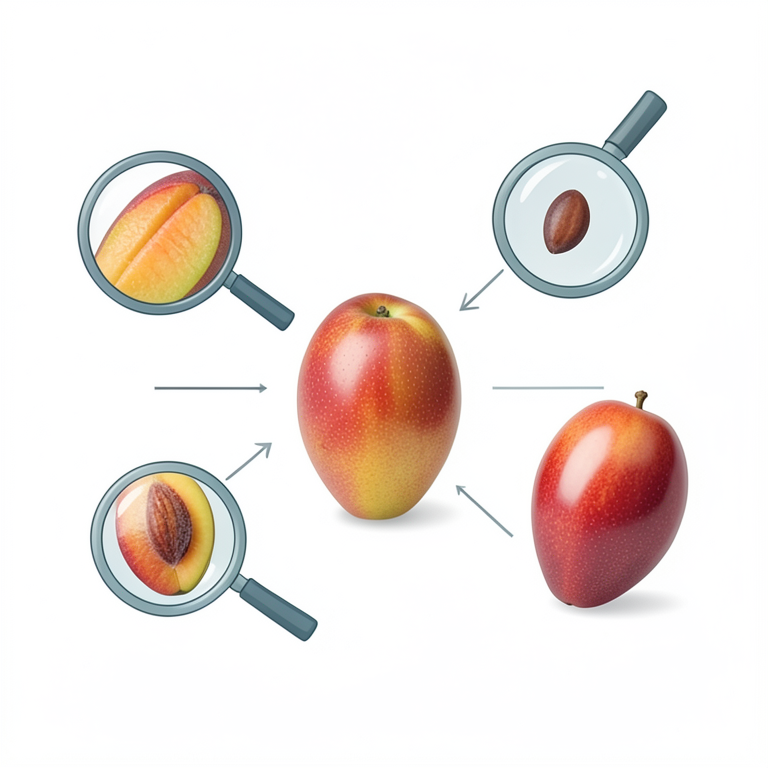
Trade Analysis Framework
AI-generated conceptual illustration (Fresh mangoes). It explains the idea and does not show study data.
View source evidence ↗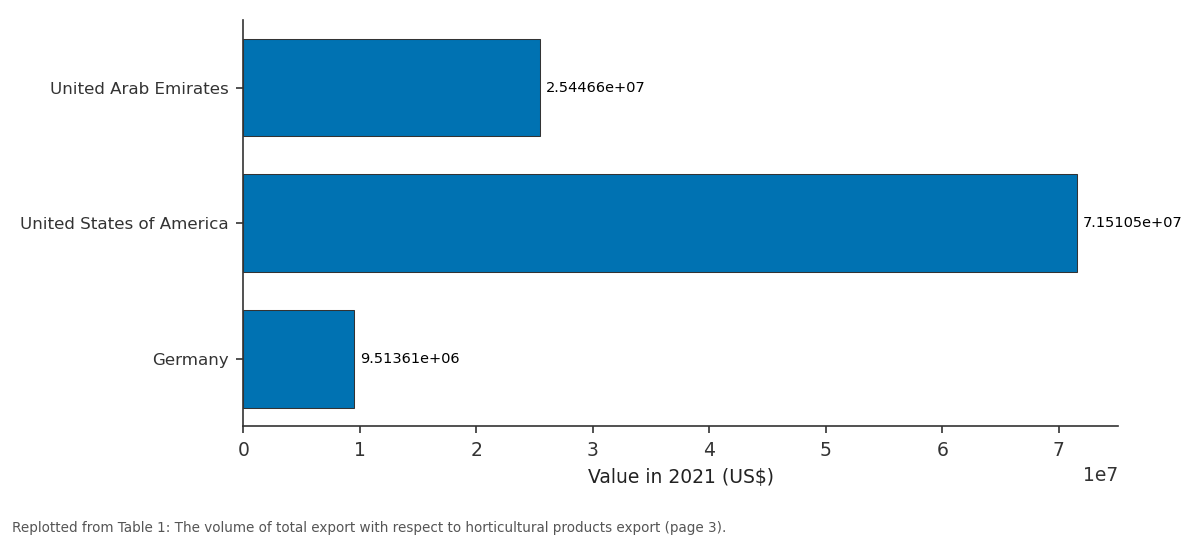
Value in 2021 (US$): United Arab Emirates vs United States of America vs Germany
Replotted from Table 1 (page 3) of the original paper. Every bar is the paper's own table value.
View source evidence ↗Figures & tables
From the original paper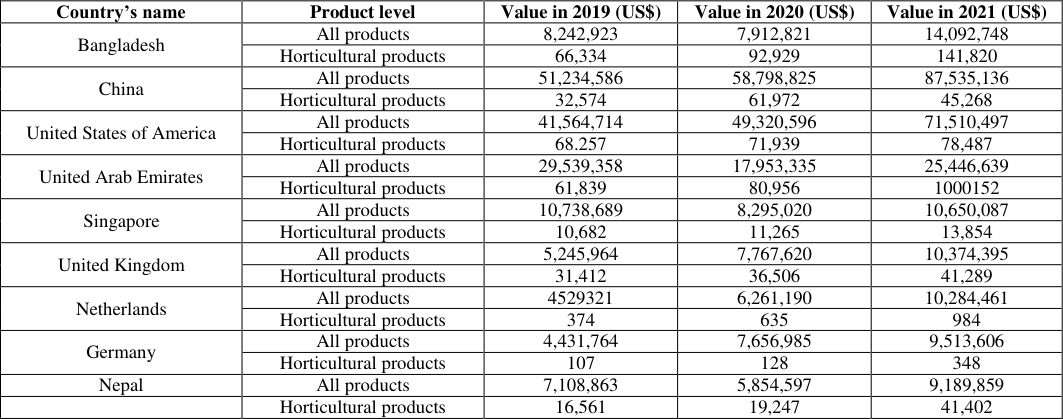 Table 1
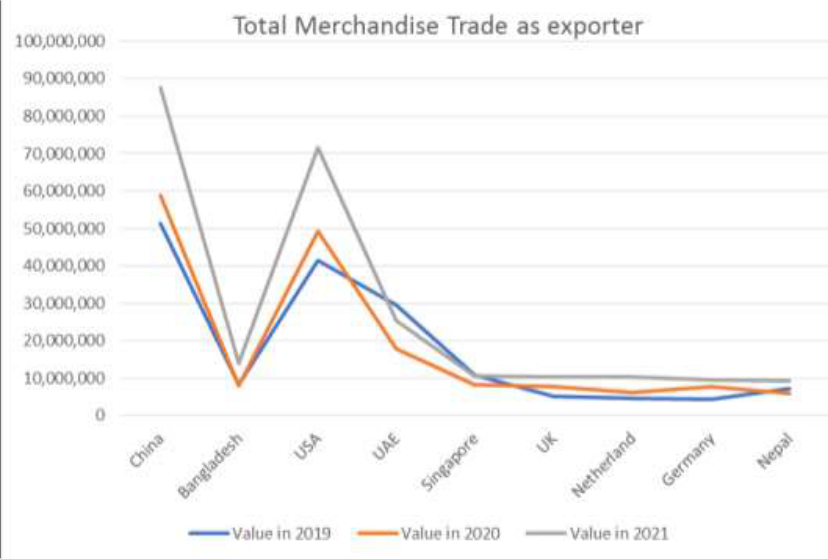 Figure 1
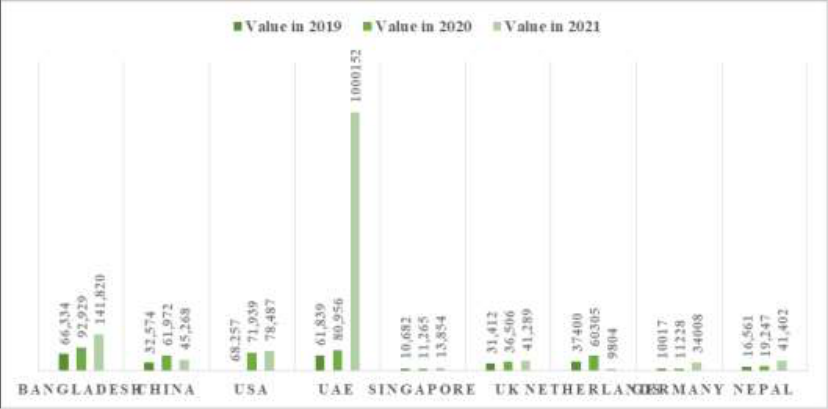 Figure 2
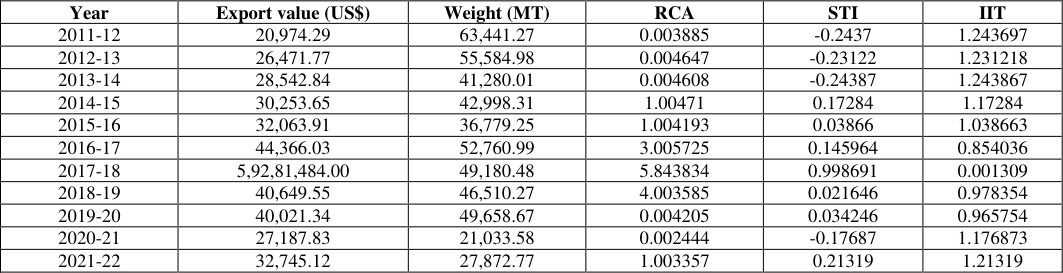 Table 2
 Figure 3
Introduction
Agriculture being the primary source of livelihood in most of the advancing nations has been intensified by agrarian cooperatives. Irrespective of communal farmers' many challenges and deprivation in establishing proper infrastructure, countable growth is listed. Cooperatives need to take the basic required steps to enhance the country's economy. This major shift is only possible through government acknowledgement, essential knowledge of market communication, health, and adept and security-based distribution of commodities. Improving productivity in Global Value Chains (GVC) and a rapid expansion in the economy of developing and impoverished countries. The main focus here is on agricultural flourishing and broadening ideologies and flexibilities. Agriculture is the most fundamental necessity of living in developing nations the highlighted means here to overpower this sector through various technical, social, and innovative improvements is specified. This is mainly accomplished by secured and progressive regulations. After globalization, the horticultural industry is one of the leading industries in the international market. It has promising effectiveness in the economic growth of the nations engaged in horticultural products supplying and exporting. About 80% of TOP farmers depend on informal sources of credit from money lenders, friends, and relatives attracting monthly interest rates of (2-5) %. Besides formal sources of credit through commercial banks, cooperative banks, etc., there are government schemes, subsidies, price support, and interest subvention schemes for farmers (NABARD). Indian fruits and vegetables supply business has made remarkable growth in terms of production and marketing. Food security and quality maintenance are the two basic areas addressed by the Indian fruit and vegetable production industry. This business has introduced the Indian farm economy with a financially high graph of profit. Through value chain analysis, it is seen that the smallholder producers associated with the cultivation process are earning a flexible income. Opportunities for rural development will be raised by empowering India's fruit and vegetable production industry. Adequate financial and technical support may help the industry for its entire improvement. India is predominantly an agrarian country. In Allahabad district of Uttar Pradesh, a large horticultural industry has been formed. Marketing plays the most crucial role in the case of horticultural production. Fresh tomatoes, cauliflower, and cabbage grown in Allahabad have high competitive advantages. Production and marketing of these vegetables depend on marketing supply chain management.
To identify the market hindrances, an effective marketing system has to be built up for developing the vegetable industry of Allahabad district, Uttar Pradesh. Horticulture is one of the leading industries in India. It has a large contribution to the local and national farm economy. The state of Karnataka is famous for its horticultural production which influences the horticultural industries of other states in India. Export and import quality of horticultural products depend on a few indicators including marketing management, supply chain, quality and security maintenance, and others. The demand for horticultural products is increasing day by day in the international market. It leads to economic growth and transactions among various countries through exporting and importing of those products.
Background of the research
India and other developing or impoverished countries have an advantage due to their high population to boost their economies. Women are the primary producers of floricultural and horticultural crops. Indian rural tribal women work in the floricultural sector and contribute to the local economy. Participation of socially and economically downtrodden village women in floricultural crop production activities brings women employment, changing the previous gender roles in Indian rural patriarchal society. Women's economic stability not only helps to promote women's empowerment but also helps to develop the condition of the household along with children's health and education. Utilizing village women's work potential, the Indian floricultural industry can witness heavy improvement, raising employment opportunities for women. The global Value Chain perspective has smoothened the agricultural global trading. This article illustrates how the cultivation of horticultural products brings several business challenges in the global export market through schematic analysis. Various factors including technical assistance in upgrading, sanction for the governance of production and manufacturing, power effectiveness, poverty reduction impact on supply, and concentrations in the value chain are explored through the GVC perspective. Local and small producers and entrepreneurs have the scope to enhance their income through the Bottom of Pyramid (BOP) approach combined with the Global Value Chain (GVC) approach. This article shows how the BOP approach enlarges the opportunities for value creation at the small local market level and improves the value chain. Interactions of private and public actors are exemplified with the assistance of global value addition and both local and global inter-firm relationships. Studying various service chains including banking and microfinance, the ICT sector, tourism and electricity, low-tech industries including packaging industries and textiles, and software industries, the strategies of business in the global market are understood. Maintaining food safety is equally important along with looking after the facts of fruits and vegetables production, farming, harvesting, processing, and other activities to keep a position in the international market of developed countries. This article addresses the subjects that which food and vegetables should be marketed, what safety measures have been taken, how the food quality can be remained intact to meet the market demands, competing with others, and how food quality and safety can be reduced the foodborne health complexities. Some facts include competitiveness, sustainability, inclusiveness, scalability, access to finance, and several others to understand the limitations and opportunities in the field of Indian agricultural trading. The total income from this sector is proportionate to the financial profit of the value chain participants, especially the farmers and the smallholders. The article also suggests some gravest policy recommendations that can improve the structural faults and Indian value chains.
To reduce the entry obstacles of women for promoting value chain development, policies have to be brought so that social strategies along with a gender-biased agricultural trading environment would be changed. The article, in a nutshell, depicts how economic equality can be attained by the women connected to global agro-industries through effective policy implementation and law legislation, reducing gender barriers, and promoting a work-friendly environment for them. Various tenets of marketplace practices including retail codes, transaction types, producerwholesaler, and other relationships are found with clarity of understanding. Through case studies such as domestic supermarket chains, the article attempts to analyze the key determinants of the high-quality horticultural industry. Many advanced schemes and projects such as the GVCs, OECD, and others have been launched to enhance growth in agricultural fields. The main motive here is the socioeconomic empowerment of nations through agricultural expansion. The floriculture market has shown multifarious development in distinct areas. This article lighted part mainly focuses on enhancing the floriculture market and its competency. As the market reach increases the struggle is heightened. Those efficient firms promoting in the mass market seem to gain technical excellence rather than profitable outcomes. Small firms if accepting the objectives of large-scale efficient firms tend to generate maximum revenue with advanced technical connectivity. The flowers on which these deeds have been performed are economically influenced. The rates of growth of this kind of planting flowers are enhanced by the act of wild primates, places, and climate. The widespread shifts and economic acknowledgement of these researches have been provided with conclusions. Focusing on how to encourage this primate and floristry development in the economy leads to the importance and rise of certain inquiries. The paper uses the measure of the Revealed Comparative Approach (RCA) index as introduced by Balassa (1965) [28] .
Objectives of the study
To check the global export performance, we use RCA expressed as
Where "RCAij = Revealed comparative advantage of the i th country', j th industry", xij = Exports of the j th industry by the i th country, Xi = Total amount exports of the i th country, xwj = World merchandise exports of the j th industry, Xw = Total merchandise world exports.
When a country has a revealed comparative advantage for a given product (RCA >1), it is indicated to be a competitive grower and exporter of that product relative to a country producing and exporting that good at or lower the world average. When the RCA index is greater than this also implies that the commodity has relatively good competitive power, when it becomes less than one, then the commodity has no competitive power.
Index Specialized Trade (IST)
This index is used to find out whether or not a product has the potential either to be exported or not. ST Index also provides the growth or the trend of the particular commodity. The value of the ST index lies between 0 to 1 which means the product has strong competitive power for export, conversely when gets a negative value then the product has low competitive value for exports. The index can be written as.
IST= Xij-Mij / Xij+Mij "Xij= Export value of commodity i by country j". Mij = Import value of commodity i by country j.
Intra Industry trade (IIT)
'An IIT constitutes a trade where an export value by a country for an industry is exactly equalized by another country for the same industry'. An IIT index positive value shows trade is suitable for that country along with a perfect competition market, and if the index value is exactly zero that implies trade happens in an imperfect competition market. For calculating the IIT index of a country (Grubel -Lloyd 1975) follows.
IIT=1-Xij-Mij / Xij+Mij IIT= Intra Industrial Trade Xij= Export value of commodity i by country j. Mij = Import value of commodity i by country j.
C. Results and Discussion
It is divided into two parts. The first part is about trends in agricultural production along with the export of horticultural products, second part is focused on the comparative advantage of the fresh mango market.
Trends in agricultural product export
India's Total Merchandise Trade as well as Agricultural Export. All products from India as an exporter country partner (products cluster at 4 digits and values in US dollars). The main countries are Bangladesh, China, USA, UAE, Singapore, UK, Netherlands, Germany and Nepal. India exports through these countries. Table 1 clearly shows that the export value of horticultural products increased from 2019 to 2021. The highest value of exports was achieved from UAE and USA respectively through horticultural in 2021. The lowest value of export is from Germany in 2021. So, it is clearly reflected from the table that developed countries also have more demand for fresh fruits and vegetables. The value of index-specialized trade lies between 0 to 1. It implies that the product has strong competitive power for export, so the export of fresh mango has strong competitive power from 2014 to onwards. The calculated value of the STI index lies between 0 to 1. So, our result is statistically significant. Another important index is IIT. An IIT index positive value shows trade is suitable for that country along with a perfect competition market. The Intra-industry trade index is a more statistically significant result shown in Table 2. Last ten years from 2011 to 2021 the value of the IIT index has all positive so the effect on GNP through fresh mango product export trading in India.
| Year | Export value (US$) | Weight (MT) | RCA | STI | IIT |
|---|---|---|---|---|---|
| 2011-12 | 20,974.29 | 63,441.27 | 0.003885 | -0.2437 | 1.243697 |
| 2012-13 | 26,471.77 | 55,584.98 | 0.004647 | -0.23122 | 1.231218 |
| 2013-14 | 28,542.84 | 41,280.01 | 0.004608 | -0.24387 | 1.243867 |
| 2014-15 | 30,253.65 | 42,998.31 | 1.00471 | 0.17284 | 1.17284 |
| 2015-16 | 32,063.91 | 36,779.25 | 1.004193 | 0.03866 | 1.038663 |
| 2016-17 | 44,366.03 | 52,760.99 | 3.005725 | 0.145964 | 0.854036 |
| 2017-18 | 5,92,81,484.00 | 49,180.48 | 5.843834 | 0.998691 | 0.001309 |
| 2018-19 | 40,649.55 | 46,510.27 | 4.003585 | 0.021646 | 0.978354 |
| 2019-20 | 40,021.34 | 49,658.67 | 0.004205 | 0.034246 | 0.965754 |
| 2020-21 | 27,187.83 | 21,033.58 | 0.002444 | -0.17687 | 1.176873 |
| 2021-22 | 32,745.12 | 27,872.77 | 1.003357 | 0.21319 | 1.21319 |
Table text extracted from the original PDF; superscript letters are shown inline. The original table image is below.
View original table image
| Country’s name | Product level | Value in 2019 (US$) | Value in 2020 (US$) | Value in 2021 (US$) |
|---|---|---|---|---|
| Bangladesh | All products | 8,242,923 | 7,912,821 | 14,092,748 |
| Horticultural products | 66,334 | 92,929 | 141,820 | |
| China | All products | 51,234,586 | 58,798,825 | 87,535,136 |
| Horticultural products | 32,574 | 61,972 | 45,268 | |
| United States of America | All products | 41,564,714 | 49,320,596 | 71,510,497 |
| Horticultural products | 68.257 | 71,939 | 78,487 | |
| United Arab Emirates | All products | 29,539,358 | 17,953,335 | 25,446,639 |
| Horticultural products | 61,839 | 80,956 | 1000152 | |
| Singapore | All products | 10,738,689 | 8,295,020 | 10,650,087 |
| Horticultural products | 10,682 | 11,265 | 13,854 | |
| United Kingdom | All products | 5,245,964 | 7,767,620 | 10,374,395 |
| Horticultural products | 31,412 | 36,506 | 41,289 | |
| Netherlands | All products | 4529321 | 6,261,190 | 10,284,461 |
| Horticultural products | 374 | 635 | 984 | |
| Germany | All products | 4,431,764 | 7,656,985 | 9,513,606 |
| Horticultural products | 107 | 128 | 348 | |
| Nepal | All products | 7,108,863 | 5,854,597 | 9,189,859 |
| Horticultural products | 16,561 | 19,247 | 41,402 |
Table text extracted from the original PDF; superscript letters are shown inline. The original table image is below.
View original table image
Conclusion
This paper has attempted to identify the trend in the agricultural sector. Focused on parallel shifts towards horticultural production. To calculate the RCA index important variables are total export value, import value, and total quantity. Values measured in US $ and quantity in terms of MT. To identify the relevant determinants of comparative advantage in fresh mango export promotion by India, we focused on the last ten years' export pattern. Also, valid statistically significant results were achieved. The study also attempted to shed light on the economic contribution of GNP through horticultural product marketing. Especially fresh mangoes product market has an opportunity such increase GNP. There are some future targets to improve the horticultural sector in India. Organic farming demand is very high throughout the world. To match world demand equal to supply we boost up for organic farming. Technology and more skill development programs are needed. Engaged more private sector with the horticultural sector as a result of this food processing industry merged with the grower and will get maximum profit. More major schemes for horticulture will be introduced by the Govt. of India, and analysing the factors affecting the demand function of the fresh mangoes market.
Figures and tables from the paper
References
24 in the original paper- Bhattacharyya R. Revealed comparative advantage and competitiveness: A case study for India in horticultural products. Journal of International Trade & Economic Development. 2012;21(6):819-840.
- Keror SJ, Yego HK, Bartilol MK. Analysis of Export Competitiveness of Kenya's Cut flower exports to the European Union Market. IOSR Journal of Economics and Finance. 2018;9(5):78-83.
- Baroh I, Hanani N, Setiawan B, Koestiono D. Indonesian coffee competitiveness in the international market: Review from the demand side. International Journal of Agriculture Innovations and Research. 2014;3(2):2319-1473.
- Sail RM. Strategic Policies for Increasing the Competitive Powers of Indonesian Horticultural Products in ASEAN Markets. Journal of International Business and Entrepreneurship Development. 2017;10(3):223-238.
- Angala A, van Rooyen J. Competing in a highly contested global environment: The case of the Namibian Date Value Chain-2001 to 2013. Journal of Economics and Sustainable Development. 2018;9(6):150-162.
- Moazzez H, Habibi A. Optimization of agricultural products export with use of linear programming model in mazandaran province. Journal of Agricultural Science and Technology. 2014;16(2):401-416.
- Luhur ES, Mulatsih S, Puspitawati E. Competitiveness Analysis of Indonesian Fishery Products in ASEAN and Canadian Markets. Significant: Journal Ilmu Ekonomi. 2019;8(1):105-120.
- Imankhan N, Taheri S. An evaluation of the comparative advantage of pistachio export and its effective factors. European Online Journal of Natural and Social Sciences: Proceedings. 2014;2(3):2278.
- Parobek J, Palus H, E, Kalamárová M, Glavonic B. Competitiveness of central European countries in the EU forest products market with the emphasis on Slovakia. Acta Facultatis Xylologiae Zvolen res Publica Slovaca. 2016;58(1):125.
- Benalywa ZA, Ismail MM, Shamsudin MN, Yusop Z. Revealed comparative advantage and competitiveness of broiler meat products in Malaysia and selected exporting countries. International Journal of Business & Society. 2019;20(1):23-44.
- Balassa B, Noland M. Revealed Comparative Advantage in Japan and the United States. Journal of International Economic Integration. 1989;4(1):18-22.
- Fertö I, Hubbard LJ. Revealed comparative advantage and competitiveness in Hungarian agri-food sectors. World Economy. 2003;26(2):247-259.
- Serin V, Civan A. Revealed comparative advantage and competitiveness: A case study for Turkey towards the EU. Journal of Economic and Social Research. 2008;10(2):25-41.
- Leromain E, Orefice G. New revealed comparative advantage index: Dataset and empirical distribution. International Economics. 2014;139:48-70.
- Yeats AJ. On the appropriate interpretation of the revealed comparative advantage index: Implications of a methodology based on industry sector analysis. Weltwirtschaftliches Archiv. 1985;121(1):61-73.
- Seyoum B. Revealed comparative advantage and competitiveness in services: A study with special emphasis on developing countries. Journal of Economic Studies. 2007;34(5):376-388.
- Hillman AL. Observations on the relation between revealed comparative advantage and comparative advantage as indicated by pre-trade relative prices. Weltwirtschaftliches Archiv. 1980;(H. 2):315-321.
- Ishchukova N, Smutka L. Revealed comparative advantage of Russian agricultural exports. Acta Universitatis Agriculturae et Silviculturae Mendelianae Brunensis. 2013;61(4):941-952.
- Crafts NF. Revealed comparative advantage in manufacturing, 1899-1950. Journal of European Economic History. 1989;18(1):127.
- Bojnec Š. Trade and revealed comparative advantage measures: Regional and central and east European agricultural trade. Eastern European Economics. 2001;39(2):72-98.
- Burange LG, Chaddha SJ. India's revealed comparative advantage in merchandise trade. Artha Vijnana. 2008;50(4):332-363.
- Shohibul A. Revealed comparative advantage measure: ASEAN-China trade flows. Journal of Economics and Sustainable Development. 2013;4(7):136-145.
- Addison-Smyth D. Ireland's revealed comparative advantage. Central Bank of Ireland Quarterly Bulletin. 2005;1:101-114.
- Balassa B. Tariff protection in industrial countries: An evaluation. Journal of Political Economy. 1965;73(6):573-594.