
Research article · 2024 · Full text
International Journal of Research in AgronomyPhytosociological study of woody species in the Khujji forest ranges of Rajnandgaon district in CG
Volume 7(4S) · Pages 30–34 · DOI: 10.33545/2618060x.2024.v7.i4sa.510 ↗
Research areasEthnobotanical and Medicinal Plants StudiesBotany and Plant Ecology StudiesPlant Taxonomy and Phylogenetics
Abstract
Author-writtenChhattisgarh in known for dense forest (44%) and it has forest division among them the survey of woody species structure was conducted in Rajnandgaon, Baghnadi and Khujji forest range of Rajnandgaon forest division Rajnandgaon district in C.G. Total woody species in Khujji forest range were identified as 50 therein 46 trees and 4 shrub with 81.2% Similarity index. The total woody species Density 444 ha-1 was recorded in Khujji forest range with Abundance 4185.12 ha-1 in Khujji forest range. The Basal area was recorded 21637 cm2 ha-1 in Khujji forest range. On the basis of Importance value index (IVI) of the top ten woody species were Lagerstroemia parviflora, Anogeissus latifolia, Tectona grandis, Diospyros melanoxylon, Casearia graveolens, Terminalia elliptica, Cassia fistula, Madhuca indica, Emblica officinalis and Buchanania latifolia in Khujji forest range. The Diversity and Dominance level of minor forest species was 1.58 and 0.03 in Khujji forest range.
Summary
Source-checkedPlain-language reading of the full paper, prepared with AI and checked against the text. Each point links to the authors' own words.
Why it matters
- Woody species such as Mahua, Mango, and Sal are economically significant as they help change the local economy. View evidence ↗
- Chhattisgarh possesses extensive forest wealth, with over 44% of its geographical area covered by mixed forests, bamboo, teak, and Sal. View evidence ↗
- The dominance of woody species, measured by the Importance Value Index (IVI), varies by area due to differences in habitat, biogeography, and disturbance. View evidence ↗
The question
- The study aimed to survey the structure of woody species within the Rajnandgaon, Baghnadi, and Khujji forest ranges of the Rajnandgaon forest division. View evidence ↗
What they did
- Researchers used 10 x 10 m quadrates, randomly placed 150 times in each forest range, to record the population of minor forest produce (MFP) woody species. View evidence ↗
- For each quadrate, the number of MFP species was counted, and their collar diameter and height were measured. View evidence ↗
- The population structure was analyzed using metrics including density, frequency, abundance, dominance, diversity, and the similarity index. View evidence ↗
What they found
- In the Khujji forest range, 50 woody species were identified, consisting of 46 trees and 4 shrubs, with a similarity index of 81.2%. View evidence ↗
- The total woody species in the Khujji forest range had a density of 444 ha-1 and an abundance of 4185.12 ha-1. View evidence ↗
- The total basal area for woody species in the Khujji forest range was 21637 cm2 ha-1. View evidence ↗
- Lagerstroemia parviflora had the highest Importance Value Index (IVI) at 27.64, followed by Anogeissus latifolia (24.33), Tectona grandis (16.31), and Diospyros melanoxylon (14.29). View evidence ↗
- The diversity level of minor forest species in the Khujji forest range was 1.58, while the dominance level was 0.03. View evidence ↗
- Anogeissus latifolia exhibited the highest frequency (37.33%), followed by Lagerstroemia parviflora (35.33%) and Tectona grandis (24.67%). View evidence ↗
- The maximum basal area was recorded for Anogeissus latifolia (5469.16 cm2 ha-1), followed by Tectona grandis (3282.30 cm2 ha-1). View evidence ↗
What it means
- The authors conclude that informed forest management strategies are necessary to preserve the diverse ecosystem of the Khujji forest range. View evidence ↗
Visual summary
2 visualsIllustrations explain the paper; charts are replotted from the paper's own table values.
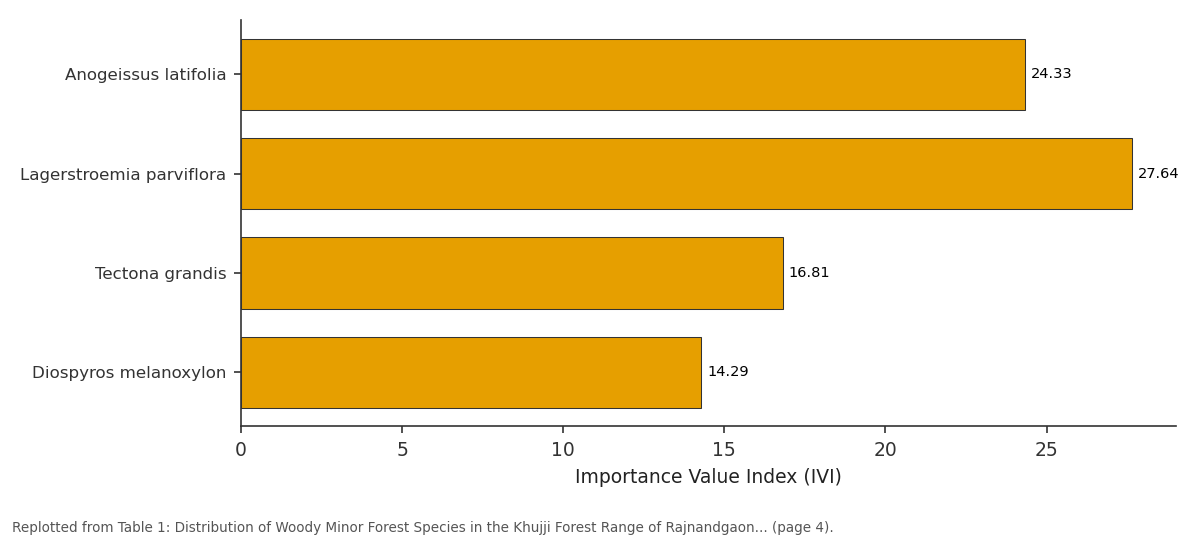
IVI: Anogeissus latifolia vs Lagerstroemia parviflora vs Tectona grandis vs Diospyros melanoxylon
Replotted from Table 1 (page 4) of the original paper. Every bar is the paper's own table value.
View source evidence ↗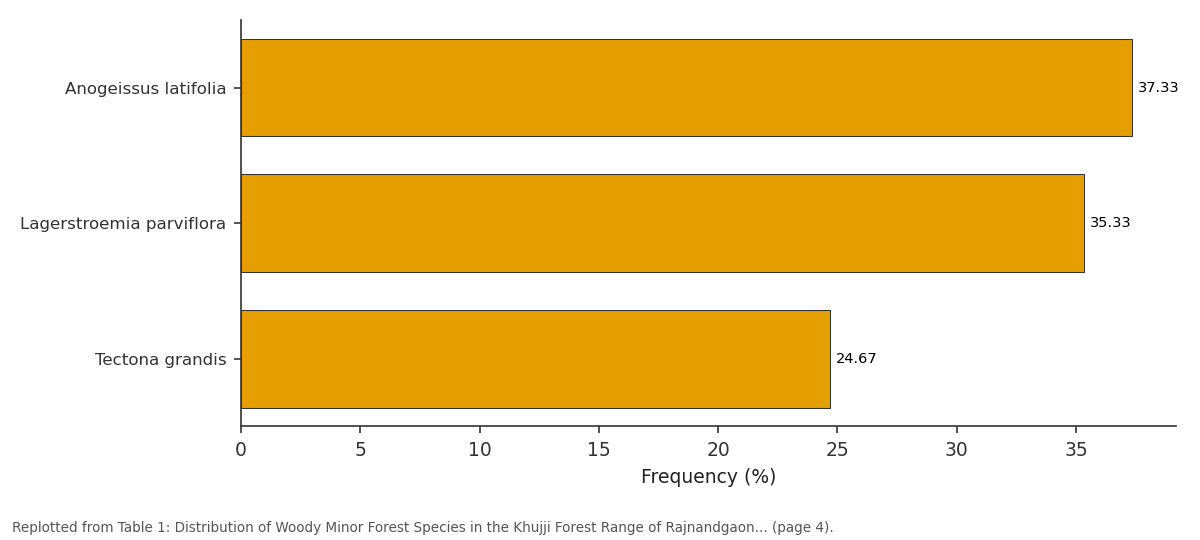
Frequency (%): Anogeissus latifolia vs Lagerstroemia parviflora vs Tectona grandis
Replotted from Table 1 (page 4) of the original paper. Every bar is the paper's own table value.
View source evidence ↗Figures & tables
From the original paper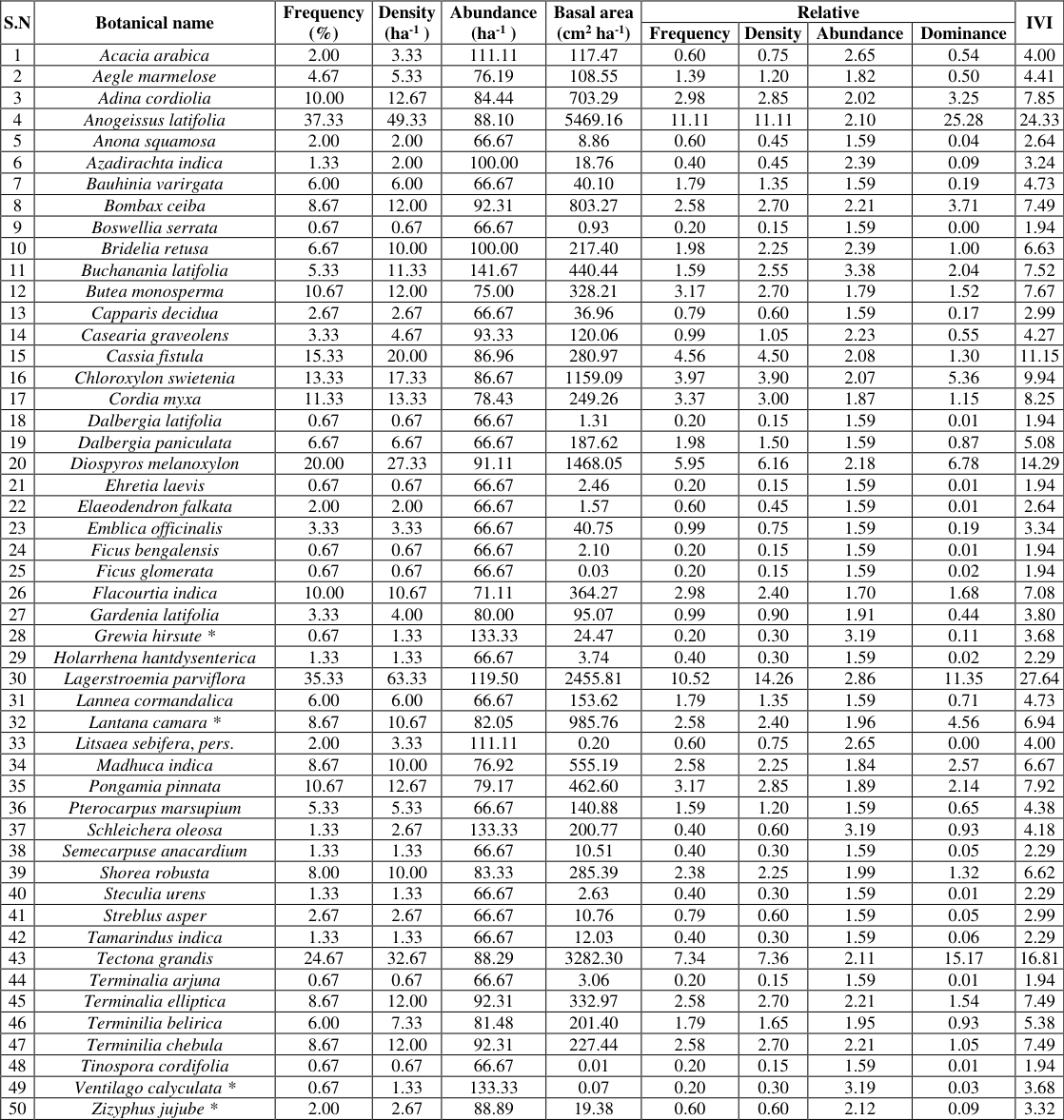 Table 1
Introduction
India is a pioneer country in the field of NTFPs, production and utilization there are reported 45,000 plant species occurs in India of which is 12% are the global wealth of flowering plants and about 33% are endemic. (Jain, 1987) [15] and out of which 3,000 plant species are economic value. The income from woody species viz. Mahua yielding edible flowers, Mango (Mangifera indica), Ber (Zizyphus mauritiana), Aonla (Emblica officinalis), Sal (Shorea robusta), Karanj (Pongamia pinnata), Tendu (Diospyrous melaonxylon) have been played important role changing the local economy. Chhattisgarh is endowed with rich forest wealth and more than 44% of the geographical area of the state is covered with luxuriant Sal (Shorea robusta), Teak (Tectona grandis), Bamboo species and mixed forests. (Bardani 2003) [16] surveyed the Bhoramdeo wildlife sanctuary of Kawardha district and report that out of 84 NTFPs there were 38 trees contributing the population structure of the dry deciduous forest. The higher value of dominance in the forest particularly of woody species according to IVI was found to be differed area to area mainly due to variation in biogeography, habitat and disturbance (Sagar et al., 2003) [13] , which have also been considered as the important factor for structuring the forest communities (Burslem and whitmore, 1999) [3] . Srivastava et al., (2005) [17] reported that the community characters differ with aspect, slop and altitude even in the same vegetation type. In our study, we found that tree diversity decrease with increasing dominance was found to be related with higher density and abundance. Similar result was observed by Naugraiya et al. in the study of rangelands. The higher value of dominance in the forest was due to lower species richness. Baduni and Sharma (1997) [18] , as the dominance of Simpson's index was strangle affected by the IVI of the important species in a community. Species diversity (richness) and dominance (Simpson index) related to each other (Zobel et al., 1976) [19] . That the forest with low diversity as a result of increased ecosystem resilience to disturbance. Therefore diversity tend to increase as the environment become more favorable and more predictable (Putman, 1994) [11] .
Materials and Methods
Rajnandgaon is situated nearly in the central part of Chhattisgarh and lies between 20° 07' 08'' to 21° 49'55''North latitudes and 80° 23' 20'' to 81°13' 05''with an altitude of 298 m above the mean sea level. Rajnandgaon is one of the westerly located District of Chhattisgarh state. The climatic condition of CG is sub-humid dry mixed deciduous forest with average annual rainfall of 1200-1400 mm, of which 80% occurs during rainy season. May is the hottest and December is coolest month of year. The soil of Rajnandgaon belongs to four different orders viz. Entisols, Vertisols, Inceptisols and Alfisols. Low to medium nitrogen, high potassium and low to medium phosphorus with low organic matter. The population of MFP woody species was be recorded by using 10 x 10 m size quadrate (Mishra 1968) [7] which was randomly in 150 times in each forest range. The number of MFP species in each quadrate was being counted with height and collar diameter measurement. The population structure of MFP woody species was being worked out in respect to density, frequency, abundance, similarity index, diversity and dominance etc. as per following formulas.
Where, D = Simpson index of dominance ni = the IVI of individual species N= IVI of all the species Margalef (1968) [5] Diversity
Results and Discussion
Results of phytosociological studies parameters viz; frequency, density, abundance, basal area of their relative values and IVI of woody species in Khujji forest range are presented in Table-1and its showed that out of 50 woody species, there were 46 trees and 4 shrubs respectively.
Frequency: In Khujji forest range more than 50% of woody species shared less than 5% of frequency of their availability. The maximum frequency was found in Anogeissus latifolia (37.33%) followed by Lagerstroemia parviflora (35.33%) Tectona grandis (24.67%), Diospyros melanoxylon (20.00%), Cassia fistula (15.33%) while frequency level (10-15%) was occurred in Chloroxylon swietenia (13.33%), Cordia myxa (11.33%), Butea monosperma (10.67%), Pongamia pinnata (10.67%), Flacourtia indica (10.00%), Adina cordifolia (10.00%) respectively. While frequency level from 5 to 10% was recorded in 13 woody species in which Buchanania latifolia (5.33%), Madhuca indica (8.67%), Shorea robusta (8.0%), Terminalia chebula (8.67%) and Terminalia belirica (6.0%) are the most common minor forest produce woody species.
Density:
The density of total woody species in the Khujji forest range was 444 plant ha -1 where the maximum density was found in Lagerstroemia parviflora (63.33 ha -1 ) followed by Anogeissus latifolia (49.33 ha -1 ) Tectona grandis (32.00 ha -1 ), Cassia fistula (20.00 ha -1 ), Diospyros melanoxylon (27.33 ha -1 ), Chloroxylon swietenia (17.33 ha -1 ). The density between 10 to 15 plant ha -1 was occurred in 13 woody species, which were Adina cordifolia, Bombax ceiba, Bridelia retusa, Buchanania latifolia, Butea monosperma, Cordia myxa, Flacourtia indica, Lantana camara, Madhuca indica, Pongamia pinnata, Shorea robusta, Terminalia elliptica and Terminalia chebula, while density between below 10 to 5 plant ha -1 was reported in 6 species with important minor forest produce woody species of Aegle marmelose and Terminalia belirica. There was 25 woody species recorded for less than 5 plant ha -1 and among them important minor forest produce woody species were Azadirachta indica and Emblica officinalis.
Abundance: A very large quantity of woody species showed overall total 6277.67 plant ha -1 in Khujji forest range where the maximum abundance was found in Buchanania latifolia (141.67 plant ha -1 ) followed by Grewia hirsute (133.33 plant ha -1 ), Schleichera oleosa (133.33 ha -1 ), Ventilago calyculata (133.33 ha -1 ) and Lagerstroemia parviflora (119.5 plant ha -1 ), Litsaea sebifera (111.11 plant ha -1 ), Acacia Arabica (111.11 plant ha -1 ), Azadirachta indica (100 plant ha -1 ), Bridelia retusa (100 plant ha -1 ), The abundance between 80 to 100 plants ha -1 was reported in 15 wood species in which Casearia graveolens (93.33 plant ha -1 ) followed by Bombax ceiba, Terminalia elliptica and Terminalia chebula (92.31 plant ha -1 ) and Diospyros melanoxylon (91.11 plant ha -1 ) were major minor forest produce species of the area. The abundance between 50 to 80 plants ha -1 gathered 27 wood species including 20 species having abundance of 66.67 plants ha -1 and among them the Aegle marmelose, Emblica officinalis, Madhuca indica, Shorea robusta, Tamarindus indica and Terminalia belirica were minor forest producing ones for the area.
Basal area: It was worked out on the basis of area of stand at diameter breast height overall it was found 21637.0 cm 2 ha -1 for woody species occurred in the Khujji forest range, where the maximum basal area was found in Anogelissus latifolia (5469.16 cm 2 ha -1 ) followed by Tectona grandis (3282.30 cm 2 ha -1 ), Lagerstroemia parviflora (2455.81 cm 2 ha -1 ), Diospyros melonoxylon (1468.00 cm 2 ha -1 ), Chloroxylon swietenia (1159 cm 2 ha -1 ). The basal areas occupied by wood species between 500 to 1159 cm 2 ha -1 were Lantana camera (985.7cm 2 ha -1 ), Bombax ceiba (803 cm 2 ha -1 ), Adina cordifolia (703.3 cm 2 ha -1 ) and Madhuca indica (555.2 cm 2 ha -1 ). There was 18 wood species having basal area in each range between of 1 to 100 cm 2 ha -1 and 100 to 500 cm 2 ha -1 while only 5 woody species having less than 1.0 cm 2 ha -1 basal area. The important MFP woody species having occupancy between 1 to 500 cm 2 ha -1 were Aegle marmelose, Azadirachta indica, Buchanania latifolia, Emblica officinalis, Tamarindus indica, Shorea robusta, Terminalia spp. respectively.
Relative frequency:
The relative frequency for woody species occurred in the Khujji forest range was found higher in order of Anogeissus latifolia (11.11%) followed by Lagerstroemia parviflora (10.52%) Tectona grandis (7.34%), Diospyros melanoxylon (5.95%). The relative frequency between 1 to 5% level was found in 21 species where minor forest produce ones were Aegle marmelose, Butea monosperma, Madhuca indica, Shorea robusta, Terminilia chebula and Terminilia belirica sequentially, while minor forest produce woody species having less them 1% of frequency were Azadirachta indica, Emblica officinalis.
Relative density:
The density of total wood species was 444 plant ha-1in Khujji forest range where it was found higher in Lagerstroemia parviflora (14.26%) followed byAnogeissus latifolia (11.11%) Tectona grandis (7.36%) and Diospyros melanoxylon (5.95%). The rest of woody species showed their density between 1 to 5 and below 1 plant ha -1 were 22 and 24 respectively which contributed the 51.38 and 9.75% density respectively in the forest range.
Relative abundance:
The relative abundance of each woody species against the total abundance of woody species in the Khujji forest was 6277.67 plant ha -1 and it was found maximum in Buchanania latifolia (3.38%) followed by Ventilago calyculata, Grewia hirsute and Schleichera oleosa (3.19%), Lagerstroemia parviflora (2.86), Litsaea sebifera (2.65) and Acacia arebica (2.65). There were 13 woody species which shared 2 to 2.5% level of abundance while rest of 30 species shared their presence of population less than 2% in respect of abundance and among these two groups the MFP woody species were Adina cordifolia, Azadirachta indica, Diospyros melanoxylon, Emblica officinalis, Madhuca indica, Shorea robusta, Tamarindus indica and Terminalia spp.
Relative dominance:
The relative dominance is the basal area occupancy of the species and the total basal area occupancy of all species was 21637 cm 2 ha -1 in the Baghnadi forest range, where the maximum relative dominance was found in Anogelissus latifolia (25.28%) followed by Tectona grandis (15.17%), Lagerstroemia parviflora (11.33%), Diospyros melanoxylon (6.78%), Chloroxylon swietenia (5.36%) and Lantana camara (4.56%). However 13 woody species shared 24.27% basal area of the woody species having basal area in range of 1 to 3%. The 32 woody species having less than 1% occupancy through basal area shared only 7.23% occupancy of basal area.
The Importance Value index of individual woody species in the Khujji forest range was found maximum for Lagerstroemia parviflora (27.64) followed by Anogelissus latifolia (24.33), Tectona grandis (16.31), Diospyros melanoxylon (14.29).
Importance value index: Cassia fistula (11.15) respectively, while IVI between 5 to 10 level was occurred in 16 woody species in order of Chloroxylon swietenia < Cordia myxa < Pongamia pinnat < Adina cordifolia < Butea monosperma < Buchanania latifolia < Bombax ceiba < Terminalia elliptica < Terminalia chebula < Flacourtia indica < Lantana camara < Madhuca indica < Bridelia retusa < Shorea robusta < Terminalia belirica < Dalbergia paniculata. The 29 woody species showed their IVI value less than 5 and the important MFP woody species in this were Aegle marmelose, Azadirachta indica and Emblica officinalis only.
Conclusion
In conclusion, the phytosociological studies conducted in the Khujji forest range have unveiled crucial insights into the distribution and abundance of woody species. Analysis of parameters such as frequency, density, abundance, basal area, and Importance Value Index (IVI) has highlighted the ecological significance of various species. While certain species like Anogeissus latifolia and Lagerstroemia parviflora dominate in terms of frequency and density, others like Azadirachta indica and Emblica officinalis are less prevalent. These findings underscore the importance of informed forest management strategies to preserve the diverse ecosystem of the Khujji forest range for future generations.
Acknowledgment
The authors express their deep sense of gratitude to DRS, IGKV, Raipur (CG), Dean, college of Agriculture, Raipur. I extend my gratitude to CCF, CF, DFO, Range officers and other field officers of Rajnandgaon forest division of state forest department of Chhattisgarh for their rendered support to identify the species and guidance to move in forest during course of study in Khujji forest ranges, without their support we could not be able to commence the work smoothly.
Figures and tables from the paper
| S.N | Botanical name | Frequency (%) | Density (ha-1 ) | Abundance (ha-1 ) | Basal area (cm2 ha-1) | Relative | — | — | — | IVI |
|---|---|---|---|---|---|---|---|---|---|---|
| Frequency | Density | Abundance | Dominance | |||||||
| 1 | Acacia arabica | 2.00 | 3.33 | 111.11 | 117.47 | 0.60 | 0.75 | 2.65 | 0.54 | 4.00 |
| 2 | Aegle marmelose | 4.67 | 5.33 | 76.19 | 108.55 | 1.39 | 1.20 | 1.82 | 0.50 | 4.41 |
| 3 | Adina cordiolia | 10.00 | 12.67 | 84.44 | 703.29 | 2.98 | 2.85 | 2.02 | 3.25 | 7.85 |
| 4 | Anogeissus latifolia | 37.33 | 49.33 | 88.10 | 5469.16 | 11.11 | 11.11 | 2.10 | 25.28 | 24.33 |
| 5 | Anona squamosa | 2.00 | 2.00 | 66.67 | 8.86 | 0.60 | 0.45 | 1.59 | 0.04 | 2.64 |
| 6 | Azadirachta indica | 1.33 | 2.00 | 100.00 | 18.76 | 0.40 | 0.45 | 2.39 | 0.09 | 3.24 |
| 7 | Bauhinia varirgata | 6.00 | 6.00 | 66.67 | 40.10 | 1.79 | 1.35 | 1.59 | 0.19 | 4.73 |
| 8 | Bombax ceiba | 8.67 | 12.00 | 92.31 | 803.27 | 2.58 | 2.70 | 2.21 | 3.71 | 7.49 |
| 9 | Boswellia serrata | 0.67 | 0.67 | 66.67 | 0.93 | 0.20 | 0.15 | 1.59 | 0.00 | 1.94 |
| 10 | Bridelia retusa | 6.67 | 10.00 | 100.00 | 217.40 | 1.98 | 2.25 | 2.39 | 1.00 | 6.63 |
| 11 | Buchanania latifolia | 5.33 | 11.33 | 141.67 | 440.44 | 1.59 | 2.55 | 3.38 | 2.04 | 7.52 |
| 12 | Butea monosperma | 10.67 | 12.00 | 75.00 | 328.21 | 3.17 | 2.70 | 1.79 | 1.52 | 7.67 |
| 13 | Capparis decidua | 2.67 | 2.67 | 66.67 | 36.96 | 0.79 | 0.60 | 1.59 | 0.17 | 2.99 |
| 14 | Casearia graveolens | 3.33 | 4.67 | 93.33 | 120.06 | 0.99 | 1.05 | 2.23 | 0.55 | 4.27 |
| 15 | Cassia fistula | 15.33 | 20.00 | 86.96 | 280.97 | 4.56 | 4.50 | 2.08 | 1.30 | 11.15 |
| 16 | Chloroxylon swietenia | 13.33 | 17.33 | 86.67 | 1159.09 | 3.97 | 3.90 | 2.07 | 5.36 | 9.94 |
| 17 | Cordia myxa | 11.33 | 13.33 | 78.43 | 249.26 | 3.37 | 3.00 | 1.87 | 1.15 | 8.25 |
| 18 | Dalbergia latifolia | 0.67 | 0.67 | 66.67 | 1.31 | 0.20 | 0.15 | 1.59 | 0.01 | 1.94 |
| 19 | Dalbergia paniculata | 6.67 | 6.67 | 66.67 | 187.62 | 1.98 | 1.50 | 1.59 | 0.87 | 5.08 |
| 20 | Diospyros melanoxylon | 20.00 | 27.33 | 91.11 | 1468.05 | 5.95 | 6.16 | 2.18 | 6.78 | 14.29 |
| 21 | Ehretia laevis | 0.67 | 0.67 | 66.67 | 2.46 | 0.20 | 0.15 | 1.59 | 0.01 | 1.94 |
| 22 | Elaeodendron falkata | 2.00 | 2.00 | 66.67 | 1.57 | 0.60 | 0.45 | 1.59 | 0.01 | 2.64 |
| 23 | Emblica officinalis | 3.33 | 3.33 | 66.67 | 40.75 | 0.99 | 0.75 | 1.59 | 0.19 | 3.34 |
| 24 | Ficus bengalensis | 0.67 | 0.67 | 66.67 | 2.10 | 0.20 | 0.15 | 1.59 | 0.01 | 1.94 |
| 25 | Ficus glomerata | 0.67 | 0.67 | 66.67 | 0.03 | 0.20 | 0.15 | 1.59 | 0.02 | 1.94 |
| 26 | Flacourtia indica | 10.00 | 10.67 | 71.11 | 364.27 | 2.98 | 2.40 | 1.70 | 1.68 | 7.08 |
| 27 | Gardenia latifolia | 3.33 | 4.00 | 80.00 | 95.07 | 0.99 | 0.90 | 1.91 | 0.44 | 3.80 |
| 28 | Grewia hirsute * | 0.67 | 1.33 | 133.33 | 24.47 | 0.20 | 0.30 | 3.19 | 0.11 | 3.68 |
| 29 | Holarrhena hantdysenterica | 1.33 | 1.33 | 66.67 | 3.74 | 0.40 | 0.30 | 1.59 | 0.02 | 2.29 |
| 30 | Lagerstroemia parviflora | 35.33 | 63.33 | 119.50 | 2455.81 | 10.52 | 14.26 | 2.86 | 11.35 | 27.64 |
| 31 | Lannea cormandalica | 6.00 | 6.00 | 66.67 | 153.62 | 1.79 | 1.35 | 1.59 | 0.71 | 4.73 |
| 32 | Lantana camara * | 8.67 | 10.67 | 82.05 | 985.76 | 2.58 | 2.40 | 1.96 | 4.56 | 6.94 |
| 33 | Litsaea sebifera, pers. | 2.00 | 3.33 | 111.11 | 0.20 | 0.60 | 0.75 | 2.65 | 0.00 | 4.00 |
| 34 | Madhuca indica | 8.67 | 10.00 | 76.92 | 555.19 | 2.58 | 2.25 | 1.84 | 2.57 | 6.67 |
| 35 | Pongamia pinnata | 10.67 | 12.67 | 79.17 | 462.60 | 3.17 | 2.85 | 1.89 | 2.14 | 7.92 |
| 36 | Pterocarpus marsupium | 5.33 | 5.33 | 66.67 | 140.88 | 1.59 | 1.20 | 1.59 | 0.65 | 4.38 |
| 37 | Schleichera oleosa | 1.33 | 2.67 | 133.33 | 200.77 | 0.40 | 0.60 | 3.19 | 0.93 | 4.18 |
| 38 | Semecarpuse anacardium | 1.33 | 1.33 | 66.67 | 10.51 | 0.40 | 0.30 | 1.59 | 0.05 | 2.29 |
| 39 | Shorea robusta | 8.00 | 10.00 | 83.33 | 285.39 | 2.38 | 2.25 | 1.99 | 1.32 | 6.62 |
| 40 | Steculia urens | 1.33 | 1.33 | 66.67 | 2.63 | 0.40 | 0.30 | 1.59 | 0.01 | 2.29 |
| 41 | Streblus asper | 2.67 | 2.67 | 66.67 | 10.76 | 0.79 | 0.60 | 1.59 | 0.05 | 2.99 |
| 42 | Tamarindus indica | 1.33 | 1.33 | 66.67 | 12.03 | 0.40 | 0.30 | 1.59 | 0.06 | 2.29 |
| 43 | Tectona grandis | 24.67 | 32.67 | 88.29 | 3282.30 | 7.34 | 7.36 | 2.11 | 15.17 | 16.81 |
| 44 | Terminalia arjuna | 0.67 | 0.67 | 66.67 | 3.06 | 0.20 | 0.15 | 1.59 | 0.01 | 1.94 |
| 45 | Terminalia elliptica | 8.67 | 12.00 | 92.31 | 332.97 | 2.58 | 2.70 | 2.21 | 1.54 | 7.49 |
| 46 | Terminilia belirica | 6.00 | 7.33 | 81.48 | 201.40 | 1.79 | 1.65 | 1.95 | 0.93 | 5.38 |
| 47 | Terminilia chebula | 8.67 | 12.00 | 92.31 | 227.44 | 2.58 | 2.70 | 2.21 | 1.05 | 7.49 |
| 48 | Tinospora cordifolia | 0.67 | 0.67 | 66.67 | 0.01 | 0.20 | 0.15 | 1.59 | 0.01 | 1.94 |
| 49 | Ventilago calyculata * | 0.67 | 1.33 | 133.33 | 0.07 | 0.20 | 0.30 | 3.19 | 0.03 | 3.68 |
| 50 | Zizyphus jujube * | 2.00 | 2.67 | 88.89 | 19.38 | 0.60 | 0.60 | 2.12 | 0.09 | 3.32 |
Table text extracted from the original PDF; superscript letters are shown inline. The original table image is below.
View original table image
References
18 in the original paper- Ahmad M, Khan MJ, Manzoor S, Zafer M, Sultana S. Check list of Among Tribal's of M.P. Indian Journal of Tropical Biodiversity. 2006;12:57-60.
- Bhattacharua P, Hayal SF. Sustained NTFPs Management for rural Development: A case study form Madhya Pradesh, India. International Forestry review. 2004;6(2):161-168, 205, 208.
- Burslem DF, Whit More TC. Species diversity susceptibility to disturbance and tree population dynamics in tropical rain forest. J Veg. Sci. 1999;10:767-776.
- Malhotra KC, Dev D, Dutta M, Vasulu TS, Yadav G, Adhikari M. Role of Minor Forest Products in Village Economy: A household Survey in Jamponi Range Mimeographed, Indian Institute of Bios social Research and Development, Culcutta, 1991.
- Margalef R. Perspective in ecological theory university of Chicago press, 1968.
- Masih SK, Sharma CB, Sharma MC. NTFPs and their Price Trends in Medicinal flora of Tehsil Isakhel, District Mianwali Pakistan. Ethnodirected. 2001.
- Mishra R. A forest ecological book. New Delhi, 1968.
- Murthy IK, Ravindranath PR, Sukumar R. Financial valuation of Non-Timber Forest Product flows in Uttrakannada district, WesthernGhat, Karnataka. Current science. 2005;(88):10.
- Naugraiya MN, Pathak PS. An analysis of grassland vegetation on a Top sequence, Indian J Range Mgmt. 1986;7(1):27-32.
- Naugraiya MN, Pathak PS. Post felling colonization and production of winter annuals in Leucaena forest. Intl. J Eco. Environ. Sci. 1993;19:213-217.
- Putman RJ. Community Ecology. Chapman & Hall, London. 1994.
- Rahbek C. The role of spatial scale and the perception of large scale species-richness. Patterns. Ecol. Lett. 2005;8:224-239.
- Sagar R, Ragubanshi AS, Singh JS. Tree species composition, dispersion and diversity along a disturbance gradient in a dry tropical forest region of India. For. Ecol. Manage. 2003;186:61-71.
- Tripathi S, Verma S, Goldey P. Ushing plants for health: Indigenous Knowledge in health care in a tribal region of Bihar, India. Int. J Sust Develop World Eco. 2000;7:321332.
- Jain PC. The effect on stock price of inclusion in or exclusion from the S&P 500. Financial Analysts Journal. 1987 Jan 1;43(1):58-65.
- Kryovrysanaki N, James A, Tselika M, Bardani E, Kalantidis K. RNA silencing pathways in plant development and defense. The International Journal of Developmental Biology. 2021 Nov 22;66(1-2-3):163-175.
- Srivastava P, Singh B, Angove M. Competitive adsorption behavior of heavy metals on kaolinite. Journal of Colloid and Interface Science. 2005 Oct 1;290(1):28-38.
- Zobel DB, McKee A, Hawk GM, Dyrness CT. Relationships of environment to composition, structure, and diversity of forest communities of the central western Cascades of Oregon. Ecological Monographs. 1976 Mar;46(2):135-156.