
Research article · 2024 · Full text
International Journal of Research in AgronomyInfluence of micronutrients on growth and productivity of kharif sunflower (Helianthus annuus L.)
Volume 7(3) · Pages 690–693 · DOI: 10.33545/2618060x.2024.v7.i3i.500 ↗
Research areasPlant Growth Enhancement TechniquesSunflower and Safflower Cultivation
Abstract
Author-writtenA field experiment was carried out during kharif season of 2022 at Experimental Farm, Agronomy Section, Oilseeds Research Station, Latur to investigate the effect of different micronutrients on growth and yield of sunflower (Helianthus annuus L.). The experiment consisted of nine treatments laid out in randomized block design replicated thrice. The treatments were T1 - Control, T2 - RDF (90:45:45 kg N:P:K ha-1), T3 - RDF + ZnSO4 @ 20 kg ha-1, T4 - RDF + FeSO4 @ 20 kg ha-1, T5 - RDF + Borax @ 2 kg ha-1, T6 - RDF + ZnSO4 @ 20 kg ha-1 + FeSO4 @ 20 kg ha-1 + Borax @ 2 kg ha-1, T7 - RDF + Multimicronutrient Grade-1 @ 25 kg ha-1, T8 - RDF + Multimicronutrient Grade-2 @ 0.2% at 20 DAS, T9 - RDF + Multimicronutrient Grade-1 @ 25 kg ha-1 + Multimicronutrient Grade- 2 @ 0.2% at 20 DAS. Application of RDF + ZnSO4 @ 20 kg ha-1 + FeSO4 @ 20 kg ha-1 + Borax @ 2 kg ha-1 (T6) recorded significantly highest growth attributes viz. plant height (195.53 cm), number of functional leaves plant-1 (38.43), leaf area plant-1 (84.84 dm2), stem girth (7.38 cm), head diameter plant-1 (19.10 cm), dry matter accumulation plant-1 (205.33 g), yield attributes viz. number of filled seeds plant-1 (905), weight of head plot-1 (6.47 kg), seed yield (1791 kg ha-1) and straw yield (3579 kg ha-1) being at par with RDF + Borax @ 2 kg ha-1 (T5) and RDF + ZnSO4 @ 20 kg ha-1 (T3) over rest of the treatments.
Summary
Source-checkedPlain-language reading of the full paper, prepared with AI and checked against the text. Each point links to the authors' own words.
Why it matters
- Sunflower is a significant oilseed crop in India, ranking fourth in importance after soybean, rapeseed, and groundnut. View evidence ↗
- Sunflower oil is valued as a premium frying oil for snacks due to its oxidative stability, which is attributed to an oleic acid content of 22-50%. View evidence ↗
- Agricultural productivity in India is challenged by soil nutrient deficiencies, specifically regarding micronutrients. View evidence ↗
The question
- The study aimed to improve the growth and productivity of sunflower by investigating the effects of various micronutrients. View evidence ↗
What they did
- The research was a field experiment conducted during the 2022 kharif season at the Oilseeds Research Station in Latur. View evidence ↗
- The study used a randomized block design with nine different treatments, each replicated three times. View evidence ↗
- The experiment utilized sunflower variety LSFH-171 sown at a rate of 5 kg per hectare. View evidence ↗
- The recommended dose of fertilizer (RDF) applied was 90:45:45 kg of Nitrogen, Phosphorus, and Potassium per hectare. View evidence ↗
What they found
- The combination of RDF with ZnSO4 (20 kg/ha), FeSO4 (20 kg/ha), and Borax (2 kg/ha) produced the highest growth metrics, including a plant height of 195.53 cm and dry matter accumulation of 205.33 g per plant. View evidence ↗
- The combined micronutrient treatment (T6) achieved the highest seed yield (1791 kg/ha) and straw yield (3579 kg/ha), performing similarly to treatments using only Borax or ZnSO4. View evidence ↗
- The combined application of ZnSO4, FeSO4, and Borax (T6) resulted in the lowest number of unfilled seeds per plant (133.67). View evidence ↗
- The maximum seed yield of 1791 kg/ha was achieved by the T6 treatment, which was statistically comparable to the Borax-only (1612 kg/ha) and ZnSO4-only (1565 kg/ha) treatments. View evidence ↗
What it means
- The authors conclude that applying RDF combined with ZnSO4 (20 kg/ha), FeSO4 (20 kg/ha), and Borax (2 kg/ha) is the most effective strategy for enhancing sunflower growth and productivity. View evidence ↗
Visual summary
2 visualsIllustrations explain the paper; charts are replotted from the paper's own table values.
Impact of Combined Micronutrients on Sunflower
AI-generated conceptual illustration (sunflower plants (Helianthus annuus L.)). It explains the idea and does not show study data.
View source evidence ↗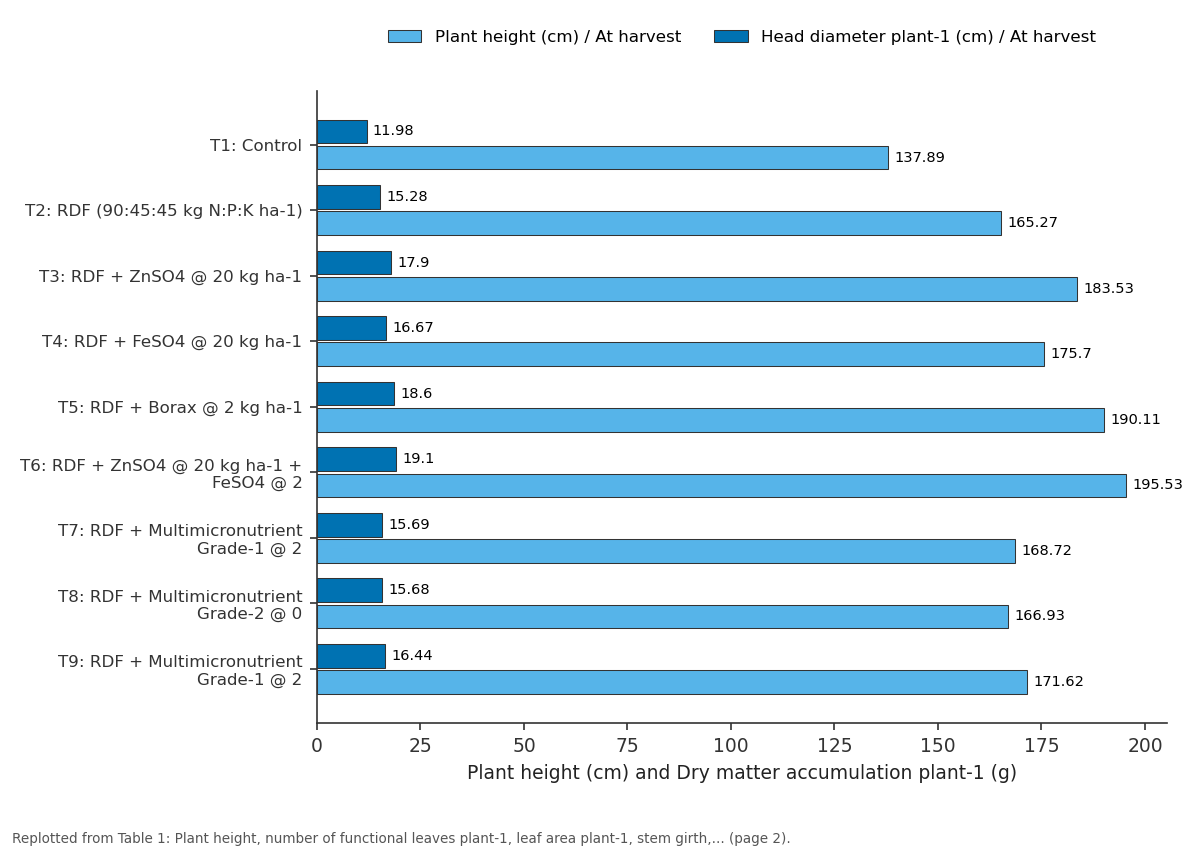
Plant height (cm) / At harvest and Head diameter plant-1 (cm) / At harvest: T1: Control vs T2: RDF (90:45:45 kg... vs T3: RDF + ZnSO4 @ 20 kg... vs T4: RDF + FeSO4 @ 20 kg... vs T5: RDF + Borax @ 2 kg
Replotted from Table 1 (page 2) of the original paper. Every bar is the paper's own table value.
View source evidence ↗Figures & tables
From the original paper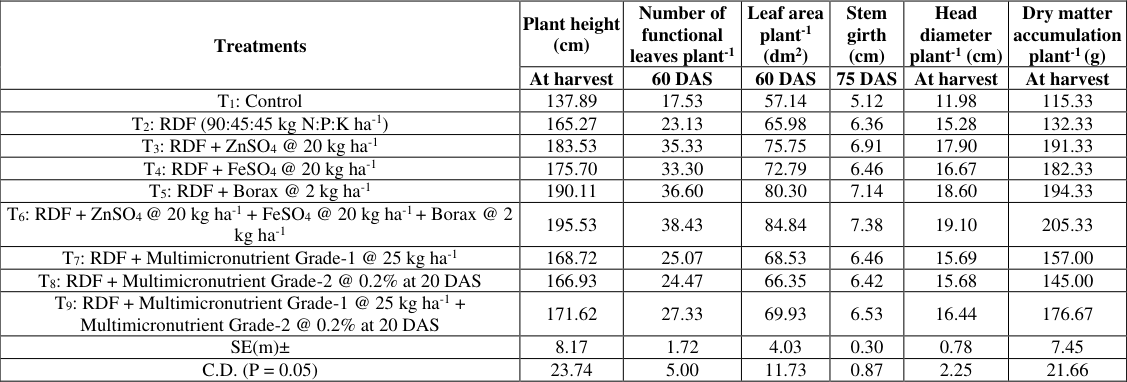 Table 1
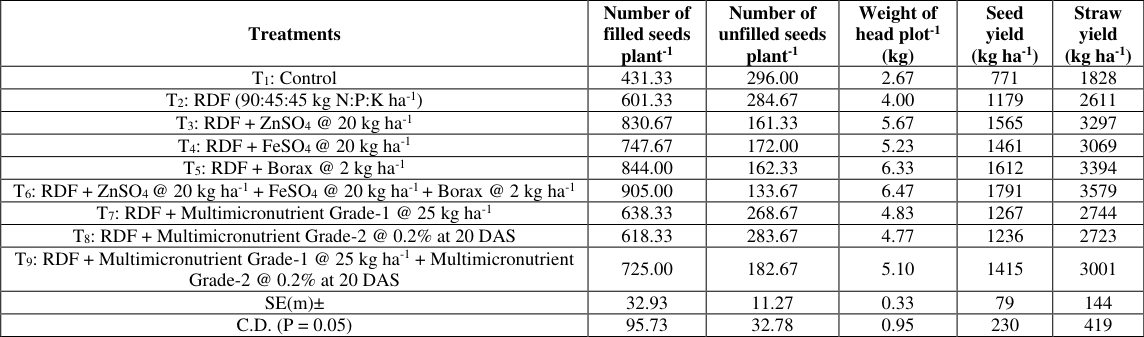 Table 2
Introduction
Sunflower being an important oilseed crop grown in kharif and rabi seasons across the country and holds fourth position after soybean, rapeseed and groundnut. The area under sunflower cultivation in India is 0.22 M ha, with the production of 0.23 MT and productivity of 1023 kg ha -1 in 2020-21 (GOI, 2021) [1] . In Maharashtra, sunflower is grown on 26,000 ha area with a production of 12,200 tonnes and productivity of 467.8 kg ha -1 (Krishi Vibhag, 2021) [2] . Sunflower is introduced in India from North America in 1969 to curtail the deficiency of country's edible oil production (Shankergoud et al., 2006) [3] . The kernel oil content ranges from 48 to 53% and for seed it ranges from 28 to 35%. The protein content ranges from 14 to 19%. The crude fibre and ash contents vary from 16 to 27% and 2.4 to 3.0%, respectively. High proportion of essential fatty acidlinoleic acid (18:2) which ranges between 40-67% considered to reduce blood cholesterol level and hence sunflower has a considerable significance. The oleic acid content of oil is 22-50% due to which it has greater oxidative stability and is useful as a frying oil in preparation of snack foods. Sunflower oil has light hue, bland flavour, high smoke point (252 -255 °C) and good nutritional value because of this it is considered as premium oil. Sunflower's protein score is 63 (Soluski and Sarware, 1973) [4] and essential amino acid index is 68 as against 79 for soybean and 100 for egg. Sunflower is also a good source of water-soluble B complex vitamins, namely nicotinic acid (318.7 mg kg -1 ), thiamine (37.8), pantothenic acid (44.8) and riboflavin (3.6). Its seeds also contain some antinutritional constituents such as chlorogenic acid (1.4 to 4.0%) and phenolic compounds (2.6 to 3.8%). Indian soils are generally deficient in nutrient status, particularly with respect to micronutrients. During 1960s, green revolution led to increase in food grain production to feed nation's rapidly increasing population but reduced soil fertility by depleting micronutrient reserves of soil. Later on, intensification of agriculture led to further depletion of micronutrient reserves causing the deficiency of other micronutrients besides aggravating the existing ones (Takkar and Shukla, 2015) [5] . Farmers are indiscriminately using micronutrient fertilizers which is also leading towards the depletion of soil fertility. In order to tackle the above challenges, the present investigation was formulated to improve growth and productivity of sunflower.
Materials and Methods
The experiment was conducted at Experimental Farm, Agronomy Section, Oilseeds Research Station, Latur to study the effect of different micronutrients on growth and yield of sunflower (Helianthus annuus L.) during kharif, 2022. The soil of experimental plot was clayey in texture, neutral in reaction having pH (7.02), low in available nitrogen (231 kg ha -1 ), very low in available phosphorus (8.57 kg ha -1 ), very high in available potassium (579.80 kg ha -1 ) and deficient in micronutrients. Soil was well-drained which was favourable for optimum growth of the crop. The experiment was laid out in randomized block design with 9 treatments replicated thrice. The truthful seed of sunflower var. LSFH-171 was used for sowing with a seed rate of 5 kg ha -1 . Sowing was done by dibbling on 17 July, 2022 and the recommended dose of fertilizer used was 90:45:45 kg N:P:K ha -1 . Nitrogen, phosphorus and potash (90:45:45 kg ha -1 ) was applied through urea (46% N), single super phosphate (16% P 2 O 5 , 48% N) and muriate of potash (60% KCl), respectively. Half dose of nitrogen and full dose of phosphorus and potash were applied in furrow at the time of sowing and remaining half dose of nitrogen was top dressed 30 DAS. Zinc sulphate (21% Zn), ferrous sulphate (19% Fe), borax (11% B) and multimicronutrient grade-1 (2% Fe, 1% Mn, 5% Zn, 0.5% Cu, 1% B) were applied as soil application at sowing while multimicronutrient grade-2 (2.5% Fe, 1% Mn, 3% Zn, 1% Cu, 0.5% B, 0.1% Mo) was foliar sprayed 20 DAS as per the treatments. In control treatment, fertilizers were not applied. The treatments were T 1 -Control, T 2 -RDF (90:45:45 kg N:P:K ha - 1 ), T 3 -RDF + ZnSO 4 @ 20 kg ha -1 , T 4 -RDF + FeSO 4 @ 20 kg ha -1 , T 5 -RDF + Borax @ 2 kg ha -1 , T 6 -RDF + ZnSO 4 @ 20 kg ha -1 + FeSO 4 @ 20 kg ha -1 + Borax @ 2 kg ha -1 , T 7 -RDF + Multimicronutrient Grade-1 @ 25 kg ha -1 , T 8 -RDF + Multimicronutrient Grade-2 @ 0.2% at 20 DAS, T 9 -RDF + Multimicronutrient Grade-1 @ 25 kg ha -1 + Multimicronutrient Grade-2 @ 0.2% at 20 DAS. The recommended cultural practices and plant protection measures were undertaken as per recommendation. The crop was harvested on 12 October, 2022. Data on various variables were analyzed by analysis of variance at P = 0.05 level of probability (Panse and Sukhatme, 1967) [6] .
Results and Discussion
Results and Discussion
Growth attributes
Results presented in Table 1 reveal that growth attributes of sunflower viz. plant height, leaf area plant -1 , stem girth, head diameter and dry matter accumulation plant -1 of sunflower were influenced significantly due to different treatments.
| Treatments | Plant height (cm) | Number of functional leaves plant-1 | Leaf area plant-1 (dm2) | Stem girth (cm) | Head diameter plant-1 (cm) | Dry matter accumulation plant-1 (g) |
|---|---|---|---|---|---|---|
| At harvest | 60 DAS | 60 DAS | 75 DAS | At harvest | At harvest | |
| T1: Control | 137.89 | 17.53 | 57.14 | 5.12 | 11.98 | 115.33 |
| T2: RDF (90:45:45 kg N:P:K ha-1) | 165.27 | 23.13 | 65.98 | 6.36 | 15.28 | 132.33 |
| T3: RDF + ZnSO4 @ 20 kg ha-1 | 183.53 | 35.33 | 75.75 | 6.91 | 17.90 | 191.33 |
| T4: RDF + FeSO4 @ 20 kg ha-1 | 175.70 | 33.30 | 72.79 | 6.46 | 16.67 | 182.33 |
| T5: RDF + Borax @ 2 kg ha-1 | 190.11 | 36.60 | 80.30 | 7.14 | 18.60 | 194.33 |
| T6: RDF + ZnSO4 @ 20 kg ha-1 + FeSO4 @ 20 kg ha-1 + Borax @ 2 kg ha-1 | 195.53 | 38.43 | 84.84 | 7.38 | 19.10 | 205.33 |
| T7: RDF + Multimicronutrient Grade-1 @ 25 kg ha-1 | 168.72 | 25.07 | 68.53 | 6.46 | 15.69 | 157.00 |
| T8: RDF + Multimicronutrient Grade-2 @ 0.2% at 20 DAS | 166.93 | 24.47 | 66.35 | 6.42 | 15.68 | 145.00 |
| T9: RDF + Multimicronutrient Grade-1 @ 25 kg ha-1 + Multimicronutrient Grade-2 @ 0.2% at 20 DAS | 171.62 | 27.33 | 69.93 | 6.53 | 16.44 | 176.67 |
| SE(m)± | 8.17 | 1.72 | 4.03 | 0.30 | 0.78 | 7.45 |
| C.D. (P = 0.05) | 23.74 | 5.00 | 11.73 | 0.87 | 2.25 | 21.66 |
Table text extracted from the original PDF; superscript letters are shown inline. The original table image is below.
View original table image
Application of RDF + ZnSO 4 @ 20 kg ha -1 + FeSO 4 @ 20 kg ha - 1 + Borax @ 2 kg ha -1 (T 6 ) recorded highest plant height (195.53 cm) which was at par with the application of RDF + Borax @ 2 kg ha -1 (T 5 ), RDF + ZnSO 4 @ 20 kg ha -1 (T 3 ) and RDF + FeSO 4 @ 20 kg ha -1 (T 4 ). This might be due to involvement of zinc in biosynthesis of plant hormoneauxin, protein synthesis and activates over 300 enzymes in plants. Zinc, iron and boron help in better utilization of nitrogen and phosphorus in plant which in turn maintains a synergistic relationship among nutrients and leads to vigorous growth. The results obtained are in accordance with the findings of Chowdhary et al. (2010) [7] .
Number of functional leaves plant -1 and leaf area plant -1 (dm 2 )
The maximum number of functional leaves plant -1 (38.43) and leaf area plant -1 (84.84 dm 2 ) were obtained with the application of RDF + ZnSO 4 @ 20 kg ha -1 + FeSO 4 @ 20 kg ha -1 + Borax @ 2 kg ha -1 (T 6 ) which was at par with RDF + Borax @ 2 kg ha -1 (T 5 ) and RDF + ZnSO 4 @ 20 kg ha -1 (T 3 ) and found significantly superior over rest of the treatments. Higher number of functional leaves plant -1 and leaf area plant -1 might be due to better growth of meristem and sufficient supply of micronutrients in an adequate proportion to the plant. The results are confirmative with the findings of Pattanayak et al.
(2016) [8] and Indu and Singh (2020) [9] .
Stem girth (cm) and head diameter plant -1 (cm) Significantly higher stem girth at 75 DAS (7.38 cm) and head diameter plant -1 (19.10 cm) were recorded with the combined application of RDF + ZnSO 4 @ 20 kg ha -1 + FeSO 4 @ 20 kg ha -1 + Borax @ 2 kg ha -1 (T 6 ) over rest of the treatments and found to be at par with RDF + Borax @ 2 kg ha -1 (T 5 ) and RDF + ZnSO 4 @ 20 kg ha -1 (T 3 ). Increase in stem girth and head diameter plant -1 might be attributed to the influence of boron and zinc responsible for boosting the borate-sugar complex formation and its translocation through the plant from source to sink and assimilation in the sink (head). These results are in accordance with findings of Kawade et al. (2018) [10] and Elayaraja et al.
Dry matter accumulation plant -1 (g) Significantly highest dry matter accumulation plant -1 (205.33 g) was recorded with the combined application of RDF + ZnSO 4 @ 20 kg ha -1 + FeSO 4 @ 20 kg ha -1 + Borax @ 2 kg ha -1 (T 6 ) over rest of the treatments and found to be at par with RDF + Borax @ 2 kg ha -1 (T 5 ) and RDF + ZnSO 4 @ 20 kg ha -1 (T 3 ).
Higher dry matter accumulation plant -1 might be due to the effect of micronutrients i.e., zinc, iron and boron in combination leads to the better vegetative and reproductive growth of plant by synthesizing plant growth promoting hormones and enhancing photosynthetic potential of the plants. Similar results were reported in the findings of Rahul et al. (2011) [12] and Rex Immanuel et al. (2019) [13] .
Yield and yield attributes
Results showed in Table 2 reveal that number of filled seeds plant -1 , number of unfilled seeds plant -1 , weight of head plot -1 , seed yield and straw yield were influenced significantly due to different treatments.
| Treatments | Number of filled seeds plant-1 | Number of unfilled seeds plant-1 | Weight of head plot-1 (kg) | Seed yield (kg ha-1) | Straw yield (kg ha-1) |
|---|---|---|---|---|---|
| T1: Control | 431.33 | 296.00 | 2.67 | 771 | 1828 |
| T2: RDF (90:45:45 kg N:P:K ha-1) | 601.33 | 284.67 | 4.00 | 1179 | 2611 |
| T3: RDF + ZnSO4 @ 20 kg ha-1 | 830.67 | 161.33 | 5.67 | 1565 | 3297 |
| T4: RDF + FeSO4 @ 20 kg ha-1 | 747.67 | 172.00 | 5.23 | 1461 | 3069 |
| T5: RDF + Borax @ 2 kg ha-1 | 844.00 | 162.33 | 6.33 | 1612 | 3394 |
| T6: RDF + ZnSO4 @ 20 kg ha-1 + FeSO4 @ 20 kg ha-1 + Borax @ 2 kg ha-1 | 905.00 | 133.67 | 6.47 | 1791 | 3579 |
| T7: RDF + Multimicronutrient Grade-1 @ 25 kg ha-1 | 638.33 | 268.67 | 4.83 | 1267 | 2744 |
| T8: RDF + Multimicronutrient Grade-2 @ 0.2% at 20 DAS | 618.33 | 283.67 | 4.77 | 1236 | 2723 |
| T9: RDF + Multimicronutrient Grade-1 @ 25 kg ha-1 + Multimicronutrient Grade-2 @ 0.2% at 20 DAS | 725.00 | 182.67 | 5.10 | 1415 | 3001 |
| SE(m)± | 32.93 | 11.27 | 0.33 | 79 | 144 |
| C.D. (P = 0.05) | 95.73 | 32.78 | 0.95 | 230 | 419 |
Table text extracted from the original PDF; superscript letters are shown inline. The original table image is below.
View original table image
Number of filled seeds plant -1
Maximum number of filled seeds plant -1 (905) were obtained by the application of RDF + ZnSO 4 @ 20 kg ha -1 + FeSO 4 @ 20 kg ha -1 + Borax @ 2 kg ha -1 (T 6 ) which was at par with RDF + Borax @ 2 kg ha -1 (T 5 ) (844) and RDF + ZnSO 4 @ 20 kg ha -1 (T 3 ) (830.67) and found significantly superior over rest of the treatments. This might be due to the efficient translocation and assimilation of photosynthates to the sink from source, pollen germination and pollen viability due to the application of boron. In addition to boron, zinc also contributes to flowering and fruit set and hence number of filled seeds plant -1 increased. The inferences are confirmative with the findings of Elayaraja et al. (2019) [11] and Waghmare et al. (2022) [14] .
Number of unfilled seeds plant -1
Minimum number of unfilled seeds plant -1 (133.67) were obtained by the application of RDF + ZnSO 4 @ 20 kg ha -1 + FeSO 4 @ 20 kg ha -1 + Borax @ 2 kg ha -1 (T 6 ) which was at par with RDF + ZnSO 4 @ 20 kg ha -1 (T 3 ) (161.33) and RDF + Borax @ 2 kg ha -1 (T 5 ) (162.33) and found significantly superior over rest of the treatments. Unfilled seeds are the effect of numerous factors including Zn, Fe and B deficiency in the center of the capitulum. Lower the number of chaffy seeds, higher will be the production of crop. The findings were supported by Chowdhary et al. (2010) [7] and Gawande et al. (2022) [15] .
Application of RDF + ZnSO 4 @ 20 kg ha -1 + FeSO 4 @ 20 kg ha - 1 + Borax @ 2 kg ha -1 (T 6 ) was found to record maximum weight of head plot -1 (6.47 kg) which was at par with RDF + Borax @ 2 kg ha -1 (T 5 ) (6.33 kg) and RDF + ZnSO 4 @ 20 kg ha -1 (T 3 ) (5.67 kg) and found significantly superior over rest of the treatments.
Significantly maximum seed yield (1791 kg ha -1 ) was obtained with the application of RDF + ZnSO 4 @ 20 kg ha -1 + FeSO 4 @ 20 kg ha -1 + Borax @ 2 kg ha -1 (T 6 ) over rest of the treatments and found to be at par with RDF + Borax @ 2 kg ha -1 (T 5 ) (1612 kg ha -1 ) and RDF + ZnSO 4 @ 20 kg ha -1 (T 3 ) (1565 kg ha -1 )
The increased seed yield caused by the application of boron may most likely owing to a healthy balance of photosynthesis and respiration. Along with boron, zinc and iron also plays a pivotal role in increasing seed yield by better partitioning of assimilates to the sink. These micronutrients increase the uptake of macronutrients which enhances the vegetative and reproductive growth of the crop and hence productivity of the crop is increased. These findings are confirmative with those of Ramulu et al. (2011) [16] and Rex Immanuel (2019) [17] .
Straw yield (kg ha -1 ) Application of RDF + ZnSO 4 @ 20 kg ha -1 + FeSO 4 @ 20 kg ha - 1 + Borax @ 2 kg ha -1 (T 6 ) was found to record maximum straw yield (3579 kg ha -1 ) which was at par with RDF + Borax @ 2 kg ha -1 (T 5 ) (3394 kg ha -1 ) and RDF + ZnSO 4 @ 20 kg ha -1 (T 3 ) (3297 kg ha -1 ) and found significantly superior over rest of the treatments.
Higher straw yield might be attributed to the better growth and development of crop because of application of micronutrients. These findings are in confirmative with the findings of Kumbhar (2017) [18] and Rahul et al. (2021) [12] .
Conclusion
From the above study it can be concluded that application of RDF along with combined application of ZnSO 4 @ 20 kg ha -1 + FeSO 4 @ 20 kg ha -1 + Borax @ 2 kg ha -1 (T 6 ) performed better in terms of growth and productivity of sunflower.
References
15 in the original paper- Anonymous. Krishi Vibhag, Maharashtra Sashan 2021b. [Weblink: https://krishi.maharashtra.gov.in]. [Visited on March 9, 2023].
- Shankergoud I, Shadakshari YG, Parameshwarappa KG, Chandranath HT, Katti P, Mesta RK. Sunflower and castor research in Karnataka -An Overview. University of Agricultural Sciences, Dharwad. 2006, 41.
- Soluski FW, Sarware G. Amino acid composition of oilseed meal and protein isolates. Canadian Institute of Food Science Journal. 1973;6:1-5.
- Pathak H, Sanyal SK and Takkar PN (Eds.) at NAAS, New Delhi, 2015, 121-152.
- Chowdhary AR, Setty TK, Nagarathna TK. Growth and yield of sunflower (Helianthus annuus L.) as influenced by micronutrient application in alfisols. Karnataka Journal of Agricultural Sciences. 2010;23(3):495-496.
- Pattanayak S, Behera A, Jena SN, Das P, Behera S. Growth and yield of sunflower (Helianthus annuus L.) hybrids under different nutrient management practices. International Journal of Bio-resource and Stress Management. 2016;7(4):845-850.
- Indu T, Singh R. Effect of sulphur and boron on growth and yield of sunflower (Helianthus annuus L.). International Journal of Current Microbiology and Applied Sciences. 2020;9(8):3320-3323.
- Kawade MB, Jadhav DB, Arshewar SP. Effect of micronutrients on growth, yield and quality of sunflower in kharif season. International Journal of Current Microbiology and Applied Sciences. 2018;SP-6:2189-2196.
- Elayaraja D, Kamalakannan P, Sathiyamurthi S. Effect of secondary and micronutrient fertilization with composted coirpith on the yield and nutrients uptake by sunflower in coastal saline soil. International Archive of Applied Sciences and Technology. 2019;10(2):01-05.
- Rahul G, Singh R, Singh E. Effect of levels of sulphur and boron on performance of sunflower (Helianthus annuus L.). The Pharma Innovation Journal. 2021;10(11):1605-1608.
- Rex Immanuel R, Saravanan D, Sudhagar Rao GB, Thiruppathi M, Saravanaperumal M. Zinc and boron micronutrient fertilization on the growth and physiological attributes of sunflower in rice-sunflower cropping sequence. Plant Archives. 2019;19(2):3015-3020.
- Waghmare PS, Suryavanshi VP, Gawande RS, Sawant DS, Kokate AP. Effect of zinc sulphate and ferrous sulphate on growth and yield of sunflower. The Pharma Innovation Journal. 2022;11(1):1334-1336.
- Gawande RS, Karanjikar PN, Waghmare PS, Kokate AP, Sawant DS. Effect of soil and foliar application of zinc sulphate and ferrous sulphate on growth and yield of sunflower (Helianthus annuus L.). The Pharma Innovation Journal. 2022;11(1):1349-1352.
- Ramulu N, Murthy K, Jayadeva HM, Venkatesha MM, Ravi Kumar HS. Seed yield and nutrient uptake of sunflower (Helianthus annuus L.) as influenced by different levels of nutrients under irrigated condition of Eastern dry zone of Karnataka, India. Plant Archives. 2011;11(2):1061-1066.
- Rex Immanuel R. Nutrient uptake and nutrient use efficiency of sunflower in response to Zn and B micronutrient fertilization. Plant Archives. 2019;19(2):543547.
Cited by 1
From OpenAlex, OpenCitations and reference lists read by Scinovex
- Effect of application of micronutrients on growth attributes and yield of sunflower (Helianthus annuus L.)
PS Lomate, AK Ghotmukale, VP Suryavanshi, DN Shinde, VR Bhairewad, NS Mali · International Journal of Research in Agronomy · 2026
A field experiment was conducted during kharif season, 2025 at Experimental Farm, Oilseeds Research Station, Latur (Maharashtra), to study the response of sunflower (Helianthus annuus L.) to different micronutrients. The experiment was laid out in a Randomized Block Design (RBD) with ten treatments replicated three times. The treatments were T1- RDF (90:45:45 kg N:P2O5:K2O ha−1), T2- RDF + ZnSO4 @ 20 kg ha−1, T3- RDF + ZnSO4 @ 25 kg ha−1, T4- RDF + FeSO4 @ 15 kg ha−1, T5- RDF + FeSO4 @ 20 kg ha−1, T6- RDF + Borax @ 4.0 kg ha−1, T7- RDF + Borax @ 5.0 kg ha−1, T8- RDF + Multi-micronutrient Grade