
Research article · 2024 · Full text
International Journal of Research in AgronomyImpact of front-line demonstration of Redgram + foxtail millet intercropping under rain-fed situation in Alkod village of Raichur District
Volume 7(3S) · Pages 367–369 · DOI: 10.33545/2618060x.2024.v7.i3se.486 ↗
Research areasAgronomic Practices and Intercropping SystemsAgricultural Economics and Practices
Abstract
Author-writtenA front line demonstration on production potential of redgram + foxtail millet intercropping system under rainfed conditions in Raichur district of Karnataka state carried out in farmers fields during 2018-19 and 2019-20 under ICAR-Krishi Vigyan Kendra, University of Agricultural Sciences, Raichur. Intercropping of foxtail millet and Redgram was sown with an objective that foxtail millet may be an alternative sustainable cropping system to sole redgram in rainfed conditions to improve the yields and income of the farmers at Alkod Village in the Raichur district. The average redgram yield was 9.73 q/ha during 2018-19 and 10.7 q/ha during 2019-20. The mean increase of equivalent yield of demo is 30% and 45% during 2018-19 and 2019-2020 respectively over the check. The higher gross (Rs. 56,701 and Rs 60,921) and net returns (Rs. 31748 and Rs. 32853) in redgram + foxtail millet intercropping over check during 2018-19 and 2019-2020 respectively, sole redgram might be higher due to redgram + foxtail millet intercropping yield, lower cost of cultivation during the study year. The mean benefit cost ratio was (1:2.27 and 1: 2.17) and (1: 2.05 and 1: 2.04) for demo and check during 2018-19 and 2019-2020 respectively.
Summary
Source-checkedPlain-language reading of the full paper, prepared with AI and checked against the text. Each point links to the authors' own words.
Why it matters
- Pigeon pea is a critical grain legume in India, ranking second after chickpea in both production and cropped area. View evidence ↗
- Intercropping short-duration millets with pigeon pea is efficient because millets grow rapidly during the pigeon pea's slow early growth stage. View evidence ↗
The question
- The study aimed to determine if intercropping foxtail millet with redgram could serve as a sustainable alternative to sole redgram cropping to increase farmer income and yields in rainfed conditions. View evidence ↗
What they did
- The research was conducted via front-line demonstrations (FLDs) in farmers' fields in Alkod village, Raichur district, during the 2018-19 and 2019-20 seasons. View evidence ↗
- Five demonstrations of redgram-millet intercropping were compared against adjacent 0.4 ha control plots using standard package of practices. View evidence ↗
- The study utilized the TS3R hybrid for redgram and the H-49 hybrid for foxtail millet. View evidence ↗
- The researchers measured grain yield, cost of cultivation, net returns, and the benefit-cost ratio (BCR). View evidence ↗
What they found
- In 2018-19, the redgram yield in the demonstration plot was 12.7 q/h compared to 9.7 q/h in the check plot, representing a 30.66% increase. View evidence ↗
- The intercrop (foxtail millet) yielded 6.75 kg/ha in 2018-19 and 7.05 kg/ha in 2019-20 in the demonstration plots. View evidence ↗
- For 2018-19, the intercropping system achieved higher gross returns (Rs. 56,701.2 vs Rs. 46,704.2) and net returns (Rs. 31,748.2 vs Rs. 23,920.2) than the check. View evidence ↗
- The benefit-cost ratio (BCR) for the intercropping demonstration was 2.27 in 2018-19 and 2.17 in 2019-20, compared to 2.05 and 2.04 for the check plots. View evidence ↗
- The introduction of foxtail millet as an intercrop did not significantly affect the plant height of the redgram. View evidence ↗
What it means
- The authors conclude that intercropping high-yielding redgram with foxtail millet is a beneficial alternative to cropping maize and cotton. View evidence ↗
Visual summary
3 visualsIllustrations explain the paper; charts are replotted from the paper's own table values.
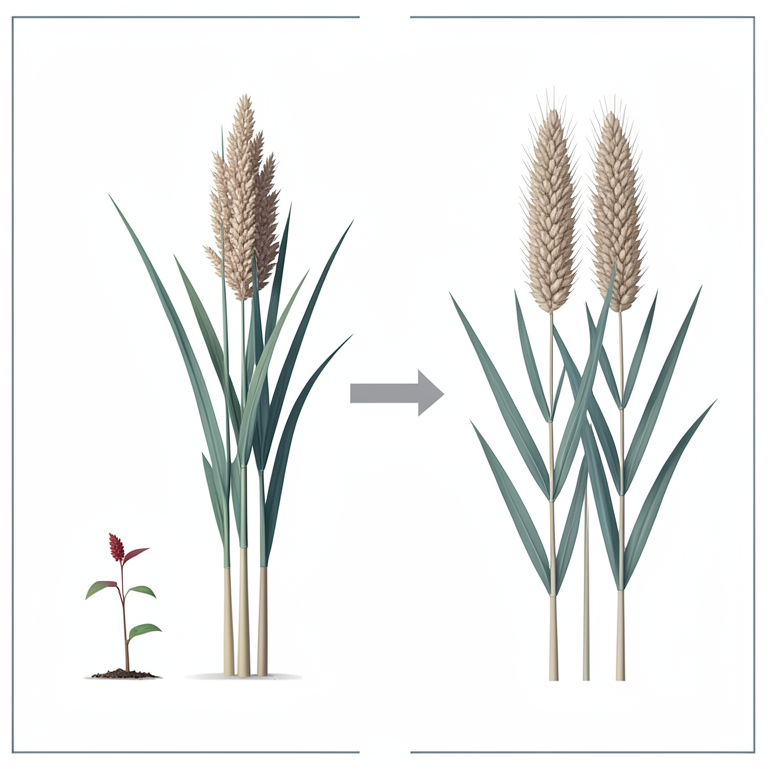
Intercropping Growth Synergy
AI-generated conceptual illustration (Redgram (pigeon pea) and foxtail millet plants). It explains the idea and does not show study data.
View source evidence ↗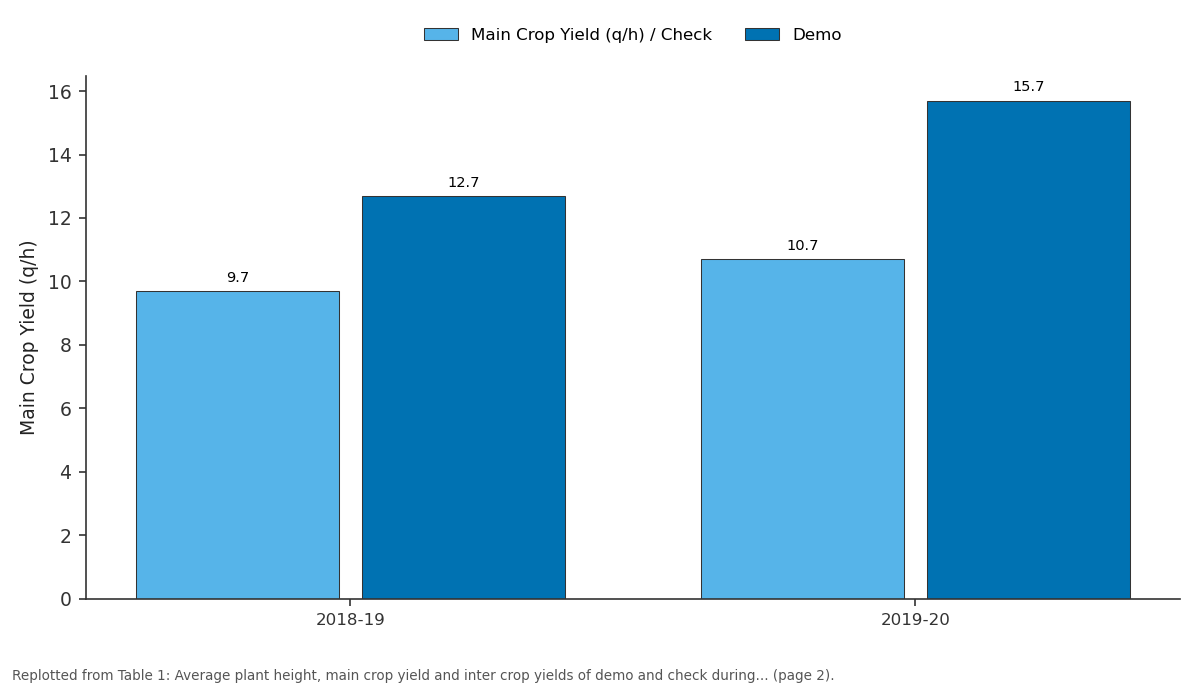
Main Crop Yield (q/h) / Check and Demo: 2018-19 vs 2019-20
Replotted from Table 1 (page 2) of the original paper. Every bar is the paper's own table value.
View source evidence ↗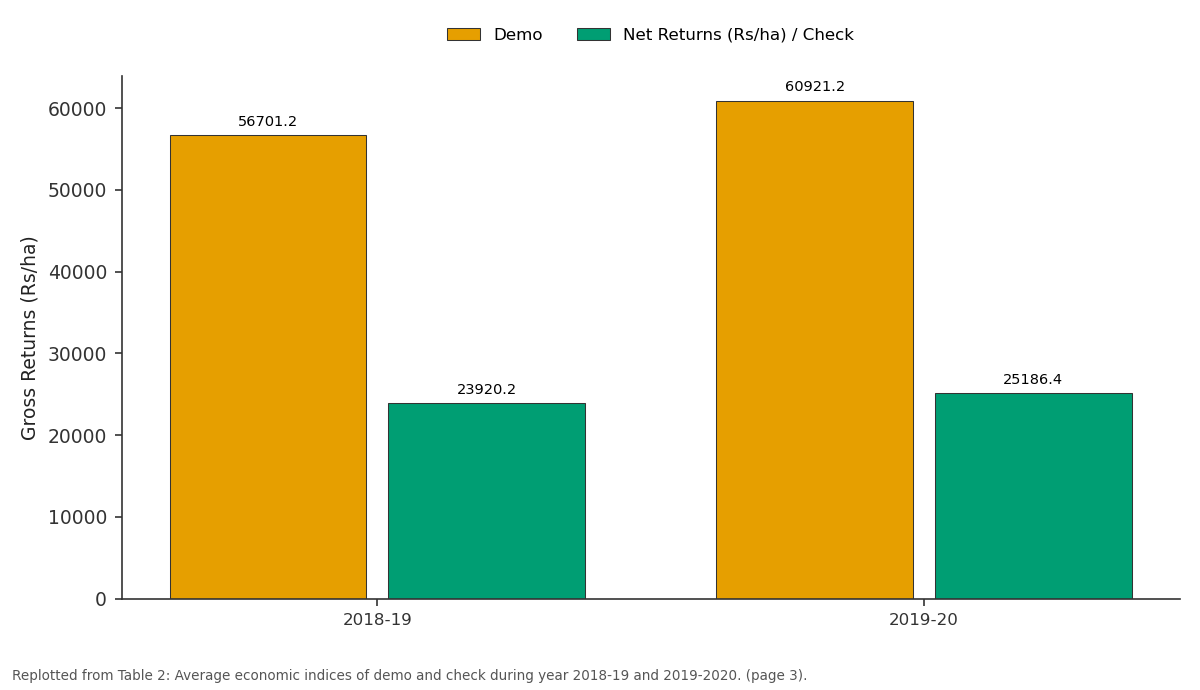
Demo and Net Returns (Rs/ha) / Check: 2018-19 vs 2019-20
Replotted from Table 2 (page 3) of the original paper. Every bar is the paper's own table value.
View source evidence ↗Figures & tables
From the original paper Table 1
 Table 2
Introduction
Pigeon pea (Cajanus cajan L.) is India's second most important grain legume crop after chickpea, It occupies 1.76% of the gross cropped area and 22% of the total pulse production in India. It is also an abundant source of minerals and vitamins (Saxena et al, 2002) [5] . Floral decoctions are used for bronchitis, cough and cold, pneumonia, dysentery and menstrual disorders (Singh & Kaur, 2012) [6] . The active constituents in the leaves and seeds are alkaloids, cyanogenic glycosides, flavonoids, saponins and tannins (Aja et al, 2015) [1] In addition, Cajanus cajan is a natural barrier to soil erosion and a biological factory for fixing atmospheric nitrogen in the soil. The plant also has ethnomedicinal uses. The infusion of leaves is used to treat anaemia, hepatitis, diabetes, urinary infections, yellow fever and other skin irritations (especially in females). In India, pigeonpea ranks second in both area and production, next only to chickpea. It is grown over an area of 3.38 m ha producing nearly 2.88 mt with an average productivity of 640 kg ha -1 (Indiastat, 2018) [2] . It is an important component of the country's agro-ecological systems, mostly intercropped with cereals, pulses, commercial crops, oilseeds, and millets. Pigeon pea is a prominent pulse crop in Karnataka, produced on 0.73 million hectares with a production of 0.47 million tonnes. However, production (651 kg/ha) is significantly lower than the national average (729 kg/ha) due to several abiotic and biotic restrictions. Pigeon pea is a rainfed crop with various traits that allow it to flourish in severe climates. It adapts well to both single-crop and intercrop circumstances (with cereals, millets, oilseeds and pulses) increasing system productivity and net income for small and marginal farmers. It occupies 1.76 % of the gross cropped area and 22 % of the total pulse production in India. In India, pigeonpea ranks second in both area and production, next only to chickpea. It is grown over an area of 3.38 m ha producing nearly 2.88 m t with an average productivity.
In low-input agriculture systems in tropical regions, intercropping techniques are now widely used. Intercropping in some crops can cause efficient land use, which is an important component of sustainable agriculture (Karlidag, 2009) [3] . Furthermore, cropping of several plant species together may reduce the adverse effects of a monoculture and thus can be employed in ecological agricultural systems. We think that the ridge of agricultural fields can be utilized in intercropping systems. Millets are commonly referred to as "nutrigrains" due to their high mineral content and B-complex vitamins. Small millets are considered "climate resilient" crops in Indian agriculture due to their early maturity, better yields due to the C4 plant type and ability to yield even in poor soil under low rainfall and poor management circumstances. Small millets contribute significantly to the nation's food and fodder security. Foxtail millet and barnyard millet have the lowest glycemic index of the minor millets. These grains, termed "wonder grains," have shown beneficial health advantages for diabetics. Foxtail millet can be sown when most other crops have already been planted. In Karnataka, foxtail millet is generally called as navane. It can be cultivated on dry land even in extreme weather conditions when other crops cannot be grown. It is also known as famine reserve and is widely planted in low-rainfall areas. Foxtail millet is a major crop in India's arid and semi-arid regions. It has long been a staple meal in South India. It is a warm season crop that is normally cultivated in late spring and harvested for grain around 75-90 days. Enhancing the productivity of the crop assumes specific significance in India mainly to combat protein malnutrition as it is the main source of protein to the predominant vegetarian population. The main concept of intercropping is to get increased total productivity per unit area and time, besides equitable and judicious utilization of land resources and farming inputs including labour. One of the main reasons for higher yields in intercropping is that the component crops are able to use growth resources differently and make better overall use of growth resources than grown separately (Willey, 1979) [7] . Besides, the growth of pigeonpea is very slow in the early stages, during which time the more rapidly growing short duration millets like foxtail millet, pearl millet and sorghum can be conveniently intercropped to utilize the natural resources most efficiently in the early stages of pigeonpea.
Materials and Methods
The present study was carried out by ICAR-KVK, Raichur in Alkod village of Devadurga taluk, Raichur district based on the FLD's conducted from 2018-19 and 2019-20 in the farmer's field in different locations of the district. Total 5 demonstrations were conducted on Redgram intercropping with Millets in alkod village for two continuous years. Each frontline demonstration was laid out and the critical inputs were applied as per the package of practices while adjacent 0.4 ha was taken as control for comparison of farmer's practice. The selection of farmers was done, on basis of survey by ICAR-KVK, Raichur and imparted trainings to the selected farmers on agronomic and package of practices in Millets intercropping with Redgram. Field days were also conducted in each cluster to show the results of front-line demonstrations to the farmers of the same and neighboring villages. The yield and economic performance of front-line demonstrations, the output was collected from FLDs as well as local control plots from all selected farmers of Millets intercropping with Redgram for analysis and interpretation of the data. The data is interpreted and presented in terms of percentage and the qualitative data were converted into quantitative form and expressed in terms of per cent increased yield. Finally, the grain yield, cost of cultivation, net returns with benefit cost ratio was worked out. An average of cost of cultivation, yield and net returns of different farmers was analyzed by the formula. Average = [F1+ F2+F3. . . . . . . . . . . .. Fn]/N; F1 = Farmer; N = No. of Farmers. In the present study, technology index was operationally defined as technical feasibility obtained due to implementation of front-line demonstrations.
Results and Discussions
To minimize the risk to bring stability, intercropping systems were demonstrated, in Alkod and Koppar village of Devadurga taluk, Raichur district based on the FLD's conducted from 2018-19 and 2019-20. The high yielding hybrid of redgram (TS3R) and Foxtail millet (H-49) recorded a grain yield of redgram 12.7 and 15.7 (q/ha) for two consecutive years respectively and a grain yield of foxtail millet was 6.75 and 7.05 (kg/ha) for two consecutive years respectively. Demo plot yield was 30 % increased when compared to check in main crop and in intercrop.
Economic indices of demo and check.
The results revealed that, the maximum plant height was seen in demo for two years i.e 152.8 cms and 156.4 cms respectively with an average mean of 154.6 cms. While, higher yield was noticed in demo of main crop for two years that is 12.7 q/h and 15.7 q/h respectively with an average mean of 14.2 over check and mean increase of yield of demo was 30.66 and 45.15 respectively for two years (Table 1). However, the maximum yield of inter crop for two years (2018-19 and 2019-20) was seen in demo plot i.e 6.75 kg/ha and 7.05 kg/ha over check respectively same results was seen by Praveen et al., (2022) [4] . The plant height is not significantly affected due to introduction of foxtail millet as an intercrop in redgram. Foxtail millet was found to be an effective intercrop combination over sole crop redgram. Intercropping system of redgram and foxtail millet gave net income of Rs. 23920/-and 31748/-for the year 2018-19 and Rs. 25186/-and 32853/-for the year 2019-20m (Table 2) in 5+5 farmer's field. The proven intercropping systems based on the experiences are being scaled up by ICAR-KVK, Raichur through front line demonstrations similar results was obtained by Praveen et al., (2022) [4] .
| Year | Cost of Cultivation | — | Gross Returns (Rs/ha) | — | Net Returns (Rs/ha) | — | BCR | — |
|---|---|---|---|---|---|---|---|---|
| Check | Demo | Check | Demo | Check | Demo | Check | Demo | |
| 2018-19 | 22784.0 | 24953.0 | 46704.2 | 56701.2 | 23920.2 | 31748.2 | 2.05 | 2.27 |
| 2019-20 | 24242.0 | 28068.0 | 49428.4 | 60921.2 | 25186.4 | 32853.2 | 2.04 | 2.17 |
| Mean | 23513.0 | 26510.5 | 48066.3 | 58811.2 | 24553.3 | 32300.7 | 2.0 | 2.2 |
Table text extracted from the original PDF; superscript letters are shown inline. The original table image is below.
View original table image
| Year | Plant Height (cms) | — | Main Crop Yield (q/h) | — | Inter Crop Yield (Kg/ha) | — | % inc. |
|---|---|---|---|---|---|---|---|
| Check | Demo | Check | Demo | Check | Demo | ||
| 2018-19 | 153.1 | 152.8 | 9.7 | 12.7 | 0.00 | 6.75 | 30.66 |
| 2019-20 | 148.0 | 156.4 | 10.7 | 15.7 | 0.00 | 7.05 | 45.15 |
| Mean | 150.5 | 154.6 | 10.2 | 14.2 | 0.00 | 6.90 | 37.90 |
Table text extracted from the original PDF; superscript letters are shown inline. The original table image is below.
View original table image
Conclusion
The farmers harvested good crop yield from intercropping of high yielding redgram with foxtail millet compared to sole cropping and obtained highest yield and % increase in yield and net returns. While net returns of Rs. 31748/-and Rs. 32853/-for two consecutive years with benefit cost ratio of 2.27 and 2.17 respectively. The farmers benefited with of high yielding redgram intercropped with foxtail millet, which was introduced as alternate to crop to maize and cotton. ICAR-KVK, Raichur conducted field days and showed the results to other farmers in the village.
References
7 in the original paper- Aja PM, Alum EU, Ezeani NN, Nwali BU, Edwin N. Comparative Phytochemical Composition of Cajanus cajan Leaf and Seed. Int. J. Microb. Res. 2015;6:42-46.
- Indiastat. 2018. Online databases. In: http://www.indiastat.com.
- Karlidag H, Yildirim E. Strawberry intercropping with vegetables for proper utilization of space and resources. J. Sustain. Agric. 2009;33:107-116. doi: 10.1080/10440040802587462.
- Praveen N, et al., Impact of front-line demonstration of millets + redgram intercropping under rain-fed situation in rangareddy district. The pharma innovation journal. 2022;11(7):4194-4197.
- Saxena KB, Kumar RV, Rao PV. Pigeonpea nutrition and its improvement. Quality Improvement in Field Crops. Food Products Press. 2002;5:227-260.
- Singh B, Kaur S. Review of Cajanus cajan as important medicinal plant. Int. J. Nat. Prod. Sci. 2012;1:140.
- Willey RW. Intercropping, its importance and research needs. Part-1. Competition and yield advantages. Field crops Abstr. 1979;32:1-10.
Cited by 1
From OpenAlex, OpenCitations and reference lists read by Scinovex
- Impact of red gram variety WRGe-97 under Front-line Demonstration (FLD’s) of Soyabean + Redgram intercropping under rain-fed situation in Sangareddy district
Kanchan Vishwakarma, K. Saritha, Ranju Ravindran Santhakumari Manoj, Jampala Rajashekar · International Journal of Research in Agronomy · 2025
This study was conducted under Front Line Demonstrations (FLDs) during 2022-23 and 2023-24 in Sangareddy district to enhance yield, reduce risk, and minimize pest and disease incidence through intercropping systems. The demonstration focused on comparing two varieties of red gram, WRGe-97 and a local variety. WRGe-97 exhibited significantly higher yields, with 8.8 qt/ha in 2022-23 and 9 qt/ha in 2023-24, outperforming the local variety, which recorded 6.5 qt/ha and 6.9 qt/ha, respectively. The average yield increase for WRGe-97 over the local variety was 30%. The plant height for WRGe-97 in th