
Research article · 2024 · Full text
International Journal of Agriculture Extension and Social DevelopmentFarming realities: An in-depth exploration of constraints encountered by both member and non-member farmers of FPO constraints encountered by farmers of FPO
Volume 7(3) · Pages 640–644 · DOI: 10.33545/26180723.2024.v7.i3g.482 ↗
Research areasAgricultural Economics and Practices
Abstract
Author-writtenEncouraging and supporting member-owned producer organizations is essential to providing farmers with the necessary tools for enhancing productivity through efficient, affordable, and sustainable resource use, ultimately leading to higher returns. These organizations can achieve this through coordinated efforts, backed by government support and successful partnerships with the private sector, academia, research organizations, societal groups, and the public sector. A total of 252 sample farmers were chosen for the study, comprising 126 members and 126 non-member farmers. The research needed to include both primary and secondary data in order to comprehend the effectiveness of farmer-producer associations.
Summary
Source-checkedPlain-language reading of the full paper, prepared with AI and checked against the text. Each point links to the authors' own words.
Why it matters
- Farmer Producer Organizations (FPOs) are critical for ensuring sustainable income for farmers by enabling the fast spread of technology and knowledge across small-scale farming networks. View evidence ↗
- Supporting member-owned producer organizations is necessary to give farmers tools that improve productivity and resource use, which leads to higher financial returns. View evidence ↗
The question
- The study aimed to identify and rank the constraints faced by farmers in pomegranate production to help develop policies and strategies that improve agricultural productivity. View evidence ↗
What they did
- The research was conducted in the Pune, Sangli, Satara, and Solapur districts of Western Maharashtra, areas selected for their significant pomegranate cultivation. View evidence ↗
- The study sampled a total of 252 farmers, split equally between 126 FPO members and 126 non-members. View evidence ↗
- The researchers used Garrett's ranking technique to analyze and prioritize the restrictions encountered by both member and non-member farmers. View evidence ↗
What they found
- For FPO members, the primary constraint was a lack of coordination for various group activities, which ranked first with a mean Garrett score of 54.31 (reported as 54.42 in text). View evidence ↗
- The second most significant constraint for FPO members was inadequate individual profit, with a mean Garrett score of 53.54. View evidence ↗
- Ignorance of member security was the third highest constraint for FPO members, scoring 52.42. View evidence ↗
- For non-member farmers, the top constraint was the difficulty in controlling Oily Spot attacks, which ranked first with a mean Garrett score of 56.30. View evidence ↗
- Non-member farmers ranked price uncertainty as their second most significant problem, with a mean Garrett score of 54.40. View evidence ↗
- The third most critical constraint for non-member farmers was a lack of technical knowledge, scoring 52.19. View evidence ↗
What it means
- The authors concluded that FPOs are beneficial to farmers, although they are still in an early stage of development. View evidence ↗
- The authors recommend improving the managerial and leadership skills of FPO CEOs, members, and boards through training and certificate programs. View evidence ↗
Visual summary
2 visualsIllustrations explain the paper; charts are replotted from the paper's own table values.
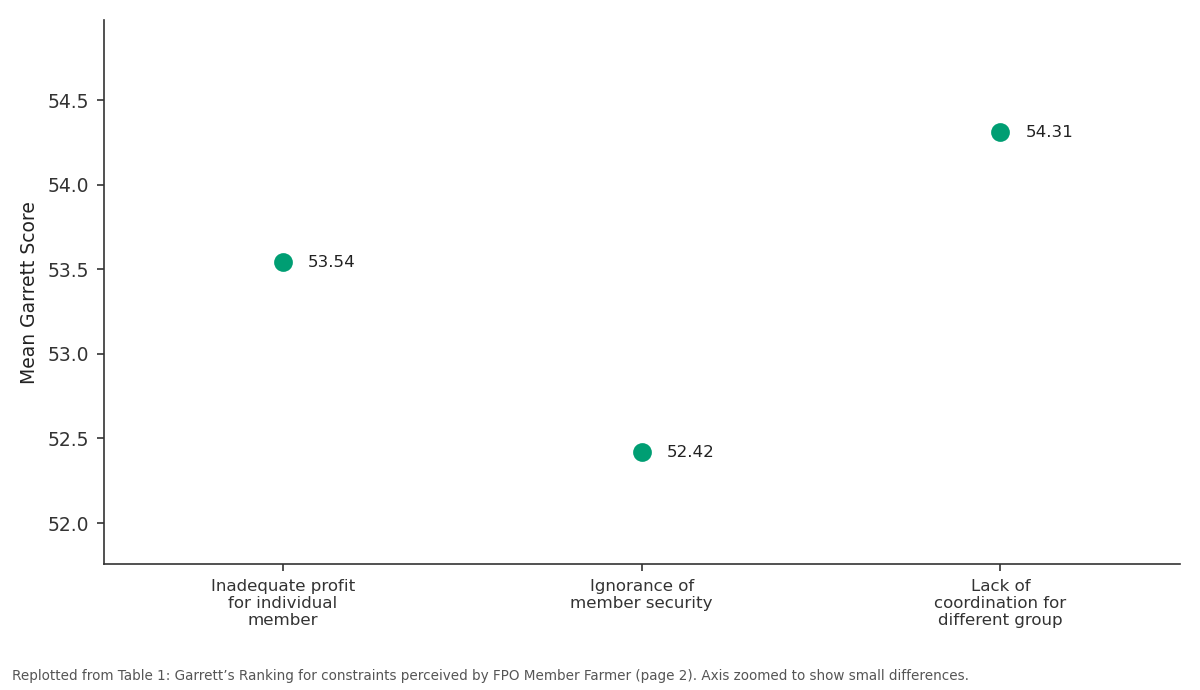
Mean Score: Inadequate profit for... vs Ignorance of member... vs Lack of coordination...
Replotted from Table 1 (page 2) of the original paper. Every bar is the paper's own table value.
View source evidence ↗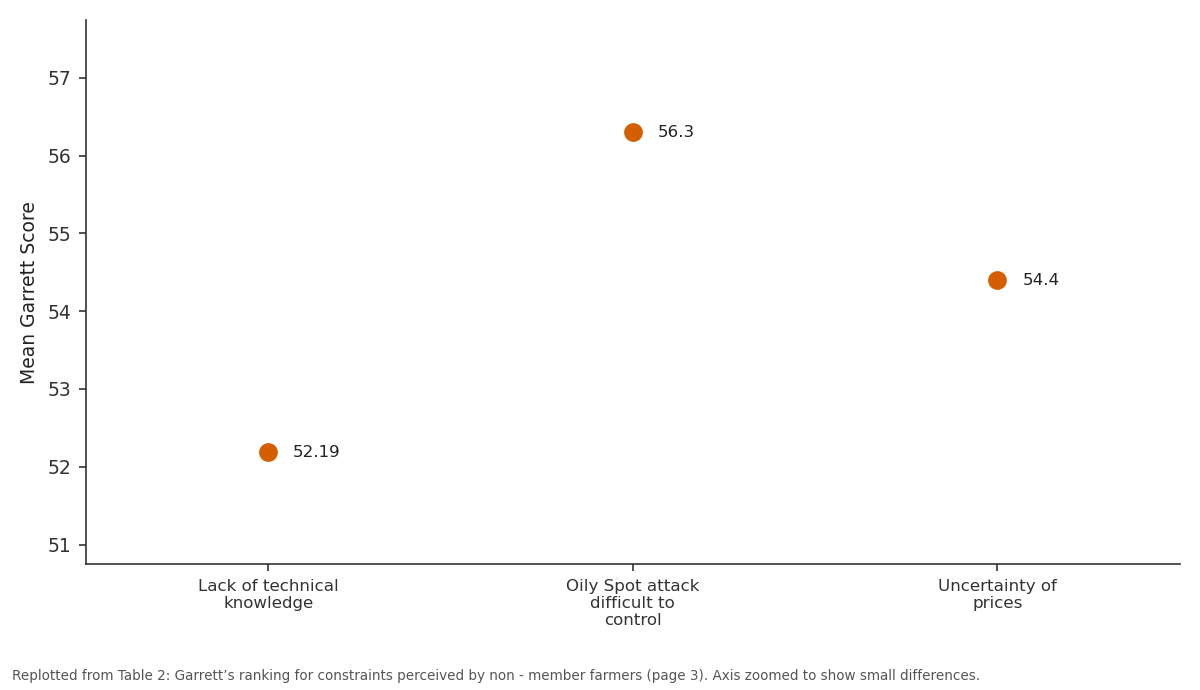
Mean Score: Lack of technical... vs Oily Spot attack... vs Uncertainty of prices
Replotted from Table 2 (page 3) of the original paper. Every bar is the paper's own table value.
View source evidence ↗Figures & tables
From the original paper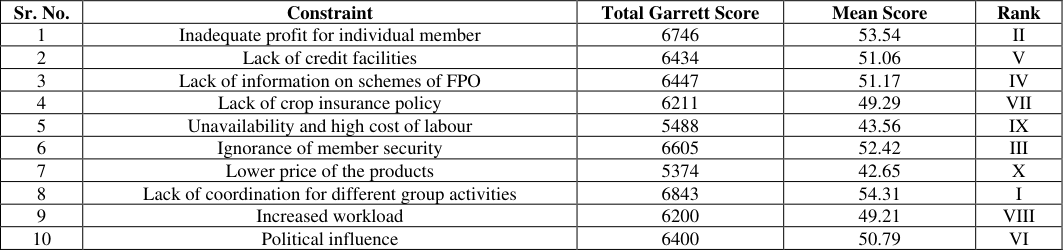 Table 1
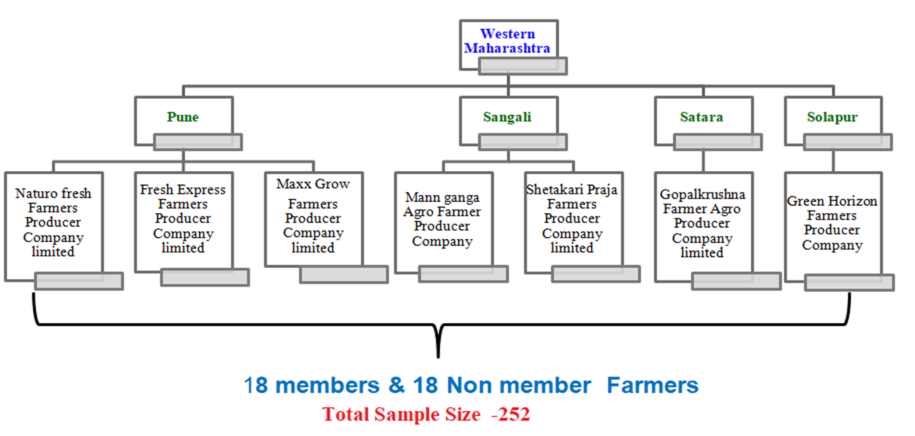 Figure 1
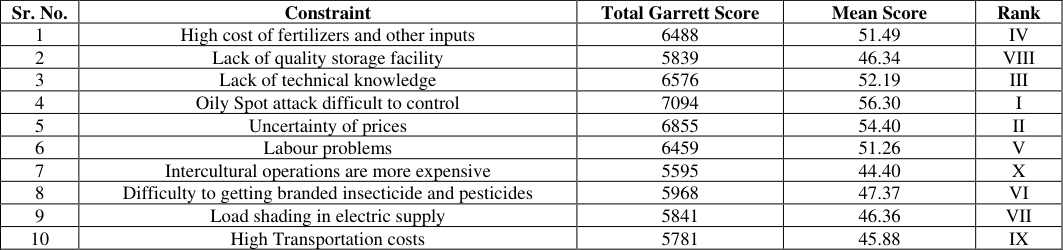 Table 2
Introduction
A Farmers Producer Organization (FPO) serves as an example of a Producer Organization (PO), comprising farmers as its members. To encourage the establishment of FPOs, the Small Farmers' Agribusiness Consortium (SFAC) provides support. A Farmer Producer Company can be formed by a group of 10 or more primary producers, two or more producer institutions, or a combination of both. These companies, established under the 2013 Indian Companies Act, operate under democratic governance, ensuring that each producer or member holds an equal number of voting rights, irrespective of their shareholding. To secure a farmer's sustainable income, Farmer Producer Organizations (FPOs) play a pivotal role. These key institutions facilitate the rapid dissemination of knowledge and technology through extensive networks of small-scale farmers. Ensuring the long-term viability of FPOs necessitates strategic government intervention. Enhancing the capacity of management teams, fostering internal learning and development within FPOs, expediting credit allocation, and establishing post-harvest infrastructure are among the various approaches to fortify the FPO ecosystem. Encouraging and supporting member-owned producer organizations is essential to providing farmers with the necessary tools for enhancing productivity through efficient, affordable, and sustainable resource use, ultimately leading to higher returns. These organizations can achieve this through coordinated efforts, backed by government support and successful partnerships with the private sector, academia, research organizations, societal groups, and the public sector. To be eligible for benefits under various government schemes and programs, FPOs must be registered and operated by farmers, with a primary focus on activities in the agricultural and related sectors.
Materials and Methods
India now has 7374 FPOs registered, with Maharashtra having the highest number at 1940. Due to the higher number of FPO registrations, the Western Maharashtra region was specifically chosen for the study. Pune, Sangli, Satara, and Solapur districts in Western Maharashtra were specifically chosen for the study because they have larger areas dedicated to pomegranate cultivation. Seven Farmer Producer Organizations were purposefully chosen based on district. Seven Farmer Producer Organizations (FPOs) were specifically chosen from the aforementioned district, as these FPOs have completed five years of operation. Seven FPOs in all three from Pune, two from Sangli, one from Satara, and one from Solapur were chosen because their case studies effectively demonstrated effectiveness and were evaluable. Pomegranate was the main crop grown by this FPO, hence it was chosen for the study because most pomegranate growers are members of the FPO. Due to similar climatic circumstances, 18 non-member farmers were chosen from the same area as 18 member farmers from each FPO. A total of 252 sample farmers were chosen for the study, comprising 126 members and 126 non-member farmers. The research needed to include both primary and secondary data in order to comprehend the effectiveness of farmer-producer associations. www.extensionjournal.com
Analytical Tools
Using Garret's ranking technique, restrictions faced by both non-member and member farmers were analyzed. The Garrett's table, the percent positions were converted into scores. Thus for each factor, the scores of the various respondents were added and then mean values were estimated. The attributes with the highest value was considered as the most important one and the other followed in order.
Percent Position = 100(Rij-0.5)/Nj Where, Rij stands for rank given for the ith factor (i= 1, 2...10) by the jth individual (j=1, 2...40) Nj stands for several factors ranked by jth individual.
Results and Discussion
Constraints faced by member and non-member farmers Constraints are limitations, restrictions, or factors that impede or restrict the ability to accomplish a task, achieve a goal, or perform a particular action. In the context of FPO pomegranate farming, there can be various constraints that affect the production. Identifying and understanding these constraints is crucial for developing strategies, policies, and interventions to support farmers and improve agricultural productivity. So attempt had been made to identify constraints and ranked by Garrets ranking technique.
Constraints faced by FPO member Farmers
The constraints faced by member farmers of FPO in production of pomegranate were depicted in table1.The production constraints faced by member farmers were presented in rank according to Garrett's ranking technique. There were ten major constraints in pomegranate cultivation of member farmers as stated by the sample farmers. The results from the table revealed that lack of co-ordination for different group activities was the major problem faced by sample Member farmers, ranked first with Garrett's score 54.42. It was found to be a major constraint in the study area. The second major problem faced by sample farmer was inadequate profit for individual member and their Garrett's score is 53.54. Ignorance of member security was another major constraints faced with 52.42 Garrett's score. and labor training could be potential solutions to address these challenges. Low product prices were identified as a constraint, which could negatively impact the income of member farmers. Addressing this constraint may involve exploring market diversification, value addition, and negotiating power enhancement. Similar results were found by Kumar and Singh (2020) [6] , Gokul et al., (2019) [18] , Tiwari and Upadhyay (2021) [19] , Verma et al., (2021) [16] and Chopade et al., (2019) [2] conducted study on Constraints of Farmer Producer Organization
| Sr. No. | Constraint | Total Garrett Score | Mean Score | Rank |
|---|---|---|---|---|
| 1 | Inadequate profit for individual member | 6746 | 53.54 | II |
| 2 | Lack of credit facilities | 6434 | 51.06 | V |
| 3 | Lack of information on schemes of FPO | 6447 | 51.17 | IV |
| 4 | Lack of crop insurance policy | 6211 | 49.29 | VII |
| 5 | Unavailability and high cost of labour | 5488 | 43.56 | IX |
| 6 | Ignorance of member security | 6605 | 52.42 | III |
| 7 | Lower price of the products | 5374 | 42.65 | X |
| 8 | Lack of coordination for different group activities | 6843 | 54.31 | I |
| 9 | Increased workload | 6200 | 49.21 | VIII |
| 10 | Political influence | 6400 | 50.79 | VI |
Table text extracted from the original PDF; superscript letters are shown inline. The original table image is below.
View original table image
Constraints faced by Non-Member farmer
The constraints faced by non-member farmers of in production of pomegranate were depicted in Non-members were worried about the volatility and uncertainty in agricultural product prices. Price fluctuations could have been affected their income and financial planning. Strategies might be included market diversification, price hedging, or establishing market linkages to mitigate price uncertainty. Non-member farmers recognized the importance of technical knowledge in modern agriculture. Lack of access to information and expertise might be hindered their ability to optimize their farming practices. Efforts to provide training, extension services, and knowledge-sharing platforms could have been empowered non-members with necessary skills.
The cost of pricey supplies and fertilizers worried nonmember farmers since it may have a big impact on their production costs. Reduced profitability and economic viability for non-members may have resulted from high input costs. One way to have overcome this limitation would have been to encourage economical farming methods or to subsidize inputs. Farmers who were not members of FPO acknowledged that labour related issues arose in their farming operations. The timely completion of duties and productivity may be impacted by these issues. [20] , Rede et al., (2018) [10] and Thombre et al., (2020) [15] .
Conclusion
The conclusion was that, while still in their infancy, Farmer Producers Organizations (FPOs) were advantageous to farmers. Several significant barriers to FPO, including lack of co-ordination for different group activities, inadequate profit for individual member, ignorance of member security, lack of information on schemes of FPO and Lack of credit facilities, were identified in the study. The study justified that the organisation is sustainable and are still in the growing phase. Interpreting these rankings helps in reflecting on the challenges that non-member farmers faced and the potential strategies that could have been implemented to address these constraints. Policymakers, agricultural organizations, and non-member farmers were all made aware of these barriers and potential solutions to collaborate on improving the productivity and resilience of the agricultural sector. The results underscored the significance of customized interventions and assistance in mitigating these limitations, ultimately resulting in enhanced means of subsistence for non-member farmers.
Recommendation
▪ Improving the leadership and managerial abilities of the FPO board of directors, members, and CEOs who continue to work for the organization. It is also required of them to offer certificate programs, training courses, etc. NIAM, BIRD, NIFTEM, MANAGE, and VAMNICOM are among the organizations holding the Sectors Skill Counselling Certificate, along with centers for entrepreneurship education and colleges catering to the agricultural sector. ▪ Legal reform must be implemented to establish a business-friendly atmosphere that enables farmers' collectives to transact in contemporary, export-focused marketplaces.
Figures and tables from the paper
| Sr. No. | Constraint | Total Garrett Score | Mean Score | Rank |
|---|---|---|---|---|
| 1 | High cost of fertilizers and other inputs | 6488 | 51.49 | IV |
| 2 | Lack of quality storage facility | 5839 | 46.34 | VIII |
| 3 | Lack of technical knowledge | 6576 | 52.19 | III |
| 4 | Oily Spot attack difficult to control | 7094 | 56.30 | I |
| 5 | Uncertainty of prices | 6855 | 54.40 | II |
| 6 | Labour problems | 6459 | 51.26 | V |
| 7 | Intercultural operations are more expensive | 5595 | 44.40 | X |
| 8 | Difficulty to getting branded insecticide and pesticides | 5968 | 47.37 | VI |
| 9 | Load shading in electric supply | 5841 | 46.36 | VII |
| 10 | High Transportation costs | 5781 | 45.88 | IX |
Table text extracted from the original PDF; superscript letters are shown inline. The original table image is below.
View original table image
References
19 in the original paper- Bhavani G, Sreenivasulu M, Naik RV. Constraint Analysis of Quality Seed Production in Telangana using Garrett's Ranking Technique. J Community Mobilization Sustainable Dev. 2021;16(2):560-564.
- Chopade SL, Kapse PS, Dhulgand VG. Constraints Faced by the Members of Farmer Producer Company. Int J Curr Microbiol App Sci. 2019;8(08):2358-2361. doi: https://doi.org/10.20546/ijcmas.2019.808.273.
- Debahash Buragohain, Dubey JP. Contract Farming: A Constraint Study using Garrett Ranking Technique. Indian J Extension Educ. 2021;57(2):212-215. DOI: 10.5958/2454-552X.2021.00055.
- Goyal N, Goyal SK. Major Constraints in Production and Marketing of Onion in Haryana. Indian Res J Extension Educ. 2022;22(2):38-43.
- Mohanty S, Mandal S, Rahim KMB. Economics of Hill Farming System with special Reference to Feasibility and Constraints in Production of Organic Commodities in Meghalaya India. Int Conf. 2015:9-11. Available from: https://www.researchgate.net/publication/279940840.
- Mukesh Kumar, Rakesh Singh. Identify the Constraints of Farmer Producer Organisation in SwaiMadhopur District of Rajasthan. Ind J Pure App Biosci. 2020;8(3):296-299. Doi: http://dx.doi.org/10.18782/2582-2845.8123.
- Nisha Devi, Krishan Kumar Raina, Ravinder Sharma. Constraints Perceived by the Farmers of Himachal Pradesh in Organic Farming. Economic Affairs. 2020;65(2):213-218. DOI: 10.46852/0424-2513.2.2020.12.
- Patel RR, Patel PK, Patel RM, Patel KJ. Major constraints faced by farmers of Sabarkantha district in Gujarat. Internat Res J Agric Eco & Stat. 2018;9(1):133-136. DOI:10.15740/HAS/IRJAES/9.1/133-136.
- Pawariya V, Poonia MK, Ram N, Yadav MM, Dagar V. An analysis of constraint and problems in production www.extensionjournal.com and marketing of Nagauri (Paan) methi in Rajasthan State of India. Environ Conserv J. 2020;21(3):171-176.
- Rede GD, Janee Yumlembam, Sorokhaibam Somina Devi, K Bhattacharyya. Garrett's Ranking Analysis for Constraints Faced in Production and Export of Pomegranate. J Sci Agric & Eng. 2018;8(25):192-193.
- Rede GD, Bhattacharyya K. Marketing and Constraints Analysis of Pomegranate in Solapur District of Maharashtra. Economic Affairs. 2018;63(1):99-106.
- Sahoo AK, Dash S, Rath SS. The Application of Garrett Scoring Techniques for Assessment of the Farmer Problems in Obtaining and Repayment of Agricultural Credit. Int J Sci & Technol Res. 2020;9(03):5192-5199.
- Shanjeevika V, Balasubramaniam P, Venkatesa N, Palanichamy J, Venkata Pirabu, Duraisamy MR. Evaluation of Constraints Encountered by Banana Growers in Adopting Water Management Practices using Henry Garrett Ranking Technique. Int J Environ Climate Change. 2022;12(11):1965-1971.
- Thombre RF, Deshmukh KV, More SS, Chavan RV. Constraint and Suggestion Analysis in Production and Marketing of Maize in Marathwada Region of Maharashtra using Garrett's Ranking Technique. Int J Curr Microbiol App Sci. 2020;9(8):1773-1778.
- Verma AK, Singh VK, Asha K, Dubey SK, Verma AP. Constraints Perceived by the Members and Nonmembers towards Functioning of FPO-AKPCL in Kannauj District of Uttar Pradesh. Economic Affairs. 2021;66(2):335-341.
- Ao W, Jamir BK. Application of Garrett ranking technique in studying the problems of bamboo cultivation: A case study of Mokokchung district, Nagaland. Indian Journal of Hill Farming. 2020;33(2):311-315.
- Gokul PV, Singh P, Singh VP, Sawarkar AN. Thermal behavior and kinetics of pyrolysis of areca nut husk. Energy Sources, Part A: Recovery, Utilization, and Environmental Effects. 2019 Dec 2;41(23):2906-16.
- Singh RS, Singh A, Kaur H, Batra G, Sarma P, Kaur H, Bhattacharyya A, Sharma AR, Kumar S, Upadhyay S, Tiwari V. Promising traditional Indian medicinal plants for the management of novel Coronavirus disease: A systematic review. Phytotherapy Research. 2021 Aug;35(8):4456-84.
- Yadav SS, Jadhav SM. Deep convolutional neural network based medical image classification for disease diagnosis. Journal of Big data. 2019 Dec;6(1):1-8.