
Research article · 2024 · Full text
International Journal of Agriculture Extension and Social DevelopmentAssessment of Awareness level of the beneficiary farmers of Pradhan Mantri Kisan Samman Nidhi scheme
Volume 7(3) · Pages 581–583 · DOI: 10.33545/26180723.2024.v7.i3g.474 ↗
Research areasAgricultural Economics and PracticesAgricultural Systems and PracticesLivestock Management and Performance Improvement
Abstract
Author-writtenThe aim of the study was to assess the level of awareness of the PM-Kisan Samman Nidhi program and its relationship to the socioeconomic and personal factors selected for the study. The Uttar Pradesh district of Kanpur Dehat is the subject of the research. Eleven blocks make up the Kanpur Dehat district. Out of a total of 10 blocks, two were purposefully picked. 120 PM-Kisan participants were chosen as a sample for the study's goals. By visiting the respondents' farms and residences, the information was acquired utilizing the personal interviewing approach. The data were analyzed using correlation analysis, frequency distribution, arithmetic mean, and standard deviation. The survey found that the majority of respondents (58.33 percent) had extensive knowledge of the PM-Kisan system. Age, family size, agricultural experience, and other four independent factors were discovered to be positively associated at the 1% level of significance. However, at a 5% level of significance, there is a positive correlation between variable yearly income and awareness level.
Summary
Source-checkedPlain-language reading of the full paper, prepared with AI and checked against the text. Each point links to the authors' own words.
Why it matters
- Agriculture serves as the primary income source for Indian families and is the foundation of the country's economy. View evidence ↗
- The PM-KISAN (Pradhan Mantri Kisan Samman Nidhi) cash transfer program was launched in December 2018 to help farmers with liquidity for purchasing agricultural inputs. View evidence ↗
- The scheme provides landholder farmers with up to 2 hectares of cultivable land a yearly reward of Rs. 6000, paid in three equal installments every four months. View evidence ↗
The question
- The study aimed to evaluate the awareness level of farmers regarding the PM-Kisan Samman Nidhi program and how this awareness relates to specific personal and socioeconomic factors. View evidence ↗
What they did
- The research was conducted in the Kanpur Dehat district of Uttar Pradesh, where two blocks were purposefully selected from the district's blocks. View evidence ↗
- A total sample of 120 PM-Kisan beneficiaries was selected, consisting of 30 respondents from each of four villages (two villages per selected block). View evidence ↗
- Awareness was measured using an interview schedule containing 14 statements, graded on a three-point scale of high, medium, and low awareness. View evidence ↗
- The study utilized arithmetic mean, standard deviation, frequency distribution, and correlation analysis to interpret the collected data. View evidence ↗
What they found
- The majority of respondents (58.33%) demonstrated high awareness of the PM-Kisan plan, while 30.84% had medium awareness and 10.83% had low awareness. View evidence ↗
- Farmers were most aware of the annual amount provided by the scheme (MPS 3.000) and least aware of how to effectively use the online portal (MPS 1.608). View evidence ↗
- Age, family size, and farming experience were found to be positively correlated with awareness levels at a 1% significance level. View evidence ↗
- Annual income showed a positive correlation with the awareness level of the program at a 5% significance level. View evidence ↗
What it means
- The authors conclude that officials should update course content to better spread awareness of the PM-Kisan plan. View evidence ↗
- The authors recommend implementing targeted government initiatives and outreach efforts to increase public awareness of the scheme. View evidence ↗
Visual summary
3 visualsIllustrations explain the paper; charts are replotted from the paper's own table values.
Factors Influencing Awareness
AI-generated conceptual illustration (Indian smallholder farmers in rural agricultural fields). It explains the idea and does not show study data.
View source evidence ↗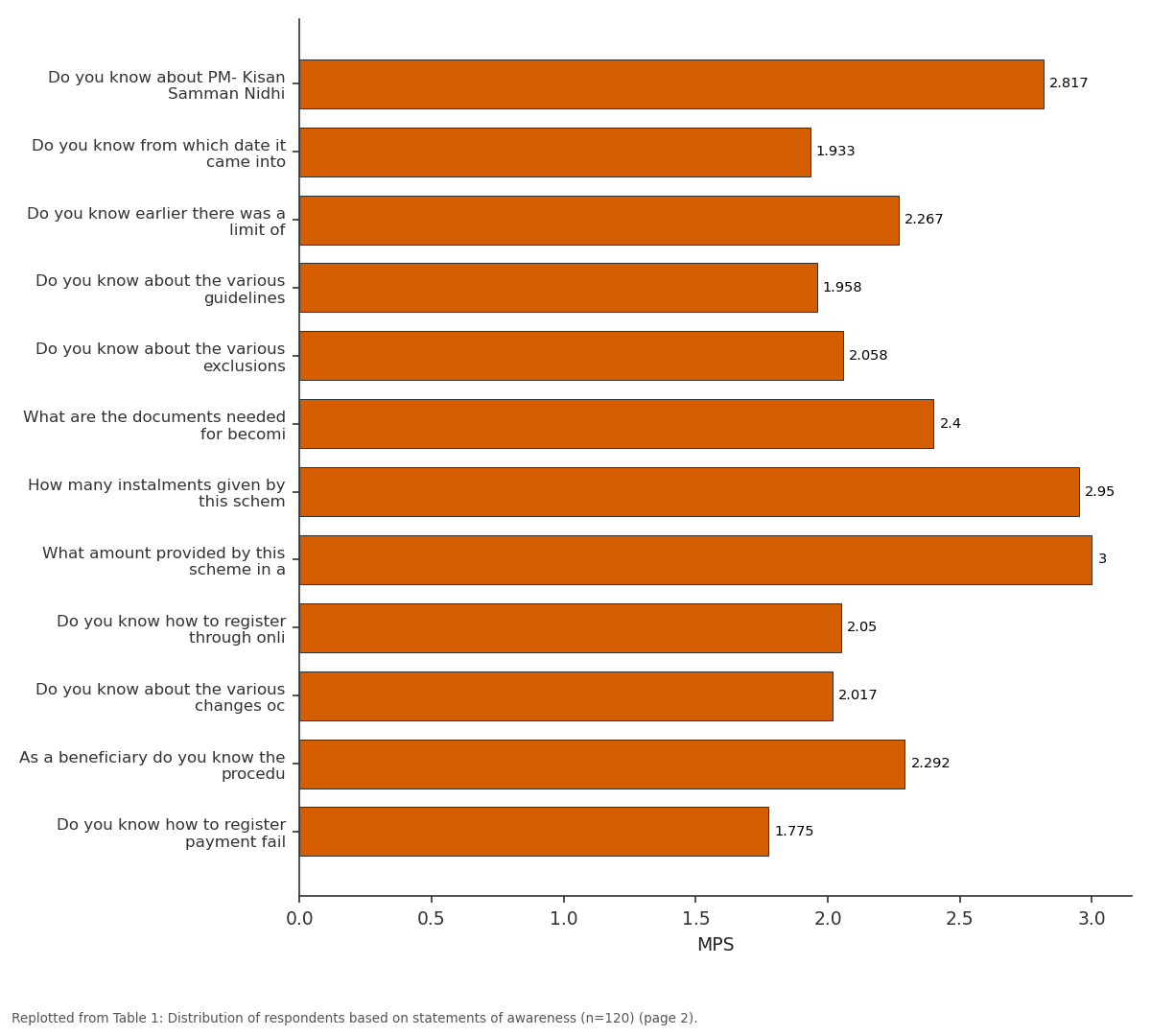
MPS: Do you know about PM-... vs Do you know from which... vs Do you know earlier... vs Do you know about the... vs Do you know about the...
Replotted from Table 1 (page 2) of the original paper. Every bar is the paper's own table value.
View source evidence ↗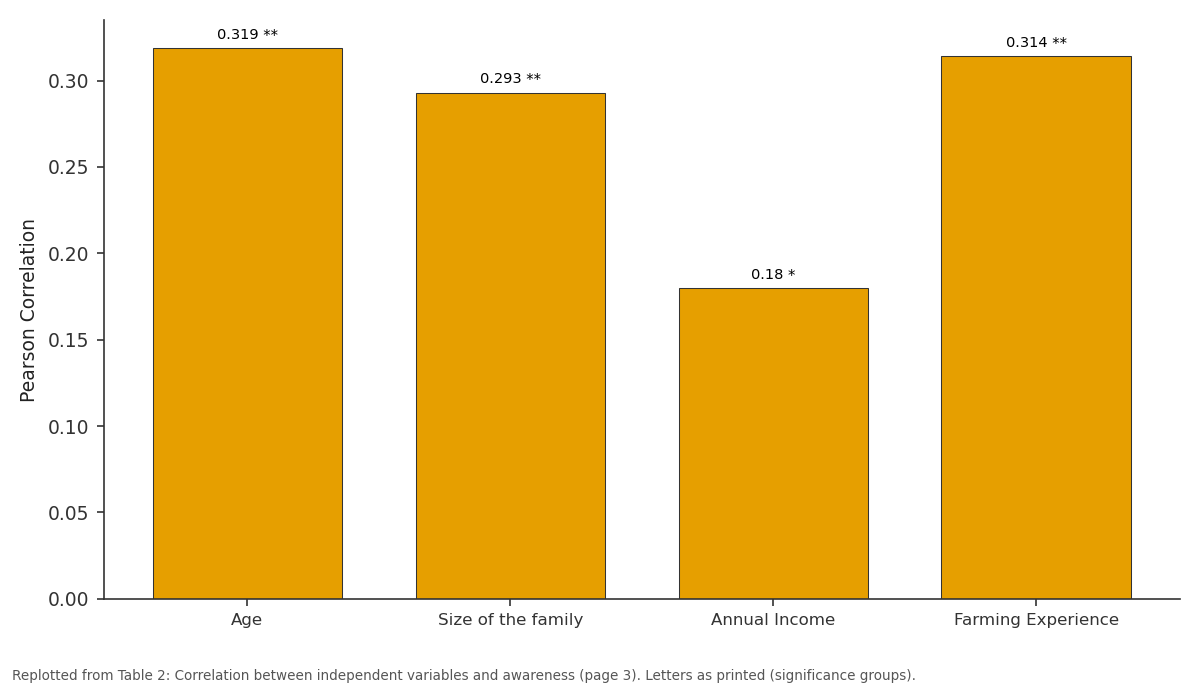
Pearson Correlation: Age vs Size of the family vs Annual Income vs Farming Experience
Replotted from Table 2 (page 3) of the original paper. Every bar is the paper's own table value.
View source evidence ↗Figures & tables
From the original paper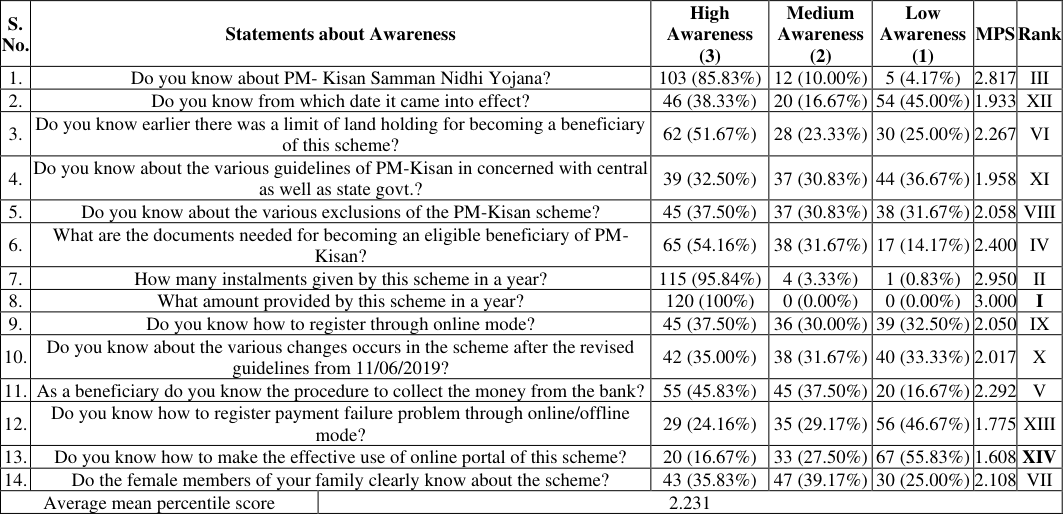 Table 1
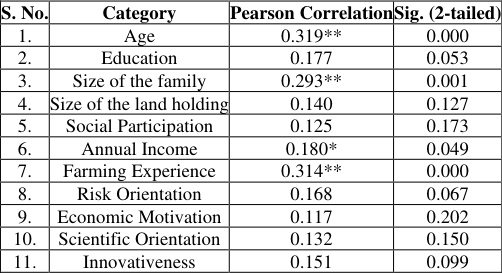 Table 2
Introduction
Agriculture is the foundation of the Indian economy. This is the primary source of income for families that are Indian. Farmers in India reportedly work day and night to feed more than 1.405 billion people, according to the NSSO-Periodic Labour Force Survey, 2022. Agriculture has always been the simplest way to feed a family. Since India's independence, there have been problems with financing agriculture that have affected the whole country. India's institutionalized system for funding agriculture was also weak. In the years that followed independence, the government reinforced the institutional credit framework of the country via a variety of efforts, which caused the base and sources of agricultural credit to steadily increase. Since the early 1990s, farmer despair and suicides have significantly grown in India, where agriculture is presently experiencing immense challenges. In any event, these programs are still in existence to help the federal government reach its stated objectives (Sonika, 2020) [8] . Numerous programs for providing financial help to small and marginal farmers were occasionally undertaken by the Indian government. Given the current state of affairs, it is noteworthy that the cash transfer program, PM-KISAN (Pradhan Mantri Kisan Samman Nidhi), was announced in December 2018 with the goal of reducing farmers' need for liquidity to purchase inputs. According to Pavan Kumar, 2018 the initiative helps farmers get different farming supplies when they need financial support. Under the initiative, families of landholder farmers who own up to 2 hectares of total cultivable land would earn a reward of Rs. 6000 yearly, distributed in three equal payments every four months. putting money into the recipient's bank account directly. The initiative seeks to lower farmers' cash flow needs in order to boost their revenue and provide prompt input availability. The project has been extremely beneficial to those who are considerably more dependent on agriculture and have less access to money. The first universal basic income program created with farmers in mind is the PM-Kisan Samman Nidhi scheme. More than 50% of the workforce receives help from the program, either directly or indirectly. Varshney et al. The study's objective was to assess the farmers' knowledge of the program and its relevance to their socioeconomic situation.
Materials and Methods
The 12 districts that make up Uttar Pradesh's Awadh area are Kheri, Sitapur, Hardoi, Farrukhabad, Kannauj, Lucknow, Barabanki, Etawah, Auraiya, Unnao, Kanpur Nagar, Kanpur Dehat, and Raebareli. The Kanpur Dehat district was purposefully chosen from among these 12 districts. The Kanpur Dehat district consists of eleven blocks. Due to the fact that two of these blocks had the greatest number of farmers who qualified for the PM-Kisan Samman Nidhi program, they will be picked. Additionally, www.extensionjournal.com two villages from each of the selected blocks were picked with the highest degree of conformance to the same requirements. The selection of respondents from the specific villages was carried out at random using a computer-based randomizer, and 30 PM-Kisan beneficiaries were picked from each of the four villages that were chosen. As a consequence, 120 individuals in total were used as sample responders for the study's goals.
Method to compute Awareness level about PM-Kisan Samman Nidhi Scheme
The available literature and discussions with topic experts were utilized to create an interview schedule with 14 statements on the PM-Kisan scheme in order to gauge the farmers' degree of familiarity with the program. The beneficiaries were asked to react depending on how wellversed they were in the PM-Kisan scheme. A three-point scale with the scores high awareness, medium awareness, and low awareness was used to grade their level of awareness. The total awareness scores for each responder were determined by summing together all of their awareness score data. The technique was used to classify awareness levels as high, medium, and low. Statistical Analysis: To analyze and interpret the data, the appropriate statistical techniques, such as the arithmetic mean, standard deviation, frequencies, percentages, and correlation coefficient ("r"), were utilized.
Results and Discussion
Results and Discussion
Socio-economic characteristics of PM-Kisan beneficiaries
According to the study, 30.83 percent of beneficiaries who responded to the survey were functionally literate, and 45 percent of beneficiaries were OBC (Other Backward Caste) members. The survey also finds that 45.00 percent of recipient respondents had modest land holdings (1-2 hectares), and 87.50 percent of them had small households (up to 5 people). A household income of roughly $20,000 per year was obtained by 65.83 percent of respondents, according to the survey, which also showed that the majority of respondents (38.33%) belonged to just one organization. Additionally, 57.5 percent of responders who received benefits had some prior agricultural experience. The study's results also revealed that, in terms of risk orientation, economic drive, scientific orientation, and innovativeness, the majority of respondents (64.17% pe, 69.17% 71.68%, and 62.50%) each had a medium level.
Level of awareness among beneficiary farmers regarding PM-Kisan Samman Nidhi scheme
According to the report, 58.33 percent of respondents had high levels of awareness regarding the PM-Kisan Samman Nidhi plan, compared to 30.84 and 10.83 percent of respondents who have medium and low levels of awareness, respectively. The results show that the great majority of respondents had knowledge of the PM-Kisan Samman Nidhi plan. There are minimal and maximum awareness scores of 20, and the average is 31,22. The results demonstrated that the chosen responders to the PM-Kisan Samman Nidhi scheme were aware of it since, of all the 14 statements, the one with the highest MPS (mean percentile score) was: What amount provided by this scheme in a year? (S8) with a score of 3.000, and the MPS (mean percentile score) for the statement with the lowest MPS was? Do you know how to make the most of the online portal for this scheme? with an S13 percentile mean score of 1.608
Correlation coefficient between independent variable and awareness level towards PM-Kisan Samman Nidhi
Age, family size, and farming experience are three independent factors that are positively correlated with one another at a 1% level of significance in the awareness of the PM-Kisan Samman Nidhi plan. At a 5% level of significance, the variable annual income is positively connected with awareness of the PM-Kisan Samman Nidhi program. This suggests that the aforementioned four independent variables had a significant impact on the degree of awareness of the PM-Kisan Samman Nidhi plan.
Conclusion
Our country's largest central government funding effort at the moment is PM-Kisan. There are more than 12 crore recipients included in it (PM-Kisan Portal 2022). The current study examines how the Uttar Pradesh area of Kanpur Dehat makes use of the PM-Kisan Samman Nidhi program. The study's conclusions indicate that the official must change upcoming course content in order to spread awareness of the PM-Kisan plan. The experts concurred with them as well because giving ranchers immediate financial advantages allows them to invest that money in rural pursuits or enables them to purchase high-quality seeds, manures, equipment, and other items that boost harvest productivity and increase farmers' income (Deepak Kumar, 2021) [3] . The proper government initiatives as well as outreach efforts should be carried in order to increase public awareness of the PM-Kisan Samman Nidhi Scheme. The central government must consider the difficulties farmers are encountering and offer them help so they can take advantage of the program if it is to be effective. The working methods and practices of the plan were generally regarded favorably by the beneficiaries (Amitha, 2022) [2] .
Figures and tables from the paper
| S. No. | Statements about Awareness | — | High Awareness (3) | Medium Awareness (2) | Low Awareness (1) | MPS | Rank |
|---|---|---|---|---|---|---|---|
| 1. | Do you know about PM- Kisan Samman Nidhi Yojana? | 103 (85.83%) | 12 (10.00%) | 5 (4.17%) | 2.817 | III | |
| 2. | Do you know from which date it came into effect? | 46 (38.33%) | 20 (16.67%) | 54 (45.00%) | 1.933 | XII | |
| 3. | Do you know earlier there was a limit of land holding for becoming a beneficiary of this scheme? | 62 (51.67%) | 28 (23.33%) | 30 (25.00%) | 2.267 | VI | |
| 4. | Do you know about the various guidelines of PM-Kisan in concerned with central as well as state govt.? | 39 (32.50%) | 37 (30.83%) | 44 (36.67%) | 1.958 | XI | |
| 5. | Do you know about the various exclusions of the PM-Kisan scheme? | 45 (37.50%) | 37 (30.83%) | 38 (31.67%) | 2.058 | VIII | |
| 6. | What are the documents needed for becoming an eligible beneficiary of PM- Kisan? | 65 (54.16%) | 38 (31.67%) | 17 (14.17%) | 2.400 | IV | |
| 7. | How many instalments given by this scheme in a year? | 115 (95.84%) | 4 (3.33%) | 1 (0.83%) | 2.950 | II | |
| 8. | What amount provided by this scheme in a year? | 120 (100%) | 0 (0.00%) | 0 (0.00%) | 3.000 | I | |
| 9. | Do you know how to register through online mode? | 45 (37.50%) | 36 (30.00%) | 39 (32.50%) | 2.050 | IX | |
| 10. | Do you know about the various changes occurs in the scheme after the revised guidelines from 11/06/2019? | 42 (35.00%) | 38 (31.67%) | 40 (33.33%) | 2.017 | X | |
| 11. | As a beneficiary do you know the procedure to collect the money from the bank? | 55 (45.83%) | 45 (37.50%) | 20 (16.67%) | 2.292 | V | |
| 12. | Do you know how to register payment failure problem through online/offline mode? | 29 (24.16%) | 35 (29.17%) | 56 (46.67%) | 1.775 | XIII | |
| 13. | Do you know how to make the effective use of online portal of this scheme? | 20 (16.67%) | 33 (27.50%) | 67 (55.83%) | 1.608 | XIV | |
| 14. | Do the female members of your family clearly know about the scheme? | 43 (35.83%) | 47 (39.17%) | 30 (25.00%) | 2.108 | VII | |
| Average mean percentile score | 2.231 |
Table text extracted from the original PDF; superscript letters are shown inline. The original table image is below.
View original table image
| S. No. | Category | Pearson Correlation | Sig. (2-tailed) |
|---|---|---|---|
| 1. | Age | 0.319** | 0.000 |
| 2. | Education | 0.177 | 0.053 |
| 3. | Size of the family | 0.293** | 0.001 |
| 4. | Size of the land holding | 0.140 | 0.127 |
| 5. | Social Participation | 0.125 | 0.173 |
| 6. | Annual Income | 0.180* | 0.049 |
| 7. | Farming Experience | 0.314** | 0.000 |
| 8. | Risk Orientation | 0.168 | 0.067 |
| 9. | Economic Motivation | 0.117 | 0.202 |
| 10. | Scientific Orientation | 0.132 | 0.150 |
| 11. | Innovativeness | 0.151 | 0.099 |
Table text extracted from the original PDF; superscript letters are shown inline. The original table image is below.
View original table image
References
5 in the original paper- Do you know about the various changes occurs in the scheme after the revised guidelines from 11/06/2019? 42 (35.00%) 38 (31.67%) 40 (33.33%) 2.017 X 11. As a beneficiary do you know the procedure to collect the money from the bank? 55 (45.83%) 45 (37.50%) 20 (16.67%) 2.292 V 12. Do you know how to register payment failure problem through online/offline mode? 29 (24.16%) 35 (29.17%) 56 (46.67%) 1.775 XIII
- Kethan M, Basha M. Impact of Indian Cinema on Youths Lifestyle and Behavior Patterns. East Asian J Multidiscip Res. 2023;2(1):27-42.
- Kumar D, Phougat S. Analysis of Pradhan Mantri Kisan Samman Nidhi (PM-Kisan) Scheme: With special reference to Haryana State. J Global Agric Ecol. 2021;12(2):1-8.
- Shaik M. Impact of artificial intelligence on marketing. East Asian J Multidiscipline Res. 2023;2(3):993-1004. https://doi.org/10.55927/eajmr.v2i3.3112.
- Varshney D, Joshi PK, Roy D, Kumar A. Pradhan Mantri Kisan Samman Nidhi (PM-KISAN) and the adoption of modern agricultural technologies in Uttar Pradesh, India. Intl Food Policy Res Inst; c2020. p. 1907.
Cited by 2
From OpenAlex, OpenCitations and reference lists read by Scinovex
- Effectiveness of media package for creating awareness among rural women regarding use of lemon grass medicinal plant (Cymbopogon citratus)
Parneet Mahal, Kanwaljit Kaur, Mandeep Sharma · International Journal of Agriculture Extension and Social Development · 2025
To check the effectiveness of developed media package on Lemon grass plant, a sample of 130 rural women from 13 villages of Ludhiana district was purposively selected. The data were collected in April and May 2024 from Ludhiana district and were analyzed with the help of percentage, mean score and paired t-test. The media package containing printed material, WhatsApp messages and video clips on Lemon Grass plant was developed and validated by 30 Subject Matter Specialists. Effectiveness of media package was measured in terms of mean change in health benefit, its nutritive value and usage into
- Awareness levels among beneficiary farmers of the Pradhan Mantri Kisan Samman Nidhi: An evaluation
Santhosh Kumar G, N Praveen, Naveen Kumar S, Srinivas Reddy D · International Journal of Agriculture Extension and Social Development · 2024
Agriculture is a vital sector in India, yet farmers face significant challenges, including inadequate financing. To address these issues, the Indian government introduced the Pradhan Mantri Kisan Samman Nidhi (PM-KISAN) scheme, which provides financial assistance to farmer families. This study evaluates the awareness levels among beneficiary farmers regarding the PM-KISAN scheme and its impact on their socioeconomic conditions. Conducted in Telangana, India, with a sample of 120 farmers, the study uses an ex-post facto research design to assess socio-economic characteristics and awareness leve