
Research article · 2024 · Full text
International Journal of Agriculture Extension and Social DevelopmentSowing success: Unraveling the drivers behind agro-ecotourism ventures and visitor engagement
Volume 7(3) · Pages 509–513 · DOI: 10.33545/26180723.2024.v7.i3f.477 ↗
Research areasAgricultural Innovations and PracticesDiverse Educational Innovations Studies
Abstract
Author-writtenAgro-ecotourism, an innovative approach within India's tourism sector, fosters collaboration between the farming sector, tourism industry, and agricultural enterprises, alongside leveraging ecosystem services. This study, conducted in the Chikkamagaluru and Kodagu districts of Karnataka, employed purposive random sampling to select respondents, revealing the positive impact of agro-ecotourism on local communities. In the research area, agro-ecotourism emerged as a significant contributor to employment and income generation for local residents, both through wage labor and entrepreneurial endeavors. The study emphasizes the vital role of agro-ecotourism initiatives in fostering economic growth in rural areas, not only through direct employment opportunities but also through ancillary services and supply chains. By strengthening these linkages between agro-ecotourism and local communities, there is an opportunity to address challenges such as rural youth migration. Empowering rural populations through meaningful employment and income generating activities can contribute to the overall sustainability and prosperity of rural areas, ensuring that the benefits of agro-ecotourism are equitably distributed among all stakeholders.
Summary
Source-checkedPlain-language reading of the full paper, prepared with AI and checked against the text. Each point links to the authors' own words.
Why it matters
- Agro-ecotourism in India is an emerging concept that creates a symbiotic relationship between agricultural enterprises, the tourism industry, and the farming sector by using ecosystem services. View evidence ↗
- This approach can increase employment in both the tourism and agriculture sectors by encouraging the sourcing of local goods and hiring local workers. View evidence ↗
- Small-scale family farmers often explore agro-ecotourism as a way to supplement their primary agricultural income. View evidence ↗
The question
- The study aims to investigate the reasons why visitors visit agro-ecotourism sites and the resulting impacts on the local community. View evidence ↗
What they did
- The research was conducted in the Kodagu and Chikkamagaluru districts of Karnataka during 2020-21. View evidence ↗
- Data was gathered from 40 local individuals via personal interviews using a pre-tested schedule and a purposive proportionate sampling technique. View evidence ↗
- The Garrett ranking technique was applied to determine the priority of benefits for the local community and the primary reasons for visitor visits. View evidence ↗
What they found
- The majority of respondents were middle-aged (47.50% between 35 to 50 years), followed by those under 35 (30%) and those 50 and above (22.50%). View evidence ↗
- Participation was predominantly male, with 33 out of 40 respondents being men, while women made up only 17.50%. View evidence ↗
- Bakery ownership was the most lucrative activity, generating an income of Rs. 22.20 lakh with 325 days of employment per year. View evidence ↗
- Other high-income activities included shop keeping (Rs 7.04 lakh), transportation (Rs. 7.02 lakh), and hotel businesses (Rs. 6.28 lakh). View evidence ↗
- Local residents identified the primary benefits as additional revenue for local businesses (97.50%) and the promotion of direct product sales (80.00%). View evidence ↗
- Recreation was the top reason for visitor visits, achieving the highest Garrett score of 78.10. View evidence ↗
- The second most common reason for visiting was to explore nearby tourist attractions. View evidence ↗
What it means
- The authors conclude that agro-ecotourism success and sustainability depend on tailoring offerings to visitor preferences while maximizing benefits for the local community. View evidence ↗
- The study emphasizes that strategic planning and stakeholder collaboration are necessary to leverage the economic and social potential of agro-ecotourism in these districts. View evidence ↗
Visual summary
3 visualsIllustrations explain the paper; charts are replotted from the paper's own table values.
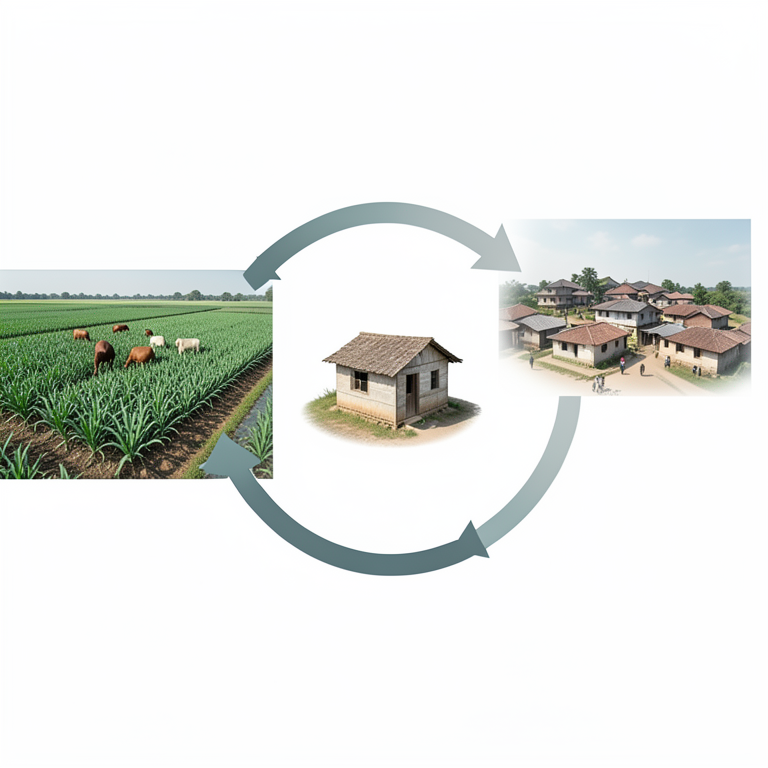
Agro-Ecotourism Ecosystem
AI-generated conceptual illustration (An Indian agricultural farm landscape with a small guest cottage and a nearby village settlement). It explains the idea and does not show study data.
View source evidence ↗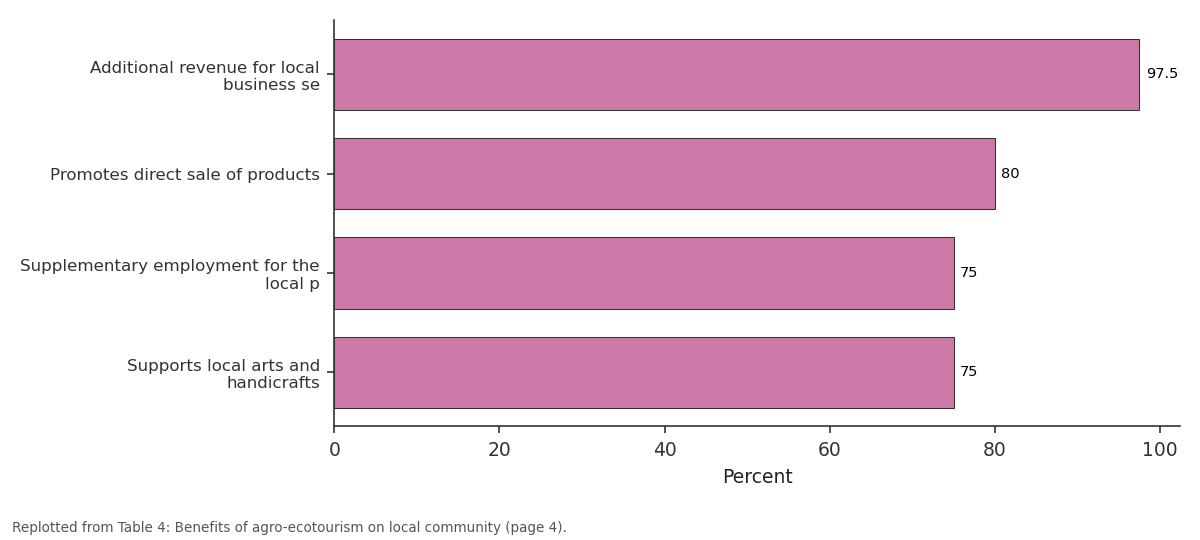
Percent: Additional revenue for... vs Promotes direct sale of... vs Supplementary... vs Supports local arts and...
Replotted from Table 4 (page 4) of the original paper. Every bar is the paper's own table value.
View source evidence ↗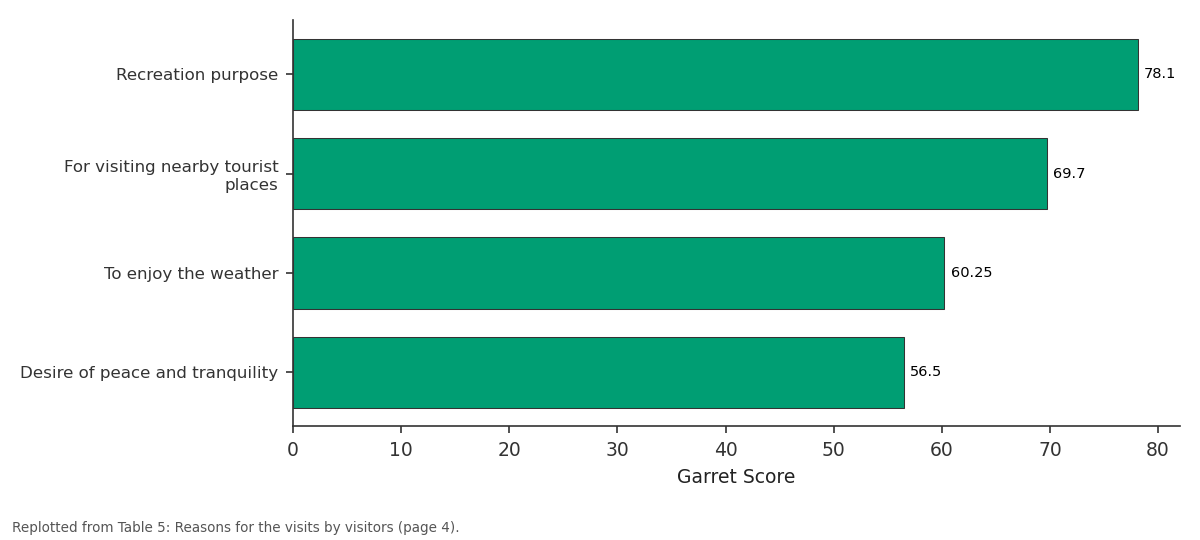
Garret Score: Recreation purpose vs For visiting nearby... vs To enjoy the weather vs Desire of peace and...
Replotted from Table 5 (page 4) of the original paper. Every bar is the paper's own table value.
View source evidence ↗Figures & tables
From the original paper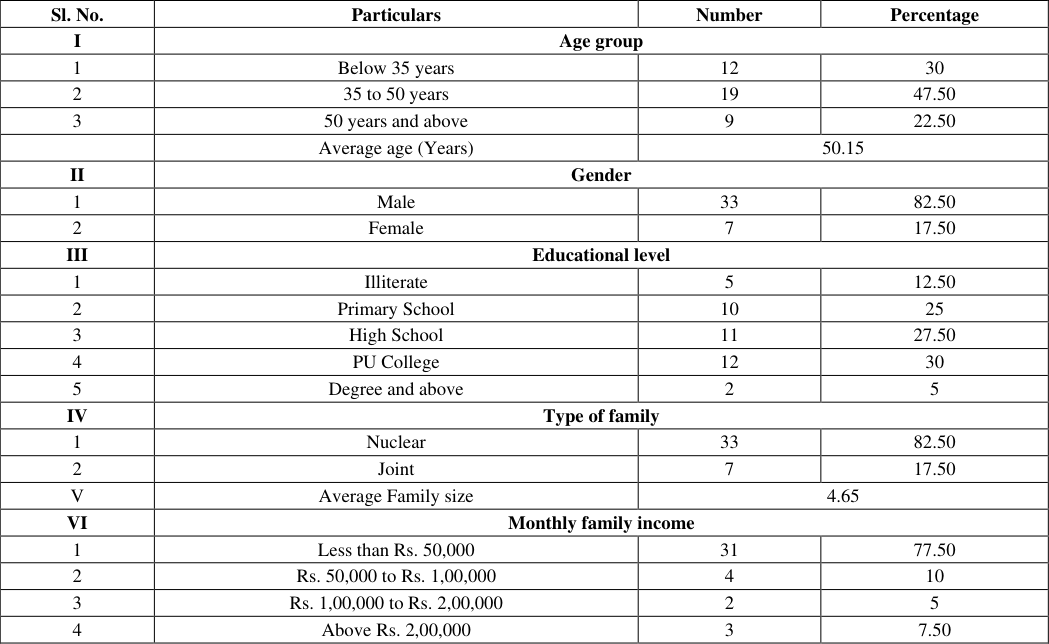 Table 1
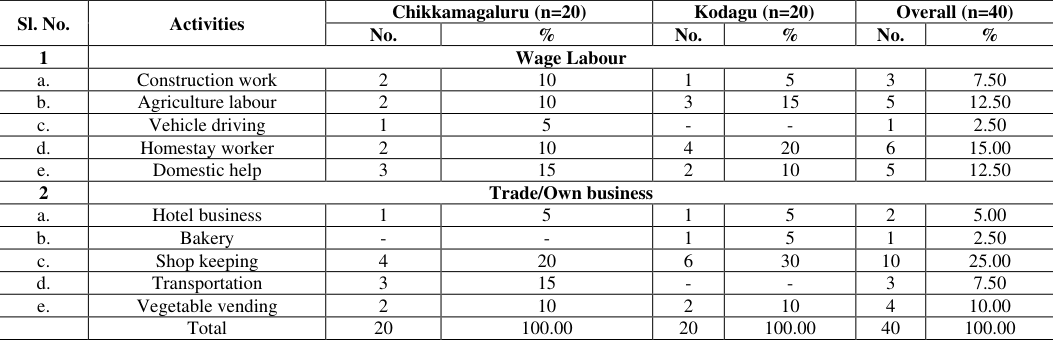 Table 2
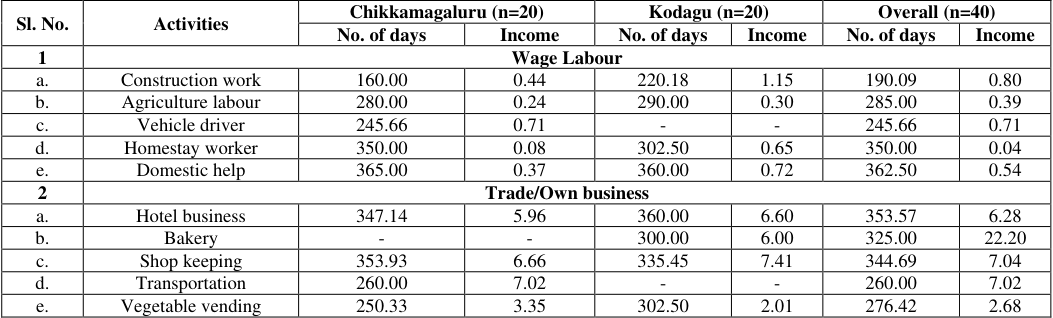 Table 3
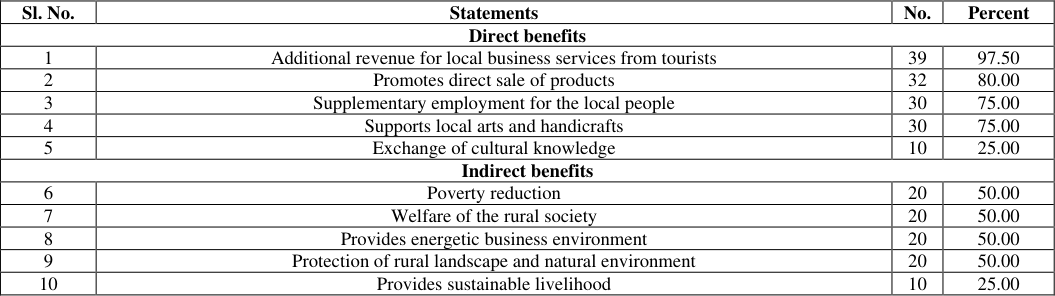 Table 4
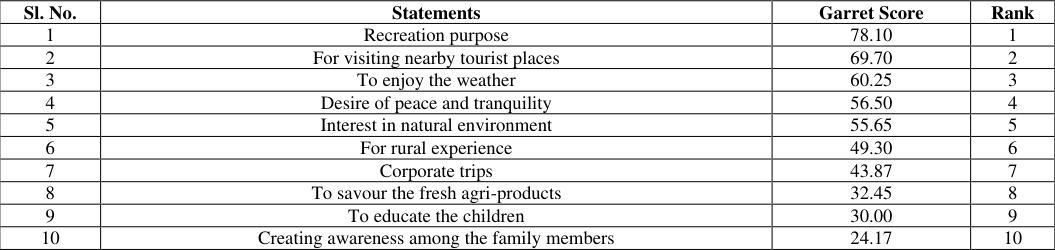 Table 5
Introduction
Agro-ecotourism, an emerging concept within the Indian tourism sector, involves a symbiotic relationship between the farming sector, tourism industry, and agricultural enterprises, leveraging ecosystem services (Barbuddhe and Singh, 2014) [3] . This entails visitors engaging in activities on active farms or agricultural ventures for leisure, education, or active participation. These experiences offer a retreat from urban life, allowing individuals to immerse themselves in rural settings, sample local cuisine, and gain insights into various agricultural practices. Destinations such as Chikkamgaluru, Madikeri, and Mysuru in Karnataka serve as prime examples of eco-tourism sites. Focusing on agro-ecotourism has the potential to enhance employment opportunities in both agriculture and tourism sectors by promoting local hiring practices and sourcing, while also fostering tourism activities rooted in local culture and the natural environment. Integration of local populations, particularly those from marginalized communities, into the tourism value chain can spur economic growth within the agro-ecotourism sub-sector through the supply of local goods, labor, and tourism services, while also prioritizing the preservation of natural habitats. Karnataka, with its diverse natural landscapes, agricultural products, and rural traditions, presents significant potential for the development of agro-ecotourism. Many farmers, particularly those with small-scale family-owned farms, recognize the need to supplement their agricultural income and are exploring opportunities in agro-ecotourism. Additionally, small investors in rural areas are venturing into agro-ecotourism investments, drawing on their vocational expertise in agriculture. Furthermore, larger investors in the tourism sector are diversifying their portfolios by investing in rural agricultural areas, further contributing to the growth of agro-ecotourism in the region. Therefore, this study aims to delve into the impacts of Agroecotourism on local community in the study area and reasons to visit bt visitors.
Methodology
The study was carried out in Chikkamagaluru and Kodagu districts of Karnataka during the year of 2020-21. Purposive proportionate sampling technique was employed for selection of farm households. Data was collected from 40 local people using pre-tested well-structured schedule through personal interview method. Tabular method of presentation was employed to compile the socio-economic characteristics of local community and impact of agroecotourism on them. In order to assist the interpretation of findings, descriptive statistical measures like percentages, averages and ratios were worked out wherever necessary.
Chi-square test and ANOVA (F test)
Chi-square test was employed to test the significant difference in socio-economic characteristics of the sample farmers in two districts. To test whether the differences in average values between the groups (farmers managed tank area, MID managed tank area and control area) is significant or not, Analysis of Variance (F-test) was employed.
Garrett ranking technique
Garrett ranking technique was used to rank the benefits of agro-ecotourism on local community by farmers and other stakeholders and to check the reasons for visits by consumers the study area. Farmer and other stakeholders were asked to rank the benefits listed whereas visitors were asked to rank the reasons listed. In this analysis, rank one meant most important benefit and reason and last rank meant less. In the next stage, rank assigned to each benefit and reason by each individual respondent was converted into percent position using the following formula, Where, R ij stands for rank given for the i th constraint (i= 1, 2……n) by the j th individual (j = 1, 2 …..50) and N j stands for number of constraints ranked by j th individual. After finding the percent positions, the percent position of each rank was converted to scores by referring to table given by Garret and Woodsworth (1969) [4] . Then the scores for each constraint were summed. In this way, total scores were arrived at for each constraint and then mean scores were calculated. Finally, overall ranking of the constraints was done by assigning ranks in the descending order of the mean scores.
Results
The socio-economic characteristics of local people are presented in Table 1. Most of the respondents (47.50%) belonged to the middle age category of 35 to 50 years followed by young people (30%) who were below 35 years of age and old age were 22.50 percent up to 50 years and above. The nature of activities among the local people is classified into two groups i.e., wage labour and trade/own business (Table 2). Wage labour includes the respondents who were working as wage labour in and around the agro-ecotourism units which includes construction work, agriculture labour, vehicle driving, homestay worker and domestic help whereas trade/own business comprises of respondents who were carrying out their own business operations in and around agro-ecotourism units which includes hotel business, bakery, shop keeping, transportation and vegetable vending. Six respondents were involved as a homestay worker (15%) in the study area. About 12 percent of them were involved as agricultural labour and domestic help in the units. This was followed by vegetable vending (10%), construction work (10%) and transportation (10%). Very few members were involved in hotel business (5%), bakery (2.50%) and vehicle driving (2.50%). In Chikkamagaluru, more number of respondents were involved in shop keeping (20%) followed by domestic help (15%) and transportation (15%).
| Sl. No. | Activities | Chikkamagaluru (n=20) | — | Kodagu (n=20) | — | Overall (n=40) | — |
|---|---|---|---|---|---|---|---|
| No. | % | No. | % | No. | % | ||
| 1 | Wage Labour | ||||||
| a. | Construction work | 2 | 10 | 1 | 5 | 3 | 7.50 |
| b. | Agriculture labour | 2 | 10 | 3 | 15 | 5 | 12.50 |
| c. | Vehicle driving | 1 | 5 | - | - | 1 | 2.50 |
| d. | Homestay worker | 2 | 10 | 4 | 20 | 6 | 15.00 |
| e. | Domestic help | 3 | 15 | 2 | 10 | 5 | 12.50 |
| 2 | Trade/Own business | ||||||
| a. | Hotel business | 1 | 5 | 1 | 5 | 2 | 5.00 |
| b. | Bakery | - | - | 1 | 5 | 1 | 2.50 |
| c. | Shop keeping | 4 | 20 | 6 | 30 | 10 | 25.00 |
| d. | Transportation | 3 | 15 | - | - | 3 | 7.50 |
| e. | Vegetable vending | 2 | 10 | 2 | 10 | 4 | 10.00 |
| Total | 20 | 100.00 | 20 | 100.00 | 40 | 100.00 |
Table text extracted from the original PDF; superscript letters are shown inline. The original table image is below.
View original table image
| Sl. No. | Particulars | Number | Percentage |
|---|---|---|---|
| I | Age group | ||
| 1 | Below 35 years | 12 | 30 |
| 2 | 35 to 50 years | 19 | 47.50 |
| 3 | 50 years and above | 9 | 22.50 |
| Average age (Years) | 50.15 | ||
| II | Gender | ||
| 1 | Male | 33 | 82.50 |
| 2 | Female | 7 | 17.50 |
| III | Educational level | ||
| 1 | Illiterate | 5 | 12.50 |
| 2 | Primary School | 10 | 25 |
| 3 | High School | 11 | 27.50 |
| 4 | PU College | 12 | 30 |
| 5 | Degree and above | 2 | 5 |
| IV | Type of family | ||
| 1 | Nuclear | 33 | 82.50 |
| 2 | Joint | 7 | 17.50 |
| V | Average Family size | 4.65 | |
| VI | Monthly family income | ||
| 1 | Less than Rs. 50,000 | 31 | 77.50 |
| 2 | Rs. 50,000 to Rs. 1,00,000 | 4 | 10 |
| 3 | Rs. 1,00,000 to Rs. 2,00,000 | 2 | 5 |
| 4 | Above Rs. 2,00,000 | 3 | 7.50 |
Table text extracted from the original PDF; superscript letters are shown inline. The original table image is below.
View original table image
Whereas in Kodagu 30 percent of farmers involved in shop keeping, followed by homestay worker (20%) and agriculture labour (15%). Local people in and around the area are the people who can be exposed to any change in the environment. By the adoption of agro-ecotourism by farmers, it has benefited the local people in both direct and indirect ways. The benefits of this agro-ecotourism are summarized in Table 4 are presented under direct benefits and indirect benefits.
| Sl. No. | Statements | No. | Percent |
|---|---|---|---|
| Direct benefits | |||
| 1 | Additional revenue for local business services from tourists | 39 | 97.50 |
| 2 | Promotes direct sale of products | 32 | 80.00 |
| 3 | Supplementary employment for the local people | 30 | 75.00 |
| 4 | Supports local arts and handicrafts | 30 | 75.00 |
| 5 | Exchange of cultural knowledge | 10 | 25.00 |
| Indirect benefits | |||
| 6 | Poverty reduction | 20 | 50.00 |
| 7 | Welfare of the rural society | 20 | 50.00 |
| 8 | Provides energetic business environment | 20 | 50.00 |
| 9 | Protection of rural landscape and natural environment | 20 | 50.00 |
| 10 | Provides sustainable livelihood | 10 | 25.00 |
Table text extracted from the original PDF; superscript letters are shown inline. The original table image is below.
View original table image
According to the responses given by the local people the main benefit was additional revenue for local business services from tourists (97.50%) followed by promotion of direct sale of products (80.00%). The study by Barbieri and Tew (2010) [2] showed that agro-tourism was perceived as having a positive impact on farm profits, with the majority reporting at least some increase after adding agro-tourism activities and nearly one-fourth reporting a two-fold or more profit increase. 75 percent of them responded the agroecotourism benefit by supplementary employment for the local people and supports arts and culture. 50 percent of them believed that agro-ecotourism helped in poverty reduction by increasing their standard of living, increase the welfare of rural society, provided energetic business environment and further it protected rural landscape and natural environment. This also promoted exchange of cultural knowledge and provided sustainable livelihood to the local people (25%). These results are on par with the study conducted by Visser (2003) [5] who reported that, agro-ecotourism has contributed toward generation of income and employment in deep rural regions. Creating awareness among the family members 24.17 10
The reasons for the visits by consumers are mentioned in Table 5. As stated by the visitors, most of them were visiting the agro-ecotourism units for recreation with the highest garret score of 78.10. This was followed by the purpose of visiting nearby tourist places which took the second place. Third reason was to enjoy the weather, fourth was to attain the desire of peace and tranquility, and fifth was the keen interest in natural environment, sixth for rural experience provided in the study area. Corporate trips arranged by companies took the seventh place, visit to savour the fresh agri-products ranked eighth place followed by the purpose to educate children which had taken ninth place. Lastly, respondents were visiting agro-ecotourism units with family to create awareness among the members. The results defined recreation as the main reason to visit agro-ecotourism unit. So the farmers should create an environment which can attract more number of tourists without harming the ecosystem which is in line with the study conducted by Ahire et al. (2018) [1] .
| Sl. No. | Statements | Garret Score | Rank |
|---|---|---|---|
| 1 | Recreation purpose | 78.10 | 1 |
| 2 | For visiting nearby tourist places | 69.70 | 2 |
| 3 | To enjoy the weather | 60.25 | 3 |
| 4 | Desire of peace and tranquility | 56.50 | 4 |
| 5 | Interest in natural environment | 55.65 | 5 |
| 6 | For rural experience | 49.30 | 6 |
| 7 | Corporate trips | 43.87 | 7 |
| 8 | To savour the fresh agri-products | 32.45 | 8 |
| 9 | To educate the children | 30.00 | 9 |
| 10 | Creating awareness among the family members | 24.17 | 10 |
Table text extracted from the original PDF; superscript letters are shown inline. The original table image is below.
View original table image
Conclusion
The majority of stakeholders involved in agro-ecotourism activities were middle-aged males. Education levels varied, with a significant proportion having completed Pre University education. Most respondents belonged to nuclear families with diverse income levels. Respondents were engaged in various occupations, with differences observed between Chikkamagaluru and Kodagu. Shop keeping, transportation, and homestay operations were prominent in both districts, contributing significantly to income generation and employment. Bakery ownership emerged as the highest income-generating activity, followed by shop keeping, transportation, and hotel businesses. Income levels varied between districts, with transportation being more lucrative in Chikkamagaluru and shop keeping in Kodagu.
Local stakeholders highlighted additional revenue for local businesses and the promotion of direct product sales as primary benefits of agro-ecotourism. Supplementary employment opportunities and support for arts and culture were also recognized as significant advantages. Visitors www.extensionjournal.com primarily sought recreation during their visits to agroecotourism units, followed by exploring nearby tourist attractions. Factors such as age, travel distance, and expenditure significantly influenced visitor behavior. The findings underscore the importance of understanding local demographics, occupations, and preferences in designing and promoting agro-ecotourism initiatives. Tailoring offerings to meet visitor preferences while maximizing benefits for local communities can enhance the sustainability and success of agro-ecotourism ventures.
Overall, the study highlights the multifaceted benefits and challenges associated with agro-ecotourism in Chikkamagaluru and Kodagu districts, emphasizing the need for strategic planning and collaboration among stakeholders to leverage its potential for economic and social development in rural areas.
Figures and tables from the paper
| Sl. No. | Activities | Chikkamagaluru (n=20) | — | Kodagu (n=20) | — | Overall (n=40) | — |
|---|---|---|---|---|---|---|---|
| No. of days | Income | No. of days | Income | No. of days | Income | ||
| 1 | Wage Labour | ||||||
| a. | Construction work | 160.00 | 0.44 | 220.18 | 1.15 | 190.09 | 0.80 |
| b. | Agriculture labour | 280.00 | 0.24 | 290.00 | 0.30 | 285.00 | 0.39 |
| c. | Vehicle driver | 245.66 | 0.71 | - | - | 245.66 | 0.71 |
| d. | Homestay worker | 350.00 | 0.08 | 302.50 | 0.65 | 350.00 | 0.04 |
| e. | Domestic help | 365.00 | 0.37 | 360.00 | 0.72 | 362.50 | 0.54 |
| 2 | Trade/Own business | ||||||
| a. | Hotel business | 347.14 | 5.96 | 360.00 | 6.60 | 353.57 | 6.28 |
| b. | Bakery | - | - | 300.00 | 6.00 | 325.00 | 22.20 |
| c. | Shop keeping | 353.93 | 6.66 | 335.45 | 7.41 | 344.69 | 7.04 |
| d. | Transportation | 260.00 | 7.02 | - | - | 260.00 | 7.02 |
| e. | Vegetable vending | 250.33 | 3.35 | 302.50 | 2.01 | 276.42 | 2.68 |
Table text extracted from the original PDF; superscript letters are shown inline. The original table image is below.
View original table image
References
2 in the original paper- Ahire LM, Srinivasarao C, Kumar SV, Reddy V. An innovative concept to earn an extra income from Agritourism: the case of an Agri-tourism center in Maharashtra. Journal of Science in Agriculture and Engineering. 2018;7:63-67.
- Visser G. The Local development impacts of backpacker tourism: Evidence from the South African experience. Urban Forum. 2003;14:264-293.