
Research article · 2024 · Full text
International Journal of Agriculture Extension and Social DevelopmentHarvesting prosperity: Exploring the economic potential of agro-ecotourism for farm households
Volume 7(3) · Pages 504–508 · DOI: 10.33545/26180723.2024.v7.i3f.468 ↗
Research areasGlobal Trade and CompetitivenessRural development and sustainabilityAgricultural Innovations and Practices
Abstract
Author-writtenAgro-ecotourism, a novel concept in the Indian tourism industry, is characterized by the collaborative engagement of the farming sector, tourism industry, and agricultural businesses, in conjunction with ecosystem services. This study was conducted in the Chikkamagaluru and Kodagu districts of Karnataka, employing purposive random sampling to select respondents.The research revealed that the annual income generated from agro-ecotourism (Rs. 18,72,820) surpassed that from agriculture (Rs. 8,21,667). The establishment cost of agro-ecotourism units was Rs. 32,55,440, with working costs amounting to Rs. 5,67,371 and fixed costs at Rs. 3,22,008. Despite this investment, the net returns amounted to Rs. 9,83,441, exceeding those from farming activities.The study underscores the significant contribution of agro-ecotourism initiatives in providing employment and additional income to rural communities through both forward and backward linkages. Strengthening these linkages is essential to mitigate rural youth migration.
Summary
Source-checkedPlain-language reading of the full paper, prepared with AI and checked against the text. Each point links to the authors' own words.
Why it matters
- Agro-ecotourism is an emerging sector in India that integrates farming, tourism, and agricultural businesses to utilize ecosystem services. View evidence ↗
- This sector has the potential to improve the economic status of local and marginalized communities by including them in the tourism value chain. View evidence ↗
- While beneficial, the growth of agro-ecotourism can lead to negative environmental impacts such as pollution and degradation. View evidence ↗
The question
- The study aims to investigate the economic implications of adopting agro-ecotourism for farm households. View evidence ↗
What they did
- The research was conducted in the Kodagu and Chikkamagaluru districts of Karnataka during 2020-21. View evidence ↗
- Data was gathered from 40 farmers selected via purposive proportionate sampling using personal interviews and structured schedules. View evidence ↗
- The researchers used a partial budgeting technique to compare the profitability of agro-ecotourism against traditional agriculture. View evidence ↗
What they found
- The average cost to establish an agro-ecotourism unit was Rs. 32,55,440. View evidence ↗
- Buildings accounted for the vast majority of establishment costs at 96.62%. View evidence ↗
- Annual fixed costs averaged Rs. 2,13,274.49, with amortized establishment costs making up 50.88% (Rs. 1,08,514.66) of that total. View evidence ↗
- Average annual working capital was Rs. 6,67,027.90, with human labor (2,880 man days) representing the largest expense at 82.08% (Rs. 5,47,500). View evidence ↗
- Agro-ecotourism units generated average gross returns of Rs. 18,72,820.00 and net returns of Rs. 9,92,517.61. View evidence ↗
- The return on investment for agro-ecotourism was 30.48%, indicating it is a profitable venture for adopting farmers. View evidence ↗
- Using partial budgeting, the study found a net gain of Rs. 12,05,792.10 per unit when comparing agro-ecotourism to agriculture alone. View evidence ↗
What it means
- The authors conclude that agro-ecotourism is a lucrative alternative to traditional agriculture, providing significantly higher annual income. View evidence ↗
- The authors recommend that government departments support small and marginal farmers in adopting agro-ecotourism via cooperatives and commodity associations. View evidence ↗
Visual summary
1 visualsIllustrations explain the paper; they do not show study data.
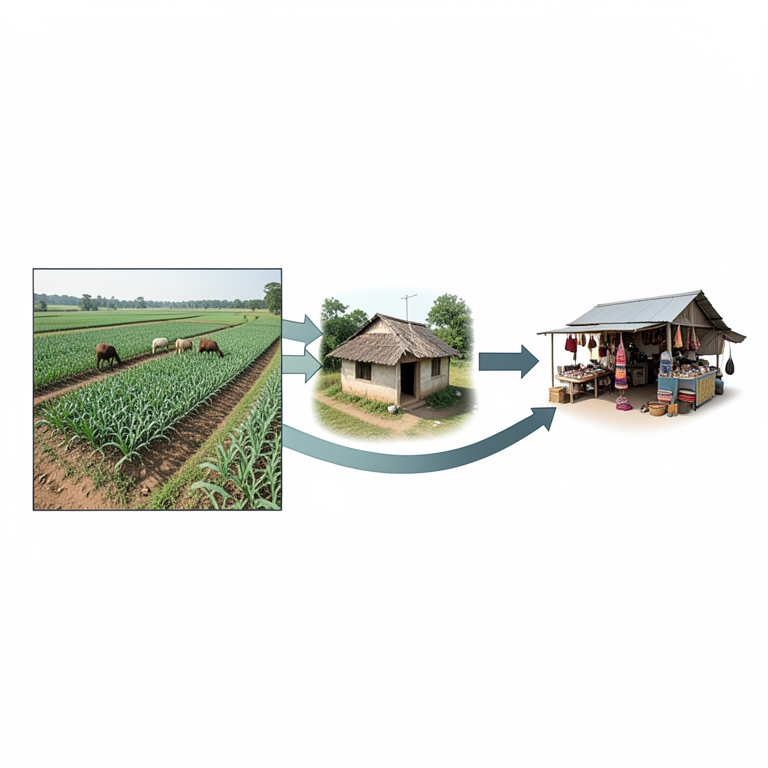
Agro-Ecotourism Value Chain
AI-generated conceptual illustration (Indian rural farm landscape with diverse crops and a small guest cottage). It explains the idea and does not show study data.
View source evidence ↗Figures & tables
From the original paper Table 1
 Table 1
 Table 2
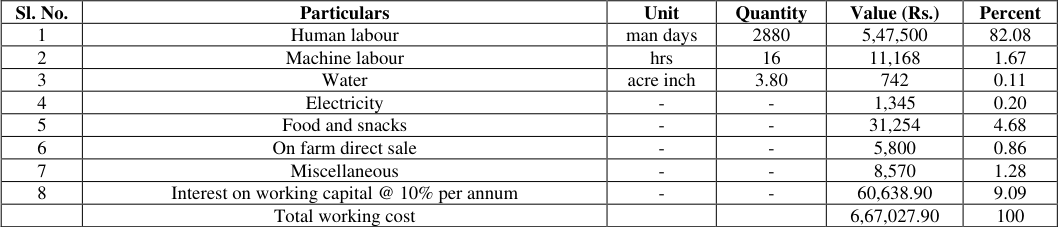 Table 3
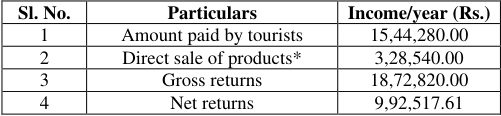 Table 4
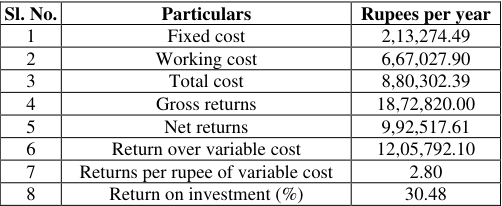 Table 5
 Table 6
Introduction
Agro-ecotourism is on the rise within India's tourism sector, fostering a mutually beneficial bond between farming, tourism, and agricultural enterprises, while leveraging ecosystem services (Barbuddhe and Singh, 2014) [3] . This concept invites visitors to immerse themselves in farm activities for leisure, education, or participation, providing a refreshing break from the urban hustle and bustle to indulge in local cuisine and gain insights into diverse farming practices. In Karnataka, celebrated for its ecological richness, destinations like Chikkamagaluru, Madikeri, and Mysuru allure eco-tourism enthusiasts. Agro-ecotourism offers a distinctive chance to boost employment in both agriculture and tourism, nurturing local hiring practices and fostering tourism experiences rooted in indigenous culture and natural landscapes. This niche sector holds promise in uplifting local communities, including marginalized groups, by integrating them into the tourism value chain. This integration involves supplying local goods, labor, and services, propelling grassroots economic development. Moreover, it underscores the importance of conserving natural ecosystems, elevating farmers' livelihoods through additional income and job opportunities, and enhancing overall community well-being. Despite its advantages, the expansion of agro-ecotourism brings challenges like environmental degradation and pollution. Recognizing the significance of environmental preservation, it is vital to mitigate these adverse effects while maximizing the socio-economic benefits of agro-ecotourism. Therefore, this study aims to delve into the economic aspects of Agro-ecotourism among farm households.
Methodology
The study was carried out in Chikkamagaluru and Kodagu districts of Karnataka during the year of 2020-21. Purposive proportionate sampling technique was employed for selection of farm households. Data was collected from 40 farmers using pre-tested well-structured schedule through personal interview method. Tabular method of presentation was employed to compile the socio-economic characteristics and ecocnomics of agro-ecotourism. In order to assist the interpretation of findings, descriptive statistical measures like percentages, averages and ratios were worked out wherever necessary.
Estimation of cost and returns
The economics of agro-ecotourism, was worked out on a per farm basis using averages and percentages.
Cost concepts I. Establishment Cost:
Cost incurred by the farmers till the agro-ecotourism generates income. The costs incurred under this comprises construction of building, infrastructure facilities like pathways and area preparation for sports and recreation and materials required to construct them etc.
d) Managerial cost:
Cost accounted for the management of farm by the farmer-owner. Farmer as an owner plays a multiple role in the production system with his mental and physical involvement. Hence, 10 per cent of the working capital has been taken as managerial cost.
e) Interest on fixed capital: Interest on fixed capital was computed at the rate of ten per cent per annum (commercial bank rate for fixed deposits). The interest was worked out on the values of fixed assets, after deducting depreciation for the year. f) Amortized cost of establishment: Amortization is an accounting technique that reduces cumulative establishment cost at a discount rate over the economic life of the agroecotourism. To arrive at amortized establishment cost, the following formula was used: Amortization was calculated by using formula:
Where, A = Annual amortized cost P = Establishment cost n = Economic life of agro-ecotourism unit (taken as 35 years) r = interest rate (2%) 2). Maintenance Cost/ Working capital: After the establishment of the agro-ecotourism farm, the cost incurred by the farmer to maintain the agro-ecotourism annually was worked out considering both variable and fixed costs. The maintenance cost was calculated by taking the average annual maintenance cost of the agro-ecotourism unit after establishment.
Variable cost: Those costs vary with the level of agroecotourism activities are considered as a variable cost. The items included in this category of cost are given below.
Labour cost:
The actual expenditure incurred on hired human labour, bullock labour and machine labour were recorded. In case of owned family labour (human, bullock and machine labour), the imputed value was considered at the market prices. Women days were converted into mandays by multiplying it with ratio of wages given to women labour to that of men labour (0.75). Machine labour was measured in hours and valued at prevailing hourly rates in the study area. Wage rate for men labour: Rs.500/manday Wage rate of women labour: Rs.300/manday Wage rate of machine labour: Rs. 800/hour Material cost: The cost on purchased inputs viz., food and snacks, materials required for packing the products and others for direct sale, electricity and miscellaneous (all the input materials purchased on payment) and for farm produced and owned inputs were also imputed at market prices.
Irrigation cost: Irrigation water cost was accounted at Rs. 200 per acre inch of water (Rohit et al., 2015) [4] .
Interest on working capital:
The prevailing bank rate of ten per cent (commercial bank lending rate for plantation) is taken to work out the interest on working capital.
3). Returns a) Gross return
Gross return is the value of payment calculated at prevailing prices at which farmers earn from agro-ecotourism in the study area. This includes the payment made by tourists and earnings from the direct sale of products. In the current study, profitability of agro-ecotourism over only agriculture was evaluated using the partial budgeting approach. The technique the additional costs, reduced returns, reduced cost and increased returns realized by farmers. Note: Infrastructure includes construction of building, pool, furniture, equipment, road etc.
Results
Results
Establishment cost
The establishment cost of agro-ecotourism unit is presented in Table 1. The results showed that 96.62 per cent of establishment cost was incurred on building followed by infrastructure (32.31%) and sports and recreation (0.74%).
| Sl. No. | Particulars | Unit | Quantity | Value (Rs.) | Percent |
|---|---|---|---|---|---|
| 1 | Building | - | - | 31,45,670 | 96.62 |
| 2 | Infrastructure | - | - | 75,450 | 2.31 |
| 3 | Sports and recreation | - | - | 24,320 | 0.74 |
| 4 | Others | - | - | 10,000 | 0.30 |
| Total establishment cost | - | - | 32,55,440 | 100 |
Table text extracted from the original PDF; superscript letters are shown inline. The original table image is below.
View original table image
| Debit | Credit |
|---|---|
| Increase in the cost due to a particular technology =A | Savings or reduction in cost due to particular technology in the farm = C |
| Decrease in returns due to a particular technology = B | Increase in gross return due to a particular technology = D |
| Total Debit = A+B | Total Credit = C+D |
| Credit minus debit = Net gain / loss |
Table text extracted from the original PDF; superscript letters are shown inline. The original table image is below.
View original table image
On an average the total establishment cost per unit was Rs. 32,55,440. This revealed that, to start the agro-ecotourism unit more capital is required to the construction of building and infrastructure.
Fixed cost
The average annual fixed cost of agro-ecotourism unit was Rs. 2,13,274.49 (Table 2). The major portion of fixed cost was occupied by the amortized establishment cost (50.88%) i.e., Rs. 1,08,514.66. This was followed by managerial cost of 31.27 per cent (Rs. 66,702.79), interest on fixed capital @ 10% per annum (9.09%), rental value of land was 8.43 per cent (i.e., Rs. 18,000) and depreciation with 0.29 per cent (Rs. 633.45). The least among was land revenue with 0.01 per cent (Rs. 35).
| Sl. No. | Particulars | Unit | Quantity | Value (Rs.) | Percent |
|---|---|---|---|---|---|
| 1 | Depreciation | - | - | 633.45 | 0.29 |
| 2 | Rental value of land | - | - | 18,000 | 8.43 |
| 3 | Land revenue | - | - | 35 | 0.01 |
| 4 | Managerial cost @10% of working capital | - | - | 66,702.79 | 31.27 |
| 5 | Interest on fixed capital @ 10% per annum | - | - | 19,388.59 | 9.09 |
| 6 | Amortized establishment cost | - | - | 1,08,514.66 | 50.88 |
| 7 | Total fixed cost | 2,13,274.49 | 100 |
Table text extracted from the original PDF; superscript letters are shown inline. The original table image is below.
View original table image
Working capital
The annual working capital of agro-ecotourism unit is represented in Table 3. The results revealed that the average working capital was about Rs. 6,67,027.90 for agroecotourism unit. Human labour took the considerable allocation (82.08%) with 2880 man days including male and female labourers which accounted for Rs. 5,47,500. After this, food and snacks (4.68%) took a cost of Rs. 31,254 followed by machine labour with 16 hrs of work (1.67%) with Rs. 11168 and miscellaneous (1.28%). On contrary to this, the study by Visser (2003) [6] showed the relatively low levels of capital investment. www.extensionjournal.com
| Sl. No. | Particulars | Unit | Quantity | Value (Rs.) | Percent |
|---|---|---|---|---|---|
| 1 | Human labour | man days | 2880 | 5,47,500 | 82.08 |
| 2 | Machine labour | hrs | 16 | 11,168 | 1.67 |
| 3 | Water | acre inch | 3.80 | 742 | 0.11 |
| 4 | Electricity | - | - | 1,345 | 0.20 |
| 5 | Food and snacks | - | - | 31,254 | 4.68 |
| 6 | On farm direct sale | - | - | 5,800 | 0.86 |
| 7 | Miscellaneous | - | - | 8,570 | 1.28 |
| 8 | Interest on working capital @ 10% per annum | - | - | 60,638.90 | 9.09 |
| Total working cost | 6,67,027.90 | 100 |
Table text extracted from the original PDF; superscript letters are shown inline. The original table image is below.
View original table image
Returns from agro-ecotourism
The returns from agro-ecotourism unit in a year are mentioned in the Table 4. As indicated in the table the returns comprised of two components i.e., amount paid by the tourists and from the direct sale of products. It is observed that the amount paid by tourists constituted the major portion of returns with Rs. 15,44,280 followed by the direct sale of products with Rs. 3,28,540. In total the amount received by the farmer was Rs. 18,72,820 and after deducting the cost, farmer left with the amount of Rs. 9,92,517.61 as profit from agro-ecotourism unit. This is the additional returns added to the income of farmers. According to the study conducted by Ahire (2018) [1] the farmers were carrying out agro-ecotourism on 8 acres of land without taking financial aid. They had engaged 8 people to work for tourism and farming activities and out of tourism activities he was able to get net income of Rs.1,30,000. Modern agriculture is driven by continuous improvements in digital tools and data as well as collaborations among farmers. As time passed, more technological advances appeared in agriculture. The additional technology aims at improving yield, efficiency and profitability. In the view profitability, the agro-ecotourism has provided additional returns among farmers who adopted this new innovation in the study area. Partial budgeting technique was employed to assess the role of agro-ecotourism in terms of realizing the increase in net returns or cost reduction. The profitability of agro-ecotourism technology over agriculture was assessed using the partial budgeting technique (Table 6). The results revealed that, the net gain per unit was about Rs. 12,05,792.10 which was higher than following only agriculture. According to the results the total added cost was Rs. 6,67,027.90. On the other hand net returns formed the total credit of Rs. 18,72,820.00 without any reduction in cost. This implies that there is increase in both the cost and returns among farmers who adopted agroecotourism. But the increase in returns is higher compared to cost which in turn strengthen the economic status of farmers. This is in line with results of study conducted by Schilling et al. (2014) [5] where they found that agro-tourism had statistically significant and positive effects on farm profitability. Similarly, the study by Barbieri and Tew (2010) [2] showed that agro-tourism was perceived as having a positive impact on farm profits, with the majority reporting at least some increase after adding agro-tourism activities and nearly one-fourth reporting a two-fold or more profit increase. The results support the acceptance of hypothesis that, returns generated was more from agroecotourism.
| Debit/Expenses | — | Credit/Savings | — |
|---|---|---|---|
| Added Cost | Amount (Rs.) | Reduced cost | Amount (Rs.) |
| Working cost | 6,67,027.90 | - | - |
| Total added cost (A) | 6,67,027.90 | Total reduced cost (B) | 0 |
| Reduced returns | Added returns | ||
| - | - | a. Gross returns | 18,72,820.00 |
| Total reduced return (C) | 0 | Total added return (D) | 18,72,820.00 |
| Total debit (A+C) | 6,67,027.90 | Total credit (B+D) | 18,72,820.00 |
| Net gain (Rs. per unit) | 12,05,792.10 |
Table text extracted from the original PDF; superscript letters are shown inline. The original table image is below.
View original table image
| Sl. No. | Particulars | Income/year (Rs.) |
|---|---|---|
| 1 | Amount paid by tourists | 15,44,280.00 |
| 2 | Direct sale of products* | 3,28,540.00 |
| 3 | Gross returns | 18,72,820.00 |
| 4 | Net returns | 9,92,517.61 |
Table text extracted from the original PDF; superscript letters are shown inline. The original table image is below.
View original table image
Conclusion
It is evident that agro-ecotourism emerges as a lucrative venture for farmers, offering higher annual income compared to traditional agriculture. Despite the lower number of days employed in agro-ecotourism, the return on investment is substantial, with a notable return over variable cost and a high return per rupee of investment. The establishment cost for agro-ecotourism units is relatively high, primarily allocated towards building infrastructure. However, this initial investment seems to pay off well, as the net gain per unit is significantly higher than that of agriculture alone. Furthermore, agro-ecotourism not only generates income from tourists but also allows for direct sales of products, adding to the overall profitability. After deducting costs, farmers are left with substantial profits,
Figures and tables from the paper
| Sl. No. | Particulars | Rupees per year |
|---|---|---|
| 1 | Fixed cost | 2,13,274.49 |
| 2 | Working cost | 6,67,027.90 |
| 3 | Total cost | 8,80,302.39 |
| 4 | Gross returns | 18,72,820.00 |
| 5 | Net returns | 9,92,517.61 |
| 6 | Return over variable cost | 12,05,792.10 |
| 7 | Returns per rupee of variable cost | 2.80 |
| 8 | Return on investment (%) | 30.48 |
Table text extracted from the original PDF; superscript letters are shown inline. The original table image is below.
View original table image
References
4 in the original paper- Ahire LM, Srinivasarao C, Kumar SV, Reddy V. An innovative concept to earn an extra income from Agritourism-the case of an Agri-tourism centres in Maharashtra. Journal of Science in Agriculture and Engineering. 2018;7:63-67.
- Rohith GV, Rashmi KS, Hamsa KR, Divya Lekshmi U, Rajeshwari D, Manjunatha AV, et al. Incorporating cost of irrigation water in the currently underestimated cost of cultivation: An empirical treatise. Indian Journal of Agricultural Economics. 2015;70(3):319-332.
- Schilling BJ, Attavanich W, Jin Y. Does agritourism enhance farm profitability?. Journal of Agricultural and Resource Economics. 2014;39(1):69-87.
- Visser G. The Local development impacts of backpacker tourism: Evidence from the South African experience. Urban Forum. 2003;14:264-293.
Cited by 1
From OpenAlex, OpenCitations and reference lists read by Scinovex
- Agro-tourism: Sustainable diversification strategy for enhancing farmers income in Goa state
PV Phadte, P.J. KSHIRSAGAR, SR Torane, DB Malave, S Bhat, SA Jagptap · International Journal of Agriculture Extension and Social Development · 2026
Agro-tourism has emerged as an effective strategy for promoting sustainable agriculture by diversifying farm income, improving resource utilization and strengthening rural livelihoods. The present study was conducted in Goa state to assess the contribution of Agro-tourism towards sustainable agricultural systems. A total of 30 Agro tourism centres were selected randomly from the study area. Primary data was collected from the selected Agro-tourism entrepreneurs and the data was analysed using simple percentages, averages and other descriptive statistical measures. The findings revealed that th