
Research article · 2024 · Full text
International Journal of Veterinary Sciences and Animal HusbandryEffect of vitamin-e on sperm mucus penetration distance and sperm morphometry in fresh vs frozen-thawed semen of Kankrej bull
Volume 9(2) · Pages 461–464 · DOI: 10.22271/veterinary.2024.v9.i2g.1243 ↗
Research areasSperm and Testicular FunctionReproductive Biology and FertilityAnimal Genetics and Reproduction
Abstract
Author-writtenThis study applied nine artificially collected ejaculates from three mature Kankrej bulls to study the cryopreservation of semen from mature Kankrej bulls in a tris egg yolk fructose dilutor at varying concentrations (G I: control, G II: 1.5 mM, and G III: 2 mM) of vitamin-E and its impact on spermatozoa penetration within cervical mucus and sperm morphometry. Fresh semen was found to have a sperm mucus penetration distance (SMPD) of 16.78±0.84 mm. Nevertheless, during post-thaw stages of cryopreserved Kankrej bull semen, the overall mean penetration distance of cryopreserved bull spermatozoa was determined to be 19.89±0.63 mm in G I, 26.44±0.82 mm in G II, and 23.00±0.69 mm in G III vitamin-E group, respectively. Compared to other concentrations, the SMPD was considerably (P < 0.01) greater in 1.5 mM vit-E. Fresh semen was discovered to include spermatozoa with average head length (HL), head width (HW), and midpiece length (ML) measurements of 8.62 ± 0.04, 4.52 ± 0.03, and 13.98 ± 0.05 μm, respectively. Using different quantities of vitamin-E at the post-thawed stage, the overall mean HL, HW, and ML were 8.56±0.03, 4.44±0.05, and 13.75±0.07 in G I; 8.51±0.03, 4.43±0.04, and 13.72±0.05 μm in G II; and 8.52±0.05, 4.45±0.08, and 13.74±0.06 μm in G III group, respectively.
Summary
Source-checkedPlain-language reading of the full paper, prepared with AI and checked against the text. Each point links to the authors' own words.
Why it matters
- Artificial insemination is a common and affordable technology used to improve cattle genetics by spreading superior genes. View evidence ↗
- The process of cryopreservation can harm spermatozoa due to extreme changes in their physical and chemical environments. View evidence ↗
- Oxidative stress, which activates lipid peroxidation of biological membranes, is a major contributor to sperm abnormalities. View evidence ↗
- Vitamin E (α-tocopherol) is a key lipid-soluble antioxidant that helps protect cells from damage. View evidence ↗
What they did
- Researchers used 9 ejaculates from 3 Kankrej bulls, cryopreserving them in a Tris Fructose Egg Yolk dilutor with three Vitamin E levels: control (G I), 1.5 mM (G II), and 2.0 mM (G III). View evidence ↗
- The sperm mucus penetration test (SMPT) measured the distance vanguard spermatozoa traveled in bovine mucus after 45 minutes of incubation. View evidence ↗
- Sperm morphometry was analyzed using a phase contrast microscope at 1000x magnification and a digital CCD camera to examine 200 spermatozoa per ejaculate. View evidence ↗
What they found
- Fresh (neat) semen had an average sperm mucus penetration distance (SMPD) of 16.78 ± 0.84 mm. View evidence ↗
- There were no significant differences in head length (HL), head width (HW), or mid-piece length (ML) among the three Vitamin E treatment groups post-thaw. View evidence ↗
- Cryopreservation caused a significant decrease in the mid-piece length (ML) of spermatozoa, dropping from 13.98 ± 0.05 μm in neat semen to 13.74 ± 0.06 μm overall post-thaw (p = 0.003). View evidence ↗
- The head length (HL) and head width (HW) of the spermatozoa did not change significantly after the cryopreservation process. View evidence ↗
What it means
- The authors conclude that adding 1.5 mM Vitamin E to the dilutor improves the quality of frozen-thawed bovine semen by increasing sperm mucus penetration. View evidence ↗
- The authors state that while cryopreservation shrinks the mid-piece length of bovine spermatozoa, it does not affect the length or width of the head. View evidence ↗
Visual summary
1 visualsIllustrations explain the paper; charts are replotted from the paper's own table values.
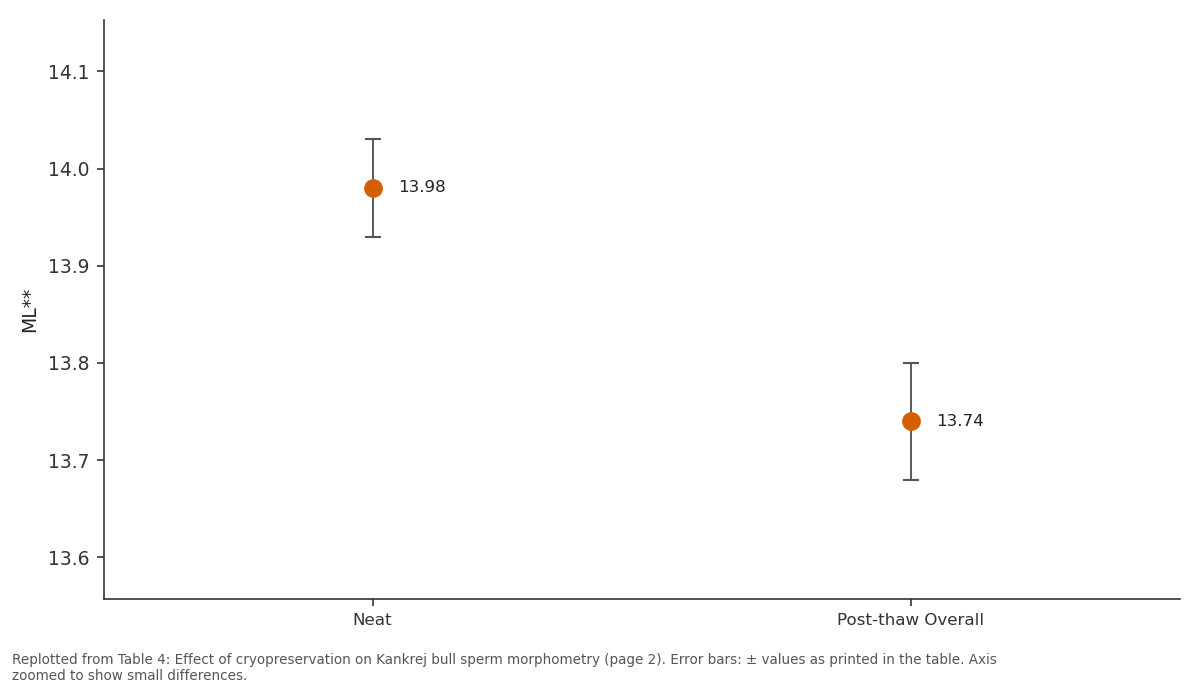
ML**: Neat vs Post-thaw Overall
Replotted from Table 4 (page 2) of the original paper. Every bar is the paper's own table value.
View source evidence ↗Figures & tables
From the original paper Table 1
 Table 2
 Table 3
 Table 4
Introduction
Artificial insemination (AI) has become one of the most widely used and reasonably priced assisted reproductive technologies, with the goal of improving the genetic quality of cattle through the dissemination of superior genes. In rich countries, farmers have begun to utilize it frequently, but it is becoming more and more widespread on cattle in developing nations. AI depends on the generation of high-quality frozen semen. The spermatozoa are subjected to a number of extreme alterations in their chemical and physical environments during cryopreservation, which harms them. Up to 50% of this harm could occur (Watson, 2000) [1] . The detrimental effects on sperm structure, biochemistry, and functional damage lead to reduced motility, compromised plasma membrane integrity, and lower fertility. The plasma membrane is the main area where cryoinjury to spermatozoa occurs (Krogenaes et al., 1994) [2] . Through the activation of lipid peroxidation (LPO) of bio membranes, oxidative stress is recognized to play a significant role in sperm abnormalities (Arabi et al., 2001) [3] . Vitamin E, also known as α-tocopherol, is the most significant lipid-soluble and chainbreaking antioxidant that aids in cell defense. By donating the hydrogen from the hydroxyl (-OH) group on the ring structure, it quickly inactivates free radicals. Primarily found in the phospholipid bilayer of cell membranes, it effectively inhibits lipid peroxidation, or the oxidative degradation of polyunsaturated fatty acids (PUFAs) in sperm membranes (Sarangi et al., 2017) [4] . Reduced post-thaw motility, viability, membrane integrity, antioxidant status, fertility, and sperm functions have all been linked to excessive reactive oxygen species (ROS) production during cryopreservation (Aitken et al. 1998; Bilodeau et al. 2000; White, 1993; Zhao and Buhr, 1995) [5,6,7,8] .
The in-vitro sperm mucus penetration test (SMPT) is a sperm function test used to assess the quality of semen and predict the ability of spermatozoa to fertilize. It measures the ability of sperm in the semen to swim up into a column of cervical mucus or substitute (Anilkumar et al., 2001) [9] .
Materials and Methods
The SMPT and morphometry of fresh and post-thawed spermatozoa cryopreserved in Tris Fructose Egg Yolk dilutor with varied concentration (G I, control; G II, 1.5 mM, and G III, 2.0 mM) of Vitamin-E were studied using a total of 9 ejaculates taken artificially from 3 Kankrej bull.
Sperm mucus penetration test (SMPT)
Using non-heparinized hematocrit capillary tubes, the Kankrej cow mucus sample with a typical fern pattern and no infection (as determined by the white side test) was used for the SMPT (Matousek et al., 1989) [10] . After 45 minutes of incubation, the vanguard spermatozoa in bovine mucus were measured in millimeters.
Sperm morphometry
Each bull produced three ejaculates, for a total of nine, which were cryopreserved in the neat and post-freeze stages and analyzed for sperm morphometry. As stated by (Gupta and Singh 2018) [11] , the slides were prepared for the morphometric examination using the Rose Bengal stain. A phase contrast microscope with a 1000x magnification and a high-resolution digital CCD camera was used to count the 200 spermatozoa that were present in each ejaculate. The data was analyzed using image analysis software (ZEN 2012, Carl Zeiss 3 Microscopy GmbH). Using standard length photographs with defined magnifications and measurement precision of ± 0.1 mm, the system was first calibrated.
Statistical analysis
For neat and post-thawed semen, a three factorial CRD (Completely Randomized Design) was employed, followed by the Duncan New Multiple Range Test (DNMRT), to ascertain the differences between various Vit-E concentrations and stages utilizing the approach outlined by (Snedecor and Cochran 1994) [12] . SPSSver.20 (Statistical Packages for Social Sciences) was used for all statistical analyses of the data that were gathered.
Results
Results
SMPT
The neat semen of Kankrej bulls had sperm mucus penetration distance values ranging from 14.83 to 18.73 mm, with an overall mean value of 16.78±0.78 mm. For the K17-98, K17-05, and K18-24 bulls, the mean penetration distance values were 19.00±1.15, 15.67±1.20, and 15.67±1.45. (Table 1). Group II had a considerably (p<0.01) greater penetration distance (PD) in comparison to the other groups. There was a significant (p<0.01) variation in PD between Groups I, II, and III, with Group II showing the largest variance. There was a highly significant (p<0.01) difference between Group I, II, III and neat penetration distance and post-thaw penetration distance.
| Bull | SMPT | Sperm morphometry | — | — |
|---|---|---|---|---|
| Penetration Distance (mm/45 min) | Head Length (μm) | Head Width (μm) | Mid-piece length (μm) | |
| K17-98 (n=10) | 19.0±1.15 | 8.55±0.05 | 4.54±0.04 | 14.10±0.09 |
| K17-05 (n=10) | 15.67±1.20 | 8.61±0.06 | 4.51±0.05 | 13.89±0.07 |
| K18-24 (n=10) | 15.67±1.45 | 8.71±0.09 | 4.49±0.06 | 13.95±0.08 |
| Overall (n=30) | 16.78±0.84 | 8.62±0.04 | 4.52±0.03 | 13.98±0.05 |
Table text extracted from the original PDF; superscript letters are shown inline. The original table image is below.
View original table image
Sperm morphometry
Table 1. illustrates the mean values of HL, HW, and ML of spermatozoa in fresh semen, indicating a non-significant variation between the bulls. Tables 3 and4 report the results of sperm morphometry for the various treatment groups at the post-thaw stage. A non-significant difference in HL, HW, and ML was found between G I, G II, and G III based on statistical analysis. An extremely significant (P < 0.01) difference of ML was found between neat and overall mean of post-thawed spermatozoa of all the groups. However, HL and HW did not differ significantly between neat and post-thaw spermatozoa.
Discussion
In the present study, post-thawed spermatozoa showed higher SMPD than pristine semen sperm. Thawing-induced cryocapacitation-like changes during freezing and thawing in the spermatozoa might have affected the distance travelled. The primary characteristics of spermatozoa that influence their capacity to flow through gel or mucus are their post-thaw motility, concentration, percentage of aberrant spermatozoa, and acrosome integrity, according to Galli et al., 1991) [13] .
The SMPD of spermatozoa that had been cryopreserved at different vit-E concentrations showed a significant increase. These findings are consistent with (Muzafer et al., 2012) [14] , who found that 0.3 mg/ml of vitamin E had a significantly stronger effect on spermatozoa penetration distance at the post-thaw stage (50.19± 1.36 percent) compared to the control in crossbred bulls. The changes in sperm motility after thawing, aberrant sperm, and acrosome integrity could be the cause of the variation in sperm penetration distance between groups.
It has been demonstrated that there is a high correlation between the spermatozoa's ability to fertilize and the bull sperm mucus penetration test (SMPT) (Tas et al., 2007) [15] . In comparison to the other treatment groups, including the control, G II with 1.5 mM Vit-E demonstrated the maximum penetration distance at the post-thaw stage in the current investigation. The fact that G II travelled a longer distance than the other groups suggests that Vit-E functions as an antioxidant during the cryopreservation of semen at a concentration of 1.5 mM in the dilutor. It was shown that while HL and HW were unaltered, spermatozoa's ML significantly decreased when semen was cryopreserved. Many writers looked examined the morphometrics of spermatozoa from different species. Higher head length and head width were observed in Jersy bulls (Sundaraman et al., 2007), Pandharpuri buffalo bulls (Aggarwal et al., 2007), and rams (Bhainsare et al., 2018) [16,17,18] in comparison to the current study. These results do not support the current findings. However, after cryopreserved Murrah buffalo bull semen, (Rana et al., 2020) [19] found a considerable reduction in sperm mid piece length, which supports the current findings.
Conclusion
In to cryopreserve bovine semen, 1.5 mM Vit-E was added to the dilutor. This improved the frozen-thawed semen's quality in terms of sperm mucus penetration. Bovine spermatozoa's mid-piece length shrank as a result of cryopreservation, but the head's length and width remained same.
Figures and tables from the paper
| Neat (n=9) | Post-thaw (n=27) | — | — |
|---|---|---|---|
| Group I | Group II | Group III | |
| 16.78±0.85 a | 19.89±0.63 b | 26.44±0.82 d | 23.00±0.69 c |
Table text extracted from the original PDF; superscript letters are shown inline. The original table image is below.
View original table image
| — | Group I | Group II | Group III |
|---|---|---|---|
| HL | 8.56±0.03 | 8.51±0.03 | 8.52±0.05 |
| HW | 4.44±0.05 | 4.43±0.04 | 4.45±0.08 |
| ML | 13.75±0.07 | 13.72±0.05 | 13.74±0.06 |
Table text extracted from the original PDF; superscript letters are shown inline. The original table image is below.
View original table image
| — | Neat | Post-thaw Overall | P value |
|---|---|---|---|
| HL | 8.62±0.04 | 8.53 ± 0.08 | 0.111 |
| HW | 4.52±0.03 | 4.44 ± 0.05 | 0.124 |
| ML** | 13.98±0.05 | 13.74 ± 0.06 | 0.003 |
Table text extracted from the original PDF; superscript letters are shown inline. The original table image is below.
View original table image
References
18 in the original paper- Watson PF. The causes of reduced fertility with cryopreserved semen. Anim. Reprod Sci. 2000;60(1):481-492.
- Krogenaes A, Ropstad E, Thomassen R, Pedersen Ø, Forsberg M. In vitro maturation and fertilization of oocytes from Norwegian semi-domestic reindeer (Rangifer tarandus). Theriogenology. 1994;41(2):371377.
- Sarangi A, Singh P, Virmani M, Sahu S, Magotra A. Effect of vitamin-E supplementation on quality of beetal buck semen during storage at 4 °C. Haryana vet. 2017;56(1):95-97.
- Aitken RJ, Gordon E, Harkiss D, Twigg JP, Milne P, Jennings Z, et al. Relative impact of oxidative stress on the functional competence and genomic integrity of human spermatozoa. Biol. Reprod. 1998;59:1037-1046.
- Bilodeau JF, Chatterjee S, Sirard MA, Gagnon C. Levels of antioxidant defenses are de-creased in bovine spermatozoa after a cycle of freezing and thawing. Mol. Reproduction and Development. 2000;55:282-288.
- White IG. Lipids and calcium uptake of sperm in relation to cold shock and preservation: A review. Reproduction Fertility and Development. 1993;5:639-658.
- Zhao Y, Buhr MM. Cryopreservation extenders affect calcium flux in bovine spermatozoa during a temperature challenge. Journal of Andrology. 1995;16:278-285.
- Anilkumar R, Devanathan TG, Pattabiraman SR, Edwin MJ. Correlation between the spermatozoal characteristics and sperm penetration distance in polyacrylamide gel and bovine cervical mucus. Theriogenology. 2001;55:685-91.
- Matousek J, Srsen V, Veselský L, Louda F. Penetration of cervical mucus and other body fluids by bull sperm in capillary tubes. Animal Reproduction Science. 1989;18(1-3):161-166.
- Gupta, Singh. Does the morphological abnormalities in semen of Jersey bulls vary significantly during different stages of processing. Journal of Entomology and Zoology Studies. 2018;6(5):2219-2222.
- Snedecor GW, Cochran WG, Statistical methods. 8thEdn. Affiliated East-West Press, New Delhi, India, 1994.
- Galli A, Basetti M, Balduzzi D, Martignoni M, Bornaghi V, Maffii M. Frozen bovine semen quality and bovine cervical mucus penetration test. Theriogenology. 1991;35(4):837-844.
- Muzafer AB, Mutha Rao M, Sanjay A, Pandey AK, Verma PK, Sultana M. Effect of anti-oxidant supplementation on post-thaw sperm characteristics, membrane integrity, migration capability and lipid peroxidation in bull semen. Indian Journal of Animal Sciences. 2012;82(5):457.
- Tas M, Bacinoglu S, Cirit U, Ozdas OB, Kemal AK. Relationship between bovine fertility and the number of spermatozoa penetrating the cervical mucus within straws. Animal Reproduction Science. 2007;101:18-27.
- Sundararaman MN, Kalatharan J, Jawahar KTP. Analyses of morphological and morphometrical deviations of bull spermatozoa by computer assisted semen analysis technique. Asian Journal of Animal and Veterinary Advances. 2007;2:196-204.
- Aggarwal RAK, Ahlawat SPS, Kumar Y, Panwar PS, Singh K, Bhargava M. Biometry of frozen-thawed sperm from eight breeds of Indian buffaloes (Bubalus bubalis). Theriogenology. 2007;68(4):682-686.
- Bhainsare P, Tekam S, Pagrut N. Biometry of local rams' sperm at Jaipur area. Journal of Entomology and Zoology Studies. 2018;6(4):328-329.
- Rana RS, Slathia I, Rana RS. Study the Morphometry of Fresh and Cryopreserved Murrah Bull Spermatozoa. Advances in Zoology and Botany. 2020;8(4):279-290.