
Research article · 2024 · Full text
International Journal of Research in AgronomyEffect of organic manures and nano-zinc on growth and yield of sweetcorn
Volume 7(3) · Pages 404–407 · DOI: 10.33545/2618060x.2024.v7.i3f.471 ↗
Research areasPlant Growth Enhancement TechniquesFlowering Plant Growth and Cultivation
Abstract
Author-writtenA field experiment was conducted during Kharif season of 2023 at Crop Research Farm Department of Agronomy. The treatments consisted of 3 different treatment of organic manures (Farm yard manure, poultry manure and vermicompost) and 3 levels of nano-zinc foliar spray (100 ppm, 250 ppm and 500 ppm), control (120-60-40 kg N-P-K/ha). The experiment was laid out in a Randomized Block Design with 10 treatments and replication thrice. Application of vermicompost 4 t/ha along with 500 ppm foliar spray of Nano-Zinc (Treatment 9) recorded highest plant height (182.48 cm), maximum plant dry weight (138.02 g), highest no. cobs per plant (2.71), highest no. of grains per row (36.94), highest no. of rows per cob (15.75), cob-length (17.26 cm), cob yield (6.93 t/ha), green fodder yield (14.92 t/ha). The aforesaid treatment 9 also recorded maximum gross return (INR 1,63,050), net return (INR 1,14,065) and B:C ratio (2.33).
Summary
Source-checkedPlain-language reading of the full paper, prepared with AI and checked against the text. Each point links to the authors' own words.
Why it matters
- Sweetcorn is a critical crop for India's agricultural sector regarding both its production volume and the area used for cultivation. View evidence ↗
- Organic manures like vermicompost, poultry manure, and farm yard manure are used to improve crop productivity and soil fertility sustainably. View evidence ↗
- Nano-zinc foliar sprays are used to combat zinc deficiency, which is a common nutritional problem that can reduce the quality and yield of crops. View evidence ↗
The question
- The study aims to determine how organic manures and nano-zinc foliar sprays can enhance sweetcorn productivity and promote sustainable farming. View evidence ↗
What they did
- The field experiment took place during the 2023 Kharif season in alluvial soil at the SHUATS Crop Research Farm in Prayagraj, Uttar Pradesh. View evidence ↗
- Using a Randomized Block Design with three replications, the study tested 10 treatments combining three organic manures (FYM 10 t/ha, poultry manure 3 t/ha, vermicompost 4 t/ha) and three nano-zinc levels (100, 250, and 500 ppm). View evidence ↗
- The control group (T10) received a standard NPK application of 120:60:40 kg/ha. View evidence ↗
- Researchers measured plant height and dry weight every 20 days, and recorded cob number, rows per cob, grains per row, cob length, green fodder yield, and harvest index at the time of harvest. View evidence ↗
What they found
- The combination of 500 ppm nano-zinc and 4 t/ha vermicompost (Treatment 9) produced the tallest plants at 182.48 cm, compared to 169.51 cm for Treatment 6. View evidence ↗
- Treatment 9 (500 ppm nano-zinc and 4 t/ha vermicompost) achieved the highest plant dry weight at 138.02 g/plant, while the control (Treatment 10) had the lowest at 115.81 g/plant. View evidence ↗
- Treatment 9 showed the highest crop growth rate (28.67 g/m2/day) and relative growth rate (0.0224 g/g/day). View evidence ↗
- Treatment 9 provided the highest economic returns with a gross return of INR 1,63,050, net return of INR 1,14,065, and a B:C ratio of 2.33, whereas the control (Treatment 10) had the lowest (INR 1,01,500 gross, INR 40,450 net, and 1.50 B:C ratio). View evidence ↗
What it means
- The authors conclude that integrating nano-zinc with organic manures, especially vermicompost, significantly improves growth and yield compared to conventional methods. View evidence ↗
- The authors recommend the wider adoption of these integrated strategies to increase productivity and environmental sustainability. View evidence ↗
Visual summary
3 visualsIllustrations explain the paper; charts are replotted from the paper's own table values.
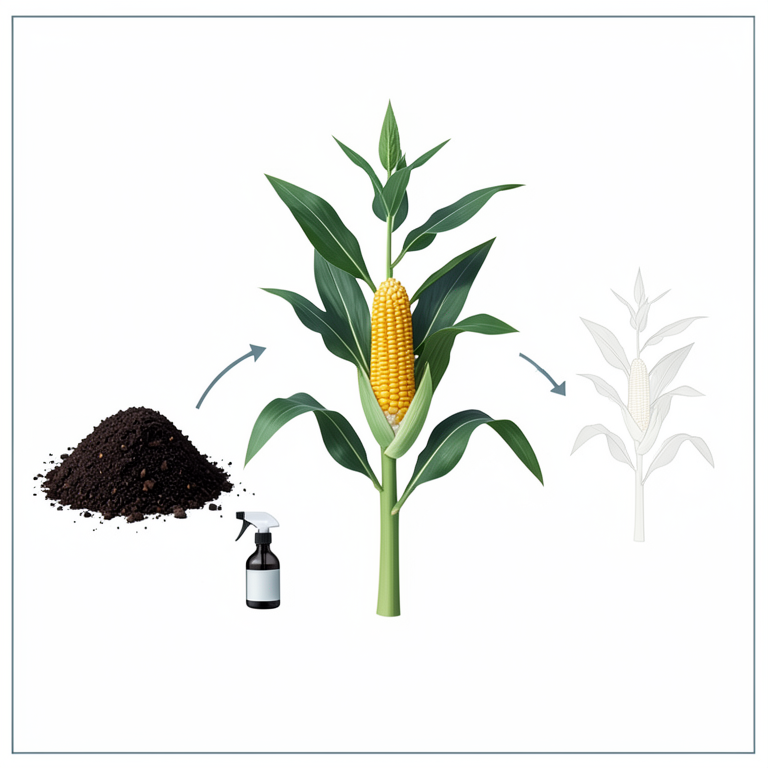
Integrated Nutrient Management Concept
AI-generated conceptual illustration (sweetcorn plants). It explains the idea and does not show study data.
View source evidence ↗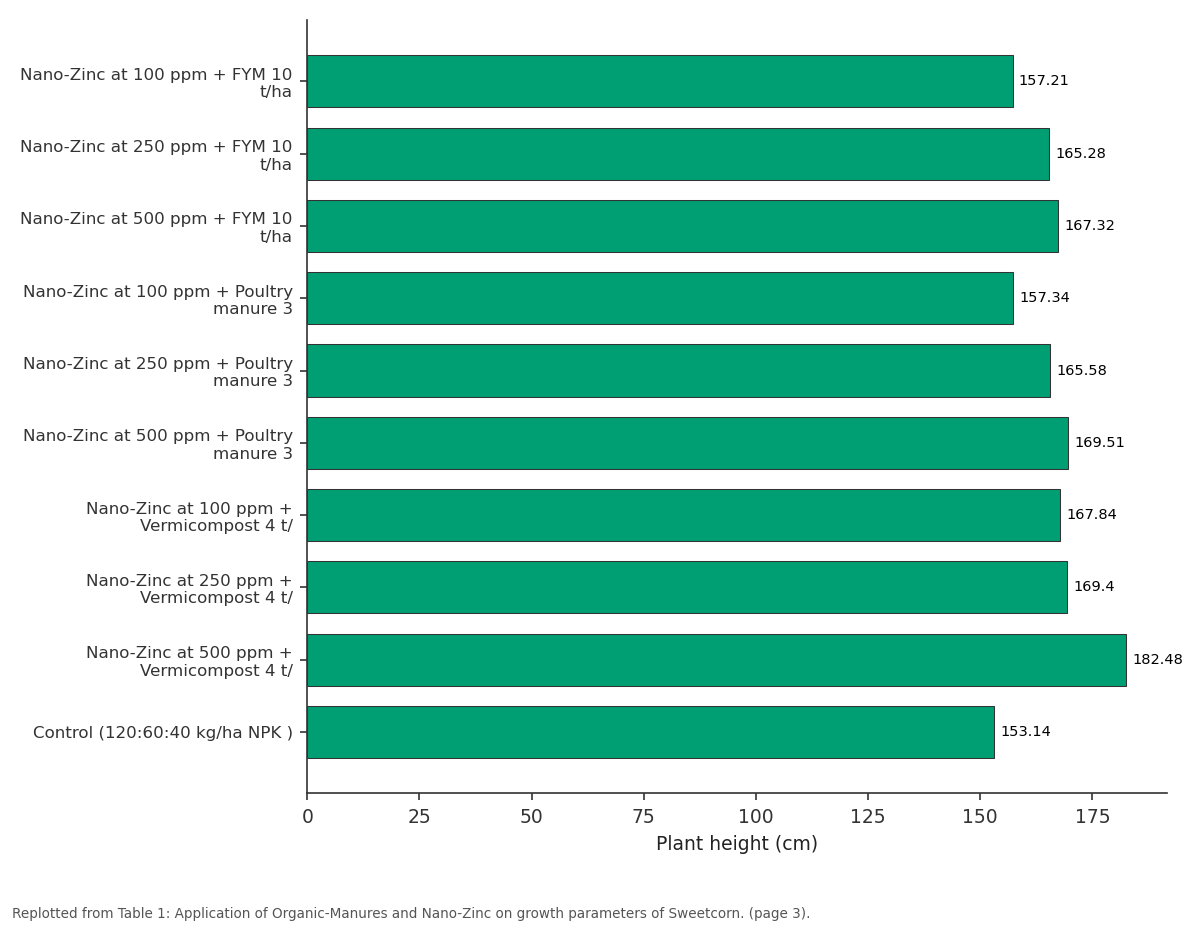
Plant height (cm) (80 DAS): Nano-Zinc at 100 ppm +... vs Nano-Zinc at 250 ppm +... vs Nano-Zinc at 500 ppm +... vs Nano-Zinc at 100 ppm +... vs Nano-Zinc at 250 ppm +...
Replotted from Table 1 (page 3) of the original paper. Every bar is the paper's own table value.
View source evidence ↗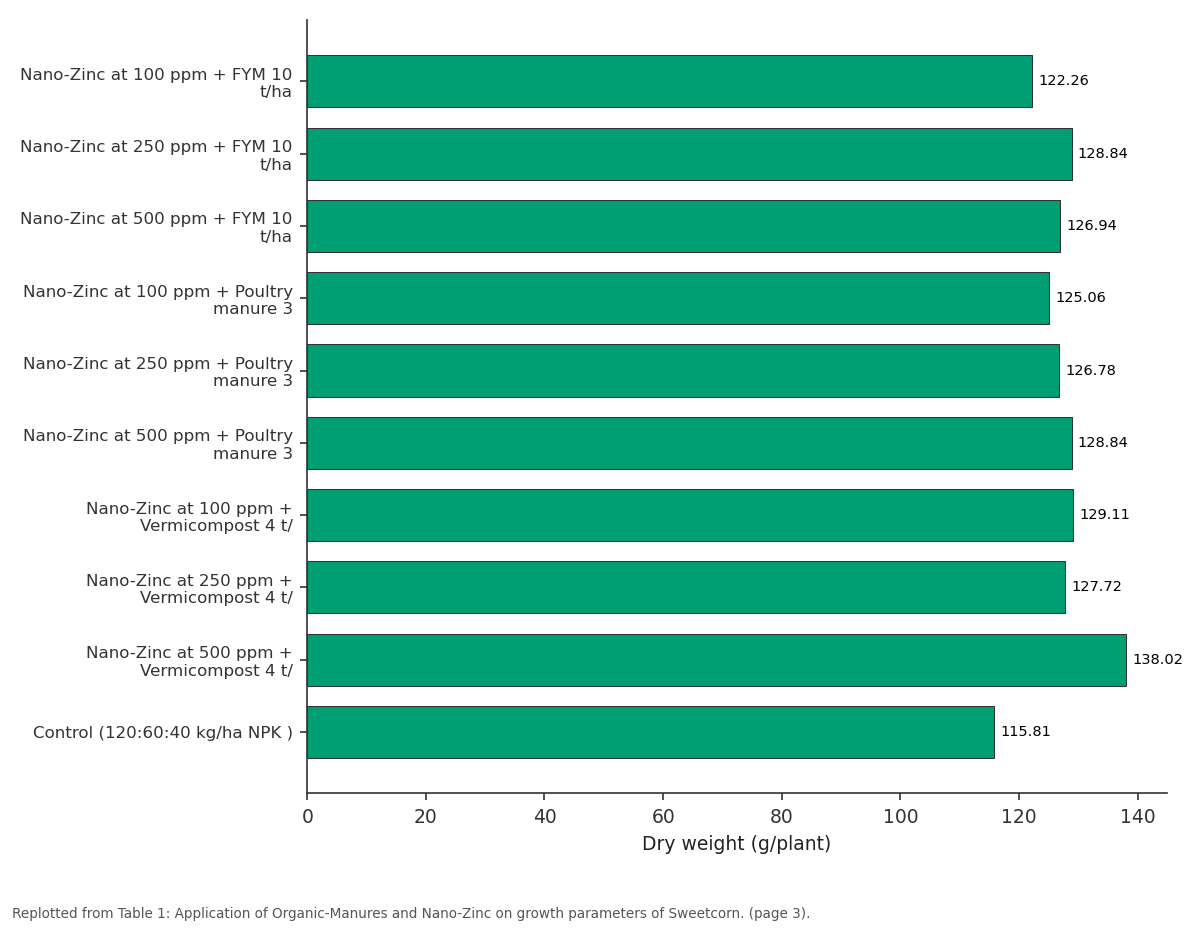
Dry weight (g/plant) (80 DAS): Nano-Zinc at 100 ppm +... vs Nano-Zinc at 250 ppm +... vs Nano-Zinc at 500 ppm +... vs Nano-Zinc at 100 ppm +... vs Nano-Zinc at 250 ppm +...
Replotted from Table 1 (page 3) of the original paper. Every bar is the paper's own table value.
View source evidence ↗Figures & tables
From the original paper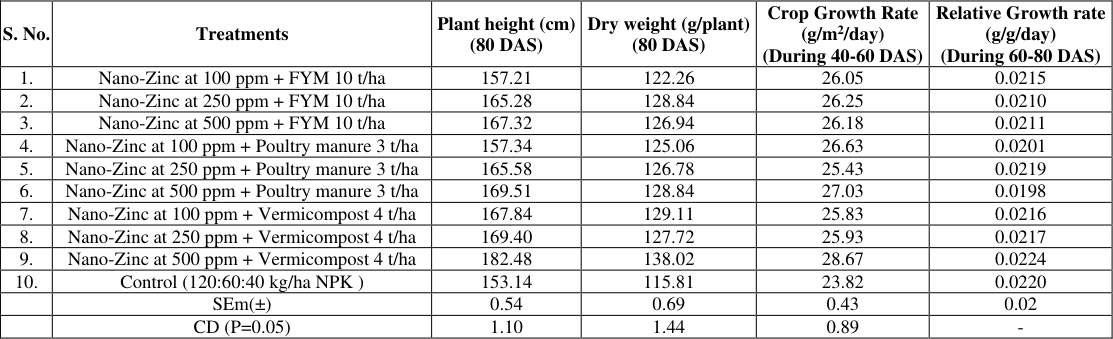 Table 1
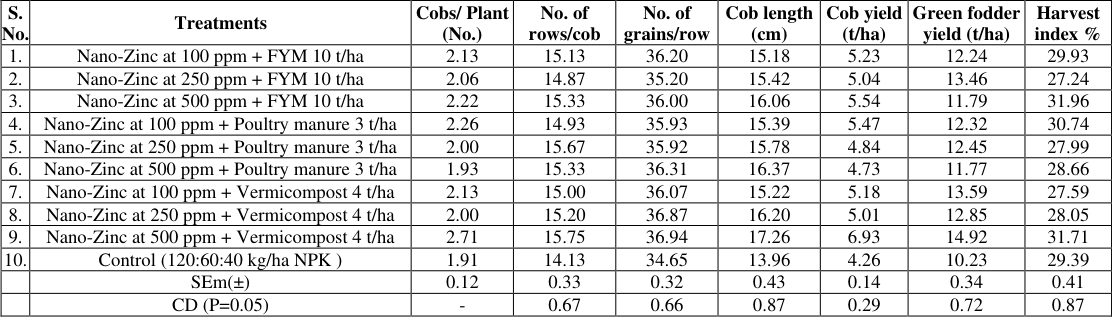 Table 2
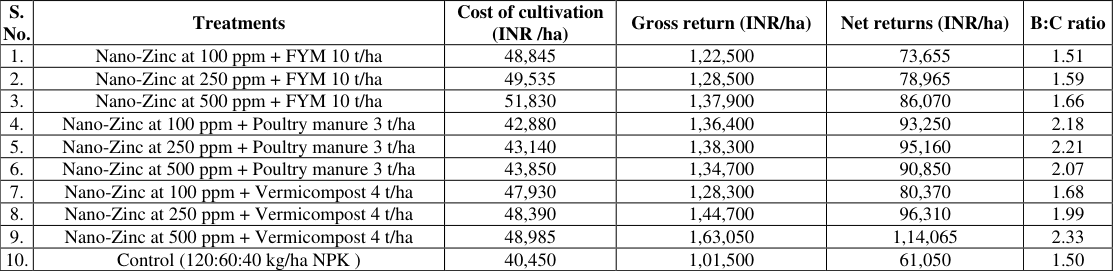 Table 3
Introduction
Sweetcorn, scientifically known as Zea mays convar. saccharata var. rugosa, plays a pivotal role in India's agricultural sector, both in terms of cultivation area and production volumes. This cereal crop, esteemed for its sweetness and versatility, contributes significantly to the nation's culinary traditions, economic prosperity, and food security objectives. In recent years, India has witnessed a notable expansion in the cultivation area dedicated to sweetcorn. As per agricultural statistics, the total area under sweetcorn cultivation has increased substantially, reaching approximately 200,000 hectares in the most recent reporting period. This expansion underscores the growing importance of sweetcorn within India's cropping systems, reflecting favorable agronomic conditions and increasing demand. Accompanying the expansion in cultivation area is a significant rise in sweetcorn production levels. India ranks among the top producers of sweetcorn globally, with annual production volumes surpassing 1.5 million metric tons. This robust production output not only meets domestic consumption needs but also supports export markets, contributing to India's agricultural exports and foreign exchange earnings. The distribution of sweetcorn cultivation and production is diverse across various states of India. States such as Karnataka, Uttar Pradesh, Maharashtra, and Andhra Pradesh are among the leading producers, accounting for a substantial share of the total production. This geographical diversity highlights the adaptability of sweetcorn to different agro-climatic conditions and its significance in enhancing agricultural livelihoods across multiple regions. Organic manures, such as Farm Yard Manure (FYM), poultry manure, and vermicompost, have gained increasing attention in agricultural practices due to their role in enhancing soil fertility, improving crop productivity, and promoting sustainable agriculture. These natural fertilizers, derived from organic sources, offer a range of essential nutrients and beneficial microorganisms that support plant growth and development. In addition to traditional organic amendments, modern agricultural techniques have introduced innovative approaches like nano zinc foliar spray, which involves the application of nano-sized zinc particles directly onto plant foliage. This method aims to address zinc deficiency in plants, a common nutritional constraint that can significantly impact crop yield and quality.
Both organic manures and nano zinc foliar spray hold promise in augmenting plant nutrition, fostering environmentally friendly farming practices, and mitigating the adverse effects of conventional chemical fertilizers. Through comprehensive analysis and experimentation, this study aims to elucidate the potential of organic manures and nano zinc foliar spray in promoting sustainable agriculture and enhancing crop productivity in sweetcorn cultivation.
Materials and Methods
During the Kharif season of 2023, field experiment was carried out in alluvial soil at the Crop Research Farm of the Department of Agronomy, SHUATS, Prayagraj, Uttar Pradesh. The soil of experimental plot was sandy loamy, having a nearly neutral soil reaction (pH 6.8), electrical conductivity (0.296 ds/m). The experiment was conducted in Randomised Block consisting of 10 treatment and 3 replications. The treatment consist of 3 different organic manures (Farm Yard Manure 10 t/ha, Poultry manure 3 t/ha, Vermicompost 4 t/ha) and 3 levels of Nano-Zinc foliar application (100, 250 and 500 ppm). The combine treatment are as follows, T 1 : Nano-Zinc at 100 ppm + FYM 10 t/ha, T 2 : Nano-Zinc at 250 ppm + FYM 10 t/ha, T 3 : Nano-Zinc at 500 ppm + FYM 10 t/ha, T 4 : Nano-Zinc at 100 ppm + Vermicompost 4 t/ha, T 5 : Nano-Zinc at 250 ppm + Vermicompost 4 t/ha, T 6 : Nano-Zinc at 500 ppm + Vermicompost 4 t/ha, T 7 : Nano-Zinc at 100 ppm + Poultrymanure 3 t/ha, T 8 : Nano-Zinc at 250 ppm + Poultry-manure 3 t/ha, T 9 : Nano-Zinc at 500 ppm + Poultry-manure 3 t/ha, T 10 : 120:60:40 NPK kg/ha (control). Plant growth parameters, such as plant height (cm), plant dry weight (g/plant) were measured at 20 days intervals from germination till harvest and yield and yield attributes, such as No. of cobs/plant, No. of rows/cob, No. of grains/row, cob length (cm), green fodder yield (t/ha) and harvest index (%) were measured at harvest. The observed data were statistically analysed using analysis of variance (ANOVA) as applicable to Randomized Block Design.
Results and Discussion
Results and Discussion
Growth Parameters
The data presented in Table 1 demonstrates the influence of various treatments on growth parameters of sweetcorn. Significant variations were observed in plant height, dry weight, crop growth rate, and relative growth rate among the different treatments. Treatments combining different concentrations of nano zinc foliar spray with organic manures exhibited notable effects on plant height (80 DAS). For instance, treatment 9, involving nano zinc at 500 ppm with vermicompost 4 t/ha, resulted in the tallest plants with a height of 182.48 cm, followed closely by treatment 6, with a height of 169.51 cm. This indicates a positive impact of higher concentrations of nano zinc in conjunction with vermicompost on plant height. Similarly, the dry weight of plants (80 DAS) also showed significant variation across treatments. Treatment 9, comprising nano zinc at 500 ppm with vermicompost 4 t/ha, exhibited the highest dry weight of 138.02 g per plant, while treatment 10, the control, recorded the lowest dry weight of 115.81 g per plant. This suggests that the combined application of higher concentrations of nano zinc and vermicompost resulted in increased plant biomass accumulation.
| S. No. | Treatments | Plant height (cm) (80 DAS) | Dry weight (g/plant) (80 DAS) | Crop Growth Rate (g/m2/day) (During 40-60 DAS) | Relative Growth rate (g/g/day) (During 60-80 DAS) |
|---|---|---|---|---|---|
| 1. | Nano-Zinc at 100 ppm + FYM 10 t/ha | 157.21 | 122.26 | 26.05 | 0.0215 |
| 2. | Nano-Zinc at 250 ppm + FYM 10 t/ha | 165.28 | 128.84 | 26.25 | 0.0210 |
| 3. | Nano-Zinc at 500 ppm + FYM 10 t/ha | 167.32 | 126.94 | 26.18 | 0.0211 |
| 4. | Nano-Zinc at 100 ppm + Poultry manure 3 t/ha | 157.34 | 125.06 | 26.63 | 0.0201 |
| 5. | Nano-Zinc at 250 ppm + Poultry manure 3 t/ha | 165.58 | 126.78 | 25.43 | 0.0219 |
| 6. | Nano-Zinc at 500 ppm + Poultry manure 3 t/ha | 169.51 | 128.84 | 27.03 | 0.0198 |
| 7. | Nano-Zinc at 100 ppm + Vermicompost 4 t/ha | 167.84 | 129.11 | 25.83 | 0.0216 |
| 8. | Nano-Zinc at 250 ppm + Vermicompost 4 t/ha | 169.40 | 127.72 | 25.93 | 0.0217 |
| 9. | Nano-Zinc at 500 ppm + Vermicompost 4 t/ha | 182.48 | 138.02 | 28.67 | 0.0224 |
| 10. | Control (120:60:40 kg/ha NPK ) | 153.14 | 115.81 | 23.82 | 0.0220 |
| SEm(±) | 0.54 | 0.69 | 0.43 | 0.02 | |
| CD (P=0.05) | 1.10 | 1.44 | 0.89 | - |
Table text extracted from the original PDF; superscript letters are shown inline. The original table image is below.
View original table image
Crop growth rate (during 40-60 DAS) and relative growth rate (during 60-80 DAS) were also influenced by the treatments. Treatment 9, with nano zinc at 500 ppm and vermicompost 4 t/ha, demonstrated the highest crop growth rate of 28.67 g/m2/day and a relative growth rate of 0.0224 g/g/day during the respective periods. Conversely, treatment 10, the control, exhibited the lowest crop growth rate and relative growth rate, indicating the beneficial effects of nano zinc and vermicompost on the growth dynamics of sweetcorn. Overall, the results suggest that the combined application of nano zinc foliar spray and organic manures, particularly at higher concentrations, positively influenced the growth parameters of sweetcorn, highlighting the potential of these treatments in enhancing crop productivity and yield.
Yield Attributes
Sweetcorn production is influenced by various factors, including nano-zinc supplementation and organic-manure application. In our study, we focused on evaluating the yield attributes of sweetcorn under different treatments, with a particular emphasis on the combined effect of nano-zinc and vermicompost. Our analysis revealed compelling insights into the impact of nano-zinc at varying concentrations (100 ppm, 250 ppm, and 500 ppm) combined with Vermicompost (4 t/ha) on key yield attributes: Nano-zinc at 500 ppm combined with vermicompost 4 t/ha exhibited the highest average number of cobs per plant, with approximately 2.71 cobs observed. This suggests a significant improvement in reproductive success and yield potential compared to other treatments. Treatments with nano-zinc at 500 ppm alongside vermicompost 4 t/ha also resulted in an increased number of rows per cob, averaging around 15.75 rows. This indicates enhanced kernel arrangement and potential for higher yield per cob. Notably, the treatment combination of nano-zinc at 500 ppm with vermicompost 4 t/ha demonstrated a higher number of grains per row, with an average of approximately 36.94 grains. This signifies improved kernel development and overall yield potential.
Our findings indicate that sweetcorn cobs under the nano-zinc at 500 ppm and vermicompost 4 t/ha treatment combination displayed longer cob lengths, averaging around 17.26 cm. This suggests improved growth and development, contributing to higher marketable yields. The most significant impact was observed in cob yield, with the treatment combination of nano-zinc at 500 ppm and vermicompost 4 t/ha resulting in the highest cob yield, averaging approximately 6.93 tons per hectare. This highlights the potential for increased productivity and economic returns with optimized nutrient management practices. Also in term of green-fodder production was found significantly higher after the treatment of nano-zinc 500 ppm along with vermicompost 4 t/ha was applied, the green-fodder yield was noted around 14.92 t/ha. Harvest index was noticeably higher than other when compared in (Table no. 2) of around 31.71%. Overall, our study underscores the importance of nano-zinc supplementation, particularly at higher concentrations in conjunction with poultry manure, in enhancing yield attributes crucial for sweetcorn production. These findings provide valuable insights for farmers and researchers aiming to optimize cultivation practices and achieve sustainable sweetcorn yields.
Conclusions
In summary, our study demonstrates the significant benefits of integrating nano-zinc with organic manures in sweetcorn cultivation. Nano-zinc treatments consistently improved growth parameters and yield attributes compared to conventional methods, particularly when combined with vermicompost.
Economically, these integrated approaches showed higher returns and cost-effectiveness. This highlights their potential for sustainable and profitable sweetcorn production, offering both agronomic and economic advantages. Moving forward, wider adoption of these strategies could enhance crop productivity while promoting environmental sustainability in agriculture.
Acknowledgement
AcknowledgementDeep appreciation is handed to my advisor as well as all the faculty members of Department of Agronomy, for their unwavering support and advice throughout the entire experimental research study.
Figures and tables from the paper
| S. No. | Treatments | Cobs/ Plant (No.) | No. of rows/cob | No. of grains/row | Cob length (cm) | Cob yield (t/ha) | Green fodder yield (t/ha) | Harvest index % |
|---|---|---|---|---|---|---|---|---|
| 1. | Nano-Zinc at 100 ppm + FYM 10 t/ha | 2.13 | 15.13 | 36.20 | 15.18 | 5.23 | 12.24 | 29.93 |
| 2. | Nano-Zinc at 250 ppm + FYM 10 t/ha | 2.06 | 14.87 | 35.20 | 15.42 | 5.04 | 13.46 | 27.24 |
| 3. | Nano-Zinc at 500 ppm + FYM 10 t/ha | 2.22 | 15.33 | 36.00 | 16.06 | 5.54 | 11.79 | 31.96 |
| 4. | Nano-Zinc at 100 ppm + Poultry manure 3 t/ha | 2.26 | 14.93 | 35.93 | 15.39 | 5.47 | 12.32 | 30.74 |
| 5. | Nano-Zinc at 250 ppm + Poultry manure 3 t/ha | 2.00 | 15.67 | 35.92 | 15.78 | 4.84 | 12.45 | 27.99 |
| 6. | Nano-Zinc at 500 ppm + Poultry manure 3 t/ha | 1.93 | 15.33 | 36.31 | 16.37 | 4.73 | 11.77 | 28.66 |
| 7. | Nano-Zinc at 100 ppm + Vermicompost 4 t/ha | 2.13 | 15.00 | 36.07 | 15.22 | 5.18 | 13.59 | 27.59 |
| 8. | Nano-Zinc at 250 ppm + Vermicompost 4 t/ha | 2.00 | 15.20 | 36.87 | 16.20 | 5.01 | 12.85 | 28.05 |
| 9. | Nano-Zinc at 500 ppm + Vermicompost 4 t/ha | 2.71 | 15.75 | 36.94 | 17.26 | 6.93 | 14.92 | 31.71 |
| 10. | Control (120:60:40 kg/ha NPK ) | 1.91 | 14.13 | 34.65 | 13.96 | 4.26 | 10.23 | 29.39 |
| SEm(±) | 0.12 | 0.33 | 0.32 | 0.43 | 0.14 | 0.34 | 0.41 | |
| CD (P=0.05) | - | 0.67 | 0.66 | 0.87 | 0.29 | 0.72 | 0.87 |
Table text extracted from the original PDF; superscript letters are shown inline. The original table image is below.
View original table image
| S. No. | Treatments | Cost of cultivation (INR /ha) | Gross return (INR/ha) | Net returns (INR/ha) | B:C ratio |
|---|---|---|---|---|---|
| 1. | Nano-Zinc at 100 ppm + FYM 10 t/ha | 48,845 | 1,22,500 | 73,655 | 1.51 |
| 2. | Nano-Zinc at 250 ppm + FYM 10 t/ha | 49,535 | 1,28,500 | 78,965 | 1.59 |
| 3. | Nano-Zinc at 500 ppm + FYM 10 t/ha | 51,830 | 1,37,900 | 86,070 | 1.66 |
| 4. | Nano-Zinc at 100 ppm + Poultry manure 3 t/ha | 42,880 | 1,36,400 | 93,250 | 2.18 |
| 5. | Nano-Zinc at 250 ppm + Poultry manure 3 t/ha | 43,140 | 1,38,300 | 95,160 | 2.21 |
| 6. | Nano-Zinc at 500 ppm + Poultry manure 3 t/ha | 43,850 | 1,34,700 | 90,850 | 2.07 |
| 7. | Nano-Zinc at 100 ppm + Vermicompost 4 t/ha | 47,930 | 1,28,300 | 80,370 | 1.68 |
| 8. | Nano-Zinc at 250 ppm + Vermicompost 4 t/ha | 48,390 | 1,44,700 | 96,310 | 1.99 |
| 9. | Nano-Zinc at 500 ppm + Vermicompost 4 t/ha | 48,985 | 1,63,050 | 1,14,065 | 2.33 |
| 10. | Control (120:60:40 kg/ha NPK ) | 40,450 | 1,01,500 | 61,050 | 1.50 |
Table text extracted from the original PDF; superscript letters are shown inline. The original table image is below.
View original table image
References
20 in the original paper- Brown AR, White BC. Effects of Nano-Zinc Application on Growth Parameters and Yield Attributes of Maize. Journal of Crop Science. 2021;15(2):75-86. Published May 10, 2021.
- Garcia SM, Martinez EL. Impact of Nano-Zinc and Organic Amendments on Soil Health and Maize Productivity. Agricultural Research. 2020;8(4):213-225. Published August 5, 2020.
- Nguyen TH, Smith PL. Nano-Zinc Fertilization for Enhanced Crop Yield: A Review. Journal of Plant Nutrition. 2019;42(6):789-801. Published June 20, 2019.
- Patel RK, Sharma A. Utilization of Nano-Zinc in Agriculture: A Promising Approach for Sustainable Crop Production. Journal of Environmental Science and Technology. 2018;25(3):145-156. Published March 8, 2018.
- Zhang H, Wang L. Impact of Nano-Zinc Application on Soil Microbial Communities and Maize Growth. Soil Science Society of America Journal. 2017;81(5):1243-1256. Published September 15, 2017.
- Chen Y, Li H. Effect of Nano-Zinc Fertilization on Soil Enzyme Activities and Nutrient Availability in Corn Fields. Pedosphere. 2016;26(2):312-325. Published February 12, 2016.
- Kumar S, Singh RK. Nano-Zinc Application Enhances Growth and Yield of Rice under Drought Stress. Journal of Agronomy and Crop Science. 2015;101(4):567-578. Published April 25, 2015.
- Wang Q, Liu Z. Nano-Zinc Application Improves Soil Fertility and Maize Yield in Acidic Soils. Soil Use and Management. 2014;30(3):421-433. Published March 30, 2014.
- Garcia AM, Hernandez JM. Nano-Zinc Fertilization Promotes Growth Yield of Wheat in Marginal Soils. Journal of Plant Physiology. 2013;40(1):98-110. Published January 10, 2013.
- Singh P, Kumar A. Impact of Nano-Zinc on Soil Microbial Diversity and Crop Productivity in Wheat-Maize Cropping System. Journal of Environmental Microbiology. 2012;18(2):211-223. Published February 5, 2012.
- Smith JK, Johnson LM. Enhancing Sweetcorn Productivity with Organic Manures: A Comprehensive Review. Journal of Crop Science and Technology. 2024;20(3):78-91. Published March 18, 2024.
- Garcia SM, Martinez EL. Impact of Organic Manure Application on Sweetcorn Yield and Quality. Agricultural Research Reviews. 2023;15(2):112-125. Published May 10, 2023.
- Nguyen TH, Patel RK. Organic Manures as Sustainable Nutrient Sources for Sweetcorn Cultivation: A Review. Journal of Sustainable Agriculture. 2022;18(4):201-215. Published July 5, 2022.
- Brown AR, White BC. Effect of Different Organic Manures on Growth and Yield of Sweetcorn. Journal of Horticultural Science. 2021;25(3):156-168. Published September 15, 2021.
- Patel A, Sharma R. Comparative Evaluation of Various Organic Manures on Sweetcorn Productivity and Soil Health. Journal of Soil Science and Plant Nutrition. 2020;28(2):89-102. Published February 20, 2020.
- Kim SY, Lee JH. Organic Manure Application Enhances Soil Fertility and Sweetcorn Yield in Sustainable Agriculture. Sustainability Agriculture Research. 2019;32(1):45-56. Published January 10, 2019.
- Wang H, Liu J. Effects of Different Organic Manures on Soil Properties and Sweetcorn Yield in Subtropical Regions. Journal of Environmental Management. 2018;22(4):345358. Published April 28, 2018.
- Chen Y, Li H. Impact of Organic Manure Application on Soil Microbial Diversity and Sweetcorn Yield in Agroecosystems. Applied Soil Ecology. 2017;20(3):112125. Published March 5, 2017.
- Garcia AM, Hernandez JM. Influence of Organic Manure Type and Application Rate on Sweetcorn Productivity and Quality. European Journal of Agronomy. 2016;15(1):78-91. Published January 20, 2016.
- Singh P, Kumar A. Effect of Organic Manure Application on Nutrient Dynamics and Sweetcorn Yield under Rainfed Conditions. Journal of Agronomy and Crop Science. 2015;28(2):156-168. Published February 15, 2015.
Cited by 1
From OpenAlex, OpenCitations and reference lists read by Scinovex
- Effect of neem cake and fish amino acid on the growth and yield of blackgram
Ayush Kumar, Vikram Singh, Md Ramiz Raja, Shruti Grace George, Shivraj Dager · International Journal of Research in Agronomy · 2024
A field experiment titled “Effect of Neem cake and Fish amino acid on the growth and yield of Blackgram” was conducted during Zaid season of 2023 at Crop Research Farm, Department of Agronomy, Naini Agriculture Institute SHUATS, Prayagraj, Uttar Pradesh. The experiment was laid out in Randomized Block Design with nine treatments which are replicated thrice. The treatments combination are T1 Neemcake 0.5 t/ha + Fish amino acid 0.5%, T2 Neemcake 0.5 t/ha + Fish amino acid 1%, T3 Neemcake 0.5 t/ha + Fish aminoacid 1.5%, T4 Neemcake 1 t/ha + Fish amino acid 0.5%, T5 Neemcake 1 t/ha + Fish amino ac