
Research article · 2023 · Full text
International Journal of Statistics and Applied MathematicsEffect of different levels of phosphorus and sulphur on maturity, yield and quality of cowpea (Vigna sinensis) Cv. Pusa Phalguni
Volume 8(6S) · Pages 1449–1451 · DOI: 10.22271/maths.2023.v8.i6ss.1672 ↗
Research areasAgricultural pest management studies
Abstract
Author-writtenThe experiment “Effect of different levels of phosphorous and sulphur on yield and quality of Cow pea (Vigna sinensis) Pusa Phalguni was conducted at the instruction a cum Research farm Department of Horticulture, Collage of Agriculture during kharif season 2012-2013. The experiment was laid out in factorial Randomized Design with three levels each of phosphorus and Sulphur consisting nine treatment combination replicated thrice. The treatment comprising of levels of phosphorus viz. P1:40 kg P2O5/ha, P2:50 kg P2O5/ha, P3:60 kg P2O5/ha and three levels of sulphur viz. S0:0 kg S/ha, S1: 20 kg S/ha, S2:40 kg S/ha and P1:60 kg P2O5/ha. Minimum crop duration (109) days to first picking (53.11) and highest no of picking (7.00) yield green pod (5o.51q) per hacter protein (23.19) B:C ratio (3.7) of cow pea under study.
Summary
Source-checkedPlain-language reading of the full paper, prepared with AI and checked against the text. Each point links to the authors' own words.
Why it matters
- Cowpea is a commercially grown crop in India, utilized as a vegetable for its green pods, a pulse for its seeds, and for foliage and fodder. View evidence ↗
- Nitrogen and phosphorus are critical nutrients for cowpea as they are essential components of phospholipids and proteins, with phosphorus specifically aiding root growth and early maturity. View evidence ↗
- Due to its high protein content in both seeds and straw, cowpea requires more sulphur than other legume crops. View evidence ↗
The question
- The study aimed to evaluate how different levels of phosphorus and sulphur affect the yield and quality of the cowpea variety Pusa Phalguni. View evidence ↗
What they did
- The research used a factorial randomized design with nine treatment combinations, each replicated three times, testing three levels of phosphorus and three levels of sulphur. View evidence ↗
- Phosphorus levels were set at 40, 50, and 60 kg P2O5/ha, while sulphur levels were 0, 20, and 40 kg S/ha. View evidence ↗
- Nitrogen and potassium were applied at 50 kg/ha each; phosphorus was provided via DAP, and sulphur was provided via Gypsum. View evidence ↗
- The experiment took place at the Department of Horticulture's research farm at the College of Agriculture during the 2012-2013 kharif season. View evidence ↗
What they found
- The earliest first picking occurred at 53.11 days when 60 kg P2O5/ha was applied. View evidence ↗
- The highest number of pickings (7.00) was recorded with the application of 60 kg P2O5/ha. View evidence ↗
- The highest green pod yield for phosphorus treatments was 6.38 kg per plot and 50.61 q per hectare, achieved at 60 kg P2O5/ha. View evidence ↗
- Applying 40 kg S/ha resulted in a higher green pod yield (6.5 kg per plot and 52.51 q per hectare) compared to no sulphur application. View evidence ↗
- The highest seed protein content (23.19%) was observed with the application of 60 kg P2O5/ha. View evidence ↗
- The highest benefit-cost (B:C) ratio of 3.7 was observed with the application of 40 kg S/ha. View evidence ↗
What it means
- The authors conclude that higher levels of phosphorus increase green pod yield, likely by promoting greater reproductive growth. View evidence ↗
- The authors suggest that sulphur improves protein content because it aids in the synthesis of amino acids. View evidence ↗
Visual summary
3 visualsIllustrations explain the paper; charts are replotted from the paper's own table values.
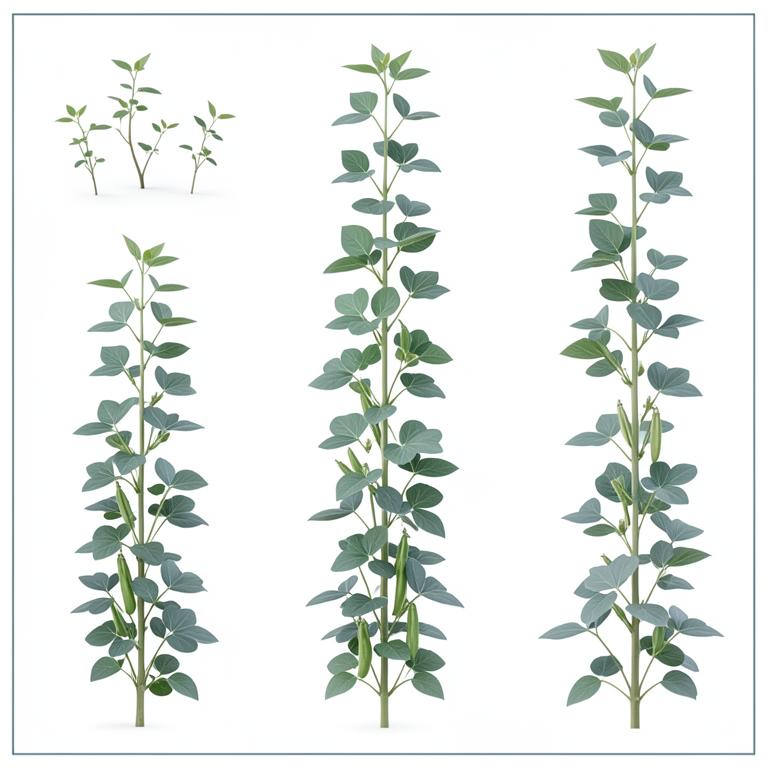
Experimental Treatment Matrix
AI-generated conceptual illustration (cowpea plants (Vigna sinensis)). It explains the idea and does not show study data.
View source evidence ↗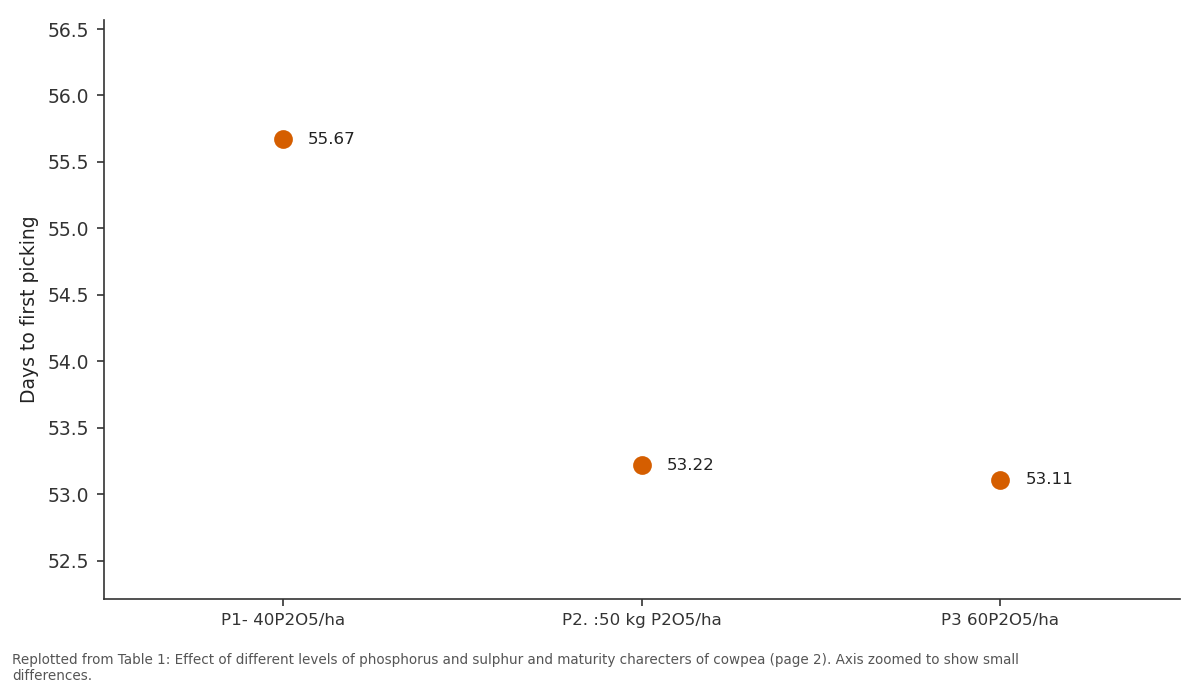
Days to first picking: P1- 40P2O5/ha vs P2. :50 kg P2O5/ha vs P3 60P2O5/ha
Replotted from Table 1 (page 2) of the original paper. Every bar is the paper's own table value.
View source evidence ↗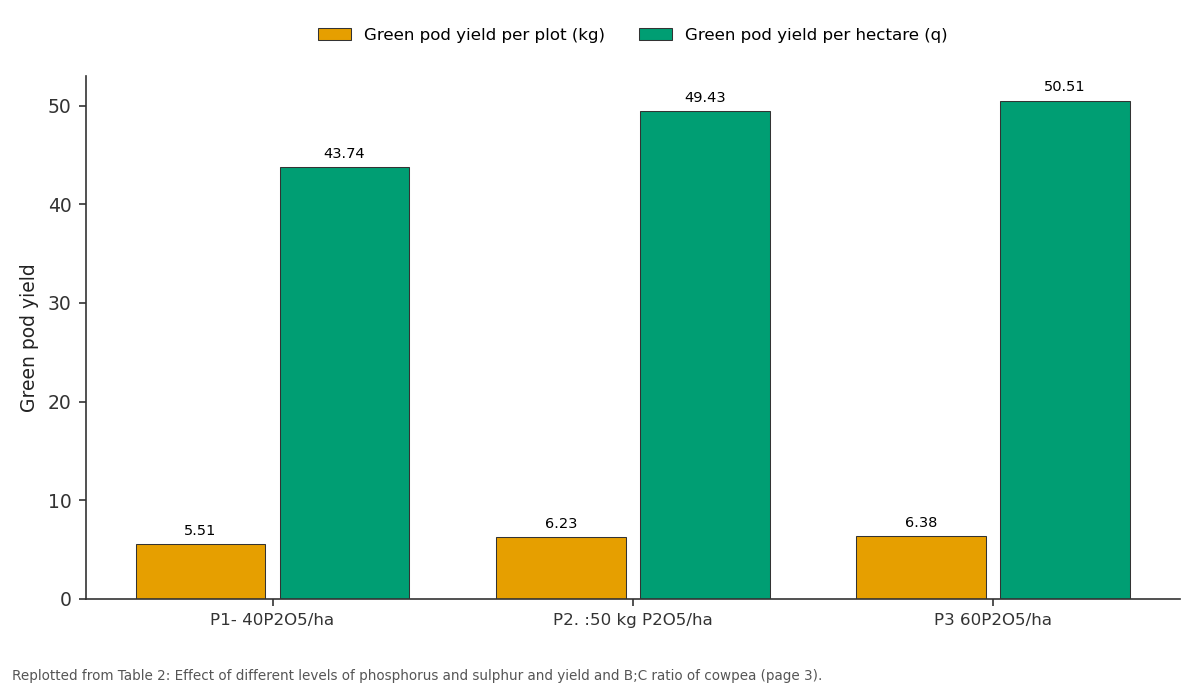
Green pod yield per plot (kg) and Green pod yield per hectare (q): P1- 40P2O5/ha vs P2. :50 kg P2O5/ha vs P3 60P2O5/ha
Replotted from Table 2 (page 3) of the original paper. Every bar is the paper's own table value.
View source evidence ↗Figures & tables
From the original paper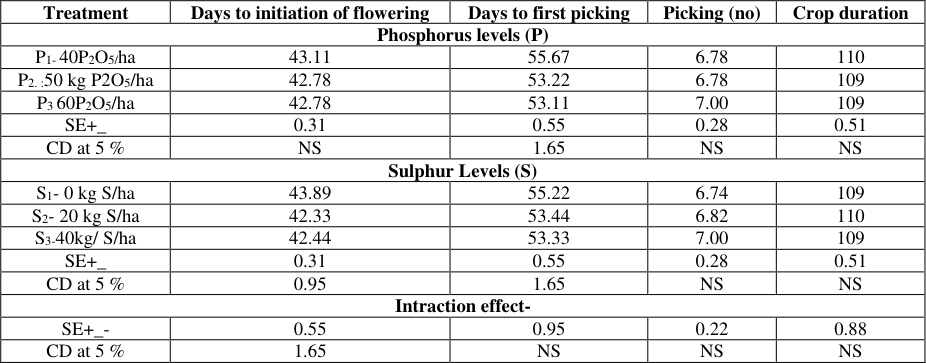 Table 1
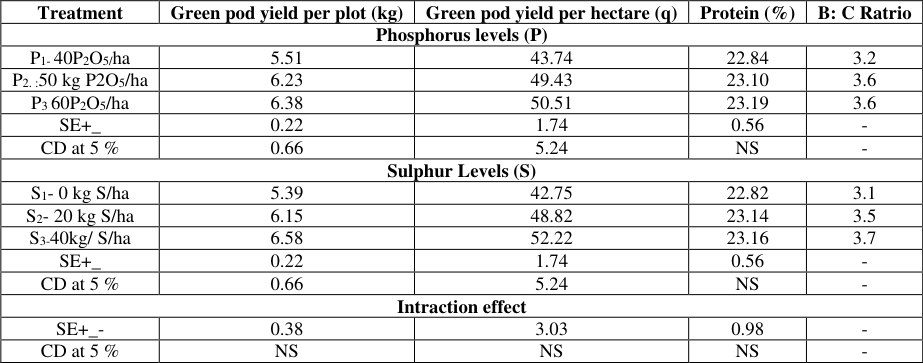 Table 2
Introduction
Cowpea is commercially growth through out in India for its long pod green as vegetable for its seed as pulse for its foliage and fodder The nutrient available to plant particularly nitrogen and phosphorus are important constitution of protein and phospholipids, phosphorus not only enhance the root growth but also promotes early plant maturity Mullin et al., (1996) [4] phosphorus does not increase seed yield but also nodulation reported that an increase of about 5%seed protein content of cowpea as a result of phosphorus application. Phosphorus is a vital element in all biological system and is limiting factor in enhancing the productivity of legumes. Its availability in tropical soils are less due to fixation by various soil reaction. Phosphorus does not only increase yield but also nodulation. Sulphur is a fourth major nutrient after nitrogen phosphorus and potassium Phosphorus all though not required in large quantities, critical to cowpea yield because of its multiple effect on plant nutrition (Muleba and Ezmumah, (1985) [5] Legume and oilseed crops have been found respond to sulphur application in soil because of deficiency in avaible sulphur dev and kumar (1982) [1] . Because of relatively higher protien content in seed and straw cowpea requirs high amount of sulphur than other legume crops.
Materials and Methods
The experiment on effect of different levels of phosphorus and sulphur on yield of Cowpea. (Vigna sinensis) Pusa Phalguni was conducted at the instruction a cum Research farm Department of Horticulture, Collage of Agriculture, Latur during kharif season 2012-2013. The experiment was laid out in factorial randomized design with three levels each of phosphorus and Sulphur consisting nine treatment combination replicated thrice. The treatment comprising of levels of phosphorus viz. P 1 :40 kg P 2 O 5 / ha, P 2 :50 kg P 2 O 5 /ha, P 3 :60 kg P 2 O 5 /ha and three levels of sulphur viz. S 0 :0 kg S/ha, S 1 : 20 kg S/ha, S 2 :40 kg S/ha. The recommended N and K each of 50 kg per hacter. Where as the P and S was applied through urea and Diaammonium phosphate (DAP), phosphorus through DAP, potash through Mutrate of potash and sulphur through Gypsum. The cultural and other operation carried out during experimentation.
The crop was protected from insect and diseases by spraying pesticides, inecticides fungicides as and when required. The observation were recorded at 15 days interval.
Results and Discussions
Results presented in table in Table 1and 2 revelved that the different levels of fertigation had a significant influence on days to first picking, no of picking, crop duration, yield and protein content.
Days to initiation of flowering
Significantly minimum days (42.78 days) to first flowering recorded by treatment 50 and60 kg phosphorus per hectar. The significantly early flowering (42.33 days) was recorded when cowpea Crop was fertilizer with 20 kg S per hectar was found statically at par with 40kg per hectar Intraction effect found significant. Sulphur encourages vegetative plant growth ultimately resulted in early flowering.
Days to first picking:
The minimum days (53.11) required to first picking with the application of 60 kg P 2 O 5 ha -1. This treatment was found significantally superior over 40 kgP2O5. Significantly minimum days to first picking with the application of 40 kg sulphur. Intraction effect of phosphorous and sulphur on Days to first picking was non -significant. Itmay be happened due to early flowering was observed No of picking: Significantly highhest number of picking (7.00) was recorded with the application of of 60 kg P 2 O 5 ha -1 . In respect of sulphur, the maximum number of picking (7.00) of cowpea pod was done when 40 kg S per hectar was applied. Intraction effect found non-significant. It may be happened due to early flowering was observed Crop duration: The cow pea fertilized with 40 kg P 2 O 5 ha -1 completed their life cycle in (110 Days) which was very close 50 kg P 2 O 5 ha -1 and60 kg P 2 O 5 ha -1 . Application of 20 kg S per hactar completed their life cycle in 110 Days. Intraction effect of phourous and sulphur was found non-significant crop duration of cowpea was not significant due to genetic characteristics of cowpea variety Pusa fhalguni.
Green pod yield per plot and hectar
The maximum green pod yield per plot and pre hector was influenced significantly due to different levels of phosphorus. The maximum pod yield per plot (6.38kg) and per hector (50.61q) was produced with the application of 60 kg P 2 O 5 ha -1. The application of 40 kg S per hector was produced higher green pod yoeld per plot (6.5kg) and per hectar (52.22q). Which was found superior over without application of sulphur per hector. The application of 40 kgS h -1 was produced higher green pod yield per plot (6.5 kg) and per hectar (52.51 q) was found superior over without application of sulphur pper hectar. The higher green pod yield was recorde with higher level of phosphorus may be due to higher dose of phosphorus may be due to higher reproductive growth similar finding were reported by Rehman et al. (2007) [8] subhramanian et al. (1977) [10] .
The higher protien content (23.19%) in cowpea seed was observerd due to application of 60 kg P 2 O 5 ha -1 . Application of 40 kg S per ha recred highest protien content (23.16%) in cowpea seed. Interaction was found non-significant. The results might be due to sulphur which helps in the synthesis of amino acids these are the sourses of protein. Similrar results found by Kurdikeri et al., (1973), Meena et al., (2005).
B:C Ratio:
The highest B:C ratio was obtained (3.6) with the application of 50 and 60 kg P 2 O 5 ha -1 . As regard to sulphur application higher B:C ratio (3.7) was observed due to the application of 40 kg S per hactar. These results are in agreement with the finding of Patel et al., (2010) [7] .
Figures and tables from the paper
References
9 in the original paper- Kuradikeri CB, Patil RV, Krishnamurthy K. Response of cow pea (Vigna unguiculata L.) To varing fertilizer level. Mysour Journal of Agriculture sciences. 1973;7:170-174.
- Meena KR, Dahama AK, Regar ML. Effect of phosphorus and zinc fertilization on yield and quality and nutrient content and uptake of chicks under sem arid Ann. Agric. RES. new Series. 2006;26(1):224-226.
- Mullins MC, Hammer Schmidt M, Kane DA, Odenthal J, Brand M, Van Eeden Fj, et al. genes establishing dorsoventral patteren formation in the zebrafish embro the ventral specifying genes. Development. 1996;123(1):81-93
- Owolade OF, Adedirain JA, Akande MA, Alali BS. Effect of application of cowpea. Fertilizer on brown bloth disease of Cowpea. African Jouranal of Biotechnology. 2003;5(4):343-347.
- Patel PM, Patel JS, Patel HK. Effect of levels of Sulphur on seed yield and quality of green gram Indian J of. Agric. Sci. 2010;6(1):169-171.
- Rehman MA, Hoque AK, Reheman NM, Talukdar MB, Islam MS. Effect of nitrogen and phosphorus on growth and yield of fresh bean J Soil. Nature. 2007;1(2):30-34.
- Shrma SK, Jat NL. Efect of phosphorus and sulphur on growth and yield of cowpea. (Vigna unguculatal. L.) Agric. Res. New Series. 2003;24(1):215-216.
- Subhramanain A, Balasubramaian A, Venkatachalamc. Effect of varying levels of fertilizer and spacing on the yield of cowpea. Madras AGRIL Journal. 1977;64(9):614-615.
- Yadav SL, Yadav LR. Effect of posphorus and biofrtilizer on productivity of garden pea under semiarid condition. Journal of food legumes. 2011;24(3):248-249.