
Research article · 2024 · Full text
International Journal of Research in AgronomyConstraints identified in production and marketing of farm produce in Prayagraj district of Uttar Pradesh
Volume 7(3S) · Pages 265–268 · DOI: 10.33545/2618060x.2024.v7.i3sd.443 ↗
Research areasAgricultural Economics and PracticesLivestock Management and Performance ImprovementAgricultural risk and resilience
Abstract
Author-writtenThe present study was conducted in Prayagraj district of Uttar Pradesh to identify the constraints faced by farmers in cultivation and sale of farm produce. A total 12 villages were selected from two blocks of Prayagraj district. Ten percent from each village were randomly selected and 240 farmers were selected for investigation randomly. On the basis of review a list of 12 constrains was prepared and data were gathered on each one. Finding of the study show that Lack of knowledge about diseases of insect and pest of crop, High cost of pesticides, and Uncertainty of weather ranked Ist, IInd, and IIIrd respectively during cultivation of major crop, and after cultivation Not getting the satisfactory price identified Ist rank followed by Price fluctuation of Agri. Produce, Middle man involved detected IInd, IIIrd ranked for sale of their Agri Produce among many problems respectively.
Summary
Source-checkedPlain-language reading of the full paper, prepared with AI and checked against the text. Each point links to the authors' own words.
Why it matters
- Agricultural farming is considered the backbone of India's socio-economic structure. View evidence ↗
- Agriculture is India's largest production sector, contributing over 15% of the national GDP. View evidence ↗
- Farmers in the study area face various challenges regarding both the cultivation and the marketing of their produce. View evidence ↗
The question
- The study aimed to identify the specific constraints farmers in the Prayagraj district of Uttar Pradesh face during the cultivation and sale of farm produce. View evidence ↗
What they did
- The research was conducted in the Prayagraj district of Uttar Pradesh during the 2019-20 period. View evidence ↗
- The study involved a random selection of 240 farmer respondents. View evidence ↗
- Henry Garrett's ranking technique was employed to evaluate and prioritize the constraints identified by the respondents. View evidence ↗
What they found
- The majority of respondents (57.08%) were in the middle age group, while 25.41% were young and 17.50% were old. View evidence ↗
- A significant majority of the farmers (58.34%) held marginal land of less than 1 hectare. View evidence ↗
- The second and third most significant cultivation constraints were the high cost of pesticides (69.7) and weather uncertainty (69.3). View evidence ↗
- The primary constraint regarding the sale of produce was not receiving a satisfactory price, which earned the highest Garrett score of 73.7. View evidence ↗
- Price fluctuations of agricultural produce and the involvement of middlemen were the second and third most significant marketing constraints. View evidence ↗
- Inappropriate storage facilities were ranked as the least significant marketing constraint with a score of 27.5. View evidence ↗
What it means
- The authors conclude that farmers in the region face significant daily challenges in both the cultivation and marketing of their crops. View evidence ↗
Visual summary
2 visualsIllustrations explain the paper; charts are replotted from the paper's own table values.
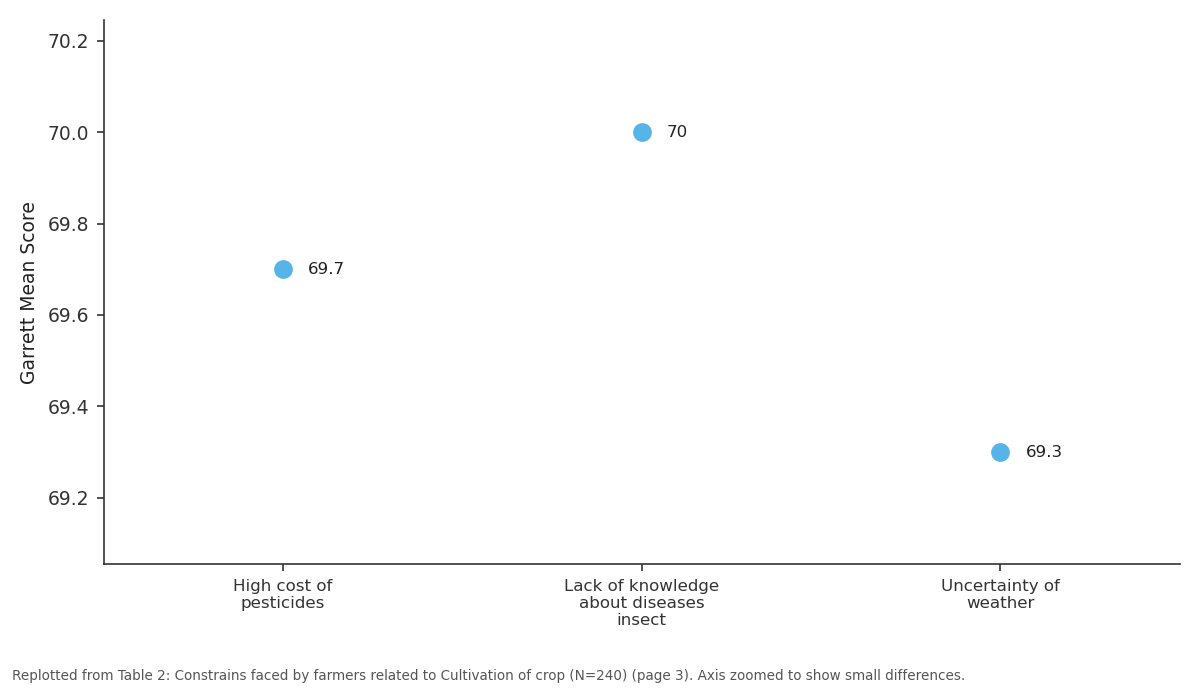
Garrett Mean Score: High cost of pesticides vs Lack of knowledge about... vs Uncertainty of weather
Replotted from Table 2 (page 3) of the original paper. Every bar is the paper's own table value.
View source evidence ↗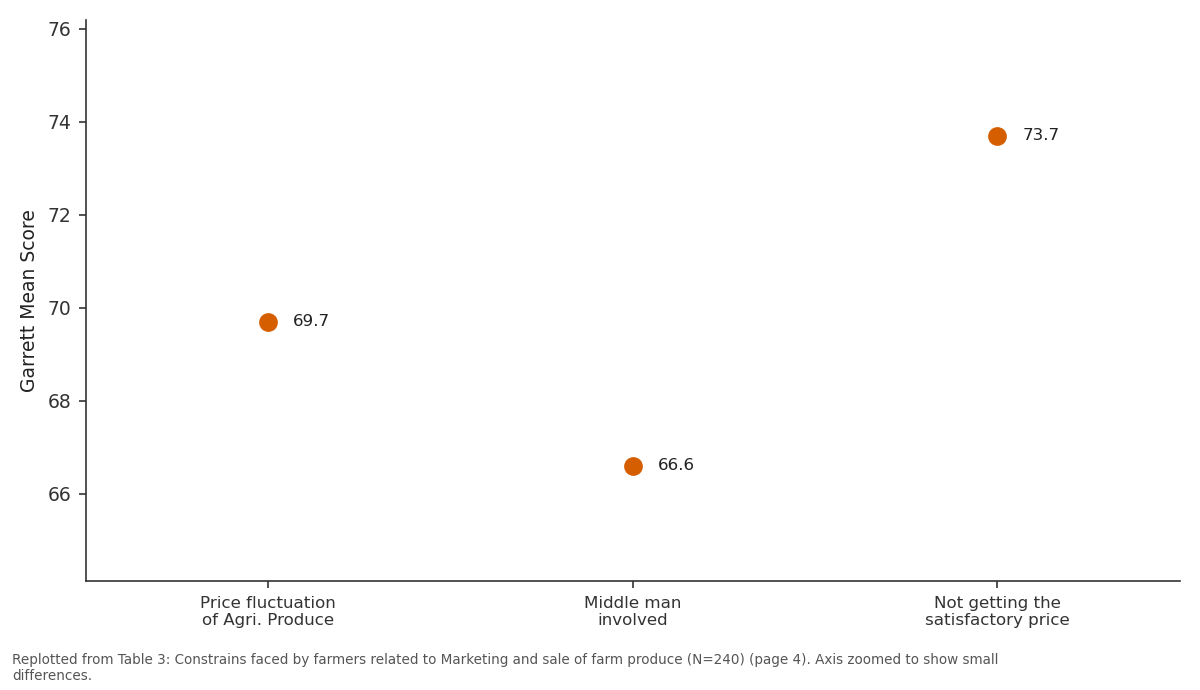
Garrett Mean Score: Price fluctuation of... vs Middle man involved vs Not getting the...
Replotted from Table 3 (page 4) of the original paper. Every bar is the paper's own table value.
View source evidence ↗Figures & tables
From the original paper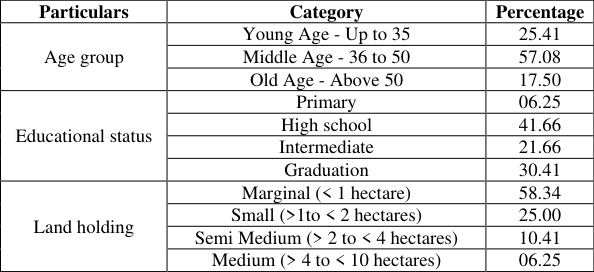 Table 1
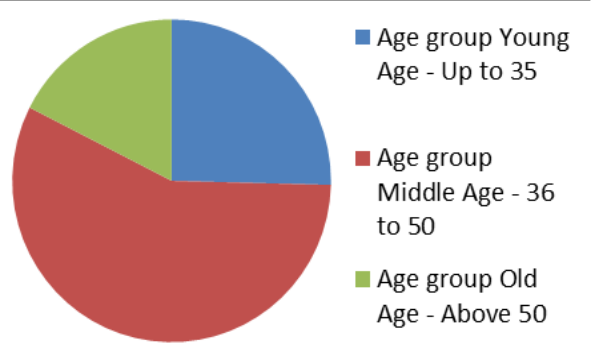 Figure 1
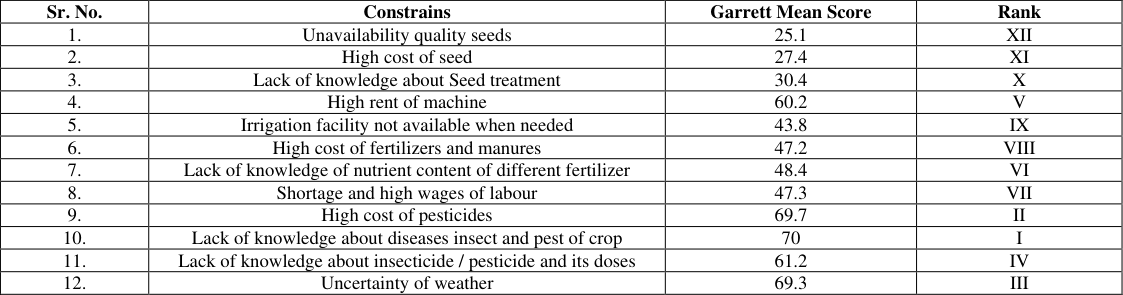 Table 2
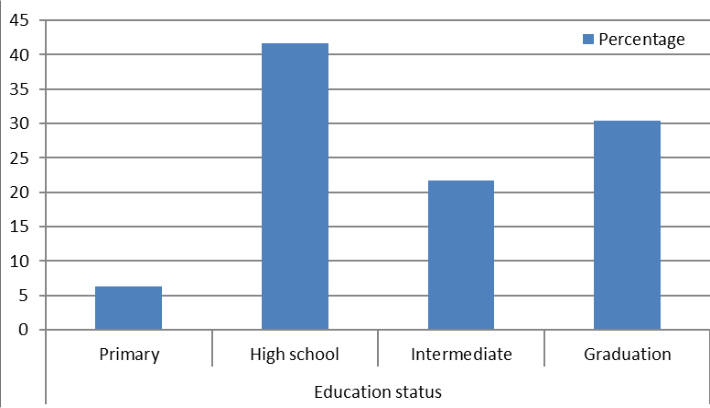 Figure 2
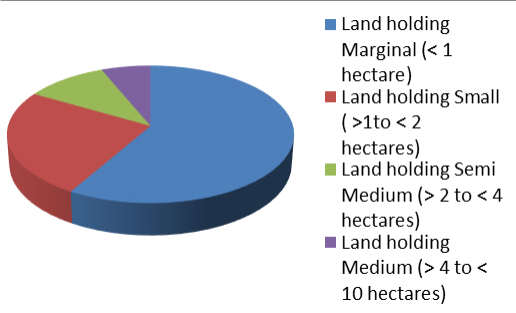 Figure 3
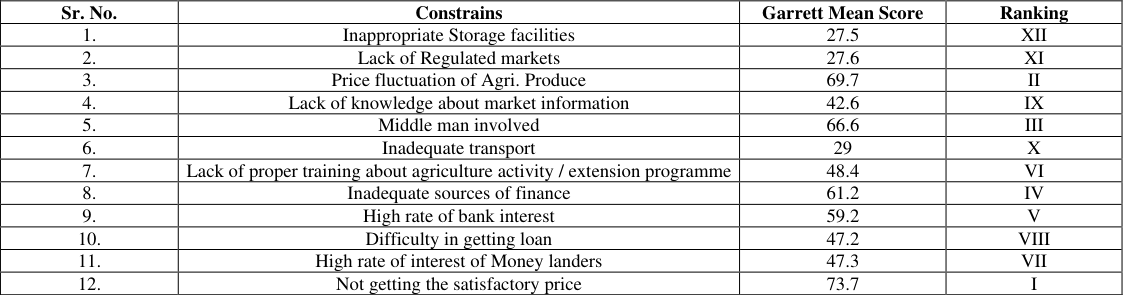 Table 3
Introduction
"India lives in villages" claimed by our father of the Nation Mahatma Gandhi. The primary occupation in the villages is that of agricultural farming. It is important to make this occupation profitable so that India is better in every respect. Farming continues to be the backbone of the socio-economic structure of the Nation. Besides its contribution of a sizeable quarter of the economic security to the two-thirds of the India's population, it has a prime role of stability of the equilibrium of supply and demand of farm commodities. This issue of equilibrium of supply and demand in itself is as complex as the diversified and dynamic domain of crop and livestock production. The consumers as well as producers through the costs directly feel the result that they have to pay for meeting their demand and getting remuneration for their efforts respectively. (Sujit et al. 2002) [1] . Agriculture is not only the way of life for people of India, but also a tradition which for centuries has shaped the outlook, the thought, the culture and economic life. Agriculture is the single largest production sector contributing more than 15 percent of GDP for India economy. Therefore, agriculture is key sector for all strategic planning for socio-economic development of our country. Speedy growth of agriculture is necessary not only to achieve self-reliance at country level but also for household food security and to bring about equity in distribution of wealth and income resulting in quick reduction in poverty line (Shrivastava et al. 2010) [2] . In the study area farm community facing various constraints related to cultivation and marketing of farm produce of different crops. This study is in the continuation of some earlier investigation carried out by researches in some another area like Lakhwinder Singh et al. (2020) [3] was found result from their study that most of the unorganised and organised seed producers faced the problems in marketing of potato seed crop. Price fluctuations of produce, non-availability of regulated markets and lack of demand were the major problems faced by them.
Objective
To identify constraints faced by the farmers during cultivation and sale of farm produce in Prayagraj district of Uttar Pradesh.
Research Methodology
The present study was conducted in Prayagraj district of Uttar Pradesh during 2019-20. Ex-post facto research design was followed for carrying out the study. The simple random sampling was used for selection of block, village, and respondent. Prayagraj district comprises of 20 blocks. Among these blocks, Jasra and Soraon block is selected purposively for the present study. Five percent villages from each block was randomly selected for the study. Thus, total 12 villages were selected for the study. A total of 240 respondent were randomly selected. Two list of 12 constrains was prepared and data were gathered on each one. The primary data were collected by personal contact method with the help of structured pre-tested interview schedule and collected data were coded, classified, tabulated and analyzed in light of objectives and in order to make the findings meaningful interpretation.
Henry Garrett's ranking technique
This technique was used to evaluate the constraints faced by the researchers. The orders of merit given by the respondents were converted in to rank by using the formula. To find out the most significant factor which influences the respondent, Garrett's ranking technique was used. As per this method, respondents have been asked to assign the rank for all factors and the outcomes of such ranking have been converted into score value with the help of the following formula.
Where, Rij -Rank given for the ith variable by the jth respondents Nj -Number of variable ranked by jth respondents With the help of Garrett's Table, the percent position estimated was converted into scores. Then for each factor, the scores of each individual were added and then total value of scores and mean values of score was calculated. The factors having highest mean value was considered to be the most important factor Dhanavandan S. (2016) [4] .
Results and Discussion 1. Personal profile of the respondent
The personal characteristics like age, education and land holding of the respondents were presented in Table 1 (Fig. 1, 2, 3), the result showed the minimum age of the respondents as 18 years while the maximum age was 60 years. The data shows that majority of 57.08 percent of the farmers were in the middle age group, followed by 17.50 percent and 25.41 percent of them were in old age group and young age group, respectively. The responded having good education, results shows that 41.66 percent of the farmers had High school education, followed by 30.41 percent of them had education up to Graduation level. Among the farmers, 21.66 percent were Intermediate and 06.25 percent of the farmers were having education up to Primary level. In the study area 58.34 percent of farmers are holding Marginal Land Holding (< 1 hectare). 25.00 percent of farmers have Small (>1 to < 2 hectares), 10.41 percent of farmers holding Semi Medium (> 2 to < 4 hectares), rest of 06.25 percent of farmers having Medium (> 4 to < 10 hectares), M.B. Shanabhoga et al. (2021) [5] also finding the same trends of personal characteristics in his study. The similar results can be seen in the study conducted by Ayush and Amar (2023) [6] . Lack of knowledge about insecticide / pesticide and its doses 61.2 IV 12.
| Particulars | Category | Percentage |
|---|---|---|
| Age group | Young Age - Up to 35 | 25.41 |
| Middle Age - 36 to 50 | 57.08 | |
| Old Age - Above 50 | 17.50 | |
| Educational status | Primary | 06.25 |
| High school | 41.66 | |
| Intermediate | 21.66 | |
| Graduation | 30.41 | |
| Land holding | Marginal (< 1 hectare) | 58.34 |
| Small (>1to < 2 hectares) | 25.00 | |
| Semi Medium (> 2 to < 4 hectares) | 10.41 | |
| Medium (> 4 to < 10 hectares) | 06.25 |
Table text extracted from the original PDF; superscript letters are shown inline. The original table image is below.
View original table image
Uncertainty of weather 69.3 III
Figures and tables from the paper
| Sr. No. | Constrains | Garrett Mean Score | Rank |
|---|---|---|---|
| 1. | Unavailability quality seeds | 25.1 | XII |
| 2. | High cost of seed | 27.4 | XI |
| 3. | Lack of knowledge about Seed treatment | 30.4 | X |
| 4. | High rent of machine | 60.2 | V |
| 5. | Irrigation facility not available when needed | 43.8 | IX |
| 6. | High cost of fertilizers and manures | 47.2 | VIII |
| 7. | Lack of knowledge of nutrient content of different fertilizer | 48.4 | VI |
| 8. | Shortage and high wages of labour | 47.3 | VII |
| 9. | High cost of pesticides | 69.7 | II |
| 10. | Lack of knowledge about diseases insect and pest of crop | 70 | I |
| 11. | Lack of knowledge about insecticide / pesticide and its doses | 61.2 | IV |
| 12. | Uncertainty of weather | 69.3 | III |
Table text extracted from the original PDF; superscript letters are shown inline. The original table image is below.
View original table image
| Sr. No. | Constrains | Garrett Mean Score | Ranking |
|---|---|---|---|
| 1. | Inappropriate Storage facilities | 27.5 | XII |
| 2. | Lack of Regulated markets | 27.6 | XI |
| 3. | Price fluctuation of Agri. Produce | 69.7 | II |
| 4. | Lack of knowledge about market information | 42.6 | IX |
| 5. | Middle man involved | 66.6 | III |
| 6. | Inadequate transport | 29 | X |
| 7. | Lack of proper training about agriculture activity / extension programme | 48.4 | VI |
| 8. | Inadequate sources of finance | 61.2 | IV |
| 9. | High rate of bank interest | 59.2 | V |
| 10. | Difficulty in getting loan | 47.2 | VIII |
| 11. | High rate of interest of Money landers | 47.3 | VII |
| 12. | Not getting the satisfactory price | 73.7 | I |
Table text extracted from the original PDF; superscript letters are shown inline. The original table image is below.
View original table image
References
5 in the original paper- Singh L, Singh D, Dhaliwal RK. Constraints in Potato Seed Production: Experiences of Organized and Unorganized Farmers of Punjab. Indian Res. J Ext. Edu, 2020, 20(2&3).
- Dhanavandan S. Application of Garrett Ranking Technique: Practical Approach. Int. J Libr. Inf. Stud. 2016;6(3):135140.
- Shanabhoga MB, Suresha SV, Dechamma S. Constraints Faced by Pomegranate Growers Using Public and Private Extension Service. Indian Res J Ext Edu. 2021;21(1):78-82.
- Pathak AK, Singh A. Application of Garrett Ranking Technique in Studying the Problems of Farmers in Paddy Cultivation: A Case Study of Ghazipur District of Uttar Pradesh. The Pharma Innovation Journal. 2023;12(10S):1091-1093.
- Yadav S, Sharma KC, Mishra P. Problems Faced by the Beneficiary Farmers in Availing the Benefits under National Horticulture Mission. Indian Res. J Ext. Edu. 2021;21(2&3):20-25.