
Research article · 2023 · Full text
International Journal of Agriculture and NutritionSustainable practices in honey production
Volume 5(2) · Pages 54–56 · DOI: 10.33545/26646064.2023.v5.i2a.141 ↗
Research areasBee Products Chemical AnalysisInsect and Pesticide ResearchInsect and Arachnid Ecology and Behavior
Abstract
Author-writtenThis paper examines the multifaceted approach to sustainable practices in honey production. It is critical to address the environmental, ethical, economic, and community-driven dimensions to promote a sustainable honey industry. The decline in bee populations worldwide calls for immediate action to integrate practices that ensure the health of bees, the environment, and the livelihoods of beekeepers. This paper provides a detailed analysis of these sustainable practices, challenges encountered, and potential solutions.
Summary
Source-checkedPlain-language reading of the full paper, prepared with AI and checked against the text. Each point links to the authors' own words.
Why it matters
- Bees are essential for human food security because they pollinate many crops vital for human consumption. View evidence ↗
- The worldwide decline of bee populations threatens biodiversity, agricultural productivity, and related economies. View evidence ↗
- Sustainable honey production is hindered by a combination of environmental threats (habitat loss, climate change, pesticides), economic pressures, and poor ethical standards. View evidence ↗
The question
- The objective of this study is to understand sustainable practices in honey production. View evidence ↗
What they did
- The authors conducted a review examining current honey production practices, associated challenges, opportunities, and potential pathways for sustainability. View evidence ↗
- The study utilizes a literature review of previous research on beekeeping techniques, colony health, and pest management. View evidence ↗
What they found
- Environmental protection in sustainable beekeeping focuses on preserving and enhancing the ecosystems where beekeeping takes place. View evidence ↗
- Maintaining and restoring natural habitats is identified as a crucial effort for the survival and productivity of bees. View evidence ↗
- Reducing and carefully managing pesticide use is necessary to protect both the bee populations and the quality of the honey produced. View evidence ↗
- Ethical beekeeping involves using methods that align with natural bee behavior and avoid synthetic interventions. View evidence ↗
- Economic sustainability can be achieved through fair trade practices, ensuring beekeepers receive fair compensation to support their livelihoods and sustainable methods. View evidence ↗
- Diversifying products and services beyond honey helps beekeepers increase their economic resilience. View evidence ↗
- Community involvement, specifically partnerships between beekeepers and local farmers, promotes practices that benefit both sectors. View evidence ↗
What it means
- The authors conclude that a sustainable future for the honey industry requires an interdependent approach combining environmental stewardship, ethical practices, economic viability, and community engagement. View evidence ↗
- Prioritizing bee health and natural behaviors is recommended as both a moral and practical strategy for maintaining resilient colonies. View evidence ↗
Visual summary
1 visualsIllustrations explain the paper; they do not show study data.
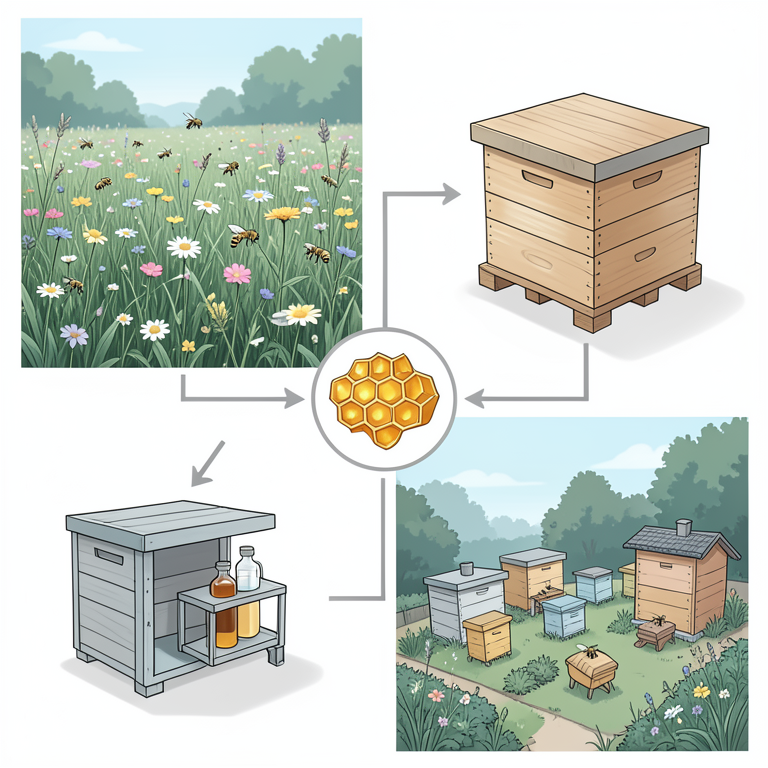
The Four Pillars of Sustainable Honey Production
AI-generated conceptual illustration (honey bees and apiary equipment). It explains the idea and does not show study data.
View source evidence ↗Figures & tables
From the original paper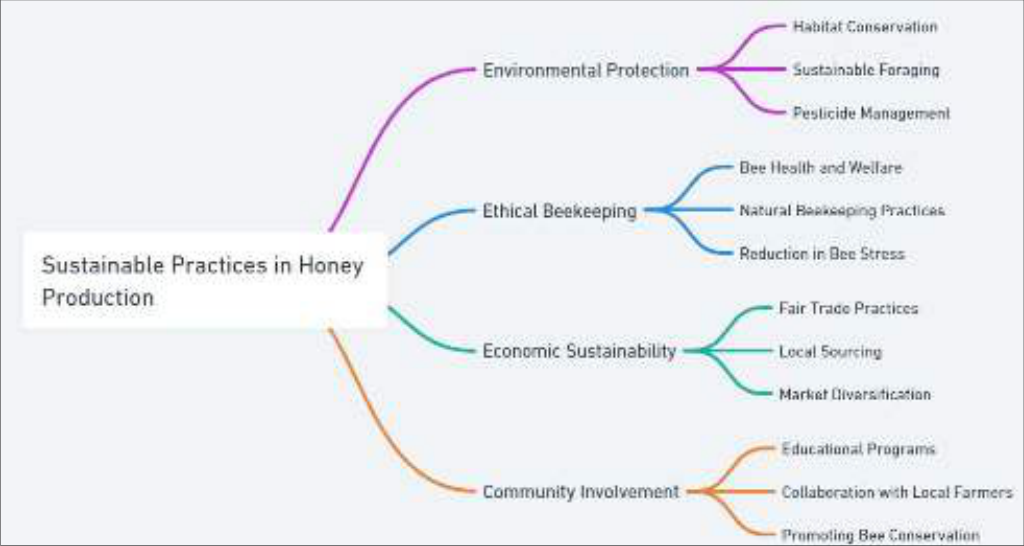 Figure 1
Introduction
Honey production is an age-old activity that has provided sweet sustenance to humans for thousands of years. In the intricate dance of nature, bees not only produce honey but also play a crucial role in pollinating a vast array of plants, including many crops vital for human consumption. However, the continuity of this precious service is at risk. The global decline in bee populations signals a brewing crisis not only for biodiversity but also for agriculture and the economies dependent on it. This alarming trend has placed the spotlight on the practices of the honey production industry, stirring a vital discourse on sustainability. Sustainability in honey production encompasses a complex network of practices designed to maintain and protect the environment, ensure the health and vitality of bee populations, and foster economic stability for those who depend on beekeeping for their livelihood. The essence of sustainable honey production lies in harmonizing human activities with the natural world, ensuring that we meet present needs without compromising the ability of future generations to meet their own. Yet, the pursuit of sustainability in honey production is laden with challenges. Environmental threats like habitat loss, climate change, and pesticide use, combined with economic pressures and often inadequate ethical standards, present multifaceted obstacles. To overcome these, an integrated approach is required-one that respects the biology of bees, their role in our ecosystems, and the socio-economic context of beekeeping. Environmental protection is a cornerstone of this approach. It calls for preserving and restoring the natural habitats that bees depend on, ensuring they have access to a healthy and diverse range of flowers from which to forage. The issue of pesticide management is particularly contentious, as the chemicals designed to protect crops can be lethal to bees. Navigating this issue requires a nuanced balance of interests, prioritizing organic and bee-friendly alternatives. Ethical beekeeping is another pillar of sustainability, focusing on the welfare of the bees themselves. Practices that align with the natural behavior and life cycles of bees are not only ethical but also bolster the resilience of colonies. It is a shift away from exploitative practices towards those that recognize bees as integral to our ecosystems, not merely as honey producers. The economic dimension of sustainability cannot be overlooked. For beekeeping practices to be truly sustainable, they must be economically viable. This encompasses fair trade, local sourcing, and market diversification. It is about creating a system where ethical and environmental stewardship is not only ecologically beneficial but also financially rewarding. Lastly, community involvement is vital. Sustainable honey production is not solely the purview of beekeepers; it requires public support and awareness.
It is about building a society that values and actively participates in the conservation of bees, recognizing that our fates are intertwined. This paper delves into these facets of sustainable honey production, examining current practices, the challenges and opportunities they present, and the pathways toward a more sustainable future for both bees and humans. Through a detailed exploration of these themes, we aim to provide insights and recommendations that could guide stakeholders in adopting practices that will ensure the health of bee populations, the bounty of our environments, and the sweetness of honey for generations to come.
Objective of study To understand the Sustainable Practices in Honey Production
Objective of study To understand the Sustainable Practices in Honey Production
Literature Review
Focusing on beekeeping practices, Kebede H et al. (2014) [1] advocate for natural beekeeping techniques that align with the biological needs of bees, emphasizing the importance of genetic diversity and disease resistance. The shift towards ethical beekeeping is further supported by Hegelund et al., (2014) [2] , who examines the natural nesting preferences and comb-building behaviors of wild bee colonies, suggesting that mimicking these conditions can enhance colony health. Additionally, Mujica M et al. (2016) [3] discuss the implications of varroa mites and other pathogens, noting that while chemical treatments are commonly used, they often have detrimental side effects, and therefore, integrated pest management strategies should be considered. From an economic standpoint, the works of Khan N et al., (2018) [4] provide insights into the economic drivers of beekeeping, advocating for fair trade and pricing mechanisms that reflect the ecological services provided by bees. Chidi OH et al., (2017) [5] delve into market diversification as a strategy for economic sustainability, highlighting the potential for bee-derived products beyond honey, such as propolis and royal jelly, to contribute to beekeepers' income.
The need for integrated approaches and supportive policies is a recurring theme in the literature. Bahta HT et al. (2018) [6] underscore the importance of policy-driven conservation strategies that support both wild and managed bee populations.
Overview on Sustainable Practices in Honey Production
Sustainable practices in honey production encompass a holistic approach aimed at ensuring the health of bee populations, protecting the environment, and supporting the economic viability of beekeeping. This approach integrates environmental stewardship, ethical beekeeping, community engagement, and sustainable business practices to address the challenges facing the beekeeping industry today, including declining bee populations, habitat loss, and the impact of climate change [10] .
Ethical Beekeeping:
This branch addresses the moral principles guiding beekeeping practices.
Bee Health and Welfare: Concerns the overall wellbeing of the bees, advocating for practices that promote their health and protect them from diseases and stress. Natural Beekeeping Practices: Encourages the use of beekeeping methods that align with the natural behavior of bees and avoid synthetic interventions. Reduction in Bee Stress: Focuses on minimizing the stress factors for bees, which is vital for their health and productivity.
Economic Sustainability:
This branch deals with the economic aspects of sustainability in beekeeping, ensuring that practices are not only environmentally friendly but also economically viable.
Fair Trade Practices: Suggests that beekeepers should receive fair compensation for their honey, which encourages sustainable practices and improves livelihoods. Local Sourcing: Highlights the importance of sourcing materials and bees locally to support regional economies and reduce transportation-related impacts. Market Diversification: Encourages beekeepers to diversify their products and services to enhance economic resilience and sustainability.
Community Involvement:
This branch recognizes the role of communities in sustainable beekeeping practices. Educational Programs: Advocates for educating the public and beekeepers about sustainable practices and the importance of bees in ecosystems. Collaboration with Local Farmers: Encourages partnerships between beekeepers and farmers to promote practices that benefit both agriculture and beekeeping. Promoting Bee Conservation: Focuses on community actions to conserve and protect bee populations, highlighting the importance of public participation in sustainability efforts.
Conclusion
The exploration of sustainable practices in honey production highlights a critical juncture at which the beekeeping industry stands today. The literature review and discussions presented in this paper underscore the interdependence of environmental stewardship, ethical beekeeping, economic viability, and community engagement in forging a sustainable path forward for the industry. Environmental protection is paramount, as it ensures the health of the ecosystems upon which bees and beekeepers rely. Efforts in habitat conservation, sustainable foraging, and stringent pesticide management are essential to safeguard pollinators against the myriad of threats they face. Ethical beekeeping practices that prioritize bee health and natural behaviors emerge as not only morally sound but also as practical strategies for maintaining robust and resilient bee colonies. Economic sustainability must be addressed to ensure that beekeepers can continue their crucial work. Fair trade practices, local sourcing, and market diversification are economic pillars that support beekeepers, allowing them to invest in sustainable practices. These economic measures also encourage resilience against market fluctuations and global economic pressures.
Community involvement stands out as a powerful force for change. Education, collaboration with local farmers, and promotion of bee conservation are all facets of community action that can significantly bolster sustainable honey production efforts. These communal efforts can lead to a greater understanding of the importance of bees in our ecosystems and contribute to policy changes that support sustainability.
Figures and tables from the paper
References
8 in the original paper- Kebede H, Tadesse G. Survey on honey production system, challenges and opportunities in selected areas of Hadya Zone, Ethiopia. Journal of Agricultural Biotechnology and Sustainable Development. 2014;6(6):60-66.
- Mujica M, Blanco G, Santalla E. Carbon footprint of honey produced in Argentina. Journal of Cleaner Production. 2016;116:50-60.
- Khan N, Khan W. Review of past literature of honey beekeeping and its production in rural area of the world. Food Science and Quality Management. 2018;74(6):1823.
- Bahta HT. The Status of beekeeping practices and honey production system in Ethiopia: A review. International Journal of Engineering Research and Development. 2018;6(2):581-585.
- Bizuayehu AA, Megerssa AT. Assessment of postharvest handling and quality of honeybee products along the value chain in SNNPR, Ethiopia. International Journal of Agriculture and Food Science. 2021;3(2):2835. DOI: 10.33545/2664844X.2021.v3.i2a.54
- Omidi-Arjenaki O, Ebrahimi R, Ghanbarian D. Analysis of energy input and output for honey production in Iran (2012-2013). Renewable and Sustainable Energy Reviews. 2016;59:952-957.
- D'Eusanio M, Serreli M, Zamagni A, Petti L. Assessment of social dimension of a jar of honey: A methodological outline. Journal of Cleaner Production. 2018;199:503-517.
- Negash D. Demonstration and participatory evaluation of apiculture technologies in Sidama National Regional state, Ethiopia. Int. J. Agric. Extension. Social. Dev. 2022;5(2):12-16.
Cited by 2
From OpenAlex, OpenCitations and reference lists read by Scinovex
- Exploring Honey Consumption and Sustainable Practices in a Segment of Algerian Households ↗
Rifka Nakib, Sonia Harbane, Asma Ghorab, Yasmine Saker, Olga Escuredo, María Shantal Rodríguez‐Flores et al. · Sustainability · 2025
In Algeria, honey plays an important role in nutrition, traditional medicine and sustainable food practices. However, little is known about how consumers perceive and use this product in their daily lives. This study aims to explore how honey consumption patterns among a specific segment of Algerian households, mainly young, educated, and digitally active individuals, relate to traditional practices and contribute…
❝ 2PDF - Italian Consumer Interest in Sustainability, Certifications, and Traceability in Honey ↗
Marta Cianciabella, Giulia Mastromonaco, Antonina Sparacino, Valentina Maria Merlino, Stefano Massaglia, Giuseppe Versari et al. · Sustainability · 2025
Honey has a long cultural tradition in Italy, valued for its sensory properties and health benefits. However, in recent years, the beekeeping sector has faced various challenges due to climate change, biodiversity loss, and economic pressures. Therefore, growing consumer awareness of sustainability, traceability, and ethical aspects is influencing food choices and putting niche-market products, such as honey, in the spotlight.…
❝ 1PDF