
Research article · 2024 · Full text
International Journal of Research in AgronomyEffect on foliar nutrition of micro nutrients on growth attributes in transplanted rice (Oryza sativa L.)
Volume 7(3) · Pages 329–331 · DOI: 10.33545/2618060x.2024.v7.i3e.418 ↗
Research areasRice Cultivation and Yield ImprovementPlant Growth and Agriculture TechniquesCrop Yield and Soil Fertility
Abstract
Author-writtenDuring the samba season (September, 2022 - February, 2023), a field experiment was carried out at Annamalai University Experimental Farm, Department of Agronomy, to study the influence of foliar application of micro nutrients on growth parameters of transplanted rice. BPT 5204, a medium-duration rice variety, is chosen for the investigation. Eight treatments spread across three replications comprised the Randomized Block Design (RBD) layout of the field experiment. The treatments included various nutrient management techniques, such as 100% RDF (T1), 100% RDF + foliar ZnSO4 application at 0.5% (T2), 100% RDF + foliar Borax application at 0.25% (T3), and 100% RDF + foliar silicon application at 1% (T4),100% RDF + ZnSO4 @ 0.5% + Borax @ 0.25% + Silicon @ 1% (T5), 100% RDF + ZnSO4 @ 0.5% + Silicon @ 1% (T6), 100% RDF + Borax @ 0.25% + Silicon @ 1% (T7) and 100% RDF + ZnSO4 @ 0.5% + Borax @ 0.25% + Silicon @ 1% (T8). The application of the 100% recommended dosage of fertilizer plus foliar application of ZnSO4 @ 0.5% + borax @ 0.25% + silicon @ 1% can be concluded based on the experimental results (T8) remarkably boost the productivity and profitability of rice. Hence this treatment was considered to be the most efficient way to enhance the yield of transplanted rice.
Summary
Source-checkedPlain-language reading of the full paper, prepared with AI and checked against the text. Each point links to the authors' own words.
Why it matters
- Rice is a critical global cereal crop, serving as the primary food source for more than half of the world's population. View evidence ↗
- Foliar application of nutrients is considered more efficient than soil application because it bypasses soil barriers and prevents nutrient leaching. View evidence ↗
- In India, zinc is recognized as the fourth most important nutrient for crops, following nitrogen, phosphorus, and potassium. View evidence ↗
The question
- The study aimed to investigate how the foliar application of micronutrients affects the growth of transplanted rice. View evidence ↗
What they did
- The field experiment was conducted at the Annamalai University Experimental Farm during the samba season from September 2022 to February 2023. View evidence ↗
- The researchers used BPT 5204, which is a medium-duration variety of rice. View evidence ↗
- The experiment utilized a Randomized Block Design (RBD) consisting of eight different treatments, each replicated three times. View evidence ↗
What they found
- The combination of 100% RDF with foliar ZnSO4 (0.5%), Borax (0.25%), and Silicon (1%) (T8) produced the tallest plants at harvest (115.97 cm), compared to the control (T1) at 91.52 cm. View evidence ↗
- Treatment T8 (100% RDF + ZnSO4 0.5% + Borax 0.25% + Silicon 1%) achieved the highest number of tillers per hill (12.48) at the maximum tillering stage, while the control (T1) had the lowest (7.11). View evidence ↗
- The highest dry matter production at harvest was 12,586 kg ha-1 under treatment T8, whereas the control (T1) produced the lowest amount at 9,207 kg ha-1. View evidence ↗
- Treatment T8 resulted in the highest Leaf Area Index (LAI) of 6.34 during the flowering stage. View evidence ↗
- The maximum Crop Growth Rate (CGR) of 4.63 g m-2 day-1 from flowering to harvest was observed in treatment T8. View evidence ↗
What it means
- The authors conclude that treatment T8 significantly increases rice productivity and profitability, and they recommend this practice to farmers. View evidence ↗
Visual summary
3 visualsIllustrations explain the paper; charts are replotted from the paper's own table values.
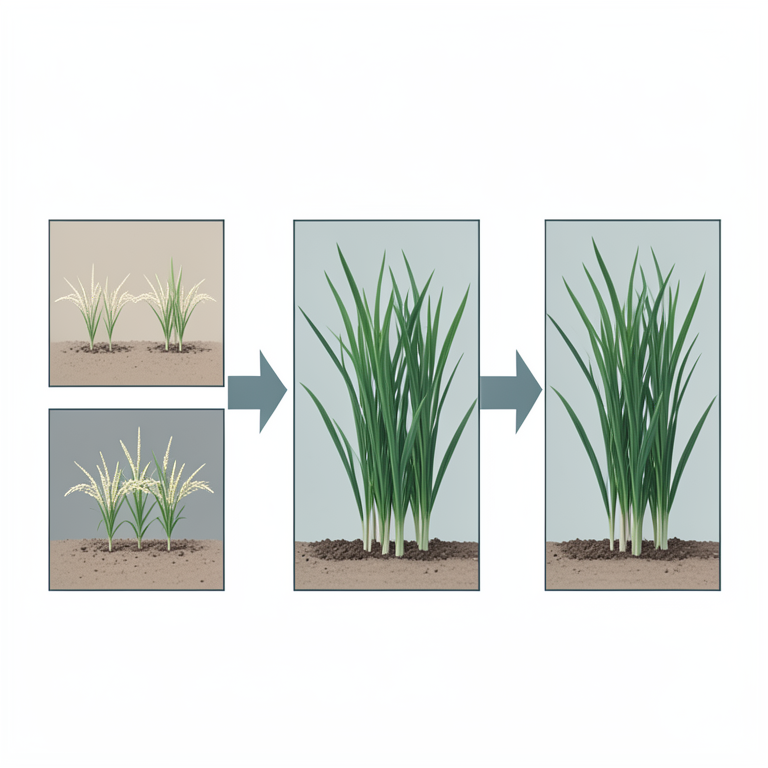
Experimental Treatment Layout
AI-generated conceptual illustration (transplanted rice plants (Oryza sativa L.)). It explains the idea and does not show study data.
View source evidence ↗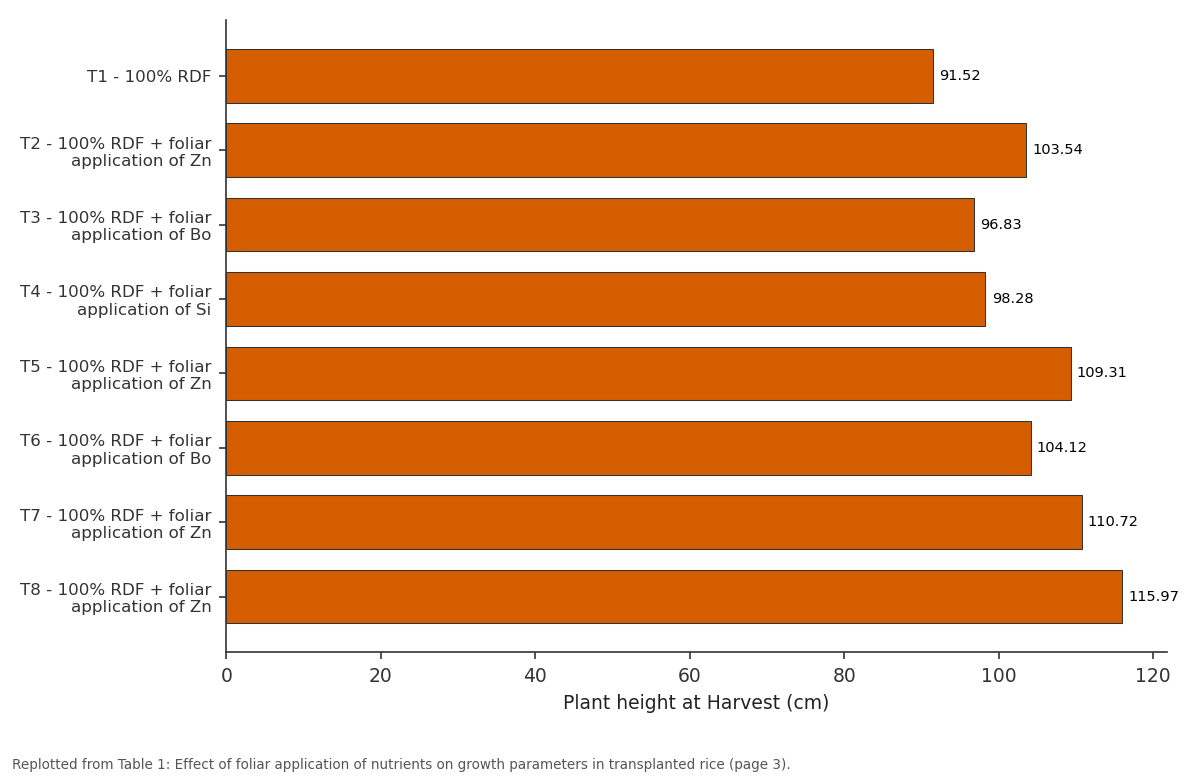
Plant height at Harvest: T1 - 100% RDF vs T2 - 100% RDF + foliar... vs T3 - 100% RDF + foliar... vs T4 - 100% RDF + foliar... vs T5 - 100% RDF + foliar...
Replotted from Table 1 (page 3) of the original paper. Every bar is the paper's own table value.
View source evidence ↗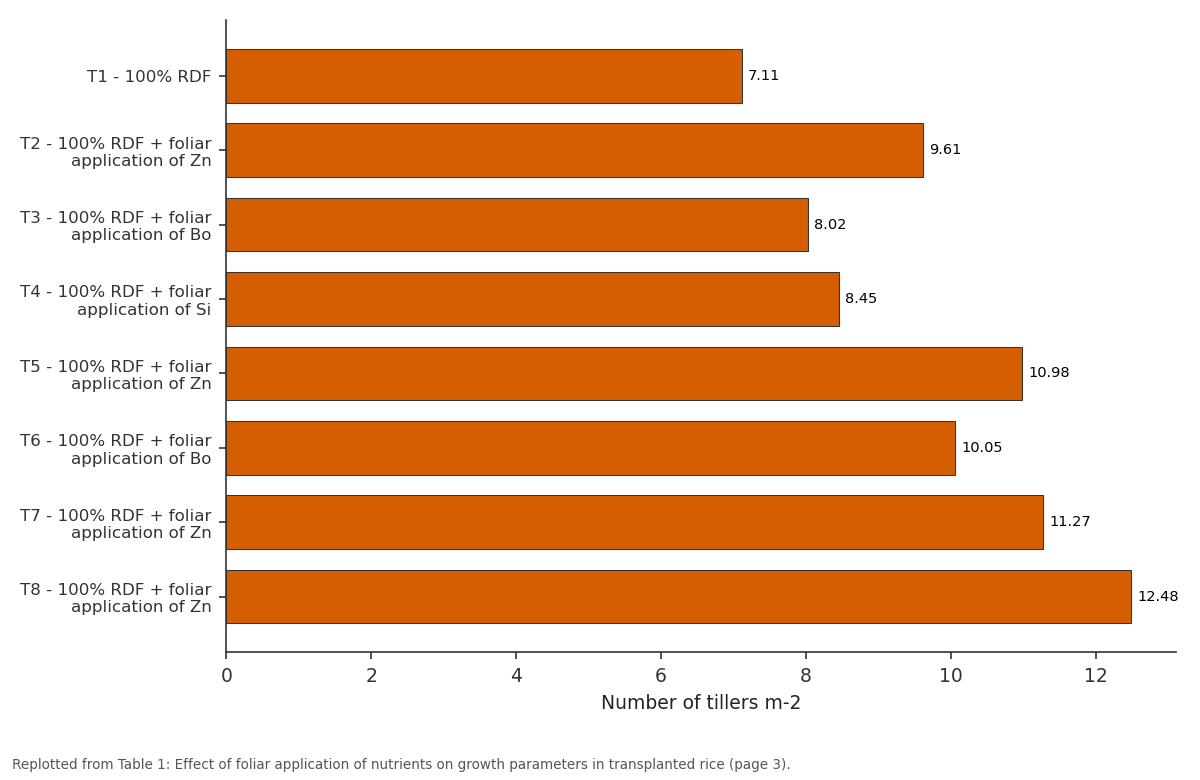
Number of tillers m-2: T1 - 100% RDF vs T2 - 100% RDF + foliar... vs T3 - 100% RDF + foliar... vs T4 - 100% RDF + foliar... vs T5 - 100% RDF + foliar...
Replotted from Table 1 (page 3) of the original paper. Every bar is the paper's own table value.
View source evidence ↗Figures & tables
From the original paper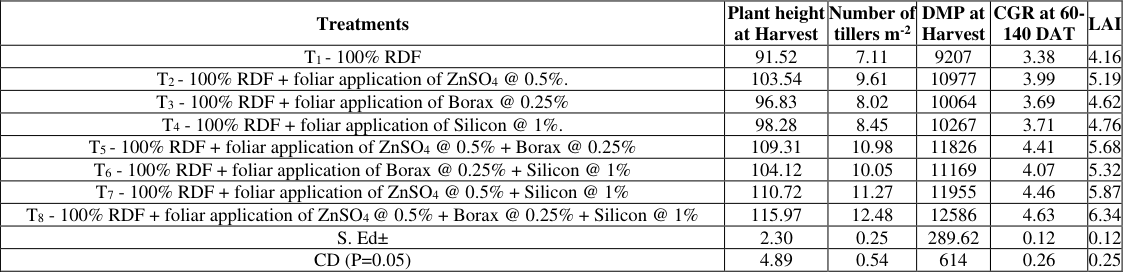 Table 1
Introduction
Rice (Oryza sativa L.) is the most significant cereal crop in the world and a staple food for over half of world population. Of all the grains produced, rice accounts for 42% and cereals for 45% of production. As per Sekhara and Devarajulu (2019) [11] , the majority of India's farming population is employed by the paddy crop. The world produces 514.6 million tonnes of rice annually with a productivity of 4.60 t ha -1 on an area of 166.91 million hectares. As per USDA (2022) [16] South East Asia's rice productivity is 4.41 t ha -1 . India comes in second place to China in terms of both production and consumption of rice. With an annual production of 130.29 Mt and a productivity of 2.80 t ha -1 , rice is grown on 46.38 million ha in India and 3.6 t ha -1 of productivity and 8.07 Mt of production are achieved by cultivating rice on 2.21 million hectares in Tamil Nadu (DES, 2021) [2] . Micronutrients can be applied through a variety of techniques, including soil application, foliar application, seed priming, and fortification; however, foliar application is thought to offer greater advantages than other approaches. Foliar application is applied to established crop stands at various stages of crop growth. When micronutrients are applied to plants, their physiological processes are improved, which leads to increased growth and the production of dry matter. The most efficient way to apply nutrients to plants is through foliar application, which removes soil barriers and leaching losses that arise from applying fertilizers through soil (Fageria et al., 2015) [3] . Foliar nutrition application, which greatly increases the rice growth, and other yield attributes which ultimately results in higher yield (Saikh et al., 2022 and Tuiwong et al., 2022) [10,15] . Zinc is considered the fourth major nutrient in India after nitrogen, phosphorus and potassium. Therefore, maintaining appropriate zinc transport to seeds, maintaining a sufficient amount of available zinc in soil solution, and increasing crop yield all depend on the application of zinc fertilizers. One of the components necessary for the growth and development of plants is boron (B). In addition to improving total chlorophyll content and plant height, Boron is primarily involved in cell wall biosynthesis and the structure and integrity of the plasma membrane (Songsriin et al., 2023) [13] . The second most abundant element on Earth's surface, silicon (Si) is important for improving crop productivity and granting biotic and abiotic stress resistance (Aroubandi, 2017) [1] . With the aforementioned information in mind, the current study examined the impact of foliar nutrient application on transplanted rice.
Materials and Methods
During the Samba season (September, 2022 -February, 2023), a field experiment was carried out at the Experimental Farm, Department of Agronomy, Faculty of Agriculture, Annamalai University, to determine the impact of foliar nutrient application in transplanted rice. Using the medium duration variety BPT 5204, the field experiment was set up in a Randomized Block Design (RBD) with eight treatments spread across three replications. The treatments included the following: 100% RDF (T 1 ), 100% RDF + foliar application of ZnSO 4 @ 0.5% (T 2 ), 100% RDF + foliar application of Borax @ 0.25% (T 3 ), 100% RDF + foliar application of Silicon @ 1% (T 4 ), 100% RDF + foliar application of ZnSO 4 @ 0.5% + Borax @ 0.25% (T 5 ), 100% RDF + foliar application of ZnSO 4 @ 0.5% + Silicon @ 1% (T 6 ), 100% RDF + foliar application of Borax @ 0.25% + Silicon @ 1% (T 7 ), and 100% RDF + foliar application of ZnSO 4 @ 0.5% + Borax @% + Silicon @ 1% (T 8 ). Applying foliar spray at 25 and 45 DAT with a spray volume of 500 lit ha - 1 using a hand-operated backpack sprayer, ZnSO 4 @ 2.5 kg ha -1 , Borax @ 1.25 kg ha -1 , and Silicon @ 5 kg ha -1 were carried out in accordance with the treatment schedule. Randomly chosen five representative plants were marked with a peg for periodic observations in each treatment plot. From the experimental field, random composite pre-sown soil samples were taken from 0 to 30 cm depth. Kg ha -1 is used to express values. Chopped and finely powdered were the oven-dried plant samples that were used to estimate the production of dry matter. In order to make statistical inferences for results that were significant, the critical difference was calculated at the 5% probability level.
Results and Discussion
Results and Discussion
Growth Parameters
The data regarding growth parameters recorded at the different growth stages of rice crop are discussed in table 1. Application of 100% RDF + foliar ZnSO 4 @ 0.5% + Borax @ 0.25% + Silicon @ 1% (T 8 ) recorded a significantly higher plant height of 115.97 cm at harvest stage among the treatments. The control (T 1 ) plants had the lowest plant height, measuring 91.52 cm at rice harvest stages. The improvement in growth attributes may be the result of applying nutrients foliar at key stages to ensure optimal and consistent availability of NPK and micronutrients throughout the rice growth phase. Phosphorus, potassium, and nitrogen are associated with various aspects of plant growth, including increased photosynthetic activity, cell enlargement, carbohydrate synthesis, and solute translocation (Gewally et al., 2018) [4] . According to Meena et al. (2019) [8] , the production of more long, erect leaves with a larger surface area was caused by the increased availability of mineral nutrients in the soil and the increased uptake of nutrients by the plant. This ultimately led to an increase in grow parameters. Furthermore, zinc application can be advantageous for cell elongation and division. This has been shown to increase net photosynthetic rate and chlorophyll content, which in turn affects plant height and leaf area index (LAI) (Sudha and Stalin, 2015) [14] . The application of 100% RDF + foliar application of ZnSo4 @ 0.5% + Borax @ 0.25% + Silicon @ 1% resulted in the highest number of tillers hill -1 of 12.48 at maximum tillering stage (T 8 ). At the maximum tillering stage, T 1 (control) registered the lowest tillers hill -1 of 7.11. This could be because zinc application influences chemical reactions like nucleotide synthesis, auxin metabolism, and enzyme activity of which have a positive impact on tiller production in plants (Soltani et al., 2020) [12] . Also, it could be due to the sustained availability of zinc and other micro nutrients that might have taken part in crop nourishment and enhanced the activity of meristematic cells and cell elongation, leading to better vegetative growth (Nandini et al., 2022) [9] . The application of 100% RDF + foliar application of ZnSO 4 @ 0.5% + Borax @ 0.25% + Silicon @ 1%, the highest dry matter production of 12586 kg ha -1 was achieved at harvest (T 8 ). The treatment T 1 (Control) produced the lowest dry matter of 9207 kg ha -1 . Applying 100% RDF along with foliar ZnSO4 at 0.5% Borax at 0.25% and Silicon at 1% (T 8 ) resulted in the highest LAI of 6.34 during the flowering stage. Micronutrients may increase the amount of leaf area on a plant, which in turn increases photosynthetic rate and prevents chlorophyll from being destroyed, ultimately leading to a higher DMP in rice. Additionally, silicon-induced leaf erectness can lead to increased photosynthesis, better water usage, decreased transpiration, and eventually an accumulation of more dry matter and an increase in leaf area, which could account for more DMP (Jinger et al., 2022) [6] . The increased photosynthetic and metabolic activity during the flowering stage, which causes an increase in various plant metabolic pathways responsible for cell division and elongation, may be the cause of the improvement in total dry matter with B application (Kumar et al., 2015) [7] . At flowering to harvest, the treatment of 100% RDF + foliar application of ZnSO 4 @ 0.5% + Borax @ 0.25% + Silicon @ 1% (T 8 ) resulted in the maximum CGR (table 1) of 4.63 g m -2 day -1 . The enhanced dry mater production and leaf area index following NPK and micronutrient application may be the cause of the increase in crop growth rate (CGR) similar findings reported with wader et al. (2013) [17] . Increased crop growth rates under micronutrient conditions may be attributed to zinc's significant contribution to photosynthesis, which increases leaf expansion and enhances plant growth when combined with other micronutrients (Jat et al., 2011) [5] .
| Treatments | Plant height at Harvest | Number of tillers m-2 | DMP at Harvest | CGR at 60- 140 DAT | LAI |
|---|---|---|---|---|---|
| T1 - 100% RDF | 91.52 | 7.11 | 9207 | 3.38 | 4.16 |
| T2 - 100% RDF + foliar application of ZnSO4 @ 0.5%. | 103.54 | 9.61 | 10977 | 3.99 | 5.19 |
| T3 - 100% RDF + foliar application of Borax @ 0.25% | 96.83 | 8.02 | 10064 | 3.69 | 4.62 |
| T4 - 100% RDF + foliar application of Silicon @ 1%. | 98.28 | 8.45 | 10267 | 3.71 | 4.76 |
| T5 - 100% RDF + foliar application of ZnSO4 @ 0.5% + Borax @ 0.25% | 109.31 | 10.98 | 11826 | 4.41 | 5.68 |
| T6 - 100% RDF + foliar application of Borax @ 0.25% + Silicon @ 1% | 104.12 | 10.05 | 11169 | 4.07 | 5.32 |
| T7 - 100% RDF + foliar application of ZnSO4 @ 0.5% + Silicon @ 1% | 110.72 | 11.27 | 11955 | 4.46 | 5.87 |
| T8 - 100% RDF + foliar application of ZnSO4 @ 0.5% + Borax @ 0.25% + Silicon @ 1% | 115.97 | 12.48 | 12586 | 4.63 | 6.34 |
| S. Ed± | 2.30 | 0.25 | 289.62 | 0.12 | 0.12 |
| CD (P=0.05) | 4.89 | 0.54 | 614 | 0.26 | 0.25 |
Table text extracted from the original PDF; superscript letters are shown inline. The original table image is below.
View original table image
Conclusion
According to the experimental findings, rice productivity and profitability are significantly increased by treatment T 8 (100% RDF + foliar application of ZnSO 4 at 0.5% + Borax at 0.25% + Silicon at 1%). Hence this practice is recommend to the farmers for getting higher productivity in transplanted rice.
References
17 in the original paper- Aroubandi H. Impact of silicon in managing rice diseases, Yield and quality of rice. Skinner Journal of Agriculture in Biological Science. 2017;3(1):22-36.
- Directorate of Economics and Statistics (DES), Government of Tamil Nadu, Production of Major Agricultural crops. 2020-2021.
- Fageria NK, Carvalho MCS, Dos Santos FC. Response of upland rice genotypes to nitrogen fertilization. Communications in Soil Science and Plant Analysis. 2015;45(15):2058-2066.
- Gewally EE, Ghoneim AM, Osman MM. Effects of nitrogen levels on growth, yield and nitrogen use efficiency of some newly released Egyptian rice genotypes. Open agriculture. 2018;3(1):310-318.
- Jat RS, Singh D, Kumar N. Effect of zinc and sulphur on growth and yield attributes of rice (Oryza sativa L.). Journal of Agricultural Science. 2011;3(2):123-128.
- Jinger D, Dhar S, Dass A, Sharma VK, Paramesh V, Parihar M, et al. Co-fertilization of silicon and phosphorus influences the dry matter accumulation, grain yield, nutrient uptake, and nutrient-use efficiencies of aerobic rice. Silicon. 2022, 1-15.
- Kumar R, Kumar M, Kumar A, Pandey A. Productivity, profitability, nutrient uptake and soil health as influenced by establishment methods and nutrient management practices in transplanted rice (Oryza sativa) under hill ecosystem of North East India. Indian Journal of Agricultural Sciences. 2015;85(5):634-639.
- Meena H, Singh MK, Meena R, Meena RN. Effect of seed rate and integrated nutrient management on growth, yield and economics of direct seeded hybrid rice (Oryza sativa). Indian Journal of Agronomy. 2019;64(3):324-329.
- Nandini PP, Laxminarayana K, Bhanu Rekha, Anjaiah T. Nutrient uptake of Rice as influenced by integrated approach for zinc enrichment. Environment and Ecology. 2022;40(2):401-406.
- Saikh MA, Singh AK, Singh SK. Effect of foliar application of zinc on growth and yield attributes of rice. Journal of Pharmacognosy and Phytochemistry. 2022;11(6):145-148.
- Sekhara K, Devarajulu M. Trends in area, production and productivity of paddy crop: An overview. International Journal of Humanities and Social Science Invention. 2019;8(1):50-58.
- Soltani A, Shah F, Gong H. Effect of foliar zinc application on growth attributes and yield components of rice (Oryza sativa L.). Journal of Soil Science and Plant Nutrition. 2020;20(2):427-434.
- Songsriin J, Amuangmorn Y, Lordkaew S, Jumrus S, Veeradittakit J, Jamjod S, et al. Efficacy of soil and foliar boron fertilizer on boron uptake and productivity in rice. Agronomy. 2023;13(3):692-699.
- Sudha S, Stalin P. Effect of zinc on yield, quality and grain zinc content of rice genotypes. International Journal of Farm Sciences. 2015;5(3):17-27.
- Tuiwong P, Lordkaew S, Veeradittakit J, Jamjod S, Prom-uthai C. Efficacy of nitrogen and zinc application at different growth stages on yield, grain zinc, and nitrogen concentration in rice. Agronomy. 2022;12(9):2093-2097.
- USDA-United States Department of Agriculture, Global Market Analysis, 2022.
- Wader SB, Pawar RB, Pharande AL. Effect of different levels of silicon on growth, yield and nutrient uptake of upland paddy in an inceptisol. Journal of Agriculture Research and Technology. 2013;38:326-328.