
Research article · 2024 · Full text
International Journal of Research in AgronomyImpact of various stages and levels of Detopping yield and yield attributes of rabi maize (Zea mays L.)
Volume 7(3) · Pages 310–314 · DOI: 10.33545/2618060x.2024.v7.i3e.414 ↗
Research areasCrop Yield and Soil Fertility
Abstract
Author-writtenA field trial was carried out at the Main Agricultural Research Station, University of Agricultural Sciences, Dharwad, Karnataka, during the rabi season of 2021-22 to study the effects of different phases and levels of Detopping on the yield and yield characteristics of rabi maize. The field experiment had sixteen treatment combinations with one control, and it was set up in a split plot design with three replications. The four stages of detopping viz., at 15, 20, 25, and 30 days after silking in main plot and there were four detopping levels in the sub-plot viz., detopping up to two, three, four, and five leaves stages of crop. The results showed that when detopping was done 30 days after silking with the top two leaves, increased grain production (6604 kg ha-1), stover yield (7845 kg ha-1), and harvest index (43.30%) were observed. With the exception of grain yield of detopping took place 25 days after silking with the top two leaves. Nevertheless, detopping the top two leaves 30 days after silking resulted in noticeably higher yield and yield attributing traits, including cob length (16.67 cm), cob girth (16.87 cm), number of rows per cob (15.41), number of seeds per row (27.92), number of seeds per cob (406) and 100 seed weight (36.15 g). The control treatment (no detopping) recorded significantly higher yield and yield attributing traits.
Summary
Source-checkedPlain-language reading of the full paper, prepared with AI and checked against the text. Each point links to the authors' own words.
Why it matters
- Detopping, which involves removing the terminal section from the top node, is a technique used by farmers to maximize maize productivity. View evidence ↗
- The practice of detopping is intended to improve light interception, nutrient uptake, and the distribution of nutrients toward the plant's reproductive areas. View evidence ↗
The question
- The study aimed to investigate how different stages and levels of detopping affect the yield and yield attributes of rabi maize. View evidence ↗
What they did
- The field experiment was conducted during the 2021-22 rabi season at the Main Agricultural Research Station in Dharwad, Karnataka. View evidence ↗
- The researchers used a split-plot design with three replications, consisting of sixteen treatment combinations and one control group. View evidence ↗
- The main plots tested detopping at 15, 20, 25, and 30 days after silking, while sub-plots tested removing up to two, three, four, or five leaves. View evidence ↗
- The study used NK-6240 Plus maize seeds, sown on December 1, 2021, with a spacing of 60 cm x 20 cm. View evidence ↗
What they found
- Detopping performed 30 days after silking resulted in a grain yield of 6516 kg ha-1, a stover yield of 7526 kg ha-1, and a harvest index of 43.10%. View evidence ↗
- Removing up to two leaves produced a significantly higher grain yield of 6530 kg ha-1, which was comparable to the yield from removing three leaves (6472 kg ha-1). View evidence ↗
- The lowest grain yield (6333 kg ha-1) occurred when detopping was carried out up to five leaves. View evidence ↗
- The combination of detopping 30 days after silking and removing the top two leaves produced a grain yield of 6604 kg ha-1. View evidence ↗
- The lowest grain production (6237 kg ha-1), stover yield (6826 kg ha-1), and harvest index (42.47%) were observed when five leaves were removed 15 days after silking. View evidence ↗
- The control group (no detopping) achieved the highest overall results, with a grain yield of 6732 kg ha-1, stover yield of 7929 kg ha-1, and a harvest index of 45.92%. View evidence ↗
What it means
- The authors conclude that the most favorable results among detopping treatments were achieved by removing up to two leaves 30 days after silking. View evidence ↗
- The authors recommend implementing this specific detopping method to increase maize yield and green fodder production. View evidence ↗
Visual summary
2 visualsIllustrations explain the paper; charts are replotted from the paper's own table values.
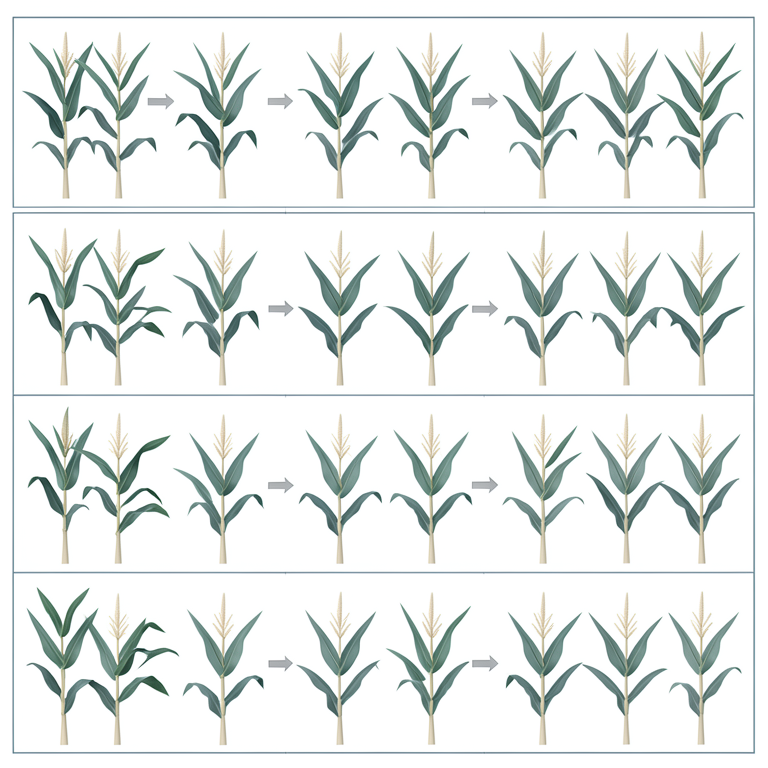
Experimental Treatment Matrix
AI-generated conceptual illustration (rabi maize plants (Zea mays L.)). It explains the idea and does not show study data.
View source evidence ↗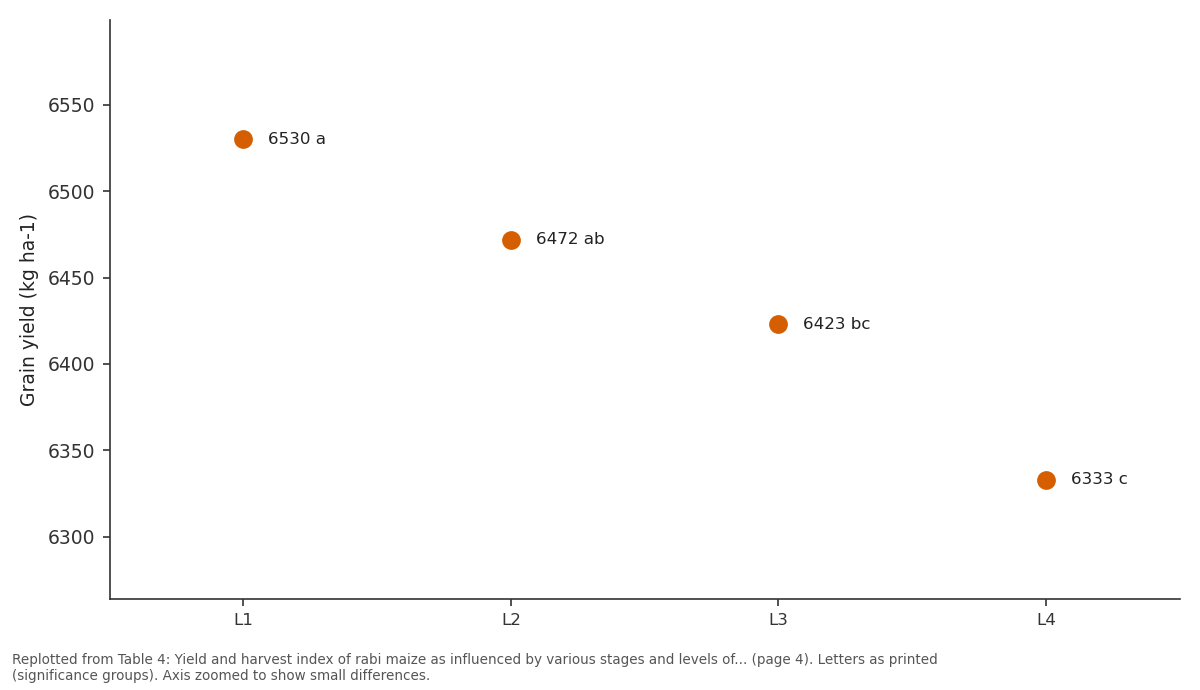
Mean: L1 vs L2 vs L3 vs L4
Replotted from Table 4 (page 4) of the original paper. Every bar is the paper's own table value.
View source evidence ↗Figures & tables
From the original paper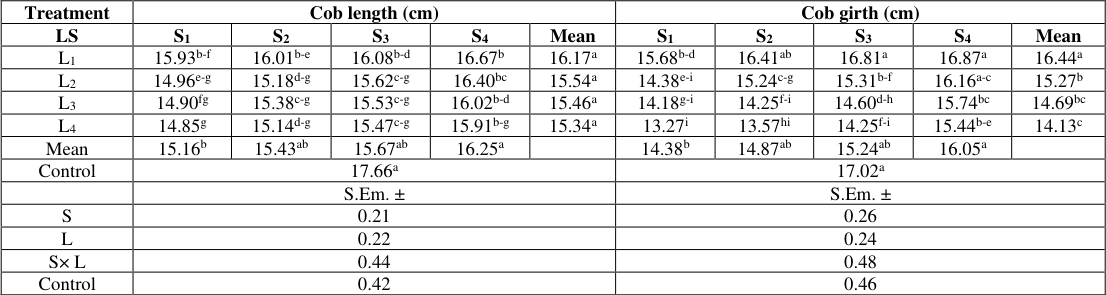 Table 1
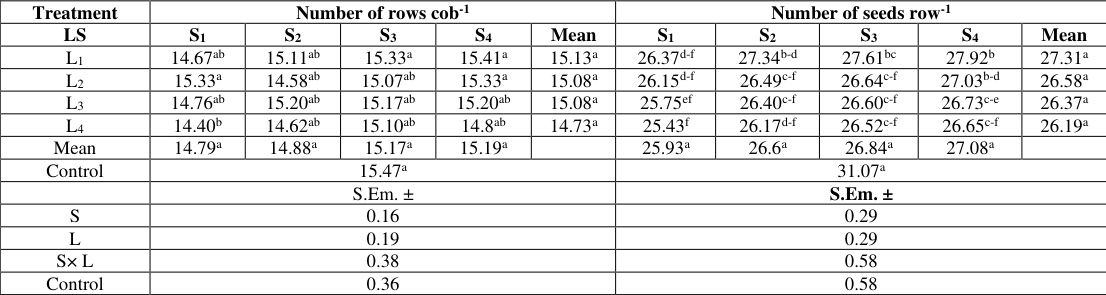 Table 2
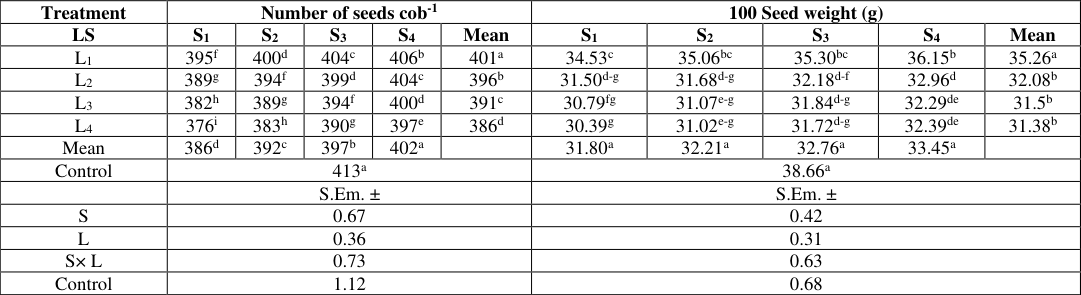 Table 3
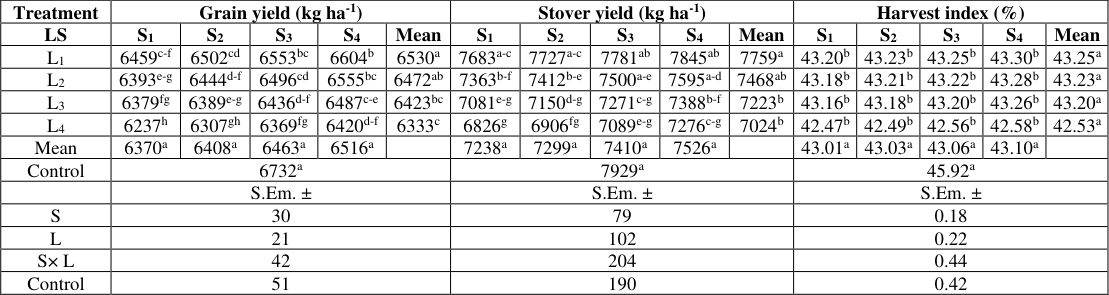 Table 4
Introduction
Maize, also commonly known as corn or makka, is an annual plant that belongs to the family Poaceae (Gramineae) and the tribe Maydeae. It is considered one of the most significant cereal crops in the world, ranking third in India after rice and wheat. With its exceptional physiological efficiency and highest genetic yield potential among food grain crops, maize is rightly referred to as the "Queen of cereals". It is a photo-thermo-insensitive crop, which makes it suitable for cultivation throughout the year in most Indian states to serve various purposes, including food, fodder, and industrial products. Standard agronomic techniques are necessary for achieve maximum yield in maize, in order to maximize productivity in mazie, a method used by cultivators of maize is called detopping, and it entails cutting off the terminal section from the top node. It enhancing the functionality of the remaining leaves, this technique helps to increase yield. Detopping boosts nutrient uptake, improves light interception, eliminates mutual shadowing of leaves and directs relation in plant nutrients to the reproductive regions of the plant. This lessens competition between the tassel and cob for available plant nutrients, aiding in improved cob development and the source sink connection. However there is not much is known about how detopping affects rabi maize productivity. Therefore, an experiment was conducted to study the effect of various stages and levels of detopping on the yield and yield attributes of rabi maize.
Materials and Methods
At the University of Agricultural Sciences' Main Agricultural Research Station in Dharwad, Karnataka, a field experiment was carried out in the Rabi season of 2021-2022. Situated in Karnataka's Northern Transition Zone (Zone 8) between the Northern dry zone (Zone 3) and the Western hilly zone (Zone 9), the farm is situated at 15°26'1"N latitude, 75°7'1"E longitude, and 678 meters above sea level. A split-plot design with three replications was used for the experiment, which comprised sixteen treatment combinations with one control (no stopping).
The sub-plot comprised four degrees of detopping (detopping up to two, three, four, and five leaves), whereas the main plot featured four stages of detopping (detopping at 15 days, 20 days, 25 days, and 30 days after silking). Maize seeds (NK-6240 Plus) sown on December 1st 2021 with spacing of 60 cm x 20 cm. The soil type at the testing site was clayey and medium black (vertisols) with an alkaline nature (7.74). The soil's characteristics were low organic carbon content (0.49%), medium available phosphorus (28.30 kg ha -1 ) and nitrogen (290.80 kg ha -1 ), high available potassium (331.40 kg ha -1 ) and normal electrical conductivity (0.39 dS m -1 ). The recommended fertilizer (150:65:65 kg N, P2O5, K2O kg ha - 1 and 25 kg ZnSO4 and FeSO4 each ha -1 ) was applied to all treatments. Herbicide and pesticide were used to control the weeds and pests and every 12-15 days interval, irrigation was given based on soil moisture content. Crop was harvested on 29th March, 2022. Maize cobs were threshed after complete drying, cleaned and seed weight was recorded from each plot and expressed in seed yield hectare (kg ha -1 ). The experimental data, that was collected during harvest was compiled and statistically analyzed using Fischer's approach of analysis of variance (Gomez and Gomez, 1984) [8] . Five percent was the level of significance employed in the "F" test. The Duncan Multiple Range Test (DMRT) was applied independently to the mean values of the main plot, subplot, and interactions using the associated error mean sum of squares and degrees of freedom.
Results and Discussion
The various detopping levels did not significantly affect the grain yield, stover yield, or harvest index of rabi maize. However, when detopping was done 30 days after silking, statistically significant in grain yield (6516 kg ha -1 ), stover yield (7526 kg ha -1 ), and harvest index (43.10%) were obtained (Table 4). When detopping was done 30 days after maize was compared to the other treatments, there was a 2.24 percent and 3.82% increase in grain and stover yields, respectively. Delay in detopping was associated with increased trend in grain yield (Afrarinesh, 2005) [1] and also due to detopping at two weeks after anthesis did not have any adverse effect on grain yield (Tahmasbi et al., 2001) [14] . These results are in conformity with findings of Bhargavi et al. (2017) [3] , Emam et al. (2013a) [4] , Woldeamlak et al. (2006) [18] , Mimbar and Susylowati (1995) [12] . The cumulative expression of yield-attributing characters (Tables 1,2, and 3) contributed to the rise in grain yield. Similarly, when detopping was done 30 days after silking, significantly maximum cob length (16.25 cm), cob girth (16.05 cm), number of rows per cob (15.19), number of seeds per row (27.08), number of seeds per cob (402), and 100 seed weight (33.45 g) were reported. This could may be the effect of a delayed harvest, which increased translocation of photosynthate and assimilation for optimal grain filling and a better source-tosink relationship. These outcomes agree with Afrarinesh's (2005) [1] findings. The productivity and yield characteristics of maize were significantly impacted by different degrees of detopping (Table 1, 2 and 3). Grain yield from detopping up to two leaves was significantly higher (6530 kg ha -1 ) and It was on par to that from detopping up to three leaves (6472 kg ha -1 ). The higher grain yield with detopping up to two leaves was due to the direct relationship between grain yield and the number of leaves removed (Tilahum, 1993) [15] . Additionally, compared to the other treatments, the enhanced yield was caused by considerably higher cob length (16.17 cm), cob girth (16.44 cm), number of rows per cob (15.13), number of seeds per row (27.31), number of seeds per cob (401), and 100 seed weight (35.26 g). These findings are consistent with those findings of Barimavandi et al. (2010) [2] and Jalilian and Delkhoshi (2014) [11] , who found that, among other factors, ear length is one of the yield attributing character and it most impacted by defoliation and leaf position on the plant. Similar results are also reported by Rathika et al. (2008) [13] . However, the lowest grain yield was recorded when detopping was carried out up to five leaves (6333 kg ha -1 ). The degree of yield reduction was directly proportional to the percentage of leaf area removed. The loss of functional leaf area reduced the plant's photosynthetic area and reduced assimilate availability to crop (Walpole and Morgan, 1970) [16] , as the kernel stores photosynthates through three main resources viz., current photosynthesis of the leaves, photosynthesis from green parts of plants excluding leaves and transfer from the source to sink (Hashemi and Maraashi, 1993) [9] . These results are consistent with those of Barimavandi et al. (2010) [2] , Jalilian and Delkhoshi (2014) [11] , Gaurkar and Bharad (1998) [7] , Heidari (2012) [10] , Esechie and Al-Alawi (2002) [6] , and Wilhelm et al. (1995) [17] . The interaction effect of various stages and levels of detopping had a significant effect on grain yield (Table 3). Detopping at 30 days after silking with top two leaves resulted in a greater grain production (6604 kg ha -1 ), which was comparable to detopping at 30 days after silking with top three leaves and 25 days after silking with top two leaves. The increase in yield could be attributed to the delay in detopping, which resulted in the removal of fewer leaves, and timely irrigation throughout crop growth. Detopping at two weeks after anthesis had no adverse effect on grain yield because it increased the accumulation of more plant biomass and the development of large sink sizes, followed by channelization of more carbohydrates from source to sink for a long period of time, indicating a strong source-sink relationship. Detopping at 30 days after silking with top two leaves resulted in a higher grain (6604 kg ha -1 ), which was comparable to detopping at 30 days after silking with top three leaves and 25 days after silking with top two leaves. The increase in yield could be attributed to the delay in detopping with removal of fewer leaves and timely irrigation throughout crop growth period. Detopping at two weeks after anthesis had no benefit effect on grain yield because it increased the accumulation of more plant biomass and large sink sizes and followed by channelization of more carbohydrates from source to sink for a long period of time. Consequently, a higher yield of maize was attained as evidenced of superior yield attributing characters (Tables 1,2, and 3), which include cob length (16.67 cm), cob girth (16.87 cm), number of rows per cob (15.41), number of seeds per row (27.92), number of seeds per cob (406) and 100 seed weight (36.15 g). These outcomes are similar with the research findings of Bhargavi et al. (2017) [3] and Emam et al. (2013b) [5] . However, when detopping was done with the top five leaves at 15 days after silking recorded significant lowest grain production (6237 kg ha -1 ), stover yield (6826 kg ha -1 ), and harvest index (42.47%) were observed (Table 4) and it was followed by the detopping at 20 days after silking, The loss of more green leaves during the early reproductive phase, which, the plant was more susceptible to source constraint and stress had an adverse effect on the amount of photosynthetically active leaf area and dry matter produced are may be the cause of the yield reduction. This shows the crucial plant stage that leads to the formation of seeds. The harvest index decreased with the removal of five leaves compared to two leaves. This demonstrates a decline in yield-attributing characteristics, which resulted in a fall in maize production. The control treatment recorded significantly higher grain (6732 kg ha -1 ), stover yields (7929 kg ha -1 ) and harvest index (45.92%) when no detopping was done than other detopped treatment combinations (Table 4).
| Treatment | Grain yield (kg ha-1) | — | — | — | — | Stover yield (kg ha-1) | — | — | — | — | Harvest index (%) | — | — | — | — |
|---|---|---|---|---|---|---|---|---|---|---|---|---|---|---|---|
| LS | S1 | S2 | S3 | S4 | Mean | S1 | S2 | S3 | S4 | Mean | S1 | S2 | S3 | S4 | Mean |
| L1 | 6459c-f | 6502cd | 6553bc | 6604b | 6530a | 7683a-c | 7727a-c | 7781ab | 7845ab | 7759a | 43.20b | 43.23b | 43.25b | 43.30b | 43.25a |
| L2 | 6393e-g | 6444d-f | 6496cd | 6555bc | 6472ab | 7363b-f | 7412b-e | 7500a-e | 7595a-d | 7468ab | 43.18b | 43.21b | 43.22b | 43.28b | 43.23a |
| L3 | 6379fg | 6389e-g | 6436d-f | 6487c-e | 6423bc | 7081e-g | 7150d-g | 7271c-g | 7388b-f | 7223b | 43.16b | 43.18b | 43.20b | 43.26b | 43.20a |
| L4 | 6237h | 6307gh | 6369fg | 6420d-f | 6333c | 6826g | 6906fg | 7089e-g | 7276c-g | 7024b | 42.47b | 42.49b | 42.56b | 42.58b | 42.53a |
| Mean | 6370a | 6408a | 6463a | 6516a | 7238a | 7299a | 7410a | 7526a | 43.01a | 43.03a | 43.06a | 43.10a | |||
| Control | 6732a | 7929a | 45.92a | ||||||||||||
| S.Em. ± | S.Em. ± | S.Em. ± | |||||||||||||
| S | 30 | 79 | 0.18 | ||||||||||||
| L | 21 | 102 | 0.22 | ||||||||||||
| S× L | 42 | 204 | 0.44 | ||||||||||||
| Control | 51 | 190 | 0.42 |
Table text extracted from the original PDF; superscript letters are shown inline. The original table image is below.
View original table image
| Treatment | Number of seeds cob-1 | — | — | — | — | 100 Seed weight (g) | — | — | — | — |
|---|---|---|---|---|---|---|---|---|---|---|
| LS | S1 | S2 | S3 | S4 | Mean | S1 | S2 | S3 | S4 | Mean |
| L1 | 395f | 400d | 404c | 406b | 401a | 34.53c | 35.06bc | 35.30bc | 36.15b | 35.26a |
| L2 | 389g | 394f | 399d | 404c | 396b | 31.50d-g | 31.68d-g | 32.18d-f | 32.96d | 32.08b |
| L3 | 382h | 389g | 394f | 400d | 391c | 30.79fg | 31.07e-g | 31.84d-g | 32.29de | 31.5b |
| L4 | 376i | 383h | 390g | 397e | 386d | 30.39g | 31.02e-g | 31.72d-g | 32.39de | 31.38b |
| Mean | 386d | 392c | 397b | 402a | 31.80a | 32.21a | 32.76a | 33.45a | ||
| Control | 413a | 38.66a | ||||||||
| S.Em. ± | S.Em. ± | |||||||||
| S | 0.67 | 0.42 | ||||||||
| L | 0.36 | 0.31 | ||||||||
| S× L | 0.73 | 0.63 | ||||||||
| Control | 1.12 | 0.68 |
Table text extracted from the original PDF; superscript letters are shown inline. The original table image is below.
View original table image
| Treatment | Cob length (cm) | — | — | — | — | Cob girth (cm) | — | — | — | — |
|---|---|---|---|---|---|---|---|---|---|---|
| LS | S1 | S2 | S3 | S4 | Mean | S1 | S2 | S3 | S4 | Mean |
| L1 | 15.93b-f | 16.01b-e | 16.08b-d | 16.67b | 16.17a | 15.68b-d | 16.41ab | 16.81a | 16.87a | 16.44a |
| L2 | 14.96e-g | 15.18d-g | 15.62c-g | 16.40bc | 15.54a | 14.38e-i | 15.24c-g | 15.31b-f | 16.16a-c | 15.27b |
| L3 | 14.90fg | 15.38c-g | 15.53c-g | 16.02b-d | 15.46a | 14.18g-i | 14.25f-i | 14.60d-h | 15.74bc | 14.69bc |
| L4 | 14.85g | 15.14d-g | 15.47c-g | 15.91b-g | 15.34a | 13.27i | 13.57hi | 14.25f-i | 15.44b-e | 14.13c |
| Mean | 15.16b | 15.43ab | 15.67ab | 16.25a | 14.38b | 14.87ab | 15.24ab | 16.05a | ||
| Control | 17.66a | 17.02a | ||||||||
| S.Em. ± | S.Em. ± | |||||||||
| S | 0.21 | 0.26 | ||||||||
| L | 0.22 | 0.24 | ||||||||
| S× L | 0.44 | 0.48 | ||||||||
| Control | 0.42 | 0.46 |
Table text extracted from the original PDF; superscript letters are shown inline. The original table image is below.
View original table image
Figures and tables from the paper
| Treatment | Number of rows cob-1 | — | — | — | — | Number of seeds row-1 | — | — | — | — |
|---|---|---|---|---|---|---|---|---|---|---|
| LS | S1 | S2 | S3 | S4 | Mean | S1 | S2 | S3 | S4 | Mean |
| L1 | 14.67ab | 15.11ab | 15.33a | 15.41a | 15.13a | 26.37d-f | 27.34b-d | 27.61bc | 27.92b | 27.31a |
| L2 | 15.33a | 14.58ab | 15.07ab | 15.33a | 15.08a | 26.15d-f | 26.49c-f | 26.64c-f | 27.03b-d | 26.58a |
| L3 | 14.76ab | 15.20ab | 15.17ab | 15.20ab | 15.08a | 25.75ef | 26.40c-f | 26.60c-f | 26.73c-e | 26.37a |
| L4 | 14.40b | 14.62ab | 15.10ab | 14.8ab | 14.73a | 25.43f | 26.17d-f | 26.52c-f | 26.65c-f | 26.19a |
| Mean | 14.79a | 14.88a | 15.17a | 15.19a | 25.93a | 26.6a | 26.84a | 27.08a | ||
| Control | 15.47a | 31.07a | ||||||||
| S.Em. ± | S.Em. ± | |||||||||
| S | 0.16 | 0.29 | ||||||||
| L | 0.19 | 0.29 | ||||||||
| S× L | 0.38 | 0.58 | ||||||||
| Control | 0.36 | 0.58 |
Table text extracted from the original PDF; superscript letters are shown inline. The original table image is below.
View original table image
References
13 in the original paper- Afrarinesh A. Study the effect of the intensity and timing of topping on maize (Zea mays L.) grain yield under Khuzestan condition. Iranian Journal of Agricultural Sciences. 2005;114:93-99.
- Barimavandi AR, Sedaghathoor S, Ansari R. Effect of different defoliation treatments on yield and yield components in maize (Zea mays L.) cultivar of SC704. Australian Journal of Crop Science. 2010;4(1):9-15.
- Bhargavi MB, Mukundam B, Malla RM, Kumari CH. Different detopping levels effect on the yield and nutrient uptake of maize (Zea mays L.). International Journal of Chemical Studies. 2017;5(5):267-270.
- Esechie HA, Al-Alawi K. Effect of tassel removal on grain yield of maize (Zea mays L.) under saline conditions. Crop Research. 2002;24(3):96-101.
- Gaurkar SG, Bharad GM. Effect of plant population, detopping and nitrogen levels on growth and yield of maize (Zea mays L.). Research Journal-Punjabrao Krishi Vidyapeeth. 1998;22:136.
- Gomez KA, Gomez AA. Statistical procedure for agriculture research (Ed, John Willey and Sons). New York. 1984;680.
- Hashemi DA, Maraashi E. Photosynthetic materials changes at anthesis stage and its effect on growth and yield components of wheat. Indian Journal of Agricultural Sciences. 1993;9(1):16-32.
- Heidari H. Effect of defoliation intensity on maize yield, yield components and seed germination. Life Science Journal. 2012;9(4):1594-1598.
- Jalilian J, Delkhoshi H. How much leaves near the ear contribute on yield and yield components of maize. Cercetări Agronomice in Moldova. 2014;2(158):5-12.
- Mimbar SM, Susylowati. The effect of time and position of topping of maize on yield of the maize -groundnut cropping system (Indonesian). Agrivista. 1995; 18(1):21-25.
- Rathika S, Velayudham K, Muthu Krishnan P, Thavaprakaash N. Effect of crop geometry and topping practices on the productivity of baby corn (Zea mays L.) based intercropping systems. Madras Agricultural Journal. 2008;95(7):380-385.
- Tahmasbi SZ, Omidy H, Choukan R. Effects of plant density and source limitation on yield, yield components and dry matter and nitrogen remobilization in corn. Seed and Plant. 2001;17(3):294-314.
- Tilahum A. Quantitative and physiological traits in maize (Zea mays L.) associated with different levels of moisture, plant density and leaf defoliation in Ethiopia. Maize Workshop of Ethiopia, Addis Ababa (Ethiopia). IARP. 1993;74-80.