
Research article · 2024 · Full text
International Journal of Research in AgronomyEffect of enriched bio digested bone sludge compost on the yield and economics of rice cultivation var. ADT 43
Volume 7(3) · Pages 227–230 · DOI: 10.33545/2618060x.2024.v7.i3d.424 ↗
Research areasRice Cultivation and Yield ImprovementAgricultural Systems and Practices
Abstract
Author-writtenA field experiment was conducted at Experimental Farm, Department of Agronomy, Annamalai University, Annamalai Nagar during the cropping year of 2022, to find out the effect of utilization of bone sludge, by-product of ossein industry as manure with other organic manures viz., bone sludge compost, pressmud compost, poultry manure compost, goat manure compost and farmyard manure on the growth and yield of rice. The results of the experiment revealed that among the different treatments tested, application of bone sludge compost @ 5 t/ha + Pressmud compost @ 5 t/ha along with balance N and K through fertilizers (T4) excelled all treatments and gave significantly higher grain yield of 6170 kg/ha and benefit-cost ratio of 2.50 when compared to other treatments. Considering the results of the present investigation, it can be concluded that application of bone sludge compost @ 5 t/ha + Pressmud compost @ 5 t/ha along with balance N and K through fertilizers registered highest values in growth parameters, yield attributes, yield of rice and economic returns in rice.
Summary
Source-checkedPlain-language reading of the full paper, prepared with AI and checked against the text. Each point links to the authors' own words.
Why it matters
- Rice is a critical global staple food, serving as the second most important cereal crop by area and feeding nearly half of the world's population. View evidence ↗
- Indiscriminate use of chemical fertilizers has led to poor soil fertility and a decline in total production from the same land area. View evidence ↗
- Unregulated industrial waste dumping threatens human health and soil quality, creating a need for recycling these materials to benefit the environment. View evidence ↗
The question
- The study aimed to develop an efficient practice for increasing rice productivity by combining bio-digested bone sludge compost with other local organic sources and inorganic fertilizers. View evidence ↗
What they did
- A field experiment was conducted during the 2022 cropping year at the Experimental Farm of Annamalai University's Department of Agronomy. View evidence ↗
- The research used a randomized block design with three replications across eight different nutrient treatments. View evidence ↗
- Dry matter production was estimated by randomly removing five plants at harvest, air-drying them, and then oven-drying them at 80±5 °C. View evidence ↗
What they found
- The combination of 5 t/ha bone sludge compost and 5 t/ha pressmud compost (T4) produced the highest number of productive tillers (491/m²) and filled grains per panicle (98.00). View evidence ↗
- The control group with no nutrient supply (T8) had the lowest grain yield (2861 kg/ha) and straw yield (5990 kg/ha). View evidence ↗
- Treatment T4 was the most economically viable, yielding the highest gross return (Rs. 135,805/ha), net return (Rs. 81,415/ha), and a benefit-cost ratio of 2.50. View evidence ↗
- The control group (T8) showed the lowest economic performance, with a gross return of Rs. 66,205/ha and a benefit-cost ratio of 1.39. View evidence ↗
What it means
- The authors conclude that applying 5 t/ha of bone sludge compost and 5 t/ha of pressmud compost with balanced N and K fertilizers is a promising method to enhance yield and economic returns for rice variety ADT 43. View evidence ↗
- The authors state that bone sludge serves as an agronomically efficient, ecologically desirable, and economically viable organic alternative for rice cultivation. View evidence ↗
Visual summary
2 visualsIllustrations explain the paper; charts are replotted from the paper's own table values.
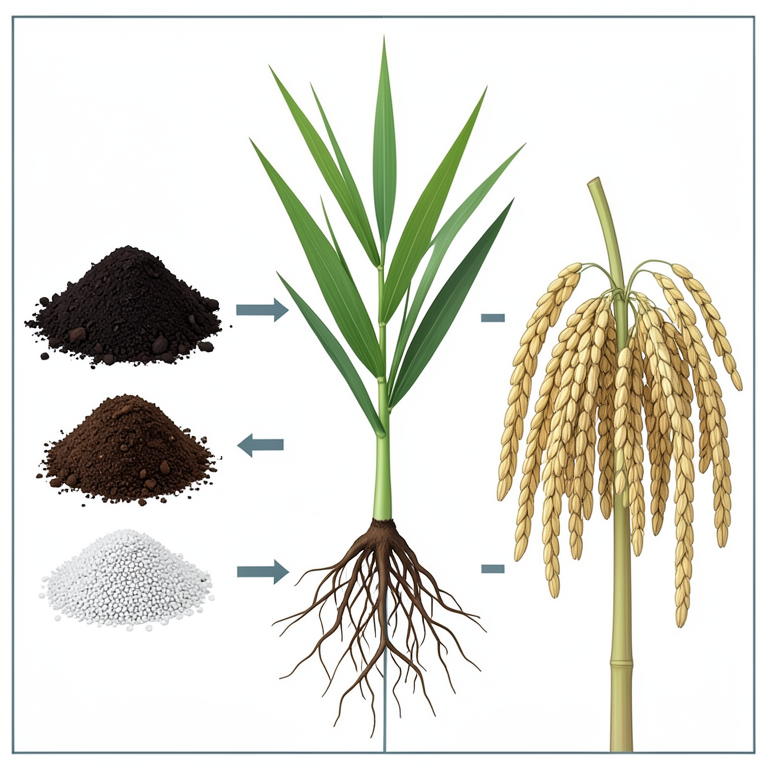
Integrated Nutrient Management Concept
AI-generated conceptual illustration (rice plants (var. ADT 43)). It explains the idea and does not show study data.
View source evidence ↗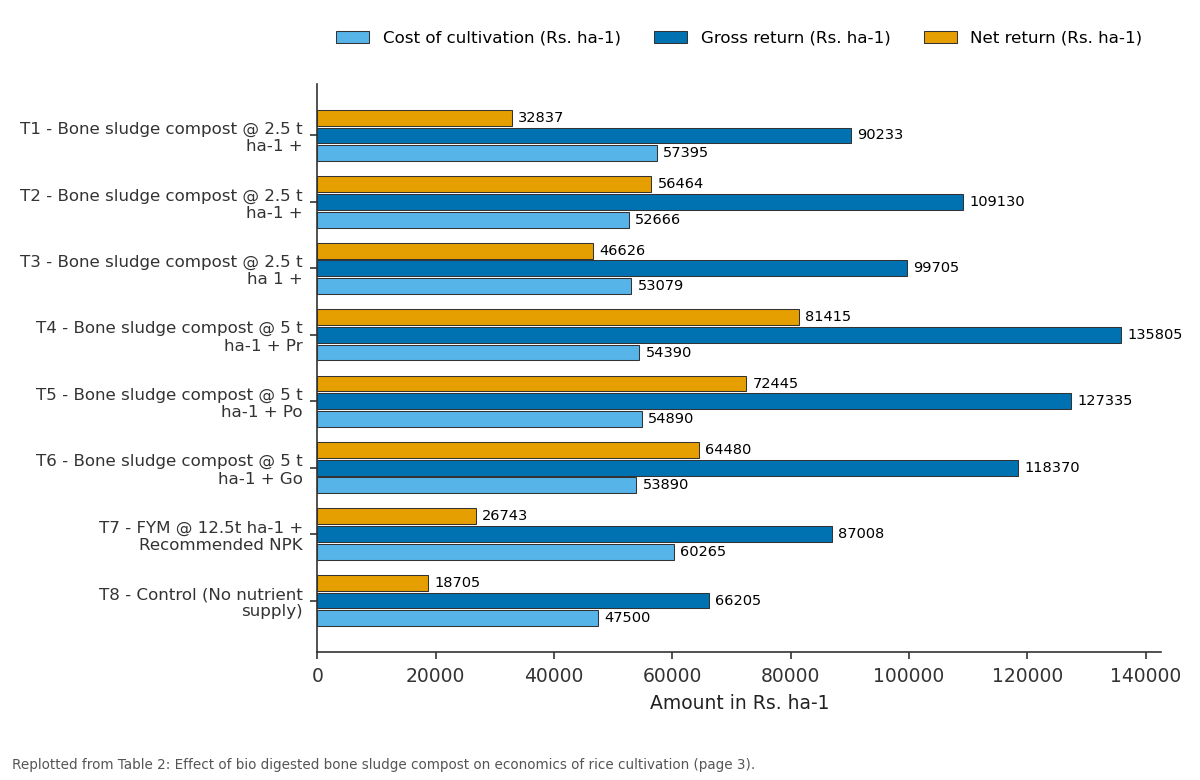
Cost of cultivation (Rs. ha-1) and Gross return (Rs. ha-1) and more: T1 - Bone sludge... vs T2 - Bone sludge... vs T3 - Bone sludge... vs T4 - Bone sludge... vs T5 - Bone sludge...
Replotted from Table 2 (page 3) of the original paper. Every bar is the paper's own table value.
View source evidence ↗Figures & tables
From the original paper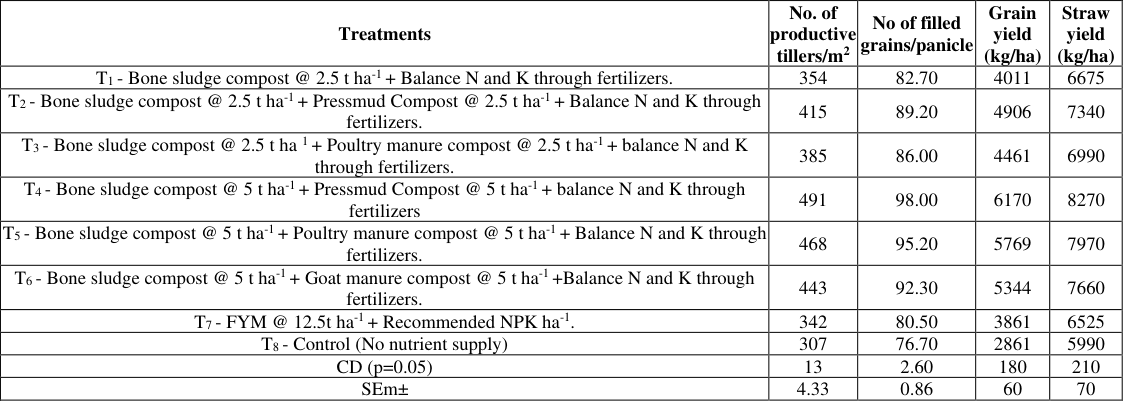 Table 1
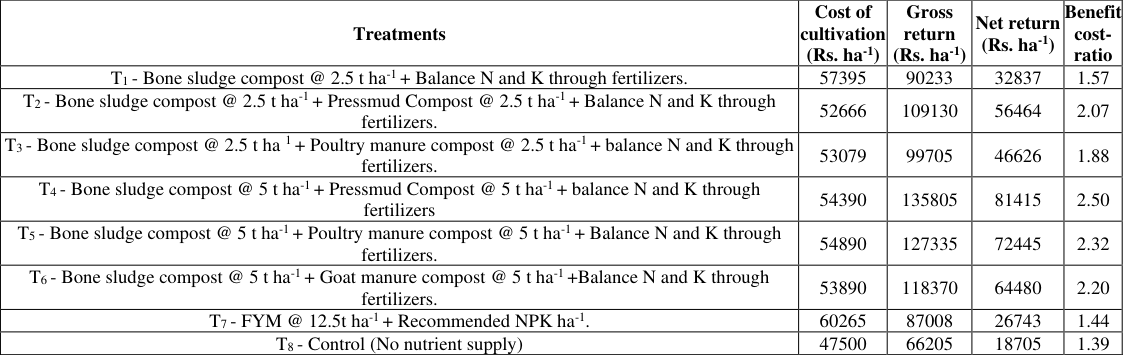 Table 2
Introduction
Rice (Oryza sativa L.) is a major staple food for nearly half of the world's population around the world and the second most important cereal crop next to wheat in terms of area (Sanjay swami and Singh, 2020). Globally rice is cultivated over an area of 162 million hectares with an annual production of around 700 million tonnes with an average productivity of 4.3 tonnes ha -1 . In India, rice is cultivated in an area of 48.53 million hectares with a production of 112.18 million tonnes and an average productivity of 2.31 tonnes ha -1 . In Tamil Nadu, rice is cultivated in an area of 2.2 million hectares with a production of 8.65 million tonnes and productivity of 3.93 t ha -1 (Directorate of Economics and Statistics, 2021) [2] . The unregulated dumping of industrial waste poses significant risks to both human health and the quality of soil, which is essential for sustaining plant life. Efforts are underway to explore methods of recycling these waste materials in a manner that benefits the environment, particularly soil health. The task at hand involves effectively integrating these waste products into a well-managed program to ensure they do not exacerbate pollution issues. The declining trend of total production from the same land, diminishing response in increase of food grains to applied fertilizer nutrients are due to imbalanced, inappropriate and indiscriminate use of chemical fertilizer leading to heavy withdrawal of nutrients from the soil resulting in poor soil fertility Besides, deterioration of soil health and degradation of land (Vignesh and Sudhagar Rao, 2019) [18] . There has been a steady decline not only in productivity but also in the recuperative capacity of soil, pollution of water resources and chemical contaminations of food grains. Maintaining soil health is essential for achieving sustainable production, and this requires addressing factors that contribute to its ongoing maintenance. Therefore, the complementary use of organic supplements alongside chemical fertilizers is crucial for preserving soil health and maximizing rice yields. The rising global population, with its growing requirements for food, fiber, and energy, presents an escalating annual demand that must be met sustainably. Meeting this demand necessitates a focus on enhancing productivity.
As a result, a comprehensive strategy is essential, aiming not only to boost yields but also to preserve and improve declining soil health. Kapse et al. (2017) [6] . Hence, the complimentary role of organics as supplements to chemical fertilizers is important for keeping the soil health in order to harness the potential yield in rice (Lency, 2001) [8] . Under these circumstances, more emphasis is now being given to integration of inorganic and organics including crop residues, agro-based industrial wastes and by-products to improve the soil. Besides improving nutrient status of soils, it also helps in improving the physical, chemical and biological properties of soil towards betterment of soil quality, and permeability which increases fertilizer use efficiency due to higher addition of humus (Prakhyath et al., 2022) [13] . The acceptance of recycling industrial wastes, which originate from both agricultural and non-agricultural sectors, is increasing for the improvement of soil quality. These recycled materials serve as a valuable source of plant nutrients, enhancing fertilizer efficiency and contributing to cost-effective agricultural practices. This approach aids in utilizing locally available resources and serves as a economically viable input for achieving profitable crop production (Imran khan et al., 2022) [4] Pressmud compost, a notable residue from the sugar industry, comprises essential macro and micronutrients. It serves as a valuable nitrogen (N) and phosphorus (P) source, enriching soil nutrients and enhancing the accessibility of micronutrients in crop systems (Randhawa et al., 2021) [14] . Bone sludge, a byproduct derived from the ossein industry, consists of bone particles suspended in bone washings. These particles are filtered, sun-dried, and contain significant amounts of both macro and micro-nutrients. The organic manures viz., pressmud compost, poultry manure compost, goat manure compost, bone sludge compost and farmyard manure are excellent organic fertilizers, as these contain high amount of nitrogen, phosphorus, potassium and other essential nutrients and have been promising in arresting the declining trend of soil health and in increasing productivity through correction of marginal deficiency. Hence, the present investigation was carried out to develop an efficient using bio digested bone sludge compost practice for rice using with locally available organic sources along with inorganic fertilizers to augment productivity of rice.
Materials and Methods
The field experiment was conducted in Q block of experimental farm, Department of Agronomy, Faculty of Agriculture, Annamalai University, Annamalai Nagar. The geographical location of Annamalai Nagar is 11º24' N latitude and 79º44' E longitude at an altitude of +5.79 m above mean sea level. The soil of the experimental field is classified as Udicchromustert (clay) according to FAO (1974). The initial analysis of the experimental soil revealed that heavy clay was neutral in reaction (pH = 7.6), with low soluble salts (EC = 0.33 dS/m), medium in available N (230 kg/ ha), low in available P2O5 (21 kg/ha) and high in available K2O (280 kg/ha). The experiment was laid out in randomized block design with three replications. The experiment comprised eight treatments viz., T1 -Bone sludge compost @ 2.5 t ha -1 + Balance N and K through fertilizers, T2-Bone sludge compost @ 2.5 t ha -1 + Pressmud compost @ 2.5 t ha -1 + Balance N and K through fertilizers, T3-Bone sludge compost @ 2.5 t ha 1 + Poultry manure compost @ 2.5 t ha -1 + Balance N and K through fertilizers, T4 -Bone sludge compost @ 5 t ha -1 + Pressmud compost @ 5 t ha -1 + Balance N and K through fertilizers, T5 -Bone sludge compost @ 5 t ha -1 + Poultry manure compost @ 5 t ha -1 + Balance N and K through fertilizers, T6 -Bone sludge compost @ 5 t ha -1 + Goat Manure compost @ 5 t ha -1 +Balance N and K through fertilizers, T7-FYM @ 12.5t ha -1 + Recommended NPK ha -1 and T8 -Control (No nutrient supply). Rice variety ADT43 was chosen as test crop for the investigation bone sludge compost, pressmud compost, poultry manure compost, goat manure compost and FYM were applied in the respective plots as per the treatment schedule. Pressmud compost, poultry manure compost and FYM were obtained from farm unit of Department of Agronomy, Faculty of agriculture, Annamalai University, Annamalai Nagar. Annamalai University, Annamalai Nagar. Bone sludge compost used in this study was obtained from Pioneer Jellice India Pvt. Ltd., Cuddalore. The nutrient content of organic manure composts viz., Bone sludge N-2.10%, P-9.96%, K-0.38%, pressmud compost N-2.63%, P-2.54%, K 2.36%, goat manure compost N-1.50%, P-0.40%, K-0.37%, poultry manure compost N-2.20%, P-1.40%, K-1.20% and FYM N-0.58%, P-0.27%, K-0.60%, respectively. The recommended package of practices was followed, and the crop was harvested. For recording plant height and for estimation of dry matter production, five plants were randomly removed at harvest stage. These samples were first air-dried in shade and then oven-dried at 80±5 °C till a constant weight was obtained and the weight was recorded. The mean dry weight was expressed in kg/ha. All the recorded data were analyzed statistically with analysis of variance using Agres software with a critical difference at 0.05 level of probability.
Results and Discussion
Results and Discussion
Yield Attributes
The yield attributes of rice viz., number of productive tillers/m² and number of filled grains/panicle were favourably influenced by the application of bio digested bone sludge compost @ 5 t/ha + Pressmud compost @ 5 t/ha along with balance N and K through fertilizers (Table 1). Maximum number of productive tillers (491/m²) and number of filled grains/panicle (98.00) were registered under the application of bone sludge compost @ 5 t/ha + pressmud compost @ 5 t/ha along with Balance N and K through fertilizers (T4). It was followed by the application of bone sludge compost @ 5 t/ha + poultry manure compost @ 5 t/ha along with Balance N and K through fertilizers (T4). The treatment with control (no nutrient supply) (T8) registered the minimum number of tillers (307/m2) and filled grains/panicle 76.70). The improved availability of nutrients, attributed to the positive impact of both inorganic and organic nutrient sources, likely enhanced the physiological and metabolic functions within the plant. This, in turn, established the groundwork for the synthesis of additional chlorophyll, maintaining higher leaf nitrogen concentration consistently throughout the cropping period. Consequently, this resulted in the production of a greater number of tillers. The present findings agree with the earlier reports of Suneel Kumar et al. (2023) [17] The utilization of both inorganic fertilizers and organic manure sources could contribute to maintaining a well-balanced nutrient supply throughout the various growth phases of rice. This combined approach might enhance the accessibility of both macro and micro-nutrients, consequently facilitating increased nutrient absorption. As a result, there could be improved translocation of photosynthates from the source to the sink, leading to a greater number of spikelets and filled grains/panicle in rice plants. These findings are in conformity with the earlier reports of Jay Nath Patel et al. (2023) [5] in rice Yield Bio digested bone sludge compost significantly influenced the grain and straw yield of rice (Table 1). Application of bone sludge compost @ 5 t/ha + pressmud compost @ 5 t/ha along with Balance N and K through fertilizers (T4) significantly registered the highest grain yield of 5792 kg/ha and straw yield of 8270 kg/ha. It was followed by application of bone sludge compost @ 5 t/ha + poultry manure compost @ 5 t/ha along with Balance N and K through fertilizers recorded with a grain yield of 5769 kg/ha and straw yield of 7970 kg/ha. Treatment with control (no nutrient supply) (T8) registered the minimum grain yield of 2861 kg/ha and straw yield of 5990 kg/ha. The increase in grain yield might be due to superior yield attributing characters under integrated nutrient management which received the essential nutrients at balanced proportions for better growth of rice Pankaj singh and Awadhesh kumar singh (2022) [12] . Furthermore, bone sludge and pressmud composts relatively added large amount of macro and micro nutrients especially P, Ca and Mg which involved in enzyme activities and impart physio-chemical and biological activities of soil resulting in more photosynthates assimilation and subsequent conversion of assimilates into yield attributes in larger fraction which ultimately resulted in higher grain and straw yields and harvest index. Similar findings of balanced supply of nutrients by integrating organics with inorganics for better growth, yield attributes and yield of rice are in agreement with the results of the study of Ajay Kumar and Sivakumar (2020) [1] , Naveen et al. (2021) [11] and Prakhyath et al. (2022) [13] .
Economics
Application of bone sludge compost @ 5 t/ha + Pressmud compost @ 5 t/ha along with Balance N and K through fertilizers (T4) significantly registered the highest gross return of Rs. 135805 ha -1 , a net return of Rs. 81415 ha -1 and benefit-cost ratio of 2.50 (Table 2). The minimum gross return of Rs. 66205 ha -1 , a net return of Rs. 18705 ha -1 and a return per rupee invested of 1.39 was noticed under control (no nutrient supply) (T8). Similar results were also noticed by Sriram (2015) [16] who concluded that higher return rupee -1 invested was achieved by introducing organic manures in reducing the purchase cost of high analyzed fertilizer inputs. The treatment control recorded the lower return rupee -1 invested. These results are in line with the findings of Keerthana (2021) [7] and Mesiya Naveen Doss and Sivakumar (2022) [9] .
| Treatments | Cost of cultivation (Rs. ha-1) | Gross return (Rs. ha-1) | Net return (Rs. ha-1) | Benefit cost- ratio |
|---|---|---|---|---|
| T1 - Bone sludge compost @ 2.5 t ha-1 + Balance N and K through fertilizers. | 57395 | 90233 | 32837 | 1.57 |
| T2 - Bone sludge compost @ 2.5 t ha-1 + Pressmud Compost @ 2.5 t ha-1 + Balance N and K through fertilizers. | 52666 | 109130 | 56464 | 2.07 |
| T3 - Bone sludge compost @ 2.5 t ha 1 + Poultry manure compost @ 2.5 t ha-1 + balance N and K through fertilizers. | 53079 | 99705 | 46626 | 1.88 |
| T4 - Bone sludge compost @ 5 t ha-1 + Pressmud Compost @ 5 t ha-1 + balance N and K through fertilizers | 54390 | 135805 | 81415 | 2.50 |
| T5 - Bone sludge compost @ 5 t ha-1 + Poultry manure compost @ 5 t ha-1 + Balance N and K through fertilizers. | 54890 | 127335 | 72445 | 2.32 |
| T6 - Bone sludge compost @ 5 t ha-1 + Goat manure compost @ 5 t ha-1 +Balance N and K through fertilizers. | 53890 | 118370 | 64480 | 2.20 |
| T7 - FYM @ 12.5t ha-1 + Recommended NPK ha-1. | 60265 | 87008 | 26743 | 1.44 |
| T8 - Control (No nutrient supply) | 47500 | 66205 | 18705 | 1.39 |
Table text extracted from the original PDF; superscript letters are shown inline. The original table image is below.
View original table image
Conclusion
Based on the present investigation, it could be concluded that application of bone sludge compost @ 5 t/ha + pressmud compost @ 5 t/ha along with Balance N and K through fertilizers (T4) holds promise in enhancing crop yield and a benefit-cost ratio of 2.50 in rice var. ADT 43 which is the felt need of present-day agriculture. produced considerably greater yield. Hence, bone sludge is a realistic organic alternative which is agronomically efficient, ecologically desirable and economically viable which paves way for realization of higher
References
13 in the original paper- Ajaykumar R, Sivakumar SD. Effect of integrated nutrient management on growth, physiological, nutrient uptake, root and yield parameters of transplanted lowland rice. Curr. J Appl. Sci. Tech. 2020;39(40):35-43.
- Imran Khan, Muhammad A, Chattha MU, Skalicky M, Bilal Chattha M, Ahsin Ayub M, et al. Mitigation of SalinityInduced Oxidative Damage, Growth, and Yield Reduction in Fine Rice by Sugarcane Press Mud Application. Front. Plant Sci. 2022;13:840900.
- Jay Nath Patel, Singh RP, Alam MS. Influences of nutrient alteration by organic and inorganic sources on protein content, their yield and economics of the transplanted rice (Oryza sativa L.). J. Pharm. Innov. 2023;12(7):3523-3528.
- Kapse G, Patoliya P, Samadder SR. Characterisation of coal washery effluent and optimisation of coagulation behaviour of Moringa oleifera seed as a coagulant. Environ. Monit. Assess. 2017;189:133.
- Mesiya Naveen Doss M, Sivakumar G. Impact of enriched bio-digested bone sludge compost on the yield and economics of sugarcane. J Pharm. Innov. 2022;11(11):1247-1249.
- Mohana Sundar C, Saravana Perumal M. Comparison of different planting methods and physiological studies for yield enhancement in rice. J Pharmacogn. Phytochem. 2021;10:1400-04.
- Naveen Kumar G, Singh PK, Naresh RK, Sharath Chandra M, Akash Kumar. Effect of planting techniques with organic and inorganic nutrient management on growth, yield attributes and productivity of rice (Oryza sativa L.) under Rice-Wheat Cropping System. Intl. J Curr. Microbiol. Appl. Sci. 2021;10(1):1-9.
- Pankaj Singh, Singh AK. The effect of integrated nutrient supply on growth and yield performance of rice (Oryza sativa L.) crop. J Pharm. Innov. 2022;11(1):774-776.
- Prakhyath KM, Prakash SS, Honnappa HM, Srinivasa N, Krishna Murthy R, Yogananda SB. Growth and development of paddy due to different amendments and nutrient management practices in sodic soil. J Pharm. Innov. 2022;SP-11(1):208-214.
- Mehakpreet R, Salwinder D, Vivek S, Amardeep T, Sandeep S, Manpreet K. Ensuring yield sustainability and nutritional security through enriching manures with fertilizers under rice-wheat system in North-western India. J Plant Nutri. 2021 Dec 16;45(4):540-557.
- Sanjay S, Singh S. Effect of nitrogen application through urea and Azolla on yield, nutrient uptake of rice and soil acidity indices in acidic soil of Meghalaya. J Env. Bio. 2020;41:139-146.
- Suneel Kumar, Agrawal S, Jilani N, Kole P, Kaur G, Mishra A, et al. Effect of integrated nutrient management practices on growth and productivity of rice: A review. J Pharm. Innov. 2023;12(5):2648-2662.
- Vignesh ET, Sudhgar Rao GB. Effect of inorganic and organic amendments on yield and economics of rice. Plant Arch. 2019;19(1):1791-1796.