
Research article · 2024 · Full text
International Journal of Research in AgronomyDemonstration of Dicoccum wheat variety DDK-1029 under Northern dry zone of Karnataka
Volume 7(3) · Pages 332–334 · DOI: 10.33545/2618060x.2024.v7.i3e.419 ↗
Research areasWheat and Barley Genetics and PathologyGenetics and Plant BreedingRice Cultivation and Yield Improvement
Abstract
Author-writtenThe present study on demonstration of dicoccum wheat variety DDK-1029 under northern dry zone of Karnataka, India was conducted at ICAR-Krishi Vigyan Kendra, Vijayapura-II (Indi). The dicoccum wheat variety DDK-1029 with package of practice, which was developed by University of Agricultural Sciences, Dharwad was used. The study was conducted in 30 demonstrations in 12 ha of farmer’s field in different villages of Indi, Chadchan, Devara Hipparagi and Sindagi Taluks of Vijayapura district for three years (2019-20 to 2021-22). The productivity of dicoccum wheat ranged from 29.80 to 33.50 q/ha with mean yield of 29.42 q/ha under demonstration field as against a yield ranged from 22.20 to 28.30 q/ha with a mean of 24.73 q/ha recorded under farmers practice. In comparison to farmers practice 19.00% higher productivity was observed in demonstrated field. The dicoccum wheat variety DDK-1029 with improved package of practice recorded higher gross returns (Rs. 93,660/ha), net return (Rs. 72,460/ha) and B:C ratio (4.41) as compared to farmers practice. Further by inclusion of dicoccum wheat variety DDK-1029 with improved package of practice realized an additional income of Rs. 13,212 per hectare, which created awareness and motivated the other farmers to adopt.
Summary
Source-checkedPlain-language reading of the full paper, prepared with AI and checked against the text. Each point links to the authors' own words.
Why it matters
- Wheat is a critical winter food crop in India, essential for the country's food grain self-sufficiency. View evidence ↗
- Dicoccum wheat is uniquely cultivated in the peninsular zone and is valued for its high protein, dietary fiber, and therapeutic properties. View evidence ↗
- Low wheat productivity in India and Karnataka is attributed to poor agronomic management, including suboptimal seed rates and a lack of location-specific improved varieties. View evidence ↗
The question
- The study aimed to evaluate the differences between introduced technology and local farmer practices regarding the extension gap, technology gap, and technology index. View evidence ↗
- The research sought to compare the yield and economic outcomes of demonstration plots against traditional farmer practices. View evidence ↗
What they did
- The study involved 30 demonstrations across 12 hectares of farmers' fields in the Vijayapura district of Karnataka over three years (2019-20 to 2021-22). View evidence ↗
- The semi-dwarf dicoccum wheat variety DDK-1029 was tested for performance against local varieties. View evidence ↗
- Participating farmers were provided seeds at a rate of 60 kg/ha and used Azospirillum for seed treatment. View evidence ↗
- Yield and cost data were collected from both practicing and non-practicing farmers, with produce prices sourced from the APMC in Indi, Vijayapura. View evidence ↗
What they found
- Demonstration fields achieved a mean yield of 29.42 q/ha (ranging from 28.70 to 32.20 q/ha), while farmer practices yielded a mean of 24.72 q/ha (ranging from 24.15 to 26.45 q/ha). View evidence ↗
- The demonstration fields showed higher productivity than farmer practices by 18.84% in 2019-20, 19.17% in 2020-21, and 17.85% in 2021-22. View evidence ↗
- The average extension gap between the demonstration and farmer practices was 4.70 q/ha, ranging from 4.55 to 5.75 q/ha. View evidence ↗
- The technology gap (difference between potential and demonstrated yield) averaged 30.58 q/ha, ranging from 27.80 to 31.30 q/ha. View evidence ↗
- The DDK-1029 variety with improved practices yielded higher mean gross returns (Rs. 93,660/ha), net returns (Rs. 72,460/ha), and a B:C ratio of 4.41 compared to farmer practices. View evidence ↗
What it means
- The authors conclude that the DDK-1029 variety with improved technology increased average yield by 19% and added Rs. 13,212/ha in income, motivating further farmer adoption. View evidence ↗
- Frontline demonstrations are identified as an effective tool for increasing dicoccum wheat production by improving farmer knowledge and skills. View evidence ↗
Visual summary
2 visualsIllustrations explain the paper; charts are replotted from the paper's own table values.
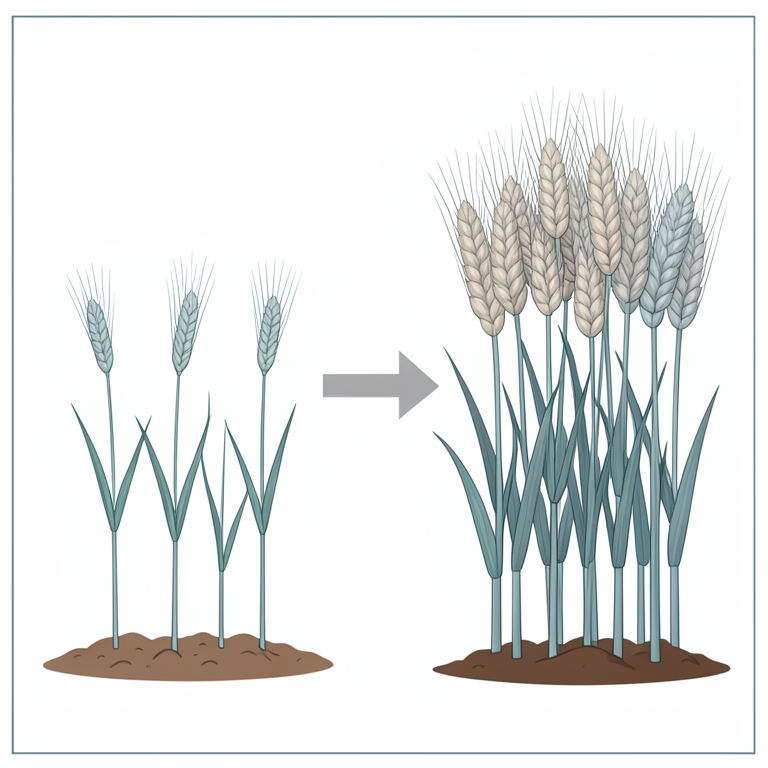
Yield Comparison
AI-generated conceptual illustration (Dicoccum wheat plants). It explains the idea and does not show study data.
View source evidence ↗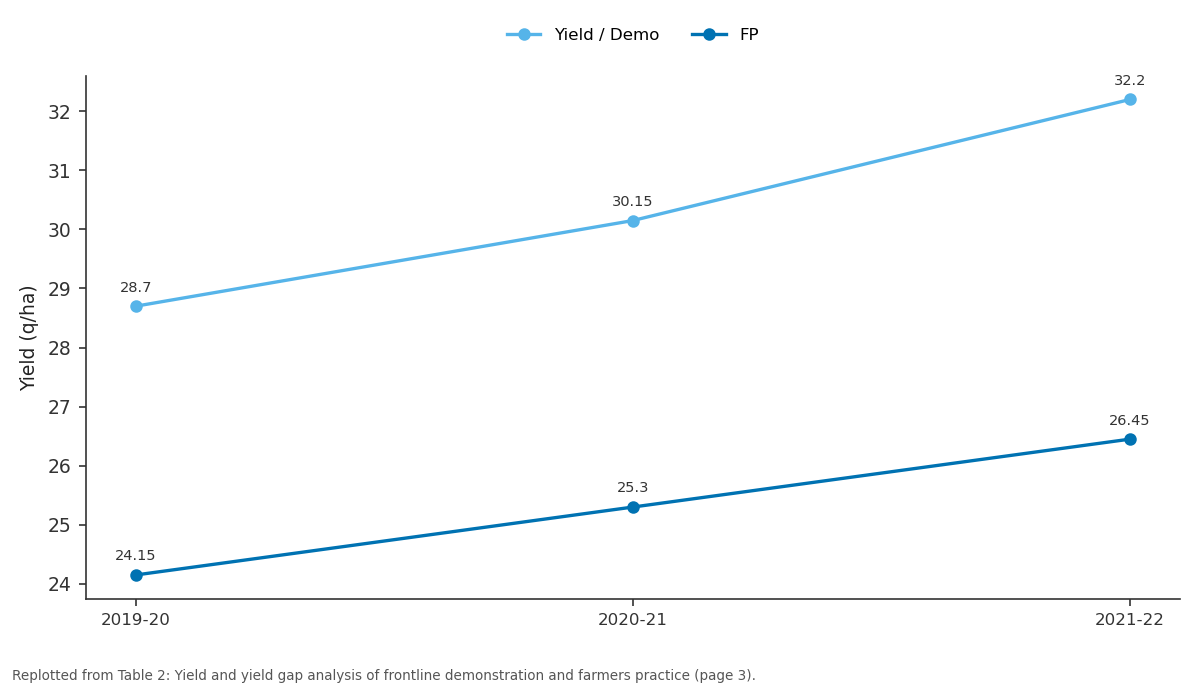
Yield / Demo and FP: 2019-20 vs 2020-21 vs 2021-22
Replotted from Table 2 (page 3) of the original paper. Every bar is the paper's own table value.
View source evidence ↗Figures & tables
From the original paper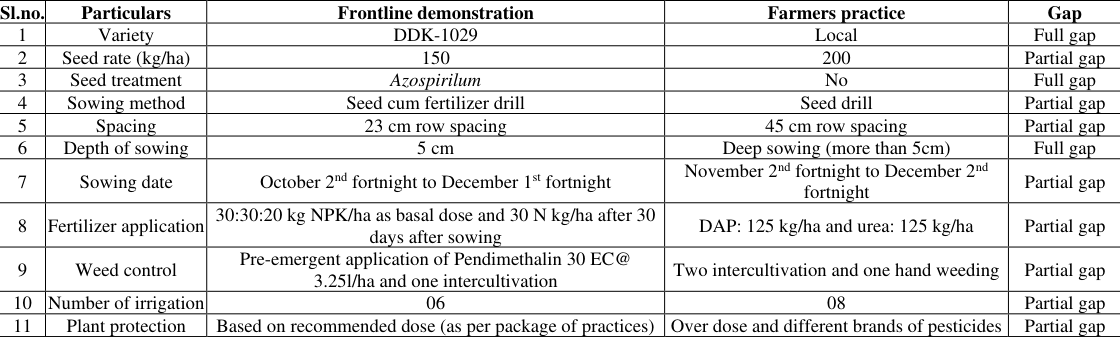 Table 1
 Table 2
 Table 3
Introduction
One of the most important winter food crops of India is wheat and its productivity has played a key role in making the country self-sufficient in food grain. It is the crop which triggered green revolution in India. It is estimated that more than 35 percent of world population depends on wheat. It supplies the daily protein requirement of human diet up to 60 percent, than any other crop. In India, wheat is the second most important food crop next to rice and it contributes nearly 35 percent to national food basket. Among food crops, it contributes about 35.81 percent of the food grain. During the crop year 2021-22, wheat was grown over an area 29.80 million hectare with the total production of 108.84 million tones and a productivity of 3300 kg per hectare which shares 12.43% of total production in the world (Anon, 2022) [2] . Delayed sowing of wheat (December or early January) causing poor seed yield, due to sub-optimal temperature at sowing, which causes delayed in germination, slow growth and development phase (Tiwari et al., 2015) [6] . Further, delayed in sowing causes supra optimal thermal stress during reproductive phases which results in forced maturity. The poor agronomic management practices such as seed rate, location specific improved variety, nutrient and irrigation management so on are responsible for low productivity of wheat in India in general and Karnataka in particular. Among the wheat, dicoccum wheat cultivation is unique in peninsular zone. It is nutritionally rich because of presence of higher protein content, more dietary fiber, resistant starch and high therapeutic value. The food prepared out of this wheat has high satiety value, unique flavor and good keeping quality. The dicoccum wheat growing farmers predominantly cultivated local types. This necessitated the development of high yielding dicoccum wheat varieties. To improve the yield potential and lodging tolerance, semi dwarf variety DDK 1029 was developed. Vijayapura district has a substantiate area under dicoccum wheat which is grown under irrigation. Dicoccum wheat is known for its nutraceutical value of regulating blood glucose level, dicoccum wheat is one of the major rabi/winter cereal crop of Vijayapura district.
The present study was taken with the following objectives ▪ To study the difference between technology introduced with local farmers practice in terms of extension gap, technology gap and technology index. ▪ To compare the yield and economics of demonstrated plots with farmers practice.
Materials and Methods
The present study was conducted at ICAR-Krishi Vigyan Kendra, Vijayapura-II (India), Karnataka in an operational area of KVK, for three years (2019-20 to 2021-22) the information on existing cultivation practices by the farmers were collected during pre-season by interacting. The information comprises of variety used, yield, profit and problem faced by the farmers.
Based on the collected information, technological gaps were identified and a suitable package of practice were prepared and introduced in the demonstration. The farmers having irrigation facility were selected for the study by adopting the University of Agricultural Sciences, Dharwad package of practice (Table 1). Macaroni and Pasta products (Anon., 2020) [1] . The farmers which are growing dicoccum wheat were purposively selected based on their willingness to participate in the demonstration, whose fields are located near main road. The study was carried by taking 0.4 ha unit area from each farmer and total 4 ha field with 10 farmers in each year; total 30 demonstration in 12 ha of farmers field in different villages of Indi, Chadchan, Devara Hipparagi and Sindagi taluks of Vijayapura district for three years. For the comparison between demonstration and farmers practice, other field grown by the same farmer or different farmer adjoining to the demonstration field were used. For each year farmers have been trained for adopting improved package of practice by conducting on and off campus trainings. The certified seeds of dicoccum wheat variety DDK-1029 were purchased from the Seed Unit, University of Agricultural Sciences, Dharwad. Seed as the critical input @ 60 kg/ha were provided to the participating farmers. For seed treatment Azospirillum were purchased from Institute of Organic Farming, University of Agricultural Sciences, Dharwad and remaining inputs were purchased from the local market. The expenditure on recommended fertilizers and plant protection measures were borne by them. The data on cost of cultivation, yield were collected from each selected framer as well as from nonpracticing farmer. For calculation of economics, price of the produce has been collected from Agricultural Produce Marker Committee (APMC), Indi, Vijayapura. From the collected data yield, cost of cultivation, gross returns, net profit and B:C ratio were worked out. The extension gap, technology gap and technology index were estimated (Samui et al., 2000) [4] by the following formulae and final conclusions were drawn.
| Sl.no. | Particulars | Frontline demonstration | Farmers practice | Gap |
|---|---|---|---|---|
| 1 | Variety | DDK-1029 | Local | Full gap |
| 2 | Seed rate (kg/ha) | 150 | 200 | Partial gap |
| 3 | Seed treatment | Azospirilum | No | Full gap |
| 4 | Sowing method | Seed cum fertilizer drill | Seed drill | Partial gap |
| 5 | Spacing | 23 cm row spacing | 45 cm row spacing | Partial gap |
| 6 | Depth of sowing | 5 cm | Deep sowing (more than 5cm) | Full gap |
| 7 | Sowing date | October 2nd fortnight to December 1st fortnight | November 2nd fortnight to December 2nd fortnight | Partial gap |
| 8 | Fertilizer application | 30:30:20 kg NPK/ha as basal dose and 30 N kg/ha after 30 days after sowing | DAP: 125 kg/ha and urea: 125 kg/ha | Partial gap |
| 9 | Weed control | Pre-emergent application of Pendimethalin 30 EC@ 3.25l/ha and one intercultivation | Two intercultivation and one hand weeding | Partial gap |
| 10 | Number of irrigation | 06 | 08 | Partial gap |
| 11 | Plant protection | Based on recommended dose (as per package of practices) | Over dose and different brands of pesticides | Partial gap |
Table text extracted from the original PDF; superscript letters are shown inline. The original table image is below.
View original table image
Results and Discussion
Results and Discussion
Yield
The yield obtained over the years under recommended and farmers practice are presented in table 2. The productivity of dicoccum wheat ranged from 28.70 to 32.20 q/ha with mean yield of 29.42q/ha under demonstration field as against a yield ranged from 24.15 to 26.45 q/ha with a mean of 24.72 q/ha recorded under farmers practice. In comparison to farmers practice there was an increase of 18.84, 19.17 and 17.85% higher productivity, respectively during 2019-20, 2020-21 and 2021-22 following demonstration field. The higher yield of dicoccum wheat under demonstration field was due to the use of latest and improved high yielding variety and with its recommended cultivation practice. These results are same with the findings of Tiwari et al. (2015) [6] Extension gap An extension gap between demonstrated field and farmers practices was worked out and it ranges from 4.55 to 5.75 q/ha with an average of 4.70 q/ha during three year study period (Table 2). This indicates that, farmers need to be educated for the adoption of improved technology with high yielding varieties through various extension activities to reverse the wider and alarming trend of galloping extension gap.
Technology gap
The difference between potential yield and demonstrated yield was explained as technology gap. The data on technology gap was ranged from 31.30 to 27.80 q/ha with an average of 30.58 q/ha (Table 2). This may be due variation in fertility and weather conditions of the area. To narrow down the technology gap, location specific recommendation appears to be necessary. These results are in line with the findings of Hiremath and Nagaraju (2009) [3] .
Technology index
Feasibility of the improved technology at the farmer's field was indicated by technology index, lower the index higher will be the feasibility of improved technology. In this study lower technology index (46.33) was observed in 2021-22, which was followed by 49.75 and 52.17 percent in 2020-21 and 2019-2020, respectively (Table 2). During 2021-22 lower technology index was appeared, this may be due to dicoccum wheat variety DDK-1029 performed well with improved technology in an area of higher soil fertility which was coupled with good weather condition. These results are similar to the findings of Hiremath and Nagaraju (2009) [3] .
Economics
The economics of the demonstration technology and farmers practice were worked out for every demonstrating year in this study which was presented in Table 3. The data on economic analysis over the year revealed the dicoccum wheat variety DDK-1029 with improved package of practice recorded higher gross returns (Rs. 93,660/ha), net return (Rs. 72,460/ha) and B:C ratio 4.41) as compared to farmers practice. Further by inclusion
| Year | Cost of cultivation (Rs./ha) | — | Gross returns (Rs./ha) | — | Net returns (Rs./ha) | — | Additional income (Rs./ha) | B:C ratio | — |
|---|---|---|---|---|---|---|---|---|---|
| Demo | FP | Demo | FP | Demo | FP | Demo | FP | ||
| 2019-20 | 18,750 | 17,940 | 81,795 | 71,243 | 63,045 | 52,795 | 10,250 | 4.36 | 3.97 |
| 2020-21 | 23,650 | 22,850 | 1,05,525 | 88,550 | 81,875 | 65,700 | 16,175 | 4.46 | 3.88 |
| 2021-22 | 30,560 | 28,740 | 1,15,920 | 95,220 | 85,360 | 66,480 | 18,880 | 3.79 | 3.31 |
| Mean | 21,200 | 20,395 | 93,660 | 79,897 | 72,460 | 59,248 | 13,212 | 4.41 | 3.93 |
Table text extracted from the original PDF; superscript letters are shown inline. The original table image is below.
View original table image
Conclusion
From the study it can be concluded that, yield of dioccum wheat variety DDK-1029 with improved technology was increased by 19.00 percent (Average of three years) over the farmer practice with an additional income of Rs. 13,212 per hectare, which created awareness and motivated the other farmers to adopt. The beneficiary farmers of the frontline demonstration also play an important role as a source of information for wider dissemination of high yielding dioccum wheat to nearby farmers. Thus, the frontline demonstration is an effective tool for increasing area, production and productivity of dicoccum wheat by changing the knowledge, skill and attitude of the farmers on the adoption of improved technologies.
Acknowledgement
AcknowledgmentI am gratefully acknowledges the financial and technical support received from ICAR-ATARI, Bengaluru and University of Agricultural Sciences, Dharwad.
References
6 in the original paper- Anonymous. Agrinnovate India, Department of Agricultural Research and Education, Ministry of Agriculture & Farmers Welfare Government of India, 2020. (Accessed 10 January 2020) Available 2020: http://www.agrinnovateindia.co.in
- Anonymous. Agricultural statistics at a glance 2022, http://agricoop.gov.in/sites/default/files/agristatglance 2022.pdf 2022.
- Hiremath SM, Nagaraju MV. Evaluation of front line demonstration trials on onion in Haveri district of Karnataka. Karnataka J Agri. Sci. 2009;22(5):1092-1093.
- Samui SK, Maitra S, Roy DK, Mondal AK, Saha D. Evaluation on front line demonstration on groundnut (Arachis hypogea L.). Journal of the Indian Society of Coastal Agricultural Research. 2000;18(2):180-183.
- Suma SB, Yeshwanthakumar KJ, Reddy SNU, Vijendra SB, Gopalareddy K, Kumar L, et al. Dicoccum wheat: current status and future prospective. New horizons in Wheat and Barley research. Edition. 2022;1(21):531-563.
- Tiwari BK, Tiwari KP, Sahare KV, Tripathi PN. Impact of Front Line Demonstration of Management Practices on Wheat (Triticum aestivum) Under Irrigated Conditions. Plant Archives. 2015;15(2):1079-1082.