
Research article · 2024 · Full text
International Journal of Agriculture Extension and Social DevelopmentConstraints affecting innovations of rice farmers in the Kole wetland system
Volume 7(3) · Pages 117–122 · DOI: 10.33545/26180723.2024.v7.i3b.417 ↗
Research areasAgricultural Systems and PracticesAgricultural Innovations and Practices
Abstract
Author-writtenThe rice cultivation practices of the Kole wetland in Kerala have become well-known, boasting a history that spans three centuries. However, there has been a significant decrease in the cultivation area and overall yield in Kerala. The challenges confronting innovations in rice production in the Kole wetland system have not been thoroughly examined using suitable methodologies. Consequently, this research employed Henry Garrett's ranking technique to assess and prioritize the constraints influencing the innovations of rice farmers in the Kole wetland system. The data were collected from 150 farmers chosen at random. The results revealed that rice farmers encounter challenges related to accessing and utilizing inputs and technology, adopting marketing innovations, and facing economic, environmental, and institutional constraints. Erratic rainfall (74.07%), delay in procurement (72.03%), unavailability of labour (70.23%), research and extension don’t know the real production problems farmers face (70.10%), and high cost of inputs (68.87%) were the major constraints noted in average values. The research suggests that utilizing the Henry Garrett technique for ranking constraints is more effective compared to relying on simple frequencies.
Summary
Source-checkedPlain-language reading of the full paper, prepared with AI and checked against the text. Each point links to the authors' own words.
Why it matters
- The Kole wetland in Kerala is a historically significant rice cultivation area with a legacy of 300 years. View evidence ↗
- Between 2005 and 2020, Kerala experienced a drastic decline in both the total yield and the area used for rice cultivation. View evidence ↗
- Innovations in management, production, and mechanization are necessary to transform rice farming from a basic livelihood into a flourishing enterprise. View evidence ↗
The question
- The study aimed to identify the primary constraints hindering innovations for rice farmers in the Kole wetland system to help improve productivity and socio-economic conditions. View evidence ↗
What they did
- The research was carried out in the rice-growing tracts of the Kole wetland located in the Thrissur district of Kerala. View evidence ↗
- The study sample consisted of 150 randomly selected farmers, with an average of 75 farmers from each of the two selected Padasekharams. View evidence ↗
- The researchers used Henry Garrett's ranking technique to identify and analyze the most significant constraints faced by the farmers. View evidence ↗
What they found
- The high cost of inputs was the top-ranked constraint for input access and use, with an average Garrett score of 68.87. View evidence ↗
- Among marketing innovations, the delay in procurement was the most critical constraint, scoring an average of 72.03. View evidence ↗
- The unavailability of labour was identified as the most significant economic constraint, with a mean Garrett score of 70.23. View evidence ↗
- Erratic rainfall was the highest-ranked environmental constraint, with an average Garrett score of 74.07. View evidence ↗
- The top institutional constraint was the perception that research and extension staff are unaware of the actual production problems farmers face, with a score of 70.10. View evidence ↗
What it means
- The authors conclude that there is a need for more frequent and intense interactions between research, extension, and farmers to develop innovations based on actual needs. View evidence ↗
- The authors recommend implementing intrinsic feedback loops in Transfer of Technology (TOT) systems to allow farmers to provide reciprocal feedback on innovations. View evidence ↗
Visual summary
3 visualsIllustrations explain the paper; charts are replotted from the paper's own table values.
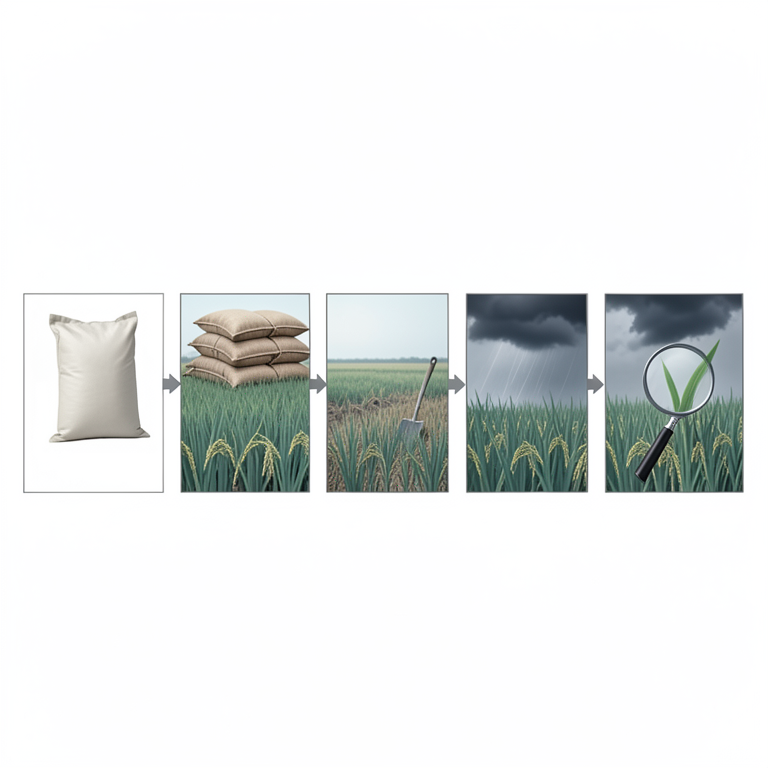
Categorized Constraints of Kole Rice Farmers
AI-generated conceptual illustration (Rice plants in a wetland paddy field). It explains the idea and does not show study data.
View source evidence ↗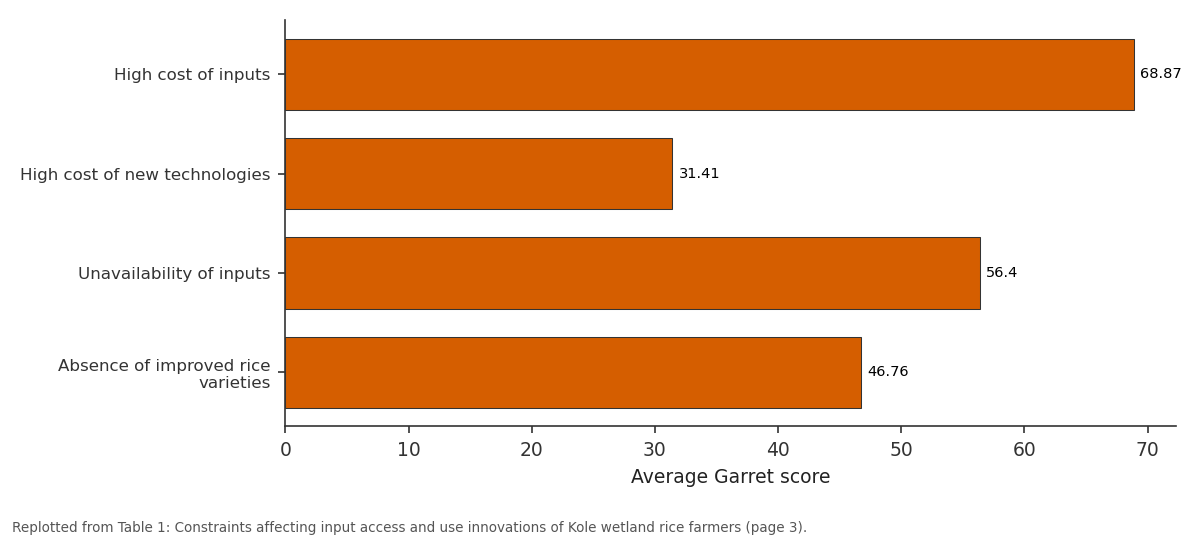
Average Garret score: High cost of inputs vs High cost of new... vs Unavailability of inputs vs Absence of improved...
Replotted from Table 1 (page 3) of the original paper. Every bar is the paper's own table value.
View source evidence ↗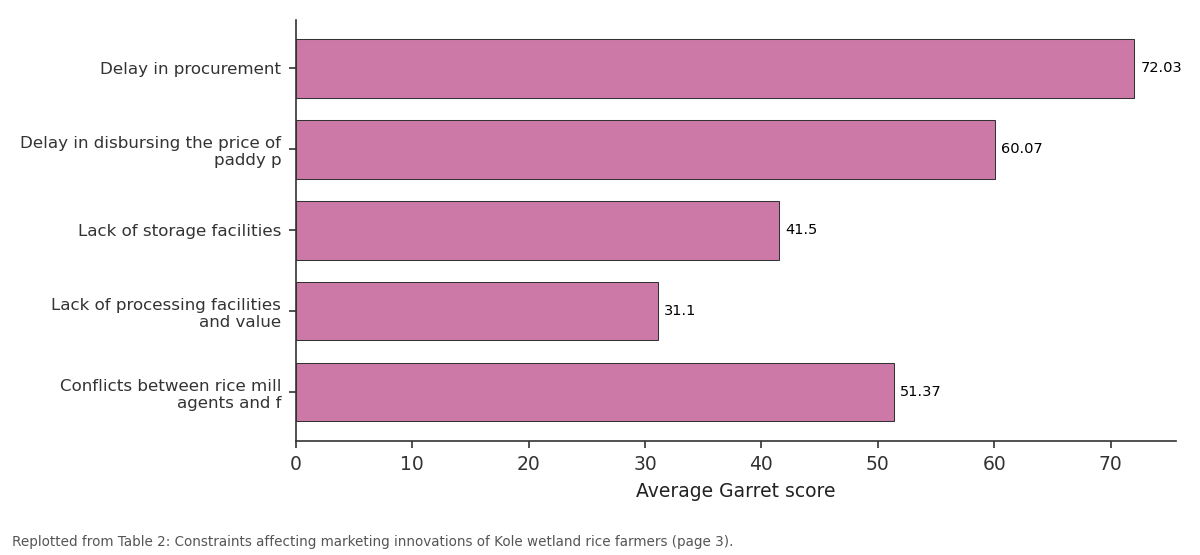
Average Garret score: Delay in procurement vs Delay in disbursing the... vs Lack of storage... vs Lack of processing... vs Conflicts between rice...
Replotted from Table 2 (page 3) of the original paper. Every bar is the paper's own table value.
View source evidence ↗Figures & tables
From the original paper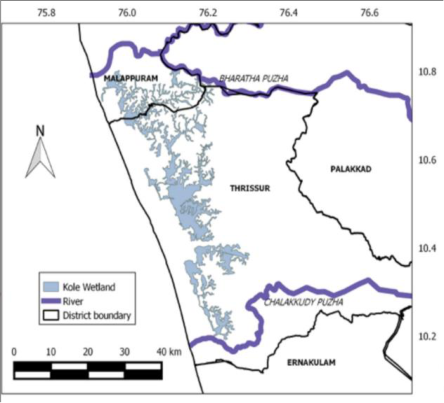 Figure 1
 Table 1
 Table 2
 Table 3
 Table 4
 Table 5
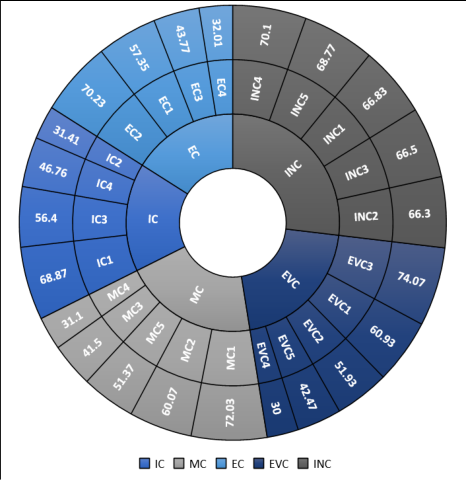 Figure 2
Introduction
The Kole wetland in Kerala has gained renown for its rice cultivation practices, with a history spanning 300 years. The Kole land is a component of the distinctive Vembanad-Kole wetland ecosystem in Kerala and has been designated as a Ramsar site since 2002 (Islam and Rahmani, 2008) [6] . Its name, 'Kole,' directly translates to 'bumper crop' in Malayalam, highlighting the wetland's remarkable productivity. The Kole wetlands are situated between the Chalakudy River in Thrissur district and the Bharathapuzha River in Malappuram district. These wetlands become submerged during the monsoon season, and agricultural activities take place in the summer months when water levels are lower. According to a significant study conducted by Johnkutty and Venugopal (1993) [13] , the shallow lagoons in the Karuvannur and Kecheri river basins, located between the Chalakudy and Bharathapuzha rivers, were reclaimed in the 18th century for rice cultivation. The Kole wetlands form the lion's share of the area under rice cultivation in the Thrissur and Malappuram districts. [10] www.extensionjournal.com Padasekharams are a collection of contiguous rice fields wherein the land owners form themselves into groups to form a Padasekharam Samithi in a democratic way under Section 7A of the Kerala Land Development Act, 1964 and registered under the Societies Act (Sreenivasan, 2012) [12] . The Padasekhara samiti or committees manage the major joint operations in these rice fields. The area of cultivation and total yield registered a drastic decline in Kerala between 2005 and 2020. Lately, rice farming in the Kole lands of Thrissur has become less appealing due to various challenges, prompting farmers to seek immediate intervention. To elevate rice cultivation beyond a basic livelihood pursuit and turn it into a flourishing enterprise, there is a requirement for innovation in production and management practices, along with the mechanization of the cultivation process. The present study was conducted to assess the major constraints affecting the innovations of rice farmers in the Kole wetland system in order to derive solutions to improve the productivity of rice and the socio-economic status of farmers.
Materials and Methods
The study was conducted in the Kole wetland rice growing tracts of Thrissur district of Kerala state. Kole land, which is one of the major rice-producing wetland systems of the state, was purposively selected for the study. Based on the list of Padasekharams under Kole from the records of the state Department of Agriculture, two Padasekharams with maximum area were selected. A total of 150 farmers, averaging 75 per Padasekharam, were selected randomly. Henry Garret's (1969) [5] ranking method was used to identify and analyse the most constraints faced by the rice farmers of the Kole area. Various authors from different countries have used this technique to analyse the constraints in different fields of study (Balasubramaniam et al., 2022; Shanthini, 2020) [1,11] . The ranks on constraints for each respondent were converted into a score as per the following procedure.
Step 1: Rank all of the variables collected from each respondent. The study used a pairwise ranking technique to obtain the ranks of all constraints in each category. Following that, each respondent ranked all constraints based on their severity in their opinion.
Step 2: Estimate the number of respondents who responded to each rank. This shows the summary of the respondents who fall into a specific rank for each constraint.
Step 3: Calculate the percent position by using the Henry Garrett formula presented below.
where Rji is the rank given for the i th variable by the j th respondent, and Nj is the number of variables ranked by the j th respondent.
Step 4: The equivalent value of the percent position was found out using the Garrett Table . The estimated percent position was then converted into scores using Garrett's Table (Dhanavandan, 2016) [3] . The score is then calculated by multiplying the number of respondents in that particular rank by the Garrett value.
Step 5: The total value for each constraint was estimated by summing the scores obtained in the fourth step.
Step 6: The total value was divided by the total number of respondents to get the averages.
Step 7: The ranks of each constraint were estimated. Ordering the average value in descending order yields the ranks of each constraint. The higher valued averages ranked first, implying that it is the most saviour problem.
Results and Discussions Constraints in the AIS of wetland rice farmers
Constraints associated with the AIS of wetlands in Kerala can potentially restrict the innovativeness of rice farmers. The extensive literature review and preliminary survey tests identified 23 constraints that posed problems to farmers in agricultural innovation process. These constraints were categorised into five groups: input and technology access and use, marketing, economic, environmental and institutional attributes. Constraint analyses were taken up separately for the Kole and Kuttanad wetland systems studied, and the results are presented here.
Constraints in the AIS of the Kole Wetland rice system
A comprehensive account of the constraints that affected the innovations of rice farmers of the Kole wetland system of Kerala is visualised in Figure 2. A detailed account of the sub-components delineated under each selected major constraint is presented as follows.
Input and technology access and use constraints:
Constraints related to input and technology access and use of innovations in the Kole wetland rice system were evaluated as perceived by the farmers. The results are presented in Table 1, and it revealed that the most critical constraint ranked first was the high cost of inputs. The constraint had an average Garret score of 68.87. This indicated that, as the input prices escalated, farmers could not buy inputs, and they chose to cultivate with fewer inputs or even excluded its use. This ultimately resulted in lower yields and reduced food security and farmer incomes (FAO, 2022) [4] . The unavailability of inputs was ranked second among the constraints faced by Kole rice farmers, with an average Garret score of 56.40. This could be attributed to the input providers' inability to stock sufficient inputs such as fertilisers, manures, soil ameliorants, etc., well before the crop season during which the demand would be high was ranked third. Rice variety Uma, developed by the Rice Research Station, Mancombu of Kerala Agricultural University and released in 1998, is the most widely cultivated variety in the Kole lands. This variety had high yield potential and tolerance to pests and diseases in the initial years of cultivation (Devika et al., 2004) [2] . However, over time, Uma has shown vulnerability to various pests and diseases and has started causing losses to rice farmers in recent times. This has resulted in an increased surge among www.extensionjournal.com rice farmers toward the need for a more promising rice variety to replace Uma. Even though new varieties like Manupriya and Manuratna developed by the Agricultural Research Station, Mannuthy of Kerala Agricultural University were released in 2006 and 2018, respectively, for the wetlands of Kerala, including Kole lands, the seeds are not widely available among the farmers. These varieties were introduced in Kole lands as part of on-farm trials and frontline demonstrations. Still, the seeds are not available in open markets or the National Seeds Corporation (NSC), which form the major seed suppliers to farmers. As such, the farmers could not utilise the potential of these varieties for higher yields and pest tolerance even though they were ready to practice it. Another constraint Kole rice farmers faced was the high cost of new technologies, which showed an average Garret score of 31.41. (Mridula and Devi (2016) [9] Even though Supplyco has entered into an agreement with the consortium of banks to pay off the paddy procurement dues of the farmers, it involved pledging paddy receipt sheets (PRS) with the bank. In this, the farmer dues were paid as post-harvest credit on PRS issued by millers. It also entailed taking an undertaking from the farmers that they would repay unless the government paid it as agreed. In turn, every delay in repayment negatively impacted the SIBIL score of the farmers and their eligibility for future loans. As such, the delay in payment of procurement price has multipronged implications for the farmers and needs to be redressed with better repayment strategies.
| Input access & use constraints | Rank scores | — | — | — | Total Garret score | Average Garret score | Rank |
|---|---|---|---|---|---|---|---|
| 1 | 2 | 3 | 4 | ||||
| High cost of inputs | 9198 | 672 | 352 | 108 | 10330 | 68.87 | 1 |
| High cost of new technologies | 146 | 280 | 1100 | 3186 | 4712 | 31.41 | 4 |
| Unavailability of inputs | 1095 | 6888 | 396 | 81 | 8460 | 56.40 | 2 |
| Absence of improved rice varieties | 657 | 952 | 5324 | 81 | 7014 | 46.76 | 3 |
Table text extracted from the original PDF; superscript letters are shown inline. The original table image is below.
View original table image
The conflicts between rice mill agents and farmers in determining Kizhivu were ranked as the third important constraint related to marketing innovations, with a mean value of 51.37. As part of meeting the prescribed fair average quality (FAQ) specifications related to moisture content (16%), damaged (2%), discoloured and broken grains (3%), foreign matter (organic and inorganic 1%), a certain quantity of paddy was deduced from the total procured paddy by the agents of millers, known as Kizhivu. This reduction was decided entirely at the discretion of the rice mills, as there was no empirically measurable equipment in the procurement fields, leading to conflicts with farmers. The lack of storage facilities (41.50) and processing facilities and value addition (31.10) were ranked as the fourth and fifth marketing constraints. [14] revealed that the unavailability of labour and the high cost of labour are the emerging constraints in the rice production systems. Further, the study by Mridula and Devi (2016) [9] on rice farmers' perception of mechanisation in the Kole lands of Thrissur reported that labour shortage and high wages were the two critical constraints that need to be urgently redressed. Lack of financial resources (43.77) and lack of farmer-friendly credit facilities/loans (32.01) were found to be the third and fourth critical economic constraints. Environmental constraints: Farming, especially in the wetland systems, formed an innovation built on the agroecosystem's environment and natural resource base. Therefore, all technological and process innovations aimed at improving the efficiency and productivity of the Kole rice system were evaluated on identified environmental constraints, and the results are included in Table 4.
| Environmental and natural constraints | Scores of ranks | — | — | — | — | Total value | Average | Rank |
|---|---|---|---|---|---|---|---|---|
| 1 | 2 | 3 | 4 | 5 | ||||
| Pest and diseases | 1350 | 7560 | 100 | 80 | 50 | 9140 | 60.93 | 2 |
| Weeds | 375 | 1200 | 6150 | 40 | 25 | 7790 | 51.93 | 3 |
| Erratic rainfall | 10875 | 120 | 50 | 40 | 25 | 11110 | 74.07 | 1 |
| Water pollution | 225 | 120 | 250 | 1080 | 2825 | 4500 | 30.00 | 5 |
| Saltwater intrusion | 75 | 180 | 1450 | 4640 | 25 | 6370 | 42.47 | 4 |
Table text extracted from the original PDF; superscript letters are shown inline. The original table image is below.
View original table image
The table results revealed that the uneven rainfall distribution was ranked at the top with an average Garret score of 74.07. This could be attributed to the inherent vagaries of below-mean-sea level rice cultivation followed in the Kole lands that depended profoundly on rainfall patterns. The untimely and unseasonal rains resulting from climate vagaries posed a severe threat to farmers in maintaining the FAQ of paddy grains to avail themselves of the benefits of the procurement scheme. As such, the innovations aimed at building system resilience and sustainability have a bearing on rainfall distribution. (Li et al., 2023) [7] . Problems of pests and disease were ranked second with a mean Garret score of 60.93. Along with the reports on the recurring resurgence of many pests, the emergence of new diseases and pests posed a severe threat to rice production in Kole lands. They caused heavy damage to rice crops and led to less remunerative yields. Weeds, especially in the submerged context of Kole, were found to be another critical problem that affected rice production. A survey conducted by Kerala Agricultural University in Kole lands to study the predominance and weed competition reported that grassy weeds were the most severe problems in Kole lands. Saltwater intrusion was (42.47) also found to be a significant constraint. This was the result of Kole lands being surrounded by canals connecting backwaters. Water pollution, perceived as the result of indiscriminate use of fertilisers and pesticides in the system, received only fifth rank among the constraints, with an average Garret score of 42.47. This could be attributed to farmers' wide acceptance of integrated pest and nutrition management processes in Kole rice production.
Institutional constraints: Institutional constraints affecting the innovations of rice farmers of the Kole wetland system were evaluated based on the identified factors such as information access among farmers, training, extension contact, knowledge of field problems among researchers and extension officers and sources for farmer feedback on innovations. The results on institutional constraints derived based on Garret ranking of farmer rating data are presented in Table 5. www.extensionjournal.com
| Institutional constraints | Rank scores | — | — | — | — | Total Garret score | Average Garret score | Rank |
|---|---|---|---|---|---|---|---|---|
| 1 | 2 | 3 | 4 | 5 | ||||
| Lack of information on new agricultural technology or techniques | 7800 | 840 | 750 | 560 | 75 | 10025 | 66.83 | 3 |
| Lack of training | 7350 | 1560 | 500 | 360 | 175 | 9945 | 66.30 | 5 |
| Lack of contact with extension staff | 7650 | 1440 | 300 | 360 | 225 | 9975 | 66.50 | 4 |
| Research and extension don’t know the real production problems farmers face | 8700 | 1320 | 300 | 120 | 75 | 10515 | 70.10 | 1 |
| Lack of opportunity to feedback to extension/research about innovations | 8325 | 1200 | 450 | 240 | 100 | 10315 | 68.77 | 2 |
Table text extracted from the original PDF; superscript letters are shown inline. The original table image is below.
View original table image
Conclusion
The study focused on identifying the key constraints that impacted the innovations of rice farmers in the Kole wetland system. These constraints were classified into different categories according to their significance in the study area, utilizing Garratt's ranking technique. This approach was deemed more effective for prioritization compared to basic frequency distributions. The study revealed rice farmers encounter challenges related to accessing and utilizing inputs and technology, adopting marketing innovations, and facing economic, environmental, and institutional constraints. There existed a need for increased frequency and intensity of government and private research and extension interactions for enhancing the capacity and capability of rice farmers, understanding the problems farmers face, and developing need-based innovations. Steps should be taken to make available the newly released varieties at the required amount of seeds at the most crucial time. The construction of proper paddy storage facilities will help the farmers to overcome distress sales. An effective www.extensionjournal.com system should be developed to ensure the availability of agro machinery in a timely manner and at affordable rents, and a greater number of skill-oriented training in the farm mechanization sector. There should be intrinsic feedback loops in all formal TOT systems to ensure timely and reciprocal interaction among all its actors which will allow farmers to give feedback on various technological innovations introduced by the extension and research systems.
Acknowledgement
AcknowledgementThe first author is a recipient of the Indian Council of Social Science Research (ICSSR) Short-term Doctoral fellowship. This article is largely an outcome of the author's doctoral work sponsored by ICSSR conducted at the Kerala Agricultural University. However, the responsibility for the facts stated, opinions expressed and the conclusions drawn is entirely that of the author.
Figures and tables from the paper
| Constraints | Rank scores | — | — | — | — | Total Garret score | Average Garret score | Rank |
|---|---|---|---|---|---|---|---|---|
| 1 | 2 | 3 | 4 | 5 | ||||
| Delay in procurement | 9750 | 660 | 250 | 120 | 25 | 10805 | 72.03 | 1 |
| Delay in disbursing the price of paddy procured | 900 | 7740 | 200 | 120 | 50 | 9010 | 60.07 | 2 |
| Lack of storage facilities | 225 | 240 | 1000 | 4560 | 200 | 6225 | 41.50 | 4 |
| Lack of processing facilities and value addition | 75 | 180 | 650 | 1160 | 2600 | 4665 | 31.10 | 5 |
| Conflicts between rice mill agents and farmers in the determination of Kizhivu* | 450 | 720 | 6350 | 160 | 25 | 7705 | 51.37 | 3 |
Table text extracted from the original PDF; superscript letters are shown inline. The original table image is below.
View original table image
| Economic constraints | Rank scores | — | — | — | Total Garret score | Average Garret score | Rank |
|---|---|---|---|---|---|---|---|
| 1 | 2 | 3 | 4 | ||||
| High cost of labour | 1095 | 7392 | 88 | 27 | 8602 | 57.35 | 2 |
| Unavailability of labour | 9344 | 1120 | 44 | 27 | 10535 | 70.23 | 1 |
| Lack of financial resources | 219 | 784 | 5104 | 459 | 6566 | 43.77 | 3 |
| Lack of farmer-friendly credit facilities/loans | 146 | 224 | 1408 | 3024 | 4802 | 32.01 | 4 |
Table text extracted from the original PDF; superscript letters are shown inline. The original table image is below.
View original table image
References
9 in the original paper- Balasubramaniam P, Sriram N, Shanjeeika V, Mohanraj V, Divya G. Constraints faced by officials of Mahatma Gandhi National Rural Employment Guarantee Act. Pharm. Innov. J. 2022;11:1494-1497.
- Devika R, Remabai NR, Leenakumary S. 'Uma' (MO 16) and 'Revathy' (MO 17): two promising rice varieties with seed dormancy. J Trop Agric. 2004;42(12):13-16.
- Dhanavandan S. Application of Garret ranking techniques: practical approach. Int. J Libr. Inf. Sci. 2016;6:135-140.
- Li S, Zhuang Y, Hongbin L, Wang Z, Zhang F, Mingquan L, et al. Enhancing rice production sustainability and resilience via reactivating small water bodies for irrigation and drainage. Nature Communications. 2023:14:3794.
- Mardiharini M, Jamal E, Rohaeni ES, Indrawanto C, Indraningsih KS, Gunawan E, et al. Indonesian rice farmers' perceptions of different sources of information and their effect on farmer capability. Open Agriculture. 2023;8:20220200.
- Mridula N, Devi PI. Farmers' perceptions on rice mechanization in the Kole lands of Thrissur district, Kerala, India. The J. Res. PJTSAU. 2016:44(1&2);4045.
- Sarath S, Sreekumar ER, Nameer PO. Butterflies of the Kole Wetlands, a Ramsar Site in Kerala, India, Journal of Threatened Taxa. 2017;9(5):10208-10215. Available at http://doi.org/10.11609/jott.3513.9.5.10208-10215.
- Shanthini B. Learners' attitude and preference towards e-learning: an empirical study. HuSS Int. J. Res. Humanit. Soc. Sci. 2020:7;39-47.
- Lauren M, McIntyre F. A new computer-assisted method for design and fabrication of occlusal splints. American journal of orthodontics and dentofacial orthopedics. 2008 Apr 1;133(4):S130-S135.
Cited by 2
From OpenAlex, OpenCitations and reference lists read by Scinovex
- Ecosystem-Based Valuation to Enhance Climate-Resilient Governance of Coastal Wetlands: The Case of the Kol Ramsar Site, India ↗
Srinithisathian Sathian, J. Brema, James Joseph, S.J. Vijay, Alexandre S. Gagnon · Resources · 2026
Wetlands are vital ecosystems that provide critical provisioning, regulating, cultural, and supporting services that underpin biodiversity conservation and local livelihoods. Despite their importance, ecosystem service valuation is often overlooked in coastal wetland restoration, limiting recognition of their contributions to the United Nations Sustainable Development Goals (SDGs). To address this gap and overcome methodological fragmentation in wetland assessments, this study develops…
❝ 0PDF - Exploring the Operations Management of Rice Farmers: A Case Study in Molave, Zamboanga Del Sur ↗
Jessa Gallano, Arha Mae D. Sealza, Jamby E. Basit, Ace Virgel T. Batingal · International Journal of Multidisciplinary Applied Business and Education Research · 2025
This study explored the operational management of rice farmers in Molave, Zamboanga del Sur, focusing on how they finance their farms and address farming needs from cultivation to harvest. Small to medium-sized rice farmers face increasing challenges related to funding, resource access, and labor practices. Understanding their management strategies provides insights into improving agricultural sustainability. A qualitative case study approach…
❝ 0PDF