
Research article · 2024 · Full text
International Journal of Research in AgronomyA study on initiatives to be adopted during COVID-19 in agriculture and allied sectors
Volume 7(3S) · Pages 97–100 · DOI: 10.33545/2618060x.2024.v7.i3sb.403 ↗
Research areasEnergy and Environmental Systems
Abstract
Author-writtenA total lockdown of the nation was imposed by the Indian government on March 24, 2020, in reaction to the COVID-19 epidemic. This decision had unfavorable effects on farmers and the supply lines for agricultural products. This was exacerbated by the reality that India's economy, like that of most emerging nations, is heavily dependent on agriculture, with only a minor amount of its agricultural systems being industrialized. Keeping in view of disruption caused by COVID-19 pandemic, the present study on initiatives adopted to overcome the pandemic situation. The state and district Cooch Behar was purposively selected for the study. A total 100 respondents were selected at the rate of 25 farmers for each village randomly. Primary data were collected through personal interview method with structured interview schedule. The data were processed into frequency. Results shown that medium level of the respondents received those initiates during COVID-19 pandemic in agriculture sector.
Summary
Source-checkedPlain-language reading of the full paper, prepared with AI and checked against the text. Each point links to the authors' own words.
Why it matters
- India's economy is highly dependent on agriculture, though most of its systems are not industrialized. View evidence ↗
- Lockdowns in India disrupted transportation, which led to decreased harvests and negatively impacted food security. View evidence ↗
- A shortage of migrant laborers during the pandemic hindered essential agricultural activities, including planting and harvesting. View evidence ↗
The question
- The study aims to identify and describe the multi-level implications of the COVID-19 lockdown on agricultural systems in the Cooch Behar district of West Bengal, India. View evidence ↗
What they did
- The research was conducted within the Cooch Behar-I and Cooch Behar-II blocks of the Cooch Behar district in West Bengal. View evidence ↗
- The sample consisted of 100 respondents, with 25 farmers randomly selected from each of the four villages. View evidence ↗
- Data were collected using structured personal interviews and analyzed by calculating frequencies. View evidence ↗
What they found
- The results indicate that a medium level of respondents received the initiatives implemented in the agricultural sector during the pandemic. View evidence ↗
- A high proportion of respondents (87%) were reached through video conferencing applications. View evidence ↗
- The distribution of free food kits through the collaboration of FPOs and KVKs was highly adopted, with 92% reporting 'Yes'. View evidence ↗
- Linking growers to markets to prevent market failure was a successful initiative for 88% of the respondents. View evidence ↗
- Collective marketing of farm produce via online platforms was not adopted by any of the respondents (0%). View evidence ↗
- Value addition of tomatoes helped sustain the income of 68% of the farmers. View evidence ↗
- Rearing desi chicken and small ruminants helped 72% of farmers avoid financial distress. View evidence ↗
- Door delivery of ready-to-cook cut vegetables was not implemented, with 0% adoption. View evidence ↗
What it means
- To increase resilience, the authors recommend online advisory services via smartphone apps, convergence of KVK and FPO activities for technical support and input supply, and strengthening FPO-market linkages for value chain management. View evidence ↗
Visual summary
2 visualsIllustrations explain the paper; charts are replotted from the paper's own table values.
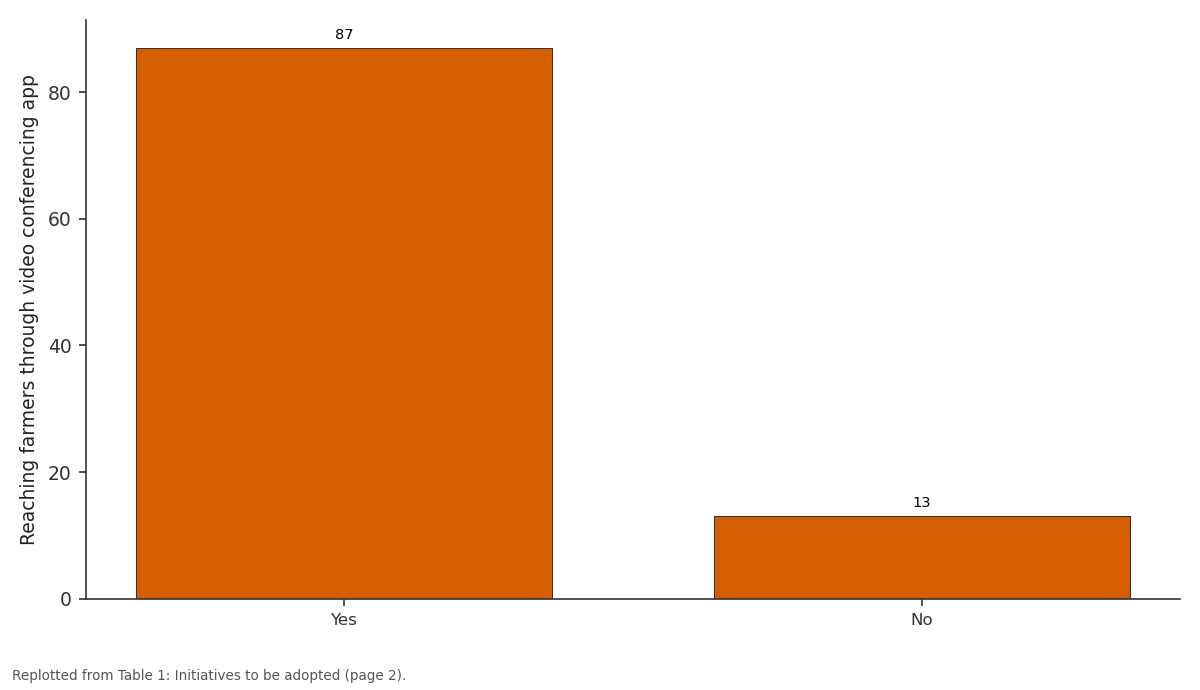
Reaching farmers through video conferencing...: Yes vs No
Replotted from Table 1 (page 2) of the original paper. Every bar is the paper's own table value.
View source evidence ↗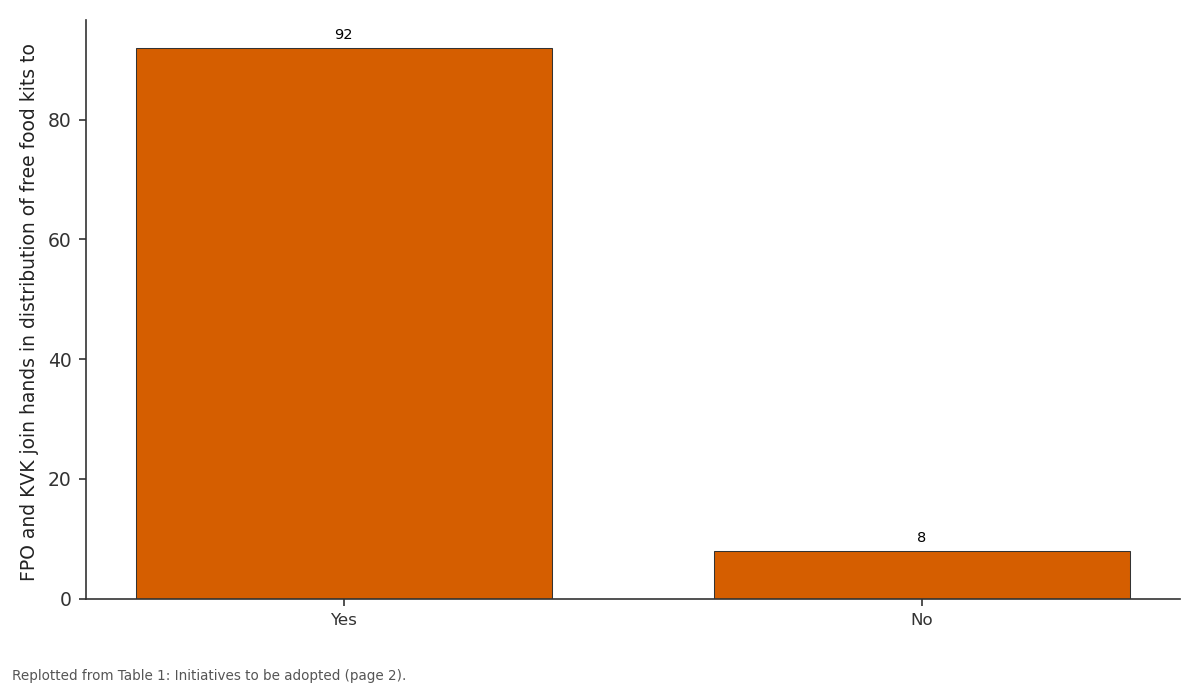
FPO and KVK join hands in distribution of...: Yes vs No
Replotted from Table 1 (page 2) of the original paper. Every bar is the paper's own table value.
View source evidence ↗Figures & tables
From the original paper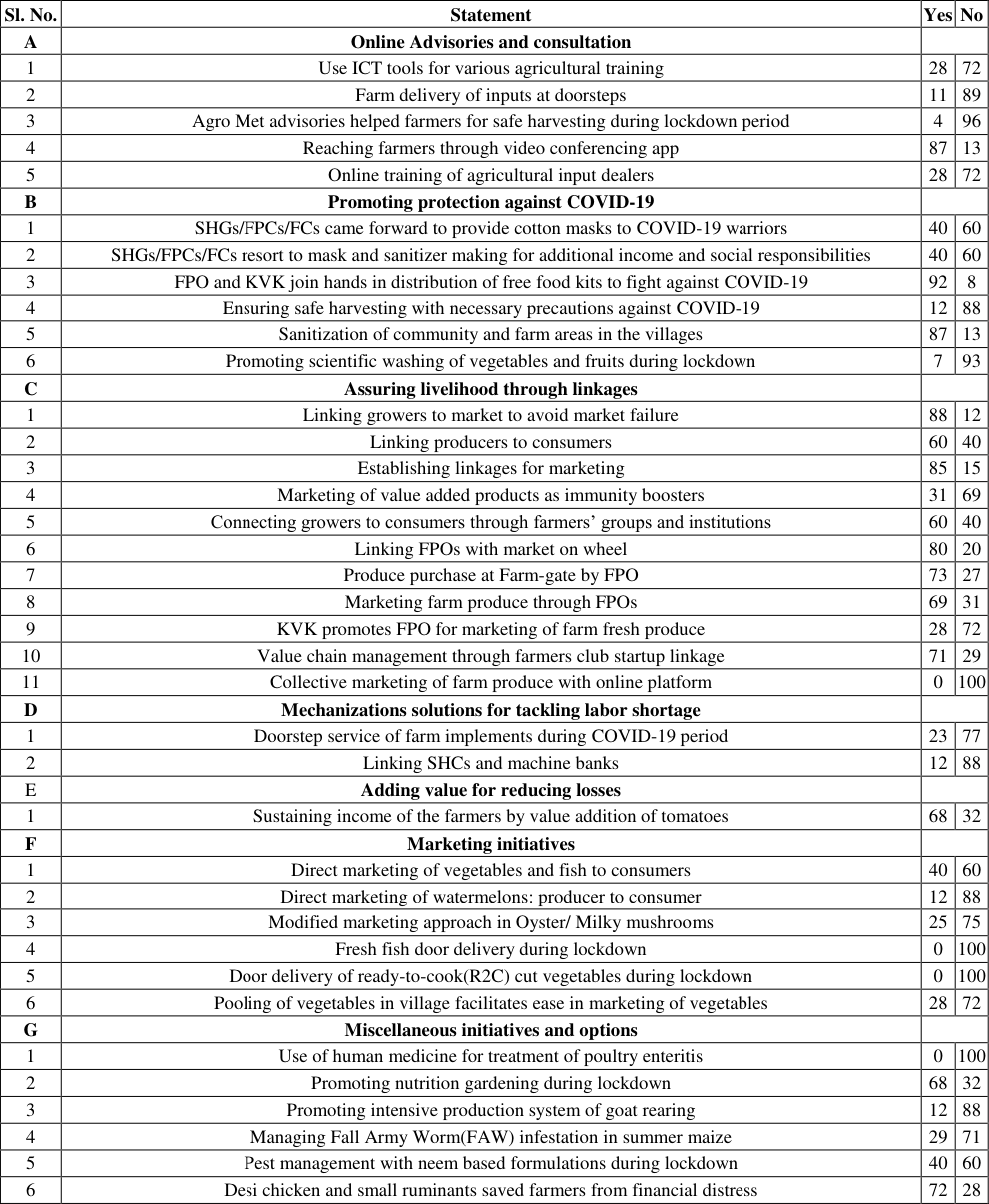 Table 1
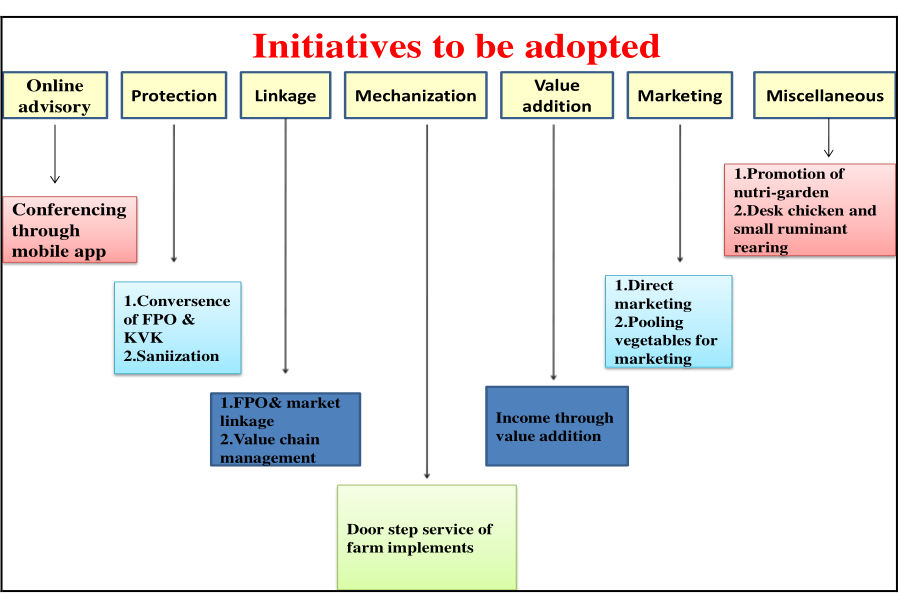 Figure 1
Introduction
The unique SARS-CoV-2 virus, also known as coronavirus 2019 (COVID-19), has recently spread, and it has turned into one of the worst pandemic scenarios in the last century (Dhama et al., 2020a, Dhama et al., 2020b, Sohrabi et al., 2020) [6,5,10] . Lockdowns on entire communities have been implemented globally to slow the disease's spread. This has disrupted economic activity and forced quick policy adjustments to lessen the pandemic's negative health effects (Ayittey et al., 2020; Bhagavathula et al., 2020, Chatterjee et al., 2020; Kumar et al., 2020c; Singh et al., 2020a) [1,2,13,7] . Owing to widespread COVID-19 mitigating measures at the national level, the exceptional circumstances that have undoubtedly overshadowed the direct effects of the virus have severely impacted economic activities related to farming systems in India as well as farmers throughout South Asia (Mahendra Dev, 2020; Pothan et al., 2020, Vardhan et al., 2022) [4,8,11] . For instance, the shutdown in India has essentially stopped transportation, which has decreased harvests and harmed food security. At the height of the spring harvest, products frequently did not make it to the "mandis" or rural marketplaces, seriously upsetting regular supply lines. India experienced hardest hit from it being an agriculturally dependent economy (Vardhan et al., 2022a) [12] . The lack of migrant labourers in the agricultural sector has also impacted planting, harvesting, and post-harvest activities (Pothan et al., 2020) [8] . In order to identify and describe the various multi-level implications of the COVID-19 lockdown and related effects on agricultural systems in the district of Cooch Behar, West Bengal, India, we present quantitative and qualitative data from the ground level in this paper. We also take into account the related emergency responses of the Indian federal government and state governments. Given the current circumstances, India's agricultural industry may not develop for many years or may develop in a way that is inconsistent with the Sustainable Development Goals (SDGs). Alternatively, lessons learned from coping with COVID-19 could potentially spark the development of more robust supply chains. Against this background, we argue that the development of sustainable agro-policies and decision-making in response to the prevention of future pandemics urgently needs to be rooted in lessons learned from the current COVID-19 pandemic.
Research Methodology
The present study was conducted in Cooch Behar-I and Cooch Behar-II blocks of Cooch Behar district in West Bengal. The purposive and random sampling techniques were followed in case of selecting the areas and respondents of the present study. The state West Bengal and Cooch Behar district were selected purposively. The Cooch Behar-I and Cooch Behar-II block from selected district were selected randomly with the help of simple random sampling procedure. The Paschim Ghugumari and Hawargadi villages were selected from Cooch Behar-I block and Chattisingh Mari and Dakshin Kalarayer Kuthi villages were selected from Cooch Behar-II block randomly. From each village 25 numbers of respondents were selected randomly. In this way total 100 numbers of respondents in the study area chosen as a sample for this study. The identified initiatives which can be adopted to make the agriculture and allied sector more resilient and vibrant are establishing provision of online advisory services through virtual conferencing with the help of some smart phone applications, convergence of KVK and FPO activities at the grass root level to provide technical backstopping along with timely critical input supply, proper management of appropriate agricultural product based value chain by establishing a strong linkage with FPO and market, ensuring the door step service of farm implements for mechanized farming due to restriction of human movement during pandemic, ensuring income through off farm product and value added on farm product, direct marketing of agricultural produce from producer to consumer, vegetables may be accumulated and sell in the market, nutria garden concept may be promoted to supply the nutrition during pandemic, rearing of deshi chicken and ruminant for supplying the protein to the farm family members during the lockdown period.
Results and Discussion
Results and Discussion
Conclusion
In the present study the identified initiatives which can be adopted to make the agriculture and allied sector more resilient and vibrant are establishing provision of online advisory services through virtual conferencing with the help of some smart phone applications, convergence of KVK and FPO activities at the grass root level to provide technical backstopping along with timely critical input supply, proper management of appropriate agricultural product based value chain by establishing a strong linkage with FPO and market, ensuring the door step service of farm implements for mechanized farming due to restriction of human movement during pandemic, ensuring income through off farm product and value added on farm product, direct marketing of agricultural produce from producer to consumer, vegetables may be accumulated and sell in the market, nutri garden concept may be promoted to supply the nutrition during pandemic, rearing of deshi chicken and ruminant for supplying the protein to the farm family members during the lockdown period.
Figures and tables from the paper
| Sl. No. | Statement | Yes | No |
|---|---|---|---|
| A | Online Advisories and consultation | ||
| 1 | Use ICT tools for various agricultural training | 28 | 72 |
| 2 | Farm delivery of inputs at doorsteps | 11 | 89 |
| 3 | Agro Met advisories helped farmers for safe harvesting during lockdown period | 4 | 96 |
| 4 | Reaching farmers through video conferencing app | 87 | 13 |
| 5 | Online training of agricultural input dealers | 28 | 72 |
| B | Promoting protection against COVID-19 | ||
| 1 | SHGs/FPCs/FCs came forward to provide cotton masks to COVID-19 warriors | 40 | 60 |
| 2 | SHGs/FPCs/FCs resort to mask and sanitizer making for additional income and social responsibilities | 40 | 60 |
| 3 | FPO and KVK join hands in distribution of free food kits to fight against COVID-19 | 92 | 8 |
| 4 | Ensuring safe harvesting with necessary precautions against COVID-19 | 12 | 88 |
| 5 | Sanitization of community and farm areas in the villages | 87 | 13 |
| 6 | Promoting scientific washing of vegetables and fruits during lockdown | 7 | 93 |
| C | Assuring livelihood through linkages | ||
| 1 | Linking growers to market to avoid market failure | 88 | 12 |
| 2 | Linking producers to consumers | 60 | 40 |
| 3 | Establishing linkages for marketing | 85 | 15 |
| 4 | Marketing of value added products as immunity boosters | 31 | 69 |
| 5 | Connecting growers to consumers through farmers’ groups and institutions | 60 | 40 |
| 6 | Linking FPOs with market on wheel | 80 | 20 |
| 7 | Produce purchase at Farm-gate by FPO | 73 | 27 |
| 8 | Marketing farm produce through FPOs | 69 | 31 |
| 9 | KVK promotes FPO for marketing of farm fresh produce | 28 | 72 |
| 10 | Value chain management through farmers club startup linkage | 71 | 29 |
| 11 | Collective marketing of farm produce with online platform | 0 | 100 |
| D | Mechanizations solutions for tackling labor shortage | ||
| 1 | Doorstep service of farm implements during COVID-19 period | 23 | 77 |
| 2 | Linking SHCs and machine banks | 12 | 88 |
| E | Adding value for reducing losses | ||
| 1 | Sustaining income of the farmers by value addition of tomatoes | 68 | 32 |
| F | Marketing initiatives | ||
| 1 | Direct marketing of vegetables and fish to consumers | 40 | 60 |
| 2 | Direct marketing of watermelons: producer to consumer | 12 | 88 |
| 3 | Modified marketing approach in Oyster/ Milky mushrooms | 25 | 75 |
| 4 | Fresh fish door delivery during lockdown | 0 | 100 |
| 5 | Door delivery of ready-to-cook(R2C) cut vegetables during lockdown | 0 | 100 |
| 6 | Pooling of vegetables in village facilitates ease in marketing of vegetables | 28 | 72 |
| G | Miscellaneous initiatives and options | ||
| 1 | Use of human medicine for treatment of poultry enteritis | 0 | 100 |
| 2 | Promoting nutrition gardening during lockdown | 68 | 32 |
| 3 | Promoting intensive production system of goat rearing | 12 | 88 |
| 4 | Managing Fall Army Worm(FAW) infestation in summer maize | 29 | 71 |
| 5 | Pest management with neem based formulations during lockdown | 40 | 60 |
| 6 | Desi chicken and small ruminants saved farmers from financial distress | 72 | 28 |
Table text extracted from the original PDF; superscript letters are shown inline. The original table image is below.
View original table image
References
11 in the original paper- Ayittey FK, Ayittey MK, Chiwero NB, Kamasah JS, Dzuvor C. Economic impacts of Wuhan 2019-nCoV on China and the world. 2020.
- Bhagavathula AS, Rahmani J, Aldhaleei WA, Kumar P, Rovetta A. Global, Regional and National Incidence and Case-fatality rates of Novel Coronavirus (COVID-19) across 154 countries and territories: A systematic assessment of cases reported from January to March 16, 2020. MedRxiv. 2020.
- Saravanabavan V, Vinothini C, Balaji D, Manna A, Mohan A, Rajesh A. A geo-spatial approach on COVID-19 mortality in Tamil Nadu. Int. J Geogr Geol. Environ 2022;4(1):123-131.
- Dev SM, Sengupta R. COVID-19: Impact on the Indian economy. Indira Gandhi Institute of Development Research, Mumbai. April 2020.
- Dhama K, Patel SK, Pathak M, Yatoo MI, Tiwari R, Malik YS, Singh R, Sah R, Rabaan AA, Bonilla-Aldana DK, Rodriguez-Morales AJ. An update on SARS-COV2/COVID-19 with Particular Reference on its Clinical Pathology, Pathogenesis, Immunopathology and Mitigation Strategies-A Review. Preprints. 2020. p. 2020030348.
- Dhama K, Sharun K, Tiwari R, Sircar S, Bhat S, Malik YS, Singh KP, Chaicumpa W, Bonilla-Aldana DK, RodriguezMorales AJ. Coronavirus Disease 2019 -COVID-19. Preprints. 2020a. 2020030001.
- Kumar P, Kalita H, Patairiya S, Sharma YD, Nanda C, Rani M, Rahmani J, Bhagavathula AS. Forecasting the dynamics of COVID-19 pandemic in top 15 countries in April 2020: ARIMA model with machine learning approach. medRxiv. 2020.
- Pothan PE, Taguchi M, Santini G. Local food systems and COVID-19. In: A Glimpse on India's Responses. Rome (Online); 2020.
- Sohrabi C, Alsafi Z, O'neill N, Khan M, Kerwan A, Al-Jabir A, et al. World Health Organization declares global emergency: A review of the 2019 novel coronavirus (COVID-19). Int J Surg. 2020;76:71-76.
- Vardhan PNH, Pal PK, Roy D, Mondal S. Study on Biophysical Impact by Adoption of Climate Resilient Technologies in Agriculture. Biol Forum -An Int J. 2022;14(1):1179-1183.
- Chatterjee P, Nagi N, Agarwal A, Das B, Banerjee S, Sarkar S, Gupta N, Gangakhedkar RR. The 2019 novel coronavirus disease (COVID-19) pandemic: a review of the current evidence. Indian J Med Res. 2020.