
Research article · 2024 · Full text
International Journal of Agriculture Extension and Social DevelopmentEvaluating the varied economic traits of Kamrupa chickens in backyard rearing systems of Assam
Volume 7(3S) · Pages 110–112 · DOI: 10.33545/26180723.2024.v7.i3sb.406 ↗
Research areasAgricultural Economics and PracticesLivestock Management and Performance ImprovementAgricultural Systems and Practices
Abstract
Author-writtenKamrupa, a dual-type, high-yielding chicken breed developed through the efforts of the AICRP on Poultry Breeding at AAU, Khanapara, has been successfully introduced across various regions of the North East. However, comprehensive studies regarding the productive and reproductive performance of Kamrupa chickens under the backyard rearing system in Assam are exceedingly limited. With this gap in mind, the current research aims to evaluate the economic characteristics of Kamrupa chickens within the context of the backyard rearing system in Assam. The study encompassed a range of parameters, including body weights at various stages (day old, 5, 20, 40, 52, and 72 weeks), age at initial egg laying, egg production up to 40, 52, and 72 weeks, egg weights at 32, 40, 52, and 72 weeks, age at sexual maturity, carcass attributes, egg quality traits, fertility, and hatchability. Analysis of the data revealed that the average body weights for Kamrupa chickens were as follows: 36.59±2.45 (day old), 218.25±28.95 (5 weeks), 1045.19±31.02 (20 weeks), 1721.56±41.57 (40 weeks), 1756.57±43.31 (52 weeks), and 2045.65±59.26 (72 weeks). Egg production data highlighted that Kamrupa chickens yielded 42.34±2.96, 83.56±5.96, and 143.45±8.69 eggs up to 40, 52, and 72 weeks, respectively. In conclusion, the study implies that Kamrupa chickens exhibit superior performance in terms of body weight, egg production, and various other traits when reared under the backyard system in Assam.
Summary
Source-checkedPlain-language reading of the full paper, prepared with AI and checked against the text. Each point links to the authors' own words.
Why it matters
- Poultry farming is a traditional practice in Assam that provides rural communities with supplementary income. View evidence ↗
- Native indigenous chickens in the region have limited productivity and modest yields because of genetic constraints. View evidence ↗
- The Kamrupa chicken is a high-yielding, dual-purpose breed developed by the AICRP on Poultry Breeding to improve productivity in the North East. View evidence ↗
The question
- The study aims to evaluate the economic traits of Kamrupa chickens when raised in backyard systems in Assam. View evidence ↗
What they did
- The research examined 200 unsexed day-old Kamrupa chicks and 200 indigenous chicks. View evidence ↗
- Body weights were measured at six specific intervals: day old, 5, 20, 40, 52, and 72 weeks of age. View evidence ↗
- The researchers tracked the age of first egg laying, egg production totals up to 72 weeks, and egg weights at four different time points. View evidence ↗
What they found
- Kamrupa chickens showed steady weight gain, starting at 36.59±2.45g (day old) and reaching 2045.65±59.26g by the 72nd week. View evidence ↗
What it means
- The authors conclude that Kamrupa chickens perform significantly better than indigenous birds in terms of body weight and egg production in backyard systems. View evidence ↗
- The authors recommend Kamrupa chickens as a viable option for rural and tribal farmers in Assam to improve their nutrition and income. View evidence ↗
Visual summary
1 visualsIllustrations explain the paper; charts are replotted from the paper's own table values.
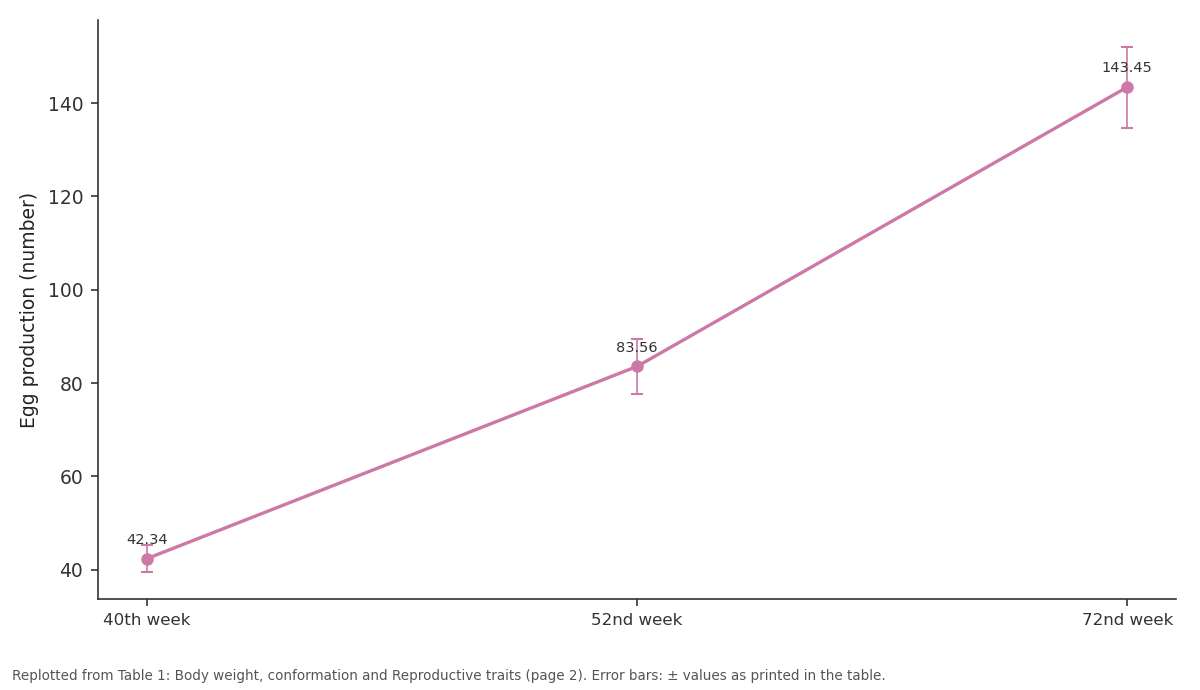
Kamrupa: 40th week vs 52nd week vs 72nd week
Replotted from Table 1 (page 2) of the original paper. Every bar is the paper's own table value.
View source evidence ↗Figures & tables
From the original paper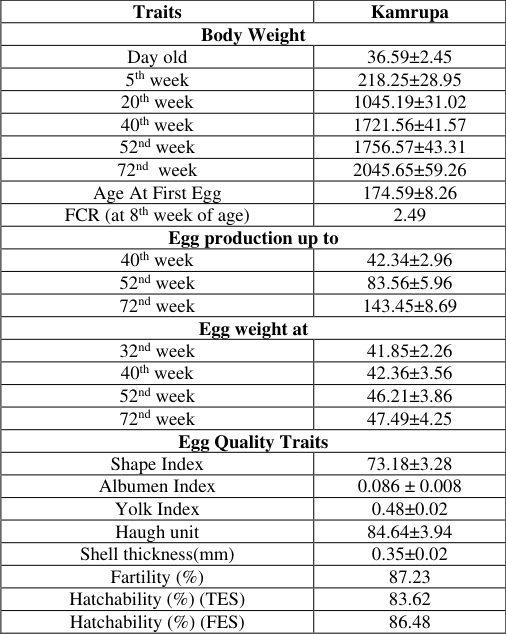 Table 1
Introduction
The people of Assam have a longstanding tradition of engaging in poultry farming, a practice deeply rooted in their history. This practice holds significant importance for their nutritional sustenance and livelihood security, a tradition that has been upheld for countless generations. Poultry rearing, specifically, serves as a supplementary income source for rural communities. A notable proportion of farmers maintain a modest flock of 10 to 15 indigenous fowls, characterized by their low resource requirements, within their residential spaces. This practice serves a dual purpose of producing both eggs and meat, contributing to their day-to-day financial needs and nutritional well-being, as documented by Islam et al. (2014) [4] . Conversely, the native indigenous fowls exhibit notably limited productivity due to their inherent genetic constraints, resulting in modest yields. A promising solution to this challenge has been the development of Kamrupa, a dual-purpose, high-yield chicken breed. Borne out of the efforts of the AICRP on Poultry Breeding at AAU, Khanapara, this breed has made successful inroads into various regions of the North East. Particularly noteworthy is Kamrupa's ability to showcase commendable levels of both productive and reproductive performance when managed within a backyard system. However, a notable gap exists in our understanding of the systematic performance of Kamrupa chickens under backyard management in Assam. Recognizing this knowledge void, the current research endeavors to comprehensively evaluate the various economic traits associated with Kamrupa chickens raised in a backyard rearing setup within the context of Assam.
Materials and Methods
The research was carried out within the geographical bounds of Kamrup district in Assam. A comprehensive examination involving 200 unsexed day-old Kamrupa chicks and an equivalent number of indigenous chicks was undertaken. These chicks were procured from the hatchery managed by the AICRP on Poultry Breeding at AAU, Khanapara. Subsequently, the chicks were raised under hover brooders for duration of 21 days. During this critical brooding phase, the chicks had access to an ample supply of clean drinking water and were provided with commercial broiler starter feed on an ad libitum basis. Following the successful brooding period, the chicks were then distributed amongst 10 skilled farmers. Each of these farmers received 20 Kamrupa chicks. The selection of these farmers was executed through a randomized process. The criterion for farmer selection was that they should have already been maintaining a minimum of 10 indigenous chickens of varying ages within a backyard setting. Upon completion of the brooding period, the chickens were released into the backyard environment, where their diet was supplemented with Rice, rice polish, wheat, Maize and other natural www.extensionjournal.com sources of nourishment. The birds were also subjected to vaccinations against Marek's, Ranikhet, Gumboro, and Fowl pox diseases. The vaccination process adhered to established protocols. Various data points were meticulously recorded throughout the study period. This included observations of body weights at key timeframes -Day old, 5 weeks, 20 weeks, 40 weeks, 52 weeks, and 72 weeks of age. Additionally, age at first egg laying, egg production up to the 40th, 52nd, and 72nd week, and egg weights at the 32nd, 40th, 52nd, and 72nd week were documented. A detailed assessment of egg quality attributes was conducted using 120 collected eggs. The age at which sexual maturity was attained was identified as the point when 50% of the pullets commenced laying eggs. The collected data pertaining to various traits underwent rigorous analysis utilizing established statistical methods as outlined by Snedecor and Cochran (1994) [12] .
Results and Discussions
The average body weights at various ages -0, 5, 20, 40, 52, and 72 weeks -were meticulously recorded. Specifically, for Kamrupa, the weights were noted as 36.59±2. 45 [14] in Nagaland, who noted analogous findings with Vanaraja birds under an extensive management system. Moving on to egg production, Kamrupa demonstrated considerable output up to 40, 52, and 72 weeks of age, with figures recorded as 42.34±2.96, 83.56±5.96, and 143.45±8.69 respectively. (as illustrated in Table 1). This concurs with the findings of Chutia (2010) [1] , who reported an overall mean annual egg production range of indigenous chickens in Assam from 53.8±0.23 to 58.4±0.26. Conversely, Kumaresan et al. (2008) [9] reported a notably higher annual egg production figure of 176±9 for Vanaraja birds reared in a backyard setting. The mean egg weights were documented at 32, 40, 52, and 72 weeks of age and are presented in Table 1. This observation aligns with the findings of Haunshi et al. (2009) [3] , who reported a similar egg weight of 38.67g±0.31 in the Miri breed of chickens. Likewise, Kalita et al. (2011) [5] documented an average egg weight of 35.27±0.15g in the case of indigenous chickens in Assam. The fertility rates of Kamrupa chickens reared under a backyard system in Assam were determined to be 91.10±2.30%. These findings align with the research conducted by Saikia et al. (2017) [13] , who reported similar results in Vanaraja and Indigenous chickens of Assam. Examining hatchability percentages, Kamrupa recorded 83.62%, on a total egg set basis, and 86.48% on a fertile egg set basis. Saikia et al. (2017) [13] also reported higher percentages of hatchability on a total egg set basis (88.52±3.95% and 86.14±3.26%) in indigenous and Vanaraja chickens of Assam, aligning closely with the present study. In contrast, Kumer et al. (2005) [8] reported a lower hatchability rate of 72.6% in Vanaraja birds under a traditional rearing system. The egg shape index was determined to be 73.18±3.28% for Kamrupa chickens. Similarly, Niranjan et al. (2008) [10] estimated a shape index of 76.10 at 32 weeks of age in Vanaraja birds. Consistent with the current study, Kalita et al. (2012a) [6] found analogous results in indigenous chickens of Assam. Observed shape indices of 73.77±3.08 and 72.62±7.56 for two strains of white Leghorn chickens. The albumin index measured 0.086±0.008 for Kamrupa. Haunchi et al. (2009) [3] suggested that improved varieties tend to have higher average albumin and yolk index (%) values compared to indigenous breeds. In the present study, the yolk index, Haugh unit, and shell thickness were measured as 0.48±0.02, 84.64±3.94 and 0.35±0.02.
| Traits | Kamrupa |
|---|---|
| Body Weight | |
| Day old | 36.59±2.45 |
| 5th week | 218.25±28.95 |
| 20th week | 1045.19±31.02 |
| 40th week | 1721.56±41.57 |
| 52nd week | 1756.57±43.31 |
| 72nd week | 2045.65±59.26 |
| Age At First Egg | 174.59±8.26 |
| FCR (at 8th week of age) | 2.49 |
| Egg production up to | |
| 40th week | 42.34±2.96 |
| 52nd week | 83.56±5.96 |
| 72nd week | 143.45±8.69 |
| Egg weight at | |
| 32nd week | 41.85±2.26 |
| 40th week | 42.36±3.56 |
| 52nd week | 46.21±3.86 |
| 72nd week | 47.49±4.25 |
| Egg Quality Traits | |
| Shape Index | 73.18±3.28 |
| Albumen Index | 0.086 ± 0.008 |
| Yolk Index | 0.48±0.02 |
| Haugh unit | 84.64±3.94 |
| Shell thickness(mm) | 0.35±0.02 |
| Fartility (%) | 87.23 |
| Hatchability (%) (TES) | 83.62 |
| Hatchability (%) (FES) | 86.48 |
Table text extracted from the original PDF; superscript letters are shown inline. The original table image is below.
View original table image
Conclusion
To draw a comprehensive conclusion, the Kamrupa chicken stands out with a notably superior performance compared to the indigenous bird across multiple facets including body weight, egg production, and various other traits. Particularly, this advantageous performance is evident within the context of a backyard rearing system when contrasted with the indigenous breed of Assam. The implications of these findings are noteworthy, especially for farmers hailing from the rural and tribal regions of Assam.
Given the heightened performance of the Kamrupa chicken, it emerges as a compelling option for these farmers seeking to bolster both their livelihoods and nutritional security. By opting to rear Kamrupa birds, these farmers can potentially www.extensionjournal.com tap into a more productive and reliable source of income, along with a consistent supply of nutritious eggs. This choice aligns well with the specific challenges faced in these regions, offering a practical solution that could contribute significantly to the economic and dietary well-being of the farming communities.
In essence, the research underscores the potential benefits of integrating Kamrupa chickens into the rearing practices of rural and tribal farmers in Assam. The superior attributes of Kamrupa chickens, particularly in terms of body weight, egg production, and overall performance, indicate a promising avenue for enhancing the livelihoods and nutritional security of these communities.
Acknowledgement
AcknowledgementThe authors gratefully acknowledge the essential support provided by ICAR. Additionally, heartfelt thanks are extended to all the personnel at AICRP on poultry breeding, Khanapara, for their valuable assistance
References
7 in the original paper- Haunshi S, Doley S, Shakuntala I. Production performance of indigenous chicken of northeastern region and improved varieties developed for backyard farming. The Indian Journal of Animal Sciences. 2009;79:901-905.
- Islam R, Kalita N, Nath P. Comparative performance of Vanaraja and Indigenous chicken under the backyard system of rearing. Journal of Poultry Science and Technology. January-March. 2014;2(1):22-25.
- Kalita N, Barua N, Chutia H, Islam R, Pathak N, Kalita R. Egg quality and carcass characteristics of Vanaraja and Indigenous chicken reared under intensive system. Indian Veterinary Journal. 2011;88:66-68.
- Kumaresan A, Bujarbaruah KM, Pathak KA, Chhetri B, Ahmed SK, Haunshi S. Analysis of a village chicken production system and performance of improved dualpurpose chickens under a subtropical hill agroecosystem in India. Tropical Animal Health and Production. 2008;40:395-402.
- Niranjan M, Sharma RP, Rajkumar U, Reddy BLN, Chatterjee RN, Bhattacharya TK. Comparative evaluation of production performance in improved chicken varieties for backyard farming. International Journal of Poultry Science. 2008;7:1128-1131.
- Ramana DBV, Nirmala G, Maruthi V, Rao GR. Performance of Vanaraja as backyard poultry. Indian Veterinary Journal. 2010;87:517-518.
- Saikia AK, Gogoi G, Neog M. Productive and Reproductive Performance of Vanaraja Birds Reared by Tribal Community of Dhemaji District of Assam. J Krishi Vigyan. 2017;6(1):162-165.
Cited by 1
From OpenAlex, OpenCitations and reference lists read by Scinovex
- Performance of Kamrupa Birds reared in Machang type and deep litter housing in flood prone areas of Dhubri district of Assam, India
FUA Ahmed, Mustafizur Rahman, Khanin Pathak, Dibyarishi Bhattacharjya, Samsun Neher, Abhijit Paul · International Journal of Agriculture Extension and Social Development · 2026
As an intervention measure to mitigate the effect of flood on small scale poultry production, an elevated stilt housing (Machang type house) was introduced to rear Kamrupa birds. Kamrupa is a dual purpose multi-coloured dual purpose bird suitable for backyard poultry developed by Assam Agricultural University. For the study, two flood prone villages namely Sreegram and Udmari of Dhubri district was selected. Sixteen farmers from the two villages were chosen and distributed with 320 Kamrupa day old chicks where each farmer received 20 day old chicks. Out of total sixteen farmers eight farmers w