
Research article · 2024 · Full text
International Journal of Research in AgronomyEffect of zeolite and potassium application on nutrient uptake and potassium use efficiency of maize
Volume 7(3) · Pages 101–105 · DOI: 10.33545/2618060x.2024.v7.i3b.396 ↗
Research areasCrop Yield and Soil Fertility
Abstract
Author-writtenThe present investigation was undertaken to study the effect of zeolite and potassium application on nutrient uptake andpotassium use efficiency of maize. The field experiment was conducted at Post Graduate Institute, Research Farm, Department of Soil Science and Agricultural Chemistry, M.P.K.V., Rahuri, during of summer 2022. The experimental site was medium deep black, clayey in texture, having a bulk density of 1.35 Mg m-3, particle density of 2.65 Mg m-3, slightly alkaline in reaction, low in electrical conductivity and medium in organic carbon and calcium carbonate content. The soil was low in available Nitrogen, medium in phosphorus and very high in potassium content. However, soils were sufficient in available micronutrients viz., Fe, Mn, Zn and Cu. The experiment was laid out in a randomized block design with ten treatments and three replications. The treatments were T1: Absolute control, T2: GRDF 120:60:40 N, P2O5, K2O + 10 t FYM ha-1, T3: Zeolite @ 400 kg ha-1, T4: Zeolite @ 600 kg ha-1, T5: Zeolite @ 400 kg ha-1 + 50% K2O of RDF (20 kg ha-1), T6: Zeolite @ 400 kg ha-1 + 75% K2O of RDF (30 kg ha-1), T7: Zeolite @ 400 kg ha-1 + 100% K2O of RDF (40 kg ha-1), T8: Zeolite @ 600 kg ha-1 + 50% K2O of RDF (20 kg ha-1), T9: Zeolite @ 600 kg ha-1 + 75% K2O of RDF (30 kg ha-1), T10: Zeolite @ 600 kg ha-1 + 100% K2O of RDF (40 kg ha-1). The recommended doses of N and P2O5 and FYM @ 10 t ha-1 are the same for all treatments as per RDF except T1. The Application of zeolite @ 600 kg ha-1 along with the RDF, that is treatment T10 showed significantly highest grain yield (83.22 q ha-1), stover yield (52.89 q ha-1), cob weight (84.22 q ha-1), seed index (38.28 gm) and number of grains per cob (722) over the rest of treatments except T9 i.e., zeolite @ 600 kg ha-1+ 75% K2O of RDF which was statistically at par. The total uptake of N, P, K and micronutrients (Fe, Mn, Zn, Cu) by maize was significantly influenced by the different levels of zeolite and potassium application after harvest of maize. Significantly, the highest uptake of N, P and K (213.30, 23.16 and 140.24 kg ha-1 respectively) and Fe, Mn, Zn and Cu (2548.83, 1210.53, 913.27 and 141.87 mg kg-1 respectively) was observed in the treatment T10 i.e., zeolite @ 600 +100% K2O of RDF (40 kg ha-1) over rest of treatments except T9 i.e., zeolite @ 600 kg ha-1+ 75% K2O of RDF which was statistically at par with T10 in respect to nitrogen and phosphorous but in case of potassium treatment T7 i.e., zeolite @400 kg ha-1 along with RDF is found to be statistically at par with treatment T10. Application of zeolite to hybrid maize found beneficial for increase in nutrient uptake of maize.
Summary
Source-checkedPlain-language reading of the full paper, prepared with AI and checked against the text. Each point links to the authors' own words.
Why it matters
- Maize is a globally significant cereal crop, often called the 'Queen of cereal crops' due to its high potential for grain yield. View evidence ↗
- Potassium is a critical nutrient for maize production because the crop requires and absorbs it in high quantities. View evidence ↗
- Zeolites can act as nutrient sources and regulators for mineral fertilizers, potentially increasing the efficiency of nitrogen and potassium use. View evidence ↗
The question
- The study aimed to evaluate how applying zeolite and potassium affects the nutrient uptake and potassium use efficiency of maize. View evidence ↗
What they did
- The field experiment took place during the summer of 2022 at the PGI Research Farm in Rahuri. View evidence ↗
- The researchers used a randomized block design consisting of ten different treatments, each with three replications. View evidence ↗
- Treatments ranged from an absolute control (T1) to combinations of zeolite (400 or 600 kg ha-1) and varying levels of potassium (50%, 75%, or 100% of the recommended dose). View evidence ↗
- Nutrient concentrations for nitrogen, phosphorus, potassium, and micronutrients (Fe, Zn, Mn, Cu) were estimated from digested, oven-dried whole plant samples. View evidence ↗
What they found
- The highest nitrogen uptake was 213.30 kg ha-1 in treatment T10, which was statistically comparable to T9 (207.83 kg ha-1). View evidence ↗
- Phosphorus uptake peaked at 23.16 kg ha-1 in treatment T10, with T9 (22.20 kg ha-1) showing a statistically similar result. View evidence ↗
- The highest potassium uptake was 140.24 kg ha-1 in T10, which was statistically at par with T7 (138.16 kg ha-1). View evidence ↗
- Treatment T10 resulted in the highest uptake of micronutrients: Fe (2548.23 g ha-1), Mn (1210.53 g ha-1), Zn (913.27 g ha-1), and Cu (141.87 g ha-1). View evidence ↗
- Potassium use efficiency was highest in T10 at 92.50%, which was statistically similar to T9 (91.66%). View evidence ↗
- The lowest potassium use efficiency (65.50%) occurred in treatment T2, which received the recommended dose of fertilizer but no zeolite. View evidence ↗
What it means
- The authors conclude that applying 600 kg ha-1 of zeolite with the recommended dose of fertilizer increases nutrient uptake and potassium use efficiency in medium black soils. View evidence ↗
- The authors note that T9, which reduced the potassium dose by 25%, performed statistically similarly to the full dose treatment. View evidence ↗
Visual summary
3 visualsIllustrations explain the paper; charts are replotted from the paper's own table values.
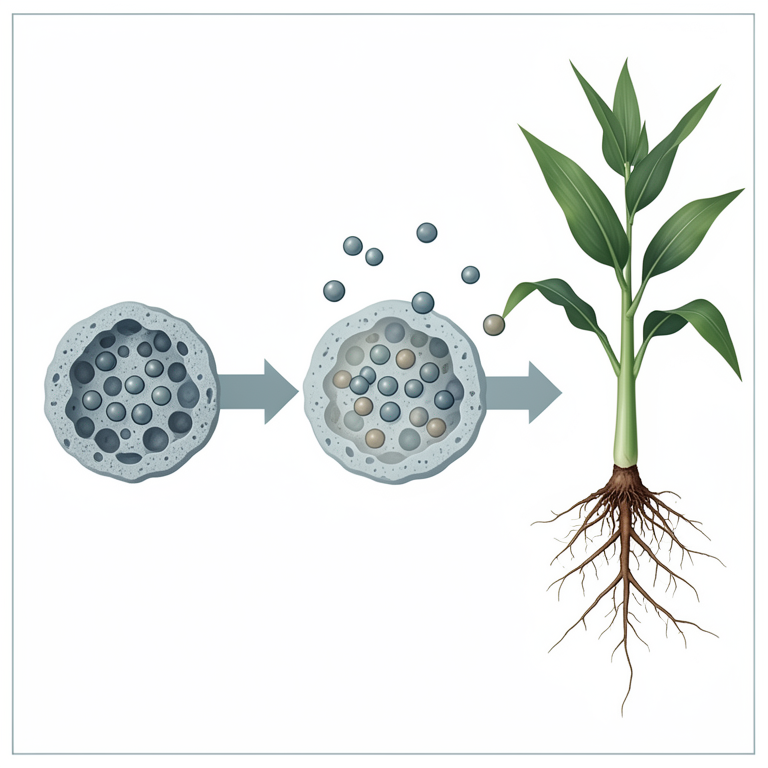
Zeolite as a Nutrient Regulator
AI-generated conceptual illustration (maize plants in soil with zeolite minerals). It explains the idea and does not show study data.
View source evidence ↗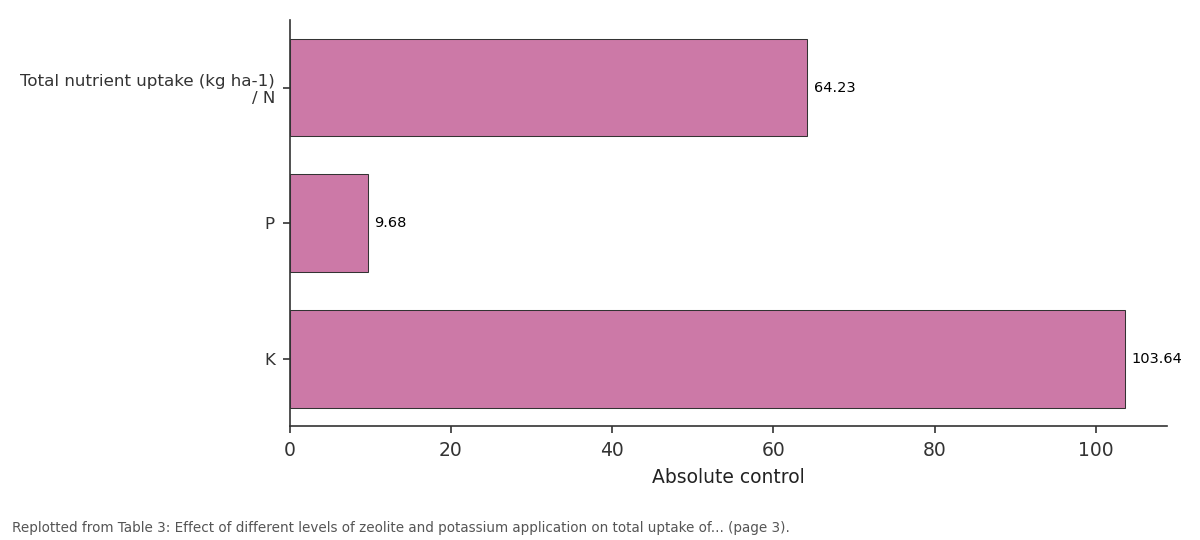
Absolute control: Total nutrient uptake... vs P vs K
Replotted from Table 3 (page 3) of the original paper. Every bar is the paper's own table value.
View source evidence ↗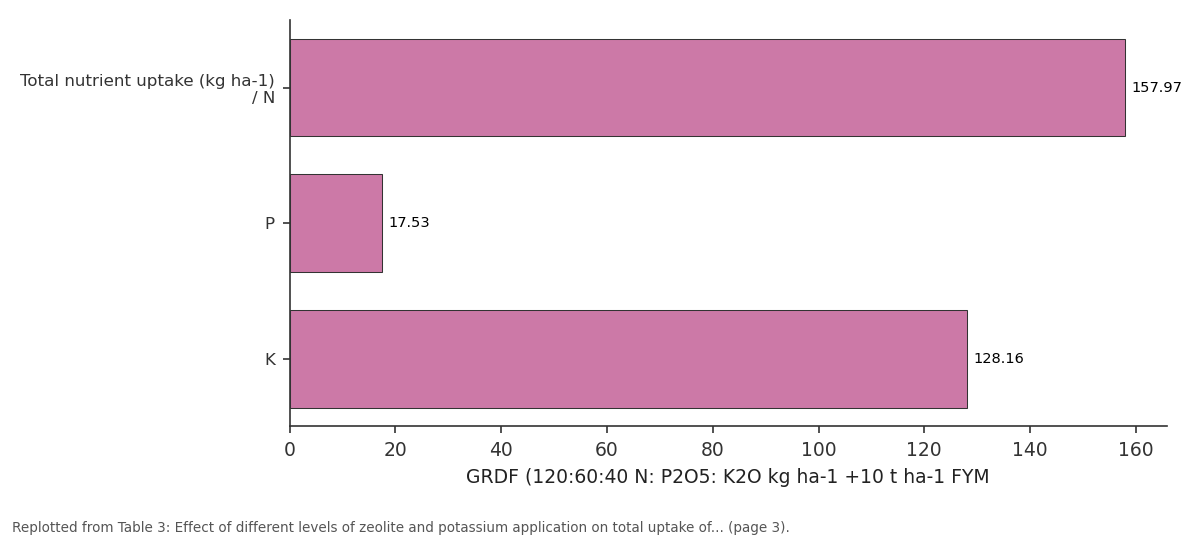
GRDF (120:60:40 N: P2O5: K2O kg ha-1 +10 t...: Total nutrient uptake... vs P vs K
Replotted from Table 3 (page 3) of the original paper. Every bar is the paper's own table value.
View source evidence ↗Figures & tables
From the original paper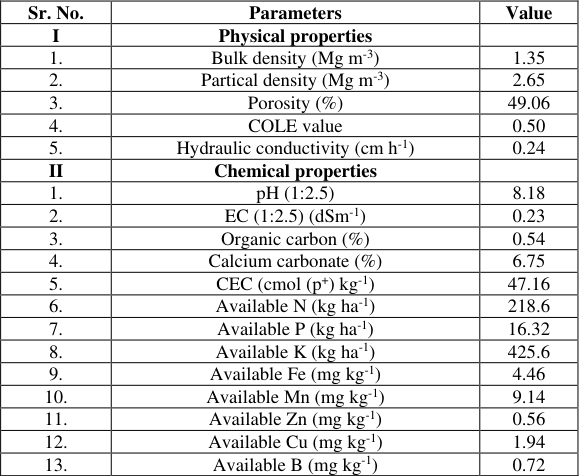 Table 1
 Table 2
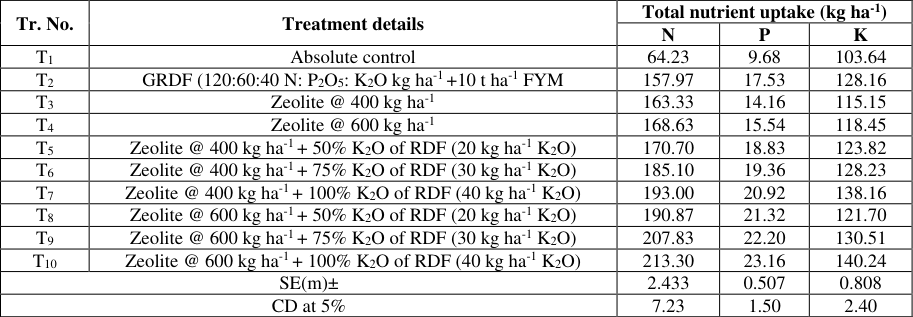 Table 3
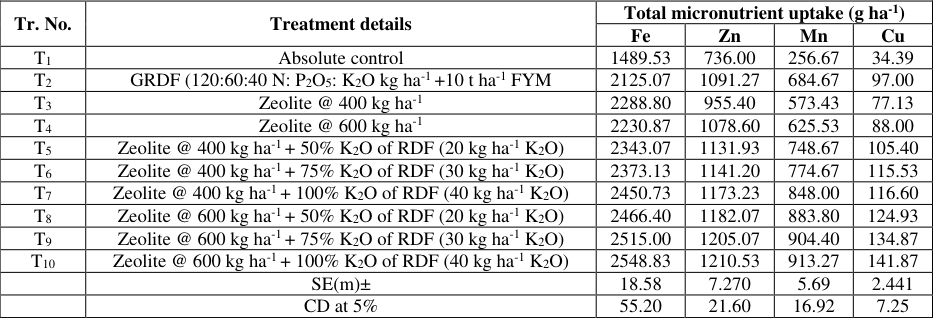 Table 4
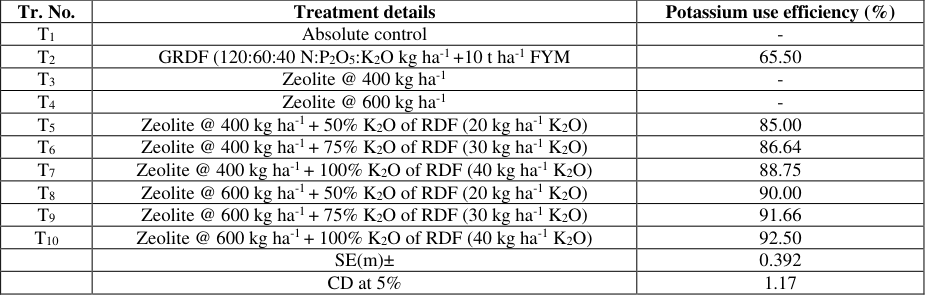 Table 5
Introduction
Maize (Zea mays L.) is an important cereal crop which belongs to the grass family with chromosome number 2n = 20. It is the world's second most widely grown crop and India's third most important cereal crop after rice and wheat. It is cultivated as a cereal grain that has been domesticated in Central America. Globally, maize is known as the "Queen of cereal crops" because of its higher grain yield potential among all the cereals. It exhibits greater adaptability as it can be grown in a variety of agro-climatic conditions. Potassium is the third major plant nutrient next to nitrogen and phosphorous with respect to crop production. The requirement for potassium in maize is high as it absorbs high quantities of potassium. It plays a significant role in enhancing crop quality, so it is recognized as a "quality element". It is associated with the movement of water, carbohydrates and nutrients in plants. About 80 different types of enzymes are stimulated by potassium (Kasana and Khan, 1976) [8] .
It plays an important role in the stomatal functioning and helps plants to grow under drought conditions (Hsiao, 1973) [5] . Insufficient potassium in plants leads to difficulty in absorbing water, which leads to an increase in drought stress. Generally, maize plants conserve water and reduce moisture stress by closing leaf stomata, which in terms are regulated by potassium. That's why plants with inadequate potassium supply may be slower in closing their stomata, which reduces drought stress. Zeolites are hydrated alumino silicate minerals made up of cross-linked tetrahedra of AlO 4 and SiO 4 , which consist of pores and corners of alumino silicate tetrahedra (AlO 4 and SiO 4 ) that are connected in three-dimensional structure of about 12 Å in diameter, connected by channels of about 8 Å diameter and made up of rings of 12 linked tetrahedron (Kaduk and Faber, 1995) [7] . Zeolites with distinct cation exchange properties, molecular sieving and adsorption (Mumpton, 1999; Glisic et al., 2009; Hecl and Toth, 2009) [13,3,4] could be used as a stabilizer, chelator and fertilizer (Loizidou and Kapetanios, 1992 and Perez-Caballero et al., 2008) [12,15] . Zeolites are excellent carriers and regulators of mineral fertilizers. Besides, they also serve as a source of nutrients. As carriers of N and K fertilizers, they can increase N and K use efficiency and decrease the application rates for equal yield to be achieved (Polat et al., 2004) [17] , zeolite enables both inorganic and organic fertilizers to slowly release their nutrients (Perez Caballero et al., 2008) [15] .
Materials and Methods
Materials and Methods
Layout and experimental design
The field experiment was conducted at PGI Research Farm, M.P.K.V., Rahuri. The soil sample was collected and analyzed at Department of Soil Science and Agricultural Chemistry, PGI, M.P.K.V., Rahuri, Dist. Ahmednagar during summer 2022. The experiment was laid out in a randomized block design with 10 treatments and 3 replications. The gross plot size was 4.50 m x 3.60 m i.e. 16.2 m 2 and net plot size was 3.0 m x 3.20 m i.e. 9.60 m 2 . The recommended spacing of 75 cm x 20 cm was adopted for dibbling of maize. The general recommended dose of nutrients (120:60:40 kg ha -1 N, P 2 O 5 and K 2 O respectively + FYM @ 10 t ha -1 ) were given to maize as per treatment details except T 1 at the time of dibbling of maize.
Soils characteristic:
The topography of experimental site was nearly uniform. Plots are prepared for sowing of maize, soils are medium black with good water holding capacity. Initial soil properties of soil before sowing are presented in table 1. Hydraulic conductivity (cm h -1 ) 0.24 II Chemical properties 1.
| Sr. No. | Parameters | Value |
|---|---|---|
| I | Physical properties | |
| 1. | Bulk density (Mg m-3) | 1.35 |
| 2. | Partical density (Mg m-3) | 2.65 |
| 3. | Porosity (%) | 49.06 |
| 4. | COLE value | 0.50 |
| 5. | Hydraulic conductivity (cm h-1) | 0.24 |
| II | Chemical properties | |
| 1. | pH (1:2.5) | 8.18 |
| 2. | EC (1:2.5) (dSm-1) | 0.23 |
| 3. | Organic carbon (%) | 0.54 |
| 4. | Calcium carbonate (%) | 6.75 |
| 5. | CEC (cmol (p+) kg-1) | 47.16 |
| 6. | Available N (kg ha-1) | 218.6 |
| 7. | Available P (kg ha-1) | 16.32 |
| 8. | Available K (kg ha-1) | 425.6 |
| 9. | Available Fe (mg kg-1) | 4.46 |
| 10. | Available Mn (mg kg-1) | 9.14 |
| 11. | Available Zn (mg kg-1) | 0.56 |
| 12. | Available Cu (mg kg-1) | 1.94 |
| 13. | Available B (mg kg-1) | 0.72 |
Table text extracted from the original PDF; superscript letters are shown inline. The original table image is below.
View original table image
EC (1:2.5) (dSm -1 ) 0.23 3.
Organic carbon (%) 0.54 4.
Calcium carbonate (%) 6.75 5.
CEC (cmol (p + ) kg -1 ) 47.16 6.
Available N (kg ha -1 ) 218.6 7.
Available P (kg ha -1 ) 16.32 8.
Available K (kg ha -1 ) 425.6 9.
Available Fe (mg kg -1 ) 4.46 10.
Available Mn (mg kg -1 ) 9.14 11.
Available Zn (mg kg -1 ) 0.56 12.
Available Cu (mg kg -1 ) 1.94 13.
Available B (mg kg -1 ) 0.72
Zeolite
Highly fine powdered zeolite purchased from Rudra Zeochem Pvt. Ltd., Nashik on the name Agripower-A-Z is a potential enriched zeolite and it is characterized for different chemical properties by standard methods. The chemical properties of zeolite are given in table 2.
| Sr. No. | Parameter | Value |
|---|---|---|
| 1. | pH (1:10) | 6.62 |
| 2. | EC (1:10) (dSm-1) | 0.09 |
| 3. | CEC (cmol (p+) kg-1) | 161 |
Table text extracted from the original PDF; superscript letters are shown inline. The original table image is below.
View original table image
Application of Zeolite and Potassium
Zeolite and Potassium as per treatment with farm yard manure @ 10 t ha -1 to all treatment plots except T 1.
The treatment comprised of T 1 : Absolute control, T 2 : GRDF 120:60:40 N, P 2 O 5 , K 2 O + 10 t FYM ha -1 , T 3 : Zeolite @ 400 kg ha -1 , T 4 : Zeolite @ 600 kg ha -1 , T 5 : Zeolite @ 400 kg ha -1 + 50% K 2 O of RDF (20 kg ha -1 ), T 6 : Zeolite @ 400 kg ha -1 + 75% K 2 O of RDF (30 kg ha -1 ), T 7 : Zeolite @ 400 kg ha -1 + 100% K 2 O of RDF (40 kg ha -1 ), T 8 : Zeolite @ 600 kg ha -1 + 50% K 2 O of RDF (20 kg ha -1 ), T 9 : Zeolite @ 600 kg ha -1 + 75% K 2 O of RDF (30 kg ha -1 ), T 10 : Zeolite @ 600 kg ha -1 + 100% K 2 O of RDF (40 kg ha -1 ).
Plant analysis
The plant samples were collected at harvest of maize. The samples were air dried in sunlight and then dried in oven at 70 0 C till constant weight obtained. The whole plant sample of each treatment was grinded through a stainless steel willey mill after oven drying. Digestion of plant samples were done and used for estimation of nutrient concentration viz., N, P, K and micronutrients Fe, Zn, Mn and Cu by using standard methods.
Total N: Micro-Kjeldahl (Parkinson and Allen 1975) [14] , Total P: Vanadomolybdate yellow colour method in nitric acid (Jackson 1973) [6] , Total K: Flame photometry (Chapman and Pratt, 1961) [2] and Total micronutrient (Fe, Mn, Zn and Cu) Atomic absorption Spectrophotometry (Zososki and Burau 1977) [20] .
Total K uptake at different treatment -Total K uptake at control treatment KUE (%) = - ------------------------------------------------------------x 100
Potassium applied through fertilizer
Results and Discussion
Effect of different levels of zeolite and potassium application on total uptake of N, P and K by maize after harvest The data regarding effect of different levels of zeolite and potassium application on total uptake of N, P and K uptake after harvest of maize are shown in table 3.
| Tr. No. | Treatment details | Total nutrient uptake (kg ha-1) | — | — |
|---|---|---|---|---|
| N | P | K | ||
| T1 | Absolute control | 64.23 | 9.68 | 103.64 |
| T2 | GRDF (120:60:40 N: P2O5: K2O kg ha-1 +10 t ha-1 FYM | 157.97 | 17.53 | 128.16 |
| T3 | Zeolite @ 400 kg ha-1 | 163.33 | 14.16 | 115.15 |
| T4 | Zeolite @ 600 kg ha-1 | 168.63 | 15.54 | 118.45 |
| T5 | Zeolite @ 400 kg ha-1 + 50% K2O of RDF (20 kg ha-1 K2O) | 170.70 | 18.83 | 123.82 |
| T6 | Zeolite @ 400 kg ha-1 + 75% K2O of RDF (30 kg ha-1 K2O) | 185.10 | 19.36 | 128.23 |
| T7 | Zeolite @ 400 kg ha-1 + 100% K2O of RDF (40 kg ha-1 K2O) | 193.00 | 20.92 | 138.16 |
| T8 | Zeolite @ 600 kg ha-1 + 50% K2O of RDF (20 kg ha-1 K2O) | 190.87 | 21.32 | 121.70 |
| T9 | Zeolite @ 600 kg ha-1 + 75% K2O of RDF (30 kg ha-1 K2O) | 207.83 | 22.20 | 130.51 |
| T10 | Zeolite @ 600 kg ha-1 + 100% K2O of RDF (40 kg ha-1 K2O) | 213.30 | 23.16 | 140.24 |
| SE(m)± | 2.433 | 0.507 | 0.808 | |
| CD at 5% | 7.23 | 1.50 | 2.40 |
Table text extracted from the original PDF; superscript letters are shown inline. The original table image is below.
View original table image
The uptake of nitrogen was significantly influenced by the application of different levels of zeolite and potassium after harvest of maize. Significantly, the highest N uptake (213.30 kg ha -1 ) was observed in treatment T 10 i.e., zeolite @ 600 kg ha -1 + 100% K 2 O of RDF (40 kg ha -1 K 2 O) over the rest of treatments except treatment T 9 (207.83 kg ha -1 ) which was statistically at par where we have applied zeolite @ 600 kg ha -1 + 75% K 2 O of RDF (30 kg ha -1 K 2 O). Lija et al. (2014) [11] and Lathifa et al.
(2011) [9] conducted experiments on maize with zeolite and they observed a positive relationship between nitrogen uptakes with zeolite application. The uptake of phosphorous was significantly influenced by the application different levels of zeolite and potassium. Significantly, the highest (23.16 kg ha -1 ) total phosphorous uptake was observed in the treatment T 10 i.e., zeolite @ 600 kg ha -1 + 100% K 2 O of RDF (40 kg ha -1 K 2 O) over the rest of treatments except T 9 (22.20 kg ha -1 ) which was statistically at par where we have applied zeolite @ 600 kg ha -1 + 75% K 2 O of RDF (30 kg ha -1 K 2 O). This might be because of the zeolite which, in combination with a single superphosphate act as an exchange fertilizer, where Ca 2+ from the mono calcium phosphate exchanges onto the zeolite in response to plant uptake of nutrient cations like (NH 4 + or K + ) which enhance the dissolution of the SSP as reported by (Ramesh et al., 2011) [10] . The uptake of potassium was significantly influenced by the application of different levels of zeolite and potassium.
Significantly, the highest potassium uptake (140.24 kg ha -1 ) was observed in the treatment T 10 (Zeolite @ 600 kg ha -1 + 100% K 2 O of RDF (40 kg ha -1 K 2 O) over the rest of the treatments except T 7 (138.16 kg ha -1 ) which was found to be statistically at par where we have applied zeolite @ 400 kg ha -1 and 100% K 2 O of RDF (40 kg ha -1 K 2 O). This increase in the total uptake of K by maize may be attributed to the sorption and release of added potassic fertilizer by zeolite, ascertaining its constant supply throughout the growth period of maize. Lija et al. (2014) [11] and Li et al. (2021) [10] both observed an increase in the uptake of potassium by application of potash along with zeolite.
Effect of different levels of zeolite and potassium application on total uptake of Fe, Mn, Zn and Cu by maize after harvest
The data regarding the effect of different levels of zeolite and potassium application on total uptake of Fe, Mn, Zn and Cu uptake after harvest of maize are shown in table 4. The micronutrient uptake was significantly influenced by the application of different levels of zeolite and potassium after harvest of maize. Significantly, the highest total uptake of Fe, Mn, Zn and Cu (2548.23, 1210.53, 913.27 and 141.87 g ha -1 respectively) was observed in treatment T 10 i.e., zeolite @ 600 kg ha -1 + 100% K 2 O of RDF (40 kg ha -1 K 2 O) over the rest of treatments except treatment T 9 (2515.00, 1205.53, 904.40 and 141.87 g ha -1 respectively) which was found to be statistically at par where we have applied zeolite @ 600 kg ha -1 + 75% K 2 O of RDF (30 kg ha -1 K 2 O).The significant increase in the uptake of micronutrients is because of their continuous supply by FYM and zeolite. An increase in the concentration of Fe, Mn, Zn and Cu in beet plants was observed with the application of zeolite as reported by Yamada et al. (2002) [19] .
| Tr. No. | Treatment details | Total micronutrient uptake (g ha-1) | — | — | — |
|---|---|---|---|---|---|
| Fe | Zn | Mn | Cu | ||
| T1 | Absolute control | 1489.53 | 736.00 | 256.67 | 34.39 |
| T2 | GRDF (120:60:40 N: P2O5: K2O kg ha-1 +10 t ha-1 FYM | 2125.07 | 1091.27 | 684.67 | 97.00 |
| T3 | Zeolite @ 400 kg ha-1 | 2288.80 | 955.40 | 573.43 | 77.13 |
| T4 | Zeolite @ 600 kg ha-1 | 2230.87 | 1078.60 | 625.53 | 88.00 |
| T5 | Zeolite @ 400 kg ha-1 + 50% K2O of RDF (20 kg ha-1 K2O) | 2343.07 | 1131.93 | 748.67 | 105.40 |
| T6 | Zeolite @ 400 kg ha-1 + 75% K2O of RDF (30 kg ha-1 K2O) | 2373.13 | 1141.20 | 774.67 | 115.53 |
| T7 | Zeolite @ 400 kg ha-1 + 100% K2O of RDF (40 kg ha-1 K2O) | 2450.73 | 1173.23 | 848.00 | 116.60 |
| T8 | Zeolite @ 600 kg ha-1 + 50% K2O of RDF (20 kg ha-1 K2O) | 2466.40 | 1182.07 | 883.80 | 124.93 |
| T9 | Zeolite @ 600 kg ha-1 + 75% K2O of RDF (30 kg ha-1 K2O) | 2515.00 | 1205.07 | 904.40 | 134.87 |
| T10 | Zeolite @ 600 kg ha-1 + 100% K2O of RDF (40 kg ha-1 K2O) | 2548.83 | 1210.53 | 913.27 | 141.87 |
| SE(m)± | 18.58 | 7.270 | 5.69 | 2.441 | |
| CD at 5% | 55.20 | 21.60 | 16.92 | 7.25 |
Table text extracted from the original PDF; superscript letters are shown inline. The original table image is below.
View original table image
Effect of different levels of zeolite and potassium application on potassium use efficiency after harvest of maize
The data regarding the effect of different levels of zeolite and potassium application on potassium use efficiency of maize is presented in table 5. The potassium use efficiency was significantly influenced by the application of different levels of zeolite and potassium. Significantly, the highest potassium use efficiency (92.50%) was observed in treatment T 10 i.e., zeolite @ 600 kg ha -1 + 100% K 2 O of RDF (40 kg ha -1 K 2 O) over the rest of treatments except treatment T 9 (91.66%) which was found to be statistically at par, where we have applied zeolite @ 600 kg ha -1 + 75% K 2 O of RDF (30 kg ha -1 K 2 O). However, the lowest potassium use efficiency (65.50%) was observed in the treatment T 2 GRDF i.e., 120:60:40 N: P 2 O 5 : K 2 O kg ha -1 + 10 t ha -1 FYM without zeolite application. The results indicate that application of zeolite @ 600 kg ha -1 along with the recommended dose of fertilizer increased the potassium use efficiency by 65.50%. This indicated that treatments with different dosses of potassium along with zeolite application increased the potassium use efficiency.
| Tr. No. | Treatment details | Potassium use efficiency (%) |
|---|---|---|
| T1 | Absolute control | - |
| T2 | GRDF (120:60:40 N:P2O5:K2O kg ha-1 +10 t ha-1 FYM | 65.50 |
| T3 | Zeolite @ 400 kg ha-1 | - |
| T4 | Zeolite @ 600 kg ha-1 | - |
| T5 | Zeolite @ 400 kg ha-1 + 50% K2O of RDF (20 kg ha-1 K2O) | 85.00 |
| T6 | Zeolite @ 400 kg ha-1 + 75% K2O of RDF (30 kg ha-1 K2O) | 86.64 |
| T7 | Zeolite @ 400 kg ha-1 + 100% K2O of RDF (40 kg ha-1 K2O) | 88.75 |
| T8 | Zeolite @ 600 kg ha-1 + 50% K2O of RDF (20 kg ha-1 K2O) | 90.00 |
| T9 | Zeolite @ 600 kg ha-1 + 75% K2O of RDF (30 kg ha-1 K2O) | 91.66 |
| T10 | Zeolite @ 600 kg ha-1 + 100% K2O of RDF (40 kg ha-1 K2O) | 92.50 |
| SE(m)± | 0.392 | |
| CD at 5% | 1.17 |
Table text extracted from the original PDF; superscript letters are shown inline. The original table image is below.
View original table image
The zeolites have good capability for effective K adsorption (Perumal et al., 2021) [16] , so the leaching loss of potassium will be decreased (Allen et al., 1993) [1] and the top soil available K will be increased (Li et al., 2021) [10] . So, plants will uptake more potassium eventually, the potassium use efficiency was increased when applied along with zeolite. Zeolite @ 400 kg ha -1 -T4
Zeolite @ 600 kg ha -1 -T5
Zeolite @ 400 kg ha -1 + 50% K2O of RDF (20 kg ha -1 K2O) 85.00 T6 Zeolite @ 400 kg ha -1 + 75% K2O of RDF (30 kg ha -1 K2O) 86.64 T7 Zeolite @ 400 kg ha -1 + 100% K2O of RDF (40 kg ha -1 K2O) 88.75 T8 Zeolite @ 600 kg ha -1 + 50% K2O of RDF (20 kg ha -1 K2O) 90.00 T9 Zeolite @ 600 kg ha -1 + 75% K2O of RDF (30 kg ha -1 K2O) 91.66 T10 Zeolite @ 600 kg ha -1 + 100% K2O of RDF (40 kg ha -1 K2O) 92.50 SE(m)± 0.392 CD at 5% 1.17
Conclusion
Application of zeolite @ 600 kg ha -1 along with RDF (120:60:40 N: P 2 O 5 :K 2 O kg ha -1 + 10 t ha -1 FYM) to hybrid maize found beneficial for increase in nutrient uptake, and potassium use efficiency in medium black soils (Inceptisol). However, the treatment T 9 zeolite @ 600 kg ha -1 along with fertilizer dose of 120: 60: 30 N: P 2 O 5 : K 2 O + 10 t ha -1 of FYM found statistically at par and reduced by 25% dose of potassium to maize.
References
20 in the original paper- Allen ER, Hossner LR, Ming DW, Henninger DL. Solubility and cation exchange in phosphate rock and saturated clinoptilolite mixtures. Soil Sci Soc Am J. 1993;57:1368-1374.
- Chapman HD, Pratt PF. Methods of analysis of soil, plant and water. Division of Agricultural Science, California University, USA. 1961;32:14-19.
- Glisic IP, Milosevic TM, Glisic IS, Milosevic NT. Effect of natural zeolites and organic fertilisers on the characteristics of degraded soils and yield of crops grown in Western Serbia. Land Degrad Dev. 2009;20(1):33-40.
- Hecl J, Toth S. Effect of fertilizers and sorbents applied to the soil on heavy metal transfer from the soil. Electron J Polish Agric Univ. 2009;12(2):29-36.
- Hsiao TC. Plant response to water stress. Ann Plant Physiol. 1973;24:519-570.
- Jackson ML. Soil chemical analysis. Prentice Hall of India, New Delhi. 1973;24:1-3.
- Kaduk JA, Faber J. Crystal structure of zeolite as a function of ion exchange. RIGAKU J. 1995;12(2):1434.
- Kasana NA, Khan MA. Studies on the relative efficiency of various complex fertilizers and mixture of straight fertilizers on yield of maize. Sarhad J Agric. 1976;14(3):127-135.
- Latifah O, Ahmed OH, Majid NMA. Enhancing nutrient use efficiency of maize (Zea mays L.) from mixing urea with zeolite and peat soil water. Int J Phys Sci. 2011;6(14):33303335.
- Li Y, Zheng J, Wu Q, Lin W, Gong X, Chen Y, et al. Zeolite alleviates potassium deficiency and improves lodging-related stem morphological characteristics and grain yield in rice. Crop Pasture Sci. 2021;72(6):407-415.
- Lija M, Haruna AO, Kasim S. Maize (Zea mays L.) nutrient use efficiency as affected by formulated fertilizer with clinoptilolite zeolite. Emirates J Food Agric. 2014;26(3):284-292.
- Loizidou M, Kapetanios EG. Study on the gaseous emissions from a landfill. Sci. Total Environ. 1992;127(3):201-210.
- Mumpton FA, La Rocamagica. Uses of natural zeolites in agriculture and industry. Proc. Natl. Acad. Sci. 1999;96(7):3463-3470.
- Parkinson JA, Allen SE. A wet oxidation procedure suitable for the determination of nitrogen and other mineral nutrients in biological material. Commun. Soil Sci. Plant Anal. 1975;6:2202-2205.
- Perez-Caballero R, Gil J, Benitez J, Gonzalez L. Effect of adding zeolite to soils in order to improve the N-K nutrition of olive trees, preliminary results. Am J Agric Biol Sci. 2008;2(1):321-324.
- Perumal P, Ahmed OH, Omar L, Majid ANM. Nitrogen, phosphorus and potassium adsorption and desorption improvement and soil buffering capacity using clinoptilolite zeolite. Agronomy. 2021;11(2):379.
- Polat E, Karaca M, Demir H, Onus AN. Use of natural zeolite (clinoptilolite) in agriculture. J Fruit Ornamental Plant Res Spec Ed. 2004;12:183-189.
- Ramesh K, Reddy DD. Zeolites and their potential uses in agriculture. In: Advances in Agronomy. 2011;113:219-241.
- Yamada M, Uehira LS, Hun K, Asahara T, Endo AE, Eneji S, Yamamoto G. Ameliorative effect of K-type and Ca-type artificial zeolites on the growth of beets in saline and sodic soils. Soil Sci Plant Nutr. 2002;48(5):651-658.
- Zososki RJ, Burau RG. A rapid nitric perchloric acid digestion method for multi-element tissue analysis. Commun Soil Sci Plant Anal. 1997;8(5):425-436.