
Research article · 2024 · Full text
International Journal of Agriculture Extension and Social DevelopmentQuantitative and qualitative characteristics of backyard poultry in Bidar district of Karnataka
Volume 7(3S) · Pages 118–120 · DOI: 10.33545/26180723.2024.v7.i3sb.408 ↗
Research areasLivestock and Poultry ManagementAgricultural Economics and PracticesAgricultural Systems and Practices
Abstract
Author-writtenThe study was carried out to characterize the quantitative and qualitative characteristics of backyard adult birds in Bidar district of Karnataka state. A multistage stratified random sampling was adopted to select 150 backyard poultry farmers from 30 villages in 3 selected talukas of Bidar district. The quantitative characters and qualitative characters were recorded during research study. The overall average body weight, shank thickness, height, wing length and shank length of adult birds was found to be 2.010±0.026 kg, 11.02±0.189 mm, 55.62±0.410 cm, 25.41±0.238 cm and 10.85±0.125 cm, respectively. Majority of birds had multicolour plumage (25.3%), yellow shank colour (54.7%), of the birds showed single type comb (94.2%), and red coloured ear lobe (85.4%). This study revealed distinctive variations among the birds of different talukas in Bidar district, providing the basis for further characterization of these native birds.
Summary
Source-checkedPlain-language reading of the full paper, prepared with AI and checked against the text. Each point links to the authors' own words.
Why it matters
- Rural backyard poultry systems are essential for ensuring nutritional security in rural regions of India. View evidence ↗
- Backyard poultry farming helps poor and landless farmers improve their livelihoods and assets to escape poverty. View evidence ↗
- There is high market demand for local 'desi' birds and eggs due to the perception that they possess superior nutritive quality. View evidence ↗
The question
- The study aimed to examine the quantitative and qualitative characteristics of backyard poultry in the Bidar district of Karnataka. View evidence ↗
What they did
- The researchers used a multistage stratified random sampling method to select talukas, villages, and respondents. View evidence ↗
- The study focused on three specific talukas: Bidar, Aurad, and Humnabad. View evidence ↗
- The study included a total of 150 backyard poultry keepers. View evidence ↗
- Researchers measured quantitative traits (weight, height, wing/shank length and thickness) and recorded qualitative traits (plumage, shank, comb, and earlobe colors). View evidence ↗
What they found
- The overall average measurements for adult birds were 2.010±0.026 kg for body weight, 11.02±0.189 mm for shank thickness, 55.62±0.410 cm for height, 25.41±0.238 cm for wing length, and 10.85±0.125 cm for shank length. View evidence ↗
- Multicolour plumage was the most common plumage type, observed in 25.3% of the birds. View evidence ↗
- Yellow shank colour was the most prevalent, found in 54.7% of the birds. View evidence ↗
- The vast majority of birds (94.2%) possessed a single type comb. View evidence ↗
- Red ear lobes were the most common, occurring in 85.4% of the birds. View evidence ↗
- The study found that there were distinctive variations in characteristics among birds from different talukas within the Bidar district. View evidence ↗
What it means
- The authors conclude that the hardiness and productivity of these birds offer significant potential for developing improved backyard strains. View evidence ↗
- The authors state that further investigation is needed for the molecular characterization of these chickens and to determine their genetic similarity or divergence from other Indian breeds. View evidence ↗
Visual summary
2 visualsIllustrations explain the paper; charts are replotted from the paper's own table values.
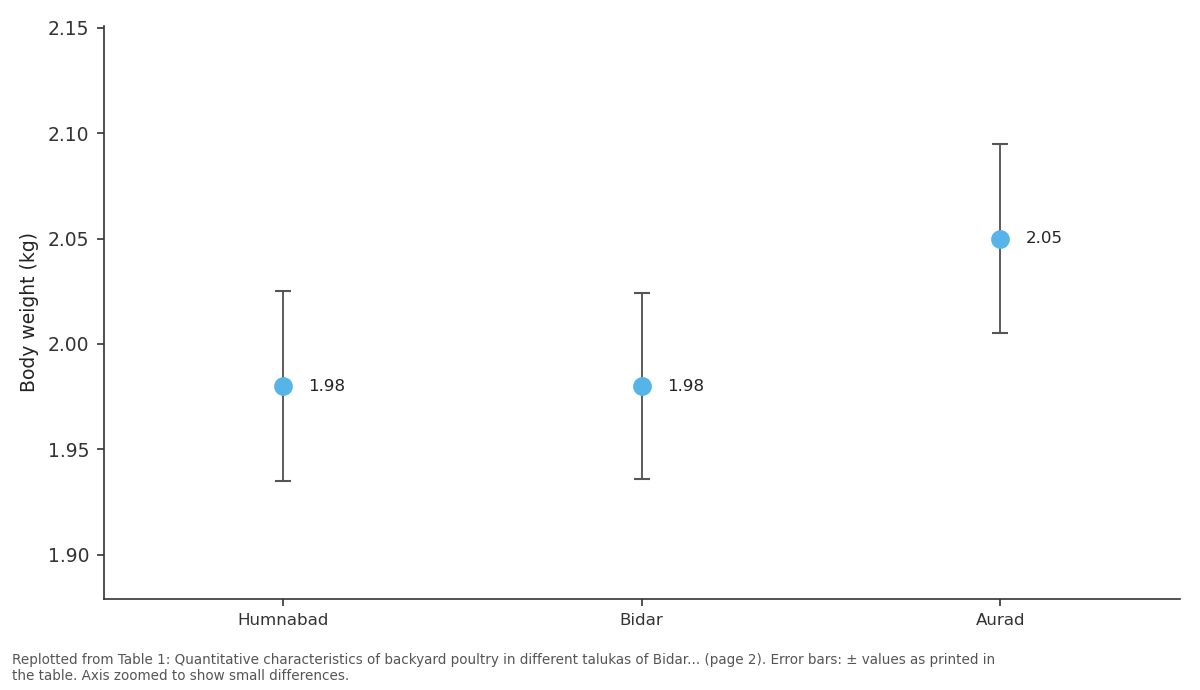
Body weight (kg): Humnabad vs Bidar vs Aurad
Replotted from Table 1 (page 2) of the original paper. Every bar is the paper's own table value.
View source evidence ↗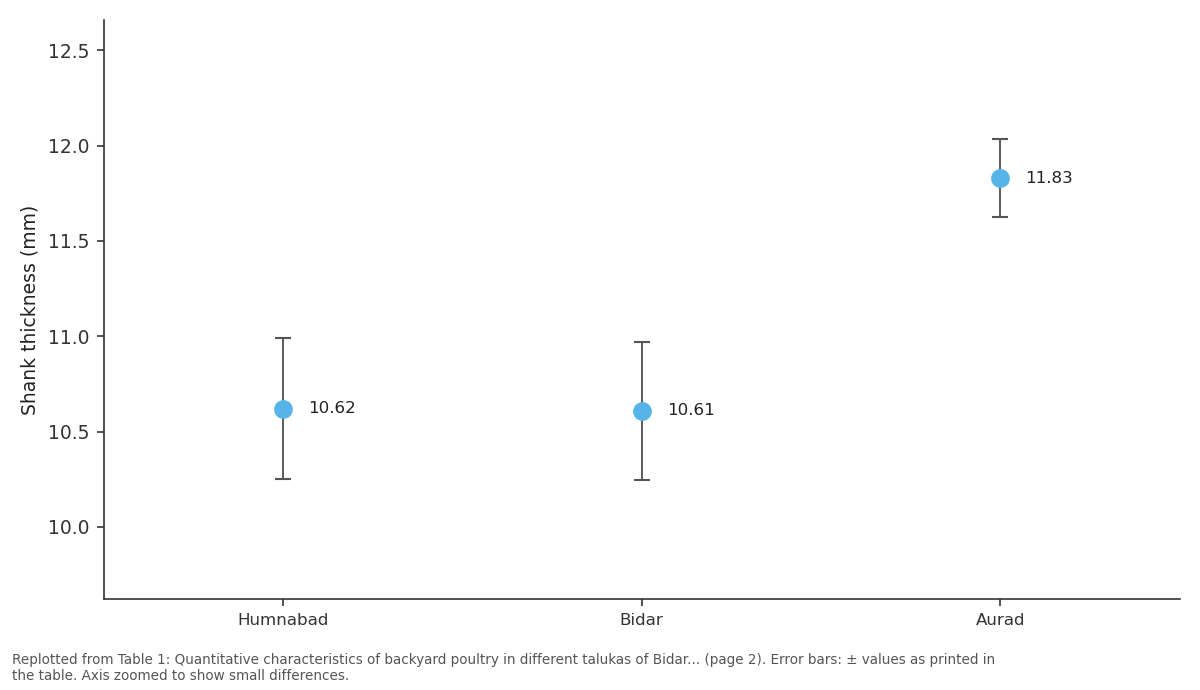
Shank thickness (mm): Humnabad vs Bidar vs Aurad
Replotted from Table 1 (page 2) of the original paper. Every bar is the paper's own table value.
View source evidence ↗Figures & tables
From the original paper Table 1
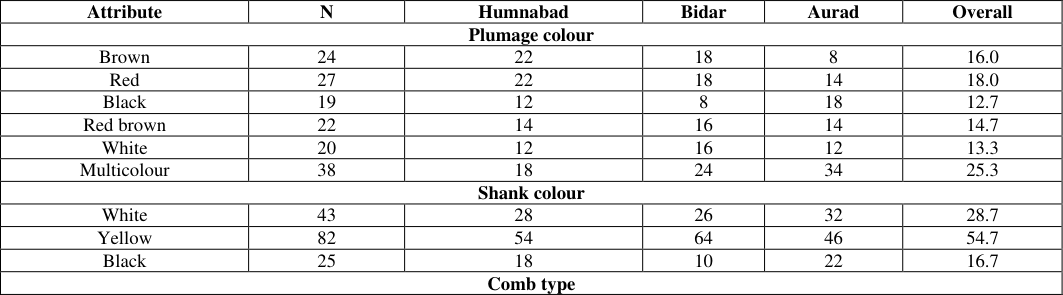 Table 2
Introduction
The rural backyard poultry systems play a pivotal role in achieving nutritional security of the country in rural areas. India, backyard poultry enterprise has supported the poor, landless farmers and other members of the backward classes to enhance their livelihoods, increase their assets and climb out of poverty (Islam et al., 2021) [7] . Poultry husbandry has occupied a pivotal position both in providing employment as well as in contributing a substantial proportion to the national GDP. Backyard poultry rearing is common among rural and landless families. In village poultry systems the production of poultry meat and eggs is extremely efficient in terms of feed and water inputs. These nutritious products can supplement household grain-based diets. Family poultry have a special place as they are under the control and managed by the women, children and the elderly. They require low investment, yield high economic returns, assist in pest control, and provide manure for fertilizer. The desi eggs and birds have high demand in the markets as people believed that local eggs and meat are of high nutritive quality. It is apparent that desi birds or look alike of desi birds fetch more prices both for eggs as well as meat (Sailo and Rahman, 2017) [9] . Market studies show that prices per kg live weight for these birds can be 50-100% higher than that of industrially produced birds (Conroy, et al., 2005) [5] . Keeping in view the importance of backyard poultry farming in Bidar district, and the paucity of literature on the rearing practices, this study was undertaken to examine the various aspects of qualitative and quantitative characters of backyard poultry farming in Bidar district.
Materials and Methods
The present study was conducted in Bidar district situated in Karnataka State which lies between 17°35′ and 18°25′ North latitude and 76°42′ and 77°39′ East longitude. It has an area of 5448 square kilometres and is bounded by Maharashtra on the north-west, Telangana on the east, and Gulbarga of Karnataka on the south. Bidar district has poultry population of about 7,34, 095, of which Humnabad taluka contains highest poultry population of 6,04,406 followed by Aurad 53,667, Basavakalyan 18,866, Bidar 28,025 and Bhalki 14,778. (AHVS, 2019) [2] . The district experiences semi-arid climate with extreme summer; the dust storms and severe heat waves are common in the district between April and May. Coldest months are December and January. The temperature varies between 20 °C and 42 °C. The summer season in Bidar starts in the first week of March and lasts until mid-June. This is followed by southwest monsoon which continues till late September and from September to end of January is winter.
Sampling design: A multistage stratified random sampling was adopted to select the talukas, villages and respondents for the present study. In the first stage of selection, Bidar, Aurad and Humnabad talukas were selected for the study based on the larger population of desi poultry birds and consultations with officials of the Animal Husbandry department regarding the availability of the backyard poultry rearing in larger proportion in Bidar district. In the second stage of selection, thirty villages were selected for the detailed survey, ten villages from each selected taluka, based on the strength of backyard poultry, the villages were identified after consultation with officials of the Department of Animal Husbandry and Veterinary Services, Government of Karnataka, giving due consideration to factors like availability of backyard poultry rearing and road connectivity. In the third stage of selection, five respondents were selected from each village at random for documentation of existing backyard poultry rearing and marketing practices and identification of constraints faced by the backyard poultry farmers for the present study. A total of 150 backyard poultry keepers were covered under this study.
Data collection and analysis:
The quantitative characters like body weight, height, wing length, shank length and shank thickness and qualitative characters like plumage colour, shank colour, comb type, and earlobe colour were examined and recorded during research study. Data from the schedules was compiled and analyzed using the data analysis tools in Microsoft Excel 2019 software.
Results and Discussion
Results and Discussion
Quantitative characteristics of backyard poultry
The quantitative characteristics of backyard poultry, including body weight, shank thickness, height of bird, wing length and shank length, are given in Table 1. The overall average body weight, shank thickness, height, wing length and shank length of adult birds was found to be 2.010±0.026 kg, 11.02±0.189 mm, 55.62±0.410 cm, 25.41±0.238 cm and 10.85±0.125 cm, respectively. These were similar to the findings of Kalitha et al. (2011) [8] and Chaterjee and Yadav (2008) [4] .
| Attribute | Humnabad | Bidar | Aurad | Overall |
|---|---|---|---|---|
| Body weight (kg) | 1.980±0.045 | 1.980±0.044 | 2.050±0.045 | 2.010±0.026 |
| Shank thickness (mm) | 10.62±0.369 | 10.61±0.362 | 11.83±0.203 | 11.02±0.189 |
| Height (cm) | 54.88±0.75 | 54.90±0.735 | 57.06±0.606 | 55.62±0.410 |
| Wing length (cm) | 24.78±0.422 | 24.80±0.414 | 26.64±0.351 | 25.41±0.238 |
| Shank length (cm) | 10.81±0.226 | 10.75±0.228 | 11.00±0.197 | 10.85±0.125 |
Table text extracted from the original PDF; superscript letters are shown inline. The original table image is below.
View original table image
Qualitative characteristics of backyard poultry
The qualitative characteristics of backyard poultry are given in Table 2.
| Attribute | N | Humnabad | Bidar | Aurad | Overall |
|---|---|---|---|---|---|
| Plumage colour | |||||
| Brown | 24 | 22 | 18 | 8 | 16.0 |
| Red | 27 | 22 | 18 | 14 | 18.0 |
| Black | 19 | 12 | 8 | 18 | 12.7 |
| Red brown | 22 | 14 | 16 | 14 | 14.7 |
| White | 20 | 12 | 16 | 12 | 13.3 |
| Multicolour | 38 | 18 | 24 | 34 | 25.3 |
| Shank colour | |||||
| White | 43 | 28 | 26 | 32 | 28.7 |
| Yellow | 82 | 54 | 64 | 46 | 54.7 |
| Black | 25 | 18 | 10 | 22 | 16.7 |
| Comb type |
Table text extracted from the original PDF; superscript letters are shown inline. The original table image is below.
View original table image
Plumage colour: Majority (25.3%) of the birds had multicolour plumage colour in the study area followed by red, brown, red brown, white and black plumage with 18.0, 16.0, 14.7, 13.3 and 12.7 percent, respectively. The findings were in agreement with the findings of Singh and Singh (2004) [10] , Tantia et al. (2005b) [12] , Vijh et al. (2005b) [13] , Gopinath (2013) [6] and Sudhir (2021) [11] who reported that majority of birds showed multicolour, followed by grey, white and black.
Shank colour: More than half (54.7%) of the bird in the study area had yellow shank colour, followed by white (28.7%) and black (16.7%). The results were in agreement with the findings of Tantia et al. (2005b) [12] , Addisu et al. (2013) [1] and Sudhir (2021) [11] .
Comb type: Most (94.2%) of the birds showed single type comb in the study area while the rest showed pea type combs. Similar findings were reported by Vijh et al. (2005b) [13] , Tantia et al. (2005a) [12] , Gopinath (2013) [6] and Sudhir (2021) [11] .
Ear lobe colour
Most (85.4%) of the birds had red coloured ear lobe and the remaining (14.7%) had white coloured ear lobes. Similar findings were reported by the Vijh et al. (2005b) [13] , Tantia et al. (2005a) [12] ,
Conclusion
The results indicated that the adult backyard poultry in the study area had body weight, shank thickness, height, wing length and shank length of 2.010 kg, 11.02mm, 55.62 cm, 25.41 cm and 10.85 cm, respectively. The plumage colour was influenced by sex in poultry (Sexual dimorphism). Most of the indigenous backyard birds in the study area had multicolour plumage, followed by red, brown, red brown, white and black. Considering the hardy nature and productive performance of these birds, there is vast potential for development of improved backyard strains. Indigenous chicken need further investigation for molecular characterization and genetic similarity/ divergence with other Indian breeds and efforts must be taken to completely characterize and conserve these birds.
References
7 in the original paper- Addisu H, Hailu M, Zewdu W. Indigenous chicken production system and breeding practice in North Wollo, Amhara Region, Ethiopia. Poultry, Fisheries & Wildlife Sciences. 2013;1:108.
- Chatterjee RN, Yadav SP. Farming system of Nicobari fowl-an endangered breed of Andaman and Nicobar Islands, India. World's Poultry Science Journal. 2008;64(2):245-256.
- Conroy C, Sparks N, Chandrasekaran D, Sharma A, Shindey D, Singh LR, et al. Improving backyard poultry-keeping: a case study from India. Agricultural Research & Extension Network. 2005, (146).
- Islam R, Kalita N, Sapcota D, Sheikh IU, Mahanta JD, Sarma M. Characterization of Free-range Indigenous Chicken Production System in North-East India (Assam). Journal of Animal Research. 2021;11(1):5970.
- Kalita N, Pathak N, Islam R, Chutia H. Production traits of indigenous chicken in rural condition of Assam. Indian Journal of Poultry Science. 2011;46(2):245-246.
- Sailo F, Rahman S. Marketing practices and constraints in backyard poultry farming in the hills of Mizoram. Int J Liv Res. 2017;7:200-205.
- Vij PK, Tantia MS, Singh TR. Kaunayen chicken-a new indigenous germplasm from Manipur. Indian Journal of Animal Sciences. 2005;86(9):1085-1087.