
Research article · 2024 · Full text
International Journal of Research in AgronomyEffect of zeolite and potassium application on changes in soil properties after harvest of maize
Volume 7(3) · Pages 95–100 · DOI: 10.33545/2618060x.2024.v7.i3b.391 ↗
Research areasCrop Yield and Soil Fertility
Abstract
Author-writtenThe present investigation was undertaken to study the effect of zeolite and potassium application on Changes in soil properties after harvest of maize. The field experiment was conducted at Post Graduate Institute, Research Farm, Department of Soil Science and Agricultural Chemistry, M.P.K.V., Rahuri, during of summer 2022. The experimental site was medium deep black, clayey in texture, having a bulk density of 1.35 Mg m-3, particle density of 2.65 Mg m-3, slightly alkaline in reaction, low in electrical conductivity and medium in organic carbon and calcium carbonate content. The soil was low in available nitrogen, medium in phosphorus and very high in potassium content. However, soils were sufficient in available micronutrients viz., Fe, Mn, Zn and Cu. The experiment was laid out in a randomized block design with ten treatments and three replications. The treatments were T1: Absolute control, T2: GRDF 120:60:40 N, P2O5, K2O + 10 t FYM ha-1, T3: Zeolite @ 400 kg ha-1, T4: Zeolite @ 600 kg ha-1, T5: Zeolite @ 400 kg ha-1 + 50% K2O of RDF (20 kg ha-1), T6: Zeolite @ 400 kg ha-1 + 75% K2O of RDF (30 kg ha-1), T7: Zeolite @ 400 kg ha-1 + 100% K2O of RDF (40 kg ha-1), T8: Zeolite @ 600 kg ha-1 + 50% K2O of RDF (20 kg ha-1), T9: Zeolite @ 600 kg ha-1 + 75% K2O of RDF (30 kg ha-1), T10: Zeolite @ 600 kg ha-1 + 100% K2O of RDF (40 kg ha-1). The recommended doses of N and P2O5 and FYM @ 10 t ha-1 are the same for all treatments as per RDF except T1. The soil physical properties viz., bulk density, porosity and hydraulic conductivity and chemical properties viz., OC, CaCO3 and CEC were significantly influenced by the application of different levels of zeolite and potassium after harvest of maize. The soil available nitrogen, phosphorous, potassium (N, P, K) and micronutrients (Fe, Mn, Zn and Cu) were significantly influenced by the application of different levels of zeolite and potassium after harvest of maize. Significantly, the highest available N, P, K (216.77, 16.04 and 436.40 kg ha-1 respectively) and DTPA extractable micronutrients Fe, Mn, Zn, Cu (4.26, 6.95, 0.49 and 1.59 mg kg-1 respectively) were observed in treatment T10 i.e., zeolite @ 600 +100% K2O of RDF (40 kg ha-1) over the rest of treatments except T9 i.e., zeolite @ 600 kg ha-1+ 75% K2O of RDF which was statistically at par. Application of zeolite and potassium influenced the soil properties and availability of nutrients in Inceptisol.
Summary
Source-checkedPlain-language reading of the full paper, prepared with AI and checked against the text. Each point links to the authors' own words.
Why it matters
- Maize is a globally significant cereal crop, ranking as the second most widely grown crop in the world and the third most important in India. View evidence ↗
- Potassium is a critical nutrient for maize production because the crop requires and absorbs high quantities of it. View evidence ↗
- Zeolites can act as fertilizer carriers that improve the use efficiency of nitrogen and potassium, potentially reducing the required application rates for the same yield. View evidence ↗
The question
- The study aimed to investigate how applying different levels of zeolite and potassium affects soil properties following the harvest of maize. View evidence ↗
What they did
- The field experiment took place during the summer of 2022 at the PGI Research Farm in Rahuri. View evidence ↗
- The researchers used a randomized block design consisting of ten different treatments, each with three replications. View evidence ↗
- Treatments ranged from an absolute control (T1) to combinations of zeolite (400 or 600 kg ha-1) and varying percentages (50%, 75%, or 100%) of the recommended dose of potassium (K2O). View evidence ↗
- Soil samples were collected from a depth of up to 22.5 cm at the time of maize harvest to analyze fertility status. View evidence ↗
What they found
- The lowest soil bulk density (1.20 Mg m-3) occurred in treatment T10 (600 kg zeolite + 100% K2O), while the highest (1.33 Mg m-3) was in the absolute control. View evidence ↗
- Treatment T10 resulted in the highest soil porosity at 53.21%, which was significantly higher than most other treatments. View evidence ↗
- The highest organic carbon content (0.64%) was found in treatment T10, compared to the lowest (0.54%) in the absolute control. View evidence ↗
- Cation Exchange Capacity (CEC) was highest in treatment T10 (56.78 cmol (p+) kg-1) and lowest in the absolute control (46.53 cmol (p+) kg-1). View evidence ↗
- Available nitrogen was highest in treatment T10 (216.77 kg ha-1) and lowest in the absolute control (164.52 kg ha-1). View evidence ↗
- The highest available potassium (436.40 kg ha-1) was observed in treatment T10. View evidence ↗
- Treatment T10 resulted in the highest available iron (DTPA-Fe) at 4.26 mg kg-1. View evidence ↗
- The highest available copper (DTPA-Cu) was 1.59 mg kg-1, observed in treatment T10. View evidence ↗
What it means
- The authors conclude that zeolite has potential as a soil amendment to improve soil structure and water movement, which can enhance soil health and crop productivity. View evidence ↗
Visual summary
3 visualsIllustrations explain the paper; charts are replotted from the paper's own table values.
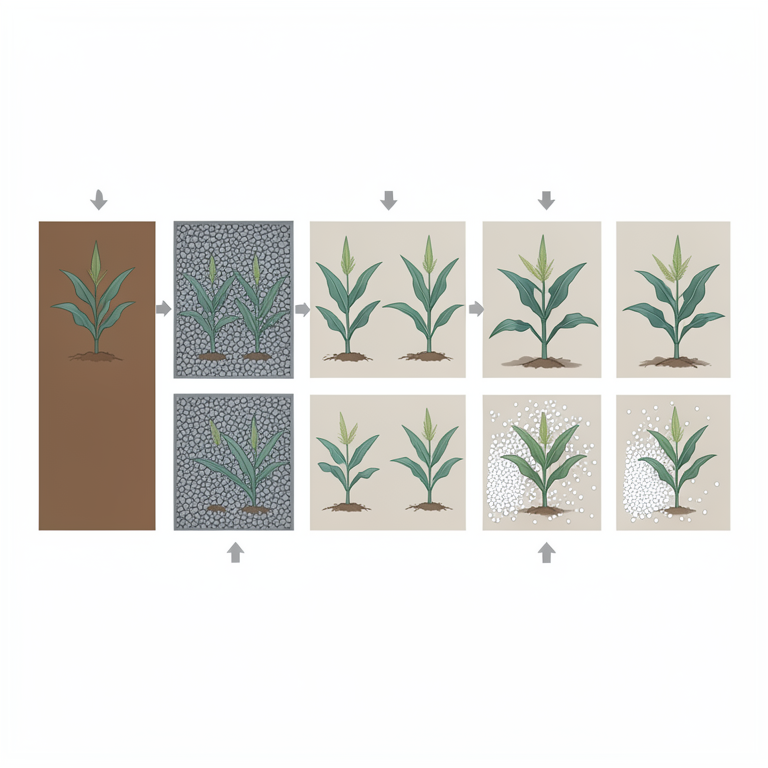
Experimental Treatment Matrix
AI-generated conceptual illustration (maize plants in soil plots). It explains the idea and does not show study data.
View source evidence ↗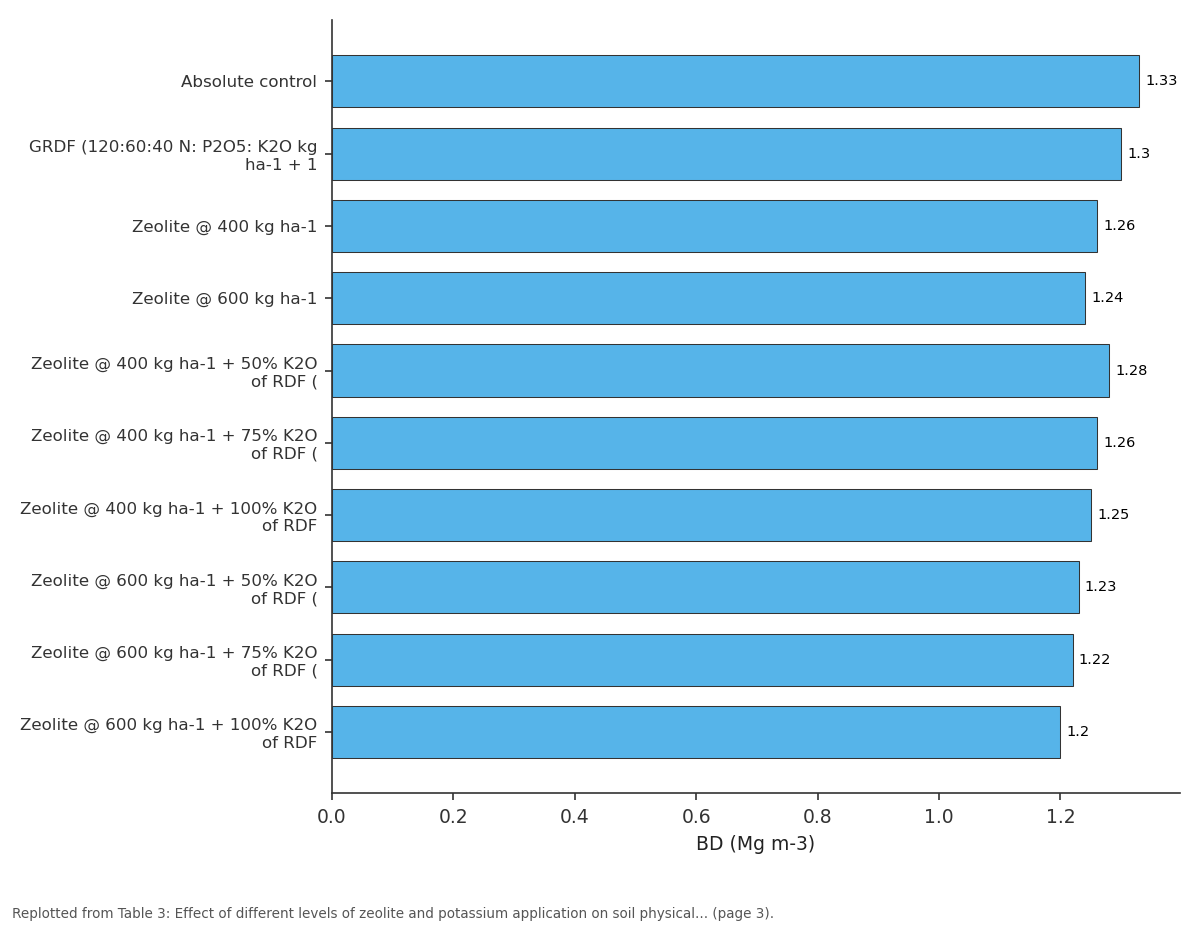
BD (Mg m-3): Absolute control vs GRDF (120:60:40 N:... vs Zeolite @ 400 kg ha-1 vs Zeolite @ 600 kg ha-1 vs Zeolite @ 400 kg ha-1 +...
Replotted from Table 3 (page 3) of the original paper. Every bar is the paper's own table value.
View source evidence ↗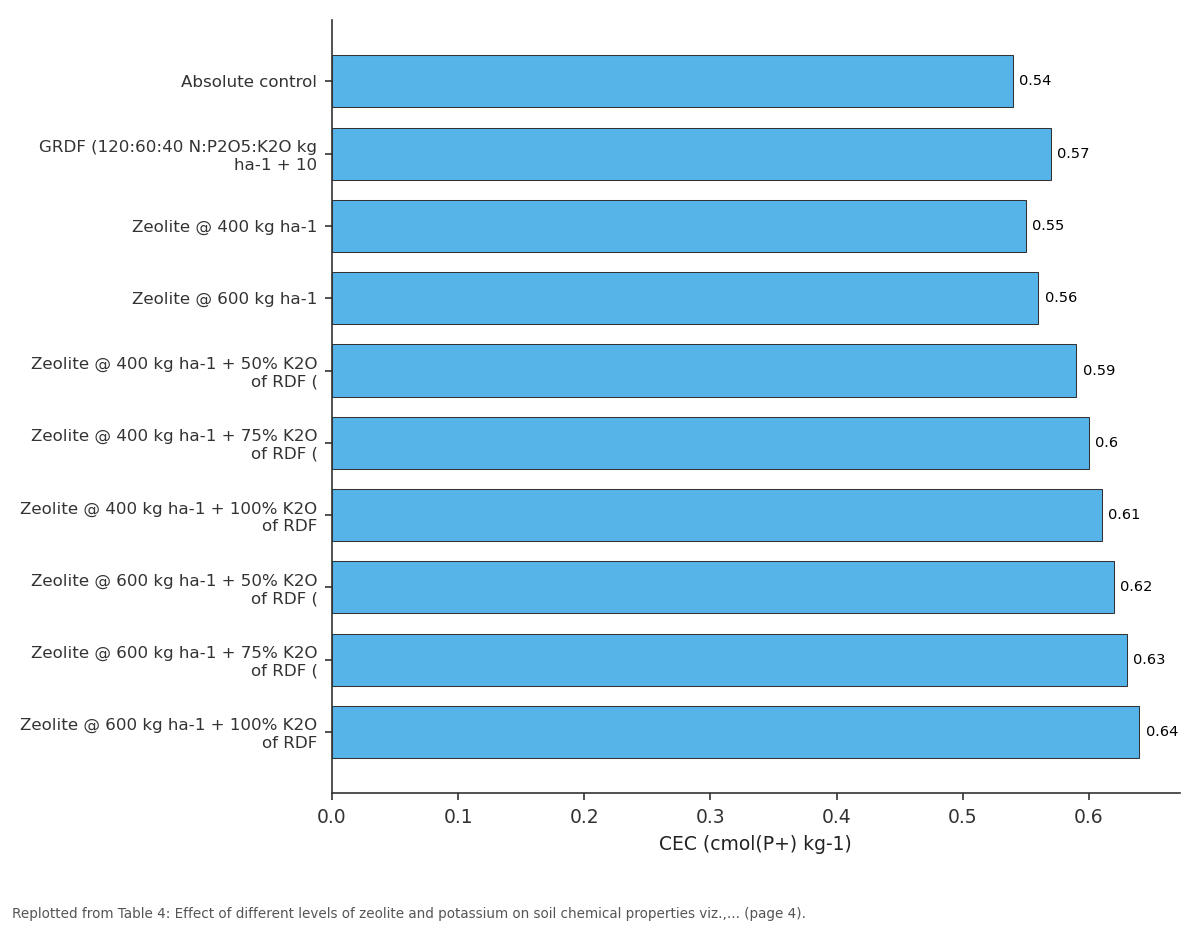
OC (%): Absolute control vs GRDF (120:60:40... vs Zeolite @ 400 kg ha-1 vs Zeolite @ 600 kg ha-1 vs Zeolite @ 400 kg ha-1 +...
Replotted from Table 4 (page 4) of the original paper. Every bar is the paper's own table value.
View source evidence ↗Figures & tables
From the original paper Table 2
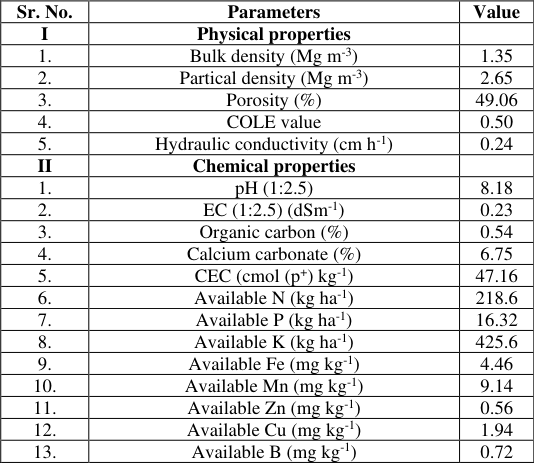 Table 1
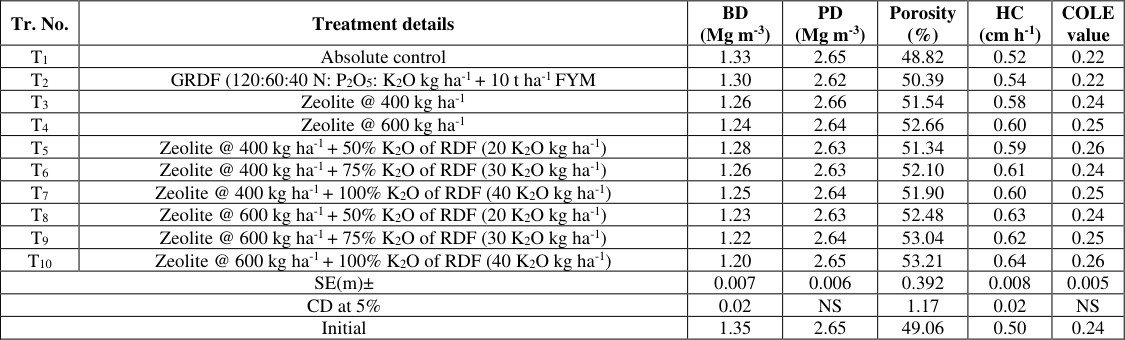 Table 3
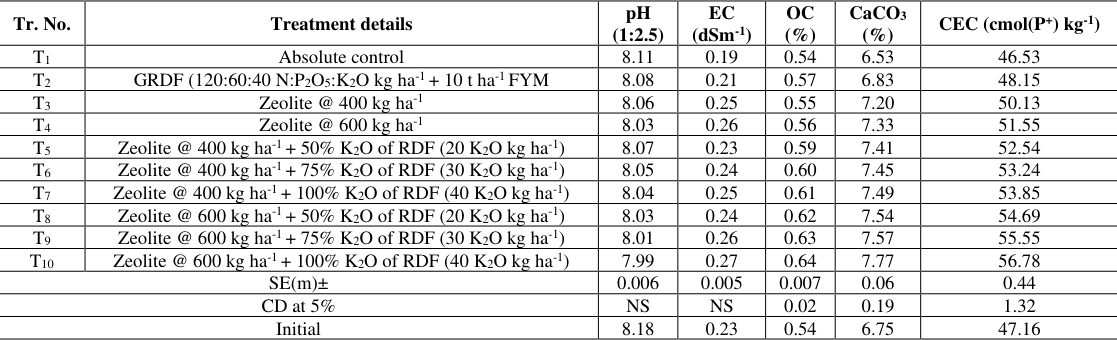 Table 4
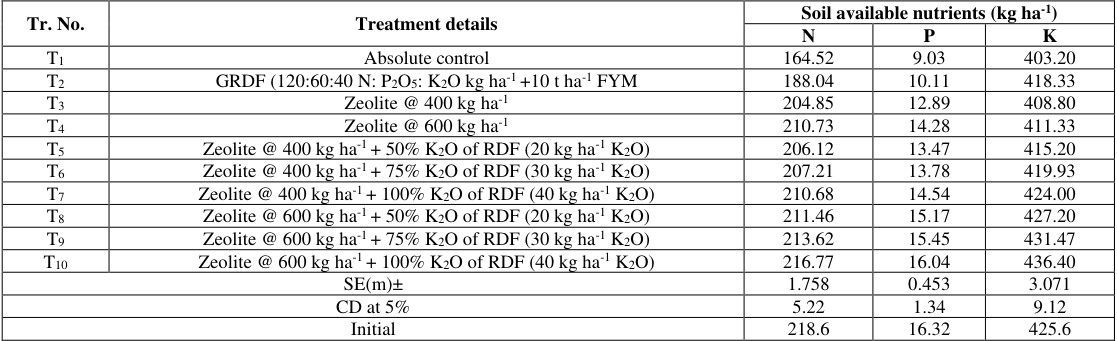 Table 5
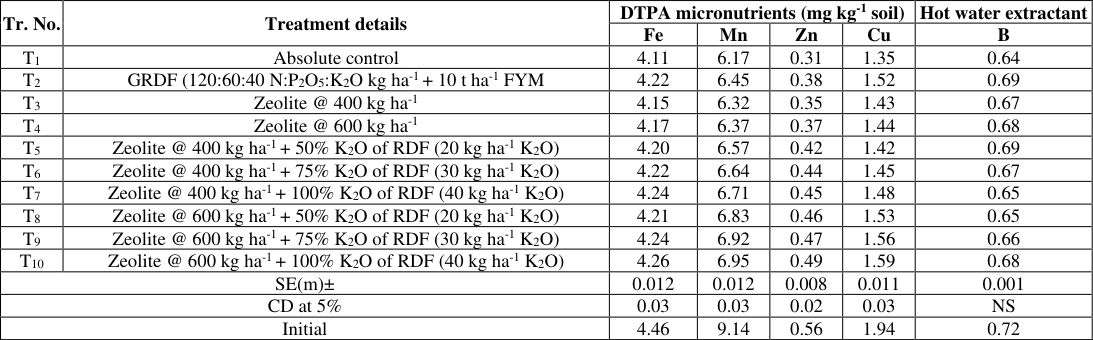 Table 6
Introduction
Maize (Zea mays L.) is an important cereal crop which belongs to the grass family with chromosome number 2n = 20. It is the world's second most widely grown crop and India's third most important cereal crop after rice and wheat. It is cultivated as a cereal grain that has been domesticated in Central America. Globally, maize is known as the "Queen of cereal crops" because of its higher grain yield potential among all the cereals. It exhibits greater adaptability as it can be grown in a variety of agro-climatic conditions. Potassium is the third major plant nutrient next to nitrogen and phosphorous with respect to crop production. The requirement for potassium in maize is high as it absorbs high quantities of potassium. It plays a significant role in enhancing crop quality, so it is recognized as a "quality element". It is associated with the movement of water, carbohydrates and nutrients in plants. About 80 different types of enzymes are stimulated by potassium (Kasana and Khan, 1976) [14] . It plays an important role in the stomatal functioning and helps plants to grow under drought conditions (Hsiao, 1973) [11] . Insufficient potassium in plants leads to difficulty in absorbing water, which leads to an increase in drought stress.
Generally, maize plants conserve water and reduce moisture stress by closing leaf stomata, which in terms are regulated by potassium. That's why plants with inadequate potassium supply may be slower in closing their stomata, which reduces drought stress. Zeolites are hydrated alumino silicate minerals made up of cross-linked tetrahedra of AlO4 and SiO4, which consist of pores and corners of alumino silicate tetrahedra (AlO4 and SiO4) that are connected in three-dimensional structure of about 12 Å in diameter, connected by channels of about 8 Å diameter and made up of rings of 12 linked tetrahedron (Kaduk and Faber, 1995) [13] . Zeolites with distinct cation exchange properties, molecular sieving and adsorption (Mumpton, 1999; Glisic et al., 2009; Hecl and Toth, 2009) [18,8,10] could be used as a stabilizer, chelator and fertilizer (Loizidou and Kapetanios, 1992 and Perez-Caballero et al., 2008) [16,20] . Zeolites are excellent carriers and regulators of mineral fertilizers. Besides, they also serve as a source of nutrients. As carriers of N and K fertilizers, they can increase N and K use efficiency and decrease the application rates for equal yield to be achieved (Polat et al., 2004) [21] , zeolite enables both inorganic and organic fertilizers to slowly release their nutrients (Perez Caballero et al., 2008) [20] .
Materials and Methods
Materials and Methods
Layout and experimental design
The field experiment was conducted at PGI Research Farm, M.P.K.V., Rahuri. The soil sample was collected and analyzed at Department of Soil Science and Agricultural Chemistry, PGI, M.P.K.V., Rahuri, Dist. Ahmednagar during summer 2022. The experiment was laid out in a randomized block design with 10 treatments and 3 replications. The gross plot size was 4.50 m x 3.60 m i.e. 16.2 m 2 and net plot size was 3.0 m x 3.20 m i.e. 9.60 m 2 . The recommended spacing of 75 cm x 20 cm was adopted for dibbling of maize. The general recommended dose of nutrients (120:60:40 kg ha -1 N, P2O5 and K2O respectively + FYM @ 10 t ha -1 ) were given to maize as per treatment details except T1 at the time of dibbling of maize.
Soils characteristic
The topography of experimental site was nearly uniform. Plots are prepared for sowing of maize; soils are medium black with good water holding capacity. Initial soil properties of soil before sowing are presented in table 1. Available N (kg ha -1 ) 218.6 7.
| Sr. No. | Parameters | Value |
|---|---|---|
| I | Physical properties | |
| 1. | Bulk density (Mg m-3) | 1.35 |
| 2. | Partical density (Mg m-3) | 2.65 |
| 3. | Porosity (%) | 49.06 |
| 4. | COLE value | 0.50 |
| 5. | Hydraulic conductivity (cm h-1) | 0.24 |
| II | Chemical properties | |
| 1. | pH (1:2.5) | 8.18 |
| 2. | EC (1:2.5) (dSm-1) | 0.23 |
| 3. | Organic carbon (%) | 0.54 |
| 4. | Calcium carbonate (%) | 6.75 |
| 5. | CEC (cmol (p+) kg-1) | 47.16 |
| 6. | Available N (kg ha-1) | 218.6 |
| 7. | Available P (kg ha-1) | 16.32 |
| 8. | Available K (kg ha-1) | 425.6 |
| 9. | Available Fe (mg kg-1) | 4.46 |
| 10. | Available Mn (mg kg-1) | 9.14 |
| 11. | Available Zn (mg kg-1) | 0.56 |
| 12. | Available Cu (mg kg-1) | 1.94 |
| 13. | Available B (mg kg-1) | 0.72 |
Table text extracted from the original PDF; superscript letters are shown inline. The original table image is below.
View original table image
Available P (kg ha -1 ) 16.32 8.
Available K (kg ha -1 ) 425.6 9.
Available Fe (mg kg -1 ) 4.46 10.
Available Mn (mg kg -1 ) 9.14 11.
Available Zn (mg kg -1 ) 0.56 12.
Available Cu (mg kg EC (1:10) (dSm -1 ) 0.09 3.
CEC (cmol (p + ) kg -1 ) 161
Application of Zeolite and Potassium
Zeolite and Potassium as per treatment with farm yard manure @ 10 t ha -1 to all treatment plots except T1.
The treatment comprised of T1: Absolute control, T2: GRDF 120:60:40 N, P2O5, K2O + 10 t FYM ha -1 , T3: Zeolite @ 400 kg ha -1 , T4: Zeolite @ 600 kg ha -1 , T5: Zeolite @ 400 kg ha -1 + 50% K2O of RDF (20 kg ha -1 ), T6: Zeolite @ 400 kg ha -1 + 75% K2O of RDF (30 kg ha -1 ), T7: Zeolite @ 400 kg ha -1 + 100% K2O of RDF (40 kg ha -1 ), T8: Zeolite @ 600 kg ha -1 + 50% K2O of RDF (20 kg ha -1 ), T9: Zeolite @ 600 kg ha -1 + 75% K2O of RDF (30 kg ha -1 ), T10: Zeolite @ 600 kg ha -1 + 100% K2O of RDF (40 kg ha -1 ).
Soil analysis
The representative surface soil samples of the experimental plots were collected upto 22.5 cm depth at harvest stage of maize from each plot to know the fertility status of soil. The collected soil samples were dried under shade, grinded in wooden mortar and pastel, sieved through 2 mm sieve and analysed for pH, EC, CaCO3, available N, P, K and DTPA extractable micronutrients Fe, Zn, Mn, Cu, B and for organic carbon determination soil was sieved through 0.5 mm sieve and analysed by using standard methods. The soil samples were analyzed at initial and at harvest of cauliflower.
Results and Discussion
Results and Discussion
Effect of Different Levels of Zeolite and Potassium Application on Physical Properties of Soil after Harvest of Maize
The data regarding the effect of different levels of zeolite and potassium application on soil physical properties after harvest of maize are shown in table 3.
| Tr. No. | Treatment details | BD (Mg m-3) | PD (Mg m-3) | Porosity (%) | HC (cm h-1) | COLE value |
|---|---|---|---|---|---|---|
| T1 | Absolute control | 1.33 | 2.65 | 48.82 | 0.52 | 0.22 |
| T2 | GRDF (120:60:40 N: P2O5: K2O kg ha-1 + 10 t ha-1 FYM | 1.30 | 2.62 | 50.39 | 0.54 | 0.22 |
| T3 | Zeolite @ 400 kg ha-1 | 1.26 | 2.66 | 51.54 | 0.58 | 0.24 |
| T4 | Zeolite @ 600 kg ha-1 | 1.24 | 2.64 | 52.66 | 0.60 | 0.25 |
| T5 | Zeolite @ 400 kg ha-1 + 50% K2O of RDF (20 K2O kg ha-1) | 1.28 | 2.63 | 51.34 | 0.59 | 0.26 |
| T6 | Zeolite @ 400 kg ha-1 + 75% K2O of RDF (30 K2O kg ha-1) | 1.26 | 2.63 | 52.10 | 0.61 | 0.24 |
| T7 | Zeolite @ 400 kg ha-1 + 100% K2O of RDF (40 K2O kg ha-1) | 1.25 | 2.64 | 51.90 | 0.60 | 0.25 |
| T8 | Zeolite @ 600 kg ha-1 + 50% K2O of RDF (20 K2O kg ha-1) | 1.23 | 2.63 | 52.48 | 0.63 | 0.24 |
| T9 | Zeolite @ 600 kg ha-1 + 75% K2O of RDF (30 K2O kg ha-1) | 1.22 | 2.64 | 53.04 | 0.62 | 0.25 |
| T10 | Zeolite @ 600 kg ha-1 + 100% K2O of RDF (40 K2O kg ha-1) | 1.20 | 2.65 | 53.21 | 0.64 | 0.26 |
| SE(m)± | 0.007 | 0.006 | 0.392 | 0.008 | 0.005 | |
| CD at 5% | 0.02 | NS | 1.17 | 0.02 | NS | |
| Initial | 1.35 | 2.65 | 49.06 | 0.50 | 0.24 |
Table text extracted from the original PDF; superscript letters are shown inline. The original table image is below.
View original table image
The bulk density of soil was significantly influenced by the application of different levels of zeolite and potassium after harvest of maize. Significantly, the lowest bulk density (1.20 Mg m -3 ) was observed in the treatment T10 i.e., zeolite @ 600 kg ha -1 + 100% K2O of RDF over the rest of the treatments except treatment T9 (1.22 Mg m -3 ) which was statistically at par where we have applied zeolite @ 600 kg ha -1 + 75% K2O of RDF (30 kg ha -1 K2O). However, the highest bulk density (1.33 Mg m -3 ) was observed in treatment T1 (Absolute control). This decrease in bulk density might be due to redistribution of soil particles by the binding action of zeolite (Hassan and Mohmoud. 2013) [9] , which leads to soil aggregate formation, so the porosity gets increased and ultimately the bulk density will be reduced (Xiliang et al., 1991) [25] .
There was no significant effect on particle density of soil by the application of different levels of zeolite and potassium after harvest of maize. However, the particle density ranged between 2.66 to 2.62 Mg m -3 . The highest (2.66 Mg m -3 ) was observed in treatment T3 i.e., zeolite @ 600 kg ha -1 and the lowest was observed in treatment T2 i.e., GRDF 120:60:40 Kg ha -1 of N, P2O5 and K2O + 10 t ha -1 FYM. The porosity of soil was significantly influenced by the application of different levels of zeolite and potassium after harvest of maize. Significantly, the highest porosity (53.21%) was observed in the treatment T10 i.e., zeolite @ 600 kg ha -1 + 100% K2O of RDF (40 kg ha -1 K2O) over the rest of treatments except T9, T8, T6 and T4 (53.04, 52.48, 52.10 and 52.66%, respectively). However, it was observed that there was an increase in the porosity in the zeolite treated plots compared to untreated plots. This might be due to an improved porous system of soil by the application of zeolite, which itself has high porosity (Georgiev et al., 2009) [7] . The hydraulic conductivity of soil was significantly influenced by the application of different levels of zeolite and potassium after harvest of maize hydraulic conductivity (0.64 cm h -1 ) was observed in the treatment T10 i.e., zeolite @ 600 kg ha -1 + 100% K2O of RDF (40 kg ha -1 K2O) over the rest of the treatments except T9 and T8 (0.63 and 0.62 cm h -1 respectively) which were found to be statistically at par with T10. This might be due to the large pore volume of the zeolite, which effectively increases the soil water permeability and the increased porosity by addition of zeolite also increases the hydraulic conductivity. Similar results were observed by Mahabadi et al. (2007) [17] and Razmi and Sepaskhah. (2012) [24] .
There was no significant effect on COLE value of the soil by the application of different levels of zeolite and potassium after harvest of maize. However, the COLE value is ranged between 0.22 to 0.26. The slight increase in COLE value might be because of an increase in the average particle size when the zeolite binds to soil which has high water holding capacity. There was no significant effect on the pH of the soil by the application of different levels of zeolite and potassium after harvest of maize. However, the pH of soil ranged between 8.11 to 7.99. The higher soil pH (8.11) was recorded in treatment T1 (Absolute control) whereas, the lowest (7.99) was observed in treatment T10, i.e., zeolite @ 600 kg ha -1 + 100% K2O of RDF (40 kg ha -1 K2O). The marginal decrease in soil pH might be because of the slightly acidic nature of zeolite, and the decomposition of FYM, releases some organic acids into the soil system, which reduces the soil pH.
There was no significant effect on EC of the soil with the application of different levels of zeolite and potassium after harvest of maize. However, the soil EC was ranged between 0.27 to 0.19 dSm -1 . The lower soil EC (0.19 dSm -1 ) was recorded in treatment T1 (Absolute control) and the higher EC (0.27 dSm -1 ) was observed in treatment T10 i.e., zeolite @ 600 kg ha -1 + 100% K2O of RDF (40 kg ha-1 K2O). This slight increase in EC might be because of the high exchange capacity of zeolite, which can introduce cations into the soil solution which is used to measure EC (Ramesh et al., 2015 and Ravali et al., 2020) [22,23 ] . The organic carbon content of soil after harvest of maize was significantly influenced by the application of different levels of zeolite and potassium. Significantly, the highest organic carbon (0.64%) was found in the treatment T10, i.e., zeolite @ 600 kg ha -1 + 100% K2O of RDF (40 kg ha -1 K2O), over the rest of treatments except T9 (0.63%) and T8 (0.62%) which were found to be statistically at par. However, the lowest (0.54%) was observed in treatment T1 (Absolute control). The increase of organic carbon was mainly due to addition of FYM, also an increase in root biomass production by the action of zeolite. Aminiyan et al. (2014) [2] reported that application of zeolite at 30% and crop residues at 5% would maintain the highest amount of organic carbon in soil.
The calcium carbonate content of soil after harvest of maize was significantly influenced by the application of different levels of zeolite and potassium. Significantly, the highest CaCO3 (7.77%) was observed in the treatment T10, i.e., zeolite @ 600 kg ha -1 + 100% K2O of RDF (40 kg ha -1 K2O), over the rest of treatments except treatment T9 and T8 (7.67 and 7.60% respectively) which were found to be statistically at par with T10. This increase in CaCO3 might be due to adsorption of calcium from mono calcium phosphate by zeolite and its subsequent release during the crop growing period, which is precipitated as calcium carbonates. Thus, an increase in CaCO3 was observed.
The CEC of soil after harvest of maize was significantly influenced by the application of different levels of zeolite and potassium. Significantly, the highest CEC (56.78 cmol (p + ) kg -1 of soil) was observed in the treatment T10 i.e., zeolite @ 600 kg ha -1 + 100% K2O of RDF (40 kg ha -1 K2O) over the rest of treatments except treatment T9 (55.55 cmol (p + ) kg -1 of soil) which was found to be statistically at par where we have applied zeolite @ 600 kg ha -1 + 75% K2O of RDF (30 kg ha -1 K2O). However, the lowest CEC (46.53 cmol (p + ) kg -1 of soil) was recorded in treatment T1 (Absolute control). [5] .
Effect of Different Levels of Zeolite and Potassium Application on Soil Available Nutrients after harvest of Maize:
The data regarding soil available N, P and K as influenced by different levels of zeolite and potassium after harvest of maize are shown are shown in table 5.
| Tr. No. | Treatment details | Soil available nutrients (kg ha-1) | — | — |
|---|---|---|---|---|
| N | P | K | ||
| T1 | Absolute control | 164.52 | 9.03 | 403.20 |
| T2 | GRDF (120:60:40 N: P2O5: K2O kg ha-1 +10 t ha-1 FYM | 188.04 | 10.11 | 418.33 |
| T3 | Zeolite @ 400 kg ha-1 | 204.85 | 12.89 | 408.80 |
| T4 | Zeolite @ 600 kg ha-1 | 210.73 | 14.28 | 411.33 |
| T5 | Zeolite @ 400 kg ha-1 + 50% K2O of RDF (20 kg ha-1 K2O) | 206.12 | 13.47 | 415.20 |
| T6 | Zeolite @ 400 kg ha-1 + 75% K2O of RDF (30 kg ha-1 K2O) | 207.21 | 13.78 | 419.93 |
| T7 | Zeolite @ 400 kg ha-1 + 100% K2O of RDF (40 kg ha-1 K2O) | 210.68 | 14.54 | 424.00 |
| T8 | Zeolite @ 600 kg ha-1 + 50% K2O of RDF (20 kg ha-1 K2O) | 211.46 | 15.17 | 427.20 |
| T9 | Zeolite @ 600 kg ha-1 + 75% K2O of RDF (30 kg ha-1 K2O) | 213.62 | 15.45 | 431.47 |
| T10 | Zeolite @ 600 kg ha-1 + 100% K2O of RDF (40 kg ha-1 K2O) | 216.77 | 16.04 | 436.40 |
| SE(m)± | 1.758 | 0.453 | 3.071 | |
| CD at 5% | 5.22 | 1.34 | 9.12 | |
| Initial | 218.6 | 16.32 | 425.6 |
Table text extracted from the original PDF; superscript letters are shown inline. The original table image is below.
View original table image
The available nitrogen content in the soil was significantly influenced by the application of different levels of zeolite and potassium after harvest of maize. Significantly, the highest (216.77 kg ha -1 ) available nitrogen was found in treatment T10 i.e., zeolite @ 600 kg ha -1 + 100% K2O of RDF (40 kg ha -1 K2O) over the rest of treatments except treatment T9 (213.62 kg ha -1 ) which is found to be statistically at par where we have used zeolite @ 600 kg ha -1 + 75% K2O of RDF (30 kg ha -1 K2O). However, the lowest nitrogen was observed in the absolute control (164.52 kg ha -1 ). The increase in the available status of nitrogen is because of reduced losses of NH4 + and NO3 -by the application of zeolite, where the pore size of the zeolite is large enough for the ammonium ion to enter, but it is small enough for the nitrifying bacteria, so the nitrification process can be prevented and the ammonia is not converted in to nitrate, eventually leaching of NO3 -is also prevented (Aiyuk et al., 2004 and Englert et al., 2005) [1,6] . The absorbed NH4 + is released slowly into soil. Also demonstrated that a 40-50% improvement in soil exchangeable ammonium retention in zeolite-treated soil. Available phosphorous content in the soil was significantly influenced by the application of different levels of zeolite and potassium after harvest of maize. Significantly, the highest (16.04 kg ha -1 ) phosphorous was observed in the treatment T10 i.e., zeolite @ 600 kg ha -1 + 100% K2O of RDF (40 kg ha -1 K2O), over the rest of treatments except treatment T9 (15.45 kg ha -1 ) which was statistically at par where we have applied zeolite @ 600 kg ha -1 + 75% K2O of RDF (30 kg ha -1 K2O). Zheng et al. (2019) [26] and Lathifa et al. (2017) [15] also reported an increase of available phosphorous in the zeolite treated soils.
The increase in available status of phosphorous might be due to reduced P fixation in the soil, because the zeolite which create very slightly alkaline conditions where the phosphorous fixation due to calcium was reduced.
The available potassium status of soil was significantly influenced by the application of different levels of potassium and zeolite after harvest of maize. Significantly, the highest available potassium (436.40 kg ha -1 ) was observed in the treatment T10, i.e., zeolite @ 600 kg ha -1 + 100% K2O of RDF (40 kg ha -1 K2O) over the rest of treatments except treatment T9 (431.47 kg ha -1 ) which was found to be statistically at par where we have applied zeolite @ 600 kg ha -1 + 75% K2O of RDF (30 kg ha -1 K2O). This might be because of zeolite, which has strong affinity for K + compared to other cations like Ca +2 , Na + and Mg +2 , so it is difficult to remove K + from zeolite exchange sites (Barrer and Colella. 1996) [4] , so the leaching loses of potassium will be reduced and availability status will be increased in soil. Significantly, the highest DTPA-Fe (4.26 mg kg -1 ) was found in the treatment T10 i.e., zeolite @ 600 kg ha -1 + 100% K2O of RDF (40 kg ha -1 K2O) over the rest of treatments except treatment T9 (4.24 mg kg -1 ) which was found to be statistically at par, where we have applied zeolite @ 600 kg ha -1 + 75% K2O of RDF (30 kg ha -1 K2O). The increase in DTPA-Fe might be due to adsorption of iron by zeolite and its subsequent release by ion exchange phenomenon during the crop growth period. An increase of 19% DTPA-Fe is also observed by Suhayda et al.
(1982) through the application of zeolite. The DTPA-Mn was significantly influenced by the application of different levels of zeolite and potassium after harvest of maize. Significantly, the highest DTPA-Mn (6.95 mg kg -1 ) was observed in the treatment T10 i.e., zeolite @ 600 kg ha -1 + 100% K2O of RDF (40 kg ha -1 K2O) over the rest of treatments except treatment T9 (6.92 mg kg -1 ) which was found to be statistically at par, where we have applied zeolite @ 600 kg ha -1 + 75% K2O of RDF (30 kg ha -1 K2O). This increase of DTPA-Mn might be because of the great potential of zeolite to hold manganese and act as a slow-release fertilizer in its release as reported by (Iskander et al., 2011) [12] . The DTPA-Zn was significantly influenced by the application of different levels of zeolite and potassium after harvest of maize. The highest (0.49 mg kg -1 ) DTPA-Zn was observed in the treatment T10 i.e., zeolite @ 600 kg ha -1 + 100% K2O of RDF (40 kg ha -1 K2O) over the rest of treatments except treatment T9 (0.47 mg kg -1 ) which was statistically at par where we have applied zeolite @ 600 kg ha -1 + 75% K2O of RDF (30 kg ha -1 K2O). This is because of the great affinity of zeolite towards zinc sorption and its subsequent release (Oren and Kaya, 2006) [19] . The DTPA-Cu was significantly influenced by the application of zeolite after harvest of maize. The significantly highest (1.59 mg kg -1 ) DTPA-Cu is observed in the treatment T10 i.e., zeolite @ 600 kg ha -1 + 100% K2O of RDF (40 kg ha -1 K2O) over the rest of treatments except treatment T9 (1.56 mg kg -1 ) which was statistically at par where we have applied zeolite @ 600 kg ha -1 + 75% K2O of RDF (30 kg ha -1 K2O). This might be because of zeolite, which has a strong affinity towards Cu sorption and its subsequent release during the growth period as reported by (Oren and Kaya, 2006) [19] .
There is no significant effect on the available boron content of soil with the application of different levels of potassium and zeolite after harvest of the maize. However, available boron was ranged between 0.64 to 0.68 mg kg -1 .
Conclusion
In conclusion, the study evaluated the impact of various levels of zeolite and potassium application on soil physical properties post-maize harvest. Zeolite application, especially at higher rates combined with potassium, significantly reduced bulk density, enhanced porosity, and increased hydraulic conductivity compared to untreated plots. These improvements are attributed to the binding action of zeolite, promoting soil aggregate formation and enhancing water permeability. While no significant effect was observed on particle density or COLE value, the findings suggest the potential of zeolite as a soil amendment to improve soil structure and water movement, thus contributing to enhanced soil health and crop productivity.
Figures and tables from the paper
| Sr. No. | Parameter | Value |
|---|---|---|
| 1. | pH (1:10) | 6.62 |
| 2. | EC (1:10) (dSm-1) | 0.09 |
| 3. | CEC (cmol (p+) kg-1) | 161 |
Table text extracted from the original PDF; superscript letters are shown inline. The original table image is below.
View original table image
| Tr. No. | Treatment details | pH (1:2.5) | EC (dSm-1) | OC (%) | CaCO3 (%) | CEC (cmol(P+) kg-1) |
|---|---|---|---|---|---|---|
| T1 | Absolute control | 8.11 | 0.19 | 0.54 | 6.53 | 46.53 |
| T2 | GRDF (120:60:40 N:P2O5:K2O kg ha-1 + 10 t ha-1 FYM | 8.08 | 0.21 | 0.57 | 6.83 | 48.15 |
| T3 | Zeolite @ 400 kg ha-1 | 8.06 | 0.25 | 0.55 | 7.20 | 50.13 |
| T4 | Zeolite @ 600 kg ha-1 | 8.03 | 0.26 | 0.56 | 7.33 | 51.55 |
| T5 | Zeolite @ 400 kg ha-1 + 50% K2O of RDF (20 K2O kg ha-1) | 8.07 | 0.23 | 0.59 | 7.41 | 52.54 |
| T6 | Zeolite @ 400 kg ha-1 + 75% K2O of RDF (30 K2O kg ha-1) | 8.05 | 0.24 | 0.60 | 7.45 | 53.24 |
| T7 | Zeolite @ 400 kg ha-1 + 100% K2O of RDF (40 K2O kg ha-1) | 8.04 | 0.25 | 0.61 | 7.49 | 53.85 |
| T8 | Zeolite @ 600 kg ha-1 + 50% K2O of RDF (20 K2O kg ha-1) | 8.03 | 0.24 | 0.62 | 7.54 | 54.69 |
| T9 | Zeolite @ 600 kg ha-1 + 75% K2O of RDF (30 K2O kg ha-1) | 8.01 | 0.26 | 0.63 | 7.57 | 55.55 |
| T10 | Zeolite @ 600 kg ha-1 + 100% K2O of RDF (40 K2O kg ha-1) | 7.99 | 0.27 | 0.64 | 7.77 | 56.78 |
| SE(m)± | 0.006 | 0.005 | 0.007 | 0.06 | 0.44 | |
| CD at 5% | NS | NS | 0.02 | 0.19 | 1.32 | |
| Initial | 8.18 | 0.23 | 0.54 | 6.75 | 47.16 |
Table text extracted from the original PDF; superscript letters are shown inline. The original table image is below.
View original table image
| Tr. No. | Treatment details | DTPA micronutrients (mg kg-1 soil) | — | — | — | Hot water extractant |
|---|---|---|---|---|---|---|
| Fe | Mn | Zn | Cu | B | ||
| T1 | Absolute control | 4.11 | 6.17 | 0.31 | 1.35 | 0.64 |
| T2 | GRDF (120:60:40 N:P2O5:K2O kg ha-1 + 10 t ha-1 FYM | 4.22 | 6.45 | 0.38 | 1.52 | 0.69 |
| T3 | Zeolite @ 400 kg ha-1 | 4.15 | 6.32 | 0.35 | 1.43 | 0.67 |
| T4 | Zeolite @ 600 kg ha-1 | 4.17 | 6.37 | 0.37 | 1.44 | 0.68 |
| T5 | Zeolite @ 400 kg ha-1 + 50% K2O of RDF (20 kg ha-1 K2O) | 4.20 | 6.57 | 0.42 | 1.42 | 0.69 |
| T6 | Zeolite @ 400 kg ha-1 + 75% K2O of RDF (30 kg ha-1 K2O) | 4.22 | 6.64 | 0.44 | 1.45 | 0.67 |
| T7 | Zeolite @ 400 kg ha-1 + 100% K2O of RDF (40 kg ha-1 K2O) | 4.24 | 6.71 | 0.45 | 1.48 | 0.65 |
| T8 | Zeolite @ 600 kg ha-1 + 50% K2O of RDF (20 kg ha-1 K2O) | 4.21 | 6.83 | 0.46 | 1.53 | 0.65 |
| T9 | Zeolite @ 600 kg ha-1 + 75% K2O of RDF (30 kg ha-1 K2O) | 4.24 | 6.92 | 0.47 | 1.56 | 0.66 |
| T10 | Zeolite @ 600 kg ha-1 + 100% K2O of RDF (40 kg ha-1 K2O) | 4.26 | 6.95 | 0.49 | 1.59 | 0.68 |
| SE(m)± | 0.012 | 0.012 | 0.008 | 0.011 | 0.001 | |
| CD at 5% | 0.03 | 0.03 | 0.02 | 0.03 | NS | |
| Initial | 4.46 | 9.14 | 0.56 | 1.94 | 0.72 |
Table text extracted from the original PDF; superscript letters are shown inline. The original table image is below.
View original table image
References
24 in the original paper- Aiyuk S, Xu H, Van Haandel A. Removal of ammonium nitrogen from pretreated domestic sewage using a natural ion exchanger. Environ Technol. 2004;25(11):1321-1330.
- Aminiyan M, Akhgar A. Effect of zeolite and plant residues on soil microbial characteristics-incubation study. Agric Adv. 2014;3:6-12.
- Barrer R, Collella J. Influence of framework charge density on ion-exchange properties of zeolites. J Chem Soc Faraday Trans 1. 1996;68:1956-1963.
- Dakovic A, Tomasevic-Canovic M, Rottinghaus GE, Matijasevic S, Sekulic Z. Fumonisin B1 adsorption to octadecyldimethylbenzyl ammonium-modified clinoptilolite-rich zeolitic tuff. Microporous Mesoporous Mater. 2007;105(3):285-290.
- Englert AH, Rubio J. Characterization and environmental application of a Chilean natural zeolite. Int J Mineral Process. 2005;75(1-2):21-29.
- Georgiev D, Bogdanov B, Angelova K, Markovska I, Hristov Y. Synthetic zeolites-structure, classification, current trends in zeolite synthesis. In: Economics and Society Development on the Base of Knowledge. Int Sci Conf. 2009;7:3-4.
- Glisic IP, Milosevic TM, Glisic IS, Milosevic NT. Effect of natural zeolites and organic fertilisers on the characteristics of degraded soils and yield of crops grown in Western Serbia. Land Degrad Dev. 2009;20(1):33-40.
- Hassan AZA, Mahmoud AWM. Combined effect of bentonite and natural zeolite on sandy soil properties and productivity of some crops. Top Class J Agric Res. 2013;1(3):22-28.
- Hecl J, Toth S. Effect of fertilizers and sorbents applied to the soil on heavy metal transfer from the soil. Electron J Polish Agric Univ. 2009;12(2):29-36.
- Hsiao TC. Plant response to water stress. Ann Plant Physiol. 1973;24:519-570.
- Iskander AL, Khald EM, Sheta AS. Zinc and manganese sorption behavior by natural zeolite and bentonite. Ann Agric Sci. 2011;56(1):43-48.
- Kaduk JA, Faber J. Crystal structure of zeolite as a function of ion exchange. RIGAKU J. 1995;12(2):1434.
- Kasana NA, Khan MA. Studies on the relative efficiency of various complex fertilizers and mixture of straight fertilizers on yield of maize. Sarhad J Agric. 1976;14(3):127-135.
- Latifah O, Ahmed OH, Majid NMA. Enhancing nutrients use efficiency and grain yield of Zea mays L. cultivated on a tropical acid soil using paddy husk compost and clinoptilolite zeolite. Bulg J Agric Sci. 2017;23(3):418-428.
- Loizidou M, Kapetanios EG. Study on the gaseous emissions from a landfill. Sci Total Environ. 1992;127(3):201-210.
- Mahabadi AA, Hajabbasi MA, Khademi H, Kazemian H. Soil cadmium stabilization using an Iranian natural zeolite. Geoderma. 2007;137(3-4):388-393.
- Mumpton FA, La Rocamagica. Uses of natural zeolites in agriculture and industry. Proc Natl Acad Sci. 1999;96(7):3463-3470.
- Oren AH, Kaya A. Factors affecting adsorption characteristics of Zn2+ on two natural zeolites. J Hazard Mater. 2006;131(1-3):59-65.
- Perez-Caballero R, Gil J, Benitez J, Gonzalez L. Effect of adding zeolite to soils in order to improve the N-K nutrition of olive trees, preliminary results. Am J Agric Biol Sci. 2008;2(1):321-324.
- Polat E, Karaca M, Demir H, Onus AN. Use of natural zeolite (clinoptilolite) in agriculture. J Fruit Ornament Plant Res. 2004;12:183-189.
- Ramesh V, Jyothi JS, Shibli SMA. Effect of zeolites on soil quality, plant growth and nutrient uptake efficiency in sweet potato (Ipomoea batatas L.). J Root Crops. 2015;41(1):2531.
- Ravali C, Rao JK, Anjaiah T, Suresh K. Effect of zeolite on soil physical and physio-chemical properties. An Int Refereed Peer Rev Index Quart J Sci Agric Eng. 2020;10:776-781.
- Razmi Z, Sepaskhah AR. Effect of zeolite on saturated hydraulic conductivity and crack behavior of silty clay paddled soil. Arch Agron Soil Sci. 2012;58(7):805-816.
- Zheng J, Chen T, Chi D, Xia G, Wu Q, Liu G, Siddique KH. Influence of zeolite and phosphorus applications on water use, P uptake and yield in rice under different irrigation managements. Agronomy. 2019;9(9):537.